Mythology
Chinese Mythology
The dragons, gods, and creatures of the Chinese imagination, retold in plain English and traced back to the classics that first recorded them, from the Classic of Mountains and Seas to the Book of Changes, with the original passages cited.
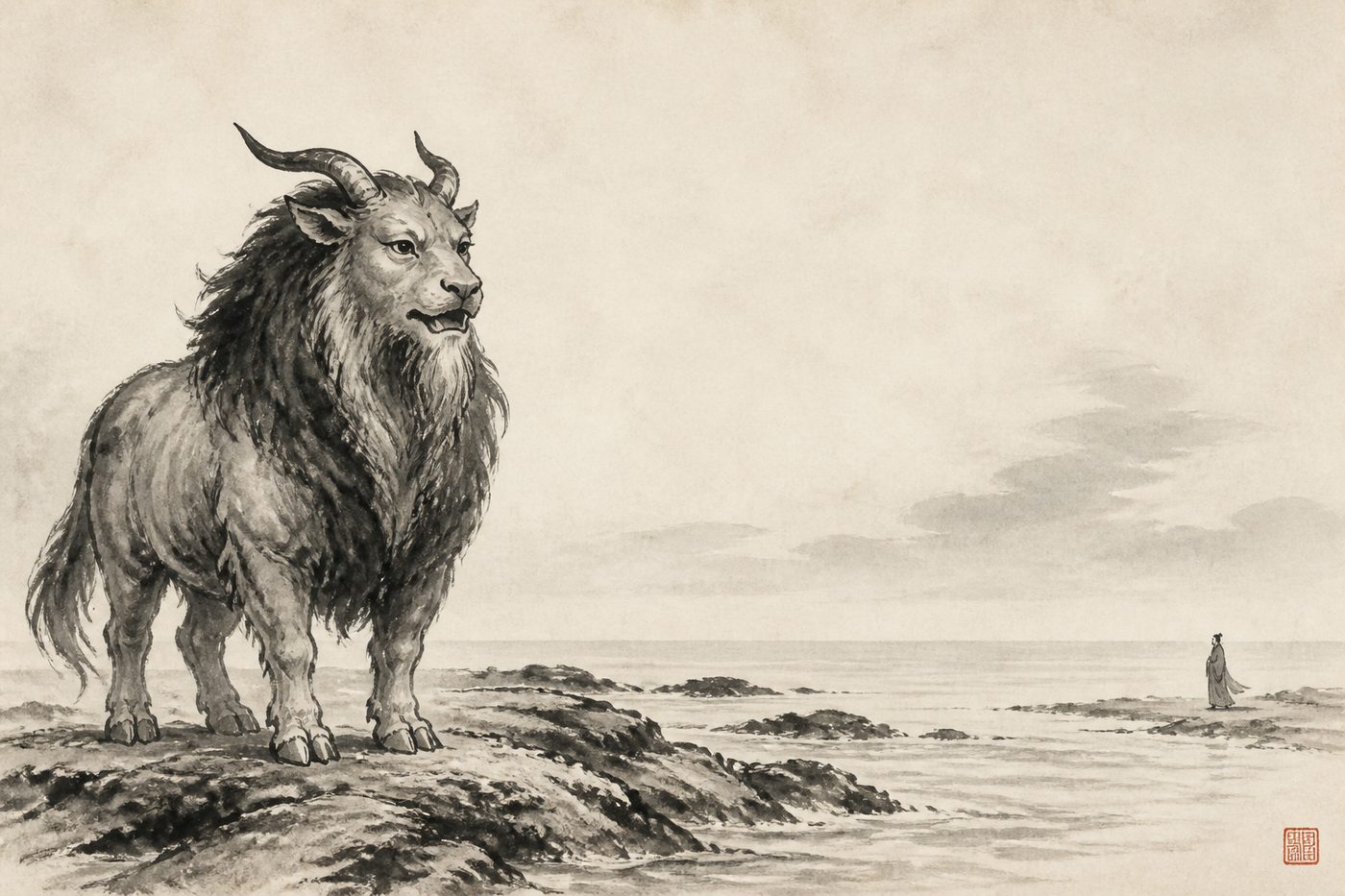
Bai Ze
白泽Bai Ze, 白泽 (báizé), is the divine beast that talks. In the legend it meets the Yellow Emperor on a shoreline in the east and dictates a complete inventory of the supernatural world: 11,520 kinds of spirit, monster and haunting, each named, each with instructions. The emperor had the whole thing drawn and published. That book existed, was used as a household charm for centuries, and is lost, except for one Tang-dynasty fragment that now sits in a library in Paris.
Read the entry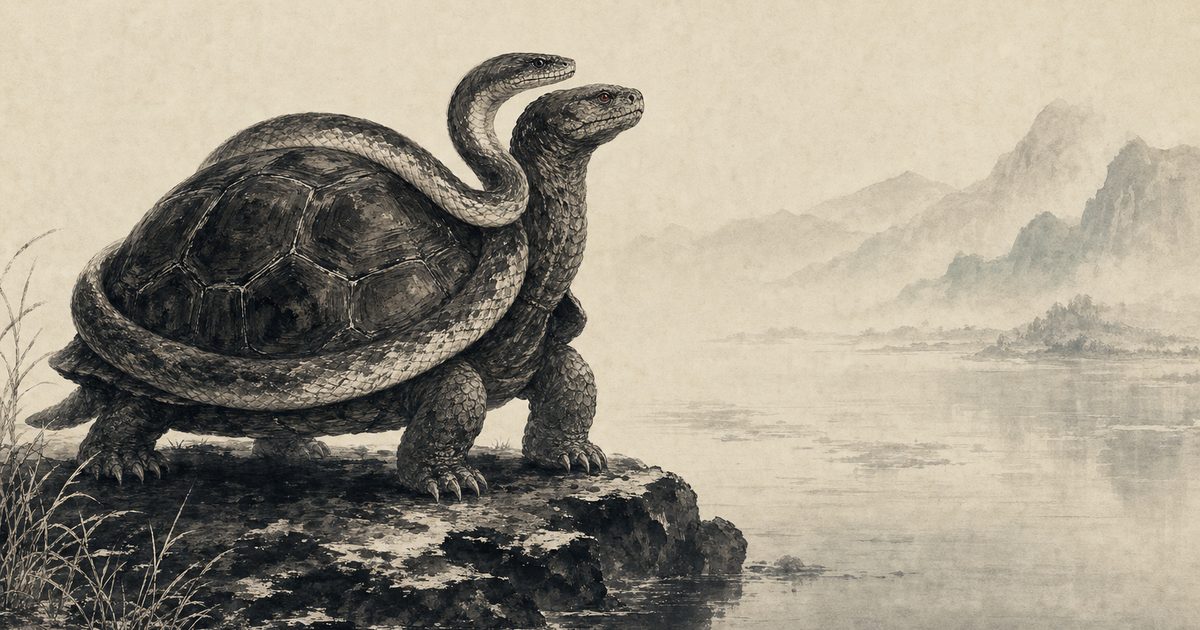
Black Tortoise
玄武The Black Tortoise, 玄武 (xuánwǔ), guards the north: winter, the element water, and the cold end of the year. It is the strangest of the four celestial guardians. It is the only one made of two animals, a tortoise with a snake coiled around it, the only one whose name does not contain the animal, and the only one that eventually grew a human body, took a new name, and got a mountain of its own.
Read the entry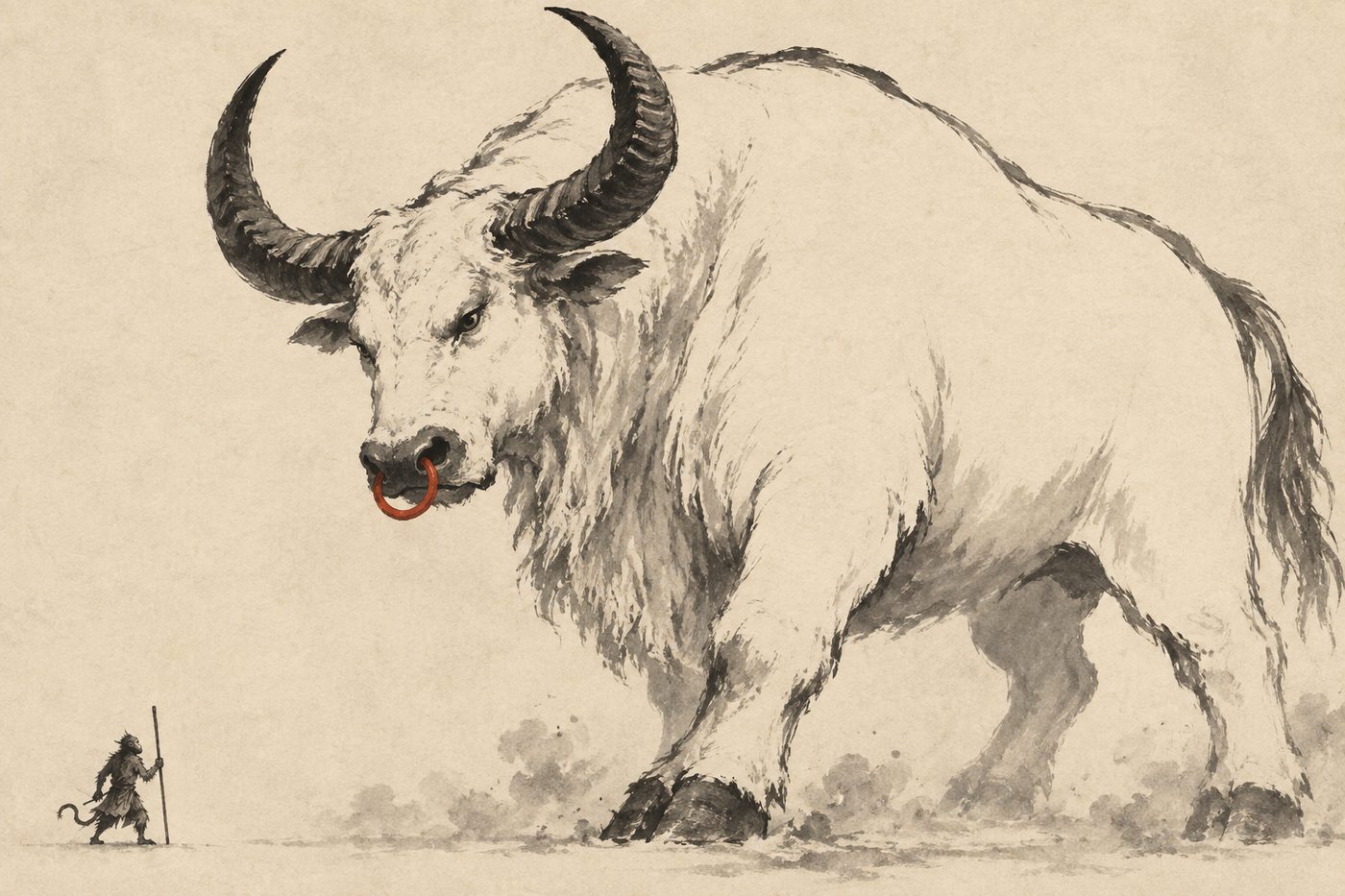
Bull Demon King
牛魔王The Bull Demon King, 牛魔王 (Niú Mówáng), is the eldest of Sun Wukong's seven sworn brothers in Journey to the West, the one demon who can fight the Monkey King to a standstill. Husband of Princess Iron Fan and father of Red Boy, he holds the fan that can put out the Flame Mountain, and the three chapters in which Wukong tries to borrow it end with a shape-shifting duel, a bull a thousand fathoms long, and a rare mercy: he surrenders, is led away by the nose, and lives.
Read the entry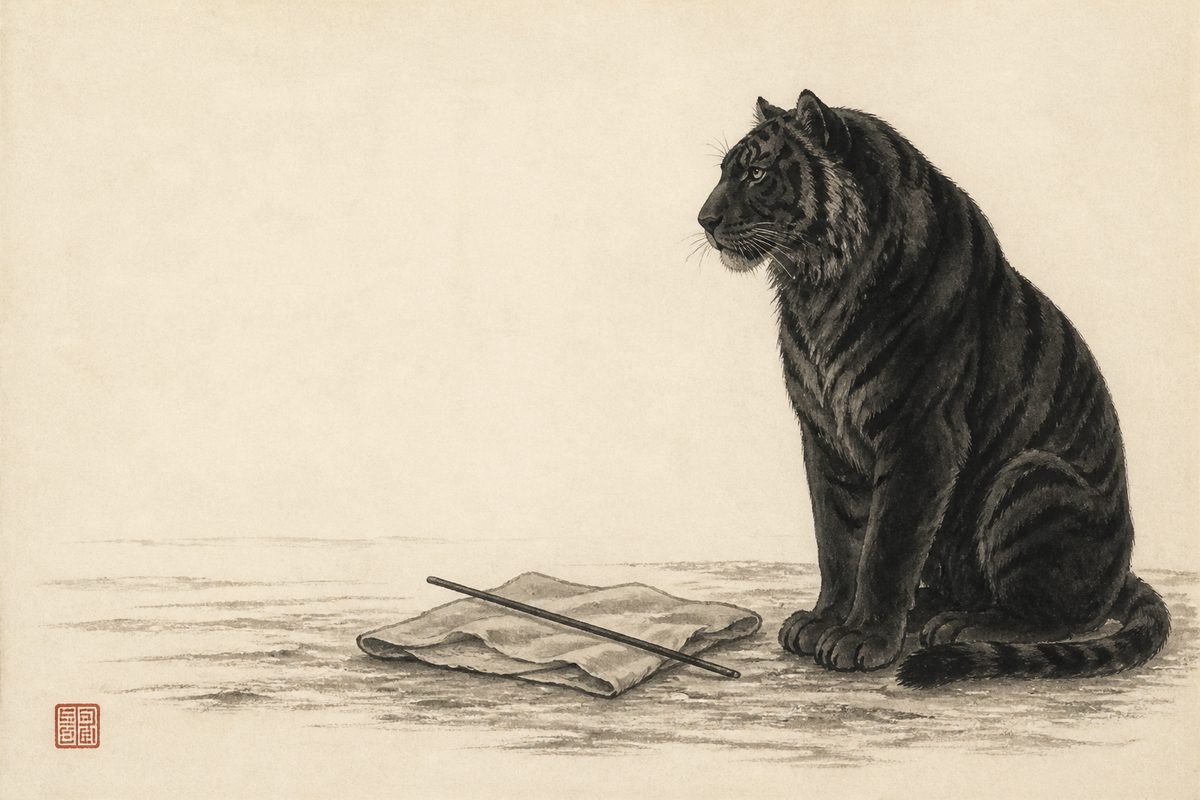
Caishen
财神Caishen, 财神 (cáishén), is the Chinese god of wealth, and the name is a job title rather than a person: at least five different men have held the post. The one on the black tiger, Zhao Gongming, enters the written record in the fourth century as a commander of plague, sent down with ghost troops to fill a quota of the dead. His promotion to the money department took about twelve hundred years, and the paperwork survives.
Read the entry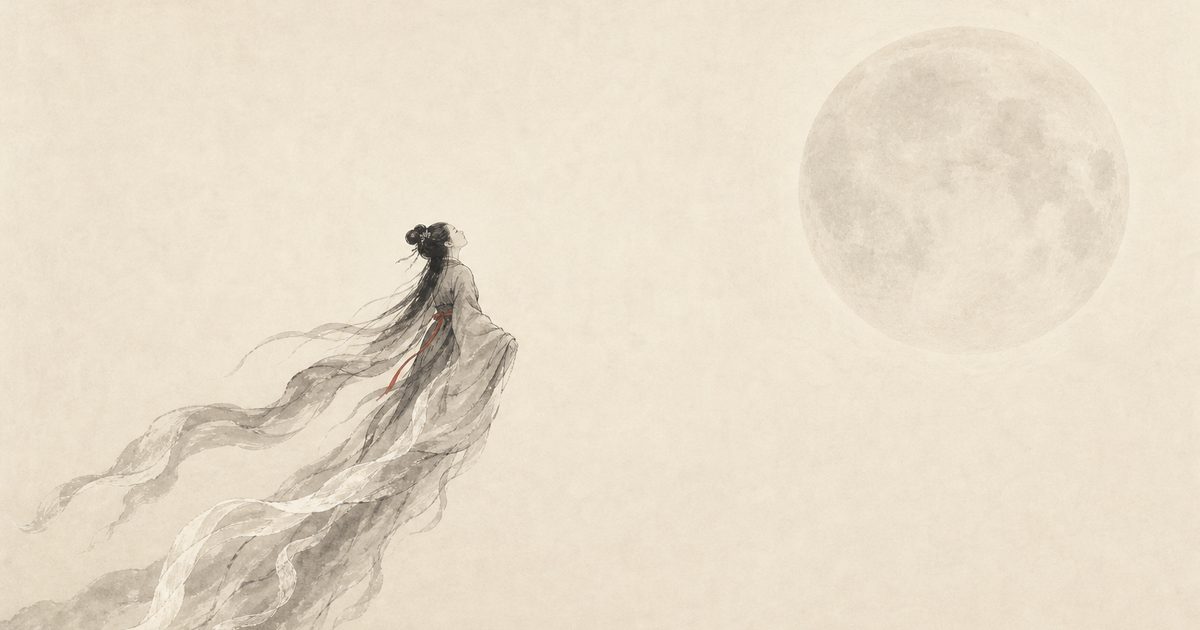
Chang'e
嫦娥Chang'e, 嫦娥 (Cháng'é), is the woman on the moon. She swallowed the drug of deathlessness her husband had been given, rose out of reach of the earth, and has been up there ever since, which is the reason a fifth of the world eats mooncakes on one particular autumn night. The oldest surviving version of her story ends rather differently from the one on the mooncake box. In that one she lands on the moon and turns into a toad.
Read the entry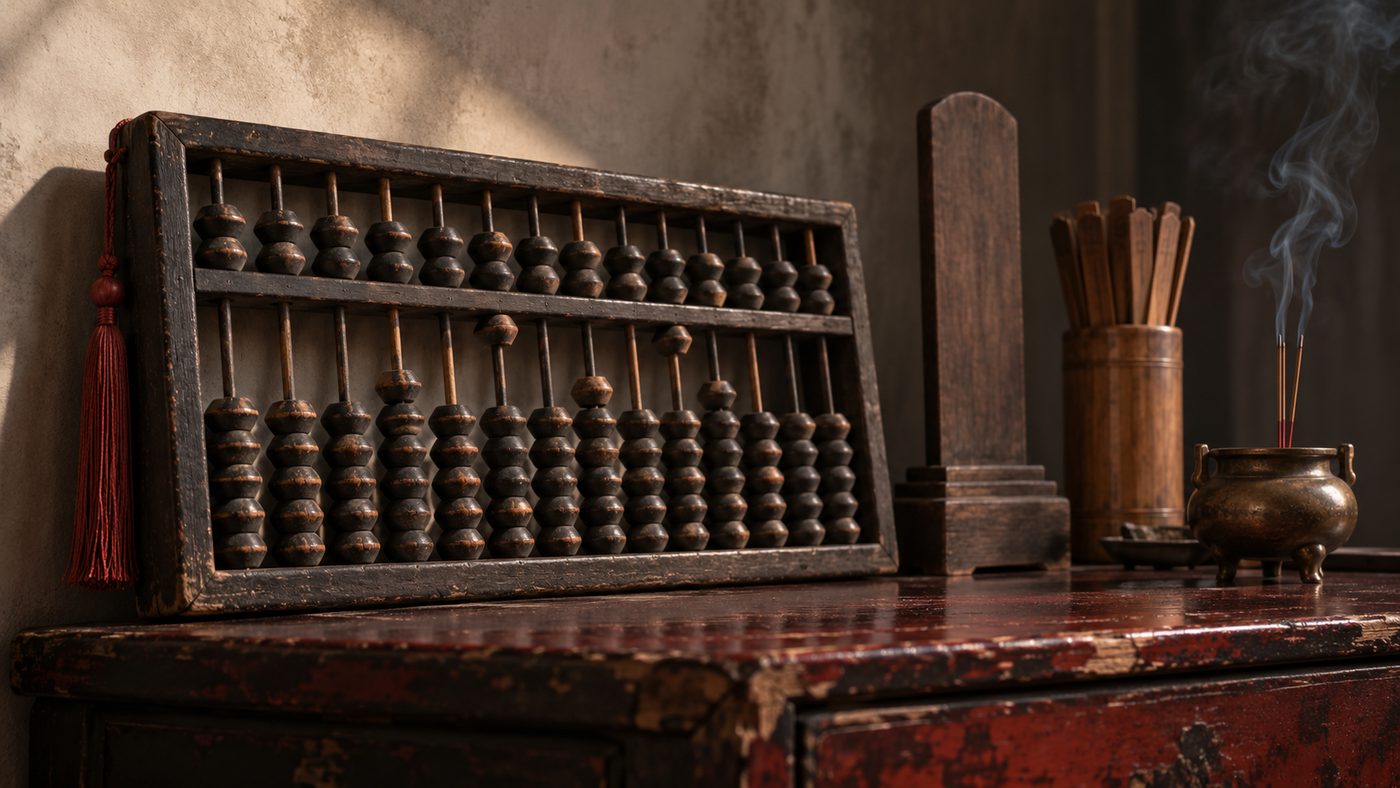
City God
城隍The Chinese city god, Chenghuang 城隍 (Chénghuáng, roughly "chung-hwahng"), is not one god but a post: the spiritual magistrate of a single walled city, who guards its living and is the first judge of its dead. Every city had its own, and the post was usually held by a named man, an upright official or a local hero appointed after his death. His temple is a courthouse with clerks, bailiffs and an abacus for settling the account of a life.
Read the entry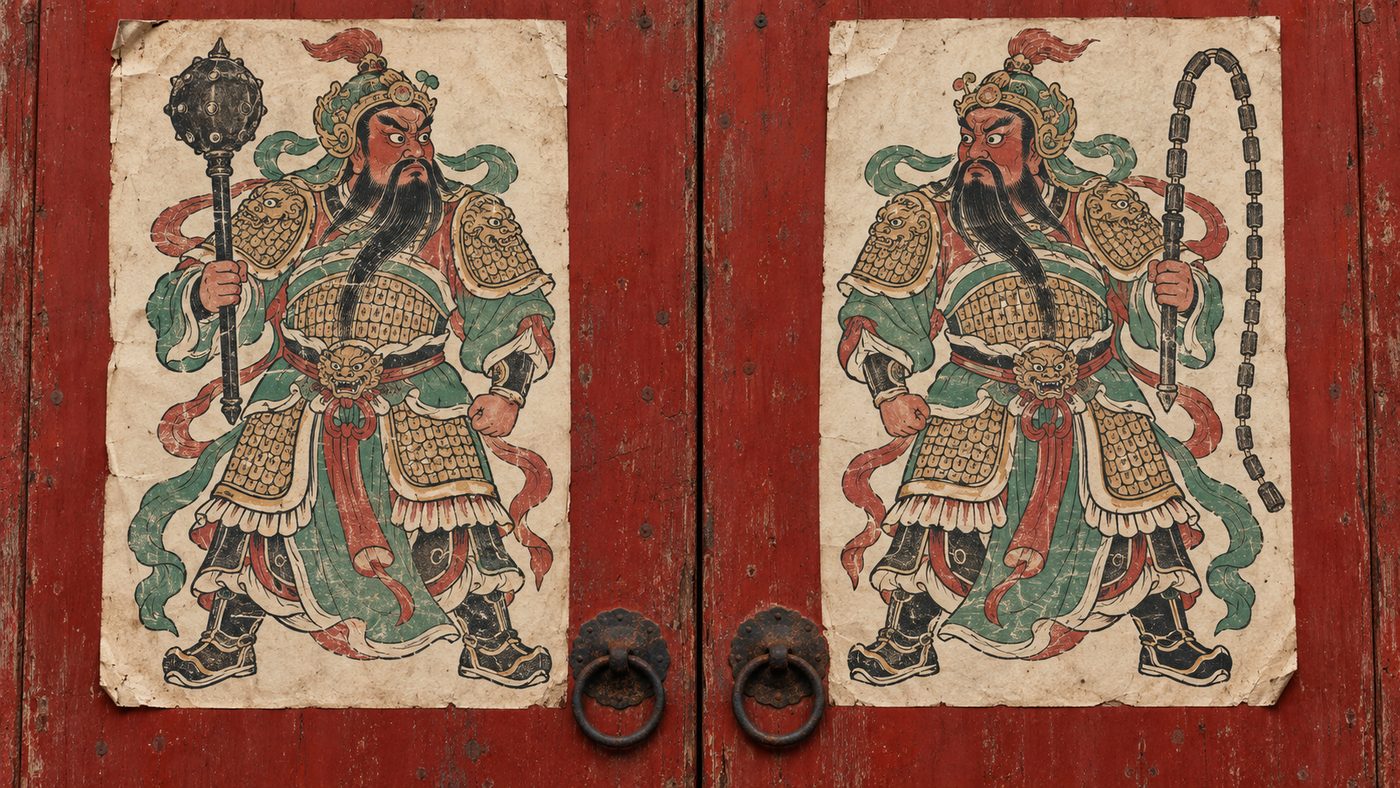
Door Gods
门神The Chinese door gods, 门神 (ménshén, roughly "mun-shun"), are the pair of armed figures pasted one on each leaf of a gate so that whatever is coming for the house stops outside. The post has been held by three casts: the peach-tree spirits Shentu and Yulü, who tie up ghosts with reed rope and feed them to a tiger; the two Tang generals Qin Shubao and Yuchi Gong, who got the job from a Ming novel; and, round the back, the demon queller Zhong Kui. Woodblock shops in Kaifeng have been printing them since the eleventh century, and in 2016 a cartoon had them facing redundancy.
Read the entry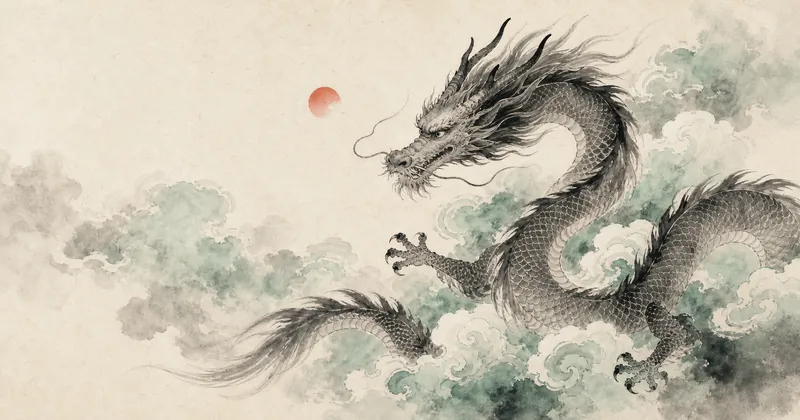
Dragon
龙The Chinese dragon, 龙 (lóng), is almost the exact opposite of the fire-breathing monster the English word "dragon" brings to mind. It is a benevolent, wingless, serpentine water-god: bringer of rain and rivers, chief of all scaled creatures, emblem of the emperor, and the auspicious ancestor a billion people invoke when they call themselves "descendants of the dragon." Less a beast to be slain than a weather system with a personality.
Read the entry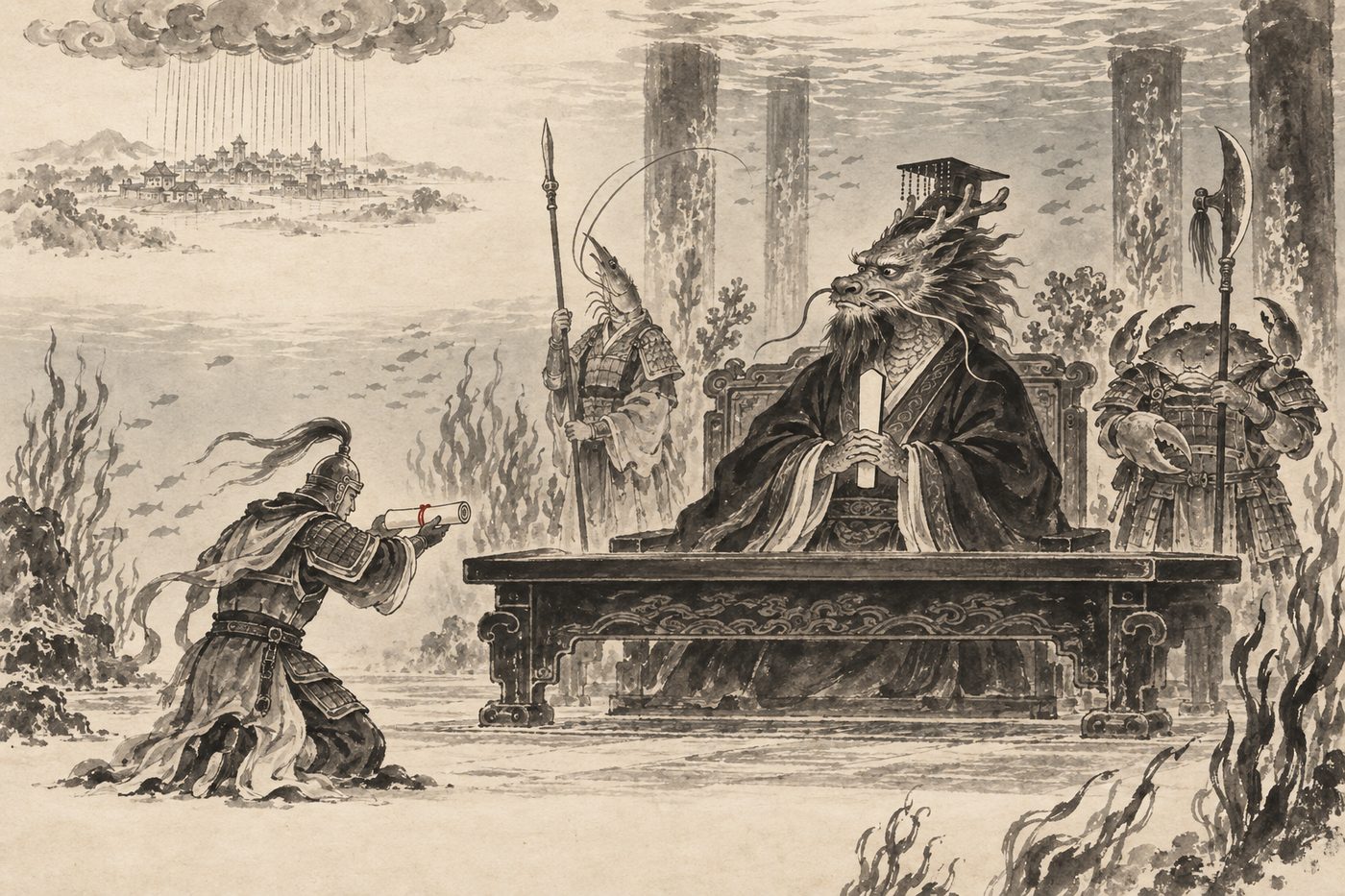
Dragon King
龙王A Dragon King, 龙王 (Lóngwáng), is not the dragon but the dragon's job: a dragon holding a post in the celestial civil service, with a stretch of water to govern, a crystal palace, an army of shrimp and crab, and a rain quota set by the Jade Emperor. There is one wherever there is water, from the four seas, ruled by the brothers Ao Guang, Ao Qin, Ao Run and Ao Shun, down to the village well. They can be petitioned for rain, and, in the most famous story about them, beheaded for delivering the wrong amount.
Read the entry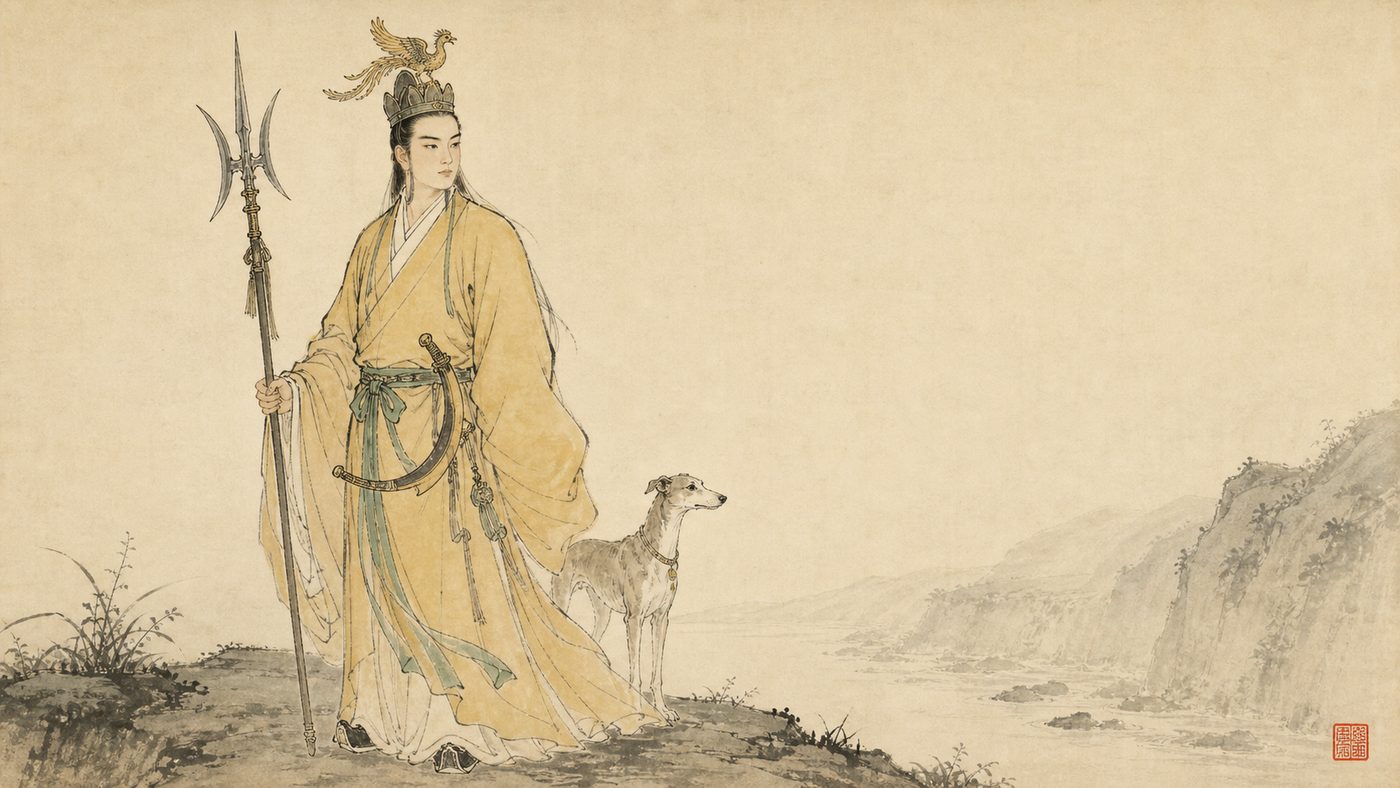
Erlang Shen
二郎神Erlang Shen, 二郎神 (èrláng shén), is the Chinese god of flood control and dragon-slaying, best known outside China as the warrior who fought the Monkey King to a standstill. Erlang is not his name. It is a birth-order word meaning second son, which is what the Song philosopher Zhu Xi called him when he wrote the god up in the twelfth century. The third eye he is drawn with today is the newest thing about him: it is absent from Journey to the West, absent from Investiture of the Gods, and still absent when Pu Songling described him in the Kangxi era.
Read the entry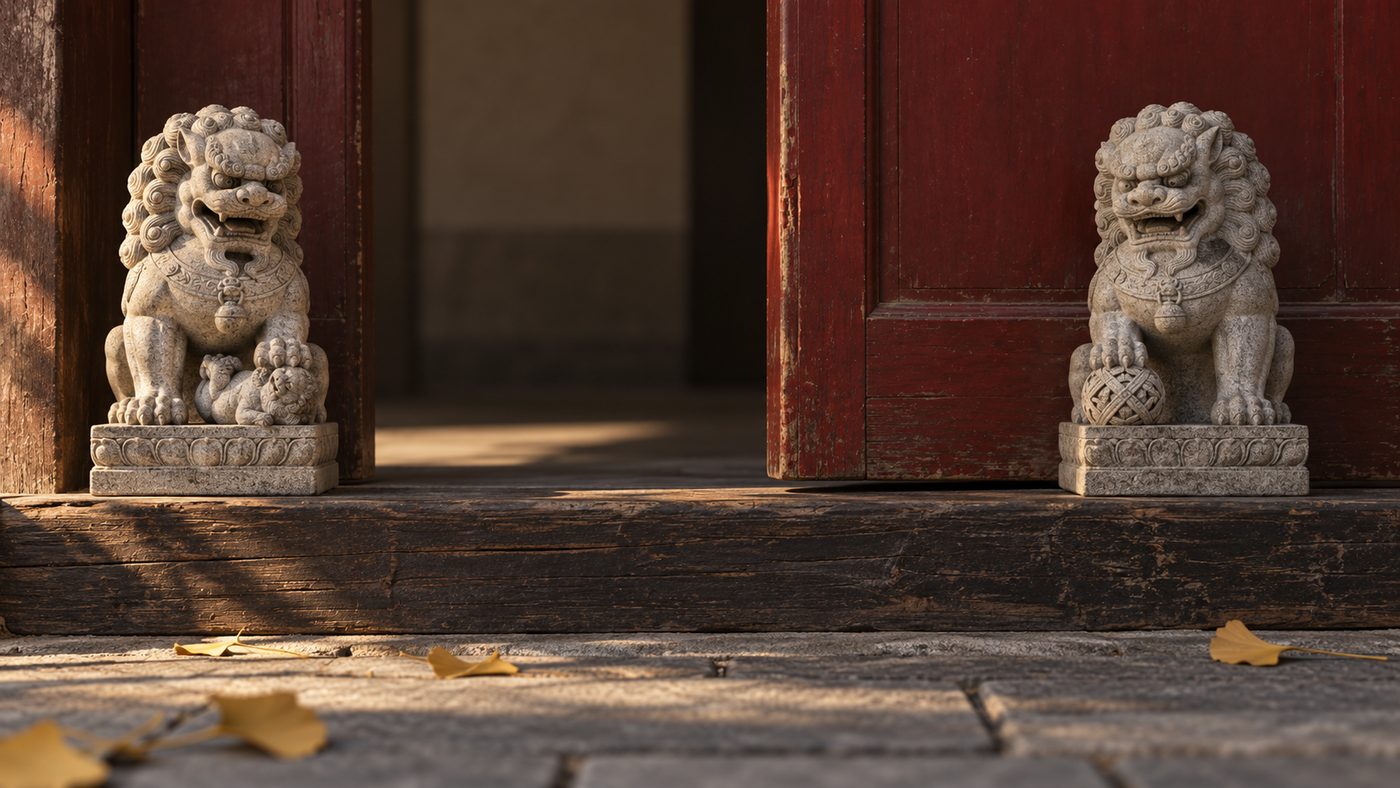
Foo Dogs (Chinese Guardian Lions)
石狮Foo dogs are Chinese guardian lions, 石狮 (shíshī, "stone lions"), the pair of carved beasts either side of a gate. They are lions, not dogs. The male rests a paw on a ball, the female on a cub, and the rule is "male on the left" counted from the building looking out, so a visitor facing the door sees the male on the right. China had no lions: they arrived as tribute in 87 CE.
Read the entry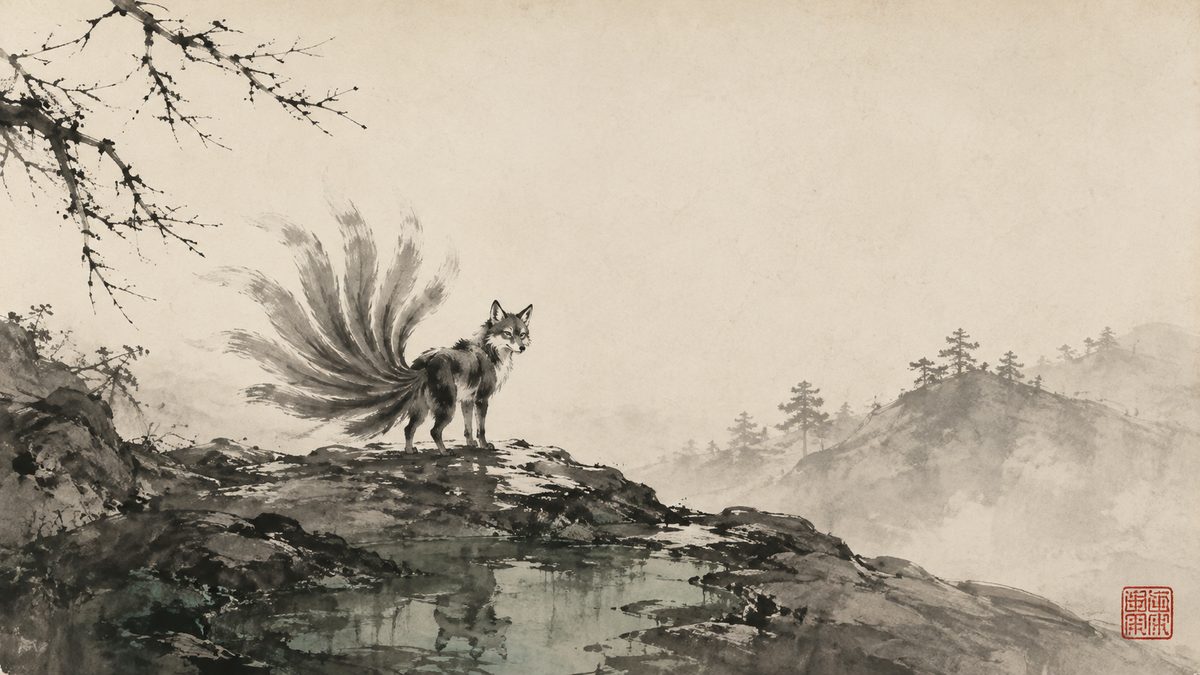
Fox Spirit
狐狸精The fox spirit, 狐狸精 (húlijīng), is the shapeshifting fox of Chinese folklore, and in its nine-tailed form, 九尾狐 (jiǔwěihú), it is the creature the rest of Asia borrowed. Almost everything said about it in English describes its last two centuries. In the oldest text that mentions it, the Classic of Mountains and Seas, the nine-tailed fox of Qingqiu cries like a human baby and eats people, and the only reason given to seek it out is that eating its flesh protects you from poison. The lucky version, the seductress version and the insult all came later, and each one can be dated.
Read the entry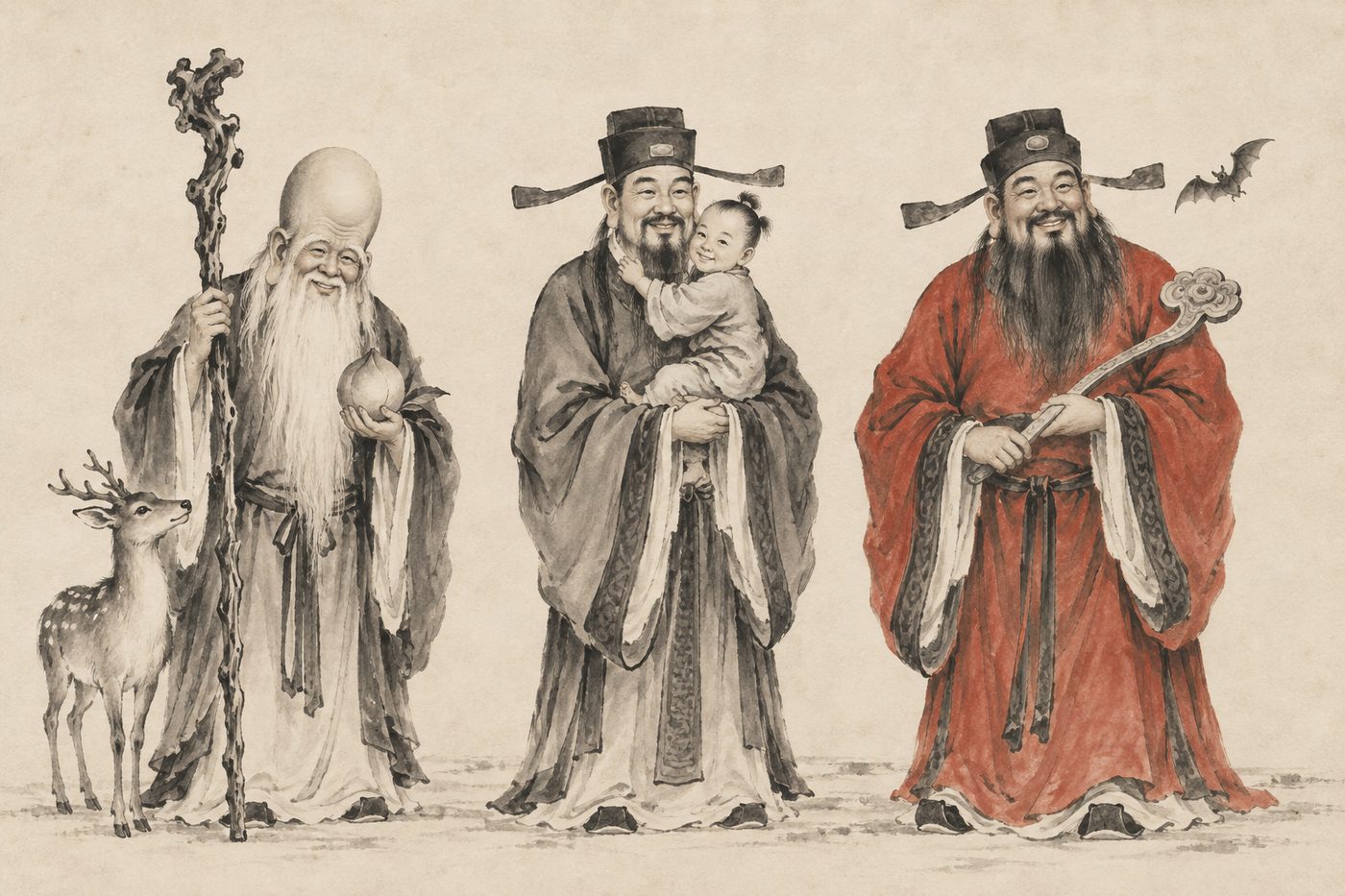
Fu Lu Shou
福禄寿Fu Lu Shou, 福禄寿 (Fú Lù Shòu), are the Three Star Gods of Chinese folk religion: Fortune, a red-robed official; Rank, a courtier holding a child; and Longevity, the bald old man with the enormous forehead, a staff, and a peach. Each began as a star, Jupiter, a star of the Big Dipper's Wenchang group, and Canopus, and each was later given a human biography. Bundled into a household trinity in the Ming dynasty, they stand in restaurants, cabinets, and jade carvings across the Chinese world, always in the same order, and always reading as a pun.
Read the entry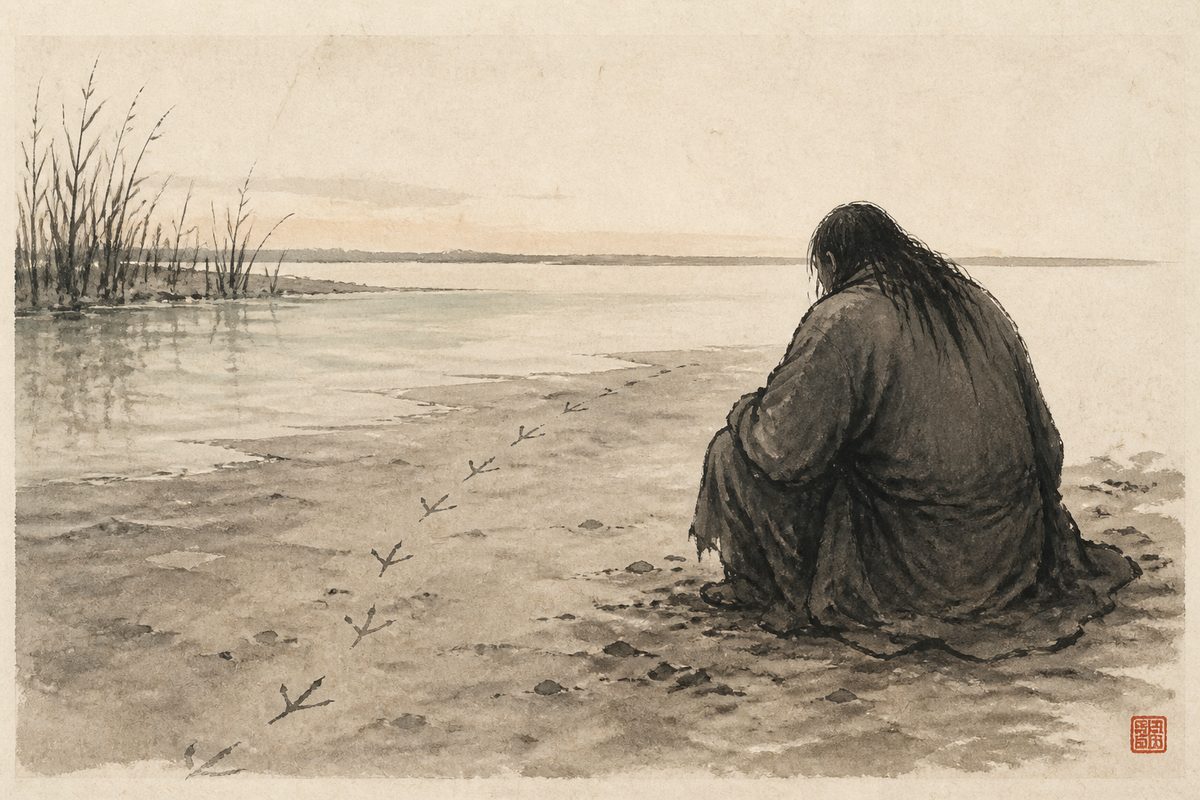
Fuxi
伏羲Fuxi is the figure credited with inventing the eight trigrams, the three-line symbols behind the Book of Changes, the feng shui compass and four corners of the South Korean flag. The oldest account of how he did it is unusual: it describes not a revelation but a procedure. He looked up at the sky, down at the ground, and at the markings of birds and beasts, and then he made them. He is also said to have knotted the first fishing nets.
Read the entry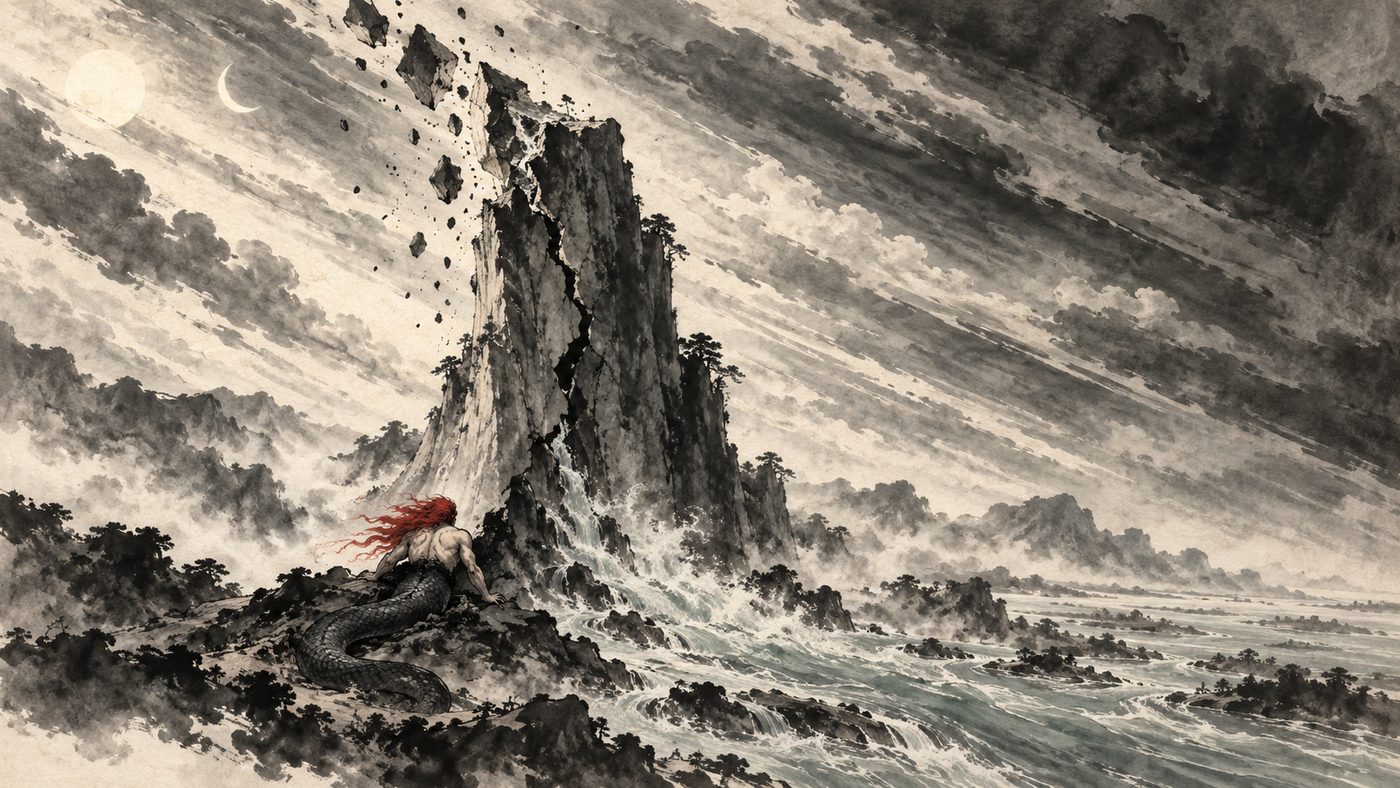
Gonggong
共工Gonggong 共工 (Gòng-gōng, roughly "gong-gong") is the Chinese water god who lost a fight to be emperor and, in his rage, rammed his head into Mount Buzhou, the mountain that held up the sky. The pillar broke, heaven tipped toward the northwest and the earth sagged to the southeast, which is why, says the Huainanzi, the stars drift west and China's rivers run east. The dwarf planet Gonggong, named in 2020, takes its name from him.
Read the entry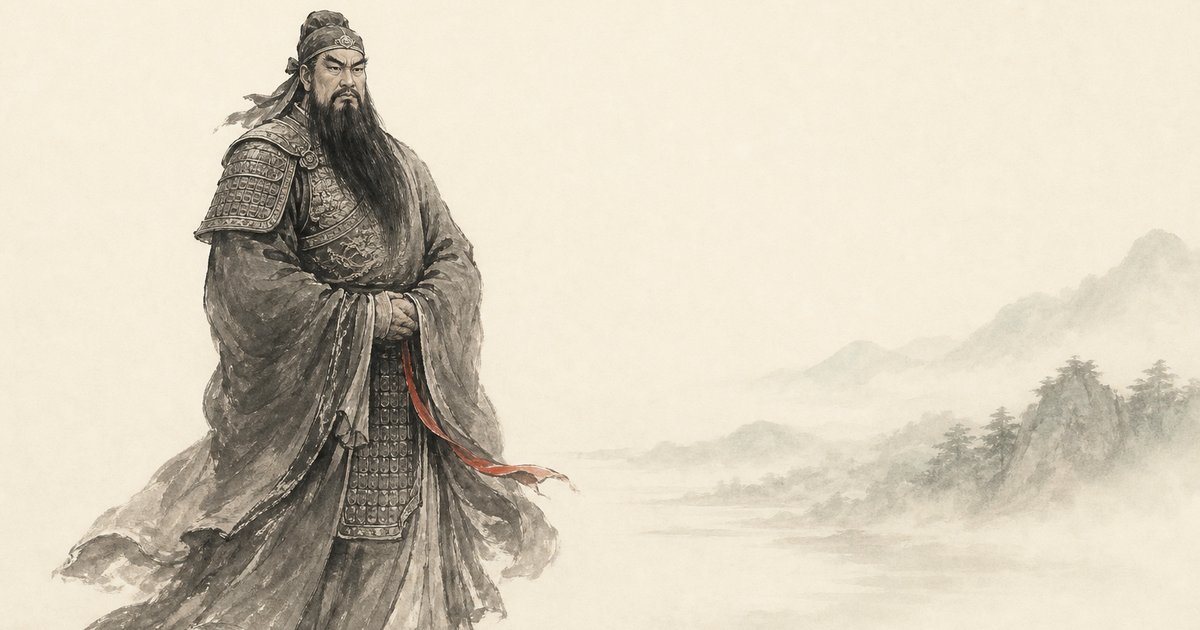
Guan Yu
关羽Guan Yu, 关羽 (Guān Yǔ), died in the winter of 219 as a defeated general who had just lost a province. Over the following sixteen hundred years the Chinese state promoted him, in stages and on paper, from marquis to duke to king to emperor to god, until his official title ran to twenty-six characters and his temples outnumbered Confucius's. He is the god of loyalty, the god of war, and, improbably, the god of money. No other subject in Chinese history was ever promoted that far after dying.
Read the entry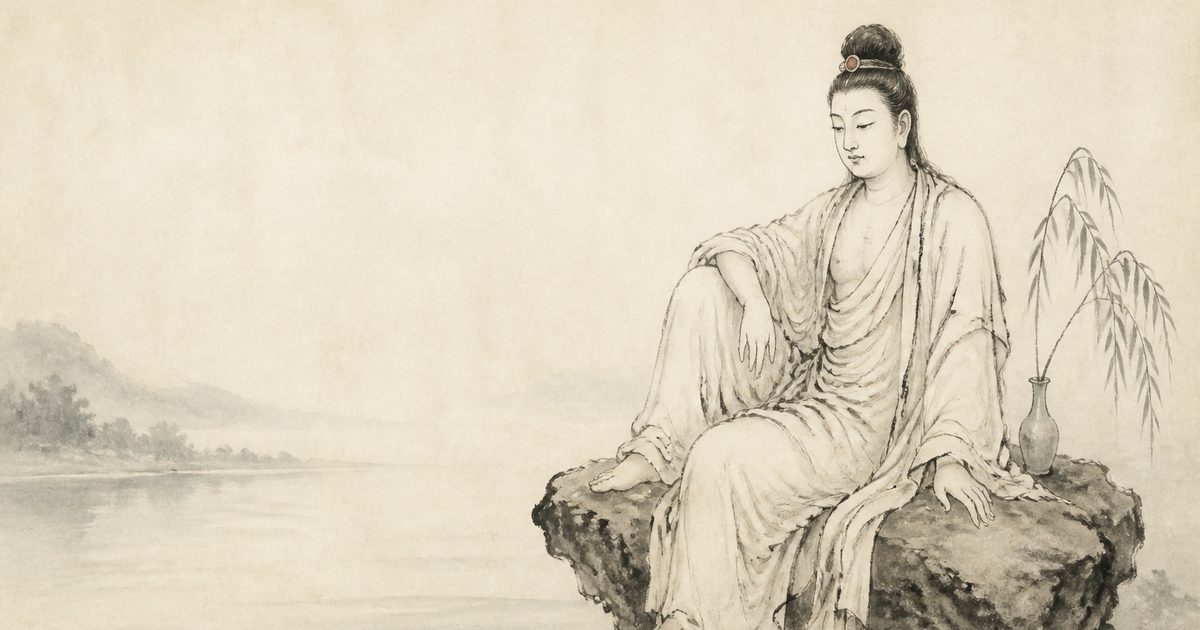
Guanyin
观音Guanyin, 观音 (Guānyīn), is the bodhisattva of compassion, the figure who hears people in trouble and comes. Male or female is the question everyone asks, and the answer is that the figure arrived in China male, was still being carved with a mustache in the Tang, and had become a woman by the Song. The sutra that made the cult famous had already granted permission for exactly that, in writing, several centuries earlier.
Read the entry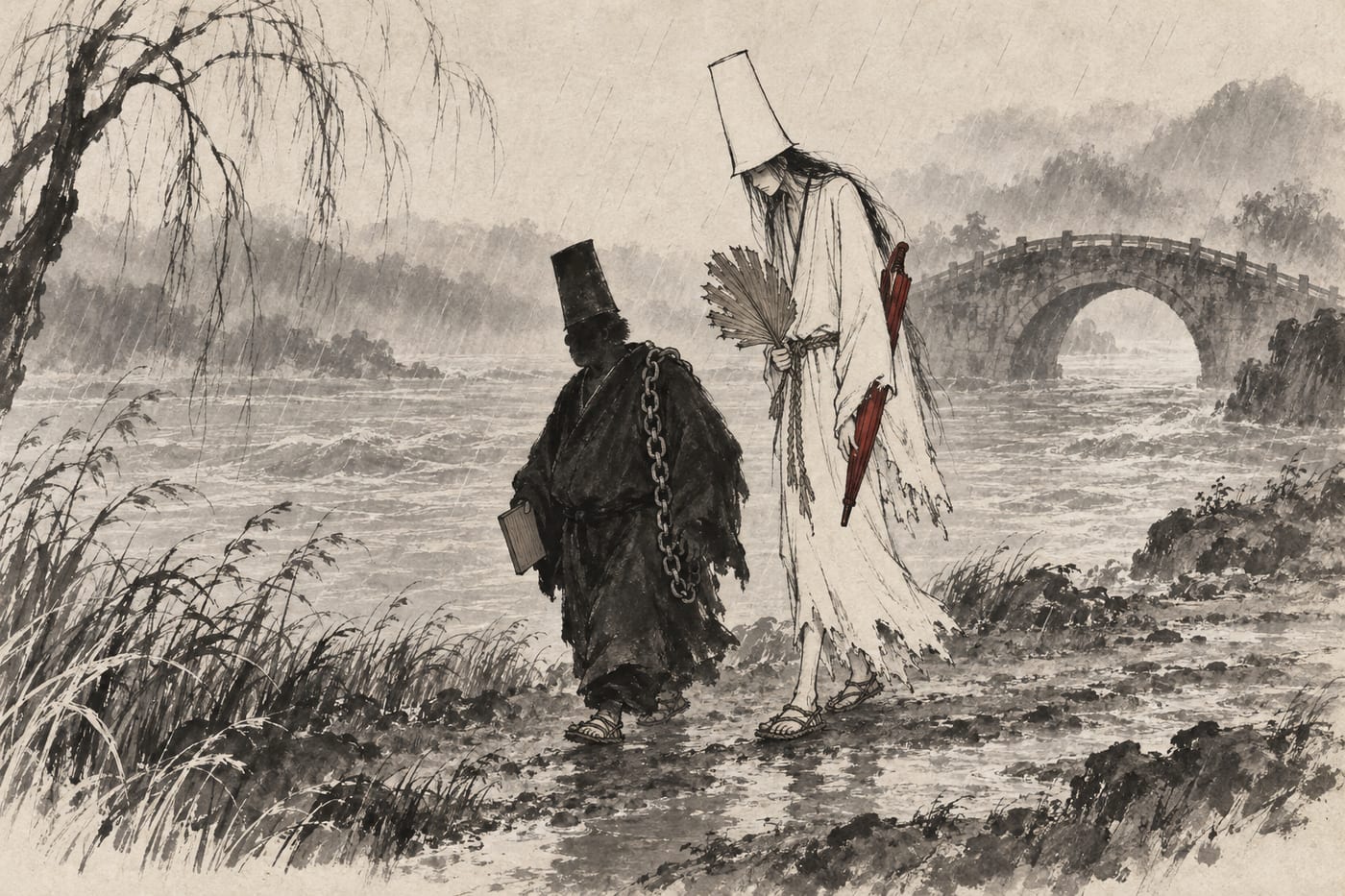
Heibai Wuchang
黑白无常Heibai Wuchang, 黑白无常 (Hēibái Wúcháng), "Black and White Impermanence," are the two constables of the Chinese underworld who come with a chain to fetch the souls of the dying: a very tall, pale one dressed in white, with a long tongue and a tall hat, and a short, dark one dressed in black. Temples in Taiwan and Fujian call them Xie Bi'an and Fan Wujiu, two friends who died keeping an appointment under a bridge. They work for the City God and King Yama, and they are also, oddly, prayed to for money.
Read the entry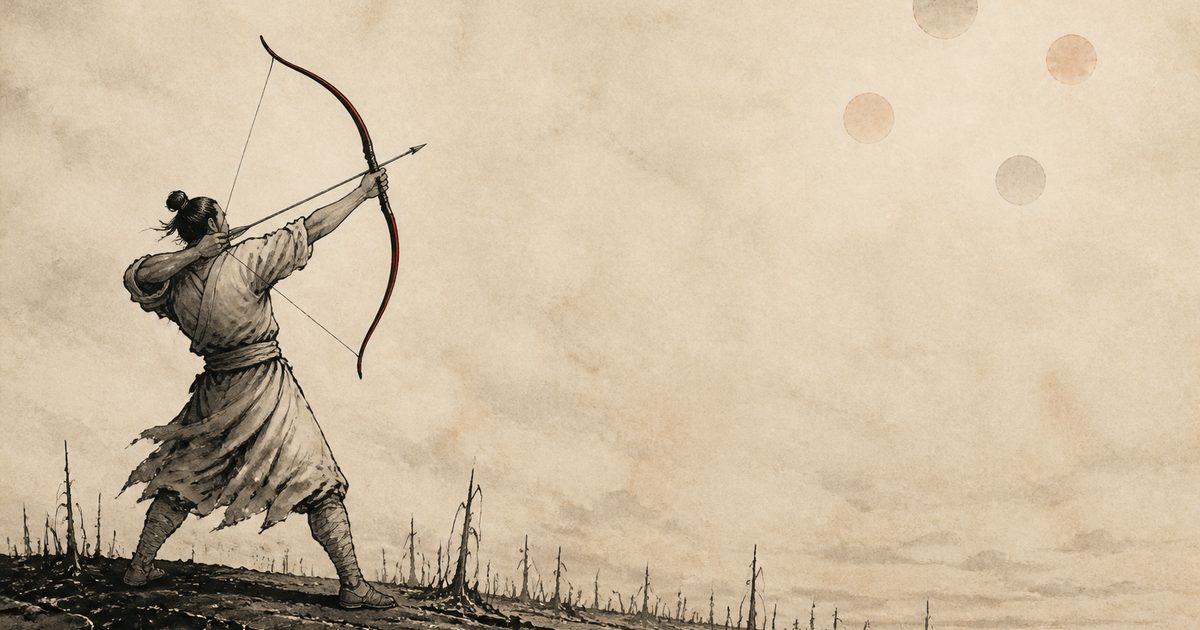
Hou Yi
后羿Hou Yi, 后羿 (Hòu Yì), is the archer who shot the extra suns out of the sky when ten of them rose at once and began cooking the world. He was given a drug that ends death, and his wife took it and left for the moon. He is also, strictly speaking, two people. The archer of the old myths and Lord Yi of Youqiong, a Xia-dynasty warlord who came to a considerably worse end, were separate men who got welded together.
Read the entry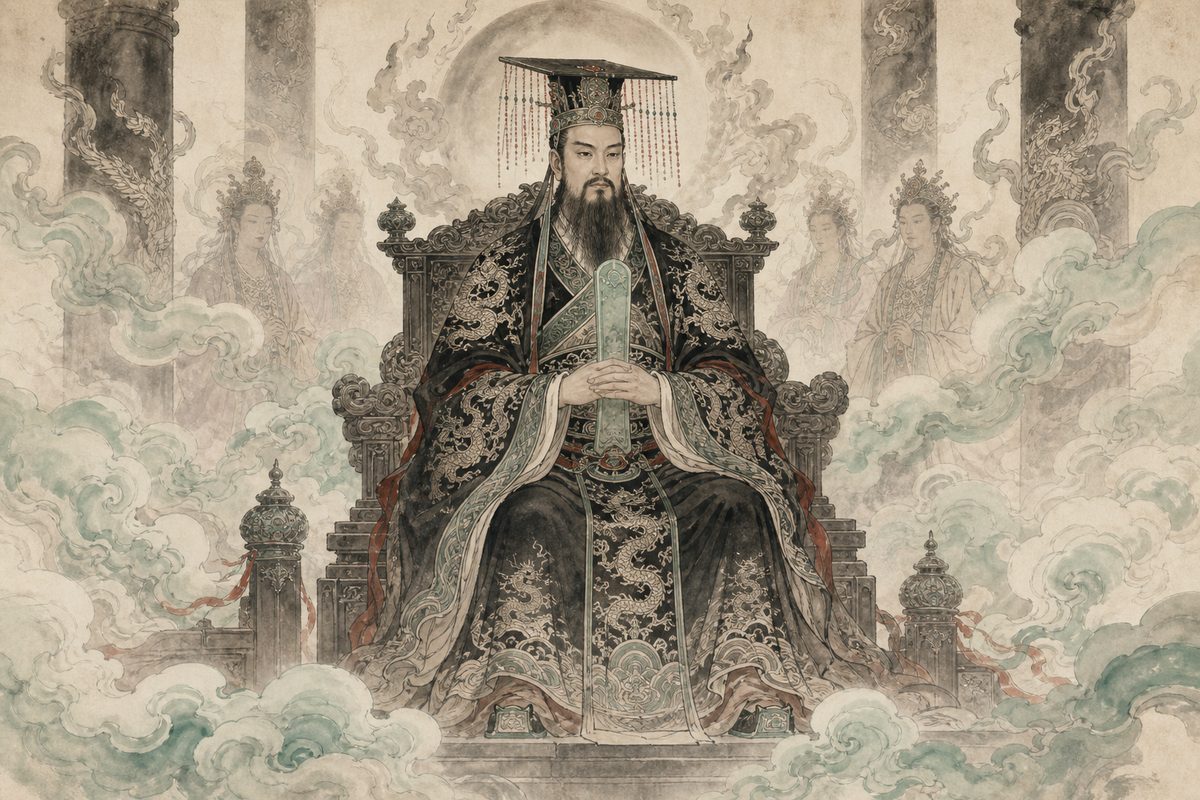
Jade Emperor
玉皇大帝The Jade Emperor, 玉皇大帝 (Yù Huáng Dàdì), is the supreme sovereign of the Chinese heavens, the august ruler most people picture when they picture Heaven: robed, crowned, and presiding over a vast celestial bureaucracy of gods and record-keepers. Yet he is famously not the highest power in Daoist theology, he was not born a god, and he was formally promoted to his cosmic office by the decree of an earthly Chinese emperor. He is the ruler of Heaven, and the one Sun Wukong could not defeat.
Read the entry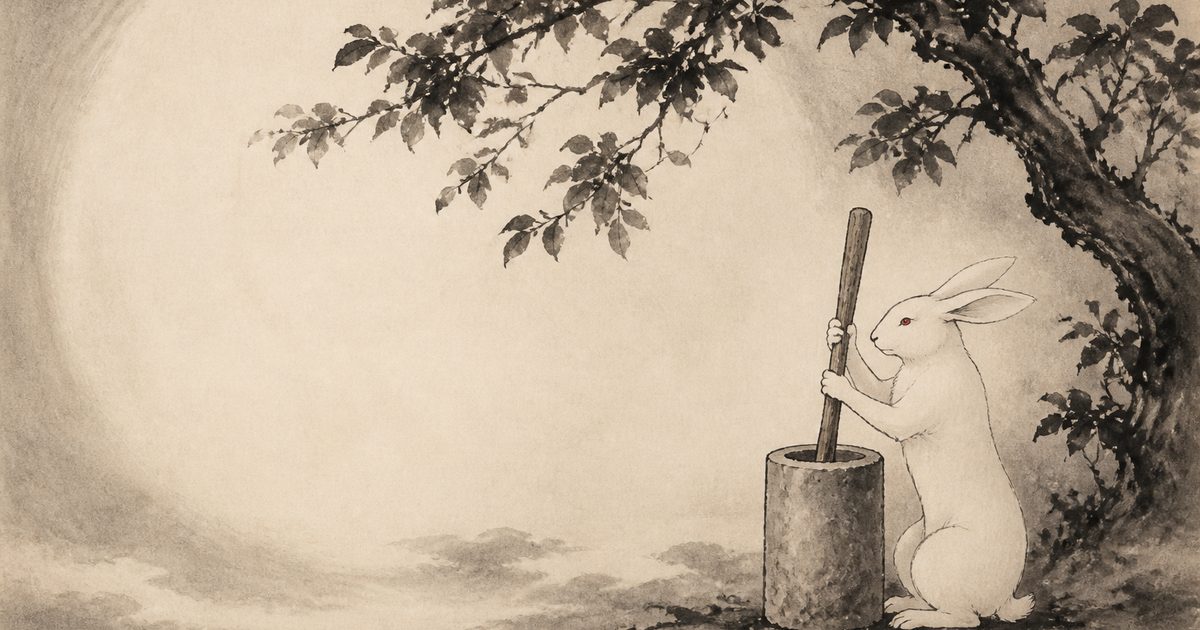
Jade Rabbit
玉兔The Jade Rabbit, 玉兔 (Yùtù), is the hare that lives on the moon and pounds medicine with a mortar and pestle. The oldest surviving description of it at work is a Han dynasty court song, and it answers the question nobody asks: the rabbit is kneeling, the pills are being carried down to the emperor, and whoever swallows them does not die. It is not a pet. It is staff.
Read the entry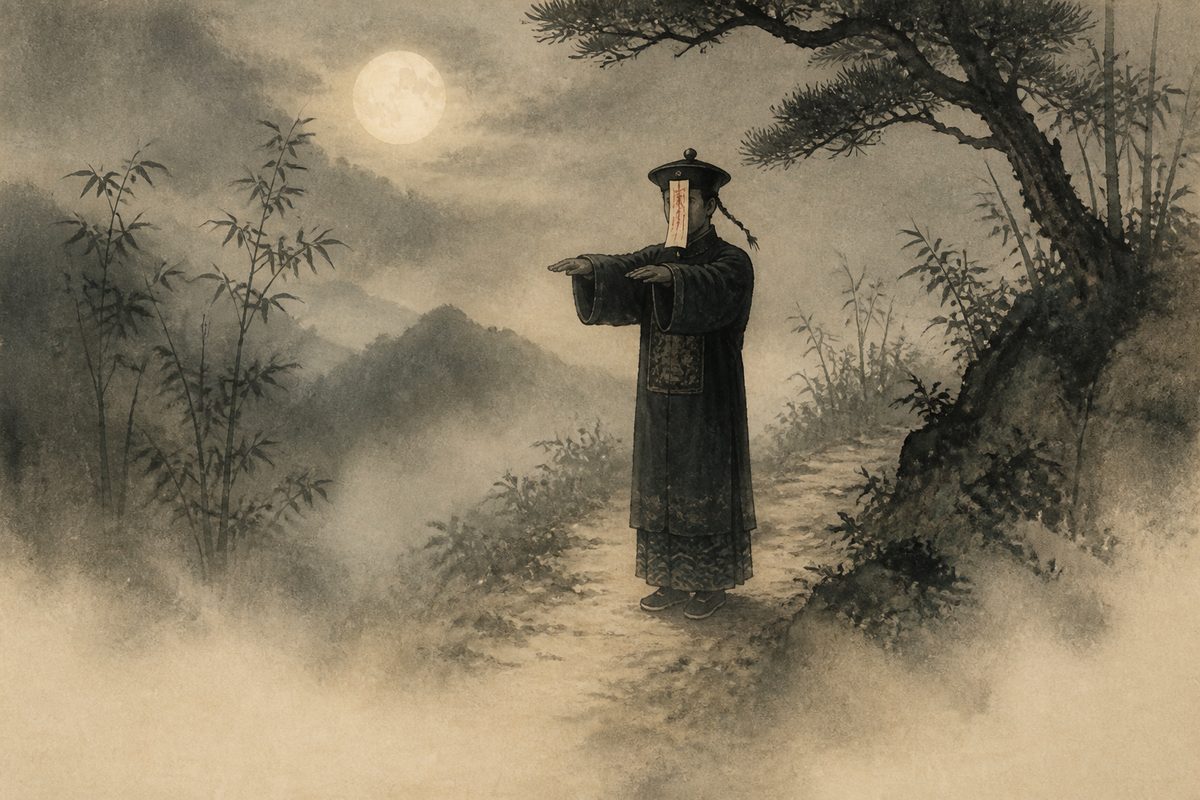
Jiangshi
僵尸A jiangshi, 僵尸 (jiāng shī), is a reanimated corpse from Chinese folklore. The name means stiff corpse, which is the most accurate description anyone has ever given it. English calls it the Chinese vampire, and that is a borrowed label: the thing the tradition describes drains qi, the life breath, rather than blood. It is famous for hopping upright with its arms held out in front of it, and the reason for that pose turns out to have nothing to do with the supernatural at all.
Read the entry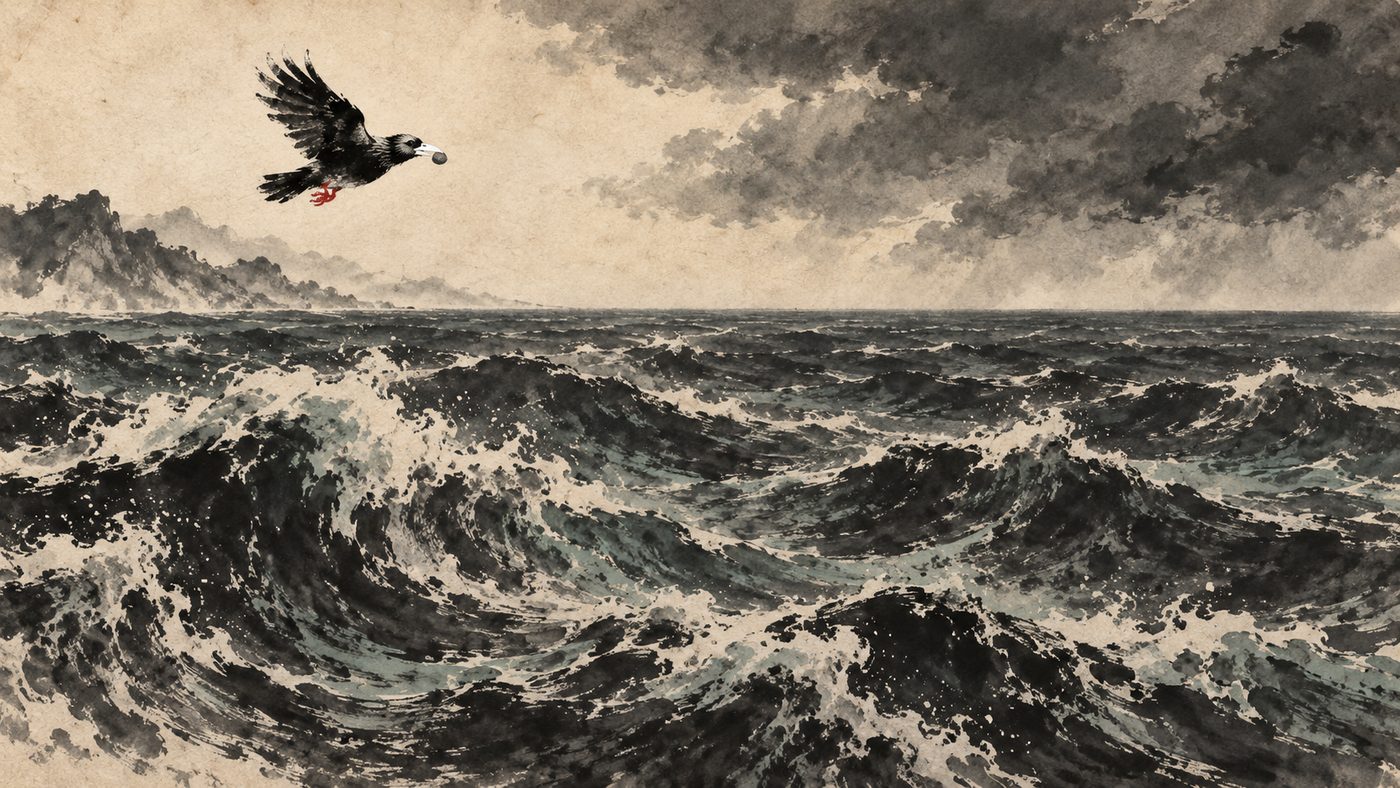
Jingwei
精卫Jingwei 精卫 (Jīngwèi, roughly "jing way") is a small bird from Chinese myth that was once a girl. In the Classic of Mountains and Seas she is the Flame Emperor's youngest daughter, who drowned in the Eastern Sea and came back as a crow-like bird with a white beak and red feet, carrying twigs and stones to fill the sea in. In Chinese the story means unbreakable resolve. The most widely used free Chinese-English dictionary hears something else: futility.
Read the entry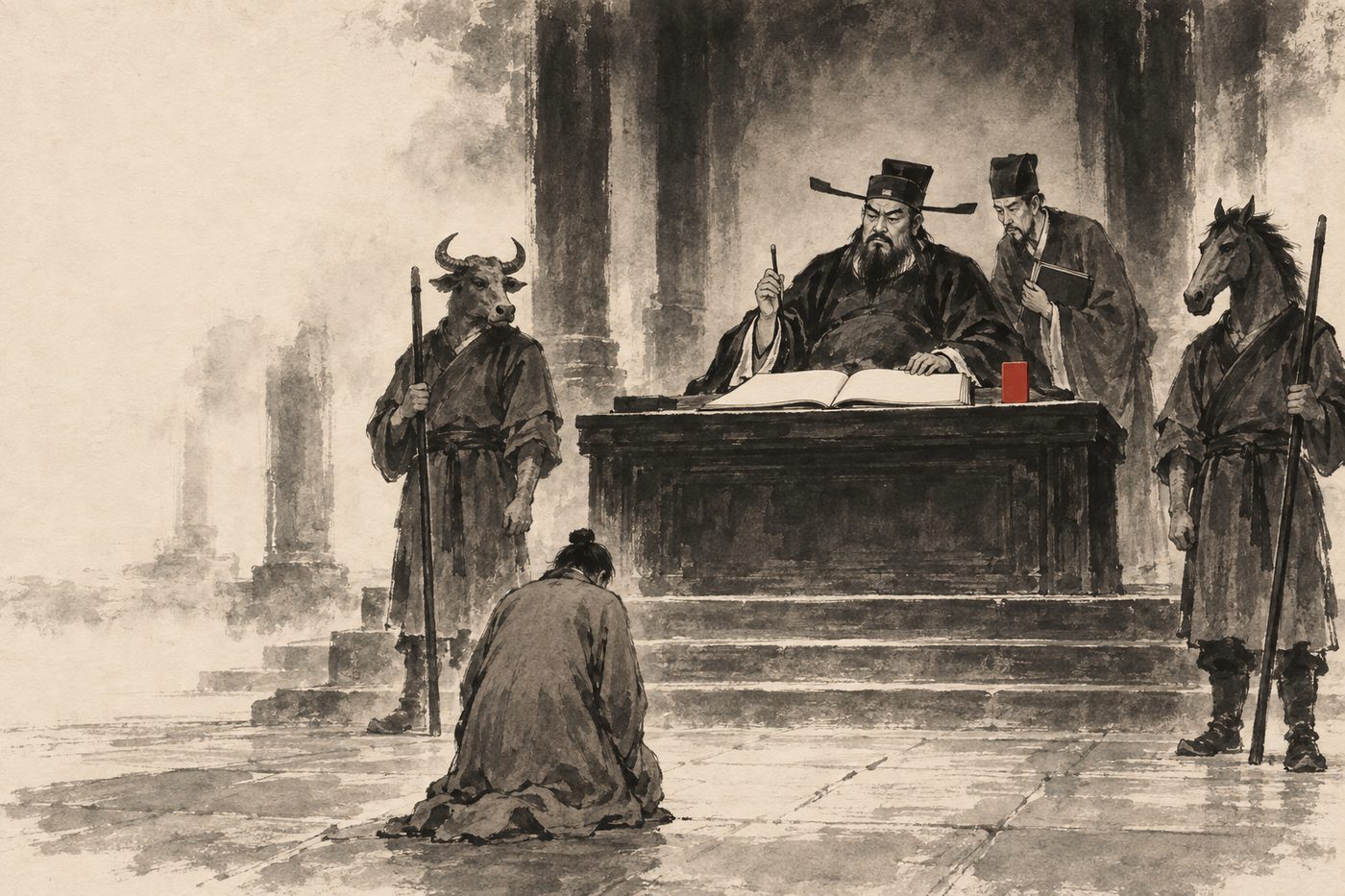
King Yama
阎王King Yama, 阎王 (Yánwáng) or Yanluo Wang, is the judge of the dead in Chinese mythology: a magistrate, not a devil, who sits behind a desk in the underworld with a ledger of every life-span and rules on where each soul goes next. He came to China with Buddhism from the Indian god Yama, and by the Tang dynasty had been filed into a bureaucracy of ten kings, of whom he is only the fifth. Real men have held the post.
Read the entry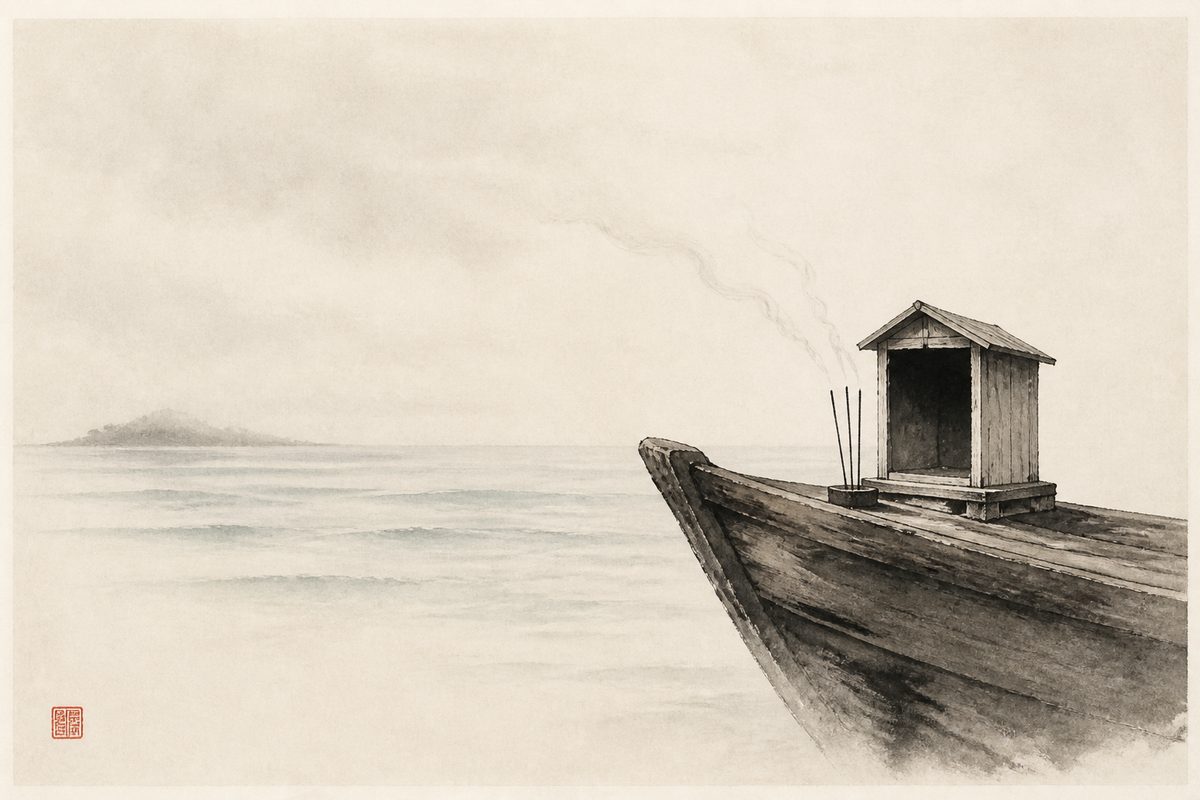
Mazu
妈祖Mazu is the Chinese sea goddess, the deity in the small shrine at the bow of a fishing boat, and the most widely worshipped female deity of the Chinese coast. The story everyone tells is that she was a girl named Lin Moniang who died young saving sailors. The oldest surviving document about her, written in 1150, does not say that. It says she was a working spirit medium, and it does not give her a name at all.
Read the entry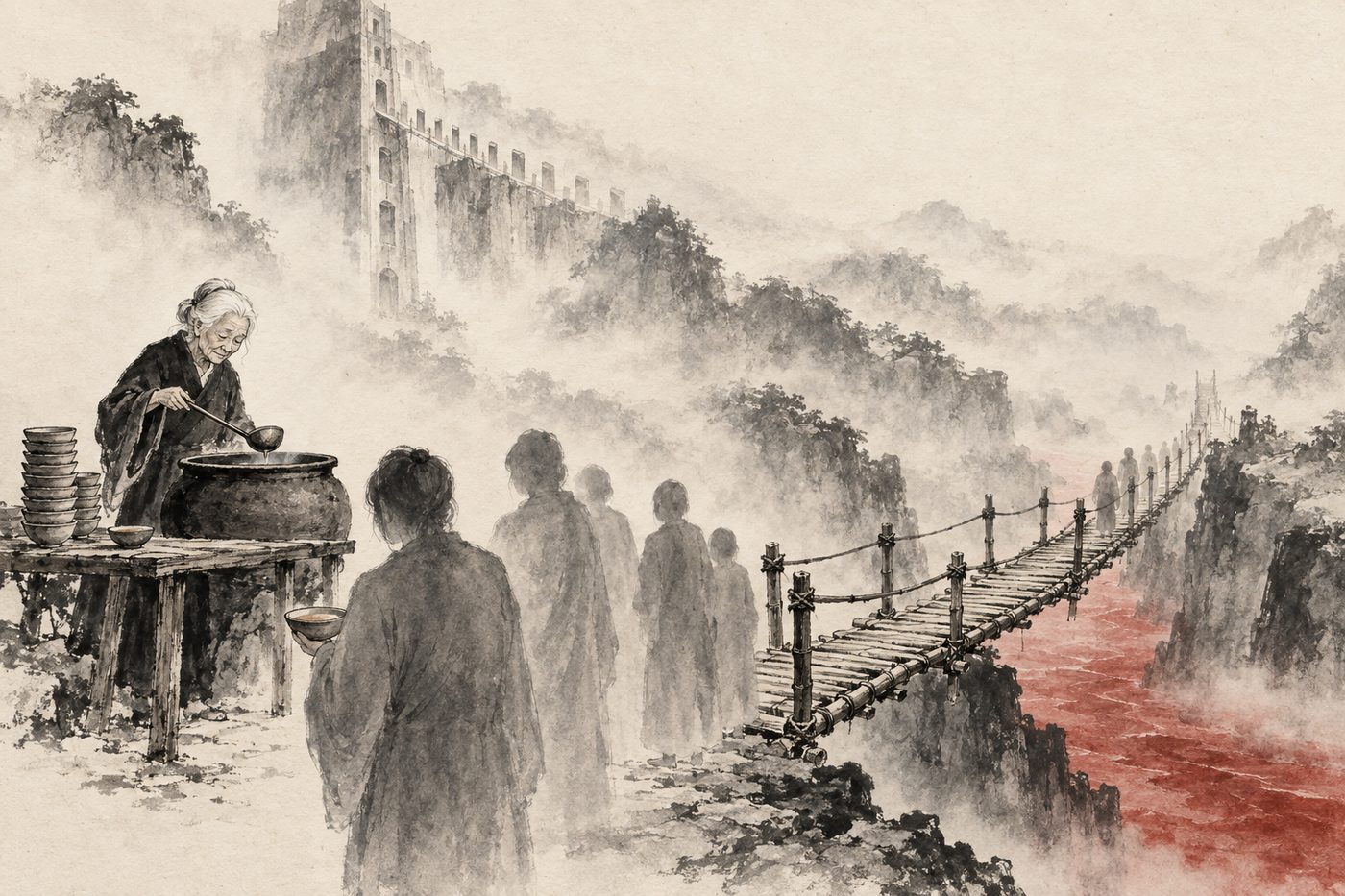
Meng Po
孟婆Meng Po, 孟婆 (Mèng Pó), "Granny Meng," is the old woman stationed at the exit of the Chinese underworld who hands every soul a bowl of soup before it is reborn. The soup erases the life just finished, so that each birth starts clean. Her only biography is in the Jade Record, a Qing morality book, which makes her a Han-dynasty scholar-hermit who built the Tower of Forgetting on Heaven's orders, and gives the soup a punishment clause for anyone who will not drink. Before she served soup, she was a wind.
Read the entry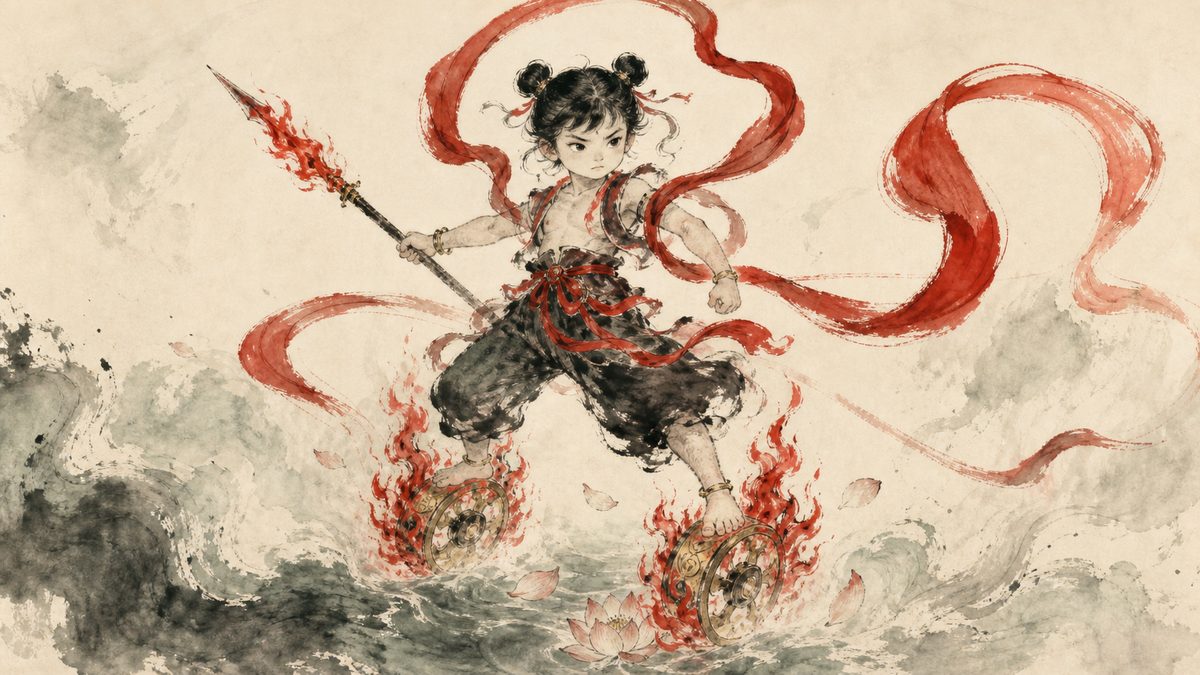
Nezha
哪吒Nezha, 哪吒 (Nézhā), is the boy god of Chinese myth: born as a ball of flesh after a three-and-a-half-year pregnancy, a dragon-slayer by age seven, dead by his own hand to spare his parents, and reborn in a body built from lotus. A protection deity with flaming wheels for feet, he is the hero of the sixteenth-century novel Investiture of the Gods and, since 2025, the star of the highest-grossing animated film ever made.
Read the entry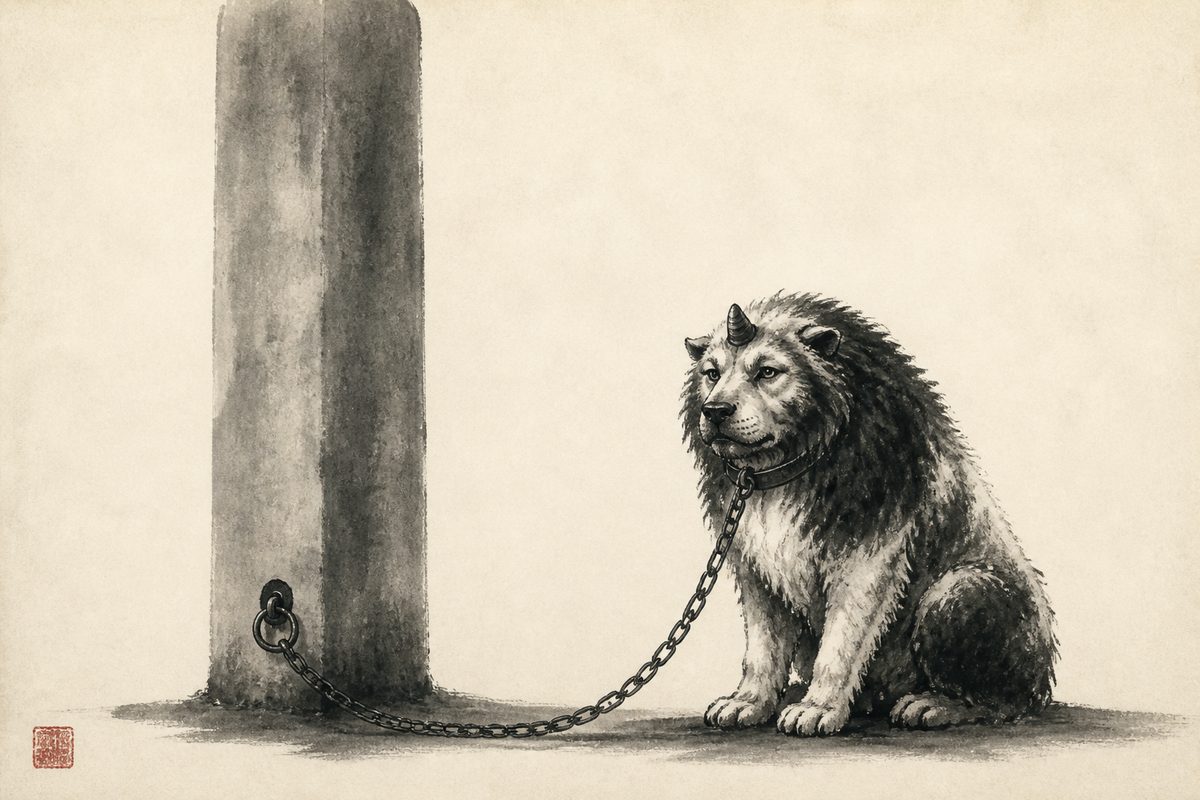
Nian
年兽Nian, 年兽 (niánshòu), is the monster said to have come down on the last night of the year to eat the village, until people discovered it feared red, fire, and noise. It is the origin story attached to almost every Chinese New Year custom. It is also the best-dated legend in Chinese folklore: the earliest known text naming the beast is a Shanghai newspaper column from 17 January 1933, and in it the animal is chained up in a picture.
Read the entry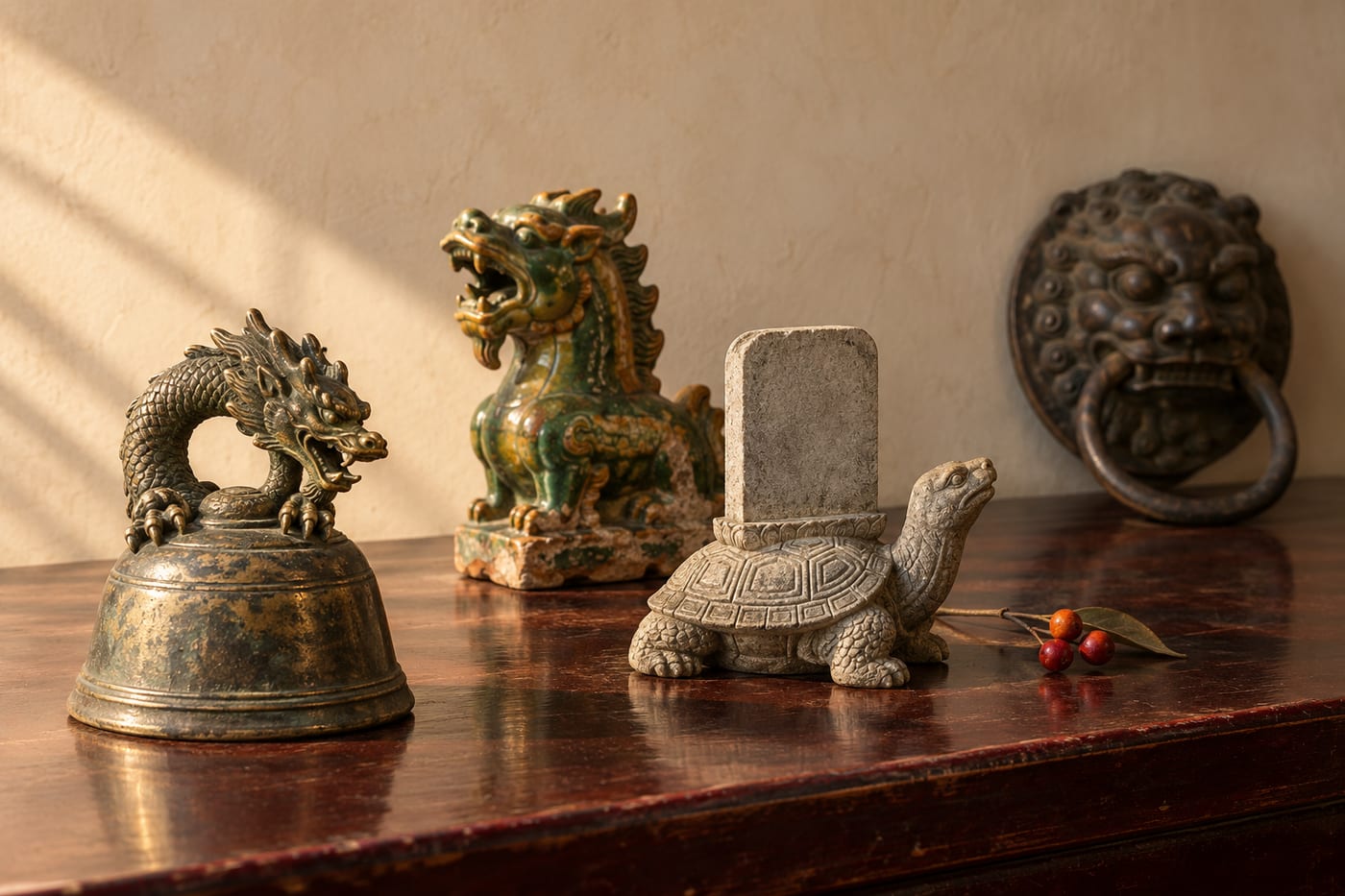
Nine Sons of the Dragon
龙生九子The nine sons of the dragon (lóng shēng jiǔ zǐ in Chinese) are a family of dragon-children from Chinese folk tradition, none of whom turned out a proper dragon. Each loves one thing and has the job to match: the tortoise under a stone stele bears weight, the beast on the roof-ridge swallows, the loop on top of a temple bell roars. The famous lists are from the Ming dynasty, around 1500, and the scholars who wrote them admitted they did not know where the list came from.
Read the entry
Nüwa
女娲Nüwa is the goddess who repaired the sky. When the four pillars holding up heaven collapsed and fire and flood broke loose, she smelted five colored stones into a patch, cut the legs off a giant sea turtle to prop the corners back up, and banked reed ash against the water. She is also credited with making the first people out of yellow clay. Those are two separate myths, from two books written about three centuries apart.
Read the entry
Pangu
盘古Pangu is the giant who separated heaven from earth. He grew inside a black egg of chaos for eighteen thousand years, pushed the clear half up and the murky half down, held them apart while he grew ten feet a day, and when he finally died his body became the world: his eyes the sun and moon, his blood the rivers, his hair the stars. He is also the latest arrival in Chinese mythology, first written down in the third century CE.
Read the entry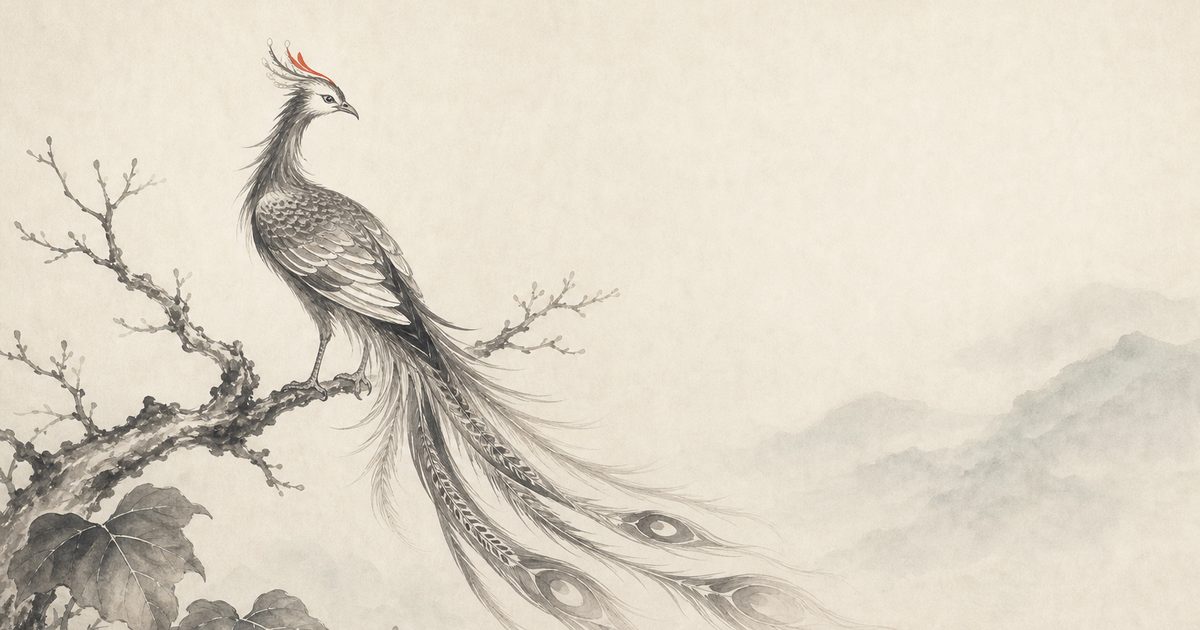
Phoenix
凤凰The Chinese phoenix, 凤凰 (fènghuáng), is the king of birds and the sign that the world is being governed well. It is also the most mistranslated animal in Chinese myth. It does not burn, it does not die, and it was never reborn from its own ashes until a Chinese poet borrowed that ending from Europe in 1920. What it actually does is arrive when the music is right.
Read the entry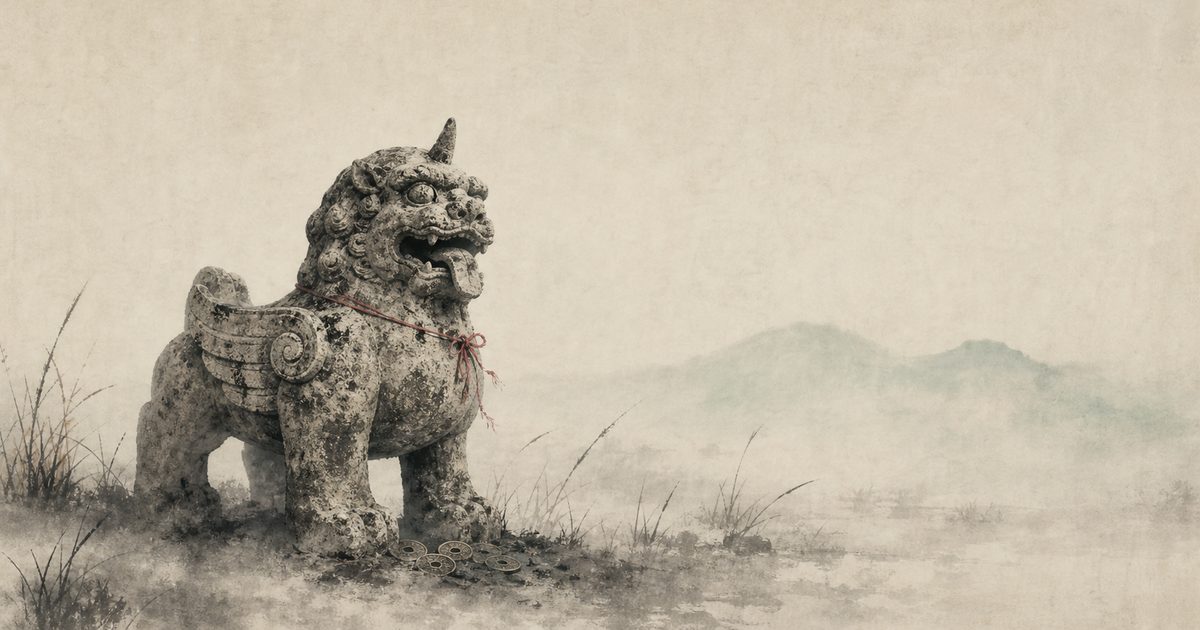
Pixiu
貔貅The pixiu, 貔貅 (píxiū), is China's wealth beast: a winged, lion-bodied, horned creature said to swallow gold and never let it out again, which is why it turns up on jade bracelets, cash registers, and casino floors across the Chinese world. Its real history is stranger than the charm. For two thousand years the word meant crack troops, and the winged stone version standing outside Nanjing arrived from the far west with the lions.
Read the entry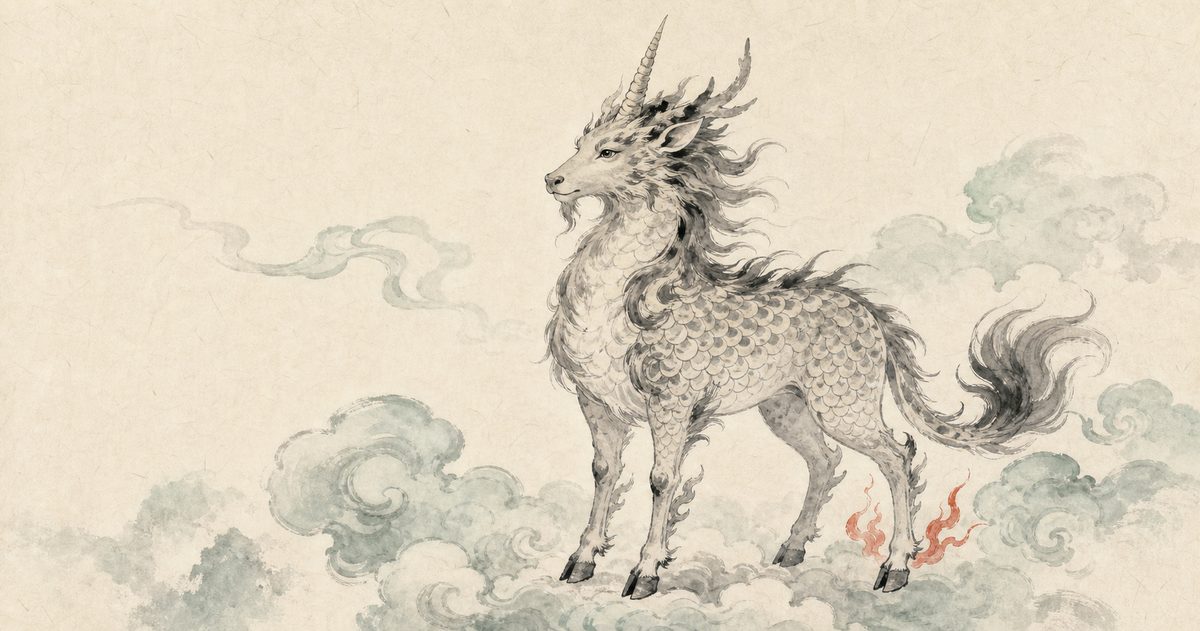
Qilin
麒麟The qilin, 麒麟 (qílín), is the gentlest creature in Chinese myth: a benevolent, scaled, hoofed animal with a deer's body, an ox's tail, and a soft horn, so kind it will not tread on a blade of grass. The West calls it the "Chinese unicorn." One of the four great auspicious animals, it appears when a sage is born or a golden age is coming, and it is the reason a real giraffe once caused a sensation at the Ming court.
Read the entry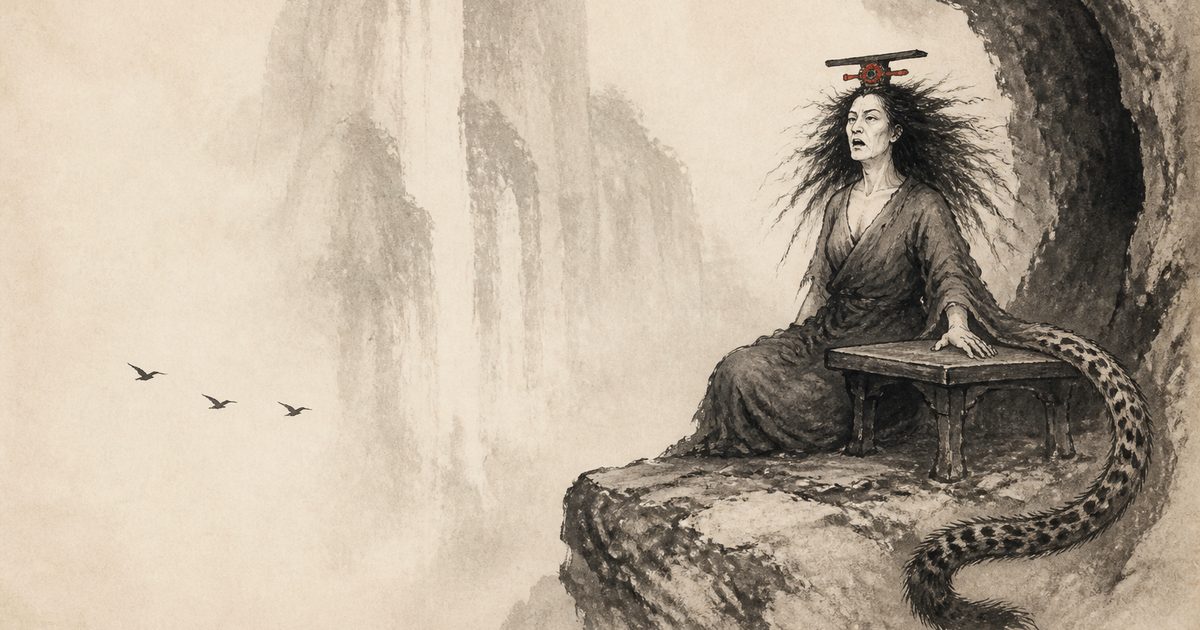
Queen Mother of the West
西王母The Queen Mother of the West, 西王母 (Xī Wáng Mǔ), also called Xiwangmu, is the Chinese goddess who keeps the peaches of immortality and decides who gets one. She is usually painted as a serene white-haired matriarch. The oldest text that names her describes something else entirely: a figure with a human face, a leopard's tail, tiger's teeth and a howl, living in a cave and holding the portfolio for plague and celestial punishment.
Read the entry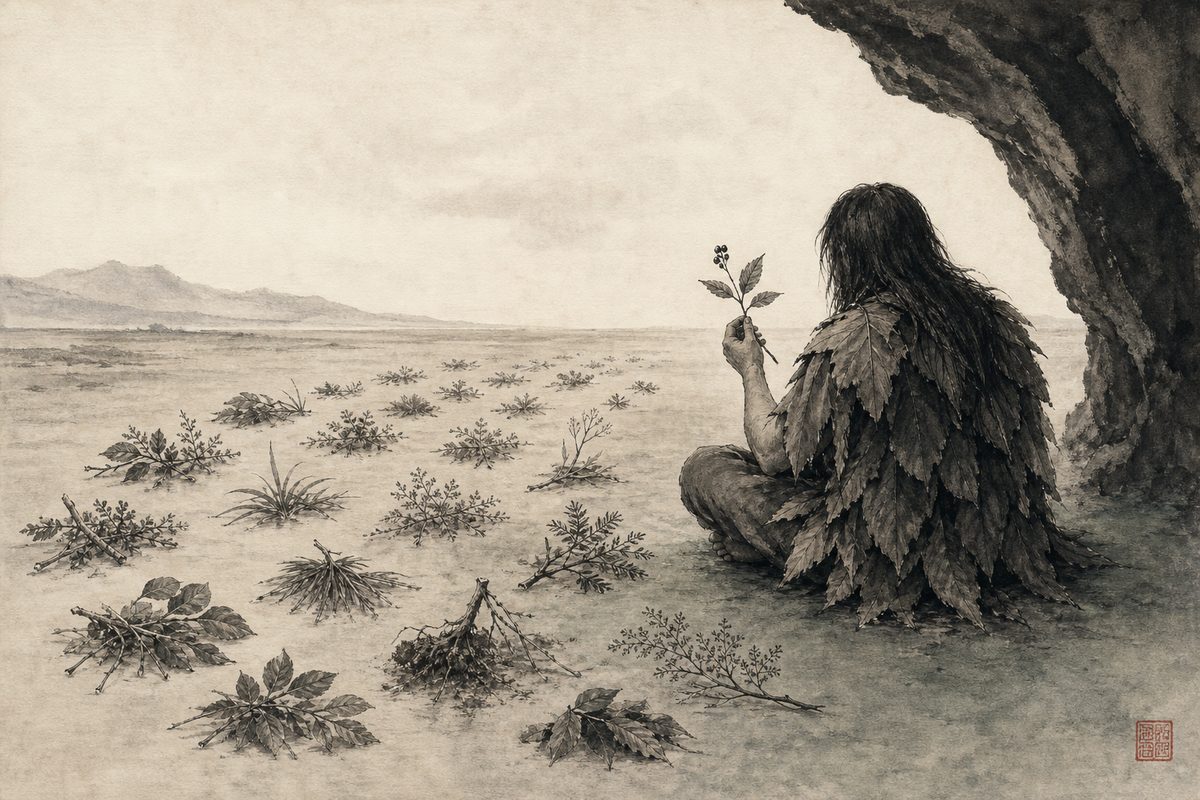
Shennong
神农Shennong is the Divine Farmer, the figure credited with giving China agriculture, the marketplace and herbal medicine. The oldest surviving account has him tasting the flavors of the hundred plants to sort the edible from the poisonous, and meeting seventy poisons in a single day. It says nothing about tea, and nothing about him dying. Both of those arrived later, and one of them arrived astonishingly late.
Read the entry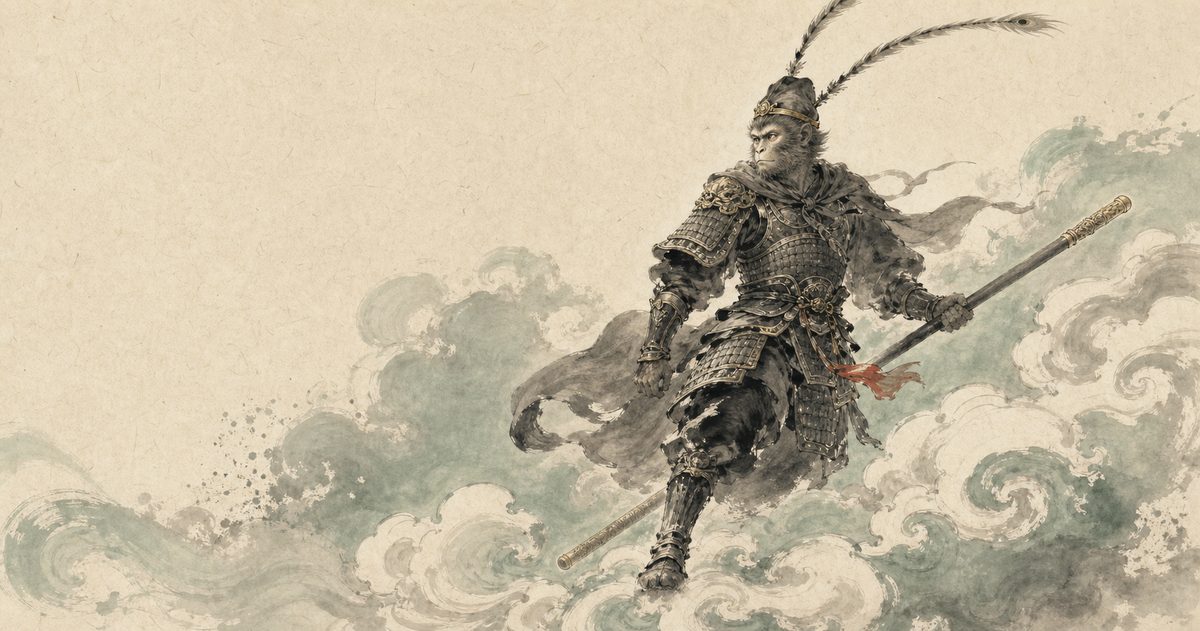
Sun Wukong
孙悟空Sun Wukong, 孙悟空 (Sūn Wùkōng), the Monkey King, is the breakout hero of the sixteenth-century novel Journey to the West and the most retold character in Chinese fiction. Born from a stone, armed with a shape-shifting staff taken from the Dragon King, he rebels against Heaven itself, is tamed on a pilgrimage to India, and ends as a Buddha. Rebel, trickster, and unlikely saint, he is now a global game and anime star.
Read the entry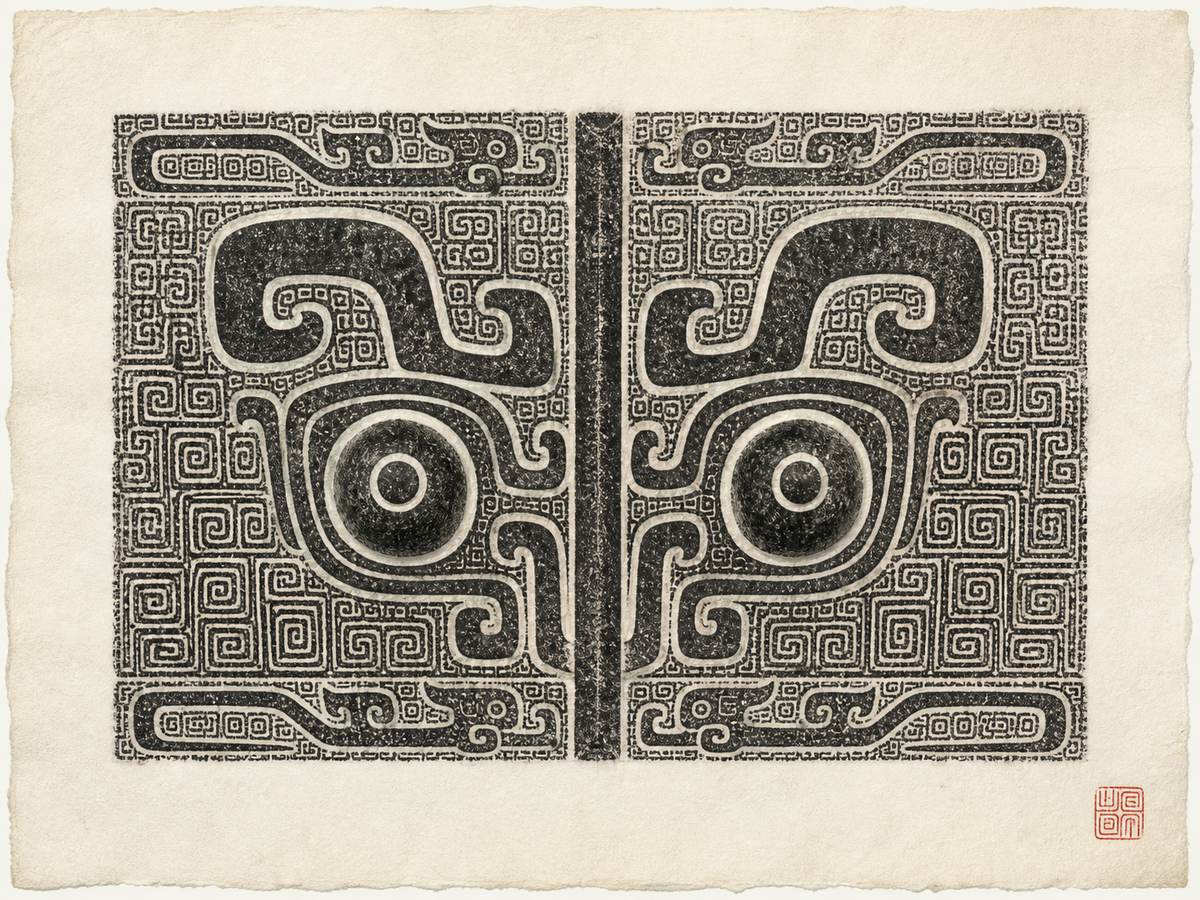
Taotie
饕餮The taotie is the face on the pot. It is the animal mask that covers Chinese ritual bronzes from roughly 1500 BCE onward: frontal, rigidly symmetrical, two enormous raised eyes, curling horns, and no lower jaw. What it is not is a monster with a story. The name taotie belongs to a glutton in a much later book, and the earliest surviving text that attaches it to the bronzes was written around 239 BCE, some nine hundred years after casters were already putting the face on vessels. Nobody knows what the Shang called it.
Read the entry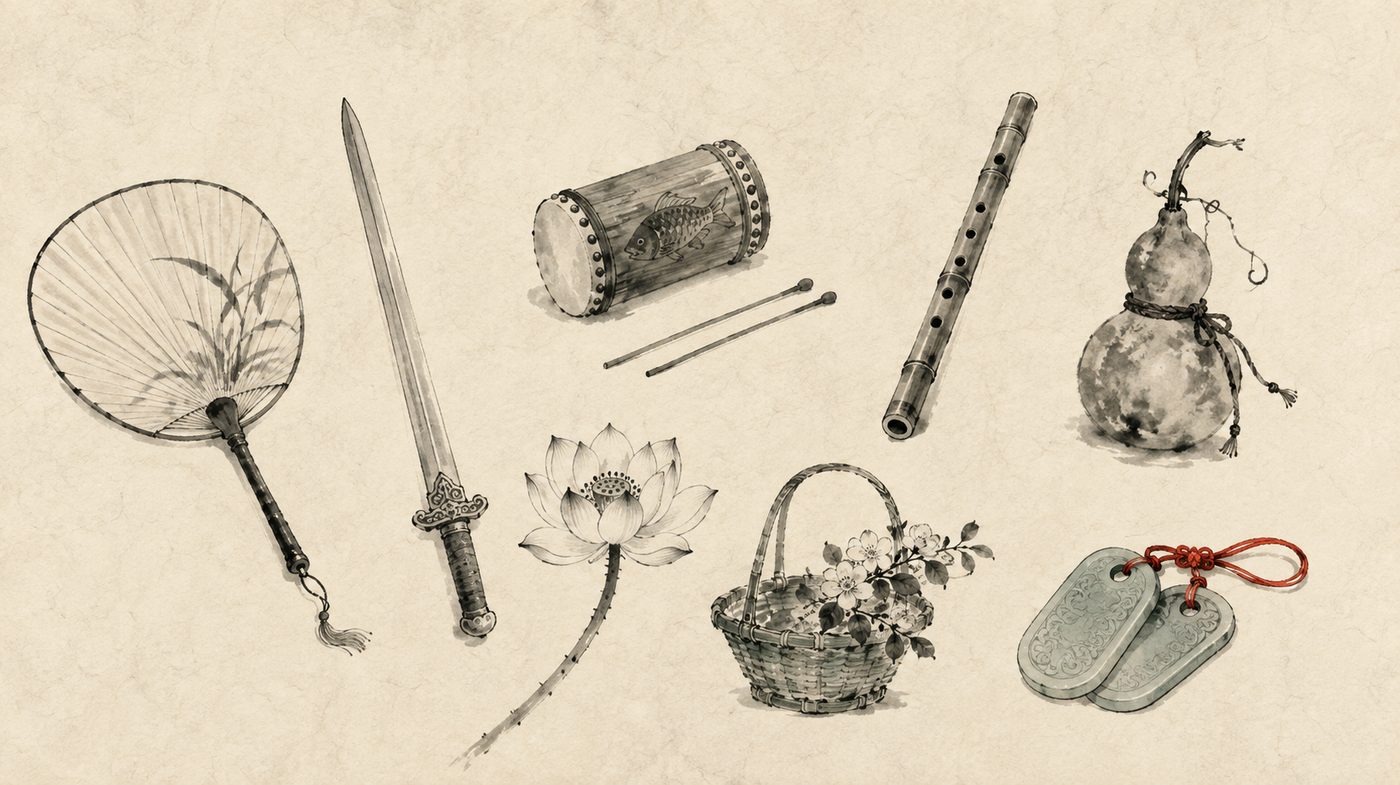
The Eight Immortals
八仙The Eight Immortals, 八仙 (Bāxiān), are the best-known group in Chinese popular religion: Lü Dongbin, Zhongli Quan, Iron-Crutch Li, Zhang Guolao, Han Xiangzi, Cao Guojiu, Lan Caihe, and He Xiangu, the one woman. They are not gods but xian, people who became deathless. The surprise is how recent the line-up is. The number eight is old; these particular eight were only settled in the Ming dynasty, by a novel.
Read the entry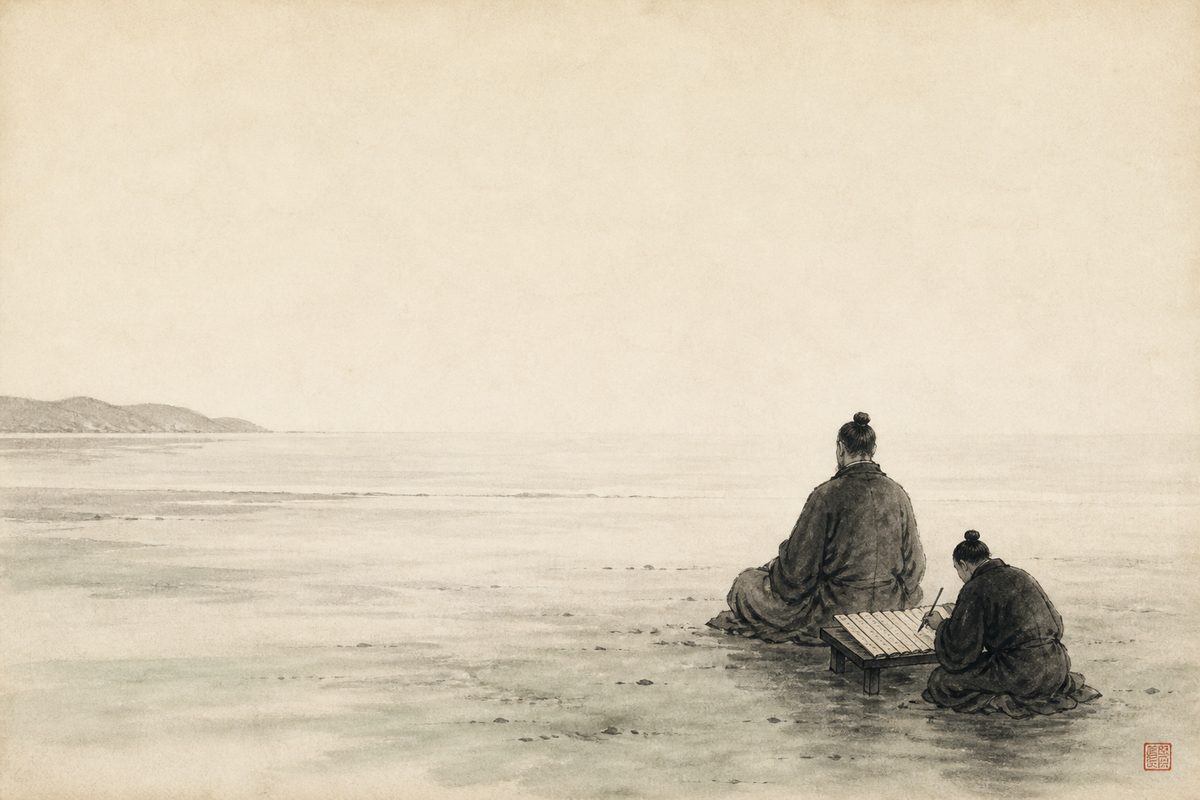
The Yellow Emperor
黄帝The Yellow Emperor, Huangdi, is the figure Chinese tradition puts at the head of its own history: the sovereign under whom writing, medicine, the calendar and the state are said to have arrived. He is almost certainly not a historical person, and the more interesting thing is what the oldest texts actually credit him with. Read them closely and he invents very little himself. He asks, and other people write it down.
Read the entry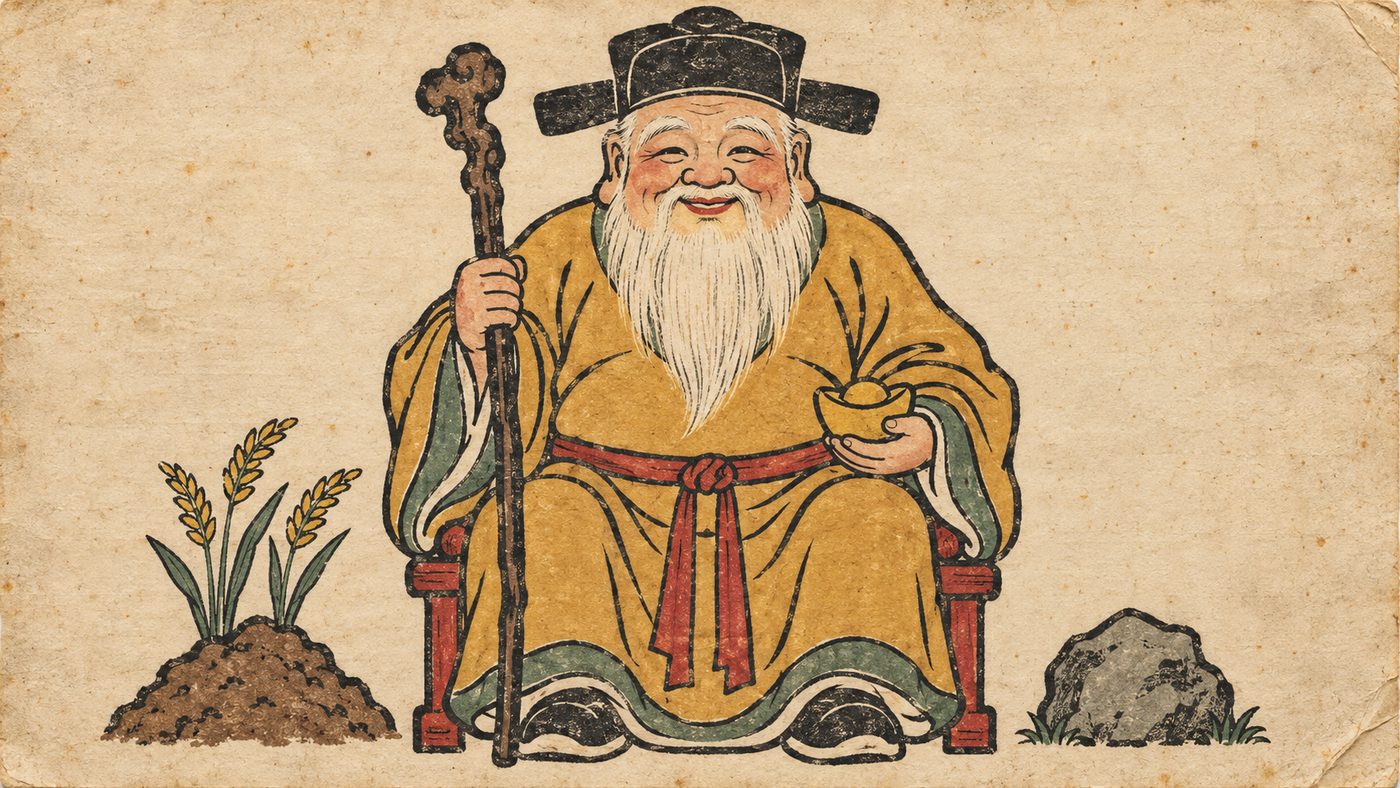
Tudigong
土地公Tudigong 土地公 (Tǔdìgōng, roughly "too-dee-gong") is the Chinese earth god: not the god of the Earth, but the god of one particular patch of it, a village, a field, a street, a garden. He is the smallest god in the pantheon and the one with the most shrines, usually a stone box the size of a mailbox with a small smiling old man inside. He is also the oldest god here. Two thousand years ago his altar stood beside the grain altar at the center of the state.
Read the entry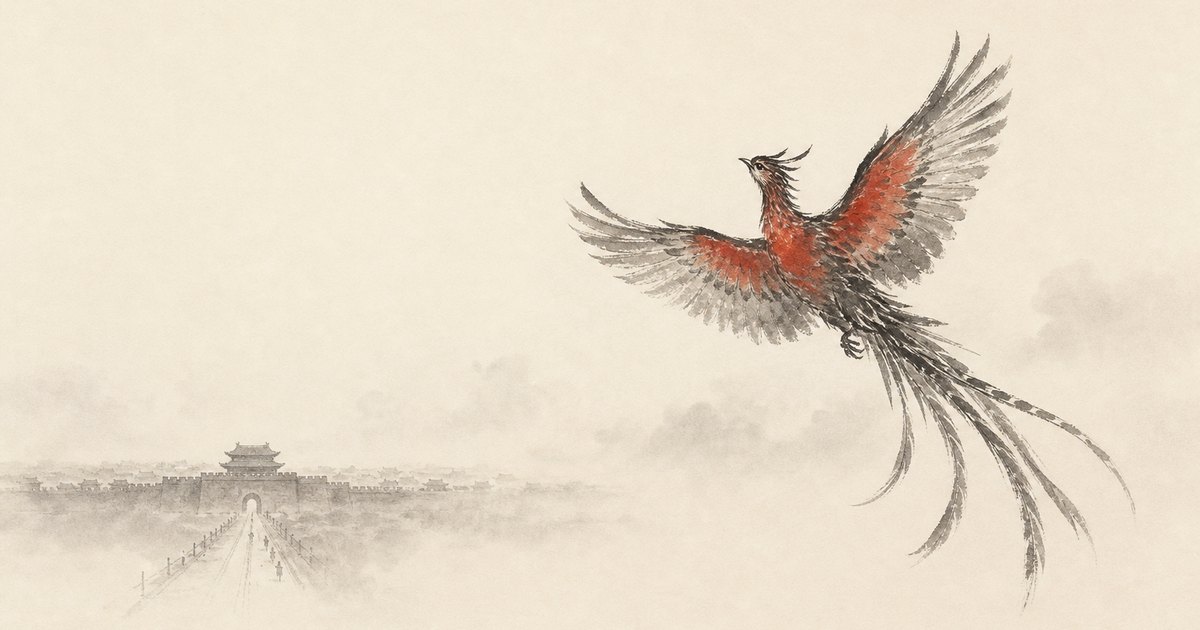
Vermilion Bird
朱雀The Vermilion Bird, 朱雀 (zhūquè), holds the south: summer, the element fire, and the direction a Chinese ruler faced when he sat down to govern. It is seven constellations running from Gemini to Corvus, it has a beak and a crop and a pair of wings that Sima Qian mapped onto real stars, and its name means, quite literally, "red sparrow."
Read the entry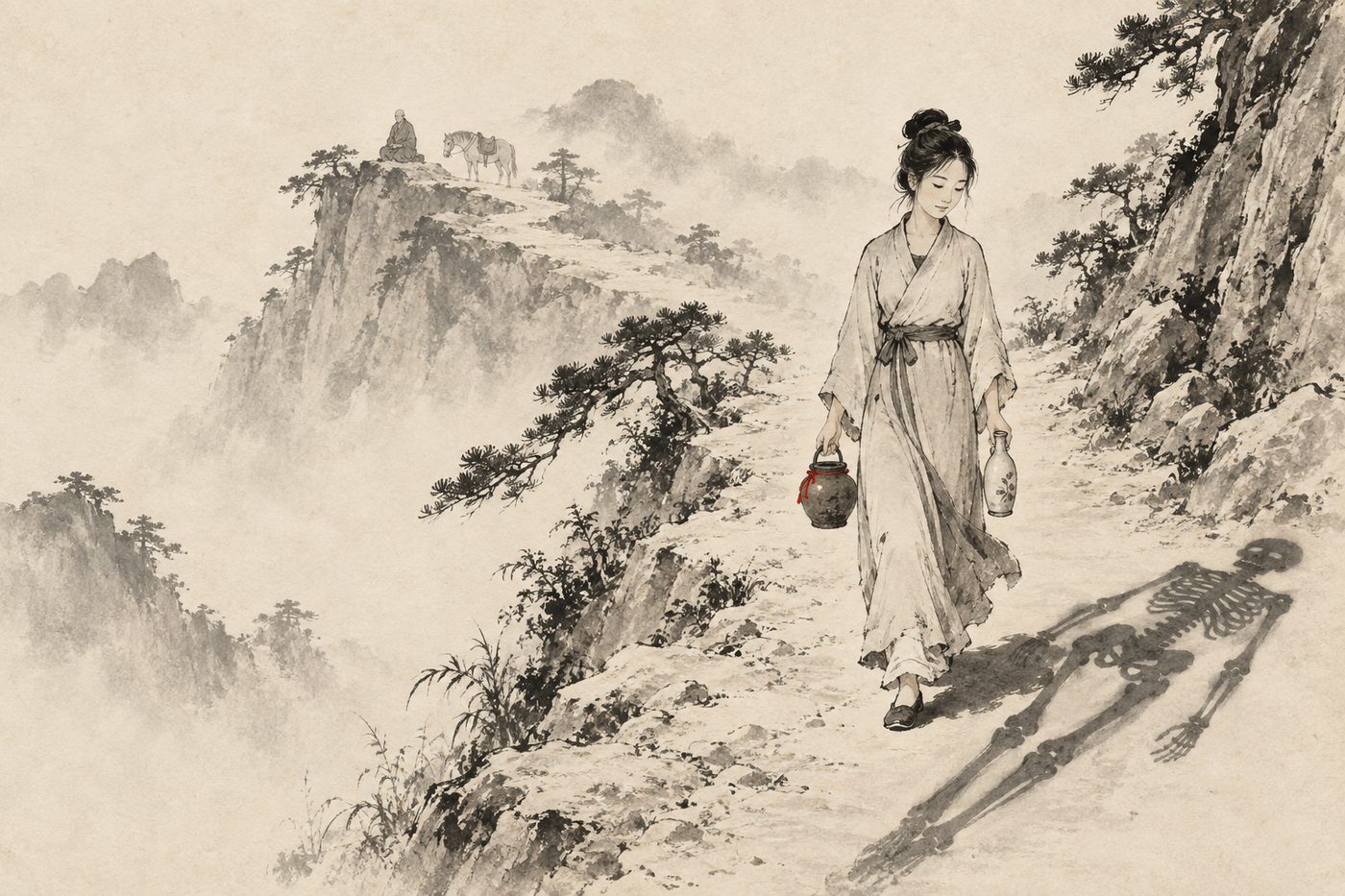
White Bone Spirit
白骨精The White Bone Spirit, 白骨精 (Báigǔjīng), also called the White Bone Demon or Lady White Bone, is the demon of chapter 27 of the sixteenth-century novel Journey to the West. Wanting to eat the monk Tang Sanzang for immortality, she takes three shapes in one afternoon, a village girl, her aged mother and her old father, and is beaten to death three times by the Monkey King, who is then dismissed by his master for murdering a family. She is in the book for one chapter. She has never left Chinese culture.
Read the entry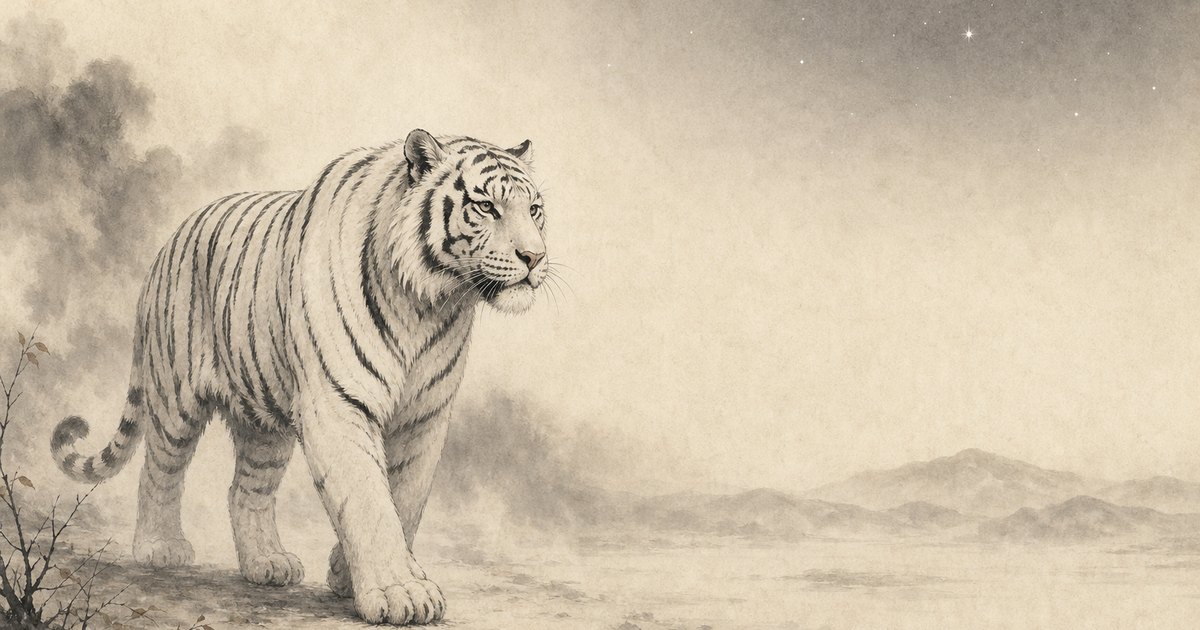
White Tiger
白虎The White Tiger, 白虎 (báihǔ), guards the west: autumn, the element metal, war, and punishment. It is also the least mythical of China's mythical beasts. The tiger is a group of stars, seven lunar mansions that include the Pleiades and all of Orion, and Sima Qian wrote down which stars are its shoulders more than two thousand years ago.
Read the entry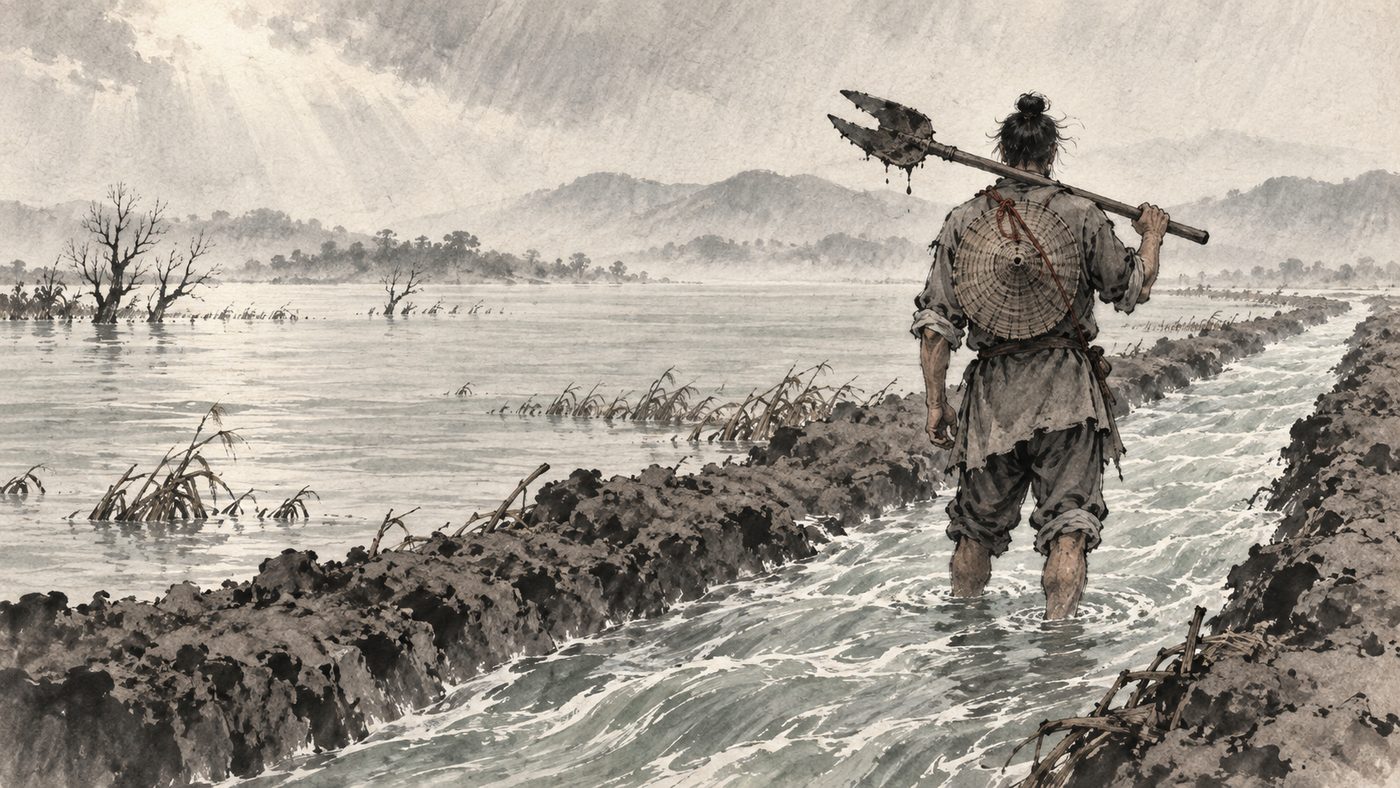
Yu the Great
大禹Yu the Great 大禹 (Dà Yǔ, roughly "dah yoo") is the hero who tamed China's Great Flood. His father Gun tried to wall the water in and was executed for it; Yu dug channels and let it run to the sea, and was so busy that, in the famous line, he passed his own door three times without going in. By tradition he founded the Xia, the first dynasty, and handed the throne to his son, which makes him the man who ended rule by merit.
Read the entry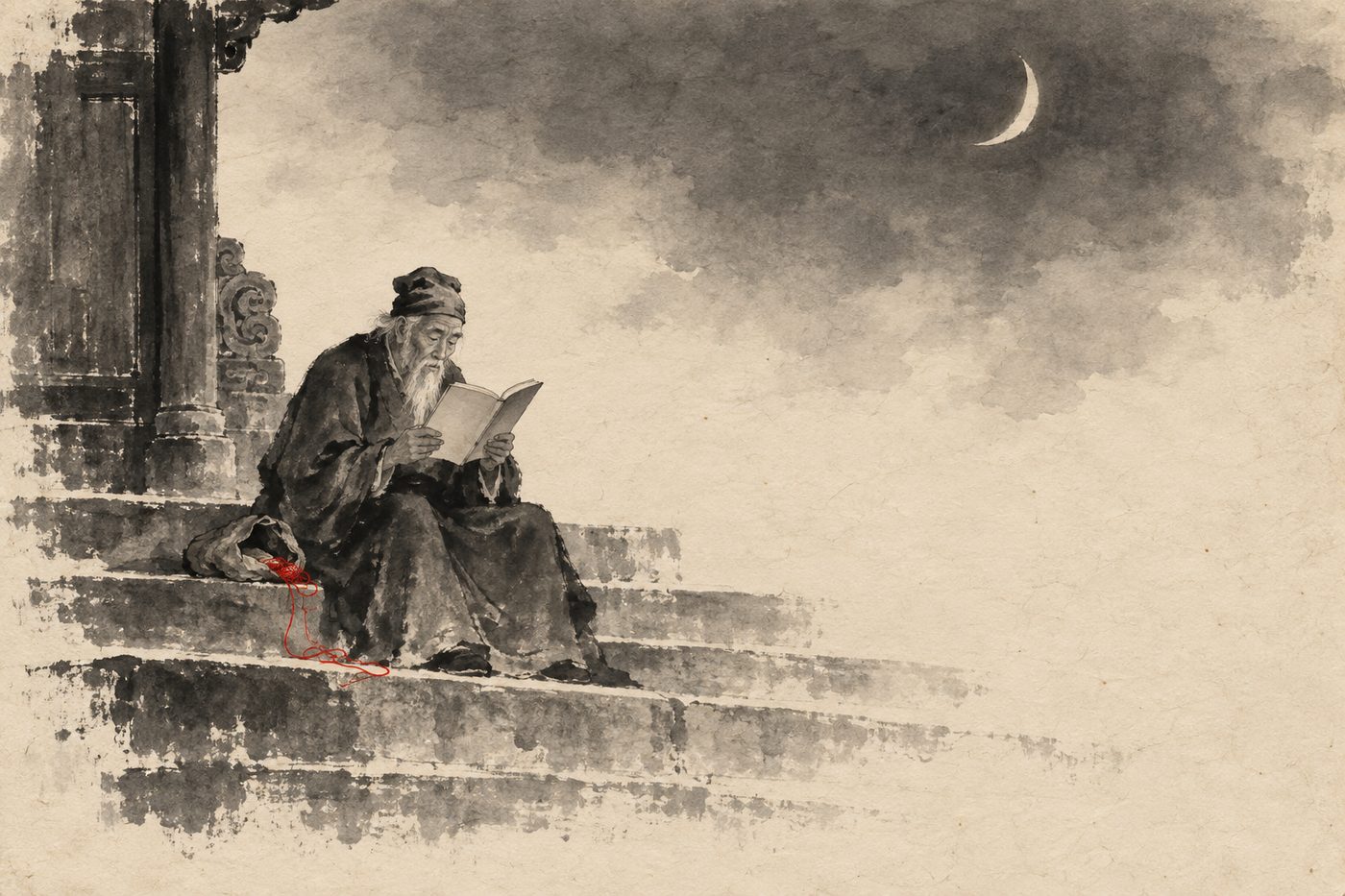
Yue Lao
月老Yue Lao, 月老 (Yuè Lǎo), the Old Man Under the Moon, is the Chinese god of marriage. He keeps the register of who will marry whom and ties an invisible red thread between the feet of the two people fated to wed, whatever their rank, distance or family feud. The whole cult grows out of one Tang-dynasty story, "The Inn of Betrothal," in which the old man is an underworld clerk reading his ledger by moonlight, and the hero, told his bride is a beggar's three-year-old, tries to have her killed. Temples to him in Taiwan count thousands of matches a year.
Read the entry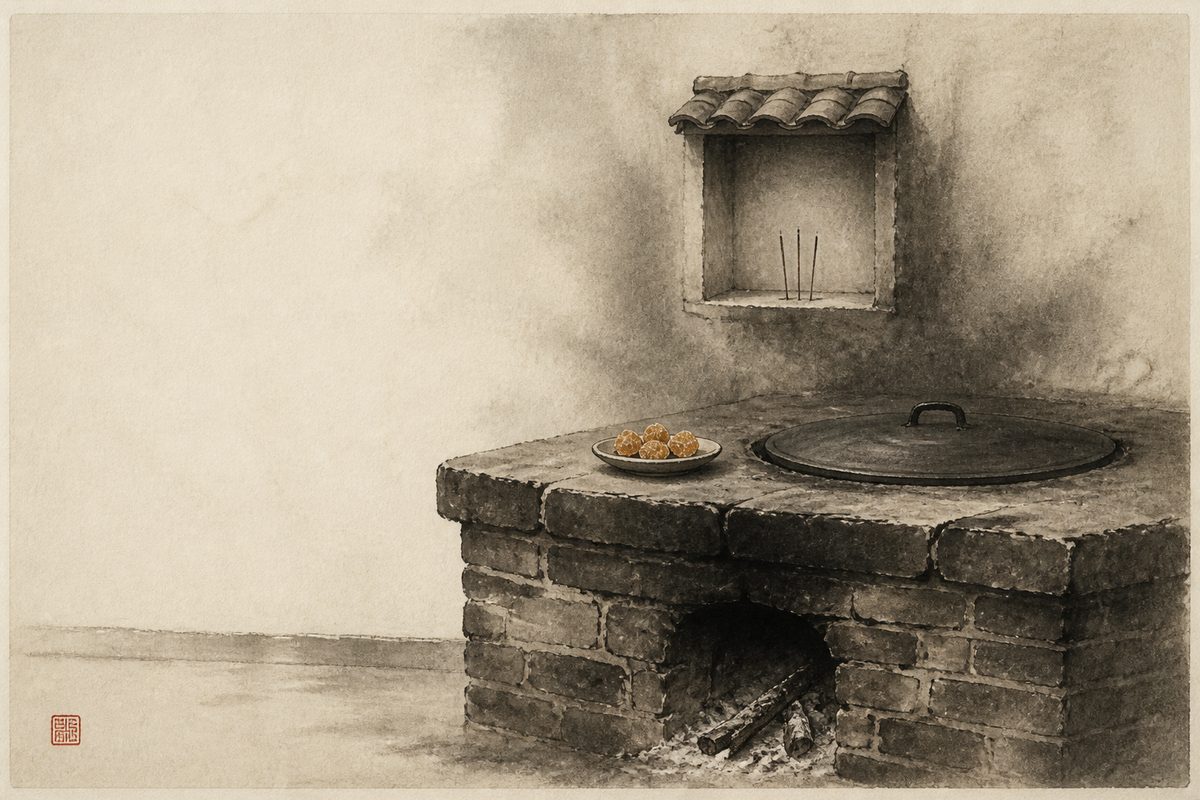
Zao Jun
灶君Zao Jun, 灶君 (zàojūn), the Chinese Kitchen God, lives above the stove, watches the household all year, and goes up to report what he has seen. He is one of the oldest gods still in domestic use: a proverb about him is quoted at Confucius in the Analects, and the earliest full account of his job, written around 320, describes a monthly audit that docks days off your life. The sugar on his mouth is a bribe, and it is a cheap version of an older one.
Read the entry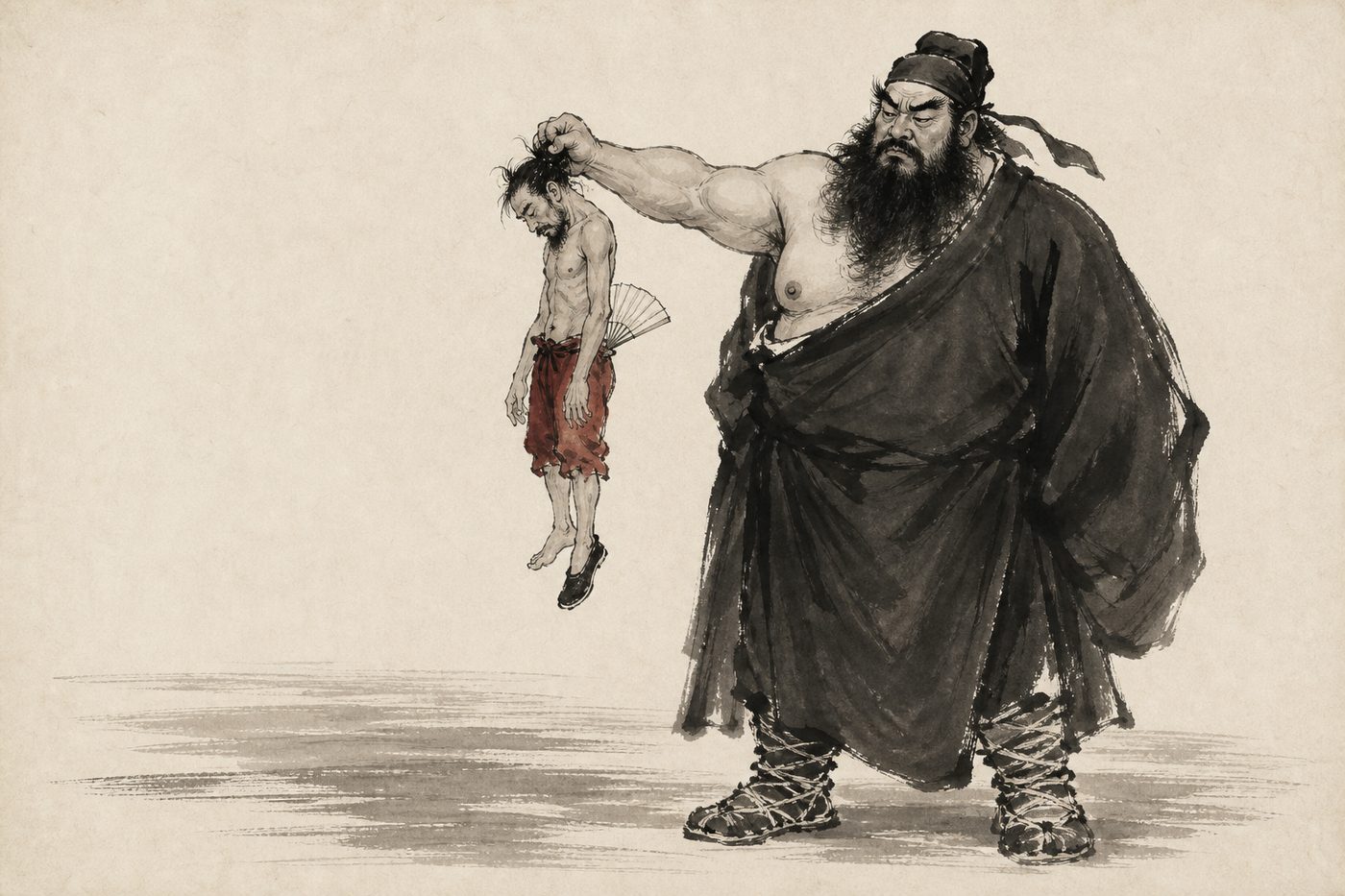
Zhong Kui
钟馗Zhong Kui, 钟馗 (Zhōng Kuí), is the demon queller of Chinese folk religion: a scowling, black-bearded figure with a drawn sword, hung on doors to keep the year's bad things outside. The story says he was a candidate who failed the imperial examination and came back from the dead to hunt demons for the emperor who had wronged him. The oldest surviving telling of that story is eleventh-century, and the scholar who wrote it down spent the next paragraph explaining why it could not be true.
Read the entry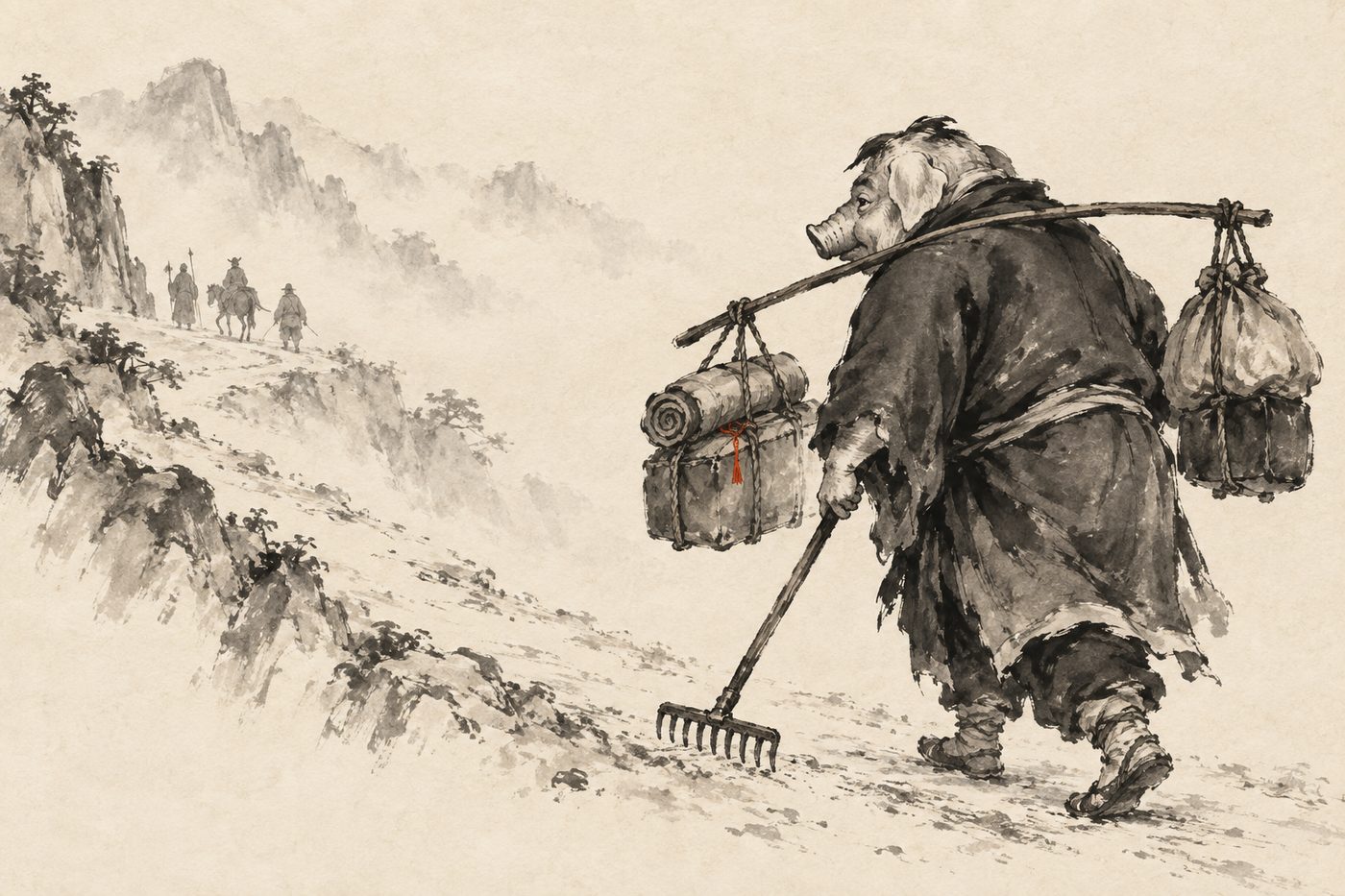
Zhu Bajie
猪八戒Zhu Bajie, 猪八戒 (Zhū Bājiè), known in English as Pigsy, is the pig-headed second disciple of the sixteenth-century novel Journey to the West. Once Marshal Tianpeng, a commander in Heaven, he was flogged and banished for drunkenly harassing the moon goddess Chang'e, took a wrong turn on his way to rebirth, and came out of a sow. Armed with a nine-toothed rake, he carries the pilgrims' luggage to India, and at the end is rewarded not with Buddhahood but with a job eating the leftovers at every altar.
Read the entryChinese gods & immortals 神仙
From the Jade Emperor and Guanyin to Nezha, the Eight Immortals, and the gods of wealth, love, and the kitchen stove.
Chinese mythical creatures 神兽
From the phoenix and the nine-tailed fox to the Four Symbols of the sky and the monstrous Four Perils.
The mythology behind Black Myth
Zhong Kui, Erlang Shen, Zhu Bajie and the Bull King as the games show them, set against what the Chinese texts actually say.
Why there is no Chinese book of myths
Greek mythology has Homer and Hesiod. Norse mythology has the Eddas. Anyone arriving at Chinese mythology looking for the equivalent volume is going to be disappointed, because there isn't one and there never was. What exists instead is three thousand years of accumulation: local folk religion, absorbed and reorganized by Daoism, crossed with Buddhism after it arrived from India, tidied at intervals by Confucian scholars who were frequently embarrassed by the whole business, and then rewritten wholesale by novelists in the Ming dynasty.
The consequence is that a Chinese god can have several incompatible origin stories, different job titles in different provinces, and a birthday that varies by temple, all without anyone considering this a problem. There is no orthodoxy to violate. When an entry on this site tells you a figure has two versions, that is not us hedging. That is the actual state of the record.
Where the stories actually come from
Four texts do most of the heavy lifting. Two are ancient and two are Ming novels, and the gap between them is roughly seventeen centuries.
| Text | When | What it gives us |
|---|---|---|
| Classic of Mountains and Seas | 4th century BCE, final form in the early Han | The oldest layer. A mythic geography of over 550 mountains and 300 waterways, listing more than 400 animals, most of which never existed. Nearly every strange creature in later Chinese art has its first written description here. |
| Huainanzi | Presented to Emperor Wu of Han in 139 BCE | Compiled under Liu An, Prince of Huainan: an eclectic sweep across cosmology, astronomy, philosophy and nature, quoting the older classics more than 800 times. Where the early myths get argued about rather than just told. |
| Investiture of the Gods | Ming dynasty, first printed between 1567 and 1619 | A hundred-chapter novel dramatizing the fall of the Shang and the rise of the Zhou, populated by immortals, demons and gods. Nezha, Jiang Ziya and the fox spirit Daji come from here. |
| Journey to the West | 16th century, earliest surviving edition c. 1592 | Attributed to Wu Cheng'en, built on the real 7th-century pilgrimage of the monk Xuanzang to India. It gave the world the Monkey King and is arguably the most popular literary work in East Asia. |
The wider library, including the passages quoted on individual entries, is on the sources page.
Heaven is an office, and the paperwork is real
This is the single strangest thing about Chinese mythology to a reader raised on Greek gods, and the most useful thing to understand early. The Chinese heaven is not a mountain where powerful personalities feud. It is a government. It has a supreme emperor, palaces, ministries with defined responsibilities, an enormous civil service, clerks, guards and servants, and the arrangement is copied deliberately from the earthly imperial court. The underworld is organized the same way, with registers and case files.
Which means gods hold posts rather than embodying forces. They can be appointed. They can be promoted for competence and demoted for failure. A great many of them are deceased humans who did something well enough to be given a job. This is why the Kitchen God files an annual report on your household, and why petitions to Chinese deities so often read like official correspondence, because that is precisely what they are.
The system is open enough that fiction could rearrange it. When Investiture of the Gods was published in the late Ming, its version of the heavenly court, complete with a registry of 365 named deities, was popular enough that folk belief reorganized itself to match. A novel changed the hierarchy of gods people actually worshipped. That is not a thing that happens to Olympus.
Common questions
Who are the main gods in Chinese mythology?
There is no single fixed pantheon, because Chinese mythology absorbed folk religion, Daoism and Buddhism over roughly three thousand years and never centralized the result. The figure most often placed at the top is the Jade Emperor, who presides over a celestial bureaucracy modeled on the imperial court, complete with ministries and paperwork. Below him sit hundreds of regional and functional deities, many of them promoted humans.
Are Chinese dragons evil like Western dragons?
No, and the contrast is close to total. The Chinese dragon is a water spirit: it governs rivers, seas and rainfall, it is associated with imperial authority rather than greed, and it is a bringer of good fortune rather than a monster to be killed. There is no Chinese equivalent of the knight-slays-dragon story, because the dragon is the thing you pray to for rain.
Who is Sun Wukong, the Monkey King?
A monkey born from a stone who acquires immense power, rebels against heaven itself, is imprisoned under a mountain for five hundred years, and is finally released to escort a monk to India. He is the central character of the sixteenth-century novel Journey to the West and probably the single most recognizable figure in Chinese mythology, still turning up in films, games and comics today.
What are the four Chinese mythical creatures?
The Four Symbols are the guardians of the four compass directions: the Azure Dragon in the east, the White Tiger in the west, the Vermilion Bird in the south, and the Black Tortoise in the north. Each corresponds to a season, an element and a quadrant of the night sky, which is where they came from originally: they are constellations before they are animals.
Are there animal gods in Chinese mythology?
Yes, though most of them hold an office rather than simply being sacred animals. The Dragon Kings are rain officials, and in 751 the Tang court formally enfeoffed the four seas as kings and paid for their sacrifices. The Black Tortoise, guardian of the north, grew a human body and became the Perfected Warrior, with a mountain range of temples at Wudang. The fox was a household god: a Tang anecdote preserved in the Extensive Records of the Taiping Era says that from the start of the dynasty ordinary people worshipped fox gods in their rooms, and quotes a saying of the time, no fox spirits, no village. The creatures guide lists the rest.
What is the Kui, the one-legged dragon or monkey of Chinese mythology?
A one-legged creature that three classical sources describe three different ways. The Classic of Mountains and Seas puts it on a mountain in the Eastern Sea, shaped like an ox, gray-green, hornless and one-legged, bringing wind and rain whenever it enters the water; the Yellow Emperor made a war drum from its hide that could be heard for five hundred li. The first Chinese dictionary, around 100 CE, says it is like a dragon with one foot, and reads horns, hands and a human face into the shape of the character. In the third century Wei Zhao, annotating the Discourses of the States, calls it a one-legged mountain goblin with a human face and an ape-like body. The kui dragon is also the name for a common one-legged dragon motif on ancient Chinese bronzes.
What are the original sources of Chinese mythology?
Mostly a handful of surviving texts rather than one scripture. The Classic of Mountains and Seas, compiled across several centuries BCE, is the oldest systematic catalog of creatures and geography. Later material comes from historical works, poetry, and vernacular novels such as Journey to the West and Investiture of the Gods. Every entry on this site names the text a story is drawn from.