Mythology · the texts behind the games

The real mythology behind Black Myth

Black Myth: Wukong (2024) is a sequel to Journey to the West, the Ming novel of about 1592, and nearly every figure in it, from Erlang Shen to the Bull King, comes out of that book. Black Myth: Zhong Kui, still without a release date, draws on something older and messier: a folk demon queller with no novel of his own. The headline correction is his. In the oldest surviving account, Zhong Kui failed the military examination, and nobody calls him ugly.

That last point matters because it is what players have been arguing about since the gameplay showing in August 2026. Shouldn't he be hideous? Wasn't he a scholar? The answer is that "scholar", "ugly" and "killed himself on the palace steps" are three separate additions, made in three separate centuries, and the earliest text has none of them. The same goes, on a smaller scale, for half of the Wukong cast. Below is each figure as the games show it, set against what the Chinese text actually says, with a link to our full page on each.

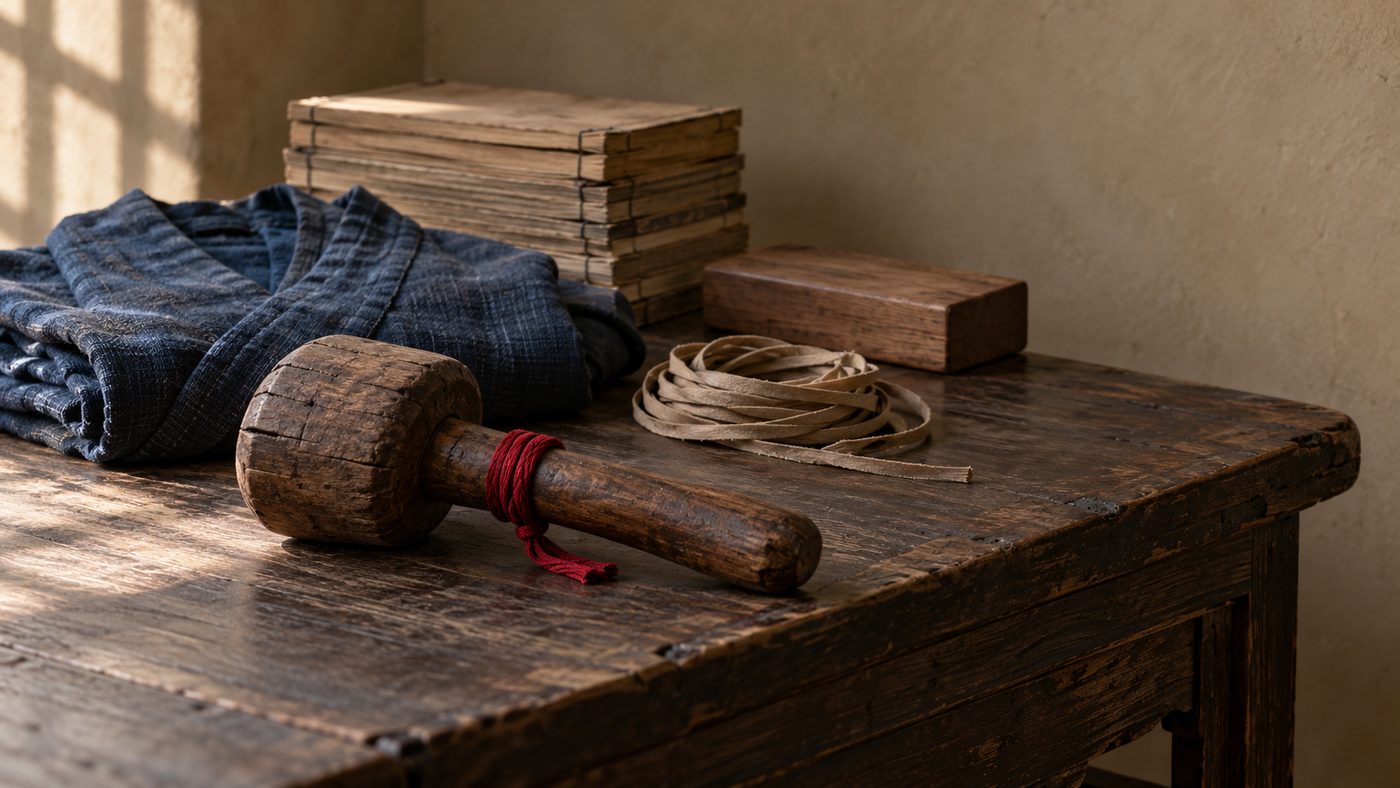
A worn wooden mallet tied with a red silk cord on an old elm table, beside a folded indigo cotton robe, a coil of rawhide lacing, a stack of thread-bound books and a pearwood printing block.
A mallet, a blue robe, rawhide for the feet and a printing block: Zhong Kui before he had a face. His name began as an old word for a mallet. Illustration.

Every figure, game against source

7 figures from this site's mythology pages appear in the two games. The middle column describes the game; the right-hand column is the text.

Figures of Chinese mythology in Black Myth: Wukong and Black Myth: Zhong Kui, what each game does with them, and what the source text says.
Figure In the game In the source
Zhong Kui Black Myth: Zhong Kui (upcoming, announced 2025) The player character is the demon queller himself, in an action retelling built around the folk story of Zhong Kui banishing evil, moving between the world of the living and the world of the dead Shen Kuo, 1090s: a man who failed the military examination, in a cap and blue robes with one arm bare. His face is not described and he does not die on the steps. Both arrive centuries later.
Sun Wukong Black Myth: Wukong (2024) A blockbuster action retelling in which the player, a successor to Wukong, walks straight into Journey to the West; it carried Chinese myth to a global audience Journey to the West, ch. 100: he accepts Buddhahood as the Victorious Fighting Buddha, and the gold band is simply gone from his head. No refusal, no second war with Heaven.
Erlang Shen Black Myth: Wukong (2024) Major antagonist and one of the game's signature encounters Ch. 6: the Jade Emperor's nephew at Guankou, who answers a call to arms but not a summons to court. He catches Wukong only with Laozi's snare and his hound's bite. The portrait gives him bright eyes, not a third one.
Zhu Bajie Black Myth: Wukong (2024) Freed from Yellowbrow's golden cymbals in Chapter 3 and the player's companion for the rest of the game; his own past with the Violet Spider is the heart of Chapter 4 Ch. 19: Marshal Tianpeng, thrown out of Heaven for grabbing the moon goddess while drunk. Ch. 65: the golden cymbals trap Wukong, not the pig. Ch. 72 to 73: seven spider women and no romance.
Bull Demon King Black Myth: Wukong (2024) The lord of Chapter 5, the Flaming Mountains, where his broken family, Rakshasi and Red Boy, carries the plot; he sees through the player's disguise and recognizes his son Ch. 59 to 61: husband of Rakshasi, the woman with the palm-leaf fan, and father of Red Boy. Cornered, he shows his true form: a white bull with horns like iron towers.
White Bone Spirit Black Myth: Wukong (2024) Mentioned in Chapter 6; players and the encyclopedias read the game as implying she was once the Monkey King's love, which the novel gives no hint of Ch. 27: a corpse demon in three disguises, struck down by Wukong, with "Lady White Bone" written down her spine. She and the monkey never exchange a tender word.
Dragon Black Myth: Wukong (2024) Serpentine loong dragons appear as bosses; the hero's shape-shifting staff is taken, as in the original novel, from the Dragon King of the East Sea Ch. 3: the staff is a lump of divine iron from the East Sea Dragon King's treasury, the weight Yu the Great used to sound the depth of rivers and seas.

Zhong Kui: was he a scholar, and was he ugly?

The oldest telling of the legend is not a story at all. It is a note. Around 1090 the polymath Shen Kuo described a painting of Zhong Kui in the palace collection, attributed to the great Tang painter Wu Daozi, and copied out the Tang inscription at the head of the scroll. In it the emperor Xuanzong, sick with fever, dreams of a small ghost running laps of the hall with his jade flute and Lady Yang's scent bag. A large ghost catches it, gouges out its eye and eats it, and introduces himself: 武舉不捷之士, "a man who failed the military examination." He has sworn to rid the realm of monsters. The emperor wakes cured and has the painter draw what he saw.

Notice what the note bothers to describe. The large ghost wears a cap and blue robes, has one arm bared, and has both feet wrapped in raw hide. It says nothing whatsoever about his face, and nothing about how he died. Then the legend grows, one layer at a time:

How the Zhong Kui story changed across three texts: the examination he failed, what is said about his face, and how he died.
Text The examination His face His death
Shen Kuo, Dream Pool Essays, Supplement (1086 to 1093), copying a Tang note on a painting in the palace Failed the military examination Not described. A cap, blue robes, one arm bare, feet in raw hide None
Unofficial History of the Tang, known only as quoted in the Ming encyclopedia Tianzhong Ji A jinshi, a civil candidate, who failed in the Wude era (618 to 626) Not described. A battered cap and a blue robe Went home in shame and struck his head on the palace steps
The Complete Tale of Zhong Kui of the Tang, an anonymous popular novel; the Qing novel Zhan Gui Zhuan tells a version of it Passed first on the list Rejected because the emperor "disliked his ugliness" Struck his head on the palace steps

So the fans who say he should be a soldier have the oldest text on their side, and the fans who say he should be ugly have a novel. The scholar arrives with the suicide, in a book now known only from a Ming quotation; the ugliness arrives last, as the reason the emperor rejects him. One honest caution: some modern reprints of Shen Kuo read "a jinshi who failed the military examination," which is a muddle of both careers. The Siku Quanshu text reads simply "a man."

Shen Kuo, to his great credit, did not believe a word of it. In the same entry, without drawing breath, he notes a tomb inscription dug up at Nanjing for the mother of the fifth-century general Zong Que, which records that Zong Que had a sister named Zhong Kui, and adds a Li Zhong Kui of the Northern Wei and two Sui generals of the same name. The name, he concludes, is old; only the painting begins with the Tang. You do not name your daughter after a demon hunter who has not been invented yet.

The likeliest explanation came later. The Rites of Zhou describes the emperor's great jade tablet as having a "zhongkui head," and in the old dialect of Qi a zhongkui was a mallet. The Qing scholar Gu Yanwu put it bluntly: the ancients drove out ghosts with a mallet. He also found a man of the Northern Wei, Yao Xuan, whose original name was Zhongkui and whose courtesy name was Bixie, "ward off evil." The mallet came first. The man was built to explain it. Our full page on Zhong Kui has the rest: the 1072 New Year prints, the bat over his head and the sister he marries off.

What the game has shown. Game Science revealed Black Myth: Zhong Kui at Gamescom Opening Night Live on August 19, 2025, and released a fifteen-minute look at a work-in-progress build in August 2026. The studio describes it as built on the folk tale of Zhong Kui banishing evil, with life and death as its theme. As of October 13, 2026 there is no release date. That is a sensible source to choose. With no canonical text, there is no single version to get wrong.
Black Myth: Wukong, figure by figure

The 2024 game is set after the novel ends. Released on August 20, 2024, it sold ten million copies in its first days and twenty million in its first month, and took Best Action Game at The Game Awards. Its premise is that the Monkey King, having reached Buddhahood, turned his back on Heaven, was brought down by Erlang Shen and sealed in stone, his six senses scattered as six relics for the player to recover. Everything the player fights along the way is borrowed from the book, and almost everything is borrowed with a twist.

Sun Wukong

The novel's ending is quieter than the game's. In chapter 100 the Buddha names Wukong the Victorious Fighting Buddha. Then he thinks of the band on his head and asks the monk to recite the loosening spell, and the monk tells him to feel for it. It is gone. He accepts the title, and there the book stops. The refusal, the second war with Heaven and the stone are the game's own sequel. Our Sun Wukong page covers the novel's monkey from the stone egg onward.

Erlang Shen

The game's opening duel is chapter 6 turned inside out. In the novel Heaven's armies have already failed when Guanyin recommends the Jade Emperor's nephew, a god living at Guankou who, she says, will answer a call to arms but not a summons to court. Erlang and Wukong fight through a famous chain of transformations, the monkey at one point disguising himself as a small temple and struggling to hide his tail, which ends up as a flagpole behind it. Erlang does not win alone: Laozi drops his steel snare on Wukong's head and Erlang's hound bites him in the leg. And the novel's portrait gives Erlang a handsome face and bright eyes, not a third one. The third eye, now the image millions of players have of him, is a later addition, dated on our Erlang Shen page.

Zhu Bajie

The game frees Bajie from a pair of golden cymbals when a star general crashes into them. Readers of chapter 65 will smile: in the novel the false Buddha Yellowbrow drops those cymbals over Wukong, and the rescuer is Kang-jin Long, the dragon spirit of the Neck mansion, one of the twenty-eight lunar mansions, who forces his horn in under the rim; Wukong drills a hole in the horn's tip, shrinks into it, and is pulled out. The game has swapped the prisoner and kept the jailer and the rescuer. Its love story between Bajie and the Violet Spider is new: the novel's spider spirits, in chapters 72 and 73, are seven sisters with a senior brother called the Hundred-Eyed Demon Lord, and no past with the pig. The novel's Bajie was thrown out of Heaven for grabbing the moon goddess while drunk, which is a different sort of romance. More on our Zhu Bajie page.

The Bull Demon King

The game's fifth chapter, on the Flaming Mountains, keeps the novel's household intact: the Bull King, his wife Rakshasi with her plantain fan, and their son Red Boy. Chapters 59 to 61 are the family's story in the book too, told as a long fight over the fan. What the novel adds is the end of the fight, when the Bull King, cornered, drops his disguise and becomes what he is: a white bull with a head like a mountain and horns like two iron towers. Our Bull Demon King page has the rest of him, including the cartoon he starred in in 1941.

The White Bone Spirit

She is only mentioned in the game, in its sixth chapter, in a way many players read as a lost love of the Monkey King's. The novel gives that reading nothing to stand on. In chapter 27 she is a corpse demon who tries three disguises on the monk, and Wukong strikes at her each time on sight; when she is finally dead, a line of writing on her spine reads "Lady White Bone." See our White Bone Spirit page.

The dragons

The game's serpentine loong bosses are a fair picture of the Chinese dragon, a water god rather than a fire-breathing beast. The staff they are fighting has a dragon history too. In chapter 3 Wukong takes it from the treasury of the Dragon King of the East Sea, where it is a lump of divine iron that Yu the Great once used to sound the depth of rivers and seas.

Who is not there: Nezha

Plenty of players go looking for Nezha, and the published summary of the game's plot does not name him; its heavenly opponents are Erlang and the Four Heavenly Kings. He belongs to the novel's earlier war. In chapter 4 his father, the Pagoda-Bearing Heavenly King, leads the first expedition against the monkey, and Nezha and Wukong both turn into three heads and six arms. The monkey wins by a trick, leaving a double to fight while he circles round and clubs Nezha on the arm.

What this page is not

It is not a guide to the games. There are no bosses, routes or builds here, and nothing about Black Myth: Zhong Kui beyond what its studio had shown publicly by October 13, 2026. And it is not a complaint. Every one of these figures was rewritten many times before a game studio got to them, by novelists, playwrights, painters and printers. Changing them is the tradition. Knowing which layer you are looking at is the fun part.

Questions people ask

What is Black Myth: Zhong Kui based on? +

On the folk story of Zhong Kui banishing evil, according to its studio, rather than on one novel. That makes it a different kind of adaptation from Black Myth: Wukong, which had a single source book in Journey to the West. Zhong Kui has no canonical text. He has a note copied by the scholar Shen Kuo in the 1090s, Ming and Qing novels and plays, and a thousand years of door prints, and they disagree about who he was. As of October 13, 2026 the game has no release date.

Was Zhong Kui ugly? +

Not in the oldest sources. Shen Kuo, in the earliest surviving account, describes his cap, his blue robes, his bare arm and his feet wrapped in raw hide, and says nothing at all about his face. The quotation from the Unofficial History of the Tang preserved in the Ming encyclopedia Tianzhong Ji adds the suicide but still no ugliness. The emperor rejecting him for his ugliness first appears in later popular novels. He was frightening on doors because a demon hunter has to frighten demons, which is a different thing.

Was Zhong Kui a scholar or a warrior? +

In the earliest text, a soldier. Shen Kuo has him introduce himself as a man who failed the military examination. The version quoted in the Ming Tianzhong Ji turns him into a jinshi, a candidate in the civil examination, and later novels make him the top scholar of his year. So the swordsman is the older Zhong Kui and the scholar is the later one, though some modern reprints of Shen Kuo carry a reading that mixes the two words.

Is Zhong Kui in Journey to the West? +

No. Zhong Kui and Sun Wukong come from unrelated material. People were hanging Zhong Kui on their doors centuries before Journey to the West was written around 1592, and the novel never brings him into its story. What the two figures share is a game studio.

Is Erlang Shen in Black Myth: Wukong the same as in Journey to the West? +

The role is the same: in chapter 6 of the novel Erlang is the god Heaven sends when its army cannot take the Monkey King, and in the game he leads the force that brings Wukong down. The look is not. The novel's portrait gives him a handsome face and bright eyes and no third eye; the third eye is a later folk attribute that the game adopted. In the novel he wins only with help, Laozi's steel snare knocking Wukong over and his hound biting him in the leg.

Is Nezha in Black Myth: Wukong? +

He is not named in the published plot summary of the 2024 game, where the heavenly opponents are Erlang Shen and the Four Heavenly Kings. In Journey to the West he does fight the Monkey King, in chapter 4, the two of them each turning into three heads and six arms. Players searching for him in the game are usually remembering the novel or the Ne Zha films.

Did Zhu Bajie and the Violet Spider have a love story in Journey to the West? +

No. In chapters 72 and 73 of the novel the pilgrims meet seven spider spirits in Silk-Web Cave; Bajie does make a fool of himself at their bathing pool, but there is no past between him and any of them. The romance is the game's invention, and a good one. The novel's Bajie was thrown out of Heaven for drunkenly grabbing the moon goddess, and ends the book not as a buddha but as Altar Cleanser, because, the Buddha says, his appetite is large and the job comes with leftovers.

Sources and further reading

More Chinese mythology

  • Chinese mythology The dragons, gods and creatures, each traced to the text that first recorded it.
  • Chinese gods The celestial bureaucracy, from the Jade Emperor down to the god of the stove.
  • Zhong Kui The demon queller who began as a stick.
  • Sun Wukong The Monkey King of Journey to the West.

Stay in the loop.

Chinese mythology, the zodiac, and the meaning behind names and symbols, rooted in the classics and read back to you. No spam. Unsubscribe anytime.