Chinese Mythology
Mazu: The Sea Goddess Whose Oldest Record Calls Her a Shaman
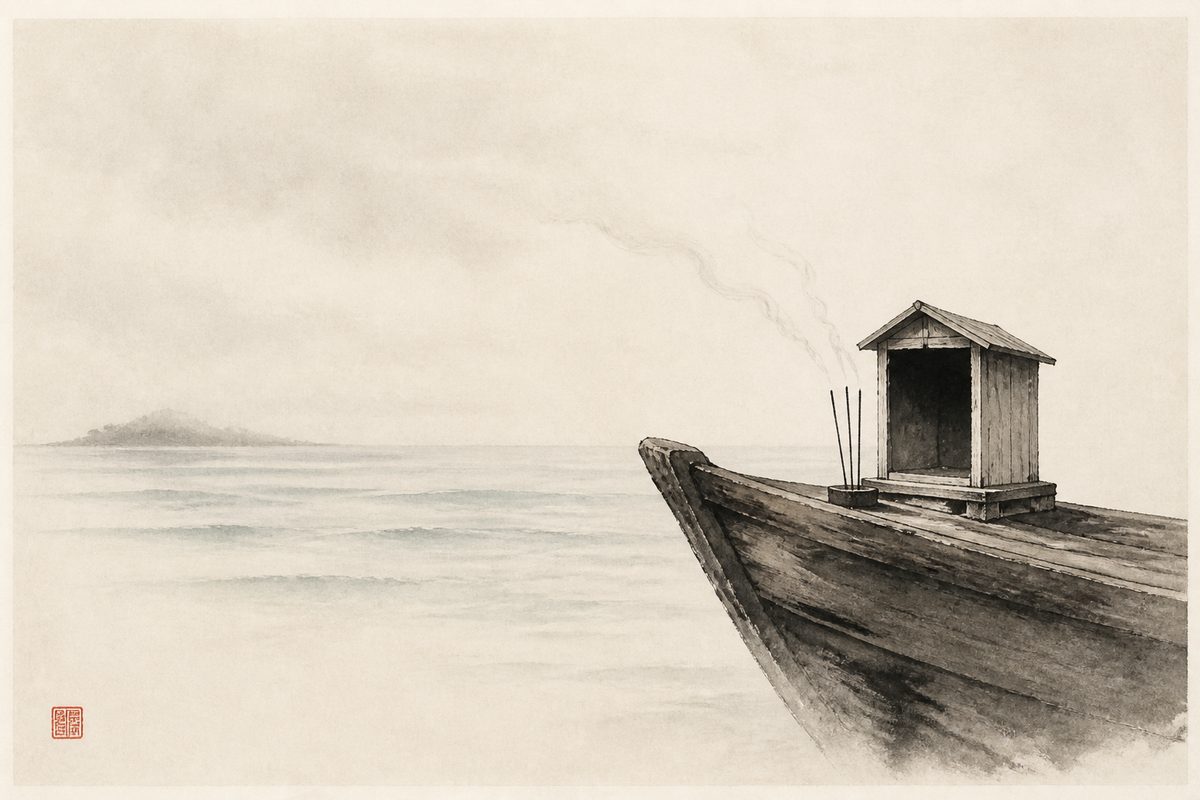
Mazu is the Chinese sea goddess, the deity in the small shrine at the bow of a fishing boat, and the most widely worshipped female deity of the Chinese coast. The story everyone tells is that she was a girl named Lin Moniang who died young saving sailors. The oldest surviving document about her, written in 1150, does not say that. It says she was a working spirit medium, and it does not give her a name at all.
Chinese gods do not, as a rule, come with paperwork. Mazu comes with a great deal of it.
Over roughly six centuries, emperors of four dynasties kept promoting her. She entered the system as an unranked local spirit on a small island off the Fujian coast, with no official standing whatsoever, and left it as the Empress of Heaven, and along the way her formal title swelled from two characters to sixty-four, which is longer than most of the poems written about her. She is, as far as I can establish, the only deity anywhere with something that genuinely resembles a personnel file.
The file is the interesting part, because every promotion is dated, and every date sits next to something the Chinese state urgently needed the sea to do. Embassies. Grain. Treasure fleets. An invasion. Line the honors up against the shipping and the pattern is not subtle.
But all of that comes later. Start with the first document, which is a small bomb.
The oldest thing anyone wrote about her calls her a shaman
In 1150, a man named Liao Pengfei wrote a record of a temple rebuilding at a place called Shengdun, near Putian in Fujian. It is a wholly ordinary piece of administrative prose, the sort of thing produced by the thousand whenever a building went up, and it happens to be the oldest surviving text about Mazu by a comfortable margin. He signs it, in the way of a man conscious of his qualifications, as a graduate by special examination.
Three deities were worshipped on the mound, he explains. Then he gets to the third:
Tradition holds that she is the divine woman who reaches heaven. Her surname was Lin and she was a native of Meizhou Island. At first she worked as a spirit medium, and she could foretell people's good and ill fortune. After she died, the community put up a temple for her on that island.
Read it again, because a great deal is missing.
There is no personal name. There is no birth date and no death date. There is no drowned father and no brother pulled from the waves in a dream, no girl who walked on water, no twenty-seven-year-old dying in a rescue, no filial piety of any description. There is a surname, an island, an occupation, and a temple.
And the occupation is the thing. The two characters Liao Pengfei uses mean a spirit medium, a person who conducts the business between the living and the dead and takes clients while doing it. This was a job. In a Fujianese fishing village in the tenth century it was a reasonably common job, and it was largely done by women, and it involved being paid. The oldest account of the most-worshipped goddess of the Chinese sea describes a working freelance psychic from a small island who was good at her trade, died, and had a shrine put up by her neighbors.
Nothing about that is disreputable, and I want to be careful not to make it sound like an exposé. It is simply not the story anybody tells now.
One honest complication. Liao Pengfei was writing in 1150, and the traditional date of her death is 987, which leaves a gap of a hundred and sixty-three years before the first surviving mention. He is not a witness. He is reporting what people in the district said, and he flags it himself with that opening phrase, tradition holds. What we can say is that in 1150, the thing tradition held was that she had been a medium. What we cannot say is what she actually was, and anyone who tells you otherwise is selling something.
There is also a small drama attached to the document itself, which spent centuries lost and surfaced only in 1987, inside a Qing-dynasty copy of a Fujianese clan genealogy. That is a nice piece of luck and it is worth saying plainly what it means: the single most important source about Mazu has been available to scholars for less than forty years. Most English-language accounts of her were written without it.
Where the Silent Girl came from
Here is the story you will find on every other page about her.
She was born in 960 on Meizhou Island, into the Lin family. She did not cry once during the first month of her life, and so her parents named her Silence. She grew into a quiet, studious, devout girl who learned to swim early and to read weather better than the fishermen. In a trance one day she saw her father and brothers foundering at sea and reached out to hold their boats; her mother, thinking her ill, shook her awake, and she lost her grip on one of them, and her father drowned. She died at twenty-seven, in 987, either climbing a mountain and ascending to heaven or drowning in the course of a rescue, depending on who is telling it. Her name is Lin Moniang, the Silent Girl.
It is a wonderful story. It is also, on the evidence, several centuries younger than the person it describes.
No Song-dynasty source names her. Liao Pengfei in 1150 has only Miss Lin; so do the other twelfth and thirteenth-century notices. The English-language encyclopedia entry for her says this in its own voice, that the early sources speak of her as Miss Lin and that the given name Mo, meaning silent, or Moniang, the Silent Girl, appeared later. The developed biography, with a birth date attached to a specific day of a specific lunar month, turns up in Ming-dynasty writing, several hundred years after the fact, in works like Zhang Xie's survey of the eastern and western oceans.
And once you notice that, the naming story starts to look strange from the wrong end. The claim is that she was called Silence because she did not cry. But the name is the older artifact here, and the anecdote explains it, which is exactly what an anecdote does when it is invented to account for a name somebody already had. A silent baby is a very tidy origin for a name that means silent. Life is rarely that tidy. Folklore always is.
What I am not going to tell you is that anyone made it up in bad faith. We do not know that, and it would be the wrong shape of accusation anyway. This is simply what a living religion does over a thousand years: it fills in. A goddess who protects your husband at sea acquires, by ordinary human demand, a childhood, a family, a face and a reason to care about drowning men. The hagiography is not a lie about her. It is a record of what her worshippers needed her to have been.
Though it is worth asking who else needed it, and that question has a sharper answer. A female spirit medium is a difficult thing to put in front of an emperor. State ritual in imperial China had an uneasy relationship with local mediums at the best of times, and canonizing one is not a natural act for a Confucian court. A chaste, filial, self-sacrificing girl who died saving others, on the other hand, is precisely the kind of person the state was in the habit of honoring. Notice which direction the biography grew in. It grew toward respectability, and it grew during the exact centuries she was being promoted.
A goddess with a promotion record
The promotions are not folklore. They are administrative records, and one of the places you can read them off is the Gujin Tushu Jicheng, the vast imperial encyclopedia completed in 1726, whose section on divine matters simply lists the honors in order, reign by reign.
| Year | What she was called | What the sea was doing |
|---|---|---|
| 1123 | No title yet, but her temple gets an imperial plaque reading Smooth Crossing | An embassy to Korea comes home after losing most of its ships |
| 1159 | Lady, under a four-character honorific built on Numinous Grace | Song China's revenue is increasingly seaborne |
| 1169 | Lady still, but the honorific has grown to six characters | |
| 1192 | Consort of Manifest Grace | Promotion out of the human ranks and into the divine ones |
| 1278 | Heavenly Consort, Protector of the Nation | The Mongol Yuan is feeding its capital by sea, on grain convoys up the coast |
| 1409 | Heavenly Consort, with a long extension | Zheng He's treasure fleets are sailing |
| 1683 | Empress of Heaven | Admiral Shi Lang takes Penghu, and then Taiwan |
The 1123 entry is the one to look at first, because Liao Pengfei's document records it too. An envoy named Lu Yundi was sent to Korea and ran into weather severe enough to destroy most of the mission's ships. His own vessel came through, and the report that went back to the throne said that a female deity had been seen on the masthead. The court responded by granting her temple a plaque. That is how the whole six-hundred-year escalator starts: a surviving diplomat, a story about a woman on a mast, and a piece of official signage.
Which makes the earliest surviving text about Mazu, that same 1150 record, something other than a piece of religious literature. It is closer to a case file. It exists because a temple was being rebuilt and somebody wanted the record of her official recognition set down in writing.
The Yuan promotion is the most nakedly practical of the lot. The Mongol regime fed its capital by sea, shipping enormous quantities of southern grain up the coast every year, and the Yuan is the dynasty that raised her from Consort to Heavenly Consort and wrote Protector of the Nation into her title. Under the Ming, the Yongle emperor extended the title again in 1409 and built her a palace-scale temple at Nanjing, which for a long time was the highest-status center of her worship in China. That was the era of the treasure fleets, and Zheng He, the most famous Muslim in Chinese history, patronized her temples and credited her with his survival. If you want a single image for how thoroughly she had become the deity of Chinese maritime power, that is the one.
And the last promotion is the frankest. In 1683 the Qing admiral Shi Lang destroyed the Ming loyalist fleet at Penghu, which delivered Taiwan to the Qing, and Mazu was credited with helping. She was made Empress of Heaven. The palace of a Ming prince in Tainan was converted into a temple under her new title. A goddess who began as a Fujianese fisherman's protector finished as the patron of the fleet that conquered the island where, three centuries later, she would be worshipped more intensely than anywhere on earth.
The number of these honors usually given is thirty-six, distributed across the Song, Yuan, Ming and Qing, with the Qing responsible for the largest share by a distance. I would treat the exact figure gently. It circulates widely in Chinese popular reference and I have not found it in a primary compilation, and in any case counting is genuinely hard here, since it depends whether you score a plaque, a four-character extension and a whole new rank as one thing or three. What is not in doubt is the direction of travel, which was relentlessly upward for six hundred years, and the correlation, which is with shipping.
The bay of A-Ma
In 1488 a temple to her went up on the southern shore of a small peninsula in the Pearl River delta, at a place called Barra. It is still there, and it is the oldest surviving structure in the city that grew around it.
Sometime in the middle of the sixteenth century, Portuguese ships arrived in the bay below that temple. The story, which the Macao government's own heritage service repeats, is that the newcomers asked what the place was called, and were told A-Ma-Gau, the bay of A-Ma. They wrote down what they heard, and the result, after four and a half centuries of wear, is Macau.
I should be honest that this is an etymological legend rather than a settled piece of philology, and it has the tell-tale shape of one, the misunderstood answer to a foreigner's question. Place names acquire these stories the way saints acquire childhoods. But the Macao authorities themselves say the city's Portuguese name is connected to the cult of A-Ma, and that connection is not in serious dispute even where the fisherman's dialogue is.
The detail I find genuinely lovely is in the name itself. A-Ma is not a title. It means, roughly, Granny. Mazu means much the same, ancestral mother, the familiar word a Fujianese family would use for a grandmother. The imperial court spent six hundred years extending her formal title to sixty-four characters of numinous grace and national protection, and the people who actually went to sea in small boats called her Granny throughout, and it is the fishermen's name that ended up on the map, and on a European colony, and on an international airport.
The same word landed elsewhere too. The Matsu Islands, off the Fujian coast and administered by Taiwan, carry her name in a different romanization, and a gravesite said to be hers is on one of them.
Nine days and three hundred and forty kilometers
None of this is history in the sense of being over.
Every spring, a temple in the Dajia district of Taichung, in Taiwan, founded in 1730, sends its statue of Mazu out on the road. The procession runs for nine days and eight nights and covers roughly three hundred and forty kilometers, south through Changhua and Yunlin into Chiayi and back again, calling at something like a hundred and ten temples on the way. Crowd estimates for the final leg run into the hundreds of thousands. It is the largest religious procession in Taiwan, and it is not a heritage performance for tourists: people walk it, sleep rough along the route, and wait on their knees in the road for the palanquin to be carried over them.
Taiwan now has close to a thousand Mazu temples. In 1980 the count was 509. That is not a slow historical drift, it is a doubling inside two generations, and it happened in a wealthy, highly educated, thoroughly modern society. Whatever is going on with her, it is not residual. Much of what happens at her altars is questions: people draw a numbered fortune stick and throw two red wooden blocks to ask her whether it is the right one, and the answer only counts on a holy cup, one flat side up and one round. Her temple at Donghai in Taitung recommends three in a row, which is also the rule on our yes or no oracle.
Part of the mechanism is that her temples reproduce. A new temple is founded by taking incense ash from an established one, which makes the network a genealogy rather than a set of franchises, with mother temples and daughter temples and a certain amount of quiet competition over seniority. The ancestral temple on Meizhou Island, where Liao Pengfei's islanders put up the original shrine, sits at the root of it.
Her birthday is kept on the twenty-third day of the third lunar month, which is the sort of date that moves around the Western calendar every year. If you want to know where it falls in a given year, or what any date looks like in the lunar calendar, our Chinese calendar converter will do the arithmetic.
How many temples, and why nobody agrees
UNESCO inscribed Mazu belief and customs on its intangible cultural heritage list in 2009, and its description refers to 5,000 Mazu temples around the world. The English-language encyclopedia entry says about 1,500, in 26 countries. Both are respectable sources. They differ by a factor of more than three.
I am not going to split the difference, because the gap is not sloppiness, it is a real question about what a temple is. Does a large temple to some other deity with a Mazu altar in a side hall count? Almost every temple on the Fujian and Taiwanese coast has one. Does a small neighborhood shrine count, of which there are thousands? Does a household altar? Does the little wooden box on the foredeck of a fishing boat, with its three sticks of incense, which is the form in which most people who have ever prayed to Mazu actually encountered her?
If you count that last one, nobody will ever have a number.
And there is the whole story, in one object. The state gave her sixty-four characters and a rank above the ranks of men. The people who went out on the water gave her a box the size of a bread bin, bolted to the front of the boat, and called her Granny. Six hundred years of imperial promotion never once changed what the fishermen called her, and in the end it was their name, not the emperors', that stuck to a city, an island group, and the goddess herself.
For the family name she carries, and the other lives it has produced, see the surname Lin.
In the classics
The passages behind the story, in the standard published translations. Open any one for the original text.
“Tradition holds that she is the divine woman who reaches heaven. Her surname was Lin and she was a native of Meizhou Island. At first she worked as a spirit medium, and she could foretell people's good and ill fortune. After she died, the community put up a temple for her on that island. ”
Original text
世傳通天神女也。姓林氏,湄洲嶼人。初,以巫祝為事,能預知人禍福;既歿,眾為立廟於本嶼。
Questions people ask
Who is Mazu?
Mazu is the Chinese goddess of the sea, worshipped along the whole Chinese coast and wherever Chinese ships went. She is held to have been a woman of the Lin family from Meizhou Island, off Putian in Fujian, who lived in the tenth century and was worshipped as a deity after her death. She protects sailors, fishermen and anyone crossing water, and she is the figure in the small shrine at the bow of a traditional Chinese fishing boat. Emperors of four dynasties promoted her by decree, ending with the title Empress of Heaven.
Was Mazu a real person?
Probably, in the limited sense that the earliest surviving document about her treats her as a local woman who had died rather than as a myth. That document, a temple record written in 1150, says only that she was surnamed Lin, came from Meizhou Island, worked as a spirit medium and could foretell fortune and misfortune, and that the islanders built her a temple after she died. Everything else that is now told about her, including her personal name, her birth date and the shipwreck rescue, appears in sources written considerably later.
What is Mazu the goddess of?
The sea, and by extension safe passage across it. Her worship began among Fujianese fishermen and coastal traders, and it spread with shipping: to Guangdong, Taiwan, Southeast Asia, Japan and eventually to overseas Chinese communities worldwide. The Chinese state adopted her for the same reason, promoting her whenever it needed the sea, first for embassies, then for grain convoys, then for the treasure fleets, then for the invasion of Taiwan.
Why is Mazu called the Empress of Heaven?
Because emperors kept giving her better titles. She began as an unranked local deity, received a temple plaque in 1123, was made a Lady later in the twelfth century, a Consort in 1192, a Heavenly Consort under the Mongol Yuan, and finally Empress of Heaven in 1683, after the Qing admiral Shi Lang credited her with his victory at Penghu and the conquest of Taiwan. Her formal title grew from two characters to sixty-four.
Is Mazu the same as Guanyin?
No, though the two are often confused and are frequently worshipped in the same building. Guanyin is a bodhisattva of Buddhist origin, venerated across the whole Buddhist world. Mazu is a Chinese folk deity with a specific hometown, a surname and a date, whose worship is tied to seafaring and to the Fujianese coast. Where Guanyin is compassion in general, Mazu is a local woman who was promoted, over six centuries, by a state that needed the sea to behave.
Is it Mazu or Matsu, and what are her other names?
The same goddess under different spellings and titles. Matsu, or Ma-tsu, is the older Wade-Giles romanization of the same name, still common in Taiwan and on the Matsu Islands named after her; Mazu is the mainland pinyin. The name itself means mother-ancestor. In Hong Kong her temples are Tin Hau temples, the Cantonese reading of Tianhou, Empress of Heaven. Taiwan calls her Tianshang Shengmu, Holy Mother in Heaven, and Macau calls her A-Ma. Her personal name in the later legend is Lin Moniang, the Silent Girl, which is why some English retellings call her the mute sea goddess: she was said not to have cried once in her first month. The earliest record, from 1150, gives no personal name at all, only the surname Lin; the page on the Lin surname tells her story from the family's side.
Related figures
Sources & further reading
- Record of the Rebuilding of the Shengdun Ancestral Temple as the Shunji Temple, by Liao Pengfei, 1150: the full text, including the passage calling her a spirit medium and the account of Lu Yundi's embassy to Korea and the Shunji plaque
- Gujin Tushu Jicheng, Shenyi dian, juan 28: the imperial encyclopedia of 1726, which lists the enfeoffment sequence from the Shunji plaque of 1123 through the Ming title of 1409
- Mazu: the English-language account, including the statement that the early sources speak of her only as Miss Lin and that the given name Mo or Moniang appeared later, the Zheng He patronage, the 1683 Tianhou title, and the figure of about 1,500 temples in 26 countries
- 妈祖, Chinese Wikipedia: the Liao Pengfei text of 1150 as the earliest extant record, and the later Ming account in Zhang Xie's Dong Xi Yang Kao giving her a birth date
- Mazu belief and customs, UNESCO Intangible Cultural Heritage: inscribed in 2009, with UNESCO's own figure of 5,000 Mazu temples worldwide and its description of the twice-yearly Meizhou temple fairs
- A-Ma Temple, Macao: the temple of 1488 at Barra and the derivation of the name Macau from A-Ma-Gau, the bay of A-Ma
- A-Ma Temple, Cultural Heritage of Macao (Macao SAR government): the temple's history and the official account of the connection between the city's Portuguese name and the cult of A-Ma
- Dajia Mazu Pilgrimage: the nine-day, eight-night, roughly 340 km route through Taichung, Changhua, Yunlin and Chiayi, and the Jenn Lann Temple of 1730
- Annual Dajia Mazu pilgrimage sets off, Focus Taiwan (Central News Agency): the route, the participating temples, and the crowd estimates
By Julian 祝君瑜, retold from the classics, with the original passages cited, updated 2026-10-07