Chinese Mythology
Chang'e (嫦娥): The Chinese Moon Goddess, and the Toad
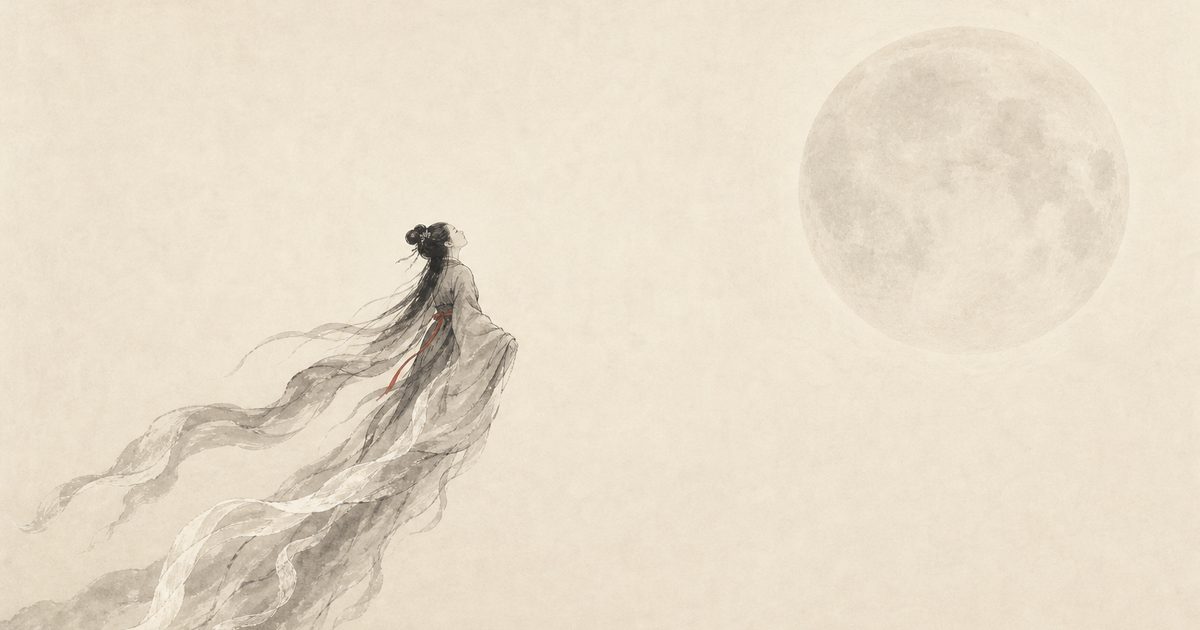
Chang'e, 嫦娥 (Cháng'é), is the woman on the moon. She swallowed the drug of deathlessness her husband had been given, rose out of reach of the earth, and has been up there ever since, which is the reason a fifth of the world eats mooncakes on one particular autumn night. The oldest surviving version of her story ends rather differently from the one on the mooncake box. In that one she lands on the moon and turns into a toad.
Were you born in a Year of the Rabbit?
Enter your birth date to find out your sign and which of the five elements it falls under. We handle the Chinese New Year cutoff, so a birthday in January or early February lands on the right side.
Chinese fortune-telling reads a lot into a birthday. For a playful old birth-chart custom, try our Chinese gender predictor.
Look at the moon tonight and you are looking at somebody's house. That is the arrangement in China, and it has held for well over two thousand years. A woman lives up there, alone except for a rabbit, and once a year the country she left behind puts food outside and looks up at her.
She is the reason for the mooncakes. She is the reason a space agency with a budget in the billions named its entire moon program after a folk tale. And in the two oldest surviving versions of her story, the ones nobody puts on the packaging, she arrives at the moon and turns into a toad.
The oldest Chang'e came out of a tomb
In 1993, archaeologists opened Tomb 15 at Wangjiatai, near Jiangling in Hubei, and found more than eight hundred bamboo slips. Among them was a divination manual scholars identify with the Guicang, the Return to the Hidden, a lost sister-text of the Book of Changes that had survived only as scattered quotations. The tomb dates no later than the Qin, which puts the slips in the third century BCE.
On the slips, under the hexagram called Guimei, the returning sister, is this. Long ago Heng'e stole the drug of deathlessness from the Queen Mother of the West and swallowed it, and so fled to the moon. Before she went she had the matter divined by a man named Youhuang, and Youhuang read the omen and told her it was auspicious. Fluttering, the returning sister, going west all alone. You will meet the sky's darkness and haze. Do not be startled, do not be afraid. Afterward you will greatly flourish.
Two things about that are worth sitting with. The first is that she checks. This is not a woman snatching a pill in a panic. She goes to a diviner, gets a reading, and leaves on a favorable omen, which makes the flight a considered decision with professional advice behind it.
The second is what the passage is doing there at all. It is not a story. It is the omen text of a hexagram, the paragraph a Qin diviner would read out to a client who had drawn that particular figure, and the moral of it is that a lone journey west turns out well. Chang'e is functioning as a precedent in a working divination manual, which means that by the third century BCE her story was already old enough and famous enough to be shorthand.
Three centuries later the astronomer Zhang Heng, the man who built the first seismoscope, retells the same episode in his Spiritual Constitution of the Universe, with the divination almost word for word. Then he adds the ending. She lodged her body in the moon, he writes, and became the toad.
Her name was changed by a taboo
She was not called Chang'e to begin with. On the Qin slips she is Heng'e, and heng is a word meaning constant, enduring, the thing that does not change.
Then in 180 BCE a man named Liu Heng became emperor of Han, and a Chinese emperor's personal name could not be written or spoken by his subjects. The taboo was not a suggestion. It rewrote geography, retitled books, and forced scribes to swap characters wholesale for a century. Heng'e needed a new first syllable, and the one she got, chang, means almost exactly the same thing, constant and everlasting, which is a fairly elegant piece of civil-service compliance.
Somewhere in the same shuffle she also acquired the female radical on both characters of her name. So the transformation of a slightly ambiguous ancient figure into an unmistakably feminine one is visible in the spelling, and it is dated, and the reason for it is a dead emperor's first name.
The husband was bolted on afterward
The version everyone knows is a marriage story. The archer Yi, whom most of the world knows as Hou Yi, shoots nine of the ten suns out of the sky when they all rise at once and start cooking the world, and is rewarded with a drug that would make him deathless. His wife takes it instead. He is left below, and every year at the full moon he sets out the cakes she liked.
Here is the part that gets left out. The single most famous statement of the myth, the sentence in the Huainanzi of 139 BCE that made it canonical, does not say they were married. It says that Yi asked the Queen Mother of the West for the drug of deathlessness, that Heng'e stole it and fled with it to the moon, and that he was left desolate with no way to make more. The chapter is not a romance. It is an argument about knowing the origins of things, and Chang'e is the illustration of a man who possessed a marvel without understanding where it came from and therefore could not replace it.
The marriage arrives with the commentary. Gao You, annotating the text a few hundred years later in the Eastern Han, writes that Heng'e was Yi's wife, and from that gloss the whole domestic tragedy grows. The ten suns are real too, and also from the Huainanzi, but from a different chapter with no Chang'e in it. What we call the myth is two stories and a footnote, welded together and then polished by two thousand years of poets who quite reasonably preferred the version with a broken heart in it.
Thief, or savior?
The classical texts are blunt about the verb. She stole it. Every early version uses that word, and none of them offers her an excuse.
The excuse is late, and it is folk. In the retellings that dominate children's books and festival television today, Yi has an apprentice, usually named Feng Meng, who breaks in while Yi is out hunting and demands the drug at knifepoint. Chang'e, cornered and unable to fight him off, swallows it herself to keep it away from him, and rises to the moon as a consequence rather than a plan. It is a much better story about a much nicer woman, and it does not appear in the early record at all.
Both versions are now genuinely part of the tradition, and there is no need to pick. But if a page tells you that the ancient Chinese saw Chang'e as a self-sacrificing heroine, it is describing the last few centuries rather than the first thousand years. The old texts have her stealing something that was not hers, being warned that the journey west would be dark, and going anyway.
Who else lives up there
The moon in China has always been crowded, and the toad got there first.
Early Chinese astronomy and folklore read the moon's dark maria as an animal, and the animal was originally a toad, which fits a body that swells and shrinks and returns from the dead every month. The rabbit shows up alongside it and eventually eclipses it. Qu Yuan's Heavenly Questions, from the Warring States period, asks what benefit there is in the gutu being in the moon's belly, and Chinese scholarship has argued for a century about which animal that word means. In 1934 the poet and philologist Wen Yiduo made a detailed phonological case that gutu was an old name for the toad, not the rabbit. Most readers still take it as the rabbit, which tells you how unsettled the question is.
What settles the cohabitation is not a text but a painting. The T-shaped silk banner from Mawangdui Tomb 1, buried near Changsha in the second century BCE, shows the heavens across the top of the T, and in the upper left a crescent moon carrying both animals at once, a large toad and a small rabbit. By the Han, the moon has a full household. The rabbit has a page of its own, which answers the question nobody thinks to ask about it, namely what is in the mortar; the zodiac rabbit page covers the sign rather than the animal on the moon.
Then there is the gardener. In the ninth century the Tang miscellanist Duan Chengshi records that the moon holds a cassia tree a little over a mile high, and beneath it a man forever chopping at it while the wound closes as fast as he cuts. His name is Wu Gang, he is from Xihe, he was studying to become an immortal, he committed some offense, and this is the sentence. China thus arrived, independently and about a thousand years earlier, at a punishment identical to the one the Greeks gave Sisyphus, and then put it on the moon where everyone could watch.
Why there are mooncakes
Mid-Autumn falls on the fifteenth day of the eighth lunar month, which under a calendar whose months begin at the new moon means the night is always a full one, and by long consensus the roundest and brightest of the year. If you want to know where that lands on a Gregorian calendar for any given year, our calendar converter will do the arithmetic.
The festival grew out of much older harvest and moon-worship rites, took its recognizable shape under the early Tang, and became a national enthusiasm under the Song. What it is about is reunion. The word for the full moon and the word for a family complete share the same roundness, the cakes are round for the same reason, and the whole occasion is built on the idea that people who cannot be in the same room can at least look at the same object at the same time.
Which is where the woman on the moon does her real work. She is the one person who cannot come home. Offerings get set out for her, children get told her story, and the festival's warmth is measured against her permanent absence. It is a surprisingly sharp piece of emotional engineering for a public holiday, and, for the record, Mid-Autumn only became a statutory public holiday in mainland China in 2008.
Some of that same lunar imagery runs through the way Chinese wishes for long life are phrased. If that thread interests you, the symbol for longevity picks it up.
The 1969 conversation
On the morning of the landing, with the lunar module a few hours from the surface, the capsule communicator in Houston read the crew of Apollo 11 the day's news. Among the headlines, he said, there is one asking you to watch for a lovely girl with a big rabbit. An ancient legend says a beautiful Chinese girl named Chang-o has been living there for four thousand years, banished for stealing the pill of immortality from her husband. Her companion is a large Chinese rabbit, easy to spot because he is always standing on his hind feet in the shade of a cinnamon tree.
Michael Collins, in the command module, answered that they would keep a close eye out for the bunny girl.
Thirty-eight years later China launched its first lunar orbiter and called it Chang'e 1. Chang'e 3 landed in 2013 and rolled out a rover named Yutu, Jade Rabbit. Chang'e 4 put the first lander in history on the far side of the moon in 2019. Chang'e 5 brought back samples in 2020, and in June 2024 Chang'e 6 returned 1,935.3 grams of rock and dust from the far side, which no country had ever done. Chang'e 7 is aimed at the south pole to go looking for water ice.
The cinnamon tree in the CapCom's script should have been a cassia, and Wu Gang has been chopping at it this whole time. Nobody has spotted him either. But the name on the side of the spacecraft is hers, the rovers are the rabbit's, and a woman who left on a favorable omen in the third century BCE now has a fleet.
In the classics
The passages behind the story, in the standard published translations. Open any one for the original text.
“Long ago Heng'e stole the drug of deathlessness from the Queen Mother of the West and swallowed it, and so fled to the moon. Before she went she had it divined by Youhuang, and Youhuang read the omen and said, it is auspicious. Fluttering, the returning sister, going west all alone. You will meet the sky's darkness and haze. Do not be startled, do not be afraid. Afterward you will greatly flourish. ”
Original text
昔者恒我竊毋死之藥于西王母,服之以奔月。將往,而枚占于有黃。有黃占之曰:吉。翩翩歸妹,獨將西行。逢天晦芒,毋驚毋恐,後且大昌。
“Yi asked the Queen Mother of the West for the drug that ends death, and E stole it and fled to the moon. Before going she had it divined by Youhuang, and Youhuang read the omen and said, it is auspicious. Fluttering, the returning sister, going west all alone. You will meet the sky's darkness and haze. Do not be startled, do not be afraid. Afterward you will greatly flourish. So Chang'e lodged her body in the moon, and became the toad. ”
Original text
羿請無死之藥於西王母,娥竊之以奔月。將往,枚筮之於有黃,有黃占之曰:吉,翩翩歸妹,獨將西行,逢天晦芒,毋驚毋恐,後且大昌。嫦娥遂託身於月,是為蟾蜍。
“It is like this. Yi asked the Queen Mother of the West for the drug of deathlessness, and Heng'e stole it and fled with it to the moon, and he was left desolate, bereft, with no way to make more. Why? Because he did not know where the drug of deathlessness came from. ”
Original text
譬若羿請不死之藥於西王母,姮娥竊以奔月,悵然有喪,無以續之。何則?不知不死之藥所由生也。
“It has long been said that in the moon there is a cassia tree and a toad. So a strange book says that the moon cassia is five hundred zhang high, a little over a mile, and below it a man is forever chopping at it, and the wound in the tree closes as fast as he cuts. The man's surname is Wu and his name is Gang. He is from Xihe. He studied to become an immortal, committed some offense, and was sentenced to fell the tree. ”
Original text
舊言月中有桂,有蟾蜍,故異書言,月桂高五百丈,下有一人常斫之,樹創隨合。人姓吳,名剛,西河人,學仙,有過,謫令伐樹。
As seen in
Over the Moon
film · 2020A grieving girl builds a rocket to prove Chang'e is real, and finds her running a neon pop empire in the lunar palace, as Chang'e.
Netflix and Pearl Studio, directed by the Disney animation veteran Glen Keane.
Questions people ask
Who is Chang'e in Chinese mythology?
Chang'e is the Chinese goddess of the moon. In the standard story she is the wife of the archer Yi, who was given a drug of deathlessness by the Queen Mother of the West. Chang'e swallowed it, floated beyond the earth's reach, and settled on the moon, where she has lived ever since with a jade rabbit for company. She is the figure the Mid-Autumn Festival honors, and China named its entire lunar exploration program after her.
What is the story of Chang'e and the elixir of immortality?
The oldest versions are one or two sentences long. The archer Yi obtained the drug of deathlessness from the Queen Mother of the West, and Chang'e took it and fled to the moon, leaving him with nothing and no way to make more. Everything else, including why she took it and whether she meant to leave him, was added by later storytellers, and the additions do not agree with each other.
Why did Chang'e turn into a toad?
Because the earliest surviving texts say she did. Both the Qin-dynasty bamboo-slip version of the Return to the Hidden and Zhang Heng's account from around 120 CE end with her lodging her body in the moon and becoming the toad. Toads were moon animals in early China long before rabbits were, and the moon's dark patches were read as one. The beautiful, lonely goddess of later poetry is a softening of a story that originally ended with a punishment or a transformation, depending on how you read it.
Why is Chang'e associated with the Mid-Autumn Festival?
Mid-Autumn falls on the fifteenth day of the eighth lunar month, when the moon is full and, by tradition, at its roundest and brightest of the year. The festival is about reunion, and the roundness of the moon and the roundness of the mooncake are both images of a family complete. Chang'e is the resident of the thing everyone is looking at, so offerings of fruit and cakes are set out for her, and children are told her story while they eat.
Is Chang'e the same as the Jade Rabbit?
No, they are two separate tenants of the same moon who ended up sharing a story. The rabbit pounds medicine with a mortar and pestle and appears in the moon's markings; Chang'e is the woman who fled there. Both are visible together on a painted silk banner from a Han tomb of the second century BCE, so their cohabitation is at least that old. China's lunar rovers are named Yutu, Jade Rabbit, after the rabbit rather than the goddess.
Why is China's moon program called Chang'e?
Because it is a lunar program and she lives there. The Chang'e missions began with an orbiter in 2007 and have since put a lander on the far side of the moon, returned samples from the near side, and in 2024 returned the first samples any country has brought back from the far side. The rovers are named Yutu, Jade Rabbit. It is one of the more literal instances of a space agency reading its own folklore and taking it at its word.
Sources & further reading
- Chang'e, Wikipedia (the versions of the myth, the naming taboo, and the modern program)
- The Return to the Hidden, Chinese Wikipedia (the Wangjiatai Qin slips and the transcription of the Guimei statement)
- The metamorphoses of Chang'e: Heng'e to Heng'e to Chang'e, and the Han naming taboo (Sina News)
- Chang'e, Chinese Wikipedia (the name forms, the early texts and the toad ending)
- Actually, Chang'e is a toad: the toad ending in the early sources (Wenhui Bao)
- Huainanzi, Peering into the Obscure, the Chang'e sentence with Gao You's commentary (Chinese Text Project)
- The T-shaped silk banner from Mawangdui Tomb 1, with the toad and the rabbit on the moon (Chinese Wikipedia)
- Mid-Autumn elements on the Mawangdui banner, fifty years after the excavation (Xinhua)
- How the rabbit got to the moon: the Heavenly Questions line, Wen Yiduo's toad argument, and the Mawangdui banner (NetEase)
- Mid-Autumn Festival, Chinese Wikipedia (the Tang formalization and the 2008 public-holiday designation)
- The bunny girl on the moon: the Apollo 11 news-briefing exchange, quoted from the NASA transcript (Science Friday)
- Apollo 11 transcript: Chang'o on the Moon (The Planetary Society)
- Chang'e 6 delivers the first lunar far-side samples to Earth, 1,935.3 grams (SpaceNews)
- China's Chang'e 7 to carry a seismograph, 2026 launch targeted (Chinese Academy of Sciences)
- Over the Moon (2020), Wikipedia
By Julian 祝君瑜, retold from the classics, with the original passages cited, updated 2026-08-26