Chinese Mythology
Dragon King (龙王): Ao Guang and the Four Dragon Kings of the Seas
A Dragon King, 龙王 (Lóngwáng), is not the dragon but the dragon's job: a dragon holding a post in the celestial civil service, with a stretch of water to govern, a crystal palace, an army of shrimp and crab, and a rain quota set by the Jade Emperor. There is one wherever there is water, from the four seas, ruled by the brothers Ao Guang, Ao Qin, Ao Run and Ao Shun, down to the village well. They can be petitioned for rain, and, in the most famous story about them, beheaded for delivering the wrong amount.
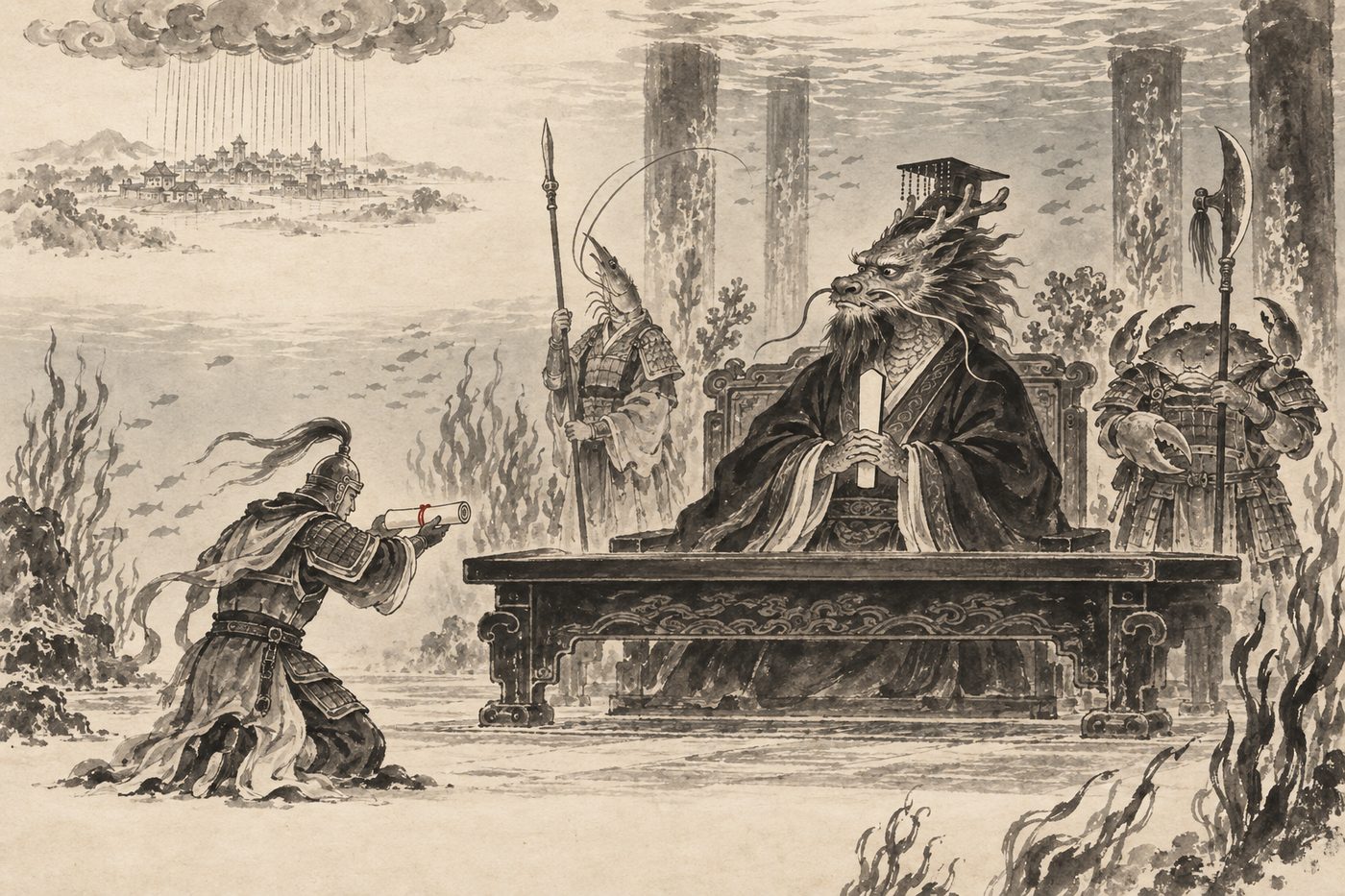
A dragon is an animal. A Dragon King is a civil servant. The distinction matters more than it sounds, and Chinese people make it without thinking: the dragon, lóng, is the great scaled rain-beast of the rivers and clouds, older than writing, and it has its own page here. The Dragon King, lóngwáng, 龙王, is what a dragon becomes when it takes a post. It gets a jurisdiction, which is a body of water; a residence, which is a crystal palace at the bottom of it; a staff, which is shrimp soldiers and crab generals; and a superior, which is the Jade Emperor, who sends it written orders about the weather and has it executed if it gets them wrong. There is one wherever there is water. The four seas have four, brothers named Ao. The Yellow River has one. The Grand Canal has two. Your grandmother's village well had one, and somebody left it an orange.
The father in Ne Zha 2
If you have thought about a Dragon King at all recently, it is because of a cartoon that made more money than any cartoon in history. Ne Zha 2, released in China on the first day of the Year of the Snake in 2025, took, Wikipedia records, some 2.2 billion dollars on a budget of eighty million, and became the highest-grossing animated film ever made and the first to pass two billion. Its most important grown-up, after the boy-god of the title and his friend, is Ao Guang, Dragon King of the East Sea, and the film's engine is his grief: believing his son Ao Bing dead, he leads the Dragon Kings of the Four Seas against Chentang Pass and then, when the boy turns out to be alive inside his friend's body, bargains for a way to give him a body of his own. He is a father before he is a king, which is the film's invention and a good one. The novel that gave the world Nezha, the sixteenth-century Investiture of the Gods, has a different Ao Guang: a petty grandee whose son bullies the wrong child and dies for it, and who goes over everyone's head to Heaven to have the child's parents punished. Our page on Nezha tells that story, and how the 1979 Shanghai cartoon Nezha Conquers the Dragon King fixed the Dragon King as a villain for a generation before the 2019 and 2025 films rehabilitated him. What both versions agree on is the shape of the office. He has a palace under the sea. He has three brothers who come when he calls. And when he is wronged, he does not fight; he files a complaint with Heaven. That is the tell. He is a bureaucrat.
The other Ao Guang most people know is the one Sun Wukong robs. In chapter 3 of Journey to the West the newly immortal Monkey King walks into the East Sea palace, announces himself as a neighbor, and demands a weapon; Ao Guang, who cannot refuse a fellow immortal and cannot fight him, ends up losing the iron pillar that held the sea floor down, which becomes the Monkey King's staff, and then beats his drum and rings his bell to summon his brothers, who arrive within minutes and are talked out of a set of golden armor, a phoenix-feather cap and a pair of cloud-walking shoes. The Wukong page has the heist. What this page wants from the scene is the aftermath: the four Dragon Kings, much put out, draft a memorial. "Your subject Ao Guang, small dragon of the East Sea," it begins, in the exact self-abasing formula a provincial governor would use to the throne, and it asks the Jade Emperor to send troops. He does. The dragons never lift a claw. They have a form for this.
A god in every puddle
Ao Guang is only the most famous of a very large class. The historian Sheng Wenqiang, writing for Sixth Tone in 2024, puts it plainly: "rather than a single deity, he is a legion. Wherever there is water, be it a lake, river, sea, or spring, there resides a Dragon King." Sheng traces how it happened. Han-dynasty farmers were already making clay dragons and praying to them for rain two thousand years ago; when Buddhism arrived it brought the Indian naga-kings, sea-serpent sovereigns with palaces and treasure, and the two ideas merged into a rain god with a court, who displaced the older lord of the Yellow River, Hebo, and by the Tang was receiving sacrifice from the emperor himself. From there the office multiplied downward. The Golden Dragon King, worshipped along the lower Yellow River and the Grand Canal, was in life a Song-dynasty man named Xie Xu, who was said to have turned into a dragon to stop a flood; the Water-Dividing Dragon King was appointed, in effect, in the Ming, when engineers diverted the Wen River to top up the canal and the locals decided that such a piece of plumbing needed a god to run it. "Even wells and mountain springs had their own Dragon King," Sheng writes, small gods with small jurisdictions, responsible for keeping the water sweet. On New Year woodblock prints, burned as offerings and pasted up in boats and over wells, he appears as a crowned official in robes holding a tablet, with the face of a dragon, attended by nature spirits: the picture on this page, more or less, and the picture on ten thousand kitchen walls.
Two pieces of the living language come from this. The first is a proverb every Chinese speaker knows: the flood washed away the Dragon King's own temple, said when people on the same side fail to recognize each other and fight, on the logic that the god of water ought at least to be able to keep his own house dry. The second is the dragon boat race, held each fifth month on rivers that have a Dragon King in them, which began, long before it was attached to a drowned poet, as a rite to the water and its master. You do not race dragon boats on a river with nobody in it.
The four brothers, and their titles
Now the roll-call, because the searchers want it and the sources give it. Here are the four sea kings as the novel names them, the titles the Tang court gave the seas in the year 751, and what each brother hands over to the Monkey King when the drum is beaten:
| Sea | The brother, in Journey to the West | The state title, from the Old Book of Tang | What he gives the Monkey King |
|---|---|---|---|
| East | Ao Guang 敖广, the eldest | King of Broad Virtue | The iron pillar that becomes the staff |
| South | Ao Qin 敖钦 | King of Broad Benefit | A phoenix-feather cap of purple gold |
| West | Ao Run 敖闰 | King of Broad Moistening | A suit of golden chain mail |
| North | Ao Shun 敖顺 | King of Broad Bounty | Cloud-walking shoes of lotus fiber |
The surname Ao is the novel's, and it is a joke of a kind: the character means proud, or to roam at large, which is what a dragon in charge of an ocean does. The titles are not a joke. The Old Book of Tang, in its treatise on rites, records that "in the first month of the tenth year of Tianbao," which is 751, under the emperor Xuanzong, "the four seas were all enfeoffed as kings," and it names the officials the court sent to sacrifice to each: a Companion to the Heir Apparent to the East Sea, King of Broad Virtue; a household clerk to the South Sea, King of Broad Benefit; and so on round the compass. That is to say: the Dragon Kings of the Four Seas hold titles conferred by a real Chinese emperor, in a real edict, in a year we can name, and the state paid for their sacrifices out of the same treasury that paid the army. When Ao Guang bows to the Jade Emperor in the novel he is doing, in fiction, what a Tang official did to the Tang throne on his behalf in fact.
The rain quota, to the drop
The best Dragon King story in Chinese literature is not about the four seas at all but about a minor river, and it is the clearest account anyone has written of what the job actually involves. It is chapter 10 of Journey to the West, and the novel tells it, characteristically, as a story about gambling.
The Dragon King of the Jing River, a tributary that runs into the Wei near Chang'an, hears that a fortune-teller in the capital, Yuan Shoucheng, has been telling fishermen exactly where to cast their nets, and, offended on behalf of his fish, goes to town disguised as a scholar to ruin him. He asks the man to predict the weather. Yuan does, to the minute and the inch: tomorrow, clouds at the hour of the dragon, thunder at the hour of the snake, rain at the hour of the horse, stopping at the hour of the sheep, "three feet, three inches and forty-eight drops in all." The Dragon King laughs, wagers fifty ounces of silver, and goes home, because he is the Governor of the Eight Rivers and the God of Rain and nobody knows tomorrow's rain but him. Then a messenger in gold arrives from Heaven with a decree. "By decree, the Governor of the Eight Rivers is to drive the thunder and lightning forth: tomorrow let rain fall as a blessing, to relieve all the city of Chang'an." The times and the quantities on the decree, the novel says, matched the fortune-teller's "to the hair."
Consider the theology of that for a moment. Rain is not the dragon's to give. It is ordered from above, in writing, with a schedule and a volume, and delivered by a dragon who is, for these purposes, a water utility. Then the dragon does what utilities do. His adviser, a shad, suggests that if he simply runs a little late and a little short the fortune-teller will be wrong and the bet won, so the next day "he waited until the hour of the snake to spread the clouds, thundered at the hour of the horse, let the rain fall at the hour of the sheep and stopped it at the hour of the monkey, and gave only three feet and forty drops. He had shifted the schedule by one hour and shaved off three inches and eight drops." Three inches and eight drops. The novelist counts them. Then the dragon goes to town to gloat, smashes the fortune-teller's shop, and the fortune-teller, unbothered, tells him: "I know you. You are no scholar; you are the Dragon King of the Jing River. You disobeyed the Jade Emperor's decree, changed the hour and cut the count, and broke the law of Heaven. On the Dragon-Chopping Terrace I fear you will not escape the blade."
He does not. He begs the Tang emperor Taizong for help, in a dream; Taizong promises to keep the executioner, his own minister Wei Zheng, busy at chess all the next afternoon; and Wei Zheng, dozing at the board, beheads the dragon in his sleep, and the head drops out of the sky into the streets of the capital. The dragon's ghost then sues Taizong in the underworld for breaking his word, which is how the emperor comes to visit King Yama's courts in the next chapter. The whole second act of the novel, the mission to fetch scriptures, is set in motion by a rain official who fudged his figures by three inches. There is a Dragon-Chopping Terrace, 剐龙台, in Heaven for exactly this. The office has a scaffold.
Five dragon kings, by color
"Who are the five great Dragon Kings?" people ask, having met four. The five are a different set, and they come not from a novel but from a decree. Ma Duanlin's Wenxian tongkao, the great encyclopedia of institutions completed in the early fourteenth century, records under the reign of the Song emperor Huizong, in 1110, that "in the eighth month a decree made all five dragon gods of the realm kings": the Green Dragon became King of Broad Benevolence, the Red Dragon King of Excellent Moisture, the Yellow Dragon King of Trusted Response, the White Dragon King of Righteous Relief, and the Black Dragon King of Numinous Moisture. Green, red, yellow, white, black: the five colors of the five elements and the five directions, with the yellow dragon at the center where the emperor sits. Every one of the titles has water in it. These were rain gods, enfeoffed by a painter-emperor who was fond of that sort of thing, and the Five Dragon Halls that the History of Song lists among the places the court sent officials to pray in drought are their temples. Four sea kings for the edges of the world, five dragon kings for the colors of it: two systems, both official, and the folk religion kept both without seeing any contradiction, because a village that needs rain does not audit its gods.
Where the word came from
"But surely," you may say, "the Chinese had dragons before they had Buddhism?" They did, and that is the Beard-shaped correction this page has to make. The creature is native and ancient; the king is an import. The word lóngwáng, dragon king, enters Chinese in the Buddhist sutras, as the translation of the Sanskrit nāgarāja, the serpent-kings of Indian myth who live in jeweled palaces under the water and guard treasure and bring rain. Kumārajīva's translation of the Lotus Sutra, made in 406 and the version every Chinese Buddhist has read since, opens with a roll-call of the Buddha's audience, and among the gods and demons sit "eight dragon kings: the dragon king Nanda, the dragon king Upananda, the dragon king Sāgara," and five more, "each with some hundreds of thousands of followers." Sāgara means Ocean. Anavatapta is the lake at the top of the world from which, in Buddhist geography, the great rivers flow. These are the first dragon kings in Chinese, and they are Indian, with palaces and retinues and a place in the hierarchy under the Buddha. The Chinese rain dragon, which had been worshipped with clay images and never had a palace, moved into the naga's house and kept the furniture. Which came first in the Chinese mind, the native beast's promotion or the foreign king's naturalization, is argued by scholars and cannot be settled from the texts; what is certain is that by the Tang, when the state started enfeoffing seas, the two had become one god.
The dragon king's daughter herding the rain
One more story, because it shows the office from underneath, and because it is the most beautiful thing ever written about the job. In the late eighth century Li Chaowei wrote a tale called Liu Yi, about a failed examination candidate riding home past the Jing River who meets a young woman herding sheep by the road, weeping. She is, she tells him, the youngest daughter of the Dragon King of Lake Dongting, married off to the second son of the Jing River dragon, mistreated by him and his parents, and exiled to this roadside. She asks Liu Yi to carry a letter home to her father, which he does, and the story ends as such stories do. But the detail that stays is the sheep. Liu Yi, puzzled, asks her what a goddess wants with a flock. "Surely gods do not slaughter?" And she says: "They are not sheep. They are rain-workers." What are rain-workers? "Thunder and lightning, and that sort of thing." The Dragon King's daughter, in her exile, has been put to minding the weather like a shepherdess, and the thunderclouds graze beside the road looking like sheep to anyone who does not know.
Her uncle, the Dragon King of the Qiantang River, is the other kind of dragon official: the one with a temper. Her father keeps the news of her mistreatment from him because, he tells Liu Yi, the nine-year flood in the reign of the sage-king Yao "was this boy in one of his rages," and he has been kept chained for it ever since. When he finds out anyway, he breaks his chain, flies to the Jing River, eats the husband, and is back before dinner, having killed, he reports, six hundred thousand people and ruined eight hundred li of crops on the way. Then he apologizes for the fuss. That is the range of the office, from a girl minding thunderclouds to an uncle who drowns a province, and both of them answer to the same Heaven, and both of them, the tale is careful to say, have their rank and their post.
So: not a monster, and not quite a god. A dragon with a job. Next time it rains on schedule, somebody under the water has read his decree.
In the classics
The passages behind the story, in the standard published translations. Open any one for the original text.
“Ao Guang, Dragon King of the East Sea, rose at once and came out of the palace to meet him with his dragon sons and dragon grandsons, his shrimp soldiers and crab generals. ... The Dragon King said: "My younger brothers are Ao Qin, Dragon King of the South Sea, Ao Shun, Dragon King of the North Sea, and Ao Run, Dragon King of the West Sea." ”
Original text
東海龍王敖廣即忙起身,與龍子、龍孫、蝦兵、蟹將出宮迎道……龍王道:「舍弟乃南海龍王敖欽、北海龍王敖順、西海龍王敖閏是也。」
“Your subject Ao Guang, small dragon of the East Sea in the Eastern Continent of the lower world of water, reports to the Great Heavenly Sage, the High Supreme Lord of the Dark Vault: recently a demon immortal named Sun Wukong, born on the Mountain of Flowers and Fruit and living in the Water Curtain Cave, has bullied this small dragon, forced his way into my water palace, demanded weapons, and thrown his spells and his weight about. ”
Original text
水元下界東勝神洲東海小龍臣敖廣啟奏大天聖主玄穹高上帝君:近因花果山生、水簾洞住妖仙孫悟空者,欺虐小龍,強坐水宅,索兵器,施法施威。
“By decree, the Governor of the Eight Rivers is to drive the thunder and lightning forth: tomorrow let rain fall as a blessing, to relieve all the city of Chang'an. ... He waited until the hour of the snake to spread the clouds, thundered at the hour of the horse, let the rain fall at the hour of the sheep and stopped it at the hour of the monkey, and gave only three feet and forty drops. He had shifted the schedule by one hour and shaved off three inches and eight drops. ”
Original text
敕命八河總,驅雷掣電行:明朝施雨澤,普濟長安城。……他挨到那巳時方布雲,午時發雷,未時落雨,申時雨止,卻只得三尺零四十點。改了他一個時辰,剋了他三寸八點。
“I know you. You are no scholar; you are the Dragon King of the Jing River. You disobeyed the Jade Emperor's decree, changed the hour and cut the count, and broke the law of Heaven. On the Dragon-Chopping Terrace I fear you will not escape the blade, and you stand here cursing me? ”
Original text
我認得你,你不是秀士,乃是涇河龍王。你違了玉帝敕旨,改了時辰,剋了點數,犯了天條。你在那剮龍臺上,恐難免一刀,你還在此罵我?
“The Dragon King said: "Your Majesty is a true dragon; I am a dragon of sin. Because I broke the law of Heaven I am to be beheaded by Your Majesty's worthy minister Wei Zheng, the officer of the human court, so I have come to beg you to save me." ”
Original text
龍王云:「陛下是真龍,臣是業龍。臣因犯了天條,該陛下賢臣人曹官魏徵處斬,故來拜求,望陛下救我一救。」
“In the first month of the tenth year of Tianbao, the four seas were all enfeoffed as kings. ... Li Sui, Companion to the Heir Apparent, sacrificed to the East Sea, King of Broad Virtue; Zhang Jiuzhang, Chief Clerk of the Prince of Yi's household, to the South Sea, King of Broad Benefit; Liu Yi, Companion to the Heir Apparent, to the West Sea, King of Broad Moistening; and Li Qirong, Groom to the Heir Apparent, to the North Sea, King of Broad Bounty. ”
Original text
十載正月,四海並封為王。……太子中允李隨祭東海廣德王,義王府長史張九章祭南海廣利王,太子中允柳奕祭西海廣潤王,太子洗馬李齊榮祭北海廣澤王。
“In the eighth month a decree made all five dragon gods of the realm kings: the Green Dragon God was made King of Broad Benevolence, the Red Dragon God King of Excellent Moisture, the Yellow Dragon God King of Trusted Response, the White Dragon God King of Righteous Relief, and the Black Dragon God King of Numinous Moisture. ”
Original text
八月,詔天下五龍神皆封王爵:青龍神封廣仁王,赤龍神封嘉澤王,黃龍神封孚應王,白龍神封義濟王,黑龍神封靈澤王。
“There were eight dragon kings: the dragon king Nanda, the dragon king Upananda, the dragon king Sāgara, the dragon king Vāsuki, the dragon king Takṣaka, the dragon king Anavatapta, the dragon king Manasvin and the dragon king Utpalaka, each with some hundreds of thousands of followers. ”
Original text
有八龍王:難陀龍王、跋難陀龍王、娑伽羅龍王、和修吉龍王、德叉迦龍王、阿那婆達多龍王、摩那斯龍王、優缽羅龍王等,各與若干百千眷屬俱。
“Liu Yi asked again: "I do not understand your herding sheep. What are they for? Surely gods do not slaughter?" The girl said: "They are not sheep. They are rain-workers." "What are rain-workers?" "Thunder and lightning, and that sort of thing." ”
Original text
毅又曰:「吾不知子之牧羊,何所用哉?神祇豈宰殺乎?」女曰:「非羊也,雨工也。」「何為雨工?」曰:「雷霆之類也。」
“The king asked: "How many did you kill?" "Six hundred thousand." "Did you damage the crops?" "Eight hundred li." "And where is the heartless husband?" "I ate him." ”
Original text
君曰:「所殺幾何?」曰:「六十萬。」「傷稼乎?」曰:「八百里。」「無情郎安在?」曰:「食之矣。」
As seen in
Ne Zha 2
film · 2025Ao Guang, Dragon King of the East Sea, who believes his son Ao Bing dead and leads the Dragon Kings of the Four Seas against Chentang Pass; the film's grief-stricken father rather than the novel's petty official, as Ao Guang.
The highest-grossing animated film ever made, at about US$2.2 billion, and the reason a generation now searches for the Dragon King by his given name.
Ne Zha
film · 2019Ao Guang keeps his dragon clan imprisoned under the sea as jailers of the demons and pins his hopes of a pardon on his son, as Ao Guang.
Nezha Conquers the Dragon King (哪吒闹海)
film · 1979The Shanghai Animation Film Studio's Dragon King of the East Sea, the villain whose son the boy-god kills and whose flood the boy-god's suicide averts, as Dragon King of the East Sea.
Questions people ask
Who are the four Dragon Kings in Chinese mythology?
The Dragon Kings of the Four Seas, four brothers who each rule one of the seas around the world, as Journey to the West names them in chapter 3: Ao Guang of the East Sea, the eldest and the one with the crystal palace the Monkey King robs; Ao Qin of the South Sea; Ao Run of the West Sea; and Ao Shun of the North Sea. The surname Ao is the novel's; the offices are older. In 751 the Tang court enfeoffed the four seas as kings with the titles Broad Virtue, Broad Benefit, Broad Moistening and Broad Bounty, and the state sacrificed to them.
Who are the five great Dragon Kings?
A different set from the four seas: five dragon gods sorted by color. In 1110, Ma Duanlin's Wenxian tongkao records, a Song decree made all five kings: the Green Dragon became King of Broad Benevolence, the Red Dragon King of Excellent Moisture, the Yellow Dragon King of Trusted Response, the White Dragon King of Righteous Relief, and the Black Dragon King of Numinous Moisture. The five colors are the five directions and five elements of Chinese cosmology, with the yellow dragon at the center. They were worshipped for rain, which every one of those titles is about.
Who is the Chinese god of dragons?
There is no single god of dragons. Dragons in Chinese belief are officials, not subjects: each Dragon King governs a body of water and answers to the Jade Emperor, the sovereign of Heaven, who issues them their rain orders and punishes them for breaking them. If you want the being that the dragons themselves obey, it is the Jade Emperor. If you want the chief of the dragons, it is Ao Guang of the East Sea, the eldest of the four sea brothers, to whom the other three come when he beats the drum.
What does the Dragon King do?
He makes rain, and he does it on orders. In chapter 10 of Journey to the West a dragon king receives a written decree from the Jade Emperor specifying the hour to raise clouds, the hour to thunder, the hour to rain and the hour to stop, and the total to the drop: three feet, three inches and forty-eight drops. When he shifts the schedule by an hour and delivers three inches and eight drops short, he is beheaded. Beyond rain, a Dragon King rules everything in his water, holds court in a palace under it, and receives offerings from fishermen and farmers at his temples.
Is the Dragon King the same as the Chinese dragon?
No. The dragon, long, is a creature, the rain-bringing chief of scaled things that was around long before Buddhism. The Dragon King, longwang, is an office that creature can hold, and the word came into Chinese with the Buddhist sutras, which list the naga-kings of India, the eight dragon kings of the Lotus Sutra, among the Buddha's audience. Chinese religion merged the Buddhist office with its own rain dragon and gave the result a palace, a court, a surname and a temple in every village. Our page on the dragon covers the creature; this one covers the job.
Who is the dragon emperor of China?
Nobody, in the mythology: dragons are kings, and the emperor they serve is the Jade Emperor, who is not a dragon. The phrase usually refers to the human emperor, who was called the true dragon and wore dragons on his robe. Journey to the West plays on exactly this when the condemned Dragon King of the Jing River goes to the Tang emperor Taizong for help and says: "Your Majesty is a true dragon; I am a dragon of sin."
Sources & further reading
- Journey to the West (西遊記), Chapter 3, the four sea kings (Chinese Wikisource)
- Journey to the West (西遊記), Chapter 10, the Dragon King of the Jing River and the rain edict (Chinese Wikisource)
- Old Book of Tang (舊唐書), juan 24, the enfeoffment of the four seas in 751 (Chinese Wikisource)
- Ma Duanlin, Wenxian tongkao (文獻通考), juan 90, the five dragon kings of 1110 (Chinese Wikisource, Siku edition)
- Lotus Sutra (妙法蓮華經), Chapter 1, Kumārajīva's translation, the eight dragon kings (Chinese Wikisource)
- Li Chaowei, The Tale of Liu Yi (柳毅傳), full text (Chinese Wikisource)
- Anthony C. Yu, 'The Journey to the West', Revised Edition (University of Chicago Press), the standard English translation
- Sheng Wenqiang, 'How the Dragon King Emerged From the Waves' (Sixth Tone, 2024)
- Ne Zha 2 (2025), plot and box office (Wikipedia)
- Dragon King (Wikipedia)
By Julian 祝君瑜, retold from the classics, with the original passages cited, updated 2026-09-17