Chinese Mythology
Zhu Bajie (猪八戒): The Pig of Journey to the West
Zhu Bajie, 猪八戒 (Zhū Bājiè), known in English as Pigsy, is the pig-headed second disciple of the sixteenth-century novel Journey to the West. Once Marshal Tianpeng, a commander in Heaven, he was flogged and banished for drunkenly harassing the moon goddess Chang'e, took a wrong turn on his way to rebirth, and came out of a sow. Armed with a nine-toothed rake, he carries the pilgrims' luggage to India, and at the end is rewarded not with Buddhahood but with a job eating the leftovers at every altar.
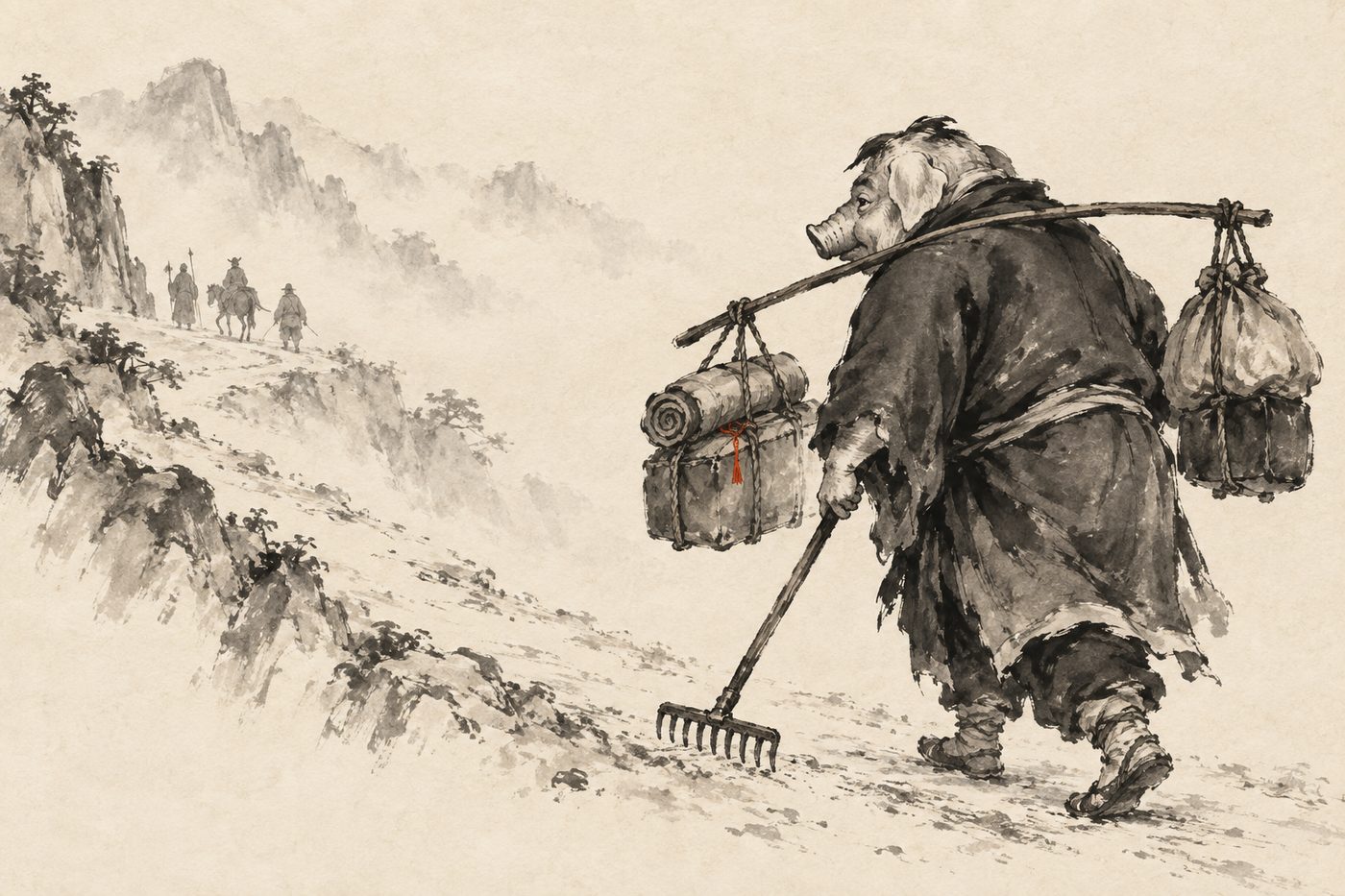
Every great quest needs one member of the party who would rather be at home eating, and Chinese literature's is a pig. Zhu Bajie, Pigsy to generations of English readers, is the second disciple of Journey to the West, the sixteenth-century novel about a monk walking to India for scriptures with a monkey, a pig, a sand-demon and a horse who used to be a dragon. The monkey is the hero. The pig is the one you recognize. He is greedy, lazy, lecherous, cowardly, sly, and enormously likable, and the novel knows it: when the rewards are handed out on the last page, the Buddha looks at him and gives him, in effect, the catering contract. He was a marshal of Heaven once. He has been the most human character in Chinese fiction ever since.
The pig who walks beside you
If you met him recently, it was probably in Black Myth: Wukong, the 2024 blockbuster that took the Monkey King to twenty million players in a month. There, the pig turns up in Chapter 3, imprisoned inside a pair of golden cymbals by the false Maitreya called Yellowbrow. A star general crashes into the cymbals, out rolls Zhu Bajie, "an old friend of Sun Wukong," as the game's plot summary has it, and he walks beside the player for the rest of the story. He is the only companion who does. He grumbles, he cheats, he turns into a giant boar when it matters, and in Chapter 4 the game gives him what the novel never quite does, a love story: an animated interlude in which a young marshal of Heaven, still human-faced, spares a spider-woman, and the Violet Spider of the present day turns out to have been waiting for him. The ending keeps faith with the book, as the games press noticed: of all the companions, Bajie is the only one who finishes without any kind of enlightenment. That is not the game being unkind. That is the novel.
Everyone's second brother
Chinese viewers did not need a game to know him. The 1986 CCTV Journey to the West, which has been rerun for four decades, fixed his face for good: the actor Ma Dehua's round, rubbery, wheedling pig, ears flapping, is what a whole country pictures when it hears the name. The World of Chinese has traced what happened when a 2010 remake tried a more realistic pig. Audiences rejected it, not because it was worse but because it was not him. He has since been cast as a romantic lead more than once, which tells you something: the 1999 series Sunny Piggy had Xu Zheng play him as a chubby hero who falls for the Dragon King's daughter, and later versions were praised as the funniest pig and the handsomest pig in turn. Nobody makes a series in which Sha Wujing, the sand-demon, gets the girl.
He is a household adjective, too. A lazy colleague is a Bajie. A man who eats too much is Bajie at the banquet. He is the Second Brother, Èr Shīxiōng, to the Monkey King's Elder Brother, and the affection in the title is real: he is the pilgrim who wants what we want, dinner and a nap and to go home, and keeps walking anyway.
The only pilgrim with a temple, and a strange congregation
Ten kilometers northeast of Baoshan, in Yunnan, there is a village called Xizhuang that claims to be Gao Village, where the pig married, and it has the only temple to him in China. The travel writer David Leffman, who went, describes two shambolic courtyards, a life-sized painted statue of the pig with his nine-toothed rake in an open gallery, a shrine to his wife Cuilan next door as a patroness of childbirth, three ancient banyan trees the locals say he planted for her when he left, and a temple fair on the twenty-third day of the lunar new year. Whether it goes back to the Song dynasty, as is likely, or to the Tang, as the village prefers, is not settled, and probably never will be.
He has one other congregation, and it is not the one you would guess. In Taiwan he is a patron deity of sex workers, hostesses and masseuses, the scholarly blog Journey to the West Research reports, on the reasonable ground that a god of appetite who never met a woman he did not proposition is at least honest about the trade. The Buddha, who called him lustful to his face in the last chapter, would probably not object.
A marshal, a drink, and a wrong turn into a sow
Now the story the temple and the game are built on. In chapter 8 the bodhisattva Guanyin, scouting the road to China for a monk worth sending west, is stopped on a mountain by a pig-faced monster, and asks him, roughly, what kind of hog he is. His answer is the whole biography in five sentences, and it is worth having in his own words. "I am no wild boar and no old hog," he says. "I was Marshal Tianpeng of the River of Heaven. Because I got drunk and made free with Chang'e, the Jade Emperor had me beaten two thousand strokes with the mallet and banished me to the dust below. My spirit went straight to find a womb to be reborn in, but I took the wrong road and landed in a sow, and came out looking like this."
Consider the shape of that. A commander of Heaven's forces on the celestial river gets drunk at the Queen Mother's peach banquet and makes a pass at Chang'e, the goddess of the moon. The Jade Emperor, who runs Heaven like a civil service, does not execute him. He has him flogged and demoted to earth, standard punishment for a disgraced official, and the fallen marshal, hurrying to be reborn as a man, takes the wrong door. He is not cursed into a pig. He is a bureaucratic accident. He then, as he tells Guanyin without visible remorse, bit his mother to death, killed the rest of the litter, took over the mountain and ate people. Guanyin, who has heard worse, offers him a deal: walk to India as the monk's disciple and the sentence is commuted. "Willingly," he says. "Willingly."
Two names, and why the second one stuck
Guanyin gives him a surname on the spot, and it is a joke: she "took his body for his surname, and so he was surnamed Zhu," which is to say Pig. Then she gives him a religious name, Wuneng, Awakened to Ability, in the same generation as Wukong, Awakened to Emptiness, and tells him to keep a vegetarian fast until the monk comes by.
The name everyone actually uses comes eleven chapters later, and it is a diet. When the monk Tang Sanzang finally meets him, the pig announces that since he has been keeping his fast at his father-in-law's house, and has now found his master, he would like to break it. The monk says no, and adds: "Since you already abstain from the five pungent vegetables and the three forbidden meats, I will give you another name: Bajie." Bājiè means Eight Precepts, the eight rules a Buddhist layman keeps on fast days, no killing, no stealing, no sex, no lying, no drink, no perfume, no soft bed, no eating after noon. The pig is delighted. He then spends ninety chapters breaking at least five of them. The whole character is in the name: a promise of restraint pinned to a creature built entirely of appetite.
Gao Village: the son-in-law who could work
Before the monk, there was a marriage. The pig had made his way to Gao Village and presented himself to a farmer called Squire Gao as a son-in-law. He was, by the squire's own account in chapter 18, a good one: he plowed and harrowed without an ox and brought in the harvest without a blade, and the farm had never done better. The trouble was that his face had turned from a black, stout fellow's into a long-snouted, big-eared pig's, that he ate three to five pecks of rice at a sitting and a hundred buns for breakfast, and that he had locked the youngest daughter, Cuilan, in the back of the house for half a year. Sun Wukong, passing through with the monk, takes the daughter's place in bed, lets the pig get into it, and chases him to his cave, where the monster, cornered, mentions that he is actually waiting for a scripture pilgrim. The fight stops. The three go back for dinner. The novel, which is very good on this, has the pig make his farewells to the whole family by proxy, then ask the squire to look after his wife, because if the scripture business falls through he intends to come back, leave the priesthood, and be a son-in-law again. Wukong tells him to shut up. He means it anyway.
This is also where the rake is introduced properly, and it introduces itself. Weapons in this novel have résumés, and the pig's is a poem: forged from divine ice-iron, hammered by Laozi himself, nine jade teeth and golden rings, "the Supreme Treasure Gold-Steeped Rake, presented to the Jade Emperor to guard his cinnabar palace," and granted to Marshal Tianpeng "as my badge of office." A scholar who has looked hard at the object, on the Journey to the West Research site, points out that it resembles no military weapon of the period so much as the iron hand harrows Yuan-dynasty farmers used to weed rice, illustrated in Wang Zhen's Book of Agriculture of 1313. A heavenly marshal armed with a garden tool, who is happiest plowing a field. The novel may not have intended the joke, but it made it.
Leftovers, not enlightenment
Fourteen years and eighty-one trials later, the pilgrims reach the Buddha, and each is told what he was, what he did, and what he gets. The list is a small masterpiece of comic bookkeeping, and for once a table is the right way to read it:
| What he was | What he did wrong | What he did right | What he gets | |
|---|---|---|---|---|
| Sun Wukong | A stone monkey, Great Sage Equal to Heaven | Wrecked Heaven | Subdued demons the whole way | Buddha Victorious in Strife |
| Zhu Bajie | Marshal Tianpeng | Got drunk at the peach banquet and harassed a goddess; "lustful, and still is" | Carried the luggage | Cleanser of the Altar |
| Sha Wujing | The Curtain-Lifting General | Broke a crystal cup at the peach banquet | Climbed the mountains and led the horse | Golden-Bodied Arhat |
The pig, hearing the others made Buddhas, protests out loud, in front of the entire assembly of the Western Paradise: "They all get to be Buddhas. Why am I a Cleanser of the Altar?" The Buddha's reply is the most quoted line about him, and deserves quoting exactly: "You have a big mouth, a lazy body, and a capacious gut. Across the four continents there are many who revere my teaching, and at every Buddhist service you will clean the altar. It is a rank with perks. What is wrong with it?" The altar is cleansed by eating what is on it. He is being given the leftovers of every temple on earth, forever, and told it is a promotion. And notice what the Buddha credits him with. Not a single fight. "Because you did good service carrying the luggage." The bags. The one job on the road he never tried to get out of.
He was not always the Marshal of Heaven
Here is the part no one tells you. The disgraced naval commander is the newest layer of the pig, not the oldest. Before the novel there were plays, and in the Yuan-dynasty stage version of the story the pig introduces himself not as a marshal of the River of Heaven but as the chariot general of Marici, a fierce boar-riding goddess of light borrowed from Indian Buddhism and known in Daoism as the Mother of the Dipper. The historian of Chinese religion Benjamin Brose, cited by the Journey to the West Research site, notes that this stage pig is essentially the goddess's mount come down to earth, which is a much better reason for a heavenly being to be a pig than a wrong turn on the way to a womb.
Marshal Tianpeng himself was real, in the sense that gods are: a Daoist exorcist under the Northern Emperor, the Hades of Daoism, named in a sixth-century rite called the Northern Emperor's Method of Killing Demons, and by the Song dynasty head of the thirty-six generals of the Department of Exorcism, a multi-armed figure in black robes and a dark cap, according to the scholar Edward Davis, holding halberds, mirrors and bells. Nothing about him was a pig. The novelist took a terrifying demon-slayer, gave him a drinking problem and a sow, and made the funniest character in the book out of the leftovers. The Buddha would have approved of the method. And the name itself is older than the novel too: the scholar Glen Dudbridge traced a pig in a fourteenth-century Korean textbook of colloquial Chinese, quoting an earlier version of the story, whose surname is written not with the character for pig but with a homophone. He was already Bajie before anyone wrote down why.
He and the Monkey King
Ask what Bajie is to Wukong and the novel answers with an image it repeats: the monkey is the mind, the pig is the body. The Monkey King is called the mind-monkey, restless, brilliant, leaping; the pig is the appetite that has to be dragged along behind it. They fight together well, the rake behind the staff, and in the great brawl against the Bull Demon King in chapter 61 it is Bajie's rake, flailing in a rage, that finally breaks the demon's guard. Off the battlefield he is Wukong's tormentor in the small ways: he calls him Elder Brother and gets called Idiot, he tattles to the monk, and he has a reliable talent for suggesting that the master recite the spell that tightens the golden headband around the monkey's skull. The novel treats them as two halves of one restless self, and it is not shy about which half it thinks most of us live in.
So when the pig next turns up, freed from a pair of cymbals in a video game or flapping his ears on a rerun, you are looking at a very old joke with a very old point. A commander of Heaven, an exorcist's terrible general, was let fall into a sow because of one bad night, walked to India complaining the whole way, carried everybody's bags, and was given, by the Buddha, in front of the saints, the leftovers. He took the job. If you were born in a Year of the Pig, the tradition says you are generous, honest and fond of your comforts, and it is worth knowing that the most famous pig in the language was all three. He never became a Buddha. He never had to.
In the classics
The passages behind the story, in the standard published translations. Open any one for the original text.
“I am no wild boar and no old hog. I was Marshal Tianpeng of the River of Heaven. Because I got drunk and made free with Chang'e, the Jade Emperor had me beaten two thousand strokes with the mallet and banished me to the dust below. My spirit went straight to find a womb to be reborn in, but I took the wrong road and landed in a sow, and came out looking like this. ”
Original text
我不是野豕,亦不是老彘,我本是天河裡天蓬元帥。只因帶酒戲弄嫦娥,玉帝把我打了二千鎚,貶下塵凡。一靈真性,徑來奪舍投胎,不期錯了道路,投在個母豬胎裡,變得這般模樣。
“Since you already abstain from the five pungent vegetables and the three forbidden meats, I will give you another name: Bajie, Eight Precepts. ”
Original text
你既是不吃五葷三厭,我再與你起個別名,喚為八戒。
“Its name is the Supreme Treasure Gold-Steeped Rake, presented to the Jade Emperor to guard his cinnabar palace. ... When I was made a marshal with the title Tianpeng, the rake was granted to me as my badge of office. ”
Original text
名為上寶沁金鈀,進與玉皇鎮丹闕。……敕封元帥號天蓬,欽賜釘鈀為御節。
“Because you did good service carrying the luggage, I raise you to the rank of Cleanser of the Altar. ... You have a big mouth, a lazy body, and a capacious gut. Across the four continents there are many who revere my teaching, and at every Buddhist service you will clean the altar. It is a rank with perks. What is wrong with it? ”
Original text
因汝挑擔有功,加陞汝職正果,做淨壇使者。……因汝口壯身慵,食腸寬大。蓋天下四大部洲,瞻仰吾教者甚多,凡諸佛事,教汝淨壇,乃是個有受用的品級,如何不好?
As seen in
Black Myth: Wukong
game · 2024Freed from Yellowbrow's golden cymbals in Chapter 3 and the player's companion for the rest of the game; his own past with the Violet Spider is the heart of Chapter 4, as Zhu Bajie.
The one companion who ends the game without any enlightenment, which is exactly how the novel ends him.
Journey to the West (CCTV series)
drama · 1986Ma Dehua's Zhu Bajie is the face most Chinese viewers still picture; a 2010 remake with a more realistic pig was rejected by audiences for not looking like him, as Zhu Bajie.
Sunny Piggy (春光灿烂猪八戒)
drama · 1999Xu Zheng played him as a chubby romantic lead who falls for the Dragon King's daughter, the first of several series to make the pig the hero, as Zhu Bajie.
Questions people ask
What is the story of Zhu Bajie?
Zhu Bajie was Marshal Tianpeng, a commander in the Jade Emperor's Heaven. In chapter 8 of Journey to the West he tells Guanyin that he got drunk, made a pass at the moon goddess Chang'e, was beaten two thousand strokes and banished, and on his way to be reborn took a wrong turn into a sow's womb. He lived as a man-eating pig monster until Guanyin recruited him for the pilgrimage to India. He married into a farming family at Gao Village, was captured by Sun Wukong, joined the monk Tang Sanzang as his second disciple, carried the luggage for fourteen years of the journey, and at the end was made Cleanser of the Altar, with the leftovers of every Buddhist service as his reward.
Did Zhu Bajie become a Buddha?
No. In the final chapter the Buddha makes Tang Sanzang and Sun Wukong Buddhas, but raises Bajie only to Cleanser of the Altar, and tells him why in so many words: a big mouth, a lazy body, and a capacious gut. When the pig protests that everyone else got to be a Buddha, the Buddha points out that the post comes with the leftovers of every altar across the four continents, and asks what is wrong with that. It is the novel's last joke and its most honest verdict.
Was Zhu Bajie a human?
Never, in the novel's telling. He begins as a god, Marshal Tianpeng of the River of Heaven, and is reborn with a pig's head and a man's body because his spirit entered a sow by mistake. He walks upright, talks, marries, and drinks like a man, but he is a heavenly official in a pig's body, not a man who turned into a pig. Guanyin gives him the surname Zhu, which simply means pig.
What is Zhu Bajie's relationship with Sun Wukong?
Junior colleague and permanent sparring partner. Wukong is the monk's first disciple and Bajie the second, so Bajie calls him Elder Brother and Wukong calls him Idiot, and they spend the journey bickering, with Bajie encouraging the monk to recite the spell that tightens Wukong's headband whenever he can. In a fight they are a team: Bajie's rake backs Wukong's staff against the Bull Demon King in chapter 61. The novel treats them as two halves of one restless mind, the monkey of the heart and the pig of the belly.
What does the name Zhu Bajie mean?
Zhu is the ordinary word for pig, given as a surname by the bodhisattva Guanyin. Bajie means Eight Precepts, the eight Buddhist rules a lay follower keeps on fast days, and it is his second religious name: Guanyin first called him Wuneng, Awakened to Ability, and the monk Tang Sanzang added Bajie in chapter 19 because the pig already abstained from the five pungent vegetables and the three forbidden meats. The joke is that the name is a diet, and he breaks it for the rest of the book.
What is Zhu Bajie's weapon?
A nine-toothed rake, which the novel names the Supreme Treasure Gold-Steeped Rake. In chapter 19 the rake gets a poem of its own: forged from divine ice-iron, hammered by Laozi, presented to the Jade Emperor, and granted to Marshal Tianpeng as his badge of office. Scholars have pointed out that it looks less like a weapon than like the iron hand harrows farmers used to weed rice paddies, which suits a god who spends the book wanting to go home and farm.
Sources & further reading
- Journey to the West (西遊記), Chapter 8, full text (Chinese Wikisource)
- Journey to the West (西遊記), Chapter 19, full text (Chinese Wikisource)
- Journey to the West (西遊記), Chapter 100, full text (Chinese Wikisource)
- Anthony C. Yu, 'The Journey to the West', Revised Edition (University of Chicago Press), the standard English translation
- 'The Historical Origins of Zhu Bajie's Previous Incarnation and his Battle Rake' (Journey to the West Research)
- 'Zhu Bajie: Patron Deity of Sex Workers' (Journey to the West Research)
- 'The Many Faces of Zhu Bajie' (The World of Chinese, 2024)
- David Leffman, 'Zhu Bajie's Temple at Xizhuang', the pig's only temple, near Baoshan, Yunnan
- 'Who Is Zhu Bajie In Black Myth: Wukong?' (TheGamer)
- Black Myth: Wukong, plot and sales (Wikipedia)
- Zhu Bajie (Wikipedia)
By Julian 祝君瑜, retold from the classics, with the original passages cited, updated 2026-09-16