Chinese Mythology
Nüwa: The Goddess Who Mended the Sky, and the Myth Stitched On Later
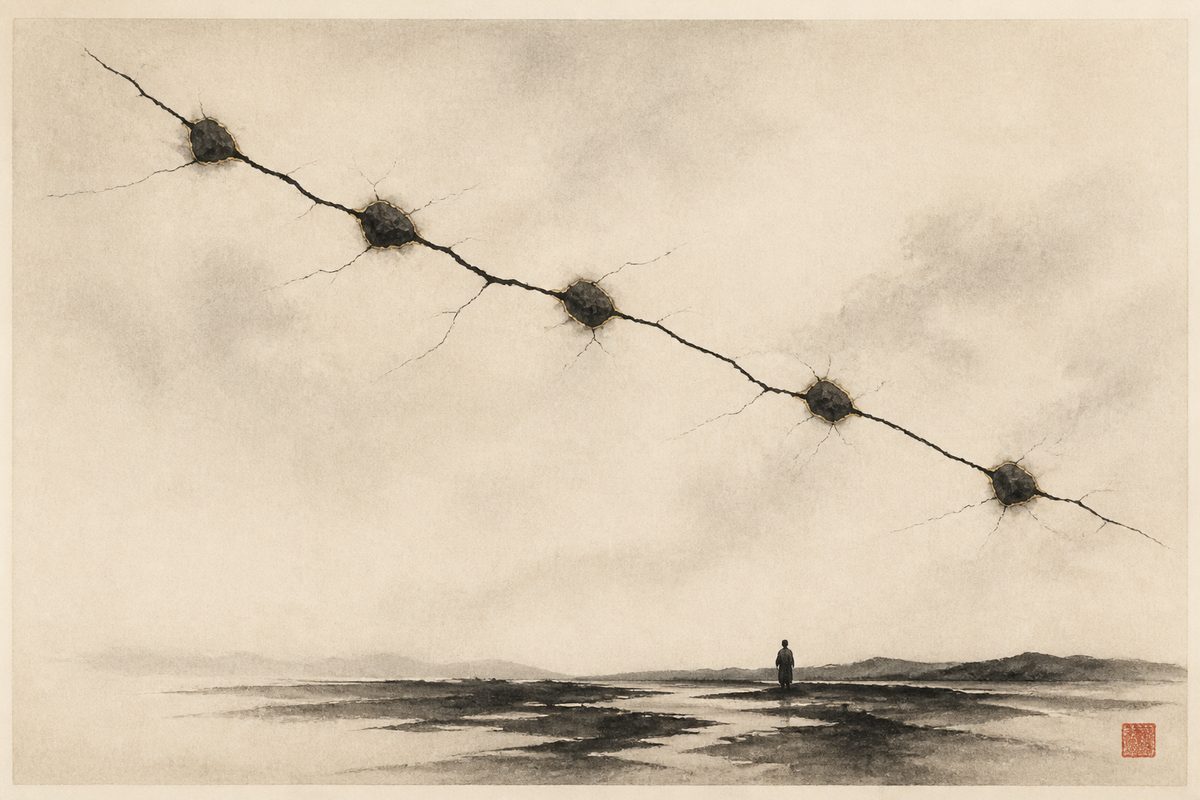
Nüwa is the goddess who repaired the sky. When the four pillars holding up heaven collapsed and fire and flood broke loose, she smelted five colored stones into a patch, cut the legs off a giant sea turtle to prop the corners back up, and banked reed ash against the water. She is also credited with making the first people out of yellow clay. Those are two separate myths, from two books written about three centuries apart.
The sky breaks, and somebody has to fix it
Begin with the emergency, because that is where the oldest surviving account of Nüwa begins, and it is a genuinely alarming piece of writing.
The four pillars that hold up the sky give way. The nine provinces of the world split apart. Heaven stops covering everything and earth stops carrying everything, which is a very economical way of saying that the roof and the floor have both failed at once. Fire breaks out and will not go out. Water rises and will not subside. And in the middle of this, in the two clauses that matter most for everything that follows on this page, fierce beasts start eating the common people and birds of prey carry off the old and the weak.
That is the Huainanzi, a compendium of essays put together at the court of Liu An, King of Huainan, and presented to Emperor Wu in 139 BCE. The chapter is called "Peering into the Obscure." Nobody in it explains why the pillars collapsed. A culprit was supplied later: the water god Gonggong, who in the same book's astronomy chapter headbutts the mountain holding up the sky, though no text makes his collision the cause of her repair until the eighth century. The Huainanzi passage simply opens on a world that has already broken, which is a bolder narrative choice than most creation literature makes.
Then Nüwa arrives and does four things, and all four are jobs.
She smelts stones of five colors and patches the blue sky with them. She cuts the legs off a giant sea turtle and stands them up as the four pillars. She kills a black dragon, which relieves the province of Ji. And she banks up ash from burnt reeds to stop the flooding water, which is a real flood-control technique and not a magical one. The passage then repeats itself in a short satisfied list: the sky patched, the pillars upright, the floodwater dried, the province level, the predators dead, the people alive.
There is no wand, no word of power, no divine fiat. There is smelting, carpentry, pest control and hydraulic engineering. Whatever else Nüwa is, the oldest complete story about her is a story about somebody competent turning up to a catastrophe with the right skills. China's other great flood story solves the same problem the opposite way: Yu the Great does not bank the water in, he digs channels and lets it out.
The other story, the one with the mud
Here is the second thing everybody knows about Nüwa, and notice that it is arriving as a second thing.
When heaven and earth had opened up, there were no people yet. So Nüwa knelt down and patted yellow earth together into human shapes, one at a time, by hand. It was punishing work and she could not keep up with it. So she took a cord, dragged it through the wet mud, and lifted it out, and the mud that flew off the rope became people too.
Then the passage delivers its last line, and the last line is the whole point of it. This, it says, is why the rich and the noble are the yellow-earth people, and the poor and the ordinary are the cord people.
It is worth sitting with that for a moment. Almost every English retelling of this story keeps the charming part, the tired goddess and her labor-saving rope, and stops just before the sentence that explains what the rope was for. But the story is not really a creation myth at all. It is an origin story for the class system, and a fairly brutal one: some of you were made with care and the rest of you are spatter.
The source is Ying Shao's Fengsu Tongyi, written around 195 CE, and the passage does not survive in the received text of that book. It comes down to us because the Taiping Yulan, a colossal Song imperial encyclopedia finished in 983 CE, quoted it. Ying Shao himself was a commandery administrator with an interest in folk belief, and he opens the passage with two characters that most translations quietly drop: 俗說, the common saying. He is not reporting doctrine. He is writing down what people around him said, with a small scholarly shrug attached to the front of it.
She is still in the language, and in the greatest novel
Of the five figures usually lined up as China's creation gods, Nüwa is the one who kept working.
Her repair job became an idiom. To patch the sky is ordinary modern Chinese for salvaging a disaster somebody else caused, and it carries a faint note of heroic futility, because the sky is quite large and you are one person with a bucket of stones.
Then there is the novel. Dream of the Red Chamber, finished around 1754 and by common consent the greatest work of Chinese fiction, opens on Nüwa. Not on its hero, not on its household of doomed cousins, but on her, at Great Waste Mountain, smelting blocks of stone for the repair. The text gives the count with beautiful pedantry: she made thirty-six thousand five hundred and one stones, and used thirty-six thousand five hundred. One was left over. It was set aside at Blue Ridge Peak, where it lay around growing conscious and miserable at having been the only block not good enough for the sky, until it eventually got itself carried into the human world, where it becomes the jade that the novel's hero is born with in his mouth. China's greatest novel begins as a footnote to a building repair, and its protagonist is a rejected brick.
She also, in the sixteenth-century Investiture of the Gods, becomes the cause of a dynasty's fall. The last Shang king visits her temple, is struck by her statue's beauty, and writes a lewd poem on the wall. She is unimpressed. What follows is a thousand-year-old novel's worth of divine retribution, and the Shang do not survive it. Her instrument is a thousand-year fox spirit, which she sends into the palace inside the body of the king's new consort, Daji.
Her quieter job is matchmaking. She is credited with instituting marriage itself, and worshipped as the divine go-between, which is the cult role that got her actual altars and actual petitions from actual people who wanted to get their children married. In Han tomb art she and Fuxi are shown holding a pair of compasses and a carpenter's square. Those two tools give modern Chinese its ordinary everyday word for rules and propriety, though in fairness the tools got there on their own: Mencius was already using compass-and-square as a figure for standards long before anyone put them in the hands of gods.
More recently she has turned up as a playable deity in Smite in 2014, behind the antagonists of Nine Sols in 2024, and, at nearly four meters tall in bronze, in Times Square in April 2012, where the sculptor Yuan Xikun installed a piece called Sky Patching before it went on to the United Nations complex in Vienna that November.
Two myths, three hundred years apart
Now put the first two sections side by side, which is a thing surprisingly few pages about her do.
| The sky repair | The clay people | |
|---|---|---|
| Source | Huainanzi, chapter 6 | Fengsu Tongyi, quoted in the Taiping Yulan |
| Date | 139 BCE | c. 195 CE |
| What she does | Smelts, props, kills, dams | Shapes by hand, then flicks a rope |
| Do humans already exist? | Yes. They are being eaten | No. That is the premise |
| What is wrong with the world | It is broken | It is empty |
| How the text frames itself | An essay at an imperial court | "The common saying is" |
The distance between those two columns is about three hundred and thirty years, and the sharpest thing in the table is the fourth row.
In the Huainanzi, the common people are already there. They are the ones the fierce beasts are eating in the opening sentence, and they are the ones still standing in the closing one. The whole structure of the passage is a population in danger and then a population saved. Nüwa cannot be the maker of humanity inside that story, because humanity is the thing the story is about rescuing.
So the familiar composite, the goddess who created mankind and repaired the sky, is a later assembly of two pieces that were not originally joined. Both pieces are genuinely hers. Neither text knows about the other one. What we call the myth of Nüwa is really two myths that got introduced to each other some time after the second one was written down.
Two honest limits on that. The first is that absence from the surviving record is not absence from the world. Most Han-era writing is lost, and it is entirely possible that somebody in 200 BCE was telling the clay story and simply did not get copied. The second is that the seam is not a flaw. Myths accumulate; that is what they are for. The point is not that somebody made a mistake, but that we can still see the join, and seeing it tells you more about how the tradition was built than the smoothed-over version does.
What the Shuowen actually says
Here is a smaller correction, and an easy one to check yourself.
You will frequently read that the Shuowen Jiezi, the first Chinese character dictionary, compiled around 100 CE, describes Nüwa as the sister and wife of Fuxi. The English Wikipedia article says exactly that. It is a natural thing to cite, because the Shuowen is early, authoritative and famous.
The entry, in full, reads: an ancient divine woman, who transformed the ten thousand things. Then the standard note that the character is written with the woman element and takes its sound from the other component. That is the whole thing. No Fuxi. No sister. No wife.
The marriage claim gets into the Shuowen the way most things get into old books, which is by being written in the margin much later. Duan Yucai, the great Qing-dynasty commentator, annotated the entry in the eighteenth century and quoted Sima Zhen's Supplement to the Records of the Three Sovereigns, an eighth-century Tang text, which does make Nüwa Fuxi's sister and successor. So the attribution has drifted about seven hundred years and one authorial layer from where it is usually placed.
Duan noticed something more interesting while he was in there. The character in her name rhymes with the word for transformation, and the dictionary's own gloss for her is she who transformed the ten thousand things. Whatever else the name meant to the people who first wrote it, it was heard as being about change.
The sound is not hers alone. Written with a different second character, one that means a little girl, Nüwa is also the human name of Jingwei, the Flame Emperor's drowned daughter who came back as a bird: same syllables, a different woman.
Ten gods who are her intestines
The earliest surviving narrative mention of Nüwa is not the sky and not the clay. It is this, from the "Great Wilderness West" chapter of the Classic of Mountains and Seas, a text assembled over several centuries from the Warring States period into the Han:
There are ten gods, called the intestines of Nüwa. They turned into gods and live in the wilds of Liguang, where they stand across the road.
That is the entire entry. Ten deities who were previously her guts, standing in a field, blocking a road. The text does not say when this happened, or how she came to be missing her intestines, or what the ten of them want. It is presented with the flat confidence of an entry in a gazetteer, which is more or less what the Classic of Mountains and Seas is.
There is one line older still, and it is a question rather than a story. The "Heavenly Questions," a poem in the Songs of Chu traditionally attributed to Qu Yuan in the third century BCE, is a barrage of unanswered riddles about the origin of things, and one of them asks: Nüwa had a body, so who made her? Later commentators, Wang Yi in the second century CE among them, took this as a wink at her being the maker of bodies, and glossed her as human-headed and snake-bodied, transforming seventy times a day. That reading may well be right. But it is the commentators' reading, not the poem's statement, and the poem is more interesting if you let it stay a riddle.
This same poem, incidentally, is the strongest evidence on our page about Pangu that nobody in the third century BCE had heard of him, since it opens by asking who could possibly report what happened before heaven and earth divided. The two figures make opposite use of the same document. Qu Yuan knows Nüwa's name and does not know Pangu's.
Her brother, and when he turned up
The image is famous even if the story is not: two figures joined at the waist, human above and serpentine below, tails wound around each other in a double helix, one holding a pair of compasses and the other a carpenter's square. It appears in Han tomb art from the late Western Han onward, on Luoyang tomb murals and on carved relief slabs. Which of them holds which tool varies, so treat any confident statement about that with suspicion.
The story that goes with the picture survives in the Duyi Zhi, a collection of oddities attributed to Li Rong, from the Tang dynasty in the ninth century. There are only two people in the world, a brother and sister on Mount Kunlun. They discuss marrying, since there is nobody else, and are ashamed of the idea. So they take it upstairs: they climb the mountain and agree that if heaven approves, the smoke from their fires will draw together into one column. The smoke draws together. She goes to him, and she weaves a fan out of grass to screen her face, which is the traditional explanation for the fan a Chinese bride once carried.
Note the gap. The picture is Han. The surviving text is Tang, roughly seven hundred years later. The sensible conclusion is not that the Tang invented the story, since the Han carvers clearly knew something, but that we have the illustration for centuries before we have the caption. That is an ordinary situation in Chinese mythology and an uncomfortable one to write about honestly, because the temptation is always to backfill the caption from the picture.
Her brother is Fuxi, and what he is famous for is a separate business entirely: the eight trigrams, the knotted-cord fishing nets, and the long list of civilizing inventions that accumulated around his name. That page tells his half. This one has deliberately not.
So what is she the god of?
The honest answer is that she is the god of two things that were probably not originally one job, and that the second one has a bleak edge most retellings sand off.
She repairs. That is the older, better-attested, more spectacular half: the five colored stones, the turtle's legs, the reed ash, a competent person fixing a broken world with actual techniques. And she makes, or at least a tradition three centuries younger says she makes, and that tradition is less interested in the making than in explaining why the results came out so unequal.
One last thing worth saying plainly, because it applies to this whole set of pages. Nüwa, Pangu, Fuxi, Shennong and the Yellow Emperor get presented as a sequence, a tidy succession of creators handing the world along. They are not a sequence. They come from different centuries, different regions and different books, and they were arranged into an order long after each had been written down separately. Nüwa is the one who best shows how that assembly worked, because you can still see the seam running down the middle of her own story.
In the classics
The passages behind the story, in the standard published translations. Open any one for the original text.
“In the distant past, the four pillars collapsed and the nine provinces split apart. Heaven no longer covered everything, earth no longer carried everything. Fire raged and would not go out; water surged and would not subside. Fierce beasts ate the common people and birds of prey carried off the old and the weak. So Nüwa smelted stones of five colors to patch the blue sky, cut the legs from a great sea turtle to set the four pillars upright, killed a black dragon to relieve the province of Ji, and banked ash from burnt reeds to stop the flooding water. The blue sky was patched, the four pillars set right, the floodwater dried up, the province of Ji made level. The predators died and the common people lived. ”
Original text
往古之時,四極廢,九州裂,天不兼覆,地不周載,火爁炎而不滅,水浩洋而不息,猛獸食顓民,鷙鳥攫老弱,於是女媧煉五色石以補蒼天,斷鼇足以立四極,殺黑龍以濟冀州,積蘆灰以止淫水。蒼天補,四極正,淫水涸,冀州平,狡蟲死,顓民生。
“The common saying is that when heaven and earth had opened up there were as yet no people. Nüwa patted yellow earth together and made people. The work was punishing and her strength was not equal to it, so she dragged a cord through the mud and lifted it out, and what came off it became people. This is why the rich and the noble are the yellow-earth people, while the poor and the ordinary are the cord people. ”
Original text
俗說天地開闢,未有人民。女媧摶黃土作人。劇務,力不暇供,乃引繩於泥中,舉以為人。故富貴者,黃土人也;貧賤凡庸者,絙人也。
“There are ten gods, called the intestines of Nüwa. They turned into gods and live in the wilds of Liguang, where they stand across the road. ”
Original text
有神十人,名曰女媧之腸,化為神,處栗廣之野,橫道而處。
“Long ago, when the universe had just opened up, there were only the two of them, Nüwa and her elder brother, on Mount Kunlun, and there were no people anywhere in the world. They discussed becoming husband and wife, and were ashamed of the idea. So the brother went up Mount Kunlun with his sister and said: if heaven means the two of us to marry, let the smoke draw together; if not, let it scatter. The smoke drew together. His sister came to him, and she wove grass into a fan to screen her face. ”
Original text
昔宇宙初開之時,只有女媧兄妹二人在崑崙山,而天下未有人民,議以為夫妻,又自羞恥。兄即與其妹上崑崙山,兄曰:「天若遣我兄妹二人為夫妻,而煙悉合;若不使,煙散。」於是煙即合,其妹即來就兄,乃結草為扇,以障其面。
As seen in
Smite
game · 2014Playable deity in the game's Chinese pantheon, as Nu Wa.
Nine Sols
game · 2024The game's antagonist faction is built on Nüwa material.
Questions people ask
What is Nuwa the god of?
Repair, mostly, and after that marriage. The oldest full account of her, in the Huainanzi of 139 BCE, is a disaster-relief story: the sky cracks, the world catches fire and floods at the same time, and she patches, props, dams and kills her way through the emergency until the world works again. She is not a god of the sky, or of the earth, or of creation in the way that word is usually meant. Her second and rather different portfolio is human: she is the divine matchmaker, credited with instituting marriage and worshipped for it, and she is the one who is said to have made the first people out of clay. Whether those jobs originally belonged to the same goddess is the interesting part.
Did Nuwa create humans?
One text says so and the older one rules it out. The clay story comes from Ying Shao's Fengsu Tongyi, around 195 CE: she shaped people out of yellow earth by hand, got tired, and finished the job by dragging a rope through mud. But in the Huainanzi, written some three hundred years earlier, people already exist when she arrives. The passage says fierce beasts were eating the common people, and it ends with the common people living. You cannot be the mother of a population that the same story describes as being eaten before you get there. So the honest answer is that the making of humans is a real part of her tradition, and it is not part of her oldest one.
Does Nuwa love Fuxi?
The texts make them siblings first and a couple second, and the couple arrives late. The pairing shows up in Han material and in Han tomb art, where the two are shown from the waist up as a man and a woman and below the waist as two entwined serpent tails. The actual story of the marriage survives in the Duyi Zhi, a Tang collection from the ninth century: they are the only two people alive, they consider marrying, they are ashamed of the idea, and they put it to heaven by burning two fires and agreeing that if the columns of smoke join, the marriage is sanctioned. The smoke joins. She weaves a fan out of grass to hide her face, which is why, the tradition says, a Chinese bride once carried a fan.
Does Nuwa have children?
Not in the way the question expects. No named child of Nüwa appears in the early texts, and the sibling-marriage story in the Duyi Zhi stops at the wedding without giving them offspring. What she has instead is humanity in general, by two competing routes: the clay in Ying Shao's account, and the flood-survivor logic of the marriage story, where a brother and sister repopulate an emptied world. There is also the strangest passage about her anywhere, in the Classic of Mountains and Seas, where ten gods are said to be her intestines, transformed. That is the closest thing to a birth notice she gets.
What does the name Nuwa mean?
Nü means woman, and it is the part of the name that is easy. The second syllable, wa, is written with a character the first Chinese dictionary, compiled around 100 CE, defines entirely by her: an ancient divine woman who transformed the ten thousand things. The Qing commentator Duan Yucai noticed that it rhymes with the word for transformation, so the name was heard as something like the woman of change. Written with a different second character, one meaning a little girl, the same sounds are the human name of Jingwei, a quite different woman.
What does the Nuwa story mean?
Read the two halves separately and they mean quite different things. The sky repair is about competence: the world breaks, and somebody with the right skills fixes it using smelting, carpentry and flood control, which is to say it is a myth about maintenance rather than creation. The clay story is about inequality, and it says so out loud. Ying Shao's version ends by explaining that the people she shaped carefully by hand became the rich and the noble, and the ones flicked off a muddy rope became the poor and the ordinary. It is not a story about where people came from so much as a story about why some of them have so much less.
Sources & further reading
- Huainanzi, chapter 6: the sky-repair passage in the original, with the five colored stones, the turtle's legs, the black dragon and the reed ash
- 女娲: the Chinese-language account, carrying the Fengsu Tongyi clay passage as quoted in the Taiping Yulan, the Heavenly Questions line with Wang Yi's commentary, the divine-matchmaker material, and the Shuowen gloss
- The Shuowen Jiezi entry for the character in Nüwa's name, with Duan Yucai's Qing-dynasty commentary and the Sima Zhen passage it quotes
- Classic of Mountains and Seas, Great Wilderness West: the ten gods who were Nüwa's intestines
- Duyi Zhi: the Tang-dynasty account of the brother and sister on Mount Kunlun, the smoke test and the grass fan
- Dream of the Red Chamber, chapter one: the 36,501 stones smelted for the sky repair and the single reject left at Blue Ridge Peak
- Nüwa: the English-language account, including the Han tomb iconography, the marriage-invention tradition, the Investiture of the Gods episode, the game appearances and Yuan Xikun's Sky Patching statue
By Julian 祝君瑜, retold from the classics, with the original passages cited, updated 2026-10-06