Chinese Mythology
Nine Sons of the Dragon: Names, Meanings and Where They Sit
The nine sons of the dragon (lóng shēng jiǔ zǐ in Chinese) are a family of dragon-children from Chinese folk tradition, none of whom turned out a proper dragon. Each loves one thing and has the job to match: the tortoise under a stone stele bears weight, the beast on the roof-ridge swallows, the loop on top of a temple bell roars. The famous lists are from the Ming dynasty, around 1500, and the scholars who wrote them admitted they did not know where the list came from.
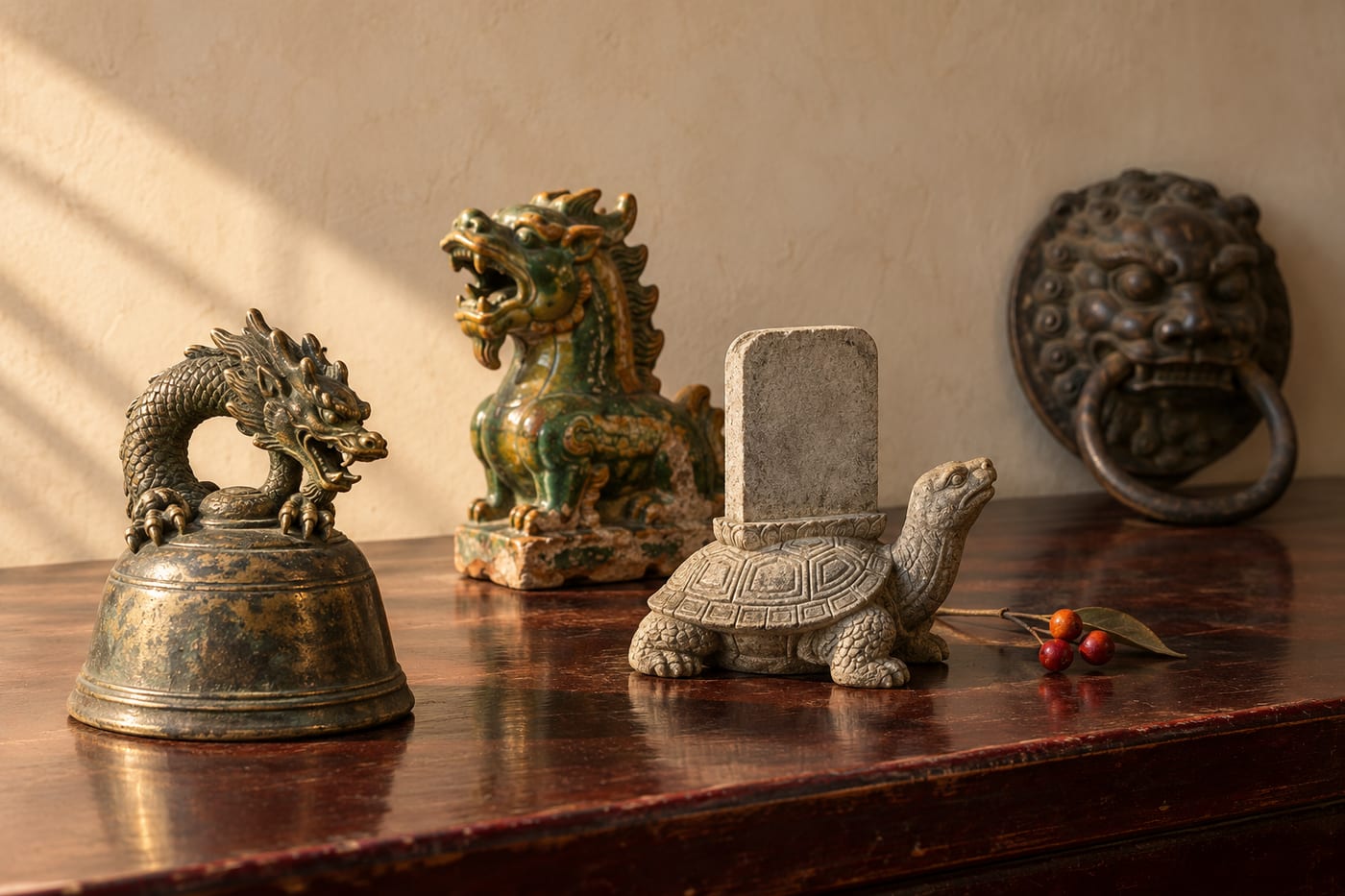
Some time in the reign of the Hongzhi emperor, who ruled from 1488 to 1505, a palace eunuch arrived at the office of one of the most senior officials in China with a question from the emperor. What, the emperor wanted to know, were the names of the dragon's nine sons? The official was Li Dongyang, Grand Secretary and the leading poet of his day. He did not know.
What happened next is the whole story of the nine sons, and Li wrote it down himself. But first, the sons, because you have almost certainly met them.
The nine sons, one by one
The saying goes that the dragon had nine sons and none of them turned out a dragon. Each loved one thing, and each was given the job that suited it. Here is the list Li Dongyang finally sent to the emperor, in his own order, with the place he says you could see each one in his day:
1. Qiuniu 囚牛 loves music. He is the little beast carved on the head of the huqin, the two-string fiddle. 2. Yazi 睚眦 loves killing. He is the dragon mouth that swallows the blade where a sword meets its handle. 3. Chaofeng 嘲风 loves danger. He is the beast running along the corner of a hall's roof. 4. Pulao 蒲牢 loves to cry out. He is the looped knob on top of a bell. 5. Suanni 狻猊 loves to sit. He is the lion under the Buddha's throne. 6. Baxia 霸下 loves to bear weight. He is the tortoise under a stone stele. 7. Bi'an 狴犴 loves lawsuits. He is the lion's head over the gate of a prison. 8. Bixi 赑屃 loves literature. He is the dragons that coil around the face of a stele. 9. Chiwen 螭吻 loves to swallow. He is the gaping head at each end of a hall's main ridge.
If that list does not match the one you saw somewhere else, you are in good company. The version most often printed today comes from a younger scholar, Yang Shen, and it brings in three sons Li never mentions: the taotie, who loves food and drink and sits on the lids of cauldrons; a water-loving creature called gongfu who stands on the pillars of bridges; and jiaotu, who looks like a river snail, loves to keep shut, and holds the ring of a door in his teeth. Yang's list also moves the name bixi onto the stele tortoise, which is where most people now put it. We will come to why the lists disagree. It is the best part.
Where you will meet them
Nobody needs to visit a museum for this. The nine sons are a field guide to a Chinese building, and once you know them you cannot stop seeing them.
On the roof
Look up at the main ridge of any palace hall or large temple and you will find a pair of enormous open mouths, one at each end, swallowing the ridge. That is chiwen. The usual explanation is that he is a water creature, and that a water creature at the top of a timber building is a standing order against fire. Lower down, along the sloping corners, runs a little procession of beasts in glazed tile, and at the head of it, according to Li Dongyang, is chaofeng, the son who loves danger. Of course he does. He lives on the edge of a roof.
Under the stone
The tortoise straining under a memorial stele is the most monumental of the sons, and the most common. You find him at the Ming Tombs outside Beijing, in the courtyards of Confucian temples, at the roadsides of old provincial towns, carrying a slab twice his height and looking, frankly, put upon. His name is older than the list. In a rhapsody on the Western Capital written by the astronomer Zhang Heng early in the second century CE, the word bixi describes a giant god straining with all his might to heave two mountains apart so the Yellow River could flow between them. Bixi first meant the effort itself. It became the tortoise who makes it.
On the bell and the gate
Every big temple bell hangs from a loop on its crown, and the loop is a dragon: pulao, the son who loves to cry out. This one has the oldest pedigree of the lot. A third-century commentator named Xue Zong, explaining a line about bells in an old rhapsody, wrote that the pulao lives by the sea and is terrified of whales, and that when a whale strikes it, it bellows. So, he says, a bell that is meant to be loud gets a pulao on top, and the beam that strikes it is carved as a whale. Big temple bells in China are still rung by a swinging log rather than a clapper.
At ground level the sons keep guard. Bi'an, who loves lawsuits, glared from the gates of prisons and magistrates' courts. Jiaotu, in Yang Shen's list, is the bronze mask clamping the ring on a big red door, the son who likes everything closed. Next to the jiaotu at a palace gate you will usually find a pair of stone lions, who are not sons at all, though Li Dongyang's suanni is their cousin: the lion the Buddha sits on.
In the hand
The smaller sons live on things you hold. Yazi, who loves killing, is the dragon at the hilt of a sword, and his name is a borrowed phrase. In the Records of the Grand Historian, the statesman Fan Ju is said to have repaid every meal anyone ever gave him and avenged every angry glare, and the word for that glare is yazi. A son named after a grudge is a sensible thing to put on a weapon. Qiuniu, the music-lover, sits on the pegbox of the huqin, and jinni, the smoke-loving lion of Yang Shen's list, crouches on the lid of an incense burner.
"Nine sons, and not one a dragon"
The saying outlived the list. In Chinese, the dragon had nine sons and none became a dragon is something a parent says about children who turned out nothing like each other, or like the parents. It is affectionate, mostly. It is the Chinese way of saying that a family can share every gene and still produce a bookworm, a brawler and one who sits on the roof all day.
The emperor's question
Back to Li Dongyang, unable to answer. He left a note about it in his collected works, and it is one of the most candid things a Chinese official ever wrote.
When the emperor's question arrived, Li says, he remembered seeing the names "in miscellaneous books" as a boy but could not produce them in a hurry, and did not know where they came from in any case. So he asked around. A Hanlin compiler named Luo Qi managed five or six, which he had from his own teacher, and that was all. Then Li asked Liu Ji, a mid-ranking official at the Ministry of Personnel, and Liu Ji came back with an old booklet that had the whole list copied onto its cover. Where had the booklet got it? Liu Ji "did not know where it came from either." Li sent it up to the emperor anyway, and then, slightly shaken, wrote the list down for posterity, "fearing it would be lost again."
Notice what this means. The canonical list of the dragon's nine sons, the one carved on souvenirs and printed on posters, entered the written record because the Grand Secretary of the Ming empire was set a pop quiz, failed it, and copied the answer off the cover of somebody's notebook. Nobody in the chain, by his own account, knew its source.
The second list is the first list, remembered
Now for the rival list. Yang Shen, born in 1488, was a generation younger than Li and knew him well. In his own collected works he tells the same story: the Hongzhi emperor wrote a little note in his own hand, Li answered it, relying on Luo Qi and Liu Ji. And then he adds the sentence that explains everything. Li, he says, once told him the list in person, and "I record it here now as best I remember it."
As best he remembered it. Yang Shen's nine are: bixi the stele tortoise, chiwen on the roof (now a son who loves to gaze into the distance), pulao on the bell, bi'an at the prison gate, the taotie on the cauldron lid, gongfu on the bridge, yazi on the sword, jinni (a smoke-loving lion) on the incense burner, and jiaotu on the door. Then, unable to stop at nine, he adds a tenth, the jinwu, a winged creature with the head of a beautiful woman and a fish's tail, who never sleeps and is therefore used for the night watch.
So the two lists that have been "politely disagreeing" for five centuries are not two traditions. They are one conversation, written down once by the man who had it and once by the man he told, years later.
Before they were sons
Except that there is an even older list, and it does not have sons in it at all.
Lu Rong, a Ming official who died in 1494, kept a notebook of things that interested him. In it he copied a passage he had found in the commonplace book of a villager at a place called Nicun, under the heading "old alternative names of objects." It gives fourteen names, each with a shape, a temperament and a place on an object. It is unmistakably the same menagerie, and nobody in it is anybody's son.
Lay the three side by side and you can watch the beasts change jobs.
| Job | Lu Rong's object names (before 1494) | Li Dongyang's nine (c. 1500) | Yang Shen's nine (as he remembered it) |
|---|---|---|---|
| Carrying a stele | xibi, a tortoise that loves weight | baxia, loves weight | bixi, a tortoise that loves weight |
| Framing the inscription | chihu, loves fine patterns | bixi, loves literature | (none) |
| Roof corner | chiwen (in a rarer spelling), loves to gaze; diaoshe, loves danger | chaofeng, loves danger | (none) |
| Ridge of the hall | a dragon that loves wind and rain; aoyu, dragon-shaped, swallows fire | chiwen, loves to swallow | chiwen, loves to gaze |
| Top of the bell | xilao, a little dragon that roars | pulao, loves to cry out | pulao, loves to roar |
| Prison gate | xianzhang, loves to imprison | bi'an, loves lawsuits | bi'an, tiger-like and fierce |
| Sword or knife | xiyi, ghost-headed, loves the smell of blood | yazi, loves killing | yazi, loves killing |
| Bridges | taotie, loves water | (none) | gongfu, loves water |
| Cauldron lids | (none) | (none) | taotie, loves food and drink |
| Incense burner | jinni, a lion that loves smoke | (none) | jinni, loves smoke |
| Door | jiaotu, a snail that keeps its mouth shut | (none) | jiaotu, loves to keep shut |
| Night watch | jinwu, never sleeps | (none) | jinwu, the tenth, never sleeps |
| Fiddle, Buddha's throne | (none) | qiuniu, loves music; suanni, loves to sit | (none) |
The taotie is the giveaway. In Lu Rong's list it loves water and stands at the heads of bridges. In Yang Shen's, the taotie has become the glutton everyone knows it as, and a new creature has been hired for the bridges. Our reading, and it is only a reading, is that Yang's half-remembered nine came out as Li's story crossed with a roster very like Lu Rong's: jiaotu, jinni, jinwu and the taotie appear in Lu and Yang but nowhere in Li.
Lu Rong did one more thing, and it is the most Ming-scholar thing in this whole story. The villager's notebook claimed the names came from the Classic of Mountains and Seas and the Treatise on Curiosities, the two great catalogs of strange creatures. Lu went and looked. "None of it is there," he reports, and then, being fair-minded, wonders whether the notebook's author had seen complete editions that he hadn't. He also notes that people of his day called the door creature a "drum nail," which he says is wrong. Even the corrections had corrections.
Older than the family
None of this means the individual sons were invented in the 1490s. Several are much older than the family they were later adopted into.
The pulao and his whale go back to Xue Zong in the third century, quoted in the seventh by Li Shan, whose commentary on the great anthology of early Chinese literature is how most of these lines survive. The bixi was a word for heroic strain in Zhang Heng's rhapsody nearly fourteen hundred years before it was a son. The yazi is a glare from the Records of the Grand Historian, around 90 BCE. The suanni is the lion, already entered under that name in the ancient dictionary Erya, a story our page on the guardian lions traces. And the taotie is the mask on Shang bronzes, some nine hundred years older than its name, as our taotie page explains. What the Ming did was gather a loose crowd of ornament-creatures, some ancient, some anonymous, and give them a single father.
The family idea caught on fast. Journey to the West, printed in 1592, a century after Li's pop quiz, gives a Dragon King's household exactly nine sons with exactly these sorts of jobs. They are the children of the Jing River Dragon King, the one the novel has beheaded for fudging the rain (the full story is on our Dragon King page), whose youngest was raised by their uncle, the Dragon King of the Western Sea. Eight are model civil servants: the fifth keeps the Buddha's bell, the sixth holds down the roof-ridges of the gods, the seventh guards the Jade Emperor's pillar. The ninth, an alligator-dragon too young for a post, has gone into business as a river monster, and Monkey has to deal with him. It is the nine-sons idea turned into a staff list, with one bad hire.
Nobody knows, and that is the point
A century after Li Dongyang, the essayist Xie Zhaozhe copied out the nine yet again, in about 1616, and added a verdict: "This saying has been handed around in recent times, and no one has traced where it comes from." He then offered his own explanation for why the dragon had so many odd children, which is that the dragon is lustful by nature and will couple with anything. It is not a scholarly position. It is, however, more honest than most.
So here is what can be said with confidence. The nine sons are not in any classic. Their roster was written down in the reign of the Hongzhi emperor, around 1500, by a Grand Secretary who could not answer the emperor's question and copied the answer from an old booklet of unknown origin, and the second famous version is that same story, retold from memory by a younger friend. What cannot be said is where the booklet got it. Nobody knows.
And it hardly matters. The sons have done their jobs regardless, carrying the steles, swallowing the ridges, bellowing from the bells, holding the doors shut, for five hundred years, on a list that started as an emperor's idle question and a scholar's slightly embarrassed note. Each of them is a dragon's son, and not one of them is a dragon. They are much more useful than that.
In the classics
The passages behind the story, in the standard published translations. Open any one for the original text.
“The dragon begot nine sons, and none became a dragon; each had something it loved. Qiuniu, of the dragon's breed, loved music all its life: the beast carved on the head of the huqin fiddle today is its likeness. Yazi loved killing all its life: the dragon mouth swallowing the blade at the top of a sword handle is its likeness. Chaofeng loved danger all its life: the running beasts on the corners of a hall are its likeness. Pulao loved to cry out all its life: the beast-shaped knob on a bell is its likeness. ”
Original text
龍生九子不成龍,各有所好。囚牛,龍種,平生好音樂,今胡琴頭上刻獸是其遺像。睚眦平生好殺,今刀柄上龍吞口是其遺像。嘲風平生好險,今殿角走獸是其遺像。蒲牢平生好鳴,今鐘上獸鈕是其遺像。
“Once, in the Hongzhi reign, a palace eunuch was sent to ask for the names of the dragon's nine sons. I remembered seeing them often in miscellaneous books when I was young, but in a hurry I could not produce them all, nor did I know where they came from. I asked the Hanlin compiler Luo Qi, who could list only five or six, which he said was all he had from his teacher. I then asked Liu Ji of the Ministry of Personnel, who brought an old booklet with the whole passage copied on its cover; he did not know where it came from either. On that basis I answered the throne. So hard is it to keep what one has learned. Fearing it would be lost again, I jot it down here, for another day. ”
Original text
昔在弘治……嘗令中官問龍生九子名目。因憶少時往往於雜書中見之,倉卒不能悉具,又莫知所出。以詢之羅編修玘,玘僅疏其五六,云得於其師左參政贊者止此。又詢於吏部劉員外績,績以故冊來,冊面備錄此語,亦不知所從出。因據以復命。蓋記問之難如此,恐久而復失之,漫識於此,以俟諸他日。
“It is popularly said that the dragon begot nine sons and none became a dragon, each having something it loved. In the Hongzhi reign the Filial Emperor wrote a little note in his own hand to ask the Grand Secretariat, and Li Dongyang answered in a memorial, relying on what Luo Qi and Liu Ji had told him. ... Li once told me about this; I record it here now as best I remember it. ”
Original text
俗傳龍生九子不成龍,各有所好。弘治中,孝廟御書小帖以問內閣,李文正公具疏以對,據圭峰羅玘、蘆泉劉績之言。……文正嘗為慎言,今影響記之,錄於此。
“Old alternative names of various objects: xibi, shaped like a tortoise, loves to bear weight, and so is used to carry stone steles. ... The taotie loves water, and so stands at the heads of bridges. ... Jiaotu, shaped like a river snail, loves to keep its mouth shut, and so stands on doors; people now call it a "drum nail," which is wrong. ... From the Classic of Mountains and Seas and the Treatise on Curiosities. The above I once saw in the notebook of a villager at Nicun, and copied it for reference. ... But when I checked the Classic of Mountains and Seas and the Treatise on Curiosities, none of it is there. ”
Original text
古諸器物異名:屭贔,其形似龜,性好負重,故用載石碑。……饕餮,性好水,故立橋頭。……椒圖,其形似螺螄,性好閉口,故立於門上,今呼鼓丁非也。……出《山海經》、《博物志》。右嘗過倪村民家,見其《雜錄》中有此,因錄之以備參考。……然考《山海經》、《博物志》,皆無之。
“This saying has been handed around in recent times, and no one has traced where it comes from. ... The dragon is lustful by nature and will couple with anything, which is why it alone has so many kinds of offspring. ”
Original text
此語近世所傳,未考所出。……蓋龍性淫,無所不交,故種獨多耳。
“In the sea there is a great fish called the whale, and by the sea there is a beast called the pulao. The pulao has always been afraid of the whale, and whenever a whale strikes it, it cries out loudly. So whenever a bell is meant to sound loud, a pulao is made on top of it, and the thing that strikes it is made as a whale. ”
Original text
海中有大魚曰鯨,海邊又有獸名蒲牢,蒲牢素畏鯨,鯨魚擊蒲牢,輒大鳴。凡鍾欲令聲大者,故作蒲牢於上,所以撞之者為鯨魚。
“My sister has nine sons. Eight of them are good: the first, Little Yellow Dragon, lives in the Huai River; ... the fifth, the Tulao Dragon, keeps the bell for the Buddha; the sixth, the Steady Beast Dragon, holds down the roof-ridges of the palaces of the gods; the seventh, the Jingzhong Dragon, guards the sky-bearing pillar for the Jade Emperor; ... and this is the ninth, the Tuo Dragon, who being young had no post to speak of. ”
Original text
舍妹有九個兒子。那八個都是好的:第一個小黃龍,見居淮瀆;……第五個徒勞龍,與佛祖司鐘;第六個穩獸龍,與神宮鎮脊;第七個敬仲龍,與玉帝守擎天華表;……此乃第九個鼉龍,因年幼無甚執事。
Questions people ask
What are the nine sons of the dragon?
They are nine dragon-children of Chinese folk tradition, each with one passion and a matching job as an ornament. In the oldest dated list, written down by the Ming Grand Secretary Li Dongyang around 1500, they are: qiuniu (loves music, on fiddle heads), yazi (loves killing, on sword hilts), chaofeng (loves danger, on roof corners), pulao (loves to cry out, on bell tops), suanni (loves sitting, under the Buddha's throne), baxia (loves bearing weight, under steles), bi'an (loves lawsuits, over prison gates), bixi (loves literature, around the stele's face) and chiwen (loves swallowing, on roof-ridges). Other lists swap in the taotie, the jiaotu of door knockers and a water-loving gongfu.
Why are there different lists of the dragon's nine sons?
Because the list was never fixed in any classic. Li Dongyang wrote that when the Hongzhi emperor asked for the names, nobody could supply them; he found the list in an old booklet whose owner did not know its source. The scholar Yang Shen later wrote that Li had told him the story, and recorded the nine as best he remembered, which is why his version differs. An earlier writer, Lu Rong, had already copied fourteen of the same beasts as "old names of objects," with no sons and no nine.
Which son of the dragon sits on Chinese roofs?
Two do, in the classic list. Chiwen, the son who loves to swallow, is the great gaping head at each end of a hall's main ridge, said to guard the building against fire. Chaofeng, the son who loves danger, is the one perched on the corners of the roof. Yang Shen's list keeps chiwen and makes it the son who loves to gaze out.
Is the turtle under a stele one of the dragon's sons?
Yes. The tortoise that carries a stone stele on its back is the son who loves to bear weight, called baxia in Li Dongyang's list and bixi in Yang Shen's, which is the name most people use now. Bixi first meant straining with effort: in Zhang Heng's Western Capital Rhapsody, from the early second century CE, a giant god heaves two mountains apart in that posture. Li Dongyang's own list gives the name bixi to a different son, the dragons that frame the inscription.
Are the nine sons of the dragon the sons of the Dragon King?
Not in the Ming lists, which only say "the dragon." But Journey to the West, printed in 1592, gives a Dragon King's family nine sons with jobs of their own: the widow of the Jing River Dragon King, the one beheaded for fudging the rain, raised nine sons, of whom the fifth keeps the Buddha's bell and the sixth holds down the roof-ridges of the gods. The ninth, an alligator-dragon, becomes a monster in the novel.
What does the saying the dragon has nine sons mean?
In everyday Chinese it is a comment on how differently children of the same parents turn out. The full saying, used by Li Dongyang and Yang Shen alike, is that the dragon had nine sons and none became a dragon, each with its own tastes. It is said of siblings, often with a sigh, and of any group sharing an origin but not a character.
Related figures
Sources & further reading
- Li Dongyang, Huailutang ji (懷麓堂集), juan 72, 'A Note on the Dragon's Nine Sons' (Siku Quanshu text, Wikisource)
- Yang Shen, Sheng'an ji (升菴集), juan 81, 'The Dragon's Nine Sons' (Siku Quanshu text, Wikisource)
- Lu Rong, Shuyuan zaji (菽園雜記), juan 2, the fourteen old names of objects (Wikisource)
- Xie Zhaozhe, Wu zazu (五雜俎), juan 9 (Wikisource)
- Li Shan, Wenxuan zhu (文選注), juan 1, quoting Xue Zong on the pulao and the whale (Wikisource)
- Zhang Heng, Western Capital Rhapsody (西京賦), the giant god straining to part the mountains (Wikisource)
- Sima Qian, Records of the Grand Historian (史記), juan 79, the biography of Fan Ju (Wikisource)
- Journey to the West (西遊記), chapter 43 (Wikisource)
- Nine sons of the dragon, Wikipedia (the four Ming lists compared)
- Bixi, Wikipedia (the stele-bearing tortoise and where to see them)
- Chiwen, Wikipedia (the ridge-end ornament)
By Julian 祝君瑜, retold from the classics, with the original passages cited, updated 2026-10-15