A temple oracle, thrown honestly
Yes or No Oracle two moon blocks, the way a Chinese temple asks its gods
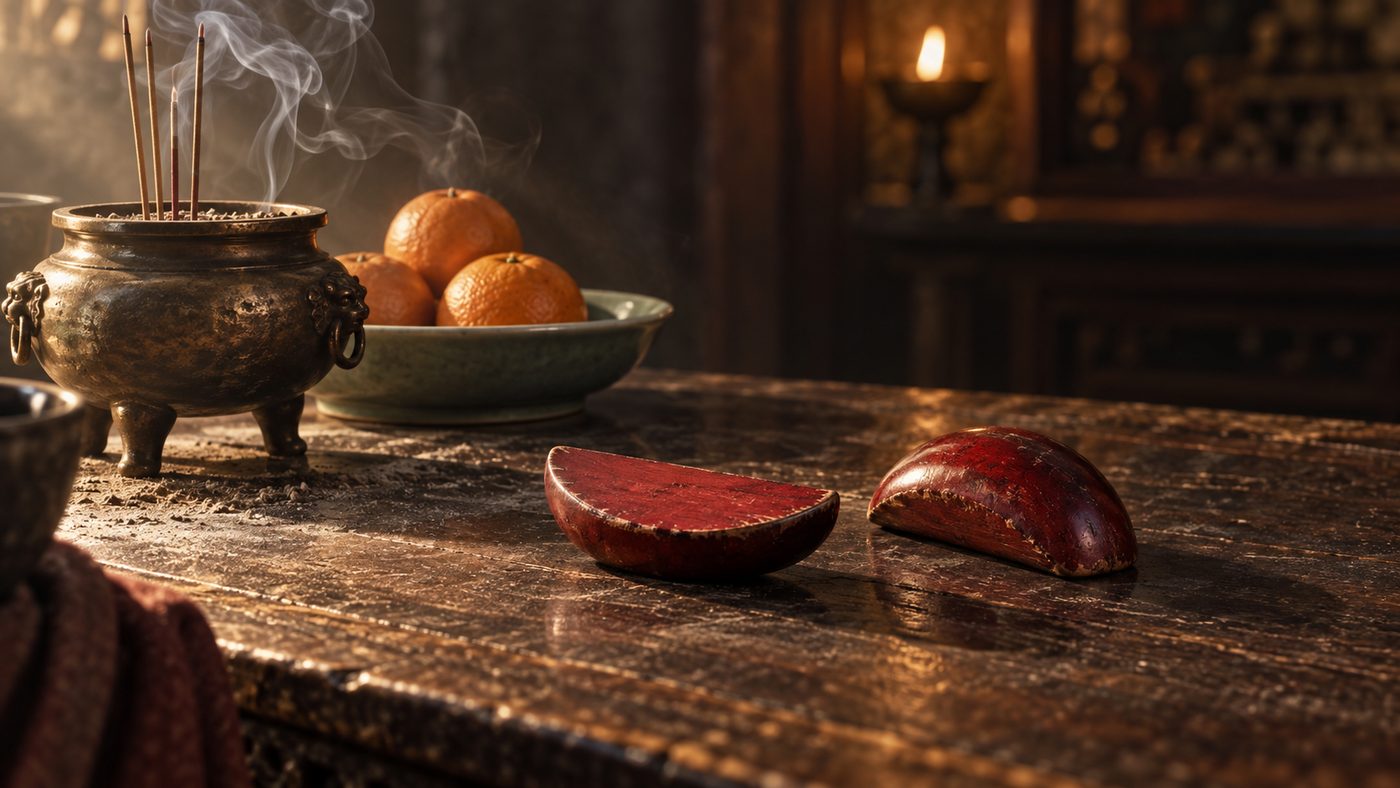
A yes or no oracle is the oldest kind of question there is, and Chinese temples still answer it every day with two pieces of wood. They are called jiaobei, or moon blocks: two red crescents, each flat on one side and rounded on the other. Ask one question, throw them here for free, and read how they land. One flat and one round is a holy cup, which means yes. Both flat is a laughing cup, and you ask again. Both round is the angry cup, and that is a no.
One yes is not enough. A careful temple wants three holy cups in a row before it calls the matter settled, and that is the rule below. The blocks are a fair simulation of real ones, with the odds taken from measured throws, and what the gods make of it is between you and them.
How the blocks are read
Each block has a flat face and a rounded one. Taipei's Xingtian Temple, which belongs to Guan Yu, calls the flat face yang, "facing up," and the rounded face yin, "facing down," and it describes a block as shaped like a crescent moon, made of bamboo, wood or plastic, always in a matched pair. A pair can land three ways, and each way has a name.
| Outcome | How the blocks land | What the temples say it means | Odds per throw here |
|---|---|---|---|
| Holy cupYes | One flat side up, one round side up | Right, good, permitted. The god agrees. | 49.9% |
| Laughing cupAsk again | Both flat sides up | The god is laughing, or will not commit. Xingtian reads it as a question put unclearly. | 27.4% |
| Angry cupNo | Both round sides up | Not right, not good, not permitted. Also called the crying cup, the face-down cup, or the yin cup. | 22.8% |
Meanings from Xingtian Temple and from the Ministry of Culture's heritage entry on the blocks, which gives the laughing cup as the god "laughing, or noncommittal" and lists crying, face-down and angry as names for the double round.
The rule this oracle follows
How to ask, step by step
- Hold the pair in your palms, flat sides together. Xingtian likens the shape to a butterfly.
- Introduce yourself: your name, your age and your address. At a temple you say it to the god; here, say it quietly to yourself.
- State one matter, briefly, phrased so that yes or no is a complete answer.
- Pause to let the god consider, then raise the blocks to your brow and let them fall.
- Read how they land and follow the rule below: three holy cups in a row for a yes, an angry cup for a no, a laughing cup to rephrase and start over.
- Once you have your answer, leave that matter alone for a while before asking it again.
How many holy cups make a yes
There is no single rulebook, which is the first thing to know. Temples set their own customs and post them for visitors, and they disagree in exactly one interesting place: how many holy cups make a yes.
The careful answer is three. The Mazu temple at Donghai, in Taitung, sets out its procedure step by step and says one holy cup or three are both acceptable, but that as a principle it recommends three in a row, to be sure of the goddess's meaning. That is what the oracle on this page does:
- Throw once. A holy cup counts one, and you throw again.
- Three holy cups in a row is a yes.
- An angry cup at any point is a no, and it cancels any holy cups that came before it.
- A laughing cup at any point is no answer at all. Put the question more plainly and start again from the first throw, because the three have to be consecutive.
The exception is Xingtian itself. Its instructions say the first throw decides: there is no need to throw again and again until a holy cup turns up, which it calls both disrespectful to the god and a good way to get yourself worked up, and the same question should wait a while before it is asked again. If you want to ask the Xingtian way, take the first throw above and stop there.
Everybody agrees about the preliminaries. Xingtian's are steps two and three above. Donghai adds your zodiac sign and your birth date, saying whether it is a lunar or a solar date. The Ministry of Culture's reference entry adds a small gesture: pass the blocks in a few clockwise circles over the incense burner before you throw. If this sounds like filling in a form, it is. Chinese gods hold offices, and a petition to an office starts with who is asking.
The laughing cup deserves its own note, because it is the best thing in the system. Xingtian's explanation is that the question was unclear. Then it adds, with some candor, that people who ask when they already know the moment is wrong, or who have made up their minds and are asking anyway, also tend to get the laughing cup.
The honest odds
Here is the arithmetic the temples do not print. If each block were a fair coin, a holy cup would come up half the time, since one flat and one round can happen two ways, and the laughing and angry cups a quarter each. Three holy cups in a row would come up one time in eight.
Real blocks are not coins. The only measured figures we could find come from an entry in Taiwan's 50th national science fair, in which four eighth-graders from Nantou County threw pairs of blocks 3,031 times, across five kinds of block and three drop heights. They got 49.3% holy cups, 27.6% laughing and 23.1% angry. The rounded face, they noticed, behaves like the bottom of a roly-poly toy: a block that lands on it rocks and settles, so the flat face ends up on top a little more than half the time. It is a school project, with a hundred throws in each cell of its tables, and we treat it as one careful measurement rather than the last word.
So that is the model. Each block lands flat side up 52.3 percent of the time, on its own, which is the rate that best fits those throws. Your browser draws each block from its cryptographic random number generator, the source it uses for encryption keys, so nobody, including us, can lean on a throw.
| Outcome | Chance on one throw | Chance per question, by the rule above | If blocks were coins |
|---|---|---|---|
| Yes (holy cup) | 49.9% | 12.4%, three in a row | 12.5% |
| Ask again (laughing cup) | 27.4% | 47.8% | 43.8% |
| No (angry cup) | 22.8% | 39.8% | 43.8% |
Which is the quiet effect of asking for three. A single holy cup is close to a coin toss. Three in a row happens about one time in eight, and the single most likely end to the whole ritual is not yes or no but a laughing cup telling you to try again. The temples give their reason as being sure of the god's meaning; the arithmetic is ours, and it says the rule makes a yes hard to come by.
One twelfth-century ruler understood the odds better than most. The official History of Jin records that Prince Hailing of the Jin once stopped at a shrine at Liaoshigang and threw the blocks with a prayer: if I have the mandate of heaven, let this throw be auspicious. It was. He threw again, adding that if things turned out as promised the god would be rewarded, and if not he would tear the shrine down. Auspicious again. In 1153, now emperor, he made the god a king. Two holy cups in a row come up about one time in four, and the god, to be fair, was under some pressure. A later historian, retelling the story in the Xu Zizhi Tongjian, was less charmed: the ruler, he wrote, was using the gods to cover a murder, which is how Hailing had come to the throne.
How it compares with a coin, a Magic 8 Ball and a tarot yes or no
Search for an oracle yes or no and most of what comes back is one of three things: a coin flip in costume, a Magic 8 Ball, or a tarot card read as yes or no. None of them knows the future, and neither do the blocks. What differs is how hard each one makes a yes, and whether it can decline to answer.
| Oracle | Chance of a yes | Declines to answer | What counts as a yes |
|---|---|---|---|
| A coin toss | 50% | Never | One toss decides |
| A Magic 8 Ball | 50.0% | 25.0% of shakes | One shake decides |
| A tarot yes or no | Set by the reader's convention | Depends on the reader | Depends on the reader |
| The moon blocks, as here | 12.4% | 47.8% of questions (a laughing cup) | Three holy cups in a row |
Magic 8 Ball: twenty answers, ten yes, five noncommittal, five no. Moon blocks: this page's rule and the measured odds above.
A coin and a Magic 8 Ball say yes half the time. The blocks, asked the careful way, say yes to about one question in eight, roughly 4 times rarer, and that is the point of three in a row: a yes has to survive three throws. Tarot has no fixed yes-or-no rule at all, so its odds are whatever the reader's convention makes them. And only the blocks have an answer that means the question is the problem. The Magic 8 Ball's noncommittal answers say "ask again later"; the laughing cup says ask it better.
Where the blocks come from
The blocks are older than any temple that uses them now, and the best account of them was written by a Song-dynasty scholar who could not resist a word puzzle. Cheng Dachang, in his twelfth-century notebook Yanfanlu, explains that people putting a question to a god used to take two clam shells, toss them into the air, and read whether they landed facing up or facing down. Later the shells gave way to bamboo or wood, shaved into the shape of a clam and split in two. The name, he says, comes in two halves as well: bei, cup, because a clam shell is hollow and holds things like a cup, and jiao, which he argues was first written as the word for teaching, because the way the halves face is what the god is teaching you.
He traced the practice further back, to the Jingchu Suishi Ji, a sixth-century record of the festival year in central China, where people at the autumn sacrifice to the earth god threw the blocks to foretell next year's harvest. A note on that text, as Cheng quotes it, says the blocks were made of paulownia wood in the shape of a small clam, and that the throw with one half up and one half down was the auspicious one. That is the holy cup, written down some fourteen hundred years ago, and it has not changed since.
The poet Han Yu met the blocks in the autumn of 805, on his way home from exile in the south. At the temple on Mount Heng, he writes, the old temple keeper, who could read the god's wishes, put the blocks in his hands, showed him how to throw, and told him the result was the most auspicious there was. Han Yu's reply, a few lines later in the same poem, is magnificently unimpressed. He has been banished to the wilds and is lucky to be alive; every hope of high office is long gone; even a god who wanted to bless him would struggle to find anything to work with.
The temples that still throw them
Walk into almost any Daoist or folk temple in Taiwan and there will be several pairs of blocks on the altar table for anyone to use; the Ministry of Culture's heritage entry says so in nearly those words. They are the ordinary way to put a question to whoever the temple belongs to: Guan Yu at Xingtian, Mazu, the sea goddess, at her temples up and down the coast, the earth god at the smallest neighborhood shrines, and Yue Lao, the matchmaker, whose temple visitors open with the same name, age and address before they ask about a match.
Chinese fortune sticks: the long answer
The blocks answer yes or no. For anything longer, temples have a second instrument, and it runs on the first. Chinese fortune sticks, kau cim in Cantonese and qiu qian in Mandarin, are a cylinder of numbered bamboo sticks. You draw one, by whatever method you are used to, though the Donghai temple asks you not to shake the cylinder too hard. The number leads to a verse, and the verse is the answer.
But the stick is not yours until the blocks say so. At Donghai you lay it on the altar and throw to ask whether it is the right one. A holy cup confirms it (one or three, with three recommended), a laughing cup means throw again, and an angry cup means set that stick aside and draw another. The Mazu temple at Lukang is stricter: a laughing or an angry cup there sends you straight back to the cylinder. Only then do you take the number to the counter and collect the printed verse, and the temple keeps a book of explanations, or a person, to help you read it.
This is why a fortune-stick number means little on its own. It points into one temple's set of verses, and sets are not the same everywhere, so a number without its temple is half an answer. The oracle above does the part that needs no book: the yes or the no.
What it can tell you, and what it cannot
It can
- Give you an honest random yes or no, from a tradition that has been throwing these for well over a thousand years.
- Tell you, with a laughing cup, that the question may be muddled, which is often the most useful answer of the three.
- Make a yes hard to get, which is what three in a row is for.
It cannot
- Know anything about you. Nothing you type is read, and the blocks cannot tell a job offer from a haircut.
- Stand in for a temple. A throw in a browser is a simulation, and we would rather say so.
- Answer "when." Timing is a question for a birth chart, which reads the years; should I quit my job and when will I get married are two of them.
Questions people ask
Is the yes or no oracle accurate?
It is accurate as a random draw, which is all any yes or no oracle can honestly be. Each block lands flat side up 52.3 percent of the time, the rate measured in 3,031 real throws for a Taiwanese science fair project, and your browser's cryptographic random number generator decides every throw. No oracle is 100 percent accurate about the future, and one that says so is selling something. What this one promises is real odds and a real temple's rule.
What kind of questions should I ask a yes or no oracle?
One question at a time, phrased so that yes or no is a complete answer. Temples are specific about this: Taipei's Xingtian Temple asks for one matter per throw, stated clearly and briefly, and treats a laughing cup as the sign that the question was muddled. "Should I take the job?" works. "Which job should I take?" does not, and neither does a question you have already decided, which the same temple says tends to get laughed at.
What does jiaobei mean?
Jiaobei are the pair of crescent blocks thrown in Chinese temples to ask a god yes or no; in English they are called moon blocks or divination blocks. Each has a flat face and a rounded one. The Song scholar Cheng Dachang explained the name in two halves: bei, cup, because the first blocks were clam shells, hollow like a cup, and jiao, which he read as an old spelling of the word for teaching, since the way the blocks land is what the god is teaching you.
Can you throw jiaobei online?
You can simulate it, which is what this page does, and temples have moved part of the ritual online themselves: the Mazu temple at Lukang runs an online fortune-stick draw that asks you to confirm the stick with a throw of the blocks. Whether a god answers through a browser is a matter for your own theology. What a temple adds is the introduction before the question, name, birth date and address, which makes people ask carefully.
What do the numbers on Chinese fortune sticks mean?
Each number points to a verse in that temple's own set, which you collect from the counter once the blocks have confirmed the stick. The verse, not the number, is the answer, and temples usually keep a book of explanations or a person to interpret it. Sets are not the same everywhere, so a number read against another temple's list gives a different answer. A yes or no from the blocks alone needs no book at all.
Can I ask the yes or no oracle the same question twice?
Not straight away, if you follow the temples. Xingtian Temple in Taipei says the same matter should wait some time before it is put to the god again, and it calls throwing over and over until a holy cup turns up both disrespectful and a good way to get yourself worked up. The exception is the laughing cup, which means the question was unclear: rephrase it and start again at once. Nothing on this page stops you asking twice, but a second answer to the same question is only a second draw, not a better one.
How does a yes or no oracle work? Is it real?
Every yes or no oracle, in a temple or online, is a random draw read through a rule, and what differs is the rule. A coin says yes half the time. This one simulates the two moon blocks of a Chinese temple, each landing flat side up 52.3 percent of the time, and follows the careful temple rule of three holy cups in a row, so a question ends in yes about 12.4% of the time, no about 39.8%, and a laugh the rest. The randomness is real. Whether a god is behind it is a matter of belief, and the page does not pretend to settle it.
What is the most accurate yes or no oracle?
None of them can be accurate about the future, so the fair question is which one is honest about how it answers. A coin and a Magic 8 Ball both say yes half the time: the 8 Ball's twenty answers are ten yes, five noncommittal and five no. The moon blocks under the three-in-a-row rule say yes to about one question in eight, roughly 4 times rarer, and they are the only one of these that can tell you the question itself is the problem.
Keep going
- Cast your chart The answer that knows your years: the eight characters, from a birthday, hour and place.
- Guan Yu The general who became a god, and whose Taipei temple takes the first throw as final.
- Mazu The sea goddess whose temples confirm every fortune stick with the blocks.
- Does he like me? The question people most want the blocks to answer, and what the tradition says instead.
Sources
- Wikipedia, "Magic 8 Ball": invented 1946 by Albert C. Carter and Abe Bookman; twenty answers, ten affirmative, five neutral, five negative
- Xingtian Temple, Taipei (行天宮), "Throwing the blocks" (擲筊): the self-introduction, one matter at a time, the three outcomes, and the first throw as final
- Donghai Longmen Tiansheng Temple, Taitung (台東東海龍門天聖宮), fortune-stick procedure (求籤流程): one or three holy cups, three in a row recommended; laughing and angry cups
- Lukang Tianhou Temple (鹿港天后宮), drawing a fortune stick (求籤): the stick confirmed by a holy cup
- National Culture Memory Bank, Ministry of Culture, Taiwan: "Jiao" (筊), the names of the three outcomes and the blocks on temple altars
- Ministry of Education, Revised Mandarin Dictionary: "zhi jiao" (擲筊), two half-moon pieces read by which way they face
- Cheng Dachang, Yanfanlu (演繁露), juan 3, "Bu jiao" (卜教): clam shells, the name, and the Jingchu Suishi Ji on the harvest throw (Chinese Wikisource)
- Han Yu, "Visiting the Temple of Mount Heng" (謁衡嶽廟遂宿嶽寺題門樓), 805 (Chinese Wikisource)
- History of Jin (金史), juan 5, annals of Prince Hailing: the two throws at the Liaoshigang shrine (Chinese Wikisource)
- Xu Zizhi Tongjian (續資治通鑑), juan 130: the same episode, with the historian's verdict (Chinese Wikisource)
- 50th National Primary and Secondary School Science Fair (Taiwan), entry 030408, "Throwing the blocks" (搏筊): 3,031 two-block throws