Tools · 八字
Bazi Calculator
Somewhere on your timeline sits a stretch of years the old texts would tell you to spend, not save: your peak years. This bazi calculator finds them the classical way. It casts your Four Pillars of Destiny, the Chinese astrology birth chart, then scores every year of your luck pillars into one life chart you can check against the years you have already lived.
By Julian 祝君瑜, every weight and convention published in the methodology, updated 2026-09-26

Cast your chart
Four pillars, day master, ten gods, hidden stems, luck pillars, and your life chart. Free, no sign-up, ten seconds.
Sex is a mechanical input here: the classical rule runs your luck pillars forward or backward depending on it, nothing more. No birth time? Leave it blank and we cast an honest three-pillar chart. Add your birth city and we correct the clock reading to true solar time for that longitude, and take out daylight saving if it was running that day; leave it blank and we read the clock literally and say so. Nothing you enter is stored.
What is bazi, and what is a bazi chart?
Bazi, 八字 (bāzì, "eight characters"), also known as the Four Pillars of Destiny, is the system of Chinese astrology that turns the year, month, day, and hour of your birth into eight characters and reads a life from them. A bazi chart is those eight characters written out as four pillars, one each for the year, month, day, and hour, and each pillar is a pair: a heavenly stem and an earthly branch, drawn from the sixty-character cycle that has ordered Chinese time since the Shang dynasty. Eight characters total, hence the name.
Here is one. Steve Jobs was born in San Francisco on February 24, 1955, at 7:15 in the evening, a time taken from his birth record (Astro-Databank, rated AA). Below is his chart as this calculator casts it, one layer at a time and in the order the tradition reads it, ending in the life chart the calculator draws for you.
The eight characters
| Row | Year | Month | Day | Hour |
|---|---|---|---|---|
| Ten god | Direct Resource 正印 | Eating God 食神 | Day master | Rob Wealth 劫财 |
| StemHeavenly stem | Yi 乙 Yin Wood | Wu 戊 Yang Earth | Bing 丙 Yang Fire | Ding 丁 Yin Fire |
| BranchEarthly branch | Wei 未 Goat, Earth | Yin 寅 Tiger, Wood | Chen 辰 Dragon, Earth | You 酉 Rooster, Metal |
| HiddenHidden stems |
|
|
|
|
- Day master
- The stem of the day pillar stands for the person. Jobs's is Bing, Yang Fire: in the old imagery, the sun rather than the candle. Every other character is read by what it does to it. The ten day masters, and what yours means.
- Ten gods
- The name over each stem is its relation to the day master, one of ten, set by element and by polarity. Yi, Yin Wood, feeds Bing Fire from the opposite polarity, so it is the Direct Resource; Wu, Yang Earth, is what Fire produces, at the same polarity, so it is the Eating God; Ding, Yin Fire, is Fire's own kind at the other polarity, the Rob Wealth. The ten pair off into five families (Resource, Output, Companion, Wealth, Influence), and the life chart scores by family. All ten, defined.
- Hidden stems
- Each branch carries one to three stems inside it, and they count toward the reading. The Tiger month hides Jia Wood, Bing Fire and Wu Earth, which is why a February birth feeds a Fire day master so heavily. Every branch and what it hides.
- The hour, in true solar time
- His birth record says 7:15 pm. In true solar time, the time by the sun over San Francisco that evening, it was 6:51, 23 minutes earlier once longitude and the equation of time are counted, which keeps his hour in the Rooster block, Ding You. Read the clock literally and the hour turns to the Dog, Wu Xu, and a quarter of the chart changes. That is why the form asks for a birth city, and why his hour pillar should be held a little loosely: it sits 9 minutes from the boundary. The twelve double hours, and why calculators disagree.
Strong or weak, and what the chart needs
The first judgment in reading any bazi chart is whether the day master stands strong or weak in its season, because everything after it depends on the answer. The calculator weighs every character that supports Bing Fire, by position, with the month branch counting heaviest:
Wood 木
2 of 8
Fire 火
2 of 8
him
Earth 土
3 of 8
favorable
Metal 金
1 of 8
favorable
Water 水
absent
favorable
A strong Fire wants spending, not feeding, so the reading treats Earth, Metal and Water as favorable: Earth to carry the heat off, Metal to give it work, Water to temper it. Wood and Fire, which feed it and double it, count against him. That rule, strengthen the weak and drain the strong, comes from the Yuanhai Ziping, and it decides how every decade and year below is scored. Counting the elements is only a description, though, not the verdict, for reasons worked through here.
Luck pillars, and the life chart drawn from them
Timing is what sets bazi apart from Western astrology's natal charts (ancient Greece did build a timing engine of its own, compared with luck pillars here). A chart walks through ten-year luck pillars (大运, dà yùn), and each one tilts every year inside it. Jobs's run backward through the sixty-character cycle, the classical rule for a man born in a Yin year, and the first began at age 7, counted the traditional way. From his teens they read:
Bing Zi
1971–1980
mixed
Status and pressure
Yi Hai
1981–1990
drags
Status and pressure
Jia Xu
1991–2000
mixed
Making and output
Gui You
2001–2010
lifts
Money and trade
Read it left to right. The Yi Hai decade (1981–1990) pulls every year inside it down by 6.8 points, the heaviest stretch of his life. The Gui You decade lifts every year by 13.3, and Ren Shen after it by 12.7, two Money and trade decades level enough that the seal covers both. Then each year's own stem and branch move its candle up or down inside its decade.
Plot those scores in the candlestick grammar traders use for markets and you get what recent tools have taken to calling a life chart, or "life k-line": a whole timeline, readable at a glance. The yearly bazi reading most people come asking for, this year's pillar set against your chart, is one candle of it; where the 2026 year lands for each animal sign, before your chart is even cast, is on the 2026 zodiac page.
Checked against the life he lived
A chart read after the fact proves nothing, so take these as a test of how the method sees a life, misses included:
- 1985
- He leaves Apple in September, after losing the boardroom fight with John Sculley. The engine labels 1985 a clash year, the tradition's word for friction forced into the open, inside the heaviest decade on the chart.
- 1987
- The lowest candle on the chart (31), in the NeXT years. Not the year of the fall itself: the floor comes two years after it.
- 1997
- Back at Apple after the NeXT deal, announced in December 1996 and closed in February 1997. A miss: the chart reads the return as close to neutral (52), and its lift arrives four years later.
- 2001–2011
- The stamped peak. The iPod in 2001, the iPhone in 2007, the iPad in 2010, all inside the two Money and trade decades. The method says the run had another decade in it; the chart stops at 2011 because the engine scores calendar years and does not speak past a life.
- 2009
- The single highest candle (76), in a year he spent largely on medical leave, including a liver transplant. The engine reads how a year's elements meet the chart; it knows nothing about a body. We would rather show you the miss than trim it.
Every year on a chart also carries labels that name its character without moving its score: peach blossom and travel horse years, and every year whose branch clashes, combines, harms, or punishes one of yours, like his 1985. If your question is a date, when will I get married reads the same marks against your birthday; if it is your work, should I quit my job reads the ten gods and the travel horse for the next eight years.
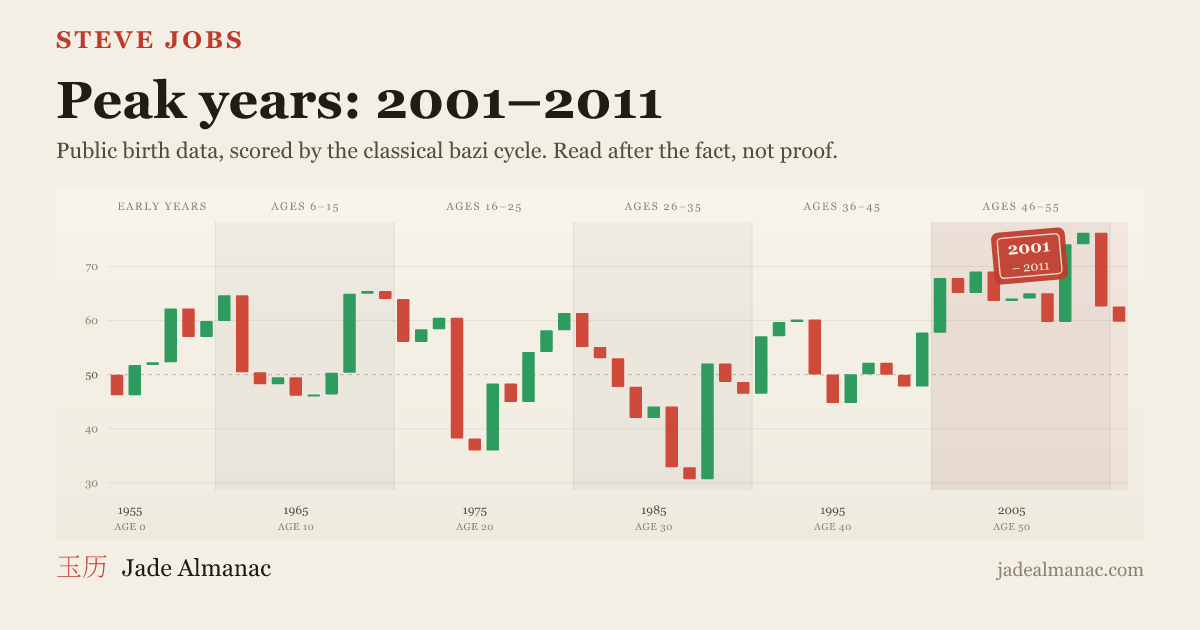
That is the whole chart, start to finish. Yours takes ten seconds.
Cast your chartThree more lives you already know
The same engine on three more public birthdays. None of them has a reliable published birth time, so each is an honest three-pillar chart, the hour left out rather than guessed. Same key as above: every candle is one year, and the red seal stamps the decade the method rates highest (two decades, when it cannot separate the top pair). Read them as illustrations of how the method sees a life, not as proof that it predicts one:
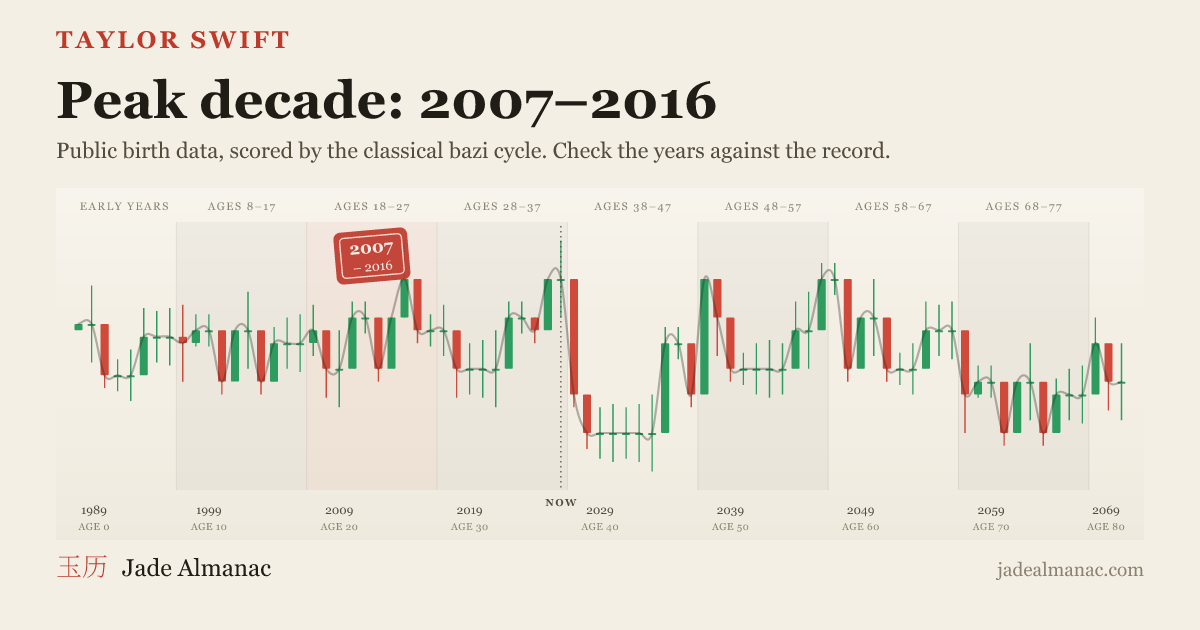
Taylor Swift (born December 13, 1989; birth time disputed, three-pillar chart).
- ✦Her chart's peak computes to 2017–2026, still running. The re-recordings, the biggest tour ever staged, and the year the fandom got a ring all sit inside it. Fans call 2007–2016 the imperial era; the chart votes for the decade she is living right now.
- ✦The strongest single year computes to 2025. A new album, a wrapped record tour, an engagement: judge that one against the headlines yourself.
- ✦The engine labels 2009 a clash year: friction shoved into the open. The year of the snatched microphone. You could not script it better.
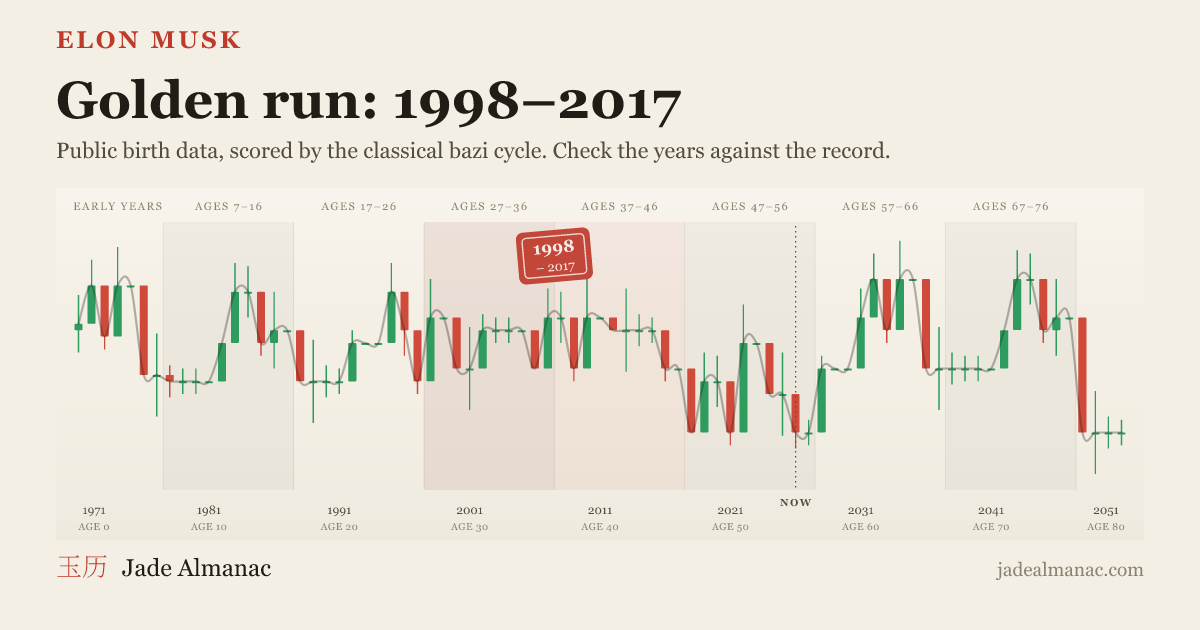
Elon Musk (born June 28, 1971; birth time unpublished, so this is an honest three-pillar chart).
- ✦Ask him about 2018. The lowest adult candle on this chart computes to 2018, from a birth date alone. Musk has called 2018 the most painful year of his career, in his own words. Find it on the chart: the deep red trough just left of the NOW line.
- ✦The chart refuses to flatter him. Its stamped peak, 1988 to 1997, covers his degrees and Zip2: the on-ramp, not the empire. The SpaceX and Tesla decades read neutral to heavy. A method that only echoed the résumé would be telling you nothing.
- ✦The engine labels 2008 a clash year (labels mark a year's character; they never move its score). Both companies nearly died that fall; both were saved by Christmas.
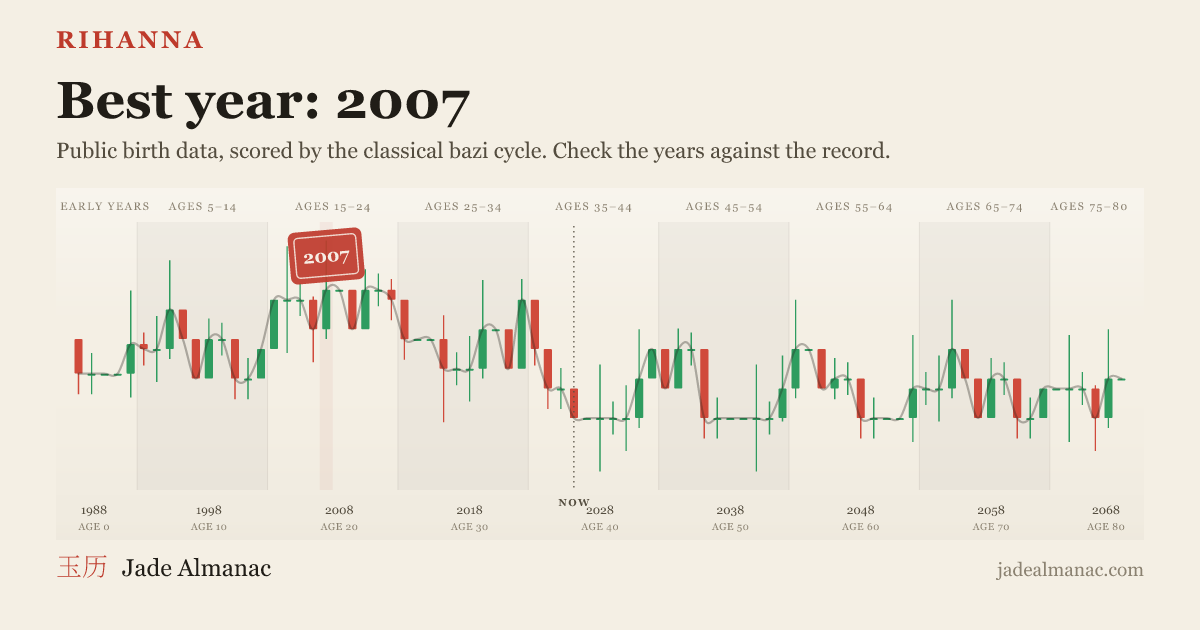
Rihanna (born February 20, 1988; birth time unverified, three-pillar chart).
- ✦Her 2003–2012 decade carries the heaviest favorable tilt the scale allows. Signed in 2005, Umbrella in 2007, and her twelfth number one, Diamonds, landing in the window's final weeks. The stamped decade is the chart-topping stretch, almost to the month.
- ✦Its single best year computes to 2012. Diamonds at the top and her first number-one album. The engine did not know that. Now you do.
- ✦2007 carries the travel-horse star, the movement year: the year the girl from Barbados took over the world. Sometimes the old language is just literal.
Public birth data, one method, no cherry-tuning. These are illustrative backtests, read after the fact rather than proof the method predicts anything; the same engine scores your chart the moment you enter a birthday above.
Four famous lives read from the outside is one thing. To see the same engine aimed at one person's actual decision, a full Deep Reading is published here end to end, chart, arithmetic and all.
How to read your life chart
Two different things get called reading here. Reading the bazi chart, the eight characters themselves, follows a fixed order the tradition has kept since the Song manuals: day master, strength, favorable elements, ten gods, branch relations, then timing. That order is walked step by step on one real chart. What follows is the other reading: the life chart this calculator draws from those eight characters.
The chart borrows the candlestick, finance's most literate little glyph, and defines it honestly. Each candle is one year. Its close is that year's overall score: fifty is neutral, above it the year's elements feed your chart, below it they tax it. Its open is simply last year's close, so the body shows the year-over-year move. Years whose branch clashes, combines, or frictions with your natal pillars carry event labels rather than wider bars: the tags name a year's character without moving its score, and tapping the year shows which relation fired.
The shaded bands behind the candles are your luck pillars: ten-year chapters, each tilting its whole decade before any single year is counted. This is why the chart has visible eras rather than noise, and it follows the classical weighting, where the decade matters more than the year. The red seal stamps the peak: the decade the method rates highest (two decades, when the top pair are level and side by side). On your own result it always points forward: a peak already lived moves the stamp to the tallest decade still ahead. The example charts above keep their historical peaks, because checking the past is what a backtest is for. A jade candle rises; a gray candle eases. Gray is not loss: the tradition reads quiet stretches as consolidation years, when the chart says build, not harvest.
And because no honest chart is a black box, every candle opens: tap a year on your result and it shows its arithmetic in plain English, which element arrived, what it does to your day master, what the decade around it was doing.
Where the method comes from
The pillars themselves are standard: solar calendar, year boundary at Lichun (立春, ~February 4), month stems by the five-tigers rule, hour stems by the five-rats rule, luck pillars running forward or backward by the classical parity-of-year-and-sex rule. Any orthodox practitioner would cast the same eight characters we do.
The scoring follows the strength-and-support method that has anchored bazi teaching since Wei Qianli's 1935 textbook Qianli Minggāo (千里命稿): judge the day master by three things, seasonal timing (does your birth month feed your element?), rooting (does it have feet in the branches?), and support (do other stems stand with it?). We quantify those three with the standard modern position weights, the month branch counting heaviest, and read favorable elements by the old rule of the Yuanhai Ziping (渊海子平): strengthen the weak, drain the strong. Yearly and decade scores follow from there, decade first, year second, exactly the priority the classics assign.
One honest caveat, stated here and on every result: this is one school's reading, simplified so it can be shown in the open. Pattern-school and blind-school practitioners would weigh the same chart differently, and charts near the strong/weak boundary are exactly where schools disagree most. We flag those charts rather than pretending the argument does not exist.
Every weight, threshold, and formula the calculator uses is written out in full, and versioned, in the calculation methodology — worked end to end on a real chart, down to how the luck-pillar starting age is counted, so the numbers can be audited rather than taken on faith.
Questions people actually ask
What is a bazi calculator?
Bazi (八字, "eight characters"), also called the Four Pillars of Destiny, encodes your birth moment as four pairs of characters: one pillar each for the year, month, day, and hour of birth. A bazi calculator, or bazi chart calculator, converts your birthday to the traditional solar calendar and casts those pillars for you. Ours goes two steps further: it reads the strength of your chart by the classical method, then scores all eighty years of your luck cycle into one life chart you can actually read.
Is a Chinese astrology birth chart the same as a bazi chart?
Yes. English has three names for one object. Bazi is the Chinese word, eight characters; Four Pillars of Destiny is its standard translation; and Chinese astrology birth chart, or Chinese natal chart, is what people call it when they are reaching for the Western vocabulary. The thing itself is the same eight characters, and the calculator above casts them whichever name you arrived with. The one real difference is with the Western birth chart: a natal chart plots where the planets stood at your birth, while a bazi birth chart is cast from the calendar, the stem-and-branch names of your year, month, day, and hour, with no observation of the sky at all.
Is a bazi calculator the same as a Four Pillars of Destiny calculator?
It is the same tool under two names, and any calculator worth using casts the same four pillars from the same birth moment. What actually separates one four pillars calculator from another is a handful of conventions, not the method: where the year turns (Lichun or Chinese New Year), where the day turns (midnight or 11 pm), whether birth time is corrected to true solar time, and how the luck-pillar starting age is rounded. Those choices can move a pillar, which is why two calculators sometimes hand the same person different characters. Ours are listed on the conventions page, beside what nine other calculators and libraries returned for the same birth moments.
Does my bazi change every year?
No. The eight characters are fixed at birth and never change; what changes is what arrives against them. Each year brings its own pillar, the year pillar of the calendar, which the tradition reads against your natal chart: the annual pillar for 2026 is Bing Wu, the Fire Horse, and it meets every chart differently. Every ten years the luck pillar turns as well. So what people call a yearly bazi reading is not a new chart but the same chart read under a new year, and that is what the life chart above scores, one candle per year.
What is a bazi rise and fall chart?
It is another name for the life chart this calculator draws: your years laid out in order, each scored by how its elements meet your eight characters, so the rises and falls of a lifetime read as one line. They come from two layers. The ten-year luck pillars tilt a whole decade up or down, which is why the chart moves in eras rather than in noise, and each year’s own pillar then moves its candle up or down inside that decade. A practitioner reads the same two layers year by year in prose; drawing them as one chart is the modern convenience, and the scores are this calculator’s arithmetic, which your result opens candle by candle.
How do I calculate my bazi chart?
By hand it is four lookups and one piece of arithmetic. Convert your birth date to the classical solar calendar, where the year turns at Lichun around February 4 and each month turns at its own solar term, not at the first of the month. Read the year pillar off the sixty-character cycle, the month pillar off the year stem plus the solar month, the day pillar off a continuous day count that has run unbroken since antiquity, and the hour pillar off the day stem plus your two-hour branch. Getting the day pillar right is the part that defeats most manual attempts, because it depends on that unbroken count rather than on anything about your birth year. The calculator above does all four, then shows the working: every convention it chose is listed on the conventions page, so you can check it against your own reckoning instead of taking it on trust.
I do not know my birth time. Can I still get a chart?
Yes. The year, month, and day pillars do not depend on the hour, so we cast a three-pillar chart and say so honestly on the result. You lose the hour pillar (about a quarter of the strength reading) and the chart is slightly less precise, but the decade structure and year scores stand. Most online calculators quietly assume noon; we would rather tell you what we do not know.
Why does the bazi year start at Lichun and not Chinese New Year?
Because bazi runs on the solar calendar, not the lunar one. The year pillar turns at Lichun (立春, "Start of Spring"), the solar term around February 4, and so do the month pillars at their own terms. A January or early-February birthday therefore often belongs to the previous bazi year. Calculators that split years at January 1 or at the lunar New Year will hand those birthdays a different chart; this one uses the classical boundary.
How seriously should I take this?
Take it as a cultural lens, not a forecast. This is one school’s simplified reading (the strength-and-support method taught since the 1930s), applied honestly and shown step by step; other schools would read the same chart differently, and we say so on every result. It is entertainment built on a real tradition. Do not use it for medical, financial, or legal decisions, and do not let any chart talk you out of a good year.
Answered at length on their own pages
Both halves of the accuracy answer are open to inspection: the versioned methodology, every weight and threshold worked end to end, and a complete Deep Reading published in full, with a 2027 almanac and a compatibility reading beside it, so you can judge the writing before you buy any of it. And if you want to read your own chart rather than be read to, the reading order is taught step by step.
Sources
- • 韦千里《千里命稿》 (Wei Qianli, Qianli Minggao, 1935), the Republican-era textbook whose day-master strength test the scoring follows: full text at the Chinese Text Project
- • 《渊海子平》 (Yuanhai Ziping, Song-dynasty compilation), the founding manual of the day-master method; favorable elements follow its strengthen-the-weak, drain-the-strong principle: Wikisource edition
- • Hong Kong Observatory: the 24 solar terms (the Lichun boundary the year pillar turns on)
- • Hidden-stem strength shares follow the proportions standardized in modern mainland scoring practice (Zhu Zuxia, 命理应用精解, 1999)
- • Steve Jobs's birth time, 7:15 pm PST in San Francisco, from the Astro-Databank record (Rodden rating AA, from a birth record); his 1985 departure and the NeXT deal from the Steve Jobs Archive and Apple's February 1997 release; his 2009 leave and transplant as reported by NBC News
Start here
The six steps in the order the tradition takes them, each one worked on a real four-pillar chart.
One pillar, in depth
The ten types, and the full arithmetic behind strong and weak, worked start to finish.
The vocabulary
What every other character in the chart is to you. The relation labels on your reading, defined, with the full table.
The layer underneath
Wood, Fire, Earth, Metal, Water read as motions rather than substances, both cycles, and what a favorable element really is.
The fourth pillar
Which two-hour block your birth time falls in, the animal it carries, and the five-rats rule that turns it into a pillar.
The alphabet
The twenty-two characters a chart is spelled with: element, animal, month, hour and hidden stems, and a decoder for your eight.
The count
All sixty names with their sounds and years, the older names the Erya gave them, the day count that has not reset since 720 BC, and a finder for any date.
Free dataset
Eight calculators, the same birth moments, and the four conventions behind their different answers. Ours is in the table too.
The words in your reading
The branch relations a reading names but never defines, with the classical tables in full and the two stars we mark.
The method we did not choose
How a geju reader starts from the month command instead of from balance, and why the favorable element means two different things.
The other system
Same birth moment, two unrelated charts. What each one is shaped to answer, and why both survived.
East meets West
Greece and China both engineered a map of your peak years. Side by side, they explain each other.
Names and meaning
The same tradition reads meaning into your birth and into your name. Get a real one, matched to yours for sound and meaning.
Same birth year
The twelve-year wheel behind your year pillar's branch.
Same birthday
Feng shui's answer to the same question: which way do you face?
Same birthday
Month, day, leap months, and your year's full identity.
The whole field
Bazi is one of four systems that read the same birth date. Where each came from, and how accurate any of it is.