Chinese Mythology
Pixiu (貔貅): China's Wealth Beast, and What It Used to Be
The pixiu, 貔貅 (píxiū), is China's wealth beast: a winged, lion-bodied, horned creature said to swallow gold and never let it out again, which is why it turns up on jade bracelets, cash registers, and casino floors across the Chinese world. Its real history is stranger than the charm. For two thousand years the word meant crack troops, and the winged stone version standing outside Nanjing arrived from the far west with the lions.
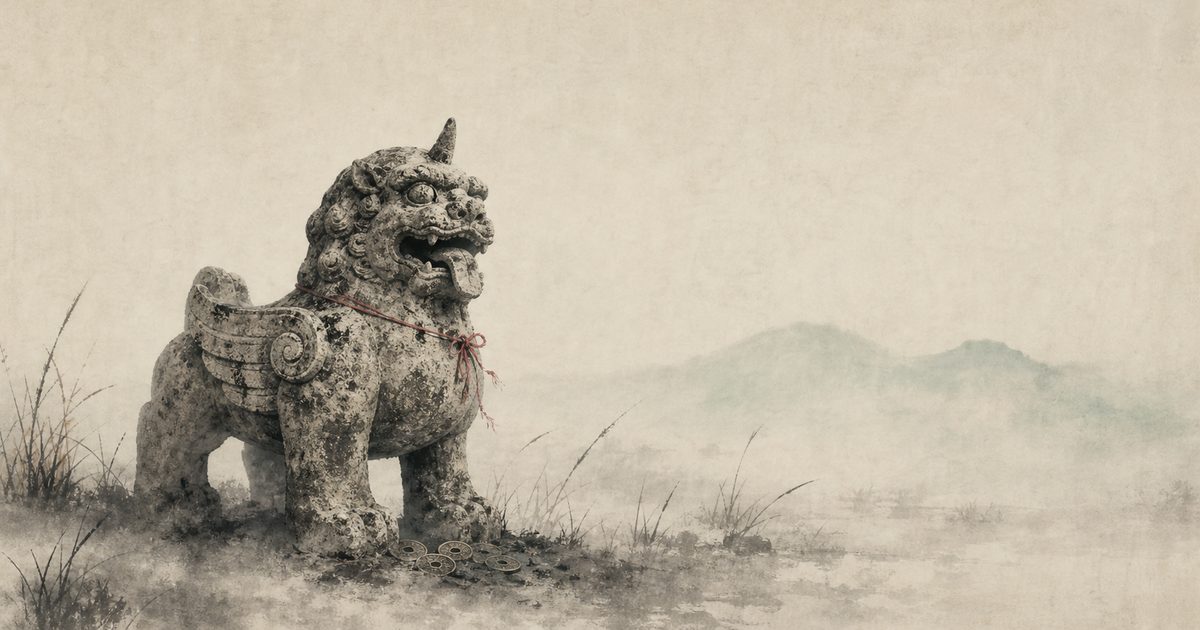
Walk through any Chinese jewelry shop, from Hong Kong to Vancouver, and you will meet the pixiu about forty times before you reach the till. It is carved on jade bangles and cinnabar beads, cast in gold for keychains, and molded in resin for the shelf beside the cash register: a squat, muscular, lion-bodied animal with wings folded flat against its back, a horn or two, and an expression somewhere between a guard dog and a gargoyle. The sales patter is always the same, and it is wonderfully direct. The pixiu eats money, the story goes, and cannot pass it. Whatever goes in stays in. Buy the bracelet.
It is one of the best-marketed animals in the world, and almost none of that is what it originally was. The classical pixiu is not a piggy bank. It is a war beast, and then a tomb guardian, and the road from there to your wrist runs through the deserts of Central Asia and the fields outside Nanjing.
It began as a word for troops
The oldest use of the name is a battle cry. In the Book of Documents, the collection of early speeches and proclamations that sits near the base of the Chinese canon, King Wu addresses his army on the morning of the battle that will end the Shang dynasty. Be valiant, he tells them, like tigers, like pi, like bears, like great bears. The pi is simply the fiercest thing he can think of to compare a soldier to, standing in a line with animals everyone in earshot has seen.
A thousand years later Sima Qian, writing the Records of the Grand Historian around 94 BCE, puts the pair pi and xiu into the Yellow Emperor's order of battle. Preparing to fight the Flame Emperor at Banquan, the founder-hero of the Chinese people cultivates virtue, musters his troops, plants the grains, comforts the people, and trains the bears, the great bears, the pi, the xiu, the chu and the tigers. Read that list plainly and you notice something the charm sellers never mention: the pixiu is introduced to Chinese literature as a unit in an army.
That stuck. For the next two thousand years, right through the imperial period, calling an army pixiu was standard literary praise, the way an English writer might call troops lions. A general's crack regiments were his pixiu. A poet describing the imperial guard reached for the same word. If you had said "pixiu" to a Tang official he would have thought of soldiers, not savings.
The winged lions came from the west
The other half of the story arrives from outside China altogether, and it arrives with real lions.
The Book of Han, completed around 111 CE, describes a far-western country called Wuyishanli, out past Jibin in the direction of what is now Afghanistan, and notes what it has that home does not: the taoba, the lion, and the rhinoceros. The third-century commentator Meng Kang added the gloss that made the creature famous. The taoba, he wrote, also called the fuba, resembles a deer with a long tail; the one-horned kind is the tianlu, "heavenly emolument," and the two-horned kind the bixie, "evil-averting."
Two things are worth noticing there. First, this is a report about foreign fauna, filed alongside the lion and the rhinoceros, which is to say that the Chinese first meet this beast as something from very far away. Second, the winged lion is one of the great shared images of the ancient world, at home in Assyria, Achaemenid Persia, and Greek art long before it reaches the Yellow River. The stone beasts that follow in China are usually read by art historians as evidence of exactly that traffic, arriving along the same routes as the horses, the grapes and the glass.
It helps to remember that China has no lions. The animal is not native to any part of it, and it reached the Han court the way ostriches did, as a diplomatic gift. In the eleventh lunar month of 87 CE an envoy from Parthia presented the emperor with a lion and an ostrich, and more arrived over the following centuries from Sogdiana, Samarkand and the Yuezhi, as pelts, as live tribute, and as stories carried by Buddhist travelers along the same roads. So the most Chinese-looking object in the world, the stone lion crouched outside the bank, the restaurant and the temple gate, is descended from an animal almost nobody in China had ever seen. The sculptors were working from description, which is precisely why the results look less like lions than like something better.
That is the family the pixiu belongs to. It is a lion assembled out of hearsay, given wings borrowed from Persia and horns borrowed from nobody in particular, and then put to work.
The beasts outside Nanjing
What China then did with the imported lion was to plant it in front of the dead. Stone tianlu and bixie appear at Han tombs and reach their peak in the Southern Dynasties, in the fifth and sixth centuries, when the emperors and princes of a string of short-lived southern courts were buried in the countryside around modern Nanjing, Danyang and Jurong.
They are still there, scattered across the fields and villages of Jiangsu, mostly stranded far from any tomb that survives, some tilted, some armless, all of them monumental: chests thrown forward, mouths open, tongues out, stubby wings carved in tight scrolls along the flank, walking on the spot toward a spirit road that vanished a millennium ago. They are listed among the country's major protected historical sites, and one of them, a bixie, serves as the emblem of the city of Nanjing. If you want to know what a pixiu actually looks like when it is not a keychain, that is the answer: far bigger than the person photographing it, weathered to the color of oatmeal, and standing in somebody's cabbage field.
Their job at the tomb was protection and status, not profit. They kept malevolent things away from the dead and announced the rank of the person buried behind them, which is why the evil-averting name, bixie, is the one that stuck to the type. Nobody was asking them for money.
The beast with no way out
So where does the money come from? The honest answer is: recently, and from nobody in particular.
The story everyone tells goes like this. The pixiu was a heavenly creature, greedy and badly behaved, and it fouled the floor of heaven once too often. The Jade Emperor, out of patience, struck it hard enough to seal its rear end permanently shut, leaving an animal that can swallow gold, silver and jewels forever and never pass a single coin. Hence its appetite for treasure, hence its usefulness to you, hence the bracelet.
It is a genuinely good story, and it is not in the classics. It does not appear in the Book of Documents, or in Sima Qian, or in the Book of Han, or in the standard early bestiaries where the pixiu is a war animal or a grave guardian. Chinese Wikipedia's own entry on the creature notes plainly that the wealth-and-protection beliefs attached to it lack any classical textual foundation, which is an unusually blunt thing for an encyclopedia to say about a national favorite, and it is correct. What we have is a modern folk tradition, propagated with enormous energy by the people who sell the objects, resting on an ancient and perfectly real animal.
Saying so does not spoil anything. Plenty of the world's best customs are younger than they look. It only means that if someone tells you the pixiu has been guarding Chinese wealth for five thousand years, they are selling you a bracelet.
How to wear one, according to the people who sell them
The contemporary etiquette is remarkably consistent for something with no scripture behind it, and since it is the thing everyone actually wants to know, here it is in full, with the honest label attached: every rule below comes from the modern trade. Not one of them appears in a classical text. That does not make them worthless, and a living custom followed by millions of people is a real thing. It does mean nobody can tell you that you are breaking an ancient law, because there is no ancient law to break.
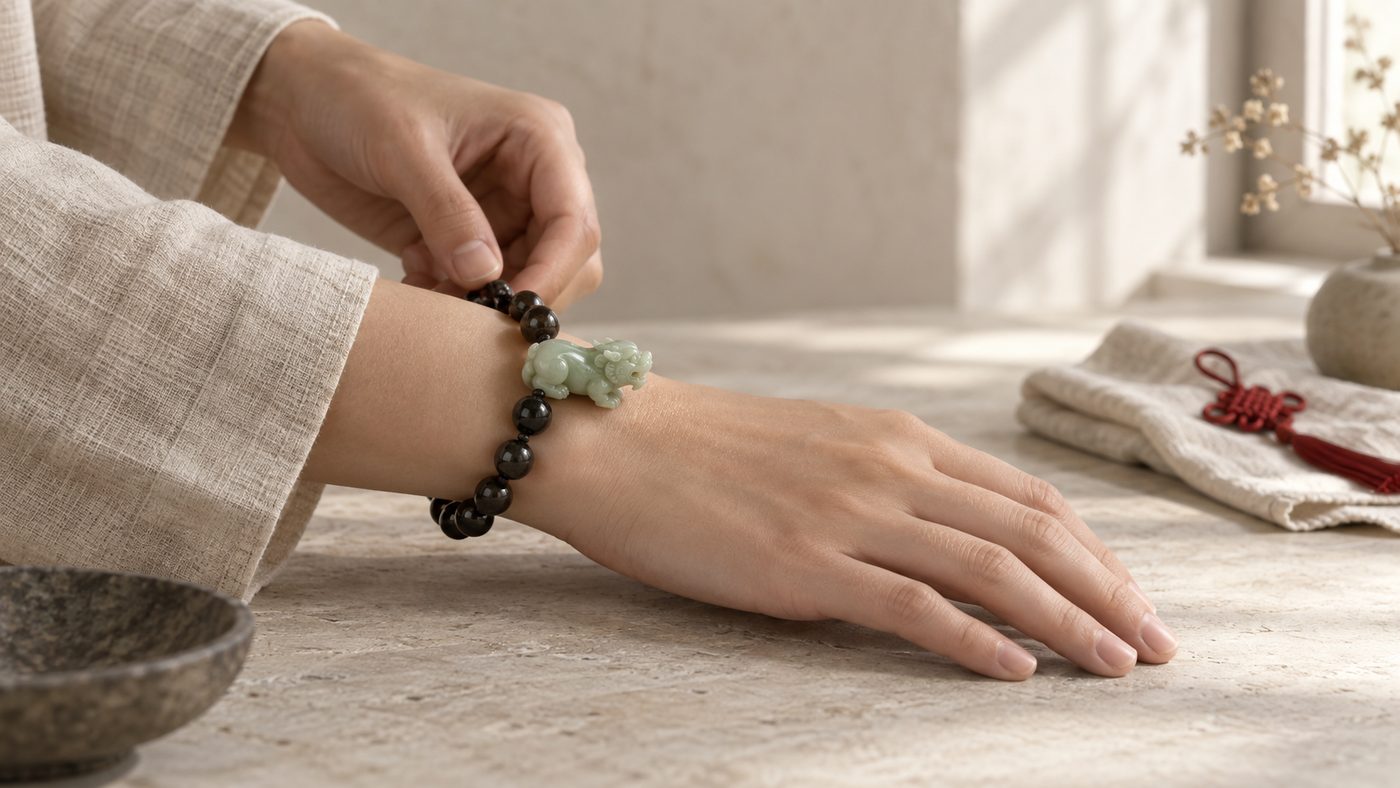
The one rule nobody contradicts, done right: head outward, toward the little finger, looking at the world rather than at your sleeve. Every other instruction below was written by someone with stock to move. That is not a reason to ignore them, but it is a reason to know what you are being told.
Which wrist. The left, in almost every telling. The reasoning offered is the principle that energy enters on the left and leaves on the right, so the receiving hand is the one that should carry a creature whose entire job is bringing things in. Two exceptions are widely allowed. Left-handed people are told to wear it on the right so it survives daily use, which is a practical concession dressed as doctrine. And a black obsidian pixiu is often placed on the right instead, on the theory that obsidian is warding rather than gathering, so it belongs on the outgoing side. Note what has happened there: the rule has been made flexible enough to accommodate whatever the buyer already owns.
Which way the head points. Outward, away from you, toward the little finger, so the animal is looking at the world it is meant to hunt in rather than at your sleeve. This is the one rule you will never see contradicted, and it is the same logic as the shop figurine facing the door.
Who is told they cannot wear one. Search for this and you get lists that flatly disagree with each other. Children under sixteen, or under twelve. Adults over seventy. Pregnant women. People born in the year of the Tiger, or the Rabbit, or the Dog. The stated reasons are usually about the beast's yang energy being too strong for a weak constitution, which is not a claim any of these sources can source. Set the lists side by side and they do not converge on a rule; they converge on a sales convention that varies by shop. The honest answer to the question is that no text bars anyone from wearing a pixiu, and that a bracelet is not a medical device. If someone tells you your sign forbids it, ask them which text says so.
Consecration, and the beast recognizing its owner. Sellers will offer to have a piece consecrated, kaiguang, so that the animal wakes up and knows whose wealth it is working for. Here the tradition being invoked is entirely real and very old. Kaiguang, the opening of light, is the rite that turns a made image into an inhabited one. It is performed by dotting in the pupils of the statue with a calligraphy brush loaded with cinnabar, by a Daoist priest or a Buddhist monk, and it is the last step in producing a religious icon across East Asia; the eye-opening of the Great Buddha at Todaiji in Nara in 752, performed for Emperor Shomu by the Indian priest Bodhisena before ten thousand monks, is one of the set-piece events of Buddhist history. What is new is the application. A rite developed for consecrating an icon of a deity, performed by ordained clergy on a statue with pupils to paint, has been extended to mass-produced jewelry, and the further claim that the animal then bonds to one owner and should not be handled by strangers has no source at all beyond the counter it is made across. If a piece is sold as consecrated, the question worth asking is who performed it. A rite with no named officiant is a marketing line.
The rest of the housekeeping. Wear one rather than a competing pair on the same wrist. Keep it off in the shower, which is ordinary advice for any strung bracelet. The stone is often matched to your own element, so a Fire person is steered toward red agate and a Water person toward dark jade, which is the five elements doing retail work. And the same rail that sells you this will sell you a dzi bead, a string of prayer beads and a red cord as though they were the same category, which they are emphatically not; that sorting is on our page about Chinese good luck charms.
Most of the bracelets it turns up on are jade, which brings its own set of questions about what the stone is and what the carving on it is saying; those are on our page about what a jade bracelet means. In shops and restaurants the pixiu sits near the register or the door, looking out, which is the one placement rule everybody agrees on. The logic of the whole charm, once you say it plainly, is unusually frank about what it wants: an animal chosen specifically because it is understood to be incapable of giving anything back.
Set beside the qilin, which arrives to announce that a sage has been born, the pixiu is the other end of the Chinese imagination about lucky beasts: not an omen you wait for but an employee you hire. Both belong to the wider bestiary of auspicious animals, and the pixiu is the only member of it that has ended up with a job in retail.
If you would rather work with the room than with the ornament, the tradition has a more structured answer for money, and it starts with where the wealth spot in your home actually is. That question has three competing answers, two of them Chinese and one of them Californian, and our feng shui wealth guide sorts out which is which. The character side of the same subject, the difference between wealth, fortune, and the blessing you wish on someone at New Year, lives on the symbol for prosperity. And the beast has a superior: the god households actually welcome on the fifth day of the new year is Caishen, who is a deity with an office, a department and a considerably stranger career history.
None of that changes what the beast is. Strip off the marketing and the pixiu remains one of the more impressive things China ever imagined: a lion that flew in from Persia, learned to guard emperors, spent fifteen centuries standing in a field, and then, in living memory, got a job watching the cash.
In the classics
The passages behind the story, in the standard published translations. Open any one for the original text.
“Be valiant, be valiant, like tigers, like pi, like bears, like great bears, here in the wilds of Shang. ”
Original text
尚桓桓,如虎如貔,如熊如羆,于商郊。
“So Xuanyuan cultivated virtue and mustered his troops, ordered the five vapors, planted the five grains, comforted the people in their multitudes, surveyed the four quarters, and trained the bears, the great bears, the pi, the xiu, the chu and the tigers, and with them fought the Flame Emperor in the wilds of Banquan. ”
Original text
軒轅乃修德振兵,治五氣,蓺五種,撫萬民,度四方,教熊羆貔貅貙虎,以與炎帝戰於阪泉之野。
“Its trees and plants, livestock, grains, fruits and vegetables, food and drink, houses, markets, coinage, weapons and gold and pearls are all as in Jibin; but it also has the taoba, the lion, and the rhinoceros. ”
Original text
其草木、畜產、五穀、果菜、食飲、宮室、市列、錢貨、兵器、金珠之屬皆與罽賓同,而有桃拔、師子、犀子。
Questions people ask
What is a pixiu?
The pixiu is a Chinese mythical beast with the body of a lion, a pair of wings, and one or two horns, best known today as a wealth charm. Popular belief says it feeds on gold and silver and has no way to pass them, so whatever it takes in stays in. In classical texts it is something quite different: a fierce animal used as a byword for brave soldiers, and, in a separate line of tradition, a winged stone guardian set before tombs.
Is the pixiu real, and how old is the money meaning?
The animal is mythical, but the word is very old. It appears in the Book of Documents as a simile for warriors and in the Records of the Grand Historian among the beasts the Yellow Emperor trained for battle, both of which predate the Han dynasty. The wealth-charm reading is a different matter. There is no classical text that tells you to keep a pixiu by the till, and the story about its sealed rear end has no early source at all. Treat the charm as living folk practice, not as ancient scripture.
What is the difference between pixiu, tianlu, and bixie?
They are three names for closely related beasts, sorted by horns. The third-century commentator Meng Kang, glossing a line in the Book of Han about a creature called the taoba, wrote that the one-horned kind was the tianlu, 'heavenly emolument,' and the two-horned kind the bixie, 'evil-averting.' Pixiu became the general name that later absorbed both. In Chinese archaeology the winged stone lions guarding old tombs are still labeled tianlu or bixie by their horns.
Why does the pixiu have no anus?
Because a folk story says the Jade Emperor punished it for fouling heaven and sealed it shut, leaving it able to eat treasure but never to give any back. It is a good story and a recent one. No classical source contains it, and it does not appear in the early texts where the pixiu is a war beast or a tomb guardian. It circulates today mainly through jewelry sellers, for reasons that are not hard to work out.
How are you supposed to wear a pixiu bracelet?
Contemporary shop lore is fairly consistent, though none of it is classical. The beast's head should face away from you, out toward the little finger and the world, so it can hunt wealth and bring it back; you wear one rather than a matched pair on the same wrist, so they do not compete; and the material is often chosen to suit your own element. Take it as etiquette rather than law. The tradition is real, the rules are modern, and nobody has ever produced a text.
Which hand should you wear a pixiu bracelet on?
The left, in almost every version of the modern rule. The reasoning given is that energy is received on the left and released on the right, so a creature whose job is to bring wealth in belongs on the receiving side. Two exceptions are commonly allowed: left-handed people are told to wear it on the right so it survives daily use, and a black obsidian pixiu is often put on the right instead on the grounds that obsidian wards off rather than gathers. None of this comes from a classical source. It is trade convention, applied consistently enough to be worth knowing and flexible enough to accommodate whatever a customer already owns.
Who cannot wear a pixiu bracelet?
Nobody, as far as any text is concerned, and the lists that say otherwise do not agree with each other. Depending on which seller you ask, the excluded group is children under sixteen or under twelve, adults over seventy, pregnant women, or people born in the year of the Tiger, or the Rabbit, or the Dog. The stated reason is usually that the beast's yang energy overwhelms a weak constitution, which none of these sources can trace to anything. Set the lists side by side and they converge on a sales convention rather than a rule. A pixiu bracelet is a piece of jewelry, not a medical device, and if you are told your sign forbids it the fair question is which text says so.
Does a pixiu need to be consecrated?
Sellers will say yes, and the rite they name is real even though the application is new. Kaiguang, the eye-opening, is the consecration that turns a made image into an inhabited one, usually by dotting in the pupils, and it is the final step in producing a religious icon across East Asian Buddhist and Daoist practice; the eye-opening of the great Buddha at Todaiji in 752 is one of its famous instances. Extending a rite meant for an icon of a deity to a mass-produced bracelet is a modern move, and the accompanying claim that the animal then recognizes one owner and must not be touched by strangers has no source beyond the shop. If a piece is sold as consecrated, ask who performed it.
Where should a pixiu go in the house?
Practitioners usually place it facing a door or a window rather than a wall, on the theory that it should be looking at the wider world it is meant to fetch from, and never pointed directly at where someone sleeps. If you want the compass answer rather than the ornament answer, the position that matters is your wealth spot, which our feng shui wealth guide works out three different ways.
Sources & further reading
- Pixiu, Wikipedia (tianlu and bixie, the Han origin, and the wealth-charm tradition)
- 貔貅, Chinese Wikipedia (the classical attestations, the military sense, and the note that the wealth beliefs have no classical textual basis)
- Stone sculptures of Southern Dynasty mausoleums, Wikipedia (the qilin, tianlu and bixie of Nanjing, Danyang and Jurong)
- Tianlu and Bixie, Visit Beijing (the horn distinction and the tomb-guardian function)
- Battle of Muye, Wikipedia (the campaign the Speech at Mu was delivered for)
- Battle of Banquan, Wikipedia (the Yellow Emperor against the Flame Emperor)
- Chinese guardian lions, Wikipedia (the Parthian lion presented to the Han court in 87 CE, and how the lion reached China at all)
- Buddhabhiseka, Wikipedia (kaiguang, the eye-opening consecration: dotting the pupils with a cinnabar-loaded brush, performed by a Daoist priest or a Buddhist monk)
- Todai-ji, Wikipedia (the 752 eye-opening of the Great Buddha, performed by the Indian priest Bodhisena)
- Which hand to wear a pixiu bracelet, Chinese Showcase (a representative statement of the modern trade rule)
- Who cannot wear a pixiu bracelet, Chinese Showcase (one of the mutually inconsistent exclusion lists discussed above)
By Julian 祝君瑜, retold from the classics, with the original passages cited, updated 2026-09-09