The Book of Changes, cast with three coins
I Ching Online toss the coins, read your hexagram
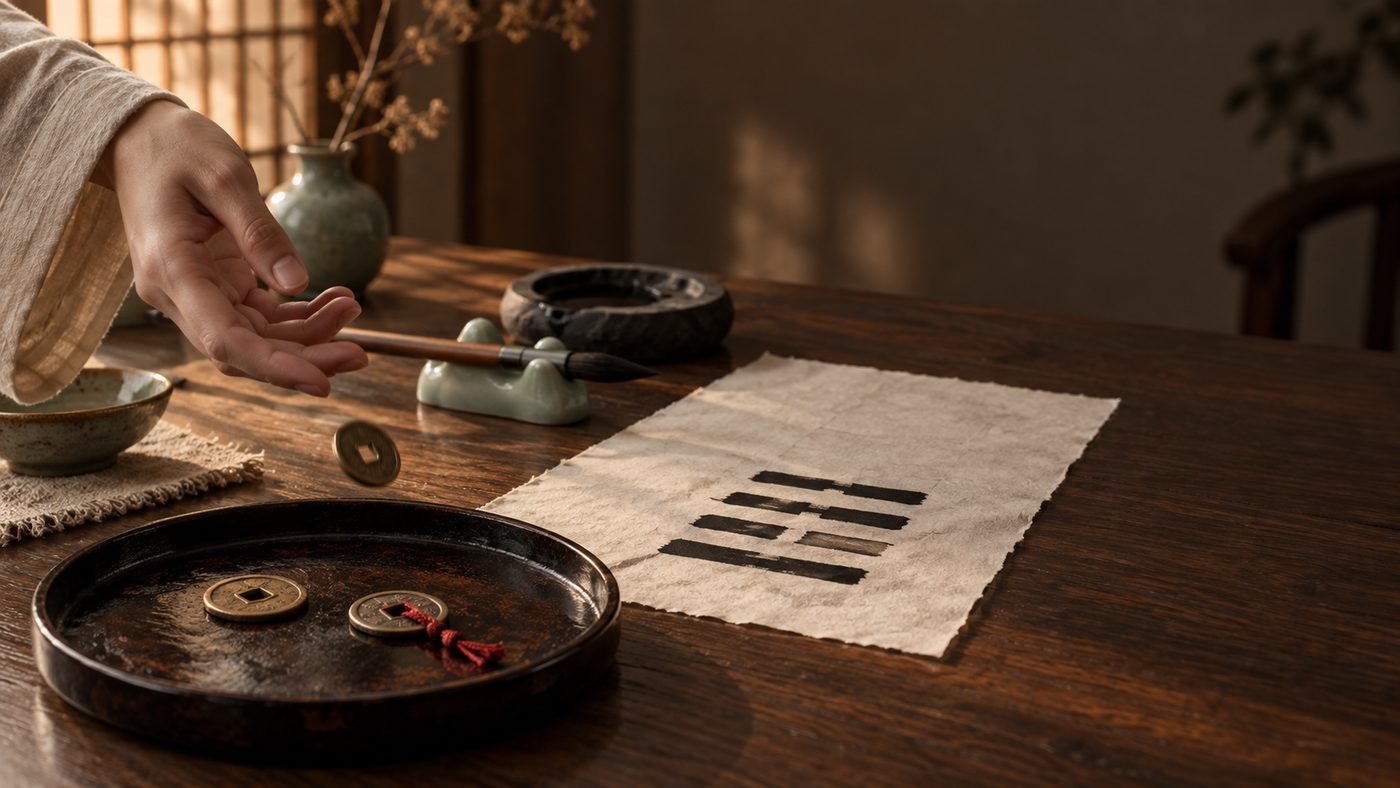
The I Ching, or Book of Changes, answers a question with a picture: six lines stacked from the bottom up, one of 64 possible hexagrams. You build it by tossing three coins six times. Each toss gives one line, solid or broken, and sometimes a moving line that is about to flip. The hexagram you land on, its moving lines, and the hexagram they turn into are your answer. Hold one question in mind and toss below; every hexagram is read in plain English.
Open questions work better than yes or no: "what should I understand about…" rather than "will I…". Typing it is optional, and it never leaves this page.
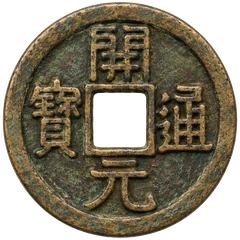
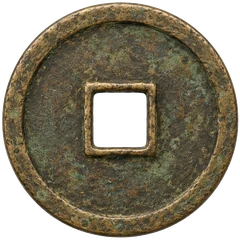
Inscribed side counts 2, plain side 3.
Six tosses, bottom line first.
- Line 1: not cast yet
- Line 2: not cast yet
- Line 3: not cast yet
- Line 4: not cast yet
- Line 5: not cast yet
- Line 6: not cast yet
How to cast the I Ching with three coins
Take three coins and decide which face counts 3 and which counts 2; tradition varies, so pick once and keep it. Toss all three and add them up. The total can only be 6, 7, 8 or 9, and it gives you the bottom line of your hexagram. Toss five more times, building upward. Odd totals make a solid line, the yang line; even totals make a broken one, the yin line. The two extremes, 6 and 9, are "old" lines: so full of their own quality that they are about to turn into the opposite. Those are your moving lines.
| Total | Line | Drawn as | With three coins | With yarrow stalks |
|---|---|---|---|---|
| 6 | Old yin | broken, moving | 1 in 8 | 1 in 16 |
| 7 | Young yang | solid, still | 3 in 8 | 5 in 16 |
| 8 | Young yin | broken, still | 3 in 8 | 7 in 16 |
| 9 | Old yang | solid, moving | 1 in 8 | 3 in 16 |
The last column is the older way of casting, dividing and counting off a bundle of fifty yarrow stalks by hand, many times over for each line. It is not just slower. With stalks a moving solid line is three times as likely as a moving broken one, so firm situations give way more readily than yielding ones. Coins treat the two alike. Neither is the "real" one; the coin method is simply the one most people use, and the one this page simulates.
How to read your hexagram and its moving lines
Start with the judgment, the short oracle attached to the whole hexagram. If you cast no moving lines, which happens in about 17.8% of casts, that is your answer, and the six line texts stay unread. If you cast moving lines, read each of their texts: they are the particular part of the situation that is live for you. Then flip every moving line, broken to solid and solid to broken, and read the new hexagram. It shows where things are heading once the change has run its course.
Readers have argued for centuries over how to weigh several moving lines at once, and the twelfth-century scholar Zhu Xi wrote rules for it that many still follow. This page keeps it simple: it marks every moving line on your hexagram and links the one it turns into, and leaves the weighing to you. One more piece of the book's own advice: ask once. Hexagram 4 says a question asked a second and third time is a nuisance, and gets no answer.
All 64 hexagrams
The hexagrams run in the traditional order of the received text, from Heaven, six solid lines, and Earth, six broken ones, to After Completion and Before Completion, which close the book on a note of unfinished business. Each pair in the sequence is related: most are the same figure turned upside down. Cast a hexagram elsewhere? Find its number and open its judgment and six lines.
- 1 Heaven
- 2 Earth
- 3 Difficult Beginnings
- 4 Youthful Folly
- 5 Waiting
- 6 Conflict
- 7 The Army
- 8 Holding Together
- 9 Small Taming
- 10 Treading
- 11 Peace
- 12 Standstill
- 13 Fellowship
- 14 Great Possession
- 15 Modesty
- 16 Enthusiasm
- 17 Following
- 18 Repairing the Spoiled
- 19 Approach
- 20 Contemplation
- 21 Biting Through
- 22 Grace
- 23 Splitting Apart
- 24 Return
- 25 Innocence
- 26 Great Taming
- 27 Nourishment
- 28 Great Excess
- 29 The Abyss
- 30 Fire
- 31 Attraction
- 32 Duration
- 33 Retreat
- 34 Great Strength
- 35 Progress
- 36 Darkening of the Light
- 37 The Family
- 38 Opposition
- 39 Obstruction
- 40 Release
- 41 Decrease
- 42 Increase
- 43 Breakthrough
- 44 Coming to Meet
- 45 Gathering Together
- 46 Pushing Upward
- 47 Exhaustion
- 48 The Well
- 49 Revolution
- 50 The Cauldron
- 51 Thunder
- 52 Mountain
- 53 Gradual Progress
- 54 The Marrying Maiden
- 55 Abundance
- 56 The Wanderer
- 57 Wind
- 58 Lake
- 59 Dispersion
- 60 Limitation
- 61 Inner Truth
- 62 Small Excess
- 63 After Completion
- 64 Before Completion
What the Book of Changes is
The core of the I Ching is the Zhouyi, the Changes of Zhou: 64 hexagrams, each with a short judgment and six line statements. Its oldest layers are usually dated to the Western Zhou period, roughly 1000 to 750 BC, which makes it one of the oldest books in Chinese. Later came the Ten Wings, a set of commentaries traditionally credited to Confucius, which turned a diviner's manual into a book of philosophy. Tradition credits the eight trigrams, the three-line halves every hexagram is built from, to the legendary sage Fuxi, and the same trigrams still sit on the bagua map of feng shui.
The judgments are terse and old, and every English version is an interpretation. The quoted judgment on each hexagram page is James Legge's of 1882, one of the first complete translations into English, which the Oxford Sacred Books of the East published and which is now in the public domain. Everything else in plain English, the judgments, the line statements and the readings, is our own rendering from the Chinese.
Questions people ask
How does an I Ching reading work?
You hold one question in mind and build a hexagram, a stack of six lines, from the bottom up. With coins, you toss three coins once per line: each coin counts 3 or 2, and the total, 6, 7, 8 or 9, decides whether the line is broken or solid and whether it is moving. The finished figure is one of 64 hexagrams. You read its judgment, then the text of any moving line, then the hexagram the moving lines turn it into.
What are moving lines in the I Ching?
A moving line, also called a changing line, is one that came up as an "old" line: a 6 (old yin) or a 9 (old yang). Old lines are about to turn into their opposite, so they carry extra weight. Their own text is read as part of your answer, and flipping them gives a second hexagram that shows where the situation is heading. A cast with no moving lines is read from the hexagram as a whole.
Are some hexagrams more likely than others?
Not with coins. Each line comes up solid or broken half the time, so every one of the 64 hexagrams has the same chance, 1 in 64. What varies is the moving lines: each line moves one time in four, so a cast with no moving lines at all happens about 17.8% of the time, a bit less than one cast in five.
Coins or yarrow stalks: does the method matter?
It changes the odds of moving lines. With three coins an old yin and an old yang are equally likely, one chance in eight each. The older yarrow-stalk method makes a moving solid line three times as likely as a moving broken one (3 in 16 against 1 in 16). So with stalks, firm lines tend to give way more often than yielding ones. Coins are quicker, came into wide use in the Tang dynasty, and are what this page uses.
Can you consult the I Ching online?
You can cast it online, which is what this page does, with three fair coins simulated by your browser's cryptographic random number generator. The text you get back is the same: the judgment and line statements of the Zhouyi, the core of the Book of Changes. Whether a reading means more than the chance that produced it is a question the I Ching has always left to the reader.
Can I ask the I Ching the same question twice?
The book itself says no. In hexagram 4, Youthful Folly, the oracle says that the first consultation is answered, but asking a second and third time is a nuisance, and a nuisance gets no answer. Cast once, read what you got, and come back to the question when something has changed.
Keep going
- Yes or no oracle When you want a straight answer instead of a picture: the moon blocks, three throws.
- Chinese fortune sticks The temple oracle: one of Guanyin's hundred verses.
- Kua number calculator The trigram your birth year gives you, and the directions that suit you.
- Cast your chart The I Ching reads a moment; your birth chart reads the years.
Sources
- Zhouyi (周易), the Chinese text of the judgments and line statements, on Wikisource
- James Legge, The Yi King, Sacred Books of the East vol. 16 (Oxford, 1882), hexagrams 1 to 32 on Wikisource
- James Legge, The Yi King (1882), full scan on the Internet Archive, for hexagrams 33 to 64
- Wikipedia, "I Ching divination": the coin and yarrow-stalk methods and their line probabilities
- Wikipedia, "I Ching": dating of the Zhouyi core and the Ten Wings, Zhu Xi's yarrow-stalk reconstruction, coins in the Tang
- Zhu Xi, Yixue qimeng (易學啟蒙), "Kao bian zhan": his rules for reading one, two, three or more moving lines (Siku edition with Hu Fangping's commentary, Wikisource)