Chinese Mythology
King Yama (阎王): The Judge of the Dead in Chinese Mythology
King Yama, 阎王 (Yánwáng) or Yanluo Wang, is the judge of the dead in Chinese mythology: a magistrate, not a devil, who sits behind a desk in the underworld with a ledger of every life-span and rules on where each soul goes next. He came to China with Buddhism from the Indian god Yama, and by the Tang dynasty had been filed into a bureaucracy of ten kings, of whom he is only the fifth. Real men have held the post.
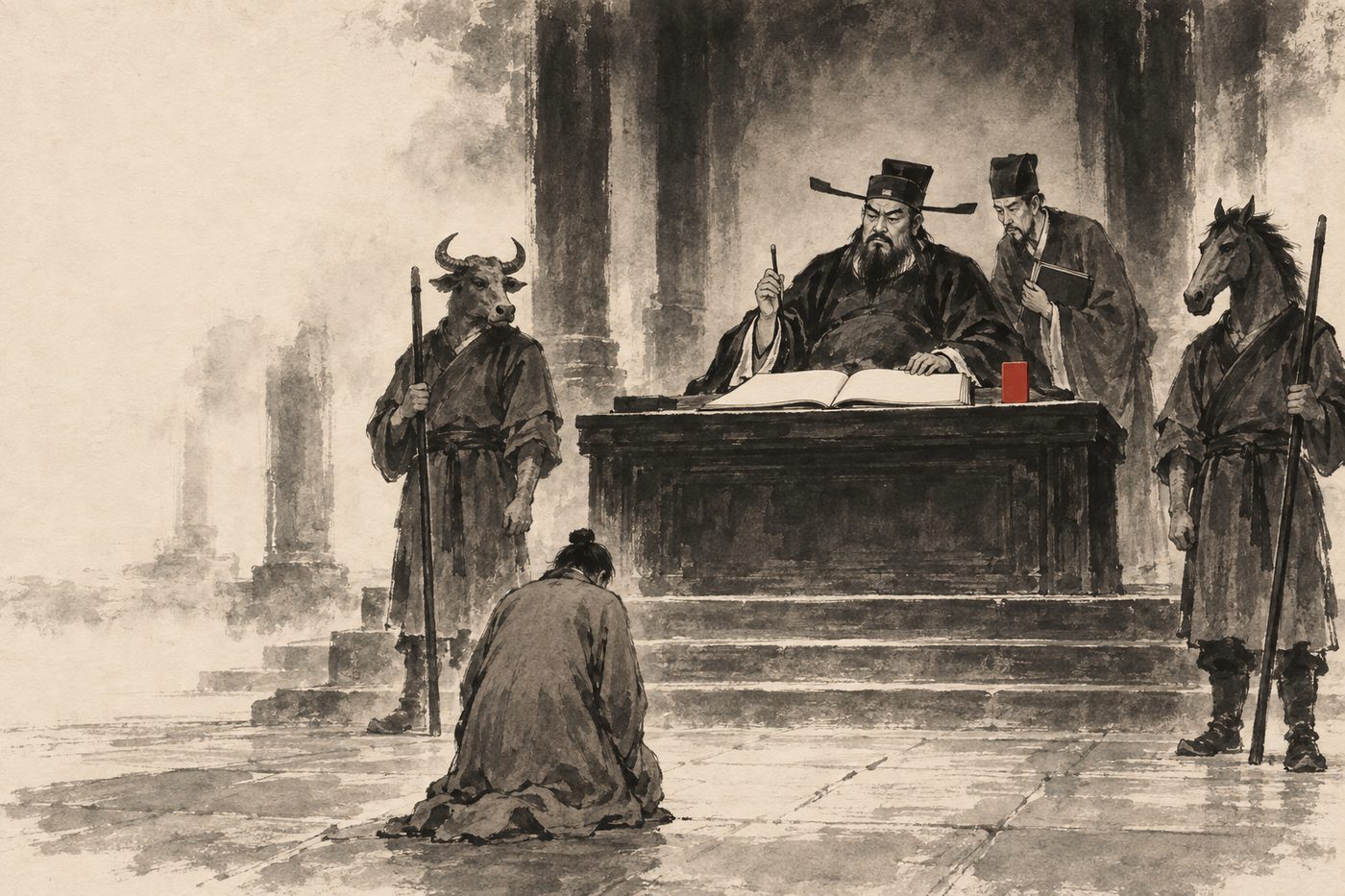
Every culture that believes in judgment after death has to decide what the judge looks like, and China, having run the largest civil service on earth for two thousand years, decided he looked like a magistrate. King Yama, Yánwáng, or in full Yanluo Wang, sits behind a desk. He has a ledger in front of him with your name in it and a number beside the name, which is the year you are due. He has a clerk. He has bailiffs, one with the head of an ox and one with the head of a horse. He has, above him, nine other kings with nine other courts, because he is not, whatever the English word "King" suggests, in charge. He is the fifth of ten. He was, by his own account, demoted. And real men have been appointed to his job.
A courthouse, not an inferno
Ask a Westerner to picture hell and you get fire. Ask a Chinese grandmother and you get paperwork. The great set piece of the Chinese underworld, the one the temples paint and the sixteenth-century novel Journey to the West stages in its eleventh chapter, is not a lake of flame but an audience. The Tang emperor Taizong, dead of a fever and a guilty conscience, is led through the Gate of Ghosts to a palace called the Hall of Senluo, and the novel gives him a proper reception: "Behind them the ten kings of the dead came down the steps," and then names all ten, in order, with Yama in the middle of the list. The kings bow. The emperor bows. There is a brief argument about who should go in first, settled by the kings with a line any civil servant would recognize: "Your Majesty is a king of men among the living; we are kings of ghosts among the dead. Each has his station. Why all this deferring?"
Then the business. The kings send for the ledger of life and death to see how long Taizong has left, and the clerk who fetches it, Judge Cui, finds the number is thirteen years, which is the year the emperor has just reached. Cui was a colleague of Taizong's minister Wei Zheng in life, and the minister has sent him a letter, carried down by the dead emperor himself, asking him to be helpful. So he is. He "snatched up a big brush thick with ink, added two strokes to the character for one, and handed the book up." One stroke, 一, becomes three strokes, 三. Thirteen years becomes thirty-three. The ten kings read it, find nothing amiss, and send the emperor home with twenty years he was never allotted. That is the Chinese underworld in one scene. There is a rule. There is a record. And there is a man with a brush.
Hold that picture, because everything else on this page is a variation on it: a court, a file, a judge who is bound by the file, and staff who are not.
Where you can still walk through his courts
If you want to see the ten courts with your own eyes, the place to go is not China but Singapore. Haw Par Villa, the theme park the Tiger Balm brothers Aw Boon Haw and Aw Boon Par built on Pasir Panjang Road and opened in 1937, has a walk-through diorama of the Ten Courts of Hell: a tunnel of painted plaster in which each court's king sits in judgment and each court's sentence is carried out in loving, lurid detail, tongues pulled, bodies sawn, the whole ledger of Chinese moral bookkeeping rendered for a Sunday outing. Ox-Head and Horse-Face stand at the entrance. Generations of Singaporean children were taken there, Wikipedia notes, in the decades before television, to learn what happened to people who cheated and lied, and a 1995 survey found that many adults still remembered the lesson. In 2021 the park opened Hell's Museum around the dioramas, calling it the world's first museum of death and the afterlife. For a third of Jade Almanac's readers, who live in Southeast Asia, King Yama is not a myth in a book. He is the third court on the left, past the gift shop.
Enma, King Yemma, and the desk in Dragon Ball
Everyone else met him through Japan. The Chinese judge crossed to Korea as Yeomra, to Vietnam as Diêm Vương, and to Japan as Enma, where the Buddhist iconography kept the magistrate's cap and desk and added a red face and a beard, and from Japan he walked straight into the two most-watched afterlives in animation. In Dragon Ball, when Goku dies, the first thing he meets is King Yemma, the enormous official who sits at the afterlife's check-in station, as Wikipedia's plot summaries call it, and sorts the dead through to heaven or hell. That is the English dub's name for him; the Japanese is Enma Daiō, the Great King Enma, which is to say Yanluo Wang, which is to say the man on this page. He is not a villain. He is management. In the film Fusion Reborn the plot turns on the fact that only Yemma can control the boundary between the living and the dead, and when the check-in station is sealed the dead spill back into the world: a Chinese theology lesson delivered at the speed of a fight scene. YuYu Hakusho goes one better and gives King Enma a son, Koenma, who runs the Spirit World's paperwork and offers the freshly dead hero a second chance through a series of tests, which is, give or take the tests, exactly what Judge Cui did for Taizong.
So if the phrase "King Yama" arrived in your head from a cartoon, you have it right. He sits at a desk. He reads a file. Somebody can talk to him.
The proverbs he lives in
Chinese uses him the way English uses the taxman: as the authority you cannot argue with and would rather not meet. Two sayings do most of the work. The first: if King Yama wants you dead at the third watch, who dares keep you till the fifth? The watches are the divisions of the night; the point is that your appointment is in the ledger and no one on earth can move it. The second is more cynical and more useful: King Yama is easy to see; the little devils are the trouble. The judge is fair, or at least bound by the file. It is the clerks and runners, the little devils of any office, who can make your life miserable, and who, as Judge Cui shows, can also be reasoned with. Anyone who has dealt with a government office in any country will recognize the theology.
Ten kings, and he is only the fifth
Now for the surprise. "King Yama" in Chinese is not one king. Some time around the Tang dynasty, Wikipedia's summary of the scholarship runs, the single Buddhist judge was absorbed into a Daoist-flavored bureaucracy of ten courts, each under its own king, and Yama was filed in at number five. The novel's list is the standard one, and here it is with what each name says and what the Jade Record, the underworld's own guidebook, says the court is for:
| Court | The king, as Journey to the West lists them | What the name says | What the court does, per the Jade Record |
|---|---|---|---|
| 1 | Qinguang Wang | King of Qin's Wide Domain | Intake: keeps the register of life-spans; the wicked are shown the Mirror of Sin, inscribed "before this mirror there are no good people" |
| 2 | Chujiang Wang | King of the First River | The Great Hell of the Living, and sixteen small hells |
| 3 | Songdi Wang | King of the Song Emperor | The Great Hell of the Black Rope |
| 4 | Wuguan Wang | King of the Five Offices | The Great Hell of Crushing |
| 5 | Yanluo Wang | King Yama | The Great Hell of Wailing and the sixteen small hells that cut out the heart; the Home-Viewing Terrace |
| 6 | Pingdeng Wang | King of Equality | The Great Hell of Loud Wailing |
| 7 | Taishan Wang | King of Mount Tai | The Great Hell of Burning Heat |
| 8 | Dushi Wang | King of the Capital | The Great Hell of Fierce Burning Heat |
| 9 | Biancheng Wang | King of Bian City | The Avici hell, the one without respite |
| 10 | Zhuanlun Wang | King of the Turning Wheel | Assigns the next birth; the six bridges and Meng Po's tower of forgetting |
Ten judges, in sequence, like a soul being passed from desk to desk with a file that grows thicker at each one. Why is the famous one fifth? The Jade Record has an answer, and it gives it in Yama's own voice. This is a Qing-dynasty morality book, copied and reprinted as an act of merit, as the book itself urges its readers to do, that claims a Song pedigree it almost certainly does not have; but it is the fullest account of the ten courts anyone wrote down, and it is the source of every diorama. In it the "Son of Heaven Yama of the Fifth Court" explains: "I originally sat in the First Court. Because I pitied those who died wronged, and again and again sent them back to the world of the living to clear their names, I was demoted and transferred." Demoted. For mercy. The judge of the dead was too soft on the wrongfully dead, kept releasing them on appeal, and was moved down the corridor to run the Hell of Wailing, where nobody gets sent back. Consider what that says about the theology. Compassion is a fault in a judge. The system is more important than the man. It is the most Chinese sentence in the book.
The ledger, and the clerk who edits it
The ledger is the heart of it. In the novel it is called the register of life and death, 生死簿, and it records, for every living person, the length of their allotted life. The Monkey King's first act of rebellion, several chapters earlier, is to storm the underworld and cross his own name out of it. Taizong's escape is the same trick done politely, from the inside, by a clerk. What both stories assume is that the file is binding on the judge. Yama does not decide how long you live; he reads how long you live. When the doctored ledger says thirty-three, the ten kings look at each other and send the emperor home. The corruption is in the record-keeping, and the record-keeping is human. Judge Cui was a mortal official before he was a ghost one, and he behaves like it.
The Jade Record adds a piece of furniture to Yama's court that no other king has, and it is the cruelest thing in the book. It is called the Home-Viewing Terrace, 望鄉臺, a curved platform eighty-one li round, and the dead are marched up it to watch, with perfect sight and hearing, what is happening at home now that they are gone. The text lists what they see, and it is not demons. It is the will being ignored, the estate being divided, the debts being denied, the widow remarrying, the children quarreling, and then this: "A few, remembering old affection, weep once over the coffin, and laugh coldly twice." Whoever wrote that had been to a funeral. The punishment in Yama's own court is not fire. It is watching your family get on with it.
Ox-Head and Horse-Face
The two bailiffs are older than the ten courts. They are in the Shurangama Sutra, a Buddhist text that reached Chinese in the early eighth century, in the passage on what the dying see: "a great iron city, snakes of fire and dogs of fire, tigers, wolves and lions, ox-headed jailers and horse-headed demons holding spears and pikes, who drive it in through the city gate." In the sutra they are a crowd. By the time of the novel they are a pair, and they have a post: chapter 11 stations "countless Ox-Heads and Horse-Faces, grim-faced, guarding the Naihe bridge," the bridge every soul crosses on the way out. They are the underworld's uniformed police, and they turn up on temple walls, in Haw Par Villa's entrance tunnel, and in the paper effigies burned at funerals, always as a pair, always with the same faintly weary expression of men who have seen every excuse. Their names in Chinese are just their descriptions, 牛头 and 马面, ox head and horse face. They do not have a story. They have a shift.
Men who got the job
Here is the strangest thing about King Yama, and the one that separates him from every other lord of the dead. In China the post is open. It has been filled by mortals, and the appointments are on record.
The first is in the Book of Sui, the official history compiled in 636, in the biography of the general Han Qinhu, who took the southern capital for the Sui in 589. Near the end of his life, the history says, a neighbor's mother saw an honor guard fit for a king at his gate, and a man in it told her, "We have come to welcome the king." Then a sick man came running into the house shouting that he wanted an audience with the king. Which king, the household asked. "King Yama." The sons and nephews wanted to beat him, and the old general stopped them, and said the line that has been quoted for fourteen hundred years: "Alive, a Pillar of State; dead, King Yama. That will do." He went to bed, and within a few days he was dead, at fifty-five. Note what he does not do. He does not protest. He does not pray. He treats the underworld as a second career, the natural next posting for a man of his rank, and the historian records it without a flicker of surprise.
The second is not a ghost story at all but a nickname. Bao Zheng, the eleventh-century magistrate who has become, as Judge Bao, the hero of a thousand operas and television serials, ran the capital's prefecture so straight that, the History of Song records, "the capital had a saying about him: where no string can be pulled, there is old Bao, the Yama." To call a living judge a Yama was the highest praise the city had. It meant he could not be reached. The compliment has stuck: in the folk tradition that grew up after him, Bao Zheng judges by day in Kaifeng and by night in the underworld, and some temples list him as one of the ten kings outright. The Chinese did not think of Yama as a being you feared so much as a standard you could hold a man to.
Before China: a twin, and the first man to die
"But surely," you may say, "he is just the Indian god of death with a Chinese name?" Half right, and the half that is wrong is the interesting half. Yama is in the Rigveda, the oldest Indian text, as the first mortal to die: he found the road to the other world and, having found it, became its king, the gatherer of the people. He is the son of the sun and he has a twin sister, Yamī, and the word yama in Sanskrit means, precisely, twin. Buddhism inherited him as the judge of the hells and carried him east, and in China he became Yanluo, which is simply the sound of the Sanskrit spelled in Chinese characters.
What is remarkable is that the Chinese remembered the twin. A glossary of Buddhist terms compiled by the monk Fayun in 1143, the Fanyi mingyi ji, explains the name to Chinese readers who could not read Sanskrit, and this is what it says: "This means twin kings. A brother and a sister are both masters of the hells; the brother handles the affairs of men and the sister the affairs of women. Hence 'twin kings.'" Two judges, one for each sex, side by side. The popular tradition dropped the sister and kept the desk, but the philology is still there in the name, a thousand years after anyone last pictured her. It also answers, better than any Hindu text, the question people type into search boxes about King Yama's wife. He has no wife in China. He has a sister, and she has half the caseload.
The Buddhist Yama was not, in the sutras, the terror the dioramas make him. In the Ksitigarbha Sutra, the great scripture of the bodhisattva who vowed to empty the hells, King Yama arrives at the Buddha's assembly with an escort of ghost kings, kneels on one knee, puts his palms together, and says he has "a small doubt" he would like to ask about. He is a petitioner. The whole Chinese career of the god, from kneeling questioner to fifth-ranked judge to a nickname for an honest magistrate, is a career in a bureaucracy, with the ranks and the transfers that implies.
The book with our name on it
One last thing. The underworld's guidebook, the Jade Record, is in Chinese the 玉历宝钞, and its first two characters are the two characters of this site's name, Yùlì, the Jade Almanac. It is a coincidence of vocabulary: the "jade" is honorific, the way the Jade Emperor's is, and the "record" and the "almanac" are the same word for a calendar of days. We took our name from the household almanac, the book on the kitchen shelf that tells you which day is good for a wedding. The other Jade Record is the one that tells you which court you are due in. They are kept, the tradition insists, with the same care, and the same brush. You will meet the clerk. Be pleasant to him.
In the classics
The passages behind the story, in the standard published translations. Open any one for the original text.
“Behind them the ten kings of the dead came down the steps: the King of Qin's Wide Domain, the King of the First River, the King of the Song Emperor, the King of the Five Offices, King Yama, the King of Equality, the King of Mount Tai, the King of the Capital, the King of Bian City and the King of the Turning Wheel. ... The ten kings said: "Your Majesty is a king of men among the living; we are kings of ghosts among the dead. Each has his station. Why all this deferring?" ”
Original text
後面卻是十代閻王降階而至,是那十代閻君:秦廣王、初江王、宋帝王、仵官王、閻羅王、平等王、泰山王、都市王、卞城王、轉輪王。……十王道:「陛下是陽間人王,我等是陰間鬼王,分所當然,何須過讓?」
“There he saw that the Tang emperor Taizong of the southern continent was allotted thirteen years of his reign. Judge Cui gave a start, snatched up a big brush thick with ink, added two strokes to the character for one, and handed the book up. The ten kings read it from the top and found thirty-three years written under Taizong's name. ”
Original text
只見南贍部洲大唐太宗皇帝註定貞觀一十三年。崔判官吃了一驚,急取濃墨大筆,將「一」字上添了兩畫,卻將簿子呈上。十王從頭一看,見太宗名下註定三十三年。
“The Son of Heaven Yama of the Fifth Court says: "I originally sat in the First Court. Because I pitied those who died wronged, and again and again sent them back to the world of the living to clear their names, I was demoted and transferred to run the Great Hell of Wailing, under the burning rock at the bottom of the sea to the northeast, together with the sixteen small hells that cut out the heart." ”
Original text
五殿閻羅天子曰:「吾本前居第一殿,因憐屈死,屢放還陽伸雪;降調司掌大海之底東北沃燋石下『叫喚大地獄』、並十六誅心小地獄。」
“Those whose evil outweighs their good are sent up the high platform to the right of the hall, called the Terrace of the Mirror of Sin. The terrace is ten feet high and the mirror ten spans around, hung facing east, and across the top are seven characters: "Before the Mirror of Sin there are no good people." ”
Original text
凡惡多善少者,使入殿右高臺,名為孽鏡臺;臺高一丈,鏡大十圍,向東懸掛,上橫七字,曰:孽鏡臺前無好人。
“The answer came: "King Yama." Qinhu's sons and nephews wanted to beat the man. Qinhu stopped them and said: "Alive, a Pillar of State; dead, King Yama. That will do." He took to his bed, and within a few days he died, aged fifty-five. ”
Original text
答曰:「閻羅王。」擒虎子弟欲撻之,擒虎止之曰:「生為上柱國,死作閻羅王,斯亦足矣。」因寢疾,數日竟卒,時年五十五。
“The capital had a saying about him: "Where no string can be pulled, there is old Bao, the Yama." ”
Original text
京師為之語曰:「關節不到,有閻羅包老。」
“Also written Yanmoluoshe. This means "twin kings." A brother and a sister are both masters of the hells; the brother handles the affairs of men and the sister the affairs of women. Hence "twin kings." ”
Original text
亦云閻魔羅社。此云雙王。兄及妹皆作地獄主。兄治男事。妹治女事。故曰雙王。
“The consciousness of the dead person sees a great iron city, snakes of fire and dogs of fire, tigers, wolves and lions, ox-headed jailers and horse-headed demons holding spears and pikes, who drive it in through the city gate toward the Unceasing Hell. ”
Original text
亡者神識,見大鐵城,火蛇火狗,虎狼師子,牛頭獄卒,馬頭羅剎,手執鎗茅,驅入城門,向無間獄。
As seen in
Dragon Ball Z
anime · 1989King Yemma, the giant official who sits at the check-in station of the afterlife and sorts the dead; the Japanese Enma, which is the Chinese Yanluo, as King Yemma (Enma Daiō).
In Fusion Reborn only Yemma can control the boundary between the living and the dead, which is exactly the Chinese king's brief.
YuYu Hakusho
anime · 1992King Enma is the unseen ruler of the Spirit World; his son Koenma runs the paperwork and gives the dead hero his second chance, as King Enma / Koenma.
Questions people ask
Who is King Yama in Chinese mythology?
King Yama, called Yanluo Wang or simply Yan Wang in Chinese, is the judge of the dead. He came to China with Buddhism from the Indian god Yama and was absorbed into a Chinese picture of the afterlife as a courthouse: ten kings, each with a court, a ledger of life-spans, clerks, and bailiffs with the heads of an ox and a horse. In the standard list, given in chapter 11 of Journey to the West, Yama is the fifth king of ten, and the Qing morality book the Jade Record has him explain that he was demoted from the first court for pitying the wrongfully dead.
Who is King Yama?
Depends who you ask. To a Hindu he is Yama, the first mortal to die, who became the lord of the dead and rides a buffalo. To a Buddhist he is the wrathful judge who presides over the hells and the cycle of rebirth. To a Chinese, Korean, Japanese or Vietnamese reader he is Yanluo, Yeomra, Enma or Diêm Vương: the magistrate of the underworld, one of ten, who reads your record and decides where you go next. The Chinese version is the one this page is about, and it is the one that reached Japan and, through Japan, Dragon Ball.
Is King Yama evil?
No, and that is the point. In Chinese belief he is a judge, not a tempter: he does not want your soul, he processes it. The Jade Record even records his demotion for being too soft. The fear people feel is the fear of an honest court when you know what is in your file, which is why the Song capital could pay its most incorruptible magistrate, Bao Zheng, the compliment of calling him a Yama. The tortures of the hells are real in the texts, but they are sentences, not appetites.
Who are the ten kings of hell?
In the order Journey to the West gives them: the King of Qin's Wide Domain, the King of the First River, the King of the Song Emperor, the King of the Five Offices, King Yama, the King of Equality, the King of Mount Tai, the King of the Capital, the King of Bian City and the King of the Turning Wheel. Each runs one court; a soul passes through them in turn. The first court does intake and holds the Mirror of Sin, over which is written that no one who stands before it is good; the fifth is Yama's; the tenth assigns the next birth and is where Meng Po serves her soup of forgetting.
Who killed Lord Yama?
That question belongs to the Indian Yama. In the Hindu story, Shiva destroys Yama when he comes to take the young devotee Markandeya, then revives him at the gods' request. The Chinese King Yama has no death story at all, because in China the post outlives the holder: he is an official, and officials get replaced. The Book of Sui records a sixth-century general being told on his deathbed that he would be the next King Yama, and taking it as a promotion.
Who is King Yama's wife?
In the Hindu texts Yama has a consort, usually named Dhumorna, and a twin sister, Yami. The Chinese king has no wife in the classical sources, but he has kept the sister: a Song Buddhist glossary explains that the name means "twin kings," a brother who judges the men and a sister who judges the women. The word Yama itself means "twin" in Sanskrit.
Sources & further reading
- Journey to the West (西遊記), Chapter 11, full text (Chinese Wikisource)
- The Jade Record (玉歷寶鈔), full text (Chinese Wikisource)
- Book of Sui (隋書), juan 52, the biography of Han Qinhu (Chinese Wikisource)
- History of Song (宋史), juan 316, the biography of Bao Zheng (Chinese Wikisource)
- Fanyi mingyi ji (翻譯名義集), the Song glossary of Buddhist terms, entry on Yama (Chinese Wikisource)
- Shurangama Sutra (楞嚴經), juan 8 (Chinese Wikisource)
- Ksitigarbha Sutra (地藏菩薩本願經), middle scroll, chapter 8, 'The Praises of King Yama and His Host' (Chinese Wikisource)
- Anthony C. Yu, 'The Journey to the West', Revised Edition (University of Chicago Press), the standard English translation
- Yama (Buddhism) (Wikipedia)
- Yama, the Hindu god of death (Wikipedia)
- Haw Par Villa, Singapore, and its Ten Courts of Hell (Wikipedia)
- Dragon Ball Z: Fusion Reborn, plot (Wikipedia)
- YuYu Hakusho, plot (Wikipedia)
By Julian 祝君瑜, retold from the classics, with the original passages cited, updated 2026-09-17