Chinese Mythology
White Tiger (白虎): Guardian of the West, and the Stars It Is Made Of
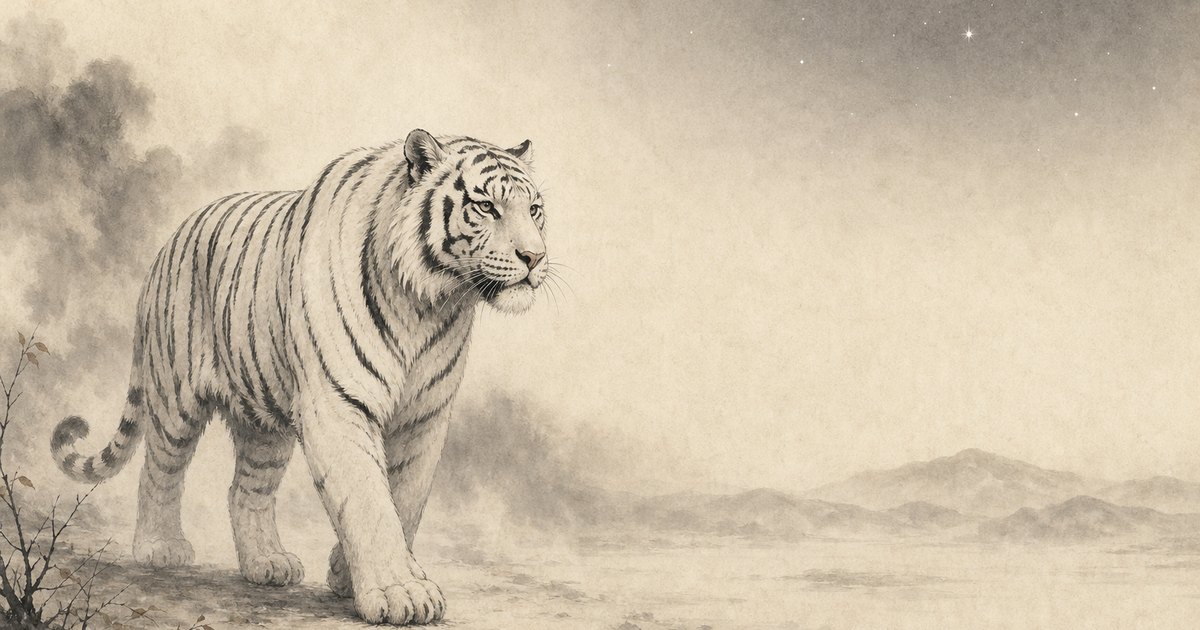
The White Tiger, 白虎 (báihǔ), guards the west: autumn, the element metal, war, and punishment. It is also the least mythical of China's mythical beasts. The tiger is a group of stars, seven lunar mansions that include the Pleiades and all of Orion, and Sima Qian wrote down which stars are its shoulders more than two thousand years ago.
Were you born in a Year of the Tiger?
Enter your birth date to find out your sign and which of the five elements it falls under. We handle the Chinese New Year cutoff, so a birthday in January or early February lands on the right side.
Chinese fortune-telling reads a lot into a birthday. For a playful old birth-chart custom, try our Chinese gender predictor.
Go outside on a clear winter evening, anywhere in the northern hemisphere, and find Orion. Almost everybody can: three bright stars in a row, a hazy little sword hanging beneath them, and four corner stars marking the shoulders and the feet of a giant. It is the one constellation that survives light pollution and a total lack of interest in astronomy.
You have just found the White Tiger. Not a symbol of it, not an allusion to it. In the Chinese sky those same stars are part of the animal's body, and we know which part, because Sima Qian wrote it down around 94 BCE and the note survives.
The tiger is a group of constellations
Chinese astronomy divides the sky along the path of the moon into twenty-eight xiù, "mansions" or lodges, in the way a Western star atlas divides it into constellations. The twenty-eight are then grouped in fours, seven mansions to a quarter, and each quarter is an animal. East is the Azure Dragon, south the Vermilion Bird, north the Black Tortoise, and west the White Tiger. The whole partition is set out here, including why the count is twenty-eight and why the quarters are numbered east, north, west, south rather than in compass or seasonal order.
The tiger's seven, in order, are Legs, Bond, Stomach, Hairy Head, Net, Turtle Beak, and Three Stars. Two of those you already know under other names. Hairy Head is the Pleiades, the little smudge of stars that looks like a tiny dipper and turns out under binoculars to be a swarm. Net is the Hyades, the V of Taurus. And Three Stars, the last mansion of the set, is Orion.
Here is where the Records of the Grand Historian becomes startling. In his treatise on the celestial offices, the founding work of Chinese observational astronomy, Sima Qian says flatly that Shen, that seventh mansion, is the White Tiger, and then breaks the constellation down piece by piece. The three stars in a straight line are the Balance Stone: Orion's Belt. The three sharp stars below them are called the Punishment, and they govern cutting down and slaughter: Orion's Sword. And the four stars outside those, he says, are the left and right shoulders and haunches.
Read that last sentence next to a modern star chart and something quietly remarkable happens. Betelgeuse and Bellatrix are the shoulders of Orion in the Western tradition; Rigel and Saiph are the feet. Two astronomical cultures with no contact worth mentioning looked at the same four bright points, made the same anatomical reading, and hung a different creature on it. One saw a hunter with a raised club. One saw a tiger. The stars were doing the same work in both skies.
Six thousand years of standing on the west
The written record for the Four Symbols goes back to the Warring States period. The archaeological record goes back a great deal further, and it is one of the most striking finds in Chinese prehistory.
In 1987, at a site called Xishuipo just outside Puyang in Henan, excavators opened a Neolithic burial numbered M45. Inside lay a tall adult man, a little over a meter eighty, and on either side of him, laid out in clam shells on the floor of the grave, were two animals: a dragon on his east side, roughly one meter seventy-eight from nose to tail, and a tiger on his west, about one meter ninety. The dragon arches its back as though about to spring. The tiger walks.
The burial has been dated to around 6,400 years before the present. That is some four thousand years before the Book of Rites, three and a half thousand before Sima Qian, and long before writing in China of any kind. Somebody in Neolithic Henan already knew that the dragon goes on the left hand and the tiger on the right, and cared enough to spend weeks arranging shells to prove it. Archaeologists call the dragon of M45 the first dragon in China. The tiger beside it is just as old and gets a fraction of the attention, which seems unfair.
The banner on the right
By the time the classics were compiled, the arrangement had hardened into ritual. The Book of Rites gives the order of march for an army, and it is a list of banners: the Red Bird goes in front, the Dark Warrior behind, the Azure Dragon on the left, and the White Tiger on the right. James Legge translated the passage in 1885, and the sentence has been the standard citation ever since.
Note what that instruction actually is. It is not decoration and it is not symbolism in the loose sense. It is a rule for orienting a body of moving men to the compass, using four animals as the compass rose, so that the formation carries the shape of the sky into a muddy field. The same logic runs the other way in architecture: Han tombs carry the four beasts on their walls and on the round eaves tiles of their roofs, one to each side of the building, so the structure sits inside a correctly oriented universe.
Daoism later gave the four of them names and ranks, turning astronomical quarters into divine officers. The Azure Dragon becomes Lord Mengzhang, the Vermilion Bird Lord Lingguang, the Black Tortoise Lord Zhiming, and the White Tiger becomes Jianbing, the Divine Lord Who Oversees the Troops. It is the most on-the-nose job title in the Chinese pantheon, and it tells you exactly what the west was thought to be for.
Metal, autumn, and the season for killing
The five-phase system assigns west the element metal, the season autumn, and the color white. Follow those three out to their human consequences and you arrive at the tiger's whole portfolio.
Metal is blades. Autumn is the harvest, which is to say the season in which living things are cut down on purpose, and then the killing frost. Put them together and you get the traditional Chinese association of the west with war, weapons, judgment, and execution. This was not a metaphor for the people running the empire. Imperial law held for most of two thousand years that death sentences should be carried out in autumn and winter rather than in the growing seasons, on the reasoning that the state's killing ought to fall in the part of the year when killing is what nature is doing anyway. Sima Qian's three sword-stars beneath Orion's belt, the ones he calls the Punishment and assigns to cutting down and slaughter, sit in the middle of the same idea.
None of that makes the tiger evil. West is where the sun goes, autumn is where the year goes, and every complete cosmology needs a quarter that handles endings. The White Tiger is the officer on that watch.
The one you keep low
Then there is the feng shui version, which is where most people meet the White Tiger without knowing they have.
Stand in your front door and look out. Popular practice calls the ground on your left the azure dragon side and the ground on your right the white tiger side, and it wants the dragon side to be the higher of the two: a taller hill, a taller building, more mass. A tiger side that rises above the dragon side is called báihǔ táitóu, "the white tiger raising its head," and practitioners treat it as a problem to be softened. There is a rhyming rule of thumb that gets quoted constantly in Chinese-language feng shui writing, to the effect that you would rather have the dragon ten thousand feet high than the tiger lifting its head at all.
Two honest notes. First, this is folk practice, not classical doctrine: it is a living tradition with real internal logic and real practitioners, and it is not something Confucius or Sima Qian would recognize as an instruction. Second, the left-right framing is relative to the building, not to the map, which is a detail an alarming amount of English-language writing on the subject gets backwards. If you want the parts of feng shui that do run on a fixed compass and a birth date, our feng shui guides work from the kua number instead.
Why it is white, and why that is not a white tiger
The color trips people constantly, especially online, where the Chinese guardian gets illustrated with photographs of the pale Bengal tigers kept in zoos.
White in this system is a coordinate. Each direction has one: green-blue for the east and spring, red for the south and summer, black for the north and winter, yellow for the center, white for the west and autumn. The tiger is white for the same reason the dragon of the east is azure, which is that the direction is, and the animal takes the color of the office. A rare recessive coat in Panthera tigris has nothing to do with it, and the Chinese record shows no interest in one.
Where the record does show interest is in tigers as omens. A white tiger appearing was occasionally read in dynastic histories as a sign that a ruler was governing humanely, on the general principle that unusual animals show up when the state is being run properly. Treat that the way you would treat any imperial portent: as court literature about politics, filed under natural history.
What it leaves behind
The White Tiger has had a quieter afterlife than the dragon, but it is embedded deeper than most people notice. Its name is on a room: in 79 CE the Han emperor Zhang gathered the empire's scholars in the White Tiger Hall in Luoyang to settle disagreements about the classics, and the record of that conference, the Bai Hu Tong, is one of the documents that fixed the five-phase correspondences we have been using all the way through this page, including the one that makes wisdom a water virtue. Its name is on the map, in the tiger-shaped ridges that Chinese siting practice looks for. And its name is on half the video-game bestiaries in East Asia, where Byakko, the Japanese reading of the same two characters, has been guarding the western gate of one fictional world after another since the 1980s.
The living animal that lent it a shape is another matter. Tigers are the zodiac's third sign and were, until very recently, a real hazard across most of China. The celestial one is safer company. It stands to the west, it holds up autumn, it takes the endings so the dragon can have the beginnings, and on a cold clear night in February it is directly overhead, three stars in a row, exactly where Sima Qian left it.
In the classics
The passages behind the story, in the standard published translations. Open any one for the original text.
“Shen is the White Tiger. The three stars in a straight line are the Balance Stone. Below them are three sharp stars called the Punishment, which govern cutting down and slaughter. The four stars outside these are the left and right shoulders and haunches. ”
Original text
參為白虎。三星直者,是為衡石。下有三星,兌,曰罰,為斬艾事。其外四星,左右肩股也。
“On the march the banner with the Red Bird should be in front, that with the Dark Warrior behind, that with the Azure Dragon on the left, and that with the White Tiger on the right. ”
Original text
行:前朱鳥而後玄武,左青龍而右白虎。
Questions people ask
What is the White Tiger in Chinese mythology?
The White Tiger, 白虎 (báihǔ), is the guardian of the west, one of the Four Symbols that hold the four quarters of the Chinese sky alongside the Azure Dragon of the east, the Vermilion Bird of the south, and the Black Tortoise of the north. It rules autumn, the element metal, and the human activities that belong to them: war, weapons, and punishment. It is also an astronomical object rather than only a story, being the name for a group of seven constellations in the western sky.
Which constellations make up the Chinese White Tiger?
Seven of the twenty-eight lunar mansions, running from Legs and Bond through Stomach, Hairy Head, Net, Turtle Beak, and Three Stars. In modern terms they cover parts of Andromeda, Aries, Taurus, and Orion. Hairy Head is the Pleiades, Net is the Hyades, and Three Stars is Orion, so the belt, the sword, and the four bright corner stars of Orion all sit inside the tiger.
Why is the tiger white?
Because west is white. In the five-phase system each direction has an assigned color, and metal, autumn, and the west all take white, in the same way that the dragon of the east takes the blue-green of spring vegetation and the tortoise of the north takes black. The color is a coordinate rather than a description of the animal. Real white tigers, the rare pale Bengals kept in zoos, have nothing to do with it.
Is the White Tiger good luck or bad luck?
Both, depending on which tradition is speaking. As a celestial guardian it is entirely benign: a protector carved on tomb doors and eaves tiles and named in Daoist ritual as a divine general. In popular feng shui the white tiger side of a site, meaning the right as you stand in a doorway looking out, is the side you want to keep low and quiet, and a building or hill that rises too high there is treated as a problem. That second body of belief is folk practice rather than classical doctrine, and it deserves the lighter grip.
What is the oldest White Tiger in China?
A grave. In 1987, at Xishuipo near Puyang in Henan, archaeologists opened a burial in which the body of a tall adult man had been laid with a dragon picked out in clam shells on his east side and a tiger in clam shells on his west. It has been dated to roughly 6,400 years ago, which puts the dragon-left, tiger-right arrangement thousands of years before any text that describes it.
What is the difference between the White Tiger and the Azure Dragon?
They are opposite corners of the same system. The Azure Dragon holds the east, spring, wood, and growth; the White Tiger holds the west, autumn, metal, and the cutting down that ends growth. In practice the pair is almost always named together, in the Book of Rites banner order, on Han tomb reliefs, on temple gates, and in the feng shui formula about what should stand on your left and on your right.
Sources & further reading
- White Tiger (China), Wikipedia (the seven western mansions and their modern star identifications)
- Four Symbols (Chinese constellation), Wikipedia (the four quarters, their elements and seasons)
- Twenty-Eight Mansions, Wikipedia (the lunar-mansion system the tiger is a quarter of)
- The Book of Rites, Quli I: the banner order on the march (Chinese Text Project, Legge translation)
- Records of the Grand Historian, Treatise on the Celestial Offices, the passage identifying Shen as the White Tiger (Chinese Text Project)
- Xishuipo, Wikipedia (the Yangshao burial M45 with its clam-shell dragon and tiger flanking the body)
- Excavating Xishuipo: a first-hand account of the 1987 dig and the dating of the dragon-and-tiger burial (Henan CPPCC)
- 四象, Chinese Wikipedia (the Daoist titles of the four guardians, including the White Tiger as Jianbing)
- Orion (constellation), Wikipedia (Betelgeuse and Bellatrix as the shoulders, Rigel and Saiph as the feet)
- Bai Hu Tong, Wikipedia (the White Tiger Hall conference of 79 CE, which took its name from the hall)
By Julian 祝君瑜, retold from the classics, with the original passages cited, updated 2026-08-26