Chinese Mythology
Gonggong: The Chinese Water God Who Knocked the Sky Askew
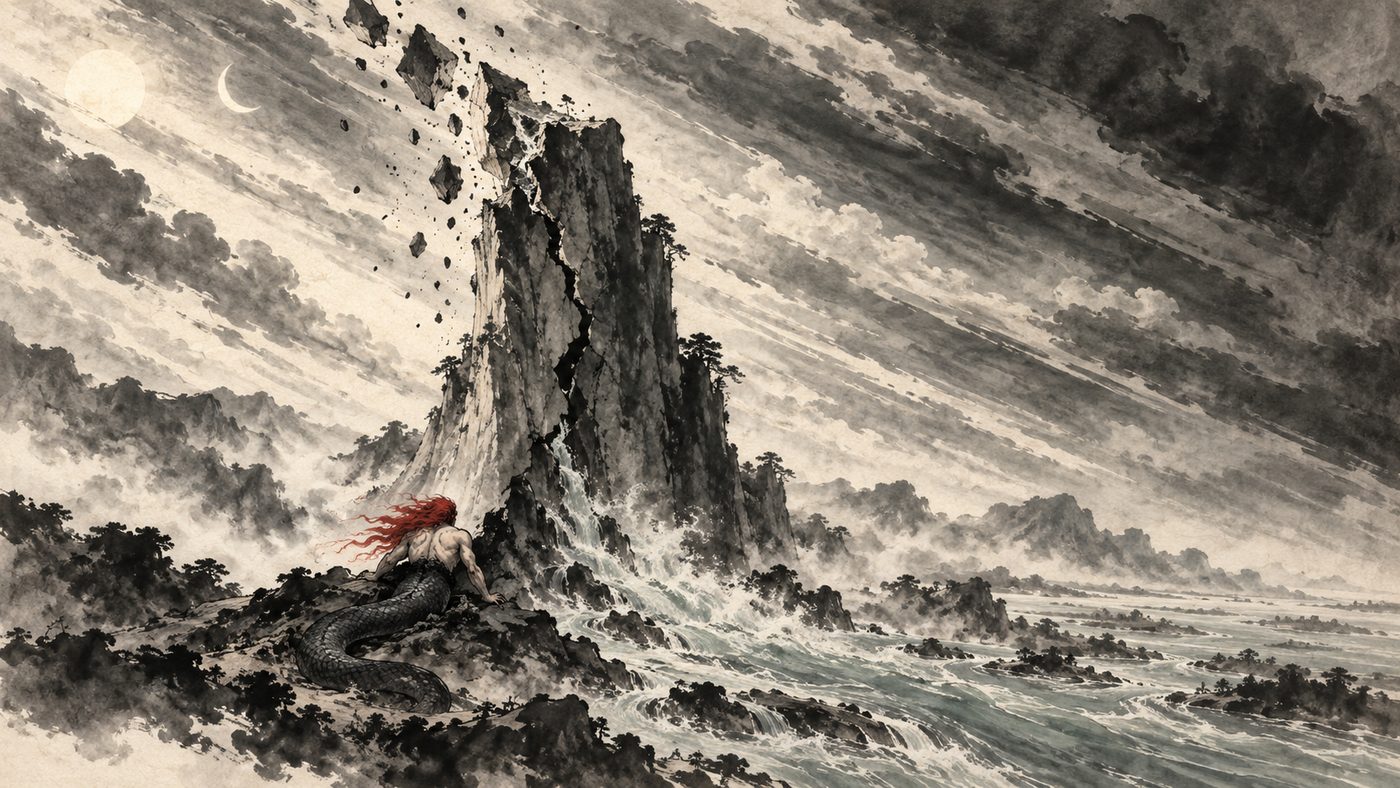
Gonggong 共工 (Gòng-gōng, roughly "gong-gong") is the Chinese water god who lost a fight to be emperor and, in his rage, rammed his head into Mount Buzhou, the mountain that held up the sky. The pillar broke, heaven tipped toward the northwest and the earth sagged to the southeast, which is why, says the Huainanzi, the stars drift west and China's rivers run east. The dwarf planet Gonggong, named in 2020, takes its name from him.
Who Gonggong is
First, the housekeeping. If you searched for Gonggong and wanted the dwarf planet beyond Neptune, you are one step removed: the planet was named after him in 2020, and he is the subject of this page.
Gonggong is the Chinese water god who lost his temper so badly that the universe still leans. He fought for the throne of heaven, lost, and in his rage ran headfirst into Mount Buzhou, the mountain that held up the sky. The mountain broke. The sky tipped toward the northwest, the earth sagged toward the southeast, and everything that was not fastened down began to slide. That, according to a Chinese book of 139 BCE, is why the stars wheel off to the west every night and why China's great rivers all run east to the sea.
He is not only a god. Depending on which ancient book you open, Gonggong is a water deity, a rebel lord, a whole clan that once ruled the nine regions, the first ruler to try to dam the world's rivers, the father of the god of the soil, and, oddly, a job title. He is also, in nearly every old source, the loser. What makes him worth a page is how many different people he managed to lose to.
Where you meet him today
Mostly, these days, in the sky.
In 2007 three astronomers at Palomar, Meg Schwamb, Mike Brown and David Rabinowitz, found a distant, reddish, icy world out past Neptune and spent twelve years calling it 2007 OR10. In 2019 they put a shortlist of names to a public vote. Schwamb announced the result on the Planetary Society's site that May: more than 280,000 votes, a late surge past the Norse god Vili, and the winner was Gonggong. The Minor Planet Center made it official on 5 February 2020, and the citation it published reads like a character reference: "Gonggong is a Chinese water god with red hair and a serpent-like tail. He is known for creating chaos, causing flooding, and tilting the Earth." Its one known moon was named at the same time, and it is called Xiangliu, after the water god's nine-headed serpent minister. Somewhere past Neptune a Chinese water god is still orbiting with his henchman in tow.
He has a political afterlife too, which is rarer for a god who breaks things. Mao Zedong wrote a poem after the Red Army beat off the Nationalists' first "encirclement" campaign in the winter of 1930 to 1931, and before it was published in People's Literature in 1962 he changed its last line to "red flags in wild disorder beneath Mount Buzhou." He also wrote a note of more than four hundred characters, as the People's Daily history channel recounts, lining up the ancient versions of the story and choosing one. "Accounts differ," he wrote. "I take the Huainanzi's Patterns of Heaven: Gonggong is a victorious hero." And then, reading the text with a lawyer's eye: did Gonggong die? "It doesn't say. It seems he did not die. Gonggong really did win." Two thousand years of commentators had treated him as a warning. Mao read the same lines and saw a man who knocked down the old heaven and walked away.
He turns up in games when a game needs a catastrophe. Ubisoft's 2021 expansion Immortals Fenyx Rising: Myths of the Eastern Realm is built around Nüwa mending the heavens, and its writers explained that they had several Gonggongs to choose from, one closer to a demonic monster and one closer to a Chinese Poseidon, and went with the version in which he rebels against the emperor.
And he is in a bowl of beans. A sixth-century almanac of the customs of the Chu region, the Jingchu suishi ji, notes that people cooked red-bean congee on the winter solstice, and its commentary gives the reason: Gonggong had a worthless son who died on the solstice and became a plague demon, and the demon is afraid of red beans. So you cook red beans, and the demon stays away. The bowl later drifted a few weeks down the calendar and became the sweet porridge of Laba.
Finally, the most famous novel in Chinese has him on its first pages, if you know where to look. Dream of the Red Chamber begins its human story in Suzhou with the phrase "in the days when the earth sank in the southeast." An educated reader would have known whose fault that was.
The mountain that held up the sky
The famous version comes from the Huainanzi, a compendium of learning assembled at the court of Liu An, King of Huainan, and presented to Emperor Wu in 139 BCE. It is worth knowing which chapter it sits in, because that changes what kind of story it is. It is not in a chapter of legends. It is in the "Treatise on the Patterns of Heaven," the astronomy chapter.
Here is the whole of it. Long ago Gonggong fought with Zhuanxu, a grandson of the Yellow Emperor, to become emperor. "In his fury he butted Mount Buzhou. The pillar of heaven broke and the cords that tie down the earth snapped. Heaven tilted to the northwest, and so the sun, the moon and the stars move that way; the earth fell short in the southeast, and so the waters and the dust come to rest there." Then, without a paragraph break, the chapter carries on explaining why heaven is round and earth is square.
So the myth is doing a job. Anyone in the Han who looked up saw the whole night sky turn around a point that was not overhead but hung well up in the north, and the stars sinking away westward. Anyone who looked at a map knew that the Yellow River and the Yangtze both rise in the high west and run down to the sea in the east. A cosmology in which heaven is a canopy on pillars and earth is a flat square has to account for both, and the collision accounts for both at once. (That is our reading of why the story sits where it sits; the Huainanzi itself just states the tilt and moves on.) It is the same instinct that, about four centuries later, put a cosmic egg at the start of the Pangu story: a myth drafted by people who were interested in how the sky worked.
Mount Buzhou itself is in the Classic of Mountains and Seas, that gazetteer of monsters and marvels compiled between the Warring States and the Han: beyond the northwest sea, at the corner of the great wilderness, "there is a mountain that does not close," called Buzhou. The name means something like "not whole" or "not joined," as if the gap were already there before anyone ran into it.
And the question the myth answers had already been asked. The Heavenly Questions, a long poem of riddles about the cosmos attributed to Qu Yuan in the third century BCE, simply wants to know: "Kanghui was filled with fury: why then does the earth sink to the southeast?" The poem gives no answer, which is its habit. The second-century commentator Wang Yi supplied one: Kanghui is Gonggong's personal name.
Who was he fighting?
Here the tidy myth falls apart, because the sources cannot agree on who beat him. The Huainanzi alone manages two opponents in two chapters.
| Opponent | What happens to Gonggong | Source | When it was written |
|---|---|---|---|
| Zhuanxu, grandson of the Yellow Emperor | Loses, butts Mount Buzhou and tilts the world; in another chapter Zhuanxu executes him "for the harm of water" | Huainanzi, Patterns of Heaven and the military chapter; Liezi | 139 BCE; Liezi later |
| Gaoxin, another ancient emperor | Butts the mountain, sinks into the abyss, his clan wiped out and no heirs left to sacrifice to him | Huainanzi, Originating in the Way | 139 BCE |
| Zhurong, the fire god | Loses, butts the mountain, and Nüwa has to repair the sky | Sima Zhen, Basic Annals of the Three Sovereigns | 8th century CE |
| Yao and Shun, the sage emperors | Denounced as a smooth talker and banished to Youzhou in the far north | Book of Documents; Sima Qian | Zhou tradition; c. 94 BCE |
| Yu the Great | Driven out; Yu kills his nine-headed minister | Xunzi; Classic of Mountains and Seas | 3rd century BCE; Warring States to Han |
The Zhurong version is the one with the neatest symbolism, water against fire, and so it is the one most modern retellings pick. It is also the latest. It comes from Sima Zhen, a Tang scholar who in the eighth century wrote a supplementary chapter for Sima Qian's great history to cover the rulers before the Yellow Emperor, whom Sima Qian had left out. His Gonggong is a lord who "tried to make water ride over wood," which is the theory of the five phases talking, then fights Zhurong, loses, and takes it out on the mountain.
There is an irony buried in the family tree. The Classic of Mountains and Seas, in its chapter on the regions within the seas, traces Gonggong's descent from the Flame Emperor through several generations to Zhurong himself: "Zhurong came down to live by the Yangtze, and fathered Gonggong." In one book the fire god is his father. In another he is the enemy who beats him. Mythology is not a single database, and nobody at the time tried to make it one.
Did Gonggong break the sky Nüwa mended?
Every modern retelling says so. Gonggong smashes the pillar, the sky cracks, fire and flood pour out, and Nüwa smelts five-colored stones to patch it. It makes a very satisfying two-act story. The oldest texts do not tell it.
The Huainanzi has both stories, and keeps them in separate chapters. Its Nüwa passage, in the chapter called "Peering into the Obscure," opens on a world that has already fallen apart, four pillars down and the nine provinces split, and never says why. Its Gonggong passage, in the astronomy chapter, breaks one pillar and tilts the sky, and never mentions a repair. Nobody in the book connects them.
The Liezi, a Daoist book traditionally assigned to a Warring States sage but, in the form we have it, generally dated by scholars to the third or fourth century CE, puts both in one paragraph, and in the opposite order. First, "long ago Nüwa smelted stones of five colors to patch its gaps, and cut the legs off the great turtle to prop up the four corners." Then: "After that, Gonggong fought with Zhuanxu." In the Liezi, Nüwa's repair comes first, and Gonggong breaks the sky afterward. The Liezi mentions no second repair, which is presumably why the sky still leans.
It is Sima Zhen, again, who joins them into cause and effect. His annals give Nüwa a reign, and "in her last years" Gonggong fights Zhurong and breaks the pillar, and "Nüwa then smelted stones of five colors to patch the sky." The story everyone now tells is an eighth-century arrangement of two older myths that had lived side by side for centuries without meeting.
Not everyone had been impressed by either of them. Wang Chong, the great skeptic of the first century CE, took the Gonggong story apart in his Lunheng with the patience of a man checking a bad invoice. "A mountain might be shaken, but Gonggong's strength could not break it. Or was it that, when heaven and earth first parted, mountains were small and people were large?" If the sky had truly been propped on a mountain and Gonggong snapped it, he went on, how did Nüwa reach it to mend it? And if a turtle's legs could hold up heaven, how large was the turtle, and who could have cut them off? He concluded that the scholars who told the story were probably describing something real, and that the details were nonsense.
The first dam-builder
The collision is the part everyone remembers. The part that shaped Chinese thinking about water is older, and it makes Gonggong a civil engineer.
The Discourses of the States, a collection of speeches compiled in the Warring States period, has a Zhou prince lecture his king, around 550 BCE by the book's reckoning, against damming a river that threatened the palace. His first example is Gonggong. "Long ago Gonggong abandoned this way. He sank into pleasure and let himself go, and set out to dam up the hundred rivers, pulling down the heights to fill in the low places, and so did harm to the world." Heaven did not bless him, the people did not help him, "and by them Gonggong was destroyed." Then comes the second example, and it is a name you may know: in the age of Shun, the prince says, Gun, the Earl of Chong, "carried on Gonggong's error," and was put to death for it. After Gun came his son, Yu the Great, who did the opposite: he dredged the rivers and let the water go.
So in this telling Gonggong is the founder of a school of flood control, the wrong school. Wall the water in, level the hills to do it, and you will be destroyed. Gun is his disciple and Yu is the reformer who proved them both wrong. The Huainanzi agrees in its own way: "in the time of Shun, Gonggong stirred up the flood" until it lapped at a place called Kongsang, and Shun had to send Yu to cut channels to the sea.
The Book of Documents gets personal about it. When a courtier recommends Gonggong for high office, the emperor Yao snorts: "Bah! His words are fine and his deeds go against them. He looks respectful, but his arrogance floods the sky." (The scholar Zhao Chaoyang has suggested that the last phrase is a copying error for something plainer, that he "made a flood rise to the sky," which would make it a charge sheet rather than a character sketch. It is an attractive idea and remains an idea.) Shortly afterward Gonggong is banished to Youzhou, in the far north, one of the "four criminals" whose punishment made the whole world submit.
Yu, for his part, finished the job. The philosopher Xunzi in the third century BCE sums up Yu's career in a jingle that ends: he "removed the people's affliction and drove out Gonggong." The Classic of Mountains and Seas gives the gorier version. Gonggong's minister was Xiangliu, a serpent with nine heads that ate from nine mountains, and wherever it touched turned to swamp. Yu killed it, and its blood stank so badly that no grain would grow; three times he filled the ground in and three times it sank. You can find Xiangliu among the creatures of Chinese myth, and, since 2020, in orbit.
A family of water officials
Behind the god there seems to be a people. The Zuo Commentary, a history of the eighth to fifth centuries BCE, has a visiting lord explain how the ancient rulers named their officials: the Yellow Emperor after clouds, the Flame Emperor after fire, "the house of Gonggong recorded things by water, so its officials were water-masters and took water names." The Chinese often write him as Gonggong-shi, "the house of Gonggong," and the books that treat him as a clan rather than a god talk about his rule, his lineage and his extinction, not his tail.
That lineage, in the Classic of Mountains and Seas, runs back to the Flame Emperor, which makes Gonggong a distant relation of Jingwei, the Flame Emperor's daughter who drowned in the Eastern Sea and became a bird that carries twigs and stones from the western hills to fill it in. It is a family that does not get on with water. She tries to fill up the sea; he tries to fill up the low ground and dam the rivers. Neither succeeds.
It runs forward, too, and more respectably. "When the house of Gonggong held sway over the nine regions," says the Book of Rites, its son was called Houtu, "and he was able to level the nine regions, and so he is sacrificed to at the earth altar." The Zuo Commentary names the son Goulong and says the same. So the son of the man who wrecked the land became the god of the land, and every village shrine to the earth god descends, on paper, from Gonggong's household. The worthless son of the solstice congee was, presumably, a different boy.
Then there is the name itself. The characters mean roughly "together" and "work," and in the Book of Documents the word is also a job. When Shun asks who can take charge of his craftsmen, the court names a man called Chui, and Shun says: "Chui, you shall be Gonggong." Sima Qian repeats it: Chui was made Gonggong, the minister of works. Whether the office was named after the ancient water-clan, or the clan and the god grew out of the memory of an office, nobody can now say. It is at least suggestive that the villain of Chinese flood myth shares his name with the title of the man in charge of public works.
Villain, rebel, or winner?
For most of Chinese history the answer was villain, and the portraits got worse as they went. A fragment of the Guicang, a lost divination manual quoted by later commentators, gives him "a human face, a snake's body and red hair." The Shenyi jing, a Han-or-later book of marvels attributed to the court wit Dongfang Shuo, puts him in the northwestern wilderness with the same red hair and serpent's body, human hands and feet, and adds a four-word character assessment that translates, without exaggeration, as greedy, wicked, stupid and stubborn. That is where the red hair and the serpent's tail on the Minor Planet Center's citation come from. The "copper head and iron forehead" some English sources add do not come from any of the texts cited on this page.
Then, in the twentieth century, a revolutionary poet took the same passage the commentators had used as a warning and read it as a victory. Mao's note does not claim that Gonggong was good. It claims that he won, because the Huainanzi never says he died, and that the man who breaks the pillar of an old heaven is the hero of the story, whatever the old heaven thought of him. It is a reading, and a very Mao reading. It is also, strictly, faithful to the text.
The texts themselves do not settle it, and they were never trying to. One book needs a reason for the tilted sky, another a bad example for a king who wants to build a dam, another a founder for the earth god's family, another a demon to scare off with beans. Gonggong serves all of them, and ends up with no fixed character at all, only a fixed consequence. Whoever he was fighting and whatever he was, the rivers still run to the southeast.
In the classics
The passages behind the story, in the standard published translations. Open any one for the original text.
“Long ago Gonggong fought with Zhuanxu to become emperor. In his fury he butted Mount Buzhou. The pillar of heaven broke and the cords that tie down the earth snapped. Heaven tilted to the northwest, and so the sun, the moon and the stars move that way; the earth fell short in the southeast, and so the waters and the dust come to rest there. ”
Original text
昔者共工與顓頊爭為帝,怒而觸不周之山,天柱折,地維絕。天傾西北,故日月星辰移焉;地不滿東南,故水潦塵埃歸焉。
“So long ago Nüwa smelted stones of five colors to patch its gaps, and cut the legs off the great turtle to prop up the four corners. After that, Gonggong fought with Zhuanxu to become emperor, and in his fury butted Mount Buzhou, broke the pillar of heaven and snapped the cords of the earth. So heaven tilts to the northwest, and the sun, moon and stars go that way; the earth falls short in the southeast, and so the hundred rivers and the floodwaters run there. ”
Original text
故昔者女媧氏練五色石以補其闕,斷鼇之足以立四極。其後共工氏與顓頊爭爲帝,怒而觸不周之山,折天柱,絕地維,故天傾西北,日月辰星就焉;地不滿東南,故百川水潦歸焉。
“In her last years there was among the lords one Gonggong, who relied on cunning and punishment to grow strong, ruled by force rather than as a true king, and tried to make water ride over wood. He fought Zhurong, failed to win, and flew into a rage. He struck Mount Buzhou with his head and it collapsed, and the pillar of heaven broke … Nüwa then smelted stones of five colors to patch the sky, cut the legs from the turtle to prop up the four corners, and heaped reed ash to stop the flood, and so saved the province of Ji. ”
Original text
當其末年也,諸侯有共工氏,任智刑以強霸而不王,以水乘木,乃與祝融戰,不勝而怒。乃頭觸不周山崩,天柱折……女媧乃鍊五色石以補天,斷鼇足以立四極,聚蘆灰以止滔水,以濟冀州。
“Long ago Gonggong abandoned this way. He sank into pleasure and let himself go, and set out to dam up the hundred rivers, pulling down the heights to fill in the low places, and so did harm to the world. August Heaven did not bless him, the common people did not help him, disaster and disorder rose up together, and by them Gonggong was destroyed. In the age of Shun there was Gun, the Earl of Chong, who spread the same reckless intent and carried on Gonggong's error, and Yao had him put to death at Mount Yu. ”
Original text
昔共工棄此道也,虞于湛樂,淫失其身,欲壅防百川,墮高堙庳,以害天下。皇天弗福,庶民弗助,禍亂並興,共工用滅。其在有虞,有崇伯鮌,播其淫心,稱遂共工之過,堯用殛之于羽山。
“The emperor said: "Bah! His words are fine and his deeds go against them. He looks respectful, but his arrogance floods the sky." … He banished Gonggong to Youzhou and exiled Huandou to Mount Chong. ”
Original text
帝曰:「吁!靜言庸違,象恭滔天。」……流共工于幽州,放驩兜于崇山
“Kanghui was filled with fury: why then does the earth sink to the southeast? (Wang Yi's commentary: Kanghui is Gonggong's name.) ”
Original text
康囘馮怒,墬何故以東南傾?
“Gonggong's minister was called Xiangliu. He had nine heads and fed on nine mountains. Wherever Xiangliu touched turned to marsh and gully. Yu killed Xiangliu, and his blood stank so that no grain could be planted there. ”
Original text
共工之臣曰相柳氏,九首,以食于九山。相柳之所抵,厥為澤谿。禹殺相柳,其血腥,不可以樹五穀種。
“A mountain might be shaken, but Gonggong's strength could not break it. Or was it that, when heaven and earth first parted, mountains were small and people were large? How else could he butt it and break it? ”
Original text
山雖動,共工之力不能折也。豈天地始分之時,山小而人反大乎?何以能觸而折之?
As seen in
Immortals Fenyx Rising: Myths of the Eastern Realm
game · 2021The rebel whose revolt against the emperor sets the story of Nüwa mending the heavens in motion, as Gong Gong.
Ubisoft's writers said they chose the version in which he rebels against the emperor, out of several competing tellings.
Questions people ask
Who is Gonggong in Chinese mythology?
Gonggong is a Chinese water god, remembered for losing a struggle to be emperor and, in his fury, ramming his head into Mount Buzhou, one of the pillars that held up the sky. In the Huainanzi of 139 BCE the pillar breaks, the sky tilts to the northwest and the earth sinks to the southeast. Other early books make him a flood-causing rebel, a clan chief exiled by the sage emperors, or the first ruler who tried to dam the rivers.
What does Gonggong mean in Chinese?
The name is written 共工, and the two characters mean roughly 'together' and 'work'. It is a Chinese name, but it was also a job title: in the Book of Documents the emperor Shun appoints a craftsman named Chui as Gonggong, meaning the official in charge of works. Scholars have long suspected that the god and the office share their name for a reason.
Why did Gonggong hit Mount Buzhou?
Because he lost. The Huainanzi says he was fighting Zhuanxu for the throne and butted the mountain 'in his fury'. Other versions change the opponent: the same book elsewhere names Gaoxin, and an eighth-century history by Sima Zhen names the fire god Zhurong. In every version the collision is an act of rage after defeat, and its result is the tilt of heaven and earth.
Is Gonggong good or evil?
Mostly evil in the old sources, and not always. The Book of Documents calls him a smooth talker whose deeds betray his words, the Discourses of the States blames him for trying to dam the rivers, and a Han-or-later book of marvels calls him greedy, wicked, stupid and stubborn. But his son Houtu became the god of the earth altar, and Mao Zedong, in a note to one of his poems, called Gonggong 'a victorious hero' who broke the old order and, as far as the text says, never died.
Does Gonggong have a moon?
The dwarf planet Gonggong does. Its single known moon is called Xiangliu, after the nine-headed serpent who served the water god as his minister in the Classic of Mountains and Seas. Both names were published by the Minor Planet Center on 5 February 2020, after the discoverers held a public vote that Gonggong won in May 2019.
Related figures
Sources & further reading
- Huainanzi, Treatise on the Patterns of Heaven: Gonggong and Zhuanxu, the broken pillar, the tilted sky (Wikisource)
- Huainanzi, Originating in the Way: Gonggong contends with Gaoxin and his clan is wiped out (Wikisource)
- Huainanzi, An Overview of the Military: Zhuanxu executes Gonggong for the harm of water (Wikisource)
- Huainanzi, The Basic Warp: in Shun's time Gonggong stirred up the flood as far as Kongsang (Wikisource)
- Liezi, The Questions of Tang: Nüwa's repair told before Gonggong's collision (Wikisource)
- Sima Zhen, Basic Annals of the Three Sovereigns: Gonggong against Zhurong, and Nüwa's repair (Wikisource)
- Heavenly Questions with Hong Xingzu's supplementary commentary, scroll 3: Kanghui's fury (Wikisource)
- Wang Yi, Chuci zhangju, scroll 3: Kanghui is Gonggong's name (Wikisource)
- Wang Chong, Lunheng, Discussing Heaven: a mountain cannot be broken by one man's strength (Wikisource)
- Discourses of the States, Discourses of Zhou part 3: Gonggong dams the hundred rivers; Gun carries on his error (Wikisource)
- Discourses of the States, Discourses of Lu part 1: the house of Gonggong and its son Houtu (Wikisource)
- Book of Documents, Canon of Yao, Wikisource critical edition: the smooth talker, the exile to Youzhou, Chui appointed Gonggong, and Zhao Chaoyang's note on 'floods the sky'
- Records of the Grand Historian, Basic Annals of the Five Emperors: Gonggong banished to Youling; Chui made Gonggong (Wikisource)
- Xunzi, Chengxiang: Yu drove out Gonggong (Wikisource)
- The Classic of Mountains and Seas, Regions Within the Seas: the descent from the Flame Emperor through Zhurong to Gonggong and Houtu (Wikisource)
- The Classic of Mountains and Seas, Regions Beyond the Seas, North: Xiangliu (Wikisource)
- The Classic of Mountains and Seas, Great Wilderness North: Xiangyao, the same minister (Wikisource)
- The Classic of Mountains and Seas, Great Wilderness West: Mount Buzhou, the mountain that does not close (Wikisource)
- The Classic of Mountains and Seas, Northern Mountains: Jingwei, the Flame Emperor's daughter (Wikisource)
- Zuo Commentary, Duke Zhao: the house of Gonggong named its officials after water; his son Goulong became Houtu (Wikisource)
- Book of Rites, Rules of Sacrifice: Houtu, son of the house of Gonggong, worshipped at the earth altar (Wikisource)
- Shenyi jing, Classic of Divine Marvels: human face, red hair, a snake's body (Wikisource)
- Guicang, Qishi fragment: Gonggong with a human face, a snake's body and red hair (Wikisource)
- Zong Lin, Jingchu suishi ji: Gonggong's worthless son, the winter solstice and the red-bean congee (Wikisource)
- Dream of the Red Chamber, chapter 1: when the earth sank in the southeast (Wikisource)
- Minor Planet Center, Minor Planet Circulars of 5 February 2020: the naming citation for (225088) Gonggong and its satellite Xiangliu
- Meg Schwamb, The Planetary Society (29 May 2019): 2007 OR10 naming vote results, Gonggong wins
- People's Daily, Party History channel (2020): Mao Zedong's note on Gonggong in his poem on the first encirclement campaign
- Ubisoft News (7 April 2021): Immortals Fenyx Rising, exploring the Chinese myths of the Eastern Realm
By Julian 祝君瑜, retold from the classics, with the original passages cited, updated 2026-09-30