The Spring Festival

Chinese New Year: when it is, which animal, and how the sixteen days are kept

The next Chinese New Year falls on Saturday, February 6, 2027, and it opens a Fire Goat year. It is not one day. The festival runs sixteen, from the reunion dinner on the eve to the lanterns on the fifteenth, and each of those days has its own name and its own business: who you visit, what you eat, when the shops reopen, when the god of wealth is let back in. The two tables below date every one of them for this lunar year and next, computed from the calendar rather than copied from a list, so they agree with our converter to the day. Under them, what the days are for, from the oldest calendar of customs we have.
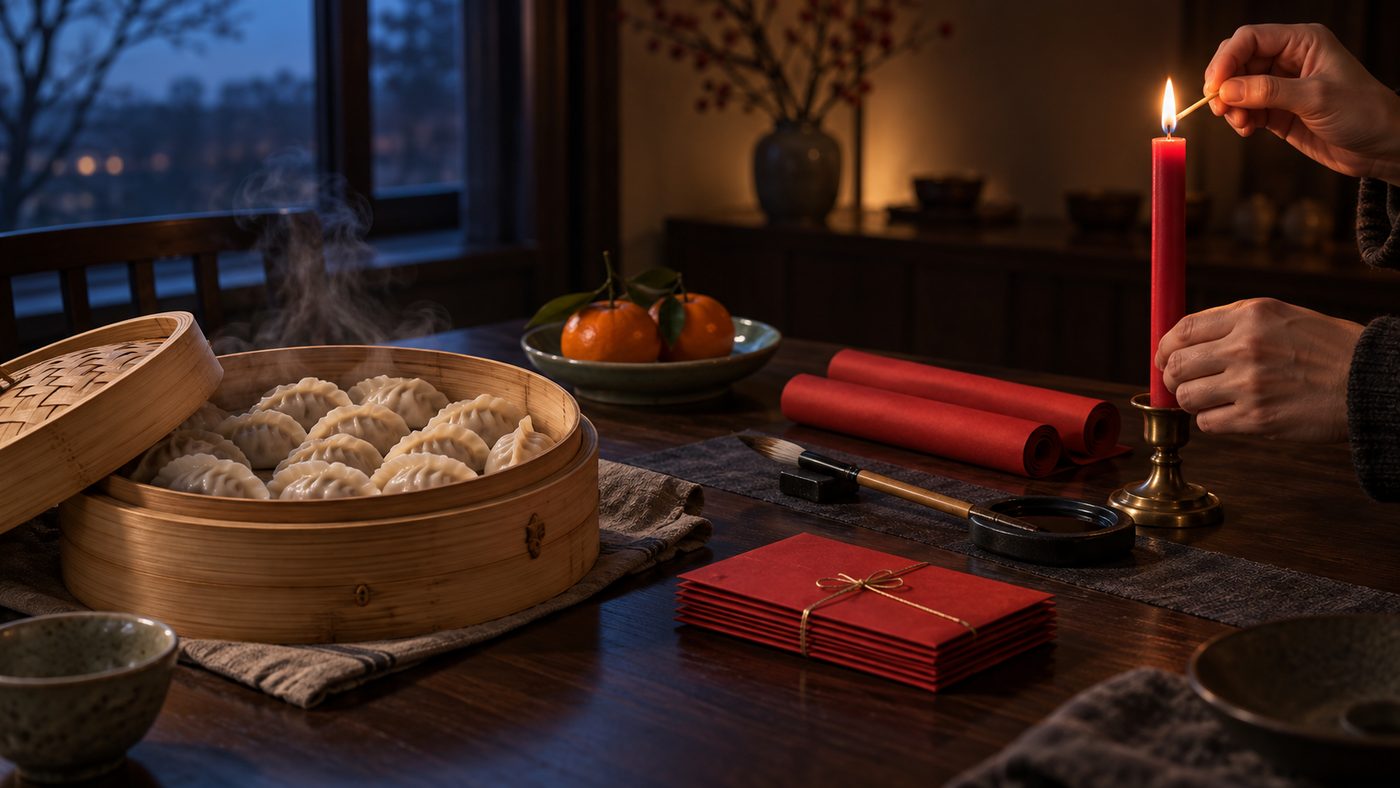
A dark wooden table by a window at dusk, set for the eve: a bamboo steamer of dumplings with the lid half off, a stack of red envelopes, a pair of red paper couplet strips still rolled beside a brush, two tangerines with leaves, and a hand lighting a single red candle.
The eve, before the doors: dumplings, envelopes, couplets not yet pasted, and the first candle. Illustration.

Chinese New Year 2026 Fire Horse · bǐng wǔ

New Year’s Day is Tuesday, February 17, 2026; the animal turns to the Horse on that morning.

The sixteen days of Chinese New Year 2026, from the eve to the Lantern Festival, with the Gregorian date and what each day is for.
Day Date What it is for
New Year’s Eve the eve · chúxī Monday, February 16 Reunion dinner; the whole family sits up to see the year out; red envelopes; the door couplets go up.
New Year’s Day day 1 · chūyī Tuesday, February 17 Firecrackers at midnight; visits and greetings to elders; no sweeping, no sharp words; dumplings in the north.
Second day day 2 · chū’èr Wednesday, February 18 Married daughters visit their parents; in old Beijing, the day the god of wealth was offered to.
Third day day 3 · chūsān Thursday, February 19 “Red mouth” day in the south, kept quietly at home to avoid quarrels; the mice’s wedding night in the folk calendar.
Fourth day day 4 · chūsì Friday, February 20 The household gods, the kitchen god first, are welcomed back from their report to heaven.
Breaking the Five day 5 · pòwǔ Saturday, February 21 The first days’ taboos lift; shops reopen; the god of wealth is received, in the south with firecrackers at dawn.
Sixth day day 6 · chūliù Sunday, February 22 Poverty is sent off: the first rubbish of the year goes out; in old Beijing, the first day of formal calls.
Humans’ Day day 7 · rénrì Monday, February 23 The birthday of humankind; a soup of seven vegetables, and in Singapore and Malaysia the raw-fish salad tossed for luck.
Grain Day day 8 · gǔrì Tuesday, February 24 The birthday of the crops; in old Beijing, 108 lamps lit after dusk to the stars.
Ninth day day 9 · chūjiǔ Wednesday, February 25 The Jade Emperor’s birthday, the great day of the Hokkien year in Fujian, Taiwan and Southeast Asia; sugarcane at the door.
Tenth day day 10 · chūshí Thursday, February 26 The stone’s birthday in northern folk custom: no grinding, no moving stones.
Eleventh day day 11 · shíyī Friday, February 27 Fathers-in-law host sons-in-law; the lantern markets begin to set up.
Twelfth day day 12 · shí’èr Saturday, February 28 Lanterns bought and hung; by the sixth-century rule, the rice kept back from the eve goes out into the street today.
Thirteenth day day 13 · shísān Sunday, March 1 Lamps set out from the inner rooms to the gate, the first night of the lantern run.
Fourteenth day day 14 · shísì Monday, March 2 The lantern markets at their busiest; sweet rice balls rolled for tomorrow.
Lantern Festival day 15 · yuánxiāo Tuesday, March 3 The first full moon; lanterns, riddles, sweet rice balls; the New Year ends here.

Chinese New Year 2027 Fire Goat · dīng wèi

New Year’s Day is Saturday, February 6, 2027; the animal turns to the Goat on that morning. The Start of Spring, where a bazi chart turns the year instead, is February 4, 2027.

The sixteen days of Chinese New Year 2027, from the eve to the Lantern Festival, with the Gregorian date and what each day is for.
Day Date What it is for
New Year’s Eve the eve · chúxī Friday, February 5 Reunion dinner; the whole family sits up to see the year out; red envelopes; the door couplets go up.
New Year’s Day day 1 · chūyī Saturday, February 6 Firecrackers at midnight; visits and greetings to elders; no sweeping, no sharp words; dumplings in the north.
Second day day 2 · chū’èr Sunday, February 7 Married daughters visit their parents; in old Beijing, the day the god of wealth was offered to.
Third day day 3 · chūsān Monday, February 8 “Red mouth” day in the south, kept quietly at home to avoid quarrels; the mice’s wedding night in the folk calendar.
Fourth day day 4 · chūsì Tuesday, February 9 The household gods, the kitchen god first, are welcomed back from their report to heaven.
Breaking the Five day 5 · pòwǔ Wednesday, February 10 The first days’ taboos lift; shops reopen; the god of wealth is received, in the south with firecrackers at dawn.
Sixth day day 6 · chūliù Thursday, February 11 Poverty is sent off: the first rubbish of the year goes out; in old Beijing, the first day of formal calls.
Humans’ Day day 7 · rénrì Friday, February 12 The birthday of humankind; a soup of seven vegetables, and in Singapore and Malaysia the raw-fish salad tossed for luck.
Grain Day day 8 · gǔrì Saturday, February 13 The birthday of the crops; in old Beijing, 108 lamps lit after dusk to the stars.
Ninth day day 9 · chūjiǔ Sunday, February 14 The Jade Emperor’s birthday, the great day of the Hokkien year in Fujian, Taiwan and Southeast Asia; sugarcane at the door.
Tenth day day 10 · chūshí Monday, February 15 The stone’s birthday in northern folk custom: no grinding, no moving stones.
Eleventh day day 11 · shíyī Tuesday, February 16 Fathers-in-law host sons-in-law; the lantern markets begin to set up.
Twelfth day day 12 · shí’èr Wednesday, February 17 Lanterns bought and hung; by the sixth-century rule, the rice kept back from the eve goes out into the street today.
Thirteenth day day 13 · shísān Thursday, February 18 Lamps set out from the inner rooms to the gate, the first night of the lantern run.
Fourteenth day day 14 · shísì Friday, February 19 The lantern markets at their busiest; sweet rice balls rolled for tomorrow.
Lantern Festival day 15 · yuánxiāo Saturday, February 20 The first full moon; lanterns, riddles, sweet rice balls; the New Year ends here.

The years ahead

New Year’s Day is always the second new moon after the winter solstice, which pins it inside a window from January 21 to February 20 and lets it wander anywhere within it. The next six, with the animal each one brings in.

  • 2027 Saturday, February 6, 2027 · Fire Goat
  • 2028 Wednesday, January 26, 2028 · Earth Monkey
  • 2029 Tuesday, February 13, 2029 · Earth Rooster
  • 2030 Sunday, February 3, 2030 · Metal Dog
  • 2031 Thursday, January 23, 2031 · Metal Pig
  • 2032 Wednesday, February 11, 2032 · Water Rat

Which animal, and when it changes

The zodiac turns on New Year’s Day and on no other day. Lunar 2027 is dīng wèi in the sixty-year count, the Fire Goat, and a baby born on February 6, 2027 is a Goat while one born the day before is a Horse. That is the popular rule, and it is the one the placemats, the greetings and this page use. A bazi chart uses a different one, the Start of Spring, which comes a few days on either side of New Year and in 2027 falls on February 4, 2027; our year-boundaries page has both dates for every year and explains who is caught between them. What the Goat year means for each of the twelve signs, which ones offend the Tai Sui and which are quiet, is on the 2027 page; the year’s compass, where to leave the ground undisturbed and where the good stars land, is on the 2027 feng shui chart.

The sixteen days, one at a time

The remarkable thing about the Chinese New Year is how little of it is new. The earliest calendar of customs we have, the Jingchu Suishiji, was written in the sixth century about the middle Yangtze, and its first day is recognizably the one being kept in Singapore next February: up at cock-crow, firecrackers in the courtyard first thing, the peach-wood boards on the door with two armed gods painted on them, the whole family in clean clothes greeting one another in order of age. Fourteen centuries later the Yanjing Suishiji described Beijing’s New Year in 1900, and the days had acquired names, rules and a god of wealth, but the shape was the same. What follows is the shape, with the two books doing the talking.

The eve chuxi · February 5, 2027

The last night of the year is the reunion dinner, the one meal a year that the whole country travels for, and then the long sit. The Dongjing Menghua Lu, a memoir of Kaifeng written in 1147 by a man who had lost the city and wanted to remember it, ends its year with the sentence everyone still quotes: “families sit round the stove until dawn, which they call guarding the year.” The same book records the market stalls in the last month printing and selling door gods, the demon-queller Zhong Kui and peach charms, which is to say that by the twelfth century the decorations were a printed commodity. The sixth-century book has the eve too, as a feast laid out for the departing year with rice deliberately left over, to be thrown into the street on the twelfth day of the new one “to send off the old and take in the new.” Lucky money is the eve’s other business, and the Beijing book describes it before the red envelope existed: coins threaded on colored string, braided into the shape of a dragon and laid at the foot of the bed.

The first day chuyi · February 6, 2027

Firecrackers first. The sixth-century book says they were set off in the courtyard at cock-crow to frighten off a one-legged mountain creature that gave people fevers, which is as good an origin for a noise as any, and the Beijing book has the whole city lighting incense and letting them off from just after midnight, “without pause, lane after lane.” Then the greetings, elders first, and the drink: the old rule was that the youngest drank before the oldest, because the young had gained a year and the old had lost one. Beijing ate dumplings, the same for rich and poor, with a coin or a tiny silver ingot hidden in one for whoever would have a lucky year. Wang Anshi’s poem on the day, the one every schoolchild learns, has the rest in four lines: firecrackers, the year ending, the warm wine, and every door swapping its old peach charm for a new one. The don’ts are a matter of not sweeping out what has just arrived: no cleaning, no throwing away, no sharp words, nothing broken.

The second day chu’er · February 7, 2027

The day a married daughter goes home. In a tradition where a bride joined her husband’s household, the second day was the one fixed visit back to her own parents, with her husband and children in tow and gifts in hand, and it still empties the roads of half the country. Beijing kept a second custom on it, according to the 1900 book: this was the capital’s day for offering to the god of wealth, “with a great many firecrackers, day and night without stopping,” three days earlier than the south.

The fifth day powu · February 10, 2027

Breaking the Five. The Beijing book states the rule and its expiry in one breath: “the fifth day is called Breaking the Five; within the five days no raw rice may be cooked and women may not go out,” and from the sixth the shops “gradually open for trade.” Everything that was forbidden on the first day is allowed again, the sweeping happens, and in the south the day belongs to the god of wealth, received at dawn with firecrackers by households competing to be first. The Caishen page has the scramble, and who exactly is being received.

The seventh day renri · February 12, 2027

Humans’ Day, and the oldest named day in the run after the first. The sixth-century book already has it: a soup of seven vegetables, figures of people cut from colored silk or gold foil and pasted on screens or worn in the hair, and a climb somewhere high to write poems. Its commentary explains the count. The first day of the year belongs to the chicken, the second to the dog, the third to the sheep, the fourth to the pig, the fifth to the ox, the sixth to the horse, and the seventh to people, each creature’s fortune for the year read off that day’s weather, and the Beijing book of 1900 repeats the list unchanged with grain added on the eighth. In Singapore and Malaysia the seventh is the day of the raw-fish salad, yusheng, tossed high at the table by everyone at once, a custom of the last century that has become the one most of our readers there would name first.

The ninth day chujiu · February 14, 2027

The Jade Emperor’s birthday, kept above all by the Hokkien, who in Fujian, Taiwan, Penang and Singapore treat it as the true New Year of the household and set a table to heaven before midnight with a pair of sugarcane stalks tied to the legs. The story they tell is of an ancestral village hiding from raiders in a cane field until the ninth and coming out to thank heaven. Elsewhere it is a quiet day, which is the general rule for the back half of the sixteen: the eighth had its 108 lamps in old Beijing, the thirteenth its lamps from the inner rooms to the gate, and the intervening days are for the calls you have not yet paid.

The fifteenth: Lantern Festival yuanxiao · February 20, 2027

The first full moon of the year closes the festival. Lanterns are hung and walked under, riddles are pinned to them, and sweet glutinous rice balls are eaten for their roundness. It was the one night of the old imperial curfew that was lifted, which is why some scholars call it the real lovers’ night of the calendar. Its own page has the history from the sixth century to the Ming palace kitchens. After it, the decorations come down, the leftover rice goes out, and the year is simply the year.

How long it lasts, and who gets the days off

Sixteen days by tradition, and a great deal longer in practice, since the run-up begins at Laba on the eighth of the twelfth month, when the first festival food is cooked and the cleaning starts, and the travel season, the largest annual movement of people on earth, runs for forty days around the date. The public holiday is the smaller thing. Mainland China gives four statutory days under the State Council order in force from 2025, from the eve through the third day of the month, and stretches them to about eight with borrowed weekends; Hong Kong gives three, Singapore and Malaysia two, and every one of them publishes the arrangement each winter, so any list read in advance is a forecast. The full holiday picture, festival by festival, is on the festivals hub.

The New Year, piece by piece

The things you buy, say, hang and hand over each have a page of their own, opening one at a time under this one. Named here; linked as they arrive.

  • Red envelopes Where the lucky money comes from, who gives to whom, and how much is right, by relationship and by country.
  • Greetings What to say to whom, in characters, pinyin and plain English, and the one greeting you should not say to your boss.
  • Spring couplets The two strips of red on the door: how to tell which goes on the left, and what the common ones say.
  • Door gods The two armed men pasted on the gate since the sixth century, and the general who joined them in the Tang.
  • Decorations The upside-down fortune character, the paper cuts, the kumquat tree, the blossoms: what each one is for.
  • Gifts What to bring to a New Year visit, what never to bring, and why the number matters.
  • Lantern Festival The fifteenth, the night the New Year ends: lanterns, riddles, rice balls, and the curfew that lifted.
  • Caishen, the god of wealth Who is received on the fifth day, why there are several of him, and the scramble to be first.
  • Laba The eighth of the twelfth month, where the New Year season begins.

Questions people ask

When is Chinese New Year 2027?

Saturday, February 6, 2027. It is the first day of the first lunar month, so it moves against the western calendar and can fall anywhere from January 21 to February 20; this one is an early-February New Year. The eve is February 5, 2027 and the Lantern Festival that closes the season is February 20, 2027. Lunar year 2026 began on Tuesday, February 17, 2026. Both dates are computed by the same calendar engine that runs our converter, in China Standard Time.

What animal is 2027 in the Chinese zodiac?

The Goat. Lunar year 2027 is dīng wèi in the sixty-year count, a Fire Goat year, and the animal changes on New Year’s Day, February 6, 2027, not on January 1. Anyone born between January 1 and that date is still a Horse. The year now running, lunar 2026, is the Fire Horse.

How long does Chinese New Year last?

Sixteen days by the traditional count, from New Year’s Eve to the Lantern Festival on the fifteenth of the first month, and the whole stretch is called the Spring Festival, chunjie. The public holiday is shorter: mainland China gives four statutory days, from the eve through the third day of the month, stretched to about eight with borrowed weekends; Hong Kong gives three, Singapore two, Malaysia two. The run-up begins earlier still, at Laba on the eighth of the twelfth month, and the shops and the taboos both restart on the fifth day.

How is Chinese New Year celebrated?

Day by day, and the days are not interchangeable. The eve is for the reunion dinner and for staying up to see the year out. The first day is for greeting elders and visiting, with nothing swept and nothing sharp said. The second is for married daughters to visit their parents. The fifth breaks the taboos, reopens the shops and receives the god of wealth. The seventh is the birthday of humankind. The fifteenth is the Lantern Festival, and the New Year ends with it. Red is worn and hung everywhere, firecrackers are set off to scare away the year, lucky money goes to children in red envelopes, and the door gets new couplets and door gods. The table on this page dates every one of the sixteen.

Is Chinese New Year the same as Lunar New Year?

Same day, wider name. Chinese New Year is the first day of the first month of the Chinese calendar. Korea, Vietnam and the other countries that took that calendar keep their own New Year on the same new moon, with their own names, Seollal and Tết, and their own customs, so Lunar New Year is the name that covers all of them. Vietnam reckons the calendar in its own time zone and very occasionally lands a day apart. Chinese Spring Festival, chunjie, is the official mainland name for the whole holiday.

Why does the date of Chinese New Year change every year?

Because the Chinese calendar counts months from the new moon and years from the sun, and the two do not divide evenly. Twelve lunar months run about eleven days short of a solar year, so the calendar inserts a whole extra month every two or three years to catch up, and New Year’s Day, always the second new moon after the winter solstice, swings back and forth inside a window of about a month. It never moves on the Chinese calendar. It only moves on yours.

What should you not do on Chinese New Year’s Day?

The folk rules are about not sweeping out the luck that has just arrived: no cleaning, no throwing anything away, no washing hair, no sharp words, no lending or borrowing, no breaking things, and nothing in white or black. Most of them hold through the fifth day, which is why the fifth is called the breaking of the five. They are customs rather than scripture, and the Yanjing Suishiji of 1900 already lists which ones Beijing kept and which ones it had quietly dropped.

Keep going

  • Chinese zodiac 2027 reads all twelve signs against the Fire Goat year the day brings in.
  • Feng shui 2027 is the year’s compass, sector by sector, for the house you are cleaning.
  • Chinese festivals has every festival of the year that follows, dated the same way.
  • The calendar converter turns any date either way and carries the month table the dates above come from.
  • The calligraphy generator writes the character for fortune, the one that goes on the door, in any of the classic scripts.

Sources

Every date in the tables is computed by the site’s own lunisolar engine, the one behind the converter, in China Standard Time. The customs are from the three books below, read in the Chinese; the holiday count follows the State Council order.

Stay in the loop.

Chinese mythology, the zodiac, and the meaning behind names and symbols, rooted in the classics and read back to you. No spam. Unsubscribe anytime.