Chinese Mythology
Vermilion Bird (朱雀): Guardian of the South, and Why It Is Not the Phoenix
The Vermilion Bird, 朱雀 (zhūquè), holds the south: summer, the element fire, and the direction a Chinese ruler faced when he sat down to govern. It is seven constellations running from Gemini to Corvus, it has a beak and a crop and a pair of wings that Sima Qian mapped onto real stars, and its name means, quite literally, "red sparrow."
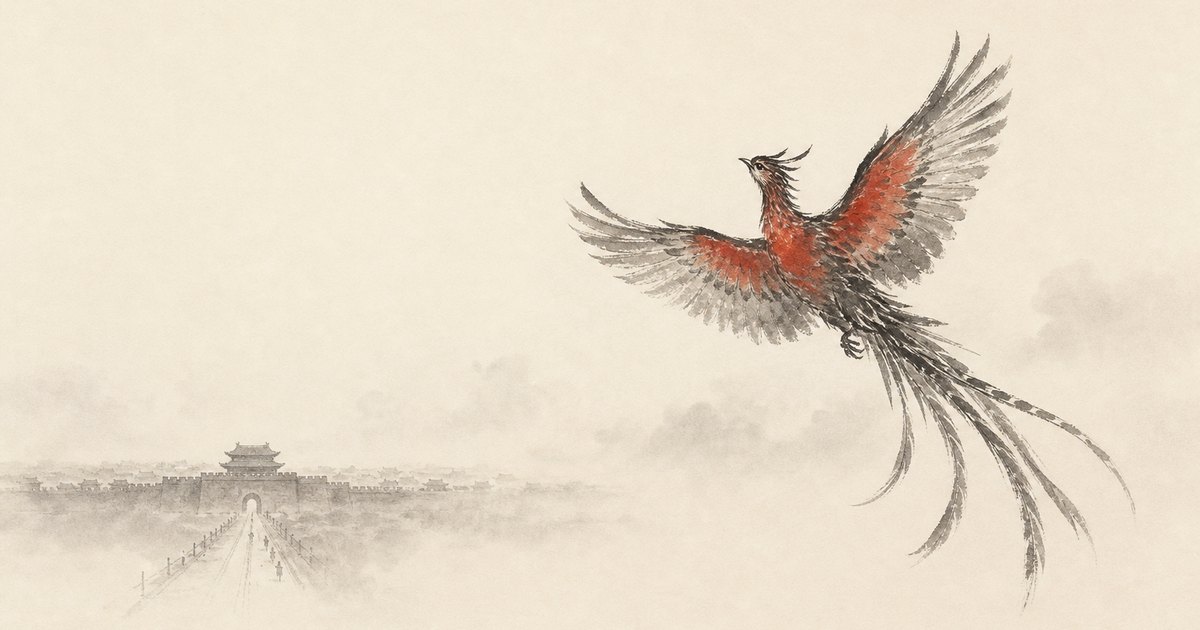
Every complete cosmology needs a south, and China gave the job to a bird. It holds summer, it holds fire, it holds the color red, and it faces the emperor across the throne room for two thousand years of political theater. It is the grandest of the four celestial guardians in terms of what it was asked to do.
It is also called a sparrow.
That is not a translation problem. The second character of its name, 雀 (què), is built from 小, "small," sitting on top of 隹, the sign for a short-tailed bird, and in ordinary Chinese it means a sparrow: the small brown thing in the eaves, the one that eats your seedlings. The guardian of one quarter of the universe is named the Red Sparrow, and once you notice it you cannot stop noticing it.
The bird is seven constellations
Chinese astronomy divides the band of sky the moon travels through into twenty-eight xiù, "lodges" or mansions, then groups them in fours, seven mansions to a quarter, one animal to a quarter. East is the Azure Dragon, west the White Tiger, north the Black Tortoise, and south this bird. The four quarters as one system covers how the twenty-eight are apportioned and where the eastern seven fall.
Its seven, in order, are Well, Ghost, Willow, Star, Extended Net, Wings, and Chariot. Laid against a modern star atlas they begin in Gemini, cross Cancer, run the whole length of Hydra, and finish in Crater and Corvus. That is a long stretch of sky, and the shape it makes is genuinely bird-like: a compact head-end around Cancer and the top of Hydra, then a long body trailing east with the wings set well back.
One of those mansions is worth stopping on. Ghost, the second, sits in Cancer, and inside it Chinese astronomers marked an object they called 積屍氣, which means something close to "the vapor of piled corpses." To the naked eye it is a faint smudge; through any pair of binoculars it resolves into a swarm of stars. Western astronomy calls it Praesepe, the Manger, or the Beehive Cluster. Two traditions looked at the same soft gray patch, and one saw bees and a feeding trough while the other saw the exhalation coming off a heap of bodies. It sits, without apparent irony, inside the bird of summer.
Sima Qian gives it a beak, a neck, and a kitchen
The founding work of Chinese observational astronomy is the treatise on the celestial offices in the Records of the Grand Historian, written around 94 BCE. Sima Qian goes through the sky palace by palace, and when he reaches the south he does something more specific than naming a bird. He dissects it.
Willow, he writes, is the bird's bill. Star is the neck. Extended Net is the crop, the pouch at the base of a bird's throat where food waits before digestion, and he adds that this mansion is the kitchen and governs the entertaining of guests. Wings are the flight feathers, and they govern guests who come from far away. Chariot is the carriage, and it governs the wind. A commentary preserved alongside the text glosses Willow further: heaven's kitchen steward, in charge of the imperial table and the blending of flavors.
Read that list next to the same author on the White Tiger and something quite deliberate comes into focus. In the west, the mansions of Orion are a balance stone and a set of stars called the Punishment, and they govern cutting down and slaughter. In the south, the mansions are a throat, a crop, a kitchen, and a welcome for visitors from a distance. The same man, in the same treatise, gives one quarter of the sky the executioner's portfolio and the opposite quarter the job of feeding the guests. The Chinese sky is not decorated with animals. It is staffed.
Red Bird first, Red Sparrow later
The sparrow problem has a history, and the older texts do not have it.
The Book of Rites gives the order of banners for an army on the march, and the phrase it uses for the south is 朱鳥, Red Bird, the second character being the ordinary general word for a bird of any size. Sima Qian, writing his southern palace, opens with the same two characters. Neither of the two most authoritative early sources for the Four Symbols calls this creature a sparrow. They call it a red bird, which is what you would expect for a thing that owns a quarter of the heavens.
Zhuque arrives later and then wins, thoroughly enough that it is now the only name most people know, and the shift has never been fully explained. What can be said is that que was already doing service as a loose word for small birds in general, that zhuque has a crisper sound than zhuniao, and that symmetry probably helped. Set the four guardian names side by side and three of them pair a color word with a two-syllable creature; the older southern name does not scan with the rest, and the sparrow one does.
The first character is more precise than English suggests. 朱 (zhū) is not red in general, which is a different and commoner word. It is vermilion specifically, the orange-leaning red of cinnabar, the mineral that was ground for the pigment used on lacquerware, on palace pillars, and in the ink an emperor used to write his approvals. When translators render the name as "Vermilion Bird" rather than "Red Bird" they are being exact, and the word carries the imperial workshop with it.
The bird you can walk down
The strangest thing about the Vermilion Bird is that you can visit it, because it is a street.
A Chinese capital laid out correctly was a diagram of the sky pressed flat. The palace sits at the north, the ruler faces south, and the gate directly ahead of him in the southern wall takes the name of the guardian in that direction: the Vermilion Bird Gate. The avenue running south from that gate is Vermilion Bird Street, and it is the spine of the city.
Tang Chang'an had the most extravagant version ever built. Its Vermilion Bird Street ran a little over five kilometers from the Vermilion Bird Gate to the Mingde Gate in the southern wall, splitting the city into an eastern and a western half administered by two different counties. Tang records give the width as a hundred paces, about 150 meters. Excavation near the Mingde Gate published in 2023 put the actual figure closer to 127 meters, which is still absurd. It is a road roughly the width of a modern airport runway, laid down in the seventh century, and its main function was not traffic. It was for the imperial procession, and for the view.
Nanjing had a smaller and more famous one: the Vermilion Bird Bridge over the Qinhuai River, carrying the road toward the lane where the great families of the Eastern Jin lived. Liu Yuxi wrote four lines about it in the ninth century that Chinese schoolchildren still memorize, and they open with weeds flowering beside the Vermilion Bird Bridge and the sun going down over the lane. The poem is about the fact that the aristocracy is gone and the swallows now nest in ordinary houses. The bird of the southern sky is in the first three characters, doing duty as an address.
Then the plan got exported. When Japan built its capitals on the Chinese model, it took the layout and the vocabulary together. Heian-kyō, which is now Kyoto, was organized around Suzaku Avenue, running south from the Suzaku Gate at about 84 meters wide. Suzaku is simply the Japanese reading of the same two characters. A city planner in eighth-century Japan set out the main street of the capital and named it after the Chinese constellation of the south, and the name is still on the map.
It is not the phoenix
This needs saying plainly, because English writing about Chinese mythology gets it wrong more often than it gets it right, and so does a fair amount of Chinese writing.
The Vermilion Bird and the fenghuang, the creature usually translated as the Chinese phoenix, are two different animals from two different traditions. The Vermilion Bird comes out of star worship and calendar-making: it is a quarter of the sky, one of a set of four, and it exists to hold a direction. The fenghuang comes out of a much older layer of bird totems, and its job is to be an omen. It is the ruler of birds, it appears when the world is being governed well, and it is paired with the dragon in the imperial iconography of empress and emperor. Neither of those functions is astronomical. The fenghuang is not a constellation and has never been assigned one.
The color test is the quickest way to keep them apart. The Vermilion Bird is red, one color, because red is the coordinate for south. The fenghuang is described in the classical sources as five-colored, carrying the full palette because it carries the full set of virtues. If a bird in a Chinese painting is uniformly cinnabar and appears with three other animals at the edges of a square, it is the guardian. If it is iridescent, alone, and turning up at a coronation, it is the fenghuang.
There is a final irony here that our page on the phoenix works out in detail. The single thing English speakers most confidently believe about the Chinese phoenix, that it burns and is reborn from its ashes, is not classical at all. It was grafted on in 1920, when the poet Guo Moruo borrowed the rebirth story from the Arabian phoenix and wrote it into a famous poem. So the West spent a century attaching fire to the wrong bird. The genuine fire bird of Chinese cosmology had been sitting in the southern sky the entire time, correctly labeled, holding the element in its own right.
Facing south
The last piece is the one that explains why this quarter mattered more than the others in daily political life.
In Chinese tradition a ruler faces south. The phrase for taking the throne is literally "to face south," and the arrangement is old enough to appear in the commentaries to the Book of Changes, which say the sage faces south to hear the empire. Everything about a palace follows from it: the throne backs onto the north, the ceremonial gate opens to the south, the officials come in facing north toward the ruler, and the whole building is a compass with a person at the center of it.
Which means that of the four guardians, the Vermilion Bird is the one an emperor was looking at. The tiger stood at his right hand and the dragon at his left, the tortoise covered his back, and directly in front of him, all day, was the bird of summer and fire. The banner order in the Book of Rites is the same arrangement carried out of doors and set marching: Red Bird in front.
What it leaves behind
The bird had a quieter afterlife in China than the dragon and a louder one abroad. Han tombs carry it on the southern wall and on the round eaves tiles of the southern eaves, one guardian to each face of the building, so the dead lie inside a correctly oriented universe. Daoist ritual promoted the four of them to divine officers with names and ranks, and the Vermilion Bird became Lord Lingguang. Chinese cities kept the gate names for centuries after anyone was consulting star charts about them, and Xi'an still has a Vermilion Bird Gate and a Vermilion Bird Street, on very close to the original line.
Outside China it survives mostly as Suzaku, which is the form that got into games, anime, and the naming conventions of Japanese astronomy satellites, and which now belongs about as much to fiction as to cosmology.
The stars are still where Sima Qian left them. On an evening in early spring, look south and find the long faint sprawl of Hydra with Alphard glowing at its head, and the little smudge of the Beehive above it in Cancer. That is a neck and a heap of corpses, in that order, on a bird named after a sparrow, guarding the direction an emperor had to face in order to be one.
In the classics
The passages behind the story, in the standard published translations. Open any one for the original text.
“Willow is the bird's bill, and governs trees and grasses. Star is the neck, and is the officer of the roll; it governs urgent business. Extended Net is the crop, and is the kitchen; it governs the entertaining of guests. Wings are the flight feathers, and govern distant guests. Chariot is the carriage, and governs the wind. ”
Original text
柳為鳥注,主木草。七星,頸,為員官。主急事。張,素,為廚,主觴客。翼為羽翮,主遠客。軫為車,主風。
“On the march the banner with the Red Bird should be in front, that with the Dark Warrior behind, that with the Azure Dragon on the left, and that with the White Tiger on the right. ”
Original text
行:前朱鳥而後玄武,左青龍而右白虎。
Questions people ask
What is the Vermilion Bird in Chinese mythology?
The Vermilion Bird, 朱雀 (zhūquè), is the guardian of the south, one of the Four Symbols that hold the four quarters of the Chinese sky alongside the Azure Dragon of the east, the White Tiger of the west, and the Black Tortoise of the north. It rules summer, the element fire, and the color red. Like the other three it is an astronomical object before it is a story: the name covers seven of the twenty-eight lunar mansions, a stretch of sky running from Gemini across Hydra to Corvus.
Is the Vermilion Bird the same as the Chinese phoenix?
No, and the two come from different places entirely. The Vermilion Bird is a direction, one quarter of a star map, and it belongs to Chinese astronomy and state ritual. The fenghuang, usually translated as the Chinese phoenix, is the ruler of birds, a good omen that appears when the world is well governed, and it belongs to a much older tradition of bird totems. The Vermilion Bird is red because south is red. The fenghuang is five-colored. They are drawn similarly and get confused constantly, including in China, but no classical text treats them as one creature.
Which constellations make up the Vermilion Bird?
Seven lunar mansions, in order: Well, Ghost, Willow, Star, Extended Net, Wings, and Chariot. In modern terms they run from Gemini and Cancer through Hydra to Crater and Corvus. The Ghost mansion contains the Beehive Cluster, which Chinese astronomers called jishiqi, roughly 'the vapor of piled corpses,' and Sima Qian identified Willow as the bird's beak, Star as its neck, Extended Net as its crop, and Wings as its flight feathers.
Why is the Vermilion Bird called a sparrow?
Because that is what 雀 (què) means. The character is built from 小, 'small,' over 隹, 'short-tailed bird,' and in ordinary Chinese it is the word for a sparrow. Older texts avoid the problem by using a different name: the Book of Rites calls the southern guardian 朱鳥, the Red Bird, and Sima Qian's astronomical treatise does the same. 朱雀 became the standard name later and has stayed slightly odd ever since, since it gives one of the four quarters of the universe the name of a small brown bird that lives in the eaves.
Why is the Vermilion Bird associated with fire?
Because it holds the south, and in the five-phase system the south is fire, summer, and the color red. The color and the element are coordinates rather than descriptions: the bird is red for the same reason the tiger of the west is white and the tortoise of the north is black. That said, the fire attribution is genuinely ancient here, which is worth noting because the fire attached to the fenghuang in English writing is a twentieth-century import.
Where does the Vermilion Bird appear in Chinese cities?
On the street map. The south gate of a properly laid out capital was the Vermilion Bird Gate, and the avenue running south from it was Vermilion Bird Street. Tang Chang'an had one roughly 127 meters wide by recent excavation, Nanjing had a Vermilion Bird Bridge over the Qinhuai River that Liu Yuxi made famous in a four-line poem, and when Japan copied the Chinese capital plan it copied the name too, which is why Heian-kyō, now Kyoto, had a Suzaku Avenue.
What is the Vermilion Bird called in Japanese?
Suzaku, written with the same two characters. Korean gives Jujak and Vietnamese Chu Tước. That is the form most people outside East Asia meet first, usually in a video game, where Suzaku has been guarding the southern gate of one fictional world after another since the 1980s.
Sources & further reading
- Vermilion Bird, Wikipedia (the seven southern mansions, their determinative stars, and the Japanese, Korean and Vietnamese names)
- Four Symbols (Chinese constellation), Wikipedia (the four quarters and their assigned elements, seasons and colors)
- Ghost (Chinese constellation), Wikipedia (the Ghost mansion and the star group Jishi, the Beehive Cluster)
- Records of the Grand Historian, Treatise on the Celestial Offices: the southern palace passage naming the bird's bill, neck, crop and wings (Chinese Wikisource)
- The Book of Rites, Quli I: the banner order on the march, which calls the southern guardian the Red Bird (Chinese Text Project, Legge translation)
- Wiktionary on the character que (ideogrammic compound of the signs for 'small' and 'short-tailed bird', meaning sparrow)
- 朱雀大街, Chinese Wikipedia (the central avenue of Tang Chang'an, running from the Vermilion Bird Gate to the Mingde Gate)
- Xi'an excavation confirming Vermilion Bird Street at roughly 127 meters wide, against the 150 meters given in Tang-era records (Beijing News)
- 乌衣巷, Chinese Wikipedia (the Vermilion Bird Bridge over the Qinhuai and Liu Yuxi's poem on the lane beyond it)
- Heian-kyō, Wikipedia (Suzaku Avenue at about 84 meters wide, and the city plan modeled on Tang Chang'an)
- Praesepe / the Beehive Cluster, Wikipedia (the open cluster in Cancer that the Ghost mansion contains)
By Julian 祝君瑜, retold from the classics, with the original passages cited, updated 2026-08-26