Chinese Mythology
Shennong: He Tasted Every Plant, and the Tea Story Is Not in His Book
Shennong is the Divine Farmer, the figure credited with giving China agriculture, the marketplace and herbal medicine. The oldest surviving account has him tasting the flavors of the hundred plants to sort the edible from the poisonous, and meeting seventy poisons in a single day. It says nothing about tea, and nothing about him dying. Both of those arrived later, and one of them arrived astonishingly late.
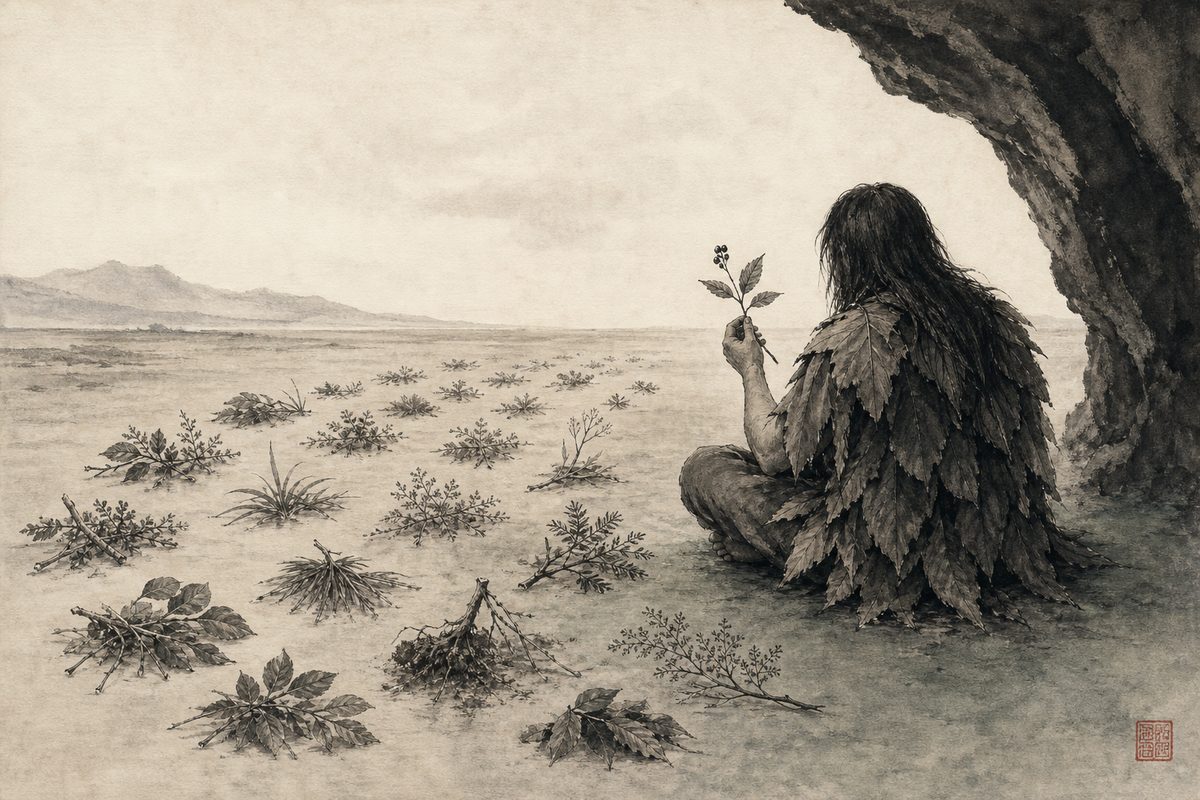
Seventy poisons in a single day
Poison. That is the job. Not farming, not medicine, not the invention of the market, though he is credited with all three. The thing Shennong is actually famous for doing is putting unknown plants in his mouth, one after another, in order to find out which of them would kill you.
The oldest surviving account of it is a single sentence in the Huainanzi, a compendium presented at the Han court in 139 BCE, and it is very matter of fact. People used to chew on plants and drink plain water, it says, and gather fruit and eat snails, and sickness and poisoning did them a great deal of harm. So Shennong taught them to sow the five grains and to judge which ground suited what, dry or wet, fat or barren, high or low. He tasted the flavors of the hundred plants and the sweetness or bitterness of the springs, so that people would know what to avoid and what to go toward. And then the line that has echoed for two thousand years: in that time, he met seventy poisons in a single day.
Seventy. In a day. Do sit with the arithmetic of that for a moment, because the myth is doing something no other myth of a wise founder does. It has priced the knowledge. The classification of the natural world is not handed down by a god, or revealed in a diagram, or read off the sky. It is bought, retail, one mouthful at a time, by a man who is going to spend the afternoon being extremely unwell.
And here is the thing about that story, which is what this page is really about. The Chinese record could not decide whether it was true. Alongside the tasting there runs a second, entirely different explanation of how one person came to know the properties of hundreds of plants, and in it he does not taste anything at all. He carries a whip.
More than a billion people describe their ancestry with his other name
Start with the modern usage, because it is enormous and almost invisible.
If you ask a Chinese person what they are, in the ethnic rather than national sense, one of the ordinary answers available is Yan Huang zisun: descendant of Yan and Huang, 炎黄子孙. It is not obscure, or poetic, or reserved for ceremonies. It turns up in newspapers, in speeches, on museum walls, in the perfectly unremarkable conversation of people who have never given the phrase a second thought. More than a billion people have a term for their own ancestry that consists of two proper names.
Huang is the Yellow Emperor. And Yan, the Flame Emperor, is this man. Which means the standard idiom for Chinese descent contains, as one of its two halves, a plant-taster from a book of the second century BCE.
We will come back to that, because the sentence I just wrote is a simplification, and the way it is a simplification is one of the best stories on this page. Yan and Shennong were not always the same person.
The sentence printed on your tea
Now the claim you have almost certainly met, whether or not you knew whose it was.
He tasted the hundred plants, met seventy-two poisons in a single day, and cured himself with tea.
That sentence is the founding text of the global tea industry. It is on packaging and in catalogues, in tea-school curricula and museum captions, in the opening paragraph of a thousand shop websites and the patter of every tea room from Hangzhou to Portland. It is usually presented as a quotation, and usually credited to the Shennong Bencao Jing, the Divine Farmer's Materia Medica, which sounds unimpeachable, being both ancient and about drugs.
Hold that thought for about two thousand words. We are going to go and look it up.
A World Heritage forest named after his medicine cabinet
In the north-west of Hubei province there is a range of mountains called Shennongjia, which UNESCO inscribed on the World Heritage List in 2016 under natural criteria nine and ten, covering 73,318 hectares across two components with a buffer zone around them. It protects the largest primary forest left in central China and it sits on a climate transition, which is why the biodiversity is extraordinary.
The name means, roughly, Shennong's ladder, and the local tradition is that this is where he came to gather herbs, building scaffolding up the cliffs to reach the ones growing out of the rock. There is no early text for that either. What there is, is a genuinely globally significant piece of temperate forest whose official name, on the World Heritage List, in the register of humanity's shared inheritance, commemorates a legendary pharmacology field trip.
Chinese tourism leans on this heavily, and the region also happens to be the country's most persistent wild-man sighting hotspot, which has nothing to do with Shennong and everything to do with a very large forest.
The shopkeeper who sells you antidotes made of himself
In 2024 the Taiwanese studio Red Candle Games released Nine Sols, a hand-drawn action game set in what the studio cheerfully calls a taopunk world, released for Windows on the twenty-ninth of May with console versions following in November. Among the characters is a merchant, one of the apemen, named Shennong, who sells the player health upgrades.
His stated business model is the myth, taken absolutely literally. He ingests poison; his body neutralizes it; what his body then expels is an antidote, which he sells you. It is grotesque, it is funny, it is dead accurate to the logic of the legend, and it is a better reading of the source material than most textbooks manage. The whole point of the tasting story is that the man's body is the instrument. The game just added a shop counter.
The game is also, incidentally, why a search for his name now returns a wiki page about gift preferences, and why a certain number of people arrive at the myth by way of a boss rush.
The Medicine King still has a birthday
He is worshipped, and specifically, and with a diary date. As the Medicine King he receives offerings from physicians, pharmacists and herbalists, and his birthday falls on the twenty-sixth day of the fourth lunar month. There is a Great Temple of Shennong and the Flame Emperor at Suizhou in Hubei, and at his temple in Tainan the titles pile up on a single figure: King Yan, God of the Five Grains, Shennong the Great Emperor, Ancestor of Farming, Great Emperor of Medicine, God of Earth, God of Fields.
That list is not confusion. It is sedimentation. Each title is a different century needing him for a different reason and none of them wanting to let go of the earlier one.
And if you want to see what he looked like to the people who prayed to him, the Wellcome Collection in London holds an anonymous Chinese watercolor of about 1920 in which he sits at the mouth of a cave, dressed in clothing made of large overlapping leaves, holding a branch with leaves and berries on it. No crown. No throne. A man in a suit of foliage, holding up a twig and looking at it.
The oldest account, and the argument it was written to win
So, back to the Huainanzi, and to something that is easy to miss about it.
That passage is not a hymn. It sits in the chapter called Xiuwu, Cultivating Effort, and the chapter is an argument. Its target is the fashionable position that the ancient sages achieved everything by doing nothing at all, by pure effortless non-action, and that striving is therefore vulgar. The author will have none of it. He rolls out the founders one after another precisely to show how hard they worked, and Shennong tasting his way through the flora is exhibit A. The seventy poisons are there to make a point about labor.
Which is why the passage is so unsentimental, and why it does not include a death. The chapter needs him exhausted, not martyred. He samples, he suffers, he keeps going, and the argument moves on.
Two other things the earliest layer gives him deserve rescuing from obscurity. The Great Commentary attached to the Book of Changes has a famous sequence of founders and their inventions, and Shennong's paragraph comes directly after Fuxi's, which is worth knowing if you have read our page on Fuxi and the eight trigrams: these two are not merely adjacent in the tradition, they are adjacent in the sentence. When Baoxi passed away, the text says, Shennong arose. He hewed wood into a plowshare and bent wood into a plow handle and taught the world the advantage of plow and hoe.
And then, immediately: at midday he made a market. He brought the people of the world to it and gathered the goods of the world, and they traded and went away, each having got what he wanted.
Shennong invents the marketplace. It is right there, in the same paragraph as the plow, in one of the most-read texts in Chinese history, and English accounts of him almost never mention it. The Divine Farmer is also the patron of commerce, and the two inventions plainly belong together: once you can grow a surplus you need somewhere to take it.
The other method, which is a whip
Here is the fact that reorganizes the rest.
Around the middle of the fourth century CE, Gan Bao compiled the Soushen Ji, Records of an Inquiry into the Spirits, and he opened the whole collection with Shennong. In his version there is no tasting whatsoever:
Shennong took an ochre whip and whipped the hundred plants, and thereby knew every one of them, whether it was bland or toxic, cooling or warming, and what its smell and taste governed. And so he sowed the hundred grains. That is why the world called him the Divine Farmer.
An ochre whip. 赭鞭. He walks through the vegetation striking it, and the plants tell him what they are. Bland or toxic, cooling or warming, and what each smell and flavor governs, which is not a vague magical sense of a plant but the exact set of categories a Chinese pharmacological handbook uses. He is not intuiting. He is reading off an instrument.
And look at the last clause, because it is doing something the tasting version never does. That is why the world called him the Divine Farmer. In Gan Bao's account the name is earned by the whip. The whip is not a colorful detail attached to a taster; in the fourth century it was the explanation.
Both traditions then acquired real places. The Shuyi Ji, a collection attributed to Ren Fang around the turn of the sixth century, records that the cauldron in which Shennong tasted the drugs still survived at Shenfu Hill in Taiyuan, and that in the Xianyang hills there was the place where he sorted the hundred drugs, a mountain also called Shennong's Original Herb Mountain with a temple on top of it. Two methods, two pilgrimage sites, one man. (A note on that second one: popular quotation often gives the character as whipped the drugs rather than sorted them, which would make it a monument to the whip. The text I can actually read says sorted, so that is what I have written, and you are entitled to know that the more interesting reading exists.)
Here is the whole tradition, laid out by what it claims he actually did:
| Source | Date | How he learns a plant | Is tea part of the story |
|---|---|---|---|
| Huainanzi, Xiuwu chapter | 139 BCE | He tastes it, and meets seventy poisons in one day | No |
| Soushen Ji, juan 1 | fourth century CE | He whips it with an ochre whip and simply knows | No |
| Shuyi Ji, juan 2 | around 500 CE | Both, at two named pilgrimage sites | No |
| Lu Yu, Classic of Tea | 760s to 780s CE | Not discussed; only that tea as a drink began with him | Yes, but no poisons and no cure |
| Gezhi Jingyuan | 1769 recension | He tastes, and tea cures the seventy poisons | Yes, and this is the first time |
| The version you have heard | modern | He tastes, and tea cures seventy-two poisons | Yes |
Read the last two rows again, and then let us go and check them.
The book with his name on it, which he did not write
The Shennong Bencao Jing, the Divine Farmer's Materia Medica, is the foundation stone of Chinese pharmacology, and it is not by Shennong. It was compiled in the Han, well over a thousand years after any date the tradition gives him, out of accumulated herbal knowledge; his name is on the cover the way Hippocrates' name is on an oath he never wrote.
What it contains is glorious. Three hundred and sixty-five drugs, sorted into three grades, and the grades are defined by a court metaphor that tells you a great deal about how Han physicians thought:
The hundred and twenty upper drugs are the ruler. They govern the nourishing of life and answer to heaven; they are without poison, and taking them freely or for a long time does not harm a person. The hundred and twenty middle drugs are the minister. They govern the nourishing of the nature and answer to man; some are without poison and some are poisonous, and their fitness must be weighed. The hundred and twenty-five lower drugs are the assistant and the envoy. They govern the treatment of disease and answer to earth; most are poisonous, and they are not for long use.
Ruler, minister, assistant. The pharmacy is a government. The safest substances are the ones with the highest rank, the dangerous ones are the junior officials you deploy for a specific job and dismiss, and the whole classification is a hierarchy of trust rather than of chemistry. (The three grades also happen to sum to three hundred and sixty-five, one for each day of the year. Han numerology being what it was, I would not call that a coincidence.)
Now. Search that text for tea.
The saying is not in it. Neither is the story: no poisons, no antidote, no rescue, not a word about the Divine Farmer curing himself of anything. Researchers who have worked through the surviving recension, including the one edited by the Qing scholar Gu Guanguang that is usually treated as among the earliest we have, report finding no trace of it, and the modern character for tea does not occur in the text at all.
But I went and looked myself, and the situation is more interesting than a flat absence, so let me show you what is actually there. Among the fruits and vegetables of the upper grade, filed between the mallow seeds and the sesame, sits this:
Bitter herb. Flavor bitter, cooling. It governs the evil influences of the five viscera, distaste for grain, and numbness of the stomach. Taken over a long period it settles the heart and boosts the vital energy, makes a person perceptive and in need of little sleep, lightens the body and holds off old age. It is also called tucao, and also called xuan. It grows in valley streams.
Perceptive, and in need of little sleep. Bitter and cooling. And the alternative name given for it is 荼, which is the character that later grew an extra stroke and became the modern character for tea. Chinese tea historians have argued for a very long time about whether that entry is tea, because in early texts the same character covers both tea and a bitter garden weed, and the Erya glosses it flatly as the weed.
I am not going to settle a Han botanical identification in a paragraph. What I will say is that the popular version of this story has the polarity exactly backwards. It has tea arriving as the antidote to seventy-two poisons, the emergency remedy of a dying man. The Materia Medica, if that entry is tea, has it in the upper grade, the rank the preface calls the ruler: no poison in it, safe to take freely and for a long time, good for calm, good for staying awake, filed with the vegetables.
Not a rescue. A tonic. Which is, if you have ever actually drunk tea, considerably closer to the truth.
Where the tea actually came from
The honest earliest link between this man and this drink is one clause, and it is Tang. Lu Yu, writing his Classic of Tea in the 760s and 770s, opens his section on drinking with the line that tea as a beverage began with Shennong and became known in the time of the Duke of Zhou of Lu. That is all. No poisons, no antidote, no dramatic rescue. A founder-attribution of exactly the kind Chinese writers routinely gave to anything they considered venerable, offered roughly three thousand years after the man is supposed to have lived.
So where does the famous sentence come from?
The earliest appearance anyone has been able to find is in the Gezhi Jingyuan, a large encyclopedia of things worth knowing compiled by Chen Yuanlong, who lived from 1652 to 1736 and rose to be a Grand Secretary. Under Food and Drink, in the section on tea, it reads: the Bencao says, Shennong tasted the hundred plants, met seventy poisons in one day, and used tea to cure them. People today do not drink tea when taking medicine, for fear it will cancel the medicine out. The recension in which this is preserved was collated in 1769, for the imperial library.
Three things about that, and they are all small and all fatal.
It says seventy, not seventy-two. Seventy is the Huainanzi's number, verbatim, from nineteen centuries earlier.
It cites "the Bencao", which is a whole genre rather than a book, and the modern habit of upgrading that to the Shennong Bencao Jing is somebody else's editorial decision.
And the tea is the only new element in the sentence. Take it out and you are left with the Huainanzi line exactly. The likeliest reading, and it is the one the Chinese researchers who traced this reach, is that Chen or a predecessor added the tea to a sentence that had been sitting in the record, tealess, since 139 BCE. Sun Biwen, a nineteenth-century scholar, then reproduced the wording identically in his Xinyilu, probably straight from Chen.
I want to be careful about what is proved here, because it is easy to over-claim. Nobody has established who added the tea, or when the seventy became seventy-two, and I am not going to pretend otherwise; an intermediate source in a Ming notebook could still turn up. What is established is the shape of it. The sentence is not ancient, it is not in the book it is credited to, and its number is wrong even by the standard of the Qing text that first carries it. Everything after that is inference, and the inference is not flattering.
None of which, and I would like to say this clearly, makes tea any less good. It just means the tea did not need him.
He was a political program before he was a god
Long before the medicine, his name was a banner.
Mencius opens a long and rather bad-tempered exchange with the arrival of a man called Xu Xing, whom the text introduces as one who preached the doctrine of Shennong, come from Chu to the small state of Teng. His follower Chen Xiang puts the position to Mencius directly: a worthy ruler plows alongside his people and eats what he himself has grown, and the duke's granaries and treasuries are simply a way of feeding himself off everyone else. That, in the Warring States, is what invoking Shennong meant. Not herbs. A political claim, that rulers should work the soil and that stored wealth is extraction.
Mencius takes it apart with the division of labor, and quite enjoys himself doing it, and the reason the exchange survives is that he won. But it tells you the man's name had a party attached to it centuries before anybody made him a god of pharmacy, and it explains something otherwise odd about him: of all the founder figures, he is the one whose myth is about physical labor and personal cost rather than authority. The Zhuangzi, in similar mood, uses Shennong's age as shorthand for an artless golden time when people lay down content and got up content. He was, for a while, the patron saint of everyone who thought civilization had gone wrong.
Two men, welded
Which brings us back to the ancestry phrase, and the simplification I flagged.
In the pre-Qin texts, Shennong the Divine Farmer and Yan the Flame Emperor are two separate figures. They are not variant names for one person; they turn up in different contexts doing different things, and Yang Bojun's reading is that the Shennong legend itself only emerges in the Warring States, being absent from the Western Zhou material.
The joining happens in the Han, and it has a mechanism. The Shiben is the earliest text to couple the names into a single compound. Then Liu Xin, the great Han bibliographer and calendrical scholar, sets out a chronology of the ancient rulers on Five Phases succession, and there the weld becomes visible: when the Divine Farmer arose, fire succeeded wood, and so he was called the Flame Emperor; he taught the people farming, and so the world called him the Divine Farmer. Read it slowly and you can watch a filing system produce a biography. One name comes from the sequence of elements; the other comes from the deeds; and the two are now the same man because the system required the slot to be filled. By the Jin the seam is invisible. Gu Jiegang's point, in the great skeptical reassessment of ancient Chinese history he launched in the 1920s, was that a thousand years of historians thereafter wrote the compound name without ever asking why it was compound.
So the standard idiom for Chinese descent names two ancestors, one of whom is a merger of two more. Which is not a scandal. It is just how a very long tradition tidies up: less a family tree than a series of mergers and acquisitions. The oldest story about his family comes from before the weld, and it shows: the Classic of Mountains and Seas calls Jingwei, the drowned girl who became a bird and set out to fill the sea, simply the Flame Emperor's youngest daughter, with no farmer anywhere in sight.
The welding left one visible scar, and it is my favorite object on this page. Because Yan means flame and the Five Phases put him with fire and the old accounts made him a farmer, the iconography drifted toward cattle. Huangfu Mi's Diwang Shiji, written in the Western Jin, describes him flatly as having a human body and an ox's head, born to a woman named Nüdeng and raised by the Jiang river, which is where the surname comes from. Temple sculptors took the description at face value, and the statue in the great temple at Suizhou was accordingly given a head shaped like an ox's. It stayed that way for centuries, until a Ming magistrate of Suizhou decided the whole arrangement was an indignity to the emperor of agriculture and had the head recast, with an imperial crown on it and court robes below.
Somebody, in other words, looked at the god of the fields, decided he was not dressed for the office, and gave him a promotion.
So how did he die?
You know the ending: poisoned at last, by a plant usually identified as heartbreak grass, dying before he could reach the antidote he always carried. In the fullest popular versions his abdomen is transparent, so that he can watch each poison work on his organs, and in the final scene he watches his own intestines blacken and part.
I would love to give you a source for that. There isn't one that I can find. The transparent belly circulates constantly, generally credited to the Classic of Mountains and Seas, and I can find no such passage in it and nobody who quotes it ever gives a chapter. The death by heartbreak grass is popular tradition, real and widely held and told at his temples, and no early text kills him at all. Gan Bao's Shennong finishes his survey and the entry ends. The Huainanzi's Shennong meets seventy poisons in a single day and the sentence simply stops, because the chapter has an argument to get on with.
The tradition supplied the death later, and you can see why. A story about a man who tests poison on his own body is unbalanced without it. He has to be killed by the work or the work costs nothing, and the whole point of him, the thing that makes him unlike a god who hands down knowledge from a cloud, is that it cost.
That is worth holding on to as the last thing, I think. Every other founder in the sequence is given a power. Pangu has size, Nüwa has the making of things, Fuxi has a method of reading the world, and the Yellow Emperor after them has a state. Shennong has a mouth and an afternoon, and the mouth is not a metaphor, and the afternoon does not go well.
Unless, of course, he had the whip. In which case none of it hurt at all, and the whole tradition of self-sacrificing physicians who tested their own prescriptions was built on a wand that somebody, at some point in the four hundred years between the Huainanzi and Gan Bao, quietly decided was too easy.
In the classics
The passages behind the story, in the standard published translations. Open any one for the original text.
“In ancient times the people chewed on plants and drank plain water, gathered fruit from the trees and ate the flesh of snails and clams. Sickness and poisoning did them a great deal of harm. So Shennong began to teach the people to sow the five grains, and to judge which ground suited what, dry or wet, fat or barren, high or low. He tasted the flavors of the hundred plants and the sweetness or bitterness of the springs, so that the people would know what to avoid and what to go toward. In that time he met seventy poisons in a single day. ”
Original text
古者,民茹草飲水,采樹木之實,食蠃蠬之肉。時多疾病毒傷之害,於是神農乃始教民播種五穀,相土地宜,燥濕肥墝高下,嘗百草之滋味,水泉之甘苦,令民知所辟就。當此之時,一日而遇七十毒。
“Shennong took an ochre whip and whipped the hundred plants, and thereby knew every one of them, whether it was bland or toxic, cooling or warming, and what its smell and taste governed. And so he sowed the hundred grains. That is why the world called him the Divine Farmer. ”
Original text
神農以赭鞭鞭百草,盡知其平毒寒溫之性,臭味所主,以播百穀,故天下號神農也。
“When Baoxi passed away, Shennong arose. He hewed wood into a plowshare and bent wood into a plow handle, and taught the world the advantage of the plow and the hoe, which he seems to have taken from the trigram Yi. At midday he made a market, brought the people of the world to it and gathered the goods of the world, and they traded and went away, each having got what he wanted, which he seems to have taken from the trigram Shihe. ”
Original text
包犧氏沒,神農氏作,斲木為耜,揉木為耒,耒耨之利,以教天下,蓋取諸益。日中為市,致天下之民,聚天下之貨,交易而退,各得其所,蓋取諸噬嗑。
“The hundred and twenty upper drugs are the ruler. They govern the nourishing of life and answer to heaven; they are without poison, and taking them freely or for a long time does not harm a person. The hundred and twenty middle drugs are the minister. They govern the nourishing of the nature and answer to man; some are without poison and some are poisonous, and their fitness must be weighed. The hundred and twenty-five lower drugs are the assistant and the envoy. They govern the treatment of disease and answer to earth; most are poisonous, and they are not for long use. ”
Original text
上藥一百二十種為君,主養命以應天,無毒,多服久服不傷人。中藥一百二十種為臣,主養性以應人,無毒,有毒,斟酌其宜。下藥一百二十五種為佐使,主治病以應地,多毒,不可久服。
“Bitter herb. Flavor bitter, cooling. It governs the evil influences of the five viscera, distaste for grain, and numbness of the stomach. Taken over a long period it settles the heart and boosts the vital energy, makes a person perceptive and in need of little sleep, lightens the body and holds off old age. It is also called tucao, and also called xuan. It grows in valley streams. ”
Original text
苦菜 味苦寒。主治五藏邪氣,厭榖胃痹。久服安心益氣,聰察少臥,輕身耐老。一名荼草,一名選。生川谷。
“At Shenfu Hill in Taiyuan the cauldron in which Shennong tasted the drugs still survives. In the Xianyang hills there is the place where Shennong sorted the drugs, also called Shennong's Original Herb Mountain, with the Ziyang temple upon it. Tradition holds that Shennong sorted the hundred drugs here, and among them is thousand-year camphor. ”
Original text
太原神釡岡中有神農嘗藥之鼎存焉。咸陽山中有神農辨藥處,一名神農原藥草山,山上紫陽觀,世傳神農於此辨百藥,中有千年龍腦。
As seen in
Nine Sols
game · 2024An apeman merchant who sells the player health upgrades, on the stated basis that his poison-resistant body neutralizes whatever he swallows, so that what he expels comes out as an antidote, as Shennong.
Made by the Taiwanese studio Red Candle Games and released for Windows on 29 May 2024, with console versions following in November. The studio calls the setting taopunk. The vendor mechanic is the myth's central premise turned into a shop counter.
Questions people ask
What is Shennong known for?
Three things, and the order matters. He is known first for agriculture, which is what his name means: the Divine Farmer, the figure the Book of Changes credits with hewing wood into a plowshare and teaching the world the use of the plow and the hoe. He is known second for herbal medicine, on the strength of the Huainanzi's line that he tasted the flavors of the hundred plants so the people would know what to avoid. He is known third, and most popularly, for discovering tea, which is the one item on the list that no early text supports. The Book of Changes also credits him with inventing the marketplace, which almost nobody mentions and which is arguably the strangest thing on his resume.
What is Shennong the god of?
Medicine, mainly, and by a route worth knowing. In the earliest texts he is not a god of anything; he is a culture hero, a ruler who did useful things. The divinity accretes later and specializes: he becomes the Medicine King, worshipped by physicians and herbalists, with a birthday on the twenty-sixth day of the fourth lunar month. At his temple in Tainan the titles stack up on one figure, King Yan and God of the Five Grains and Ancestor of Farming and Great Emperor of Medicine and God of Fields, which is what happens when several centuries of people each need him for something slightly different.
What did Shennong discover?
The five grains, which ground suits which crop, and the medicinal properties of a very large number of plants. The materia medica that bears his name lists three hundred and sixty-five drugs, sorted into three grades on a court metaphor: a hundred and twenty upper drugs that behave like a ruler, a hundred and twenty middle drugs like a minister, and a hundred and twenty-five lower drugs like an assistant, mostly poisonous and not for long use. He did not write that book. It was compiled in the Han, many centuries after any date given for him, and his name is on the cover the way Hippocrates' name is on oaths he never took.
Did Shennong discover tea?
Almost certainly not, and the trail of the claim is unusually clear. The sentence everyone quotes, that he tasted the hundred plants, met seventy-two poisons in a day and cured himself with tea, is attributed to the Divine Farmer's Materia Medica, and it is not in it. Neither is the story behind it. What the text does carry, among the upper-grade fruits and vegetables, is an entry for a bitter cooling herb that makes a person perceptive and in need of little sleep, whose alternative name is the early character that later became the character for tea, and which may or may not be tea; the identification has been argued over for centuries. Either way it is filed as a safe daily tonic rather than an antidote. The earliest appearance of the famous sentence is in the Gezhi Jingyuan, a Qing encyclopedia by Chen Yuanlong, in the 1769 recension of the imperial library, where it reads seventy poisons rather than seventy-two and cites only a vague "the Bencao." The earliest honest link between the man and the drink is one clause in Lu Yu's Classic of Tea in the Tang, roughly three thousand years after the fact.
How did Shennong die?
In popular tradition he is killed by the job, poisoned by a plant usually identified as heartbreak grass, dying before he can reach the antidote. It is a good ending and it is a late one. No early text kills him. The Huainanzi, which is the oldest account of the tasting, has him meet seventy poisons in a single day and simply carry on; the sentence ends and the chapter moves to its actual argument. The death is the tradition finishing a story it felt was unfinished, which is a reasonable instinct, since a man who tests poison on himself for a living really ought not to retire comfortably.
Related figures
Sources & further reading
- Huainanzi, the Xiuwu chapter: the passage on Shennong teaching the five grains, tasting the flavors of the hundred plants and the springs, and meeting seventy poisons in a single day
- Soushen Ji, juan 1: Gan Bao's opening entry, in which Shennong whips the hundred plants with an ochre whip and the world therefore calls him the Divine Farmer, followed by the entry on Chi Songzi the rain master
- 神农得茶解毒 由来考述: the tracing of the tea saying to Chen Yuanlong's Gezhi Jingyuan in the 1769 Wenyuan Ge recension of the Siku Quanshu, the wording 一日而遇七十毒,得茶以解之, Chen's dates of 1652 to 1736, the identical wording reproduced in Sun Biwen's Xinyilu, and the search of the Gu Guanguang recension of the Bencao Jing
- Shennong Bencao Jing, the entry for kucai among the upper-grade fruits and vegetables: the bitter cooling herb that makes one perceptive and needing little sleep, whose alternative name is the early character for tea. Checked directly against the text rather than taken from the secondary literature
- Lu Yu's Classic of Tea, section six on drinking: the single clause crediting tea as a drink to Shennong
- 神农: the Chinese-language account, with the pre-Qin attestations, Yang Bojun on the legend's Warring States emergence, the Shiben coupling of the names, Liu Xin's welding of Shennong to the Flame Emperor, and the Jin-dynasty fusion
- 「神农氏」「炎帝」融合过程考辨, Journal of Xinyang Normal University, 2020: the peer-reviewed treatment of how and why the two figures merged
- Shennong: the English-language account, including the Medicine King worship, the birthday on the twenty-sixth of the fourth lunar month, the Great Temple at Suizhou, the stacked titles at the Tainan temple, and the heartbreak grass tradition
- Hubei Shennongjia, UNESCO World Heritage List: inscribed 2016 under natural criteria ix and x, 73,318 hectares across the Shennongding and Badong and Laojunshan components
- Nine Sols: the Red Candle Games release, 29 May 2024 for Windows and November 2024 for consoles, and the taopunk setting
- Mencius, Teng Wen Gong part one: the arrival of Xu Xing, one who preached the doctrine of Shennong, and the argument that a worthy ruler should plow alongside his people
- The Legend of the Divine Farmer, The Public Domain Review: the anonymous Chinese watercolor of about 1920 in the Wellcome Collection showing him at a cave mouth in leaf clothing holding a branch of leaves and berries
- 炎帝形象为何多为「牛首人身」, Hunan Daily: the ox-headed depiction traced to Huangfu Mi's Diwang Shiji, and the Ming-dynasty recasting of the Suizhou statue's head with an imperial crown
By Julian 祝君瑜, retold from the classics, with the original passages cited, updated 2026-09-30