Chinese Mythology
Erlang Shen: The God Whose Third Eye Is the Newest Thing About Him
Erlang Shen, 二郎神 (èrláng shén), is the Chinese god of flood control and dragon-slaying, best known outside China as the warrior who fought the Monkey King to a standstill. Erlang is not his name. It is a birth-order word meaning second son, which is what the Song philosopher Zhu Xi called him when he wrote the god up in the twelfth century. The third eye he is drawn with today is the newest thing about him: it is absent from Journey to the West, absent from Investiture of the Gods, and still absent when Pu Songling described him in the Kangxi era.
"Erlang" is not a name
Let us clear this up on the doorstep, because almost every English page about him gets it wrong in the first line. 二郎 does not mean anything mystical. It means second son. Er is two. Lang is a young gentleman. Put them together and you have roughly "the second boy," which is what you might call the middle child of a family down the road whose given name you had never quite caught.
So when Chinese texts call this god Erlang, they are not using his name. They are using his position in a household. And the household in question belonged to somebody else entirely.
The oldest plain statement of this comes from a man who had very little patience for any of it. Zhu Xi, the philosopher who spent the twelfth century systematizing Confucian thought and who is roughly to Chinese intellectual history what Aquinas is to European, was asked about the temple. His answer, recorded by his students in the Classified Conversations, begins by explaining who the temple was actually for, and then adds, almost as an afterthought, that the one showing up to perform the miracles is his second son.
That is the whole etymology. A god worshipped for a thousand years is known to the world by a phrase meaning "the second boy," and he acquired it because he happened to be standing next to his father.
The temple was built for his father
The father is a real person, and one of the more genuinely impressive engineers of the ancient world.
Li Bing was the Qin-appointed governor of Shu, which is modern Sichuan, in the third century BCE. The Min River came down out of the mountains every year and flooded the Chengdu plain, and Li Bing's response was not a dam. It was a division. He cut a channel through a rocky outcrop to split the river in two, sending part of it into an irrigation network and letting the rest run on. The cut is called the Separated Hill, and Zhu Xi names it in his very first clause: the temple was founded for Li Bing, for his merit in opening it.
The system is called Dujiangyan. It is over two thousand years old, it has no dam wall, and it is still in use. If you want one fact to hold onto about where this god came from, it is that the cult began as gratitude for a piece of civil engineering that worked.
What happened next is what always happens to successful public works. The gratitude outlived the memory of the man, the temple kept receiving visitors, and the miracles reported there needed an author. Zhu Xi is wonderfully dry about the mechanism. The temple was for Li Bing; nowadays a great many miracles appear there; and it is his second son who comes out.
Nobody had to invent a new god. They simply promoted a family member.
A god who renegotiated his own job title
Here is the passage that no English page about Erlang Shen seems to have read, and it is the best thing in the entire record.
Having explained the temple, Zhu Xi goes on to give what can only be described as the god's employment history. At first, he says, the god was enfeoffed as a king. Then Emperor Huizong came along. Huizong was the Northern Song emperor who was passionately, expensively and in the end catastrophically fond of Daoism, and in the course of reorganizing the celestial bureaucracy to his taste he decided that this god was really a zhenjun, a Perfected Lord, which is a Daoist rank. So the god was retitled.
You can hear Zhu Xi's opinion of this in the grammar. He says Huizong decided the god was some sort of Perfected Lord. It is the tone of a man describing a reorganization he did not vote for.
And then the god complained.
The complaint arrives through Zhang Jun, a Southern Song general, who prayed at the temple during a campaign and dreamed that the god spoke to him. The grievance is entirely practical, and the commercial specificity of it is worth savoring. As a king, the god explains, he received blood-food, meaning meat sacrifice, and therefore his power to bless and to punish actually worked. As a Perfected Lord he is more honorable, certainly, but Daoist rank comes with vegetarian offerings, and without the nourishment of meat he has no power at all. He wants the kingship back. Not for the prestige. For the catering.
Zhang Jun petitioned the court, and the title was restored.
A lesser writer would stop there, having delivered a charming anecdote. Zhu Xi's next sentence is why this page exists:
I do not know whether Zhang Jun really had this dream, or whether he was campaigning at the time and made the story up for the occasion.
A twelfth-century philosopher writes down the miracle and then, without pausing for breath, observes that the general had a strong motive to invent it. He is not attacking the god. He is noting that the only witness to the god's demand was a man who stood to gain from the god making it.
And Zhu Xi is not finished. He closes with the economics, which are startling. Every year the local households hold the festival sacrifice and slaughter some tens of thousands of sheep. The bones are piled like a hill in front of the temple. And the prefecture, he adds, collects a tax on it.
Read that again, because it reframes the whole thing. This is not a quaint story about a village deity. It is a description of a large, seasonal, meat-based industry with a government revenue stream attached, whose supply contract had recently been renegotiated by the supplier, in a dream, through a general.
What he is actually the god of
All of which tells you what he was for. He is a water god. He controls floods, he subdues the dragons that were understood to cause them, and his home address in every source is Guankou, the mouth of the irrigation cut in Sichuan.
This is worth saying plainly, because the modern presentation of him is rather different. Give a character a spear, a hunting dog and a famous duel, and the games will file him under war. It is not an unreasonable reading of the material. It is simply not what the temple was for, and it quietly loses the most interesting thing about him, which is that he began as the personification of a piece of flood-control infrastructure and was promoted from there.
There is a second identification you will meet, so it is worth knowing. Some sources make Erlang Shen not Li Bing's son but Zhao Yu, a Sui-dynasty official at Jiazhou who also killed a river dragon and was also worshipped at Guankou. Modern scholarship, notably Zhang Zhenglang's work on Investiture of the Gods, treats the whole figure as several local gods who merged: Li Bing's second son, Zhao Yu, and others besides, gradually collapsing into one name because they occupied the same place and did the same job.
That is the honest version. He is not one god with a confused biography. He is several dragon-killing water spirits from the same stretch of river who, over a few centuries, became one.
Journey to the West gives him a surname and stops
By the sixteenth century he is famous enough to be cast in the biggest novel in the language, and this is where nearly everyone meets him.
He arrives in chapter 6. Heaven's regular forces have failed to arrest Sun Wukong, and Guanyin proposes bringing in the Jade Emperor's nephew, who lives at Guanjiang and who, in a phrase that tells you everything about his character, takes commissions from Heaven but does not answer its summonses. He is freelance. He works for the celestial bureaucracy without belonging to it.
When he introduces himself to Wukong, he does it by title, and the title repays attention. He calls himself the enfeoffed Zhaohui Lingxian Wang, and the portrait poem in the same chapter calls him Zhaohui as well. That is a Song-dynasty state honorific. Four centuries after Huizong's reshuffle, a Ming novelist is still dressing this character in the official titles the Song court issued. The novel is not inventing him. It is drawing on a cult with paperwork.
Now for the part that undoes the internet. Wukong recognizes him and asks whether he is the one whose mother was the Jade Emperor's sister, who went down to the mortal world and married a man named 楊君.
Yang Jun. Mister Yang. A surname and a courtesy word, and nothing else. That is the entire name the novel gives his father, and by extension all it gives him. The chapter never calls him 楊戩. That two-character name, the one on every game wiki and every piece of fan art, does not appear in Journey to the West at all. It comes later, from Investiture of the Gods, and it stuck so thoroughly that most readers now assume it was always there.
So the sequence runs like this. A birth-order word for a thousand years. A surname in the sixteenth century. A full name later still.
The fight with the Monkey King
Three of the four questions Google reports people asking about Erlang Shen are about Sun Wukong, so let us settle them.
They are not brothers, and they are not related. The relationship is professional. Wukong has wrecked the peach garden and beaten the heavenly army, and Guanyin's suggestion is essentially to hire a contractor. Erlang Shen is the Jade Emperor's nephew on his mother's side, which makes him celestial family, but the portrait poem is blunt about how he feels regarding that connection: too proud to acknowledge his heavenly relatives, he went back to Guanjiang to live. He is not part of Heaven's chain of command. He is the specialist you call when the chain of command has failed.
The duel itself is a shape-shifting contest, and it is one of the great set pieces in Chinese literature. Wukong turns into a sparrow; Erlang Shen turns into a hawk. Wukong becomes a cormorant; Erlang Shen becomes a crane. Wukong drops into the water as a fish; Erlang Shen becomes a fish hawk. Down through a bustard, and finally Wukong disguises himself as a roadside shrine, with his tail standing up behind it as a flagpole, which is the detail everybody remembers.
Nobody wins on merit. Wukong is knocked off his feet by Erlang Shen's lean hound, which catches him by the calf, and then finished off from above when Laozi drops a weapon on his head out of the clouds. So the arrest succeeds. But the novel is careful never to let Erlang Shen beat him in a straight contest, and four hundred years of argument have been built on that refusal.
If you want the story from Wukong's side, with the peaches and the furnace and the mountain, that is his page. Here the chapter matters for a different reason: as a dated document that tells us what this god looked like in the sixteenth century.
He has no third eye until the Qing
Picture Erlang Shen. You are picturing a third eye, vertical, in the middle of his forehead. It is the single feature that makes him instantly identifiable in a game, a cartoon or a temple.
It is also the newest thing about him, and you can watch it fail to appear.
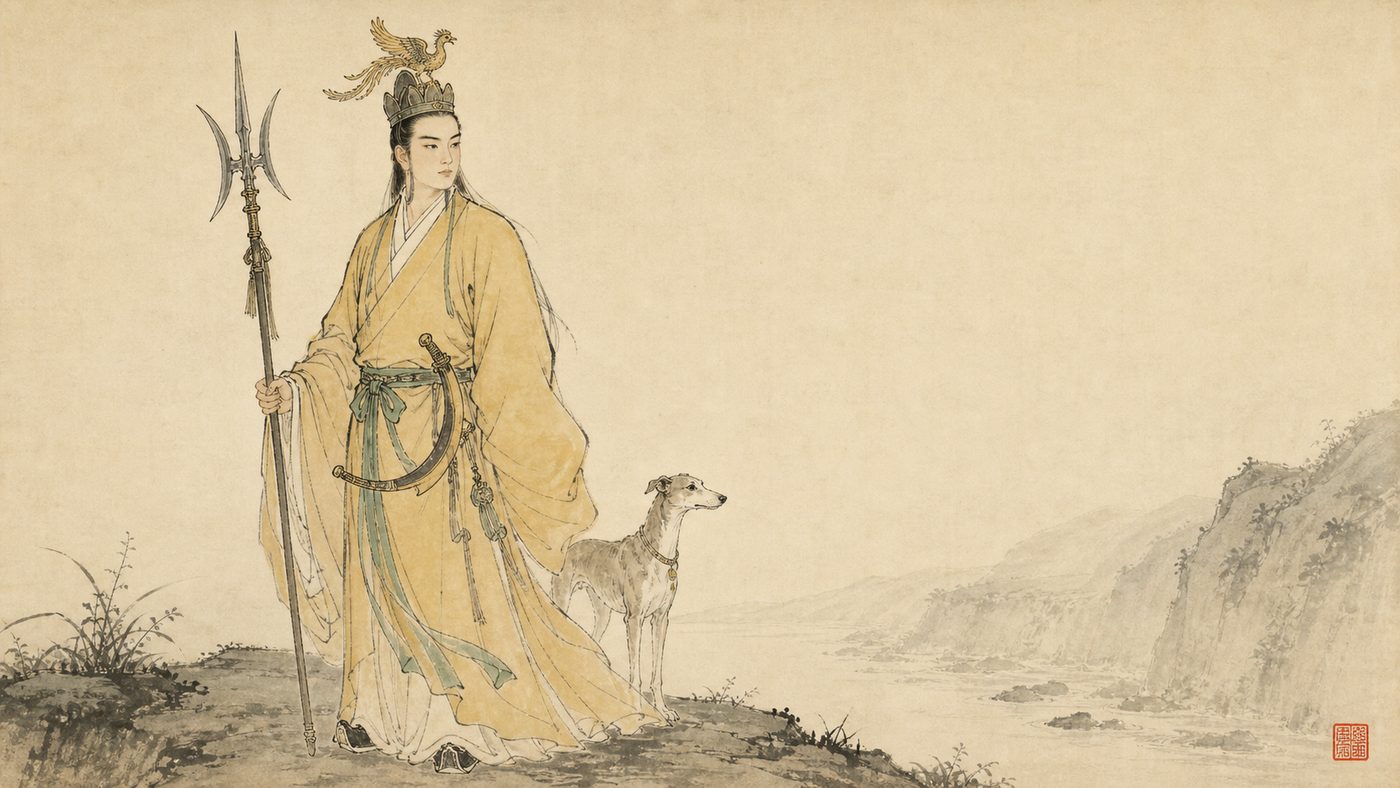
Journey to the West gives him a full portrait poem, sixteen lines of it, the kind of head-to-toe inventory that Ming novels use when they want you to see somebody. It covers his face, his ears, his hat, his robe, his boots, his socks, his belt, his slingshot and his spear. His bearing is clear and handsome; his ears hang to his shoulders; his eyes have light in them. A three-peaked flying-phoenix cap, a robe of pale goose-yellow, a crescent-moon slingshot at the waist, a three-pointed double-edged spear in hand.
There is no third eye in it. Not in the poem, not anywhere in the chapter. A text that itemizes his socks does not mention an extra eye in his forehead, which is not the sort of thing a novelist forgets. Investiture of the Gods, the novel that finally gives him the name Yang Jian, does not give him one either.
Now go forward another century, to the Kangxi era, and open Pu Songling's Strange Tales from a Chinese Studio. In the story "Xi Fangping," a man goes down into the underworld to get justice for his father, and eventually comes before Erlang Shen. Pu Songling gives us one line of description, and it is a gift:
Xi looked at Erlang: a tall figure with a heavy beard, not like what is commonly said of him in the world.
Tall. Bearded. And explicitly not what people say he looks like. There is still no third eye, and on top of that we have a late-seventeenth-century writer telling us that the god in the books and the god in popular imagination had already come apart. Something was circulating that the texts did not support. Pu Songling noticed, and said so.
Modern scholars generally place the three-eyed Erlang Shen no earlier than the Qing, and point to nineteenth-century local gazetteers describing temple statues with an eye in the forehead. That dating rests on modern scholarship rather than on a classical text I can put in front of you, so take it as the current consensus rather than as a quotation. What is not in doubt is the absence: three separate texts across five centuries describe this god in detail, and not one of them gives him a third eye.
Here is the whole accumulation, laid out:
| Layer | Date | Where it is recorded | What it added |
|---|---|---|---|
| A temple for a flood engineer | 3rd c. BCE cult, recorded later | Zhu Xi, Classified Conversations | Li Bing, Dujiangyan, the Separated Hill |
| The second son does the miracles | by the 12th century | Zhu Xi | the name "Erlang," meaning second son |
| King, then Perfected Lord, then king again | Huizong's reign to the Southern Song | Zhu Xi | the state titles, and the dream that reversed one |
| Cast opposite the Monkey King | 16th century | Journey to the West, ch. 6 | the spear, the hound, the duel, the surname Yang |
| Given a full name | later Ming | Investiture of the Gods | Yang Jian |
| Still no third eye | late 17th century | Pu Songling, "Xi Fangping" | a tall bearded man, unlike the popular image |
| The third eye | Qing, per modern scholarship | local gazetteers | the feature everybody now draws first |
The chapter that cannot count its own monsters
One more thing, offered in the spirit of not tidying up the evidence.
In chapter 6, Guanyin recommends Erlang Shen to the Jade Emperor and mentions that he once destroyed six monsters. A few hundred words later, the portrait poem in the same chapter praises his fame for subduing eight monsters.
Six, then eight, in one chapter, about the same deeds.
It is a trivial inconsistency and it changes nothing, which is exactly why it is worth pointing at. Novels accrete. Chapters get assembled from older material that did not agree in the first place, and the seams stay visible if you look. Anyone who tells you the traditional sources present one coherent Erlang Shen has not counted his monsters.
Where you meet him now
He is having a considerable moment. Black Myth: Wukong made him one of its signature encounters in 2024, and the version it presents, third eye included, is now the image millions of people have of him. How the game's duel lines up with chapter 6, snare and hound included, is on the mythology behind Black Myth. He has been a playable character in Smite since 2016. The 2022 animated film New Gods: Yang Jian recast him as a down-at-heel bounty hunter, which is a stranger and better idea than it sounds.
None of that is a complaint. A god who spent a thousand years absorbing other local deities, renegotiating his rank and acquiring an extra eye is in no position to object to being reinterpreted by a video game. Accretion is what he does. The third eye was somebody's addition once too.
It is just worth knowing, when you meet him at a boss fight, that underneath the armor there is a second son with no name of his own, standing next to his father's irrigation works, waiting for someone to bring him a sheep.
In the classics
The passages behind the story, in the standard published translations. Open any one for the original text.
“The Erlang temple at Guankou in Shu was originally established for Li Bing, for his merit in cutting the Separated Hill. Nowadays a great many miracles appear there, and it is his second son who comes out. At first he was enfeoffed as a king. Later Emperor Huizong, who was fond of Daoism, decided he was some sort of Perfected Lord, and changed his title to Perfected Lord. When Zhang Jun was campaigning he prayed at the temple, and at night dreamed the god spoke to him: I was formerly enfeoffed as a king, and had offerings of blood-food, so my power to bless and to punish could be exercised. Now I am styled Perfected Lord, and although that is more honorable, everyone sacrifices to me with vegetarian food. Without the nourishment of blood-food I have no power to bless or punish. Now you must restore my enfeoffment as king, and the power will return. Zhang Jun thereupon petitioned to have the title restored. I do not know whether Zhang Jun really had this dream, or whether he was campaigning at the time and made the story up for the occasion. These days the households hold their yearly festival sacrifice and kill some tens of thousands of sheep. The bones are piled like a hill in front of the temple, and the prefecture takes a tax on it as well. ”
Original text
蜀中灌口二郎廟,當初是李冰因開離堆有功,立廟。今來現許多靈怪,乃是他第二兒子出來。初間封為王,後來徽宗好道,謂他是甚麼真君,遂改封為真君。向張魏公用兵禱於其廟,夜夢神語云:我向來封為王,有血食之奉,故威福用得行。今號為真君,雖尊,凡祭我以素食,無血食之養,故無威福之靈。今須復我封為王,當有威靈。魏公遂乞復其封。不知魏公是有此夢,還復一時用兵,托為此說。今逐年人戶賽祭,殺數萬來頭羊,廟前積骨如山,州府亦得此一項稅錢。
“His bearing is clear and handsome, his face impressive; his ears hang down to his shoulders and his eyes have light in them. On his head a three-peaked flying-phoenix cap; on his body a robe of pale goose-yellow. Gold-threaded boots over coiled-dragon socks; a jade belt worked with rosettes and the eight treasures. At his waist a slingshot shaped like the new moon; in his hand a three-pointed, double-edged spear. With an axe he split Peach Mountain and rescued his mother; with pellets he shot down the paired phoenixes of Zhaluo. His fame runs far for subduing eight monsters; in righteousness he joined the seven sages of Meishan. Too proud to acknowledge his heavenly relatives, he returned in his godhood to dwell at Guanjiang. The bright-city Zhaohui, holy and numinous, transforming without limit, and called Erlang. ”
Original text
儀容清俊貌堂堂,兩耳垂肩目有光。頭戴三山飛鳳帽,身穿一領淡鵝黃。縷金靴襯盤龍襪,玉帶團花八寶粧。腰挎彈弓新月樣,手執三尖兩刃槍。斧劈桃山曾救母,彈打鋋羅雙鳳凰。力誅八怪聲名遠,義結梅山七聖行。心高不認天家眷,性傲歸神住灌江。赤城昭惠英靈聖,顯化無邊號二郎。
“Xi looked at Erlang: a tall figure with a heavy beard, not like what is commonly said of him in the world. ”
Original text
席視二郎,修軀多髯,不類世間所傳。
As seen in
Black Myth: Wukong
game · 2024Major antagonist and one of the game's signature encounters, as Erlang, the Sacred Divinity.
The game's version wears the third eye, the late attribute this page dates.
Smite
game · 2016Playable warrior, as Erlang Shen.
New Gods: Yang Jian
donghua · 2022Title character, reimagined as a down-at-heel bounty hunter, as Yang Jian.
Questions people ask
What is Erlang Shen the god of?
Flood control and dragon-slaying, before anything else. His temple stands at Guankou on the Min River in Sichuan, at the Dujiangyan irrigation works, and it was founded for the engineer who built them. Games and cartoons present him as a god of war, which is a reasonable read of a figure who carries a spear and fights the Monkey King, but it is not what the temple was for. He is a water god who is good in a fight.
Who is Erlang Shen to Sun Wukong?
They are not brothers, and they are not related at all. In Journey to the West, Erlang Shen is the Jade Emperor's nephew, and he is brought in as a specialist to arrest Sun Wukong after the regular heavenly army has failed. Guanyin recommends him precisely because he is an outsider: he lives at Guanjiang, takes commissions from Heaven, and answers a summons only when he feels like it. The two of them are opponents by contract, not by blood.
Is Erlang Shen stronger than Sun Wukong?
The novel is careful not to answer that. Their transformation duel is a draw, with each of them changing shape to counter the other in turn, and Wukong is finally brought down by a combination of Erlang Shen's hound and a weapon dropped on his head from the clouds by Laozi. So the arrest works, but Erlang Shen does not win the fight on his own. That ambiguity is deliberate, and it is a large part of why the matchup is still argued about four hundred years later.
Why does Erlang Shen have three eyes?
For most of his history he did not. The full portrait of him in Journey to the West describes a handsome young man with long earlobes and bright eyes, and never mentions a third one. Investiture of the Gods does not give him one either. Even in the late 1600s, when Pu Songling put him in a story, he is described as tall and heavily bearded and explicitly unlike the popular image, with still no third eye. Scholars generally place the three-eyed Erlang Shen no earlier than the Qing dynasty, which makes his single most recognizable feature the most recent thing about him.
Who is Erlang Shen's sister, and why does he fight his nephew?
She is Sanshengmu, the Third Holy Mother, goddess of Mount Hua, and the story is the Lotus Lantern. She falls in love with Liu Yanchang, a scholar who has just failed the capital examinations, and has a son by him, Chenxiang. Her brother Erlang Shen, enforcing the law of Heaven and the rule of the family, captures her and pins her under Mount Hua, and the grown boy splits the mountain open with a divine axe to free his mother. It is the other half of his reputation: the hero who arrests the Monkey King is the villain who imprisons his own sister. The story goes back at least to Yuan-dynasty plays about Chenxiang splitting Mount Hua, and most people now know it from the 1999 Shanghai animated film Lotus Lantern.
Related figures
Sources & further reading
- Wikipedia, Erlang Shen: the competing identifications (Li Bing's second son, Zhao Yu, Yang Jian), the Song enfeoffments, and the Guankou cult
- Zhang Zhenglang (张政烺), 'Notes on Investiture of the Gods', in Collected Studies in Literature and History (文史丛考), Zhonghua Book Company 2012: the argument that Erlang Shen is several folk gods merged into one
- Journey to the West Research: the origin of the Monkey-versus-Erlang battle and its ties to Han-dynasty funerary art and Sichuan folklore
- Chinese Wikipedia, The Lotus Lantern (宝莲灯): Sanshengmu, Liu Yanchang, Erlang Shen's arrest of his sister, Chenxiang splitting Mount Hua, and the Yuan-dynasty plays
- Wikipedia, Lotus Lantern (1999 film), Shanghai Animation Film Studio
By Julian 祝君瑜, retold from the classics, with the original passages cited, updated 2026-10-06