Our pick
Chinese Name
Chinese Name Generator: a name made to fit you
Type your name and get a real Chinese name, not a phonetic spelling. This works the way Chinese parents do: a single-character surname that opens on the sound of yours, then a given name that catches the rest of the sound and carries a genuine, well-omened meaning. Each one arrives with the story of how it was built, so you can actually tell it is good.
Name me in Chinese
Your name in, a real Chinese name out, with the story behind each one.
Listening to the sound of your name…
Three names for
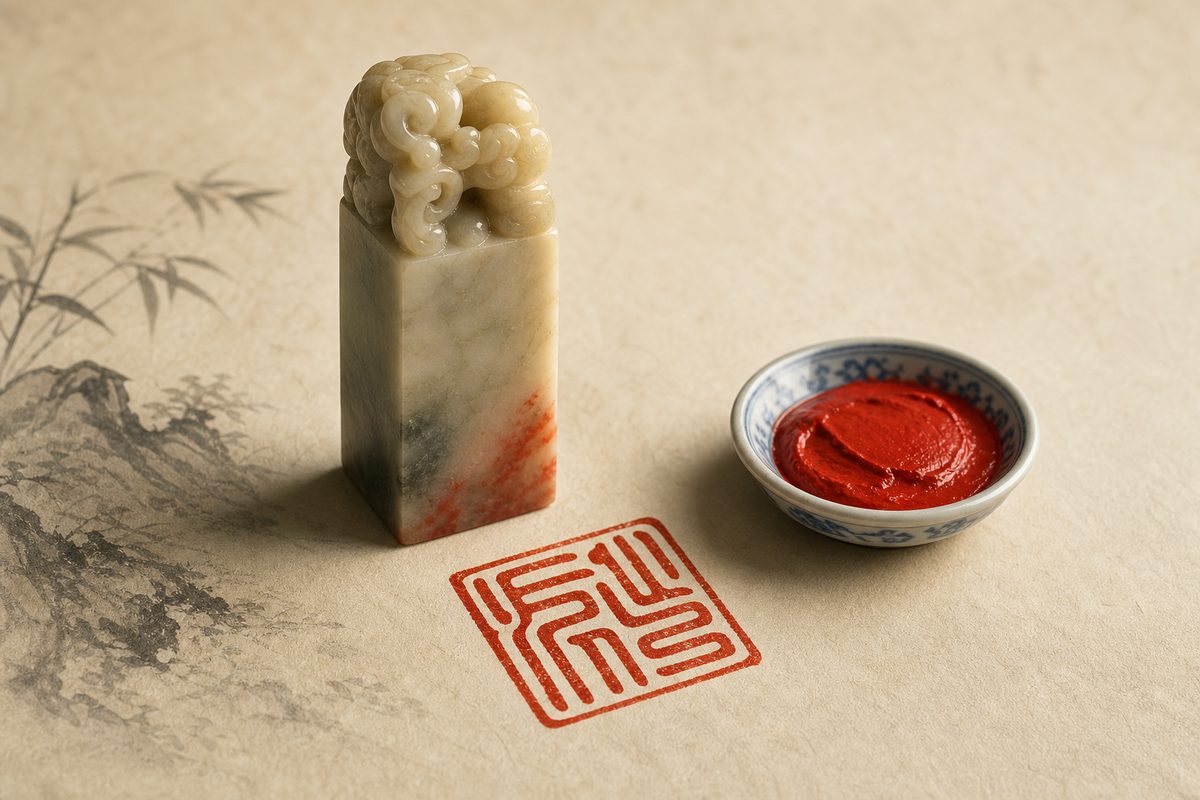
Each is a real name a native speaker would read as a name, built on the sound of yours. Pick the one that sounds like you, then carve it as a seal or write it in calligraphy.
Want to go deeper? Leave your email and open the full pack: the meaning of every character in all three names, a card to keep for each, and stroke-by-stroke tracing.
You'll also get the Jade Almanac letter. No spam; unsubscribe anytime.
That didn't go through. Try again, or write to hello@jadealmanac.com.
How a Chinese name is actually built
A Chinese name is short, usually two or three characters, and the order tells you something about the culture that made it: the family name comes first, because the family comes before the person. There are only a few hundred common surnames, catalogued since the Song dynasty in a rhyming primer children still learn, the Hundred Family Surnames (bǎi jiā xìng), and almost all of them are a single character. Which spelling you meet depends on where the family sailed from: Chen, fifth by census, is the same character as Chan, Tan and Tran. The given name, one or two characters, is where the art lives.
A good foreign-to-Chinese name does not spell you out syllable by syllable. It does two things at once. First it finds a real surname whose sound leans toward yours: Bell becomes 贝 (Bèi), Garcia becomes 高 (Gāo), Vincent becomes 温 (Wēn). Then it builds a given name that catches the rest of your sound and, just as important, means something a parent would be glad to give: peace, clarity, a particular flower, or one of the many characters for fine jade, which is why the name Jade means something rather different in Chinese than in English. Get both right and the result reads, to a native, like a name someone chose on purpose.
This is a real craft with a real institution behind it. China's official spellings of foreign names are fixed by a single office, the Xinhua News Agency transliteration desk, set up under Zhou Enlai in the 1950s so that one foreign name would map to one agreed Chinese version, with no freelancing. A name for yourself is warmer than a wire-service rendering, but it runs on the same instinct: sound first, then a character the reader is happy to see.
A spelling versus a name
The quickest way to see the difference is side by side. Take the name David, rendered both ways:
| Phonetic transliteration | A crafted name | |
|---|---|---|
| Result | 大卫 (Dàwèi) | 戴伟 (Dài Wěi) |
| How it was chosen | Characters picked for sound alone | A real surname, then a chosen meaning |
| What it means | "big guard," an accident of the sounds | the Dài surname plus "great," on purpose |
| Reads as | correct, but flavorless, like a passport | a name a parent might have chosen |
Both are pronounceable; only one is a name. This tool makes the second kind.
The traps this quietly avoids
Most "Chinese name" tools are transliterators, and transliteration is exactly where foreigners end up with names that make native speakers wince. The classic failures are worth naming, because dodging them is the whole point.
- The accidental pun. Characters chosen for sound alone can spell something unfortunate; a careless rendering of Charlotte can land close to the sound of "kill him." A meaning-aware name checks for this.
- The object or place name. An impressive-looking character is often a thing, not a name; choosing one is the equivalent of introducing yourself as "Eiffel Tower." Real given names draw from a different, human vocabulary.
- The wrong gender. Characters carry a strong felt gender; a woman's name built from stony, martial characters (or a man's from delicate, floral ones) reads immediately as a mistake.
- The rare character. A character no one can read or type is a lifelong inconvenience, not a distinction.
- The five-character sprawl. Spelling out a full Western name produces a string no native would parse as a name. The fix is not more characters; it is a proper surname plus a proper given name.
Questions people actually ask
What is my name in Chinese?
There are two answers, and they are not the same. A phonetic transliteration just borrows characters that sound roughly like your name, with no eye on meaning: it is how the news renders "David" as Dàwèi, correct but flavorless, the way a passport spells a sound. A real Chinese name is chosen the way parents choose one, a single-character surname that echoes your sound followed by a given name that both catches the rest of the sound and means something good. This tool makes the second kind, the name a Chinese person would actually read as a name.
How is a Chinese name spelled in English?
In pinyin, the romanization China made standard and the ISO adopted as ISO 7098 in 1982. The rules are few. Surname first, then the given name, each with a capital: Mao Zedong, Wang Fang. A two-character given name is written as one word, so Zedong, not Ze Dong or Ze-Dong, under China’s pinyin orthography standard (GB/T 16159-2012). Tone marks are dropped outside textbooks, which is why one spelling can stand for several different characters, and why passports write the ü in a name like 吕 as LYU. Older spellings survive where families or governments kept them: Taiwanese passports let the holder choose Wade-Giles, so Zhang there is often Chang, and Hong Kong and the diaspora keep Cantonese forms such as Cheung, Chan and Wong. A spelling records the sound; it is the characters that are the name.
Is this a Chinese name converter?
Yes, in the sense people usually mean: type your English name and you get Chinese characters back. It does not convert you letter by letter or syllable by syllable, though, because that produces a transliteration rather than a name (see the David example above). It converts your name the way a Chinese speaker would, into a real surname that echoes your sound and a given name with a chosen meaning, and shows you the pinyin spelling and the reasoning for each of the three it returns.
How long is a Chinese name?
Almost always two or three characters: a one-character family name first, then a one or two-character given name. Surname first is not a style choice, it is the grammar of the culture, family before self. A well-made foreign name follows the same shape rather than transliterating every syllable of your name into a five-character string no native would read as a name at all.
Will a Chinese person actually recognize it as a real name?
That is the whole point, and the reason this is not a random-character generator. The model works to the conventions natives use: a common single-character surname, given-name characters that carry good meaning and sit well together in tone, gender read correctly, and the usual traps avoided. Every candidate is then checked against those rules before you see it, and each one arrives with a short story explaining how it was built, so you can judge it yourself.
What mistakes do foreigners make with Chinese names?
The famous ones: spelling a whole name out into a long unpronounceable string; picking characters that spell an accidental pun, so the name sounds like something rude; choosing an impressive-looking character that is really a place or an object, the equivalent of naming yourself "Eiffel Tower"; or a rare character no one can read. Putting the surname and given name in the wrong order is the quiet giveaway that a name was made by a machine. This tool is designed against all of them.
How do I pick my Chinese name?
Work in the order a Chinese parent works. Pick the surname first, and pick it from the common stock: one character, ideally one whose sound sits near the first syllable of your family name. Then choose one or two characters for the given name, and judge each on four things at once, the sound against the surname, the meaning, the tone contour (three flat tones in a row sounds wrong even when every character is fine), and whether the character is one an ordinary person can read and write. Say the whole thing out loud, surname first, before you commit; most bad names are audible rather than visible. Then ask a native speaker what it makes them think of, because a character can be blameless on its own and comic beside the one next to it. If you would rather see three finished candidates with the reasoning shown, that is what the generator above does.
How can I find out my Chinese name?
If somebody gave you one, a teacher, a colleague, a host family, that is your name and it outranks anything a tool produces; ask them to write it out and to tell you which character is the surname, because the order surprises people. If what you have instead is the version that shows on a visa, a diploma, or in a news article, that is a transliteration rather than a name: an official desk borrowed characters for their sound alone, which is why it often runs to four or five characters and means nothing in particular. Everyone else does not have one to find, and never did. A Chinese name is made, not discovered, which is the honest answer to a question the internet usually dodges.
What is the rarest Chinese name?
There is no single answer, and the interesting part is why. Rarity in a Chinese name sits almost entirely in the surname, because given names are freely composed and a genuinely unique two-character given name is easy to make by accident. Surnames are the fixed stock, and it is far larger than people expect: Yuan Yida's Dictionary of Chinese Surnames collects 23,813 attested through history, while only about six thousand are still carried by anyone today and the hundred commonest cover roughly five people in six. That leaves a long tail of surnames held by a few hundred families or fewer. Compound surnames are where the tail is most visible, and the numbers fall off a cliff below the familiar ones: Ouyang, Sima, Shangguan and Zhuge are recognizable from history and fiction, while Diwu, literally "Fifth", survives from a Han-dynasty resettlement that renumbered a relocated clan First through Eighth and left mostly the fifth branch standing. Names that rare are a lineage record, not a curiosity, which is why we write up surnames one at a time rather than ranking them.
Is it free?
Yes. All three names and the story behind each are free, no email needed. Leave an email and you also get the meaning of every character, a card to keep for each name, and stroke-by-stroke tracing. No payment, no watermark. A deeper, more personalized reading is something we may offer later, and you can raise your hand for it, but the name itself is yours to keep.
Sources
- • The Xinhua News Agency transliteration desk, the office that has set China's official renderings of foreign names since the 1950s
- • The Hundred Family Surnames (bǎi jiā xìng), the classic Song-dynasty primer of common single-character surnames: Chinese Text Project
- • Pinyin as ISO 7098 (1982), Taiwan's passport romanization choices, the LYU passport spelling: Wikipedia, Pinyin
- • Yuan Yida and Qiu Jiaru, Dictionary of Chinese Surnames (中国姓氏大辞典, Jiangxi People's Publishing House, 2010), the standard census-based count of surnames attested through Chinese history, for the rarity figures above
Once you have your name
Any character in six classic scripts, from clean print to running brush and seal.
The characters themselves
Love, strength, peace, and more, sourced and explained, with tracing.
The half you inherit
One clan at a time: the origin, the migrations, and who still carries it.