Chinese Mythology
Fuxi: The Eight Trigrams, and the Diagram That Fooled Leibniz
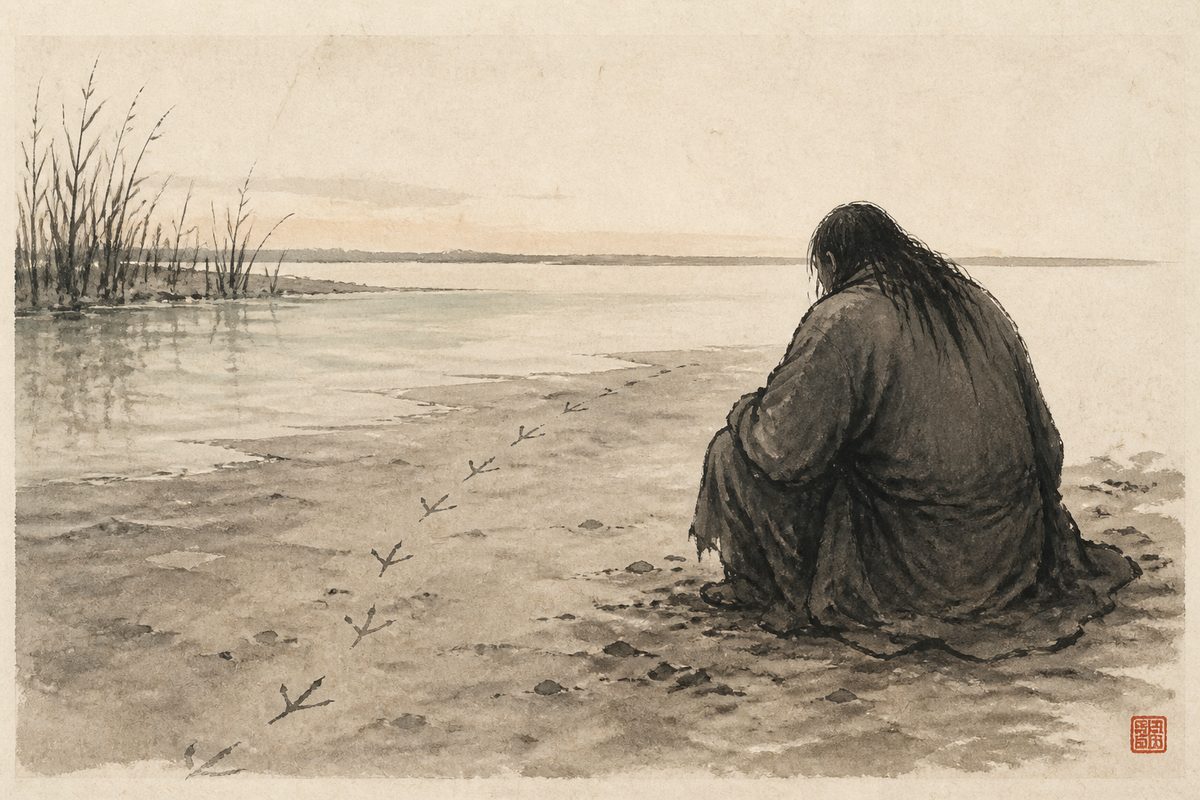
Fuxi is the figure credited with inventing the eight trigrams, the three-line symbols behind the Book of Changes, the feng shui compass and four corners of the South Korean flag. The oldest account of how he did it is unusual: it describes not a revelation but a procedure. He looked up at the sky, down at the ground, and at the markings of birds and beasts, and then he made them. He is also said to have knotted the first fishing nets.
What he is supposed to have made
Of all the figures in Chinese mythology, Fuxi is the one whose invention you can still buy.
The eight trigrams are eight little stacks of three lines each, every line either solid or broken. Eight, because two options in three positions gives you eight. They are the atoms of the Book of Changes, they are the working layer of the feng shui compass, they sit on the bagua mirror hung over doorways from Guangzhou to Flushing, and four of them are printed in the corners of the South Korean flag. Nothing else invented by a Chinese mythological figure is still in this much daily use.
The oldest text that explains where they came from is the Great Commentary, the long philosophical appendix attached to the Book of Changes and datable, in its received form, somewhere between the Warring States period and the early Han. It opens the relevant section like this:
In antiquity, when Baoxi ruled the world, he looked up and observed the images in the sky, looked down and observed the patterns on the earth, observed the markings of the birds and beasts and what suited each stretch of ground. Near at hand he took from his own body, far off he took from other things. And then he first made the eight trigrams.
The same passage goes on to say that he knotted cords into nets, for hunting and for fishing.
Two things about that. The first is that the text does not call him Fuxi. It calls him Baoxi, which is one of at least half a dozen ways his name gets written, and we will come back to that. The second is the shape of the sentence, which is the most interesting thing on this page and which almost nobody quotes.
It is a method, not a miracle
Read the passage again and notice what does not happen in it.
Nothing is given to him. Nobody descends. No animal surfaces bearing a diagram. There is a man, and a long list of things he looks at, and then, at the end of the list, the trigrams. Look up, look down, look at what animals leave behind, look at what grows where, take some of it from your own body and the rest from the world, and then make the symbols. That is not a revelation narrative. It is a description of fieldwork.
Which is odd, because the version most English pages lead with is the other one. In that account the arrangement is revealed to Fuxi in the markings on the back of a dragon-horse, sometimes a tortoise, that comes up out of the river. It is a good image and it has been painted a thousand times. What it is not is what the Great Commentary says.
Here is the honest limit on that comparison, and it is worth stating rather than hiding, because the temptation is to turn a real observation into a bigger claim than it will carry.
| The Great Commentary | The dragon-horse | |
|---|---|---|
| Source | Book of Changes, Xici part two | Widely transmitted; we have not established a first attestation |
| Date | Warring States to early Han | Unknown to us, and later texts carry it |
| How the trigrams arrive | Made, after a long look at the world | Delivered, already arranged, on an animal's back |
| What Fuxi does | Observes, abstracts, classifies | Receives and transmits |
| What it implies about the trigrams | They are a human reading of nature | They are a message from outside nature |
We can say with confidence that the oldest surviving text explaining the trigrams gives an observational procedure and no dragon-horse. We cannot say when the dragon-horse first appeared, because we have not found a source that dates it, and putting a century on it would be inventing one. So the claim on this page is the narrow one, and the narrow one is quite enough: the empirical version is the one in the older book.
The notation is still running
The trigrams did not stay in the myth. They became infrastructure.
They are the eight positions on a bagua map, which is the layout tool that divides a home into life areas and which we run as a bagua map guide. They sit under the eight-mansions system that turns a birth year into a set of favorable and unfavorable directions, which is what our kua number calculator computes. They are the reason the Book of Changes can be consulted at all: you produce six lines, you read off two trigrams, you look up what they say together.
And four of them are on a national flag. The South Korean taegeukgi carries a red and blue taegeuk in the center and four black trigrams in the corners, named in Korean as geon, gon, gam and ri, which are four of the same eight symbols: heaven, earth, water and fire. A three-line binary notation that, according to its own founding text, came out of watching animal tracks in mud, is now doing load-bearing symbolic work on the flag of a G20 economy.
He also still has addresses. Tradition puts his birth at Chengji, variously identified with modern Lantian in Shaanxi or Tianshui in Gansu, and his death at Chen, which is modern Huaiyang in Henan. Both places have kept him. And he turns up as a character in the Koei strategy and action games, which is how a good number of the people reading this first met the name, though I have not been able to pin down a reliable release year for any of those appearances and would rather say so than guess.
The letter that reached Leibniz two years late
This is the best story anyone has about the trigrams, and the ending has been improved in the retelling, so here it is with the dates in.
Joachim Bouvet was a French Jesuit in Beijing who had made himself an expert on the Book of Changes. Gottfried Wilhelm Leibniz had been working on base-two arithmetic since at least 1679, and wrote more than a hundred manuscripts on it, most of which he never published. What he did not have was a reason for anyone else to care about a number system with only two digits in it.
The two men were corresponding by 1700. Leibniz explained his binary notation, and in his letters of 1701 Bouvet argued back that the Book of Changes was an independent, parallel invention of the same thing. He sent a diagram of the hexagram arrangement to prove it.
The post between Beijing and Europe was slow enough to be part of the story. The study of the episode in the Journal of East-West Thought dates Bouvet's letter to 4 November 1701 and its arrival on Leibniz's desk to 1 April 1703, about five weeks before the Explication de l'Arithmétique Binaire appeared in print in 1703 with the trigrams set beside their binary values. Leibniz wrote that this recovery of the diagram's meaning, after so great an interval of time, would seem all the more curious.
The correspondence he spotted is entirely real. Read the arrangement in the right direction, with broken lines as zero and solid lines as one, and you count 0, 1, 2, 3, 4, 5, 6, 7 straight through. That is not a coincidence and it is not a stretch.
The great interval of time is the problem. The arrangement that resembles binary counting was put in that order by Shao Yong, a Northern Song scholar who lived from 1011 to 1077. Fuxi's name sits on it as an attribution, in the ordinary way that Chinese intellectual tradition credits a founding sage with a much later refinement. The diagram that crossed Europe in that envelope was roughly six hundred years old, not four thousand, and Leibniz had no way to know it.
To be precise about what is being corrected: this is a claim about the object in the post, not about the whole history of hexagram ordering. The binary reading is genuine. The provenance of the specific arrangement that convinced Leibniz is Song, not archaic.
His name will not hold still
The Great Commentary calls him Baoxi. Elsewhere he is Paoxi, or Mixi, or Fuxi written with a different first character, or Fuxi written with a third one. The early record cannot settle on a spelling.
That kind of instability is a signal. When a name is composed from meaningful characters, scribes tend to keep them, because the characters carry the sense. When a name is a sound that somebody is trying to write down, scribes reach for whatever characters approximate the noise, and you get a scatter of variants like this one.
What that suggests is a figure who came into the written tradition from outside it, from speech rather than from a book. What it does not prove is anything more specific than that, and there are livelier hypotheses about where he came from that this page is not going to endorse without better evidence than a spelling list.
He was two people, and the merger had a motive
Now the part that reframes the whole set.
Before the Han dynasty there was a divinity called Taihao, the Great Bright One, who appears vaguely in the sources and is not Fuxi. Two separate figures, in two separate traditions. At some point they became one, and the identification stuck so thoroughly that most modern accounts treat Taihao as simply another name for Fuxi.
The machinery that fused them was chronology. Liu Xin, the Han scholar and bibliographer, built a systematic dynastic sequence in his Shijing using Five Phases succession, and he started it with Fuxi holding the virtue of wood. Wood generates fire, so the Flame Emperor comes next with fire; fire generates earth, so the Yellow Emperor follows with earth; and the chain runs on down to Liu Xin's own present. It is a beautiful scheme. It also required every legendary figure to have exactly one slot, which is a strong incentive to decide that two half-remembered eastern deities were really the same person all along.
Gu Jiegang, the most consequential Chinese historian of the twentieth century on this subject, argued in a 1930 study that Liu Xin's scheme was not disinterested scholarship. It was built, Gu said, to legitimate Wang Mang's seizure of the throne, by supplying a cosmic sequence into which the usurper fitted as the rightful next term.
Gu's larger idea, published in 1923, is the one to carry away from this page. He called it the layered accumulation of ancient Chinese history, and the core of it is a rule that sounds like a joke until you check it: the later the source, the earlier the legendary figure it introduces. The Zhou texts know the Yellow Emperor. Warring States texts add Yao and Shun in front of him. Han texts add Fuxi and Shennong in front of them. The past keeps growing a new beginning, and it grows it at the far end, where nobody can check.
Gu was making an argument, not delivering a verdict, and he has been contested for a century. But if you want one idea that explains why five different creation figures are always presented as a neat sequence and never quite fit into one, that is the idea.
His sister, in one paragraph
He is paired with Nüwa, first in Han-dynasty material and Han tomb carvings, where the two of them appear human above the waist and joined below it as two entwined serpent tails, one with a pair of compasses and one with a carpenter's square. The narrative of the marriage, the two of them alone on Mount Kunlun putting the question to heaven and watching the smoke, survives in a Tang collection from the ninth century. Her page has the text and the full story, along with the sky repair and the clay people. This one has the trigrams. That division is deliberate, and it is roughly how the sources divide them too.
So what did he actually invent?
Strip it back to the oldest layer and the answer is two things: the eight trigrams, and nets made of knotted cord.
Everything else in the standard list came later. Writing, in the form of tallies and knotted records replacing something cruder. Marriage and the system of surnames. The zither. Cooking. Domesticated animals. Each of these gets attached to his name in a text somewhat further from the source than the last, which is exactly the pattern Gu Jiegang described, running in miniature inside a single biography.
That is not a debunking. A culture hero who accumulates inventions is doing his job; the accumulation is the tradition. But the two oldest items are worth keeping separate from the rest, because they are the ones the earliest surviving text actually gives him, and because one of them turned out to be a durable piece of notation that a German mathematician would recognize two thousand years later from across a continent, and get slightly wrong, and publish anyway.
In the classics
The passages behind the story, in the standard published translations. Open any one for the original text.
“In antiquity, when Baoxi ruled the world, he looked up and observed the images in the sky, looked down and observed the patterns on the earth, observed the markings of the birds and beasts and what suited each stretch of ground. Near at hand he took from his own body, far off he took from other things. And then he first made the eight trigrams, in order to reach through to the powers of the bright spirits and to sort the natures of the ten thousand things. He knotted cords and made them into nets, for hunting and for fishing, which he seems to have taken from the trigram Li. ”
Original text
古者包犧氏之王天下也,仰則觀象於天,俯則觀法於地,觀鳥獸之文,與地之宜,近取諸身,遠取諸物;於是始作八卦,以通神明之德,以類萬物之情。作結繩而為罔罟,以佃以漁,蓋取諸離。
Questions people ask
What was Fuxi the god of?
Of useful inventions, and of one in particular. The oldest source that explains him, the Great Commentary attached to the Book of Changes, credits him with exactly two things: the eight trigrams and the knotted-cord net for hunting and fishing. Later tradition piled on writing, marriage, music, cooking, animal husbandry and the system of surnames, until he became a general-purpose founder of civilization. He is also counted as the first of the Three Sovereigns, though that ranking is a piece of Han-dynasty chronology rather than an ancient inheritance.
What does Fuxi mean in Chinese?
Frustratingly little, and the reason is interesting. His name is written several different ways across the early texts, and the Great Commentary does not even call him Fuxi; it calls him Baoxi. Other sources give further variants. A name written that many ways is usually a name being transcribed from a sound rather than assembled from meanings, which is what you would expect from a figure who arrived in the written record from an older oral tradition. The characters used can be glossed individually, but doing so tells you about the scribes rather than about him.
Was Nuwa in love with Fuxi?
The sources make them brother and sister first. Their pairing appears in Han-dynasty material, and Han tomb art shows the two of them human above the waist and joined below it as two entwined serpent tails, usually holding a pair of compasses and a carpenter's square. The surviving narrative of the marriage is much later, in a Tang collection of the ninth century, and it is not a romance: they are the last two people alive, they consider marrying, they are embarrassed, and they put the question to heaven by watching whether two columns of smoke will join. The full story, and the text it comes from, are on our page for Nüwa.
What is fu shi?
Usually a misspelling of Fuxi, and the confusion is understandable. The syllable is written xi in pinyin but sounds nothing like the English letter x, which sends people reaching for sh. If you have arrived here after searching fu shi or fu hsi, you are in the right place: Fu Hsi is the older Wade-Giles romanization of the same name and still turns up in mid-century translations. Note that it is not the same word as fu shi in any other sense you might have met.
Did the I Ching invent binary code?
No, but a real historical episode sits underneath that claim. The Jesuit Joachim Bouvet, writing from Beijing in 1701, argued to Leibniz that the Book of Changes was an independent parallel invention of binary notation, and sent him the hexagram arrangement to prove it. Leibniz, who had been working on base-two arithmetic since 1679, saw that the ordering matched binary counting exactly, and his Explication de l'Arithmetique Binaire appeared in 1703 with the trigrams set beside their binary values. The correspondence is real. The dating is not: that arrangement was put in that order by the Song scholar Shao Yong, who lived from 1011 to 1077, and it carries Fuxi's name as an attribution rather than an authorship.
Related figures
Sources & further reading
- Book of Changes, the Great Commentary part two: the passage on Baoxi observing heaven and earth and then making the eight trigrams and the knotted nets
- 伏羲: the Chinese-language account, with the early textual attestations, the written variants of the name, Liu Xin's Five Phases chronology beginning from Fuxi's wood virtue, and the Han-dynasty pairing with Nüwa
- Fuxi: the English-language account, including Taihao as a separate pre-Han divinity, the dragon-horse legend, and the traditional birthplace at Chengji and death at Chen
- Binary number: Leibniz's work on binary from 1679, the correspondence with Joachim Bouvet in 1700 and Bouvet's 1701 letters arguing the Book of Changes was a parallel invention of binary notation, the 1703 publication of the Explication de l'Arithmetique Binaire, and Shao Yong (1011 to 1077) rearranging the hexagrams into a format resembling modern binary numbers
- The Development of Binary Arithmetic by Leibniz, Journal of East-West Thought: the dating of Bouvet's letter to 4 November 1701 and its arrival on 1 April 1703, and the Xiantiantu diagrams drawn up by Shao Yong
- Gu Jiegang and the thesis of the layered accumulation of ancient Chinese history, East China Normal University: the 1923 argument, and the 1930 study reading Liu Xin's chronology as political construction
- Flag of South Korea: the taegeuk and the four trigrams geon, gon, gam and ri in the corners
By Julian 祝君瑜, retold from the classics, with the original passages cited, updated 2026-08-26