Chinese Mythology
Tudigong (土地公): The Chinese Earth God and His Roadside Shrines
Tudigong 土地公 (Tǔdìgōng, roughly "too-dee-gong") is the Chinese earth god: not the god of the Earth, but the god of one particular patch of it, a village, a field, a street, a garden. He is the smallest god in the pantheon and the one with the most shrines, usually a stone box the size of a mailbox with a small smiling old man inside. He is also the oldest god here. Two thousand years ago his altar stood beside the grain altar at the center of the state.
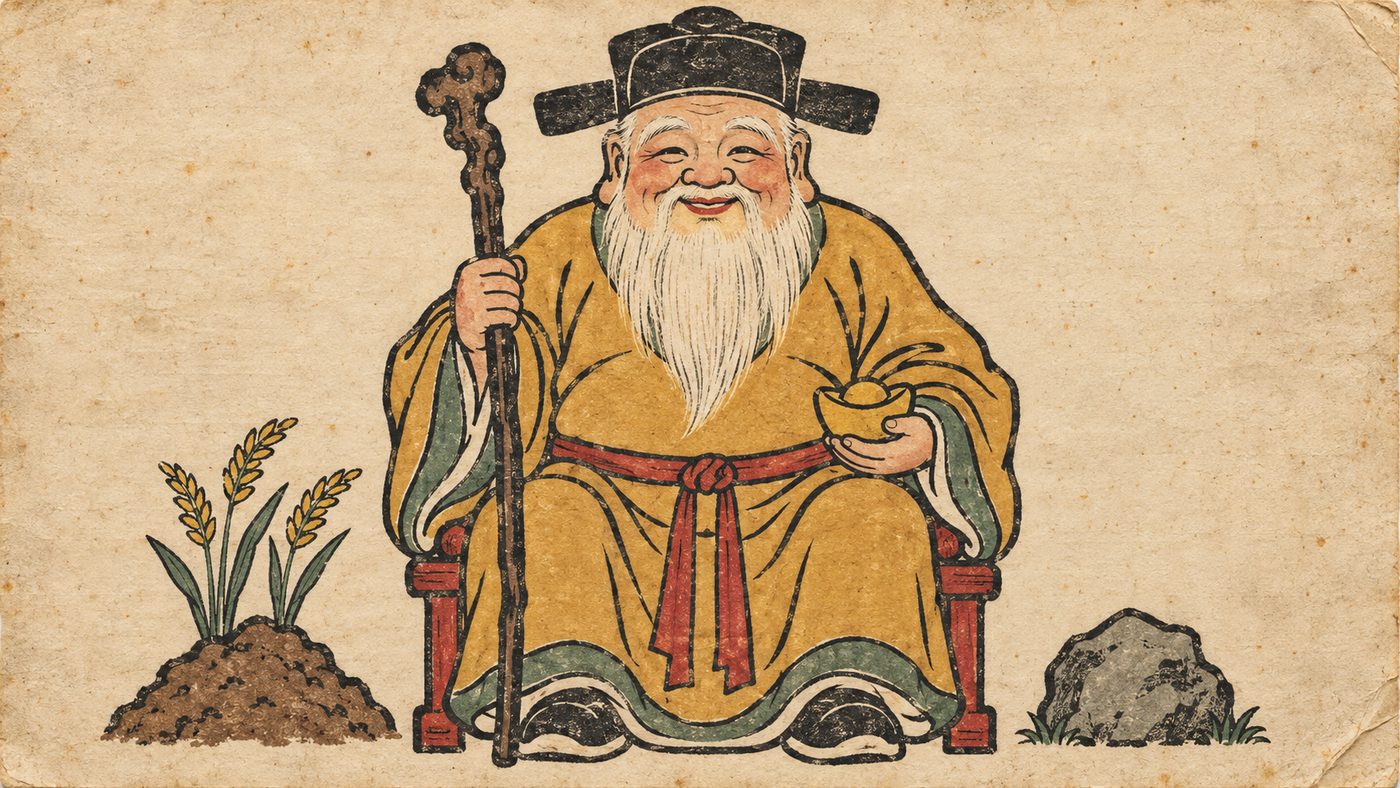
The god of this patch of earth
The first thing to get right about Tudigong is that he is not the god of the Earth. He is the god of that bit over there. A village has one. So does the next village, and it is a different one, with a different name in local usage and a different shrine, and neither has any authority over the other. A field can have its own. A garden can have its own, as we will see, to Monkey's considerable annoyance. The office is defined by how little of the world it covers.
This makes him the most encountered god in Chinese religion and the least impressive. You have almost certainly walked past one. The shrine is a stone or brick box, waist high, sometimes smaller than a mailbox, set at the entrance to a lane or under a tree or at the corner of a field, with a tiled miniature roof and a figure inside about the size of a forearm: a plump old man, beaming, long white beard, soft cap, a staff in one hand. In front of him there is usually a cup of tea going cold, a couple of oranges, and three sticks of incense burned down to stubs.
He answers to a small pile of names, most of them affectionate. Tudigong is the plain one, "the lord of the earth." Tudi Ye is "grandpa earth," which is how people mostly talk to him. Fude Zhengshen, the Upright God of Blessing and Virtue, is the formal title that goes on a temple register and a red signboard. Hakka communities call him Bogong, "uncle." Across much of Malaysia, Singapore and Indonesia his temples run under the Hokkien name Tua Pek Kong, grand uncle, though those also gather up some local founding figures along the way, so the identification is close rather than exact. Every one of those names is a kinship term. Nobody calls him Your Majesty.
And now the part that catches people out. This unassuming old man in a box is the oldest god on this website. He is older than the Jade Emperor, older than Guanyin in China, older than the entire heavenly civil service he currently sits at the bottom of. Two thousand years ago his altar stood at the center of the state, and a dynasty's survival was described as keeping it standing.
The shrine you have already walked past
What people actually want from him is small and specific, and that is not a criticism, it is the design. You ask the earth god about the ground you are standing on. A shopkeeper asks for steady business at this address. A farmer asks about this field. Someone building a house tells him first, as a courtesy to the landlord. A family burying a relative informs him, because the grave is on his patch. Travelers used to tell him they were leaving and tell him again when they got back. Nobody asks him to change their fate; that is several departments up.
The rhythm of feeding him is domestic too. In Fujian and Taiwan, shops make him an offering on the second and the sixteenth of every lunar month, a practice called zuoya, "making the ya," from an old military ritual that migrated into commerce. The first of those in the year, on the second day of the second lunar month, is touya, the head ya, and it doubles as his birthday, the biggest of his feasts. A second celebration falls at the mid-autumn full moon, when the harvest is in. It is worth saying plainly, because the internet gets this one wrong constantly: his birthday is the second day of the second month, not the second day of the first. The first month's second day belongs to the god of wealth.
Which raises the obvious question, since a shop tends to feed both. The difference is that Caishen is asked for money and the earth god is asked for the conditions in which money is possible: a lane that stays busy, a plot that does not turn out to have a problem, neighbors who do not sue. One is a windfall and the other is a lease.
The offerings are deliberately unimpressive. Tea or rice wine, fruit, a few sweets, incense, sometimes a plate of whatever the household is having. Some places bring him a cooked chicken at the feasts and most do not. He is not a god you impress, and there is a faint, consistent strain of folk humor about him being a soft touch, easily pleased, perhaps a little too easily.
Beside him in many shrines, though not all, sits Tudipo, the earth grandmother, his wife. She has no classical text behind her at all, and the reasoning about her is genuinely split. Some communities keep her because a god ought to have a household like anyone else. Others deliberately leave her out, on the theory that a wife would make him partial, or soften him, or that he would spend his time attending to her instead of the fields. It is an unusually frank piece of folk politics, and it tells you how people picture the job: an official, at a desk, who can be lobbied.
As for how many of these shrines exist, the honest answer is that nobody knows and nobody can. They are too small and too informal to register. A great many were built by a village on its own initiative and are maintained by whoever lives nearest. Any specific number you see quoted for them should be treated with suspicion. The one countable fact in this whole subject comes from Ming law, and we will get to it, because it is also the point at which his career goes wrong.
Outranked by a city
Here is the demotion, and the remarkable thing is that the state wrote it all down.
In 1369, the first year but one of the Ming, the Ministry of Rites took up the question of the city god, Chenghuang, the spiritual magistrate of a walled city. In the course of recommending that his worship be regularized, the ministry recorded an objection from earlier scholars, and recorded it without much enthusiasm for answering it: since there is already an earth altar, there ought not also to be a city god. The city god, in other words, was the newcomer, and educated opinion thought him redundant.
The court regularized him anyway, and did it in the most bureaucratic manner imaginable. City gods were granted noble titles pinned exactly to the administrative rank of the place they guarded. The capital's got a long and glorious one. A prefecture's city god became a Duke of Awesome Spirit Who Inspects and Governs the People, at the upper second grade. A department's became a Marquis of Numinous Aid, third grade. A county's became an Earl of Manifest Aid, fourth grade. Robes and crown ornaments were specified to match. The following year the emperor changed his mind and stripped the titles again, ordering the gods to be called simply the city god of such-and-such a place, their statues thrown in the water and their halls built to the dimensions of a government office.
The earth god appears nowhere in any of it. No title, no grade, no robes, not even the indignity of having his statue removed. What he got instead, in the same body of Hongwu legislation, was this: in every hamlet, for each hundred households, one altar is raised, sacrificing to the gods of the five soils and the five grains.
Read those two provisions next to each other and the whole shape of his career is visible. One god was given a rank in the peerage and a temple sized like a courthouse, and had it all taken away again within a year. The other was written into the law as infrastructure, one unit per hundred households, like a well. The city god went up in the world by becoming an official. The earth god stayed exactly where he had always been, which by the fourteenth century meant underneath.
| Earth god (Tudigong) | City god (Chenghuang) | |
|---|---|---|
| Jurisdiction | One village, field, street or plot | One walled city and its dead |
| Rank in the Ming settlement | None. Legislated instead as one altar per hundred households | Duke, marquis or earl by administrative level (1369), titles revoked (1370) |
| Where you meet him | A box at the end of the lane | A large temple, laid out like a government office |
| What you ask for | Steady conditions on this ground | Justice, judgment, the fate of the city's souls |
He started at the top
To see how far he fell, you have to go back to what he was.
The classical earth god is the she 社, an altar of heaped earth, and the she is not a minor institution. It is half of the pair sheji, the altars of earth and grain, and sheji is the standard word for the state itself; a dynasty falls when its altars of earth and grain are destroyed. The Book of Rites puts it in ranks: the king raises a Great Altar for the multitude of clans and a Royal Altar for himself, the lords raise a State Altar for the hundred surnames and a Lords' Altar for themselves, and grandees and those below them, forming groups, raise what is called an Established Altar. Every tier of society, from the throne down to a group of commoners, had an earth altar. That last tier is the ancestor of the box at the end of your lane.
The god of those altars had a name and a biography. When the house of Gonggong held sway over the nine regions, says the Book of Rites, its son was called Houtu, and he was able to level the nine regions, and therefore he is sacrificed to as the she. The Zuo Commentary, older still, gives him another name in the same breath: Gonggong had a son called Goulong, who became Houtu, and Houtu is the she. So the earth god begins as the Book of Rites likes its gods to begin, as a competent man who did a large public-works job and was deified for it.
Why did the earth end up worshipped in thousands of small pieces rather than once, properly, as a whole? Because the tradition thought about that and gave an answer. Ban Gu's Baihu Tong, the record of a court conference on ritual held in 79 CE, sets it out with a logician's tidiness. Without earth a person has nowhere to stand and without grain nothing to eat, so both must be honored. But the land is vast and cannot be revered everywhere, and the grains are many and cannot be sacrificed to one by one. Therefore one heaps up earth and raises an altar, to show that the earth is honored.
That is the entire theology of the roadside shrine, written eighteen centuries before the shrines anyone can currently see. You cannot worship the earth. It is too big, and you would never finish. So you pile up a handful of it, put a god in charge of the pile, and worship that instead. Multiply the pile by every hundred households and you have the density.
One last detail from the deep end, and it is a good one. The single passage in the Analects that deals with the earth altar is not about ritual at all. Duke Ai asks Zai Wo about the she; Zai Wo explains that the Xia planted pine at theirs, the Yin cypress, and the Zhou chestnut, and then cannot resist adding that the Zhou chose chestnut, li, in order to make the people tremble, zhanli. Confucius, hearing about this afterward, delivers one of his flattest lines: a thing done is not to be discussed, a thing settled is not to be argued, a thing past is not to be blamed. Which is the Master declining, with visible effort, to dignify a pun.
Buried in the exchange is the oldest form of the shrine. Before the box, before the smiling old man, before the statue of any kind, the earth god was a tree standing over a mound of soil, and the argument about him was over which species.
The smallest god in Journey to the West
The novel that best captures what became of him is Journey to the West, where the local earth god turns up constantly and is never once treated with respect.
In chapter 24 the pilgrims reach a Daoist abbey with a ginseng-fruit tree in its garden, and Monkey, who is congenitally unable to leave fruit alone, knocks one down with a golden mallet. It vanishes on landing. Suspecting theft, he makes a sign with his fingers, recites the syllable "Om," and compels the earth god of that particular garden to appear. Note the scale: not the mountain's earth god, not the district's, the garden's.
The little god arrives, bows, and asks what the Great Sage requires. Monkey accuses him, at length, of skimming. The reply is the finest thing in the scene, and it is entirely a matter of rank: the Great Sage has wrongly accused your little god. This treasure belongs to an earth immortal, and your little god is only a ghost immortal. How would I dare take it? I am not even lucky enough to smell it. He then explains, with complete and unanswerable local expertise, that the fruit fears all five elements and sinks straight into the ground on contact with earth, which after all is his own department; and that this particular soil is forty-seven thousand years old and harder than wrought iron. Monkey hits the ground with his iron cudgel, fails to leave a mark, concedes the point, and dismisses him. The earth god goes straight back to his own little temple.
He is like that everywhere in the book. In chapter 60, when the pilgrims are stuck at the Flame Mountain, it is the local earth god who explains where the fire came from, and who turns out to be a demoted furnace attendant serving out his posting. In the peach orchard of Heaven itself, an earth god walks Monkey round the stock and recites the ripening schedule for the Queen Mother's trees. He knows the ground. He has no power whatsoever. He is summoned by anyone with a spell and dismissed when he stops being useful, and he is unfailingly polite about it, referring to himself throughout as "your little god."
It is a comic portrait, and it is also a fairly exact piece of social observation about the sixteenth-century divine bureaucracy: the lowest-ranking official in a system is the one who actually knows what is happening on the ground.
Earth god, city god, stove god
He is not alone down there. The Book of Rites lists seven sacrifices the king establishes for the multitude of clans, and the list is startlingly domestic: the Director of Destinies, the central roof-hole, the state gate, the state road, the unappeased dead, the door, and the stove. Three of those are furniture. The door is Menshen, the pair of armed men pasted on the gate at New Year. The stove is Zaojun, who watches the household all year and files a report. The central roof-hole, zhongliu, is the opening in the roof of an old house over the sunken floor where rain came in, which is to say the household's own patch of earth, the indoor cousin of the she. The same chapter of the Book of Rites draws the parallel outright: the household's root is the roof-hole, the state's root is the earth altar.
So the small gods of Chinese religion are not a folk scattering that grew up outside the official system. They are a state list, and they have been one for two thousand years. The door, the stove, the floor. The earth god is simply the one who works outdoors, and who, unlike the rest of them, was once the most important god a village had.
He is still there. Walk to the end of almost any older lane in southern China, Taiwan, Malaysia or Singapore and you will find a small tiled roof about knee height, an old man smiling out of it, and someone's oranges going soft in front of him. It is the longest continuously held post in the Chinese pantheon, and its holder has never been promoted.
In the classics
The passages behind the story, in the standard published translations. Open any one for the original text.
“When the house of Gonggong held sway over the nine regions, its son was called Houtu, and he was able to level the nine regions. Therefore he is sacrificed to as the she. ”
Original text
共工氏之霸九州也,其子曰后土,能平九州,故祀之以為社。
“The king raises an altar for the multitude of clans: this is called the Great Altar. The king raises one for himself: this is the Royal Altar. The lords raise one for the hundred surnames: this is the State Altar. The lords raise one for themselves: this is the Lords' Altar. Grandees and those below them, forming groups, raise an altar: this is called the Established Altar. … The king establishes seven sacrifices for the multitude of clans: to the Director of Destinies, to the central roof-hole, to the state gate, to the state road, to the unappeased dead, to the door, and to the stove. ”
Original text
王為群姓立社,曰大社。王自為立社,曰王社。諸侯為百姓立社,曰國社。諸侯自為立社,曰侯社。大夫以下,成群立社曰置社。…王為群姓立七祀,曰司命,曰中霤,曰國門,曰國行,曰泰厲,曰戶,曰灶。
“Without earth a person has nowhere to stand; without grain, nothing to eat. But the land is vast and cannot be revered everywhere; the grains are many and cannot be sacrificed to one by one. Therefore one heaps up earth and raises an altar, to show that the earth is honored. ”
Original text
人非土不立,非穀不食。土地廣博,不可遍敬也;五穀眾多,不可一一祭也。故封土立社,示有土尊。
“Duke Ai asked Zai Wo about the altar of the earth. Zai Wo replied: "The Xia used pine, the Yin used cypress, the Zhou used chestnut, saying it was to make the people tremble." When the Master heard of it he said: "A thing done is not to be discussed, a thing settled is not to be argued, a thing past is not to be blamed." ”
Original text
哀公問社於宰我。宰我對曰:「夏后氏以松,殷人以柏,周人以栗。曰:『使民戰栗。』」子聞之,曰:「成事不說,遂事不諫,既往不咎。」
“Village altars: in every hamlet, for each hundred households, one altar is raised, sacrificing to the gods of the five soils and the five grains. … Earlier scholars held that since there is already an earth altar, there ought not also to be a city god. … The remaining prefectures' city gods were made Dukes of Awesome Spirit who inspect and govern the people, at the upper second grade; departments' were made Marquises of Numinous Aid, at the third grade; counties' were made Earls of Manifest Aid, at the fourth grade. … In the third year an edict removed the titles, and they were called simply the city god of such a prefecture, department or county. ”
Original text
里社,每裏一百戶立壇一所,祀五土五穀之神。…先儒謂既有社,不應復有城隍。…其餘府為鑑察司民城隍威靈公,秩正二品。州為鑑察司民城隍靈佑侯,秩三品。縣為鑑察司民城隍顯佑伯,秩四品。…三年,詔去封號,止稱其府州縣城隍之神。
“He made the sign with his fingers, recited the syllable "Om," and compelled the earth god of that garden to appear, who bowed to him and said: "The Great Sage has summoned your little god. What are your orders?" … The earth god said: "The Great Sage has wrongly accused your little god. This treasure belongs to an earth immortal, and your little god is only a ghost immortal. How would I dare take it? I am not even lucky enough to smell it." … And the earth god went straight back to his own little temple. ”
Original text
他就捻著訣,念一口「唵」字咒,拘得那花園土地前來,對行者施禮道:「大聖呼喚小神,有何吩咐?」…土地道:「大聖錯怪了小神也。這寶貝乃是地仙之物,小神是個鬼仙,怎麼敢拿去?就是聞也無福聞聞。」…那土地即回本廟去訖。
As seen in
Journey to the West
novel · 1592The road's permanent local witness: summoned by Monkey in garden after garden and mountain after mountain, always deferential, always better informed than anyone about his own patch of ground., as 土地 (the local earth god).
Not one character but dozens, one per location, which is the point of the office.
Little Door Gods
film · 2016Facing redundancy. The film opens with a collapsed divine economy in which the minor gods, earth gods among them, are being laid off for lack of believers..
Light Chaser Animation; released in a shorter English cut on Netflix in 2017 as The Guardian Brothers.
Questions people ask
Who is Tudigong, the Chinese earth god?
Tudigong is the god of one specific place: a village, a field, a street, a shop's plot of ground. His formal temple title is Fude Zhengshen, the Upright God of Blessing and Virtue, and he is usually shown as a plump, smiling old man with a long white beard, a soft cap, a staff and sometimes an ingot. He is the lowest rank of the Chinese divine bureaucracy and by far the most commonly encountered, because his jurisdiction is deliberately small enough that almost every place has its own.
What is the difference between the earth god and the city god?
Scale and rank. The earth god looks after a hamlet, a field or a lane; the city god, Chenghuang, is the spiritual magistrate of a whole walled city and judges its dead. The Ming founder made the difference official in 1369 by granting city gods noble titles graded to the administrative hierarchy, duke for a prefecture, marquis for a department, earl for a county, while the earth god received no rank at all. In the same body of law every hundred rural households were required to keep an earth altar, so the smaller god ended up with far more shrines and far less standing.
Who is Tudipo?
Tudipo, the earth grandmother, is the earth god's wife, and she appears beside him in many but not all shrines. She has no classical text behind her and local opinion about her is unusually divided: some communities keep her because a god should have a household like anyone else, while others deliberately leave her out on the reasoning that she would soften his judgment or make him partial. Where she is present, offerings are usually made to the pair together.
When is Tudigong's birthday, and what do people offer him?
His main feast falls on the second day of the second lunar month, known in Fujian and Taiwan as touya, the first ya offering of the year, with a second celebration at the mid-autumn full moon. Shopkeepers also feed him on the second and sixteenth of every lunar month. The offerings are modest and domestic on purpose: tea or rice wine, fruit, a few sweets, incense, and sometimes a plate of whatever the household is eating. He is not a god you impress.
Is Tua Pek Kong the same as Tudigong?
They overlap and are often worshipped as one. Tua Pek Kong, the Hokkien "grand uncle," is the tutelary god of a place across much of Malaysia, Singapore and Indonesia, and in practice many of his temples are earth-god temples under a Southeast Asian name, with the same role of looking after the ground a community stands on. Some Tua Pek Kong temples also honor local founding figures, so the identification is close but not exact.
Sources & further reading
- Book of Rites, Jifa (Chinese Text, Wikisource)
- Book of Rites, Jiao Te Sheng, on the earth altar (Wikisource)
- Zuo Commentary, Duke Zhao year 29, Goulong as Houtu (Wikisource)
- Ban Gu, Baihu Tong, Altars of Earth and Grain, 79 CE (Wikisource)
- Analects 3.21, Bayi (Wikisource)
- History of the Ming, Treatise on Rites 3, village altars and city-god ranks (Wikisource)
- Journey to the West, chapter 24 (Wikisource)
By Julian 祝君瑜, retold from the classics, with the original passages cited, updated 2026-09-23