Chinese Mythology
Yu the Great: The Flood-Tamer Who Never Went Home
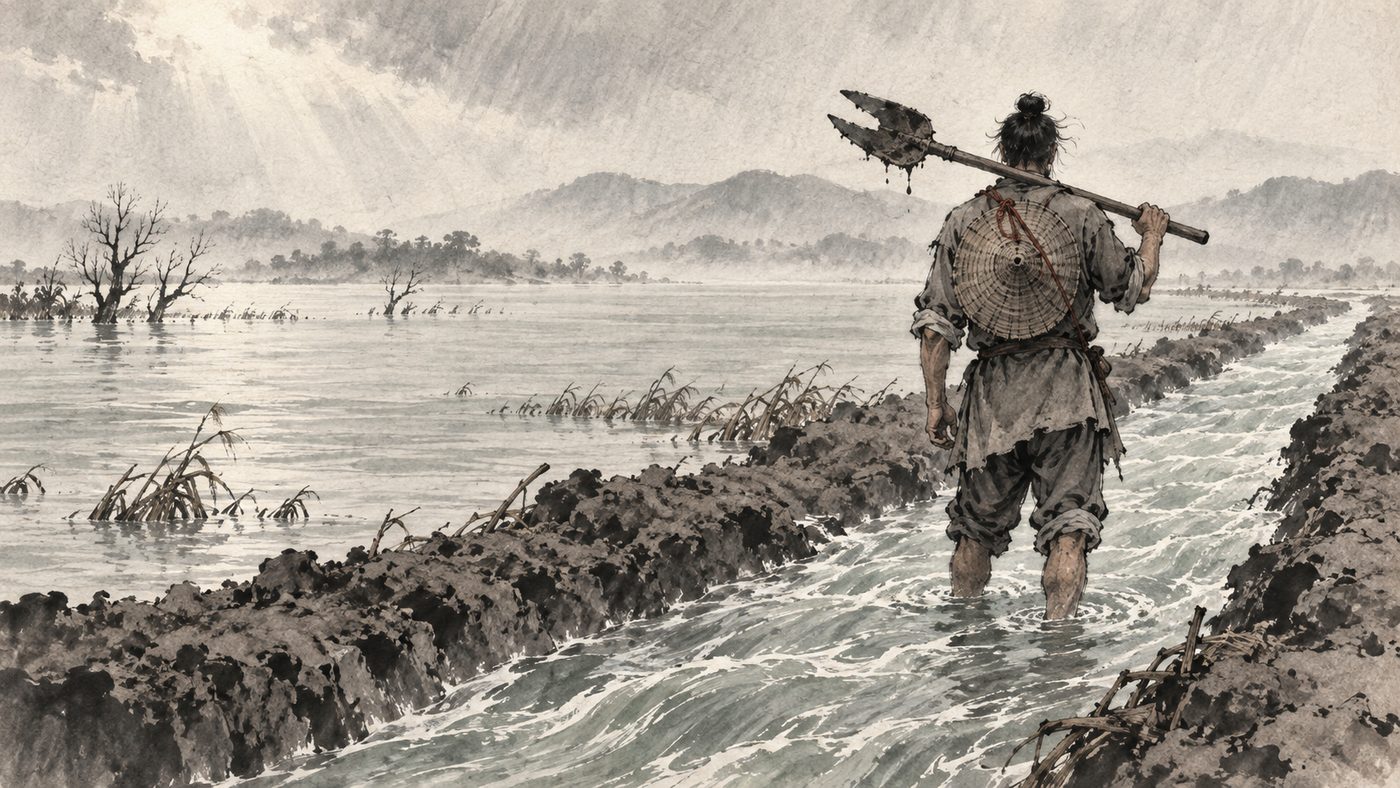
Yu the Great 大禹 (Dà Yǔ, roughly "dah yoo") is the hero who tamed China's Great Flood. His father Gun tried to wall the water in and was executed for it; Yu dug channels and let it run to the sea, and was so busy that, in the famous line, he passed his own door three times without going in. By tradition he founded the Xia, the first dynasty, and handed the throne to his son, which makes him the man who ended rule by merit.
Who Yu the Great was
Every culture that has rivers has a flood story, and most of them end with a boat. China's ends with a spade.
Yu the Great is the man who drained the world. In the version every Chinese schoolchild knows, a flood covers the land, Yu's father Gun spends nine years, by Sima Qian's count, trying to hold it back with walls of earth, fails, and is put to death. Yu takes over the job and does the reverse. He digs. He cuts channels, dredges riverbeds, and lets the water go where water wants to go, which is down and out to sea. It works.
He is called Da Yu, Great Yu, and sometimes Xia Yu, after the dynasty he is supposed to have founded. The Xia is traditionally the first of China's dynasties, and Yu's place at the head of it gives him a second job in the story, a less comfortable one. He is the ruler who handed the throne to his son. Before Yu, the tradition says, the realm went to the worthiest man. After Yu, it went to the eldest boy, for roughly four thousand years.
So the page has two stories to tell, a flood and a family, and they turn out to be the same story.
Where you still meet him today
Yu is not a figure you meet in video games. He is a figure you meet in speeches.
The single most quoted thing about him is a line from Mencius, the fourth-century BCE book of the philosopher's conversations: while he was at work on the waters, Yu passed the door of his own house three times and never went in. In Chinese that is a set phrase, and it is still the standard way to praise someone who put the public job ahead of their own family. It is meant as the highest compliment. Whether his wife saw it that way is a question the sources do not ask.
Every spring, on or near the solar term called Grain Rain, around April 20, there is a ceremony at the Mausoleum of Yu on Kuaiji Mountain outside Shaoxing, in Zhejiang. Sima Qian, the Han historian, says this is where Yu died, on a tour of inspection in the east. The rite was put on China's national list of intangible cultural heritage in 2006, and from 2007, as Xinhua's report on the ceremony puts it, it has been a state-level rite, jointly hosted by the national Ministry of Culture and the Zhejiang provincial government. That places Yu in very select company: a legendary king honored by a modern state with a formal sacrifice.
He is also in the Palace Museum in Beijing, in the heaviest possible form. In the Hall of Joyful Longevity stands a mountain of green jade 224 centimeters high and weighing, by the museum's own catalogue, 5,000 kilograms. It shows Yu's laborers cutting through cliffs to let a river out. The boulder came from Mileta Mountain near Hotan in Xinjiang. In 1781 the Qianlong Emperor's workshops drew up the design from a Song-dynasty painting of Yu in the palace collection, then shipped the stone by canal to Yangzhou, where carvers spent six years grinding it into shape; it was finished in 1787. Since jade cannot be cut, only worn away with abrasive grit (the jade hub explains why), every tree and figure on it is the product of sand and patience. It is, in other words, a monument to the flood-tamer made by the method he would have approved of: slow, collective, and relentless.
And he is in the feet of Daoist priests. Yu's labors crippled him, and the old texts are precise about the damage. The Zhuangzi says he wore the down off his calves and the hair off his shins, with the downpour for his bath and the gale for his comb. A fragment of the Shizi, a fourth-century BCE book that survives only in quotations, goes further: after ten years without looking in at home, his nails were gone, one side of his body was withered, and he walked with a limp so bad that his feet no longer passed each other, "and people called it the Pace of Yu." That hobble became a ritual. Daoist masters still perform a stepping dance based on it, tracing cosmic patterns across the floor of the altar; the scholar Poul Andersen studied it with working priests in Tainan in the 1980s and traced its theory back to Yu setting the world in order after the flood. A king's injury, turned into choreography, still danced.
Even the language keeps him. Yu, the tradition says, cast nine great bronze tripods, and "to ask the weight of the tripods" came to mean coveting the throne. The Chinese dictionary now gives the same two-word phrase, wending, a second and much happier sense: to win a championship.
Dam or drain: the father who failed
The flood story is usually told as engineering: the father built walls, the son dug ditches, the son was cleverer. The oldest version is stranger, and much darker.
In the Classic of Mountains and Seas, that bestiary of monsters and marvels compiled between the Warring States and the Han, the flood "rose to the sky." Gun does not merely build a dam. He steals something from heaven to do it: the high god's xirang, the self-growing soil, a magic earth that swells of its own accord, and he uses it "without waiting for the god's command." For that, the god sends the fire god Zhurong to kill him. And then comes the sentence that makes the whole myth: "From Gun, Yu was born." The son comes out of the punishment. The god then orders Yu to finish the job.
So the first flood-tamer is a thief and a rebel, and his son is born out of his punishment. The Book of Documents tells a tidier version in the chapter called "The Great Plan": Gun dammed the waters and threw the natural order into confusion, he was put to death, Yu rose in his place, and heaven gave Yu the Great Plan in nine divisions, the blueprint for how the world should run. The first of those nine divisions is the five phases, and the first of the five phases is water. (The later legend that the Plan came up out of the Luo River written on a turtle's back belongs to the Luoshu story, which is its own long detour.)
Strictly, Gun was not even the first to try walls. The Discourses of the States says the water god Gonggong had set out to dam the hundred rivers long before him, and was destroyed for it, and that Gun simply "carried on Gonggong's error."
China's other great flood myth goes the other way. When Nüwa repairs the broken sky, she stops the floodwater with the ash of burnt reeds. She blocks it; Yu lets it out. Taken together, the two stories stake out the two answers to a river, and the tradition clearly picked a winner.
| Gun, the father | Yu, the son | |
|---|---|---|
| Method | Walls the water in with earth | Cuts channels so the water runs to the sea |
| Authority | Acts without the god's command | Ordered by the god to finish the work |
| Outcome | The flood stays | The rivers reach the sea and the land can be farmed |
| Fate | Executed by the fire god Zhurong | Receives the Great Plan and founds the Xia |
| Main source | Classic of Mountains and Seas | Mencius · Book of Documents |
Three times past his own door
Now the famous line, and a small scandal hiding inside it.
Mencius tells it first. He lists the rivers: Yu dredged the nine channels of the Yellow River, cleared two more into the sea, opened the Ru and the Han, drained the Huai and the Si into the Yangtze, "and only then could the central lands feed themselves." Then: "In that time Yu was away eight years, and passed his own door three times without going in."
Two centuries later, Sima Qian retells it in the Records of the Grand Historian, the first great history of China, and the numbers move. His Yu "wore out his body and burned his thoughts, lived away thirteen years, and passing the gate of his house did not dare go in." The three passes have gone. So has the brisk tone. Sima Qian gives Yu a motive Mencius never mentions: grief, and fear, because his father had failed at the same task and been executed for it. A son who has watched his father killed for an unfinished job does not stop in for dinner.
Most English retellings merge the two, so you get "thirteen years, passing his door three times," a line neither author actually wrote. Both versions are real. They are simply different books.
What everyone agrees on is that the work wrecked him, and that this was the point. Confucius, in the Analects, says of him twice in one breath, "In Yu I find no fault": he ate plain food and gave his best to the spirits, wore coarse clothes and saved his finery for the rites, lived in a humble house and spent his strength on the irrigation ditches. It is the portrait of the ideal official, and it has been on the syllabus ever since.
Nine provinces and nine tripods
When the water went down, Yu had to say what was underneath. The chapter of the Book of Documents called the "Tribute of Yu" does exactly that. It opens with Yu spreading out the land, following the mountains, cutting back the forests, and fixing the high peaks and the great rivers, and then it walks the reader through nine provinces one by one, with their soils, their rivers and the goods each should send as tribute.
It is, in effect, the first geography of China, and its framework outlived every dynasty. "The Nine Provinces" is still a literary name for the whole country, the way "Albion" is for Britain. Which tells you how the story was used: whoever wanted to describe the whole realm wrote it as Yu's survey.
Then there are the tripods. The Zuo Commentary, under the year 606 BCE, has an ambitious king of Chu march his army to the edge of the Zhou royal domain and ask, with menace, how big and heavy the royal tripods are. The Zhou envoy's answer is one of the great put-downs in Chinese literature. When the Xia still had virtue, he says, the distant regions sent pictures of their creatures and the nine governors sent metal, and the tripods were cast with those creatures on them, so that people would know the spirits from the demons. "It lies in virtue, not in the tripods." The weight of the tripods, he says, "is not yet for asking." The Zuo says only "the Xia"; by the Han, officials quoted in Sima Qian's treatise on the imperial sacrifices say flatly that Yu gathered the metal of the nine governors and cast nine tripods. The tripods were lost by the end of the Zhou. The phrase, as the living-culture section above noted, is still in the sports pages.
The man who ended rule by merit
Here is the part the textbook glosses over.
Before Yu, the tradition says, rulers chose their successors by merit: Yao passed the realm to Shun, and Shun passed it to Yu. Sima Qian sets Yu at the end of that line and in its bloodline: his Records open with the Yellow Emperor, who rose as the house of Shennong declined, and make Yu the Yellow Emperor's great-great-grandson. Yu duly named his own successor, a minister called Yi. But when Yu died, the throne went to his son Qi, and from then on it stayed in families. The Xia is the first dynasty because Yu was the first father to be succeeded by his son.
The Chinese have been arguing about how that happened for well over two thousand years, and the three surviving versions go from polite to brutal.
Mencius is asked the question directly. His student Wan Zhang puts it bluntly: people say virtue declined with Yu, because he gave the throne to his son and not to the worthiest man. Is that so? Mencius says no. "If heaven gives it to the worthy, it goes to the worthy; if heaven gives it to the son, it goes to the son." Yi, in his telling, stood aside for Qi, and the people went to Qi of their own accord, singing his praises instead of Yi's.
Sima Qian keeps the courtesy but adds a political reason. Yi had served Yu only a short time, and the world had not come round to him, "so the lords all left Yi and paid court to Qi, saying, 'Our lord is the son of Emperor Yu.'" That is not heaven choosing. That is a coalition choosing.
The Bamboo Annals do not bother with manners. These were chronicles dug out of a looted royal tomb of the old state of Wei around 280 CE, and the Book of Jin, in its biography of Shu Xi, one of the scholars who edited them, notes that they differ widely from the classics and lists the differences. One of them reads, in its entirety: "Yi usurped Qi's throne, and Qi killed him."
There is also a fourth version, and it belongs to myth rather than politics. A note by the seventh-century commentator Yan Shigu on the History of the Former Han, which he says he took from the Huainanzi (the passage is not in the text as it survives), tells how Qi was born. Yu, digging through Huanyuan Pass, turned himself into a bear to do the work, and told his wife, the woman of Tushan, to bring his food when she heard a drum. He knocked a stone onto the drum by mistake. She came, saw her husband as a bear, fled in shame, and at the foot of Mount Song turned into stone. She was pregnant. Yu shouted, "Give me my son!" and the stone split open on its north side, and out came Qi. The Han emperor Wu, touring the region in 110 BCE, recorded in an edict that he had seen "the stone of the mother of Qi."
A father executed, a son born from his corpse, a wife turned to stone by the sight of her husband at work, and a grandson born out of the stone. For a figure remembered mainly for irrigation, it is quite a family.
(Yu's courtship at Tushan has its own omen, a white fox with nine tails, which he reads on the spot as a sign he will be king. That story is told on the fox spirit page.)
Was Yu the Great real?
For most of Chinese history nobody asked. Then, in 1923, a young historian named Gu Jiegang asked very loudly.
Gu was the leader of the "Doubting Antiquity" movement, which argued that China's early history had been built up in layers, with each later age adding older and grander ancestors. He picked Yu as his test case, and his argument went through the dictionary. The Shuowen Jiezi, the first Chinese dictionary, around 100 CE, glosses the character 禹 as a creature, built on a component it explains as a beast's foot pressing the ground. A creature with feet that tread the earth, Gu concluded in print, was "probably something like a lizard," and Yu might have begun as a beast cast on the Nine Tripods and only later been promoted to a man.
The idea that the great Yu was a bug became a national joke. In 1935 Lu Xun wrote a short story about the flood, Curbing the Flood, in which a crowd of pedantic scholars sit on a hill while the water rises, and one of them insists that "Yu is a bug. Can bugs control water?" The argument Gu started, about how much of early Chinese history is history, has never stopped.
Then the evidence started to arrive. In 2002 a small, grimy bronze bowl came back to Beijing from abroad and was examined at the Poly Art Museum, which now holds it: a vessel called the Sui Gong xu. It dates to around 900 BCE, and its 98-character inscription begins, as the paleographer Li Xueqin read it, "Heaven commanded Yu to spread out the soil, to follow the mountains and dredge the rivers." That is almost word for word the language of the Tribute of Yu, on a bronze centuries older than any surviving copy of the book. The American scholar Constance Cook argues that the inscription reads like a harvest song of thanksgiving, with Yu as a founder and earth deity. So by 900 BCE Yu was not a lizard, and he was not yet quite a man either.
In 2016 a team led by the geologist Wu Qinglong published a paper in Science arguing that an earthquake around 1920 BCE brought down a landslide that dammed the Yellow River at Jishi Gorge, and that when the dam broke it produced one of the largest freshwater floods since the end of the last ice age, a plausible real event behind the Great Flood and the rise of the Xia. The paper made headlines around the world. Science then published comments from other researchers challenging the dating, the size of the lake, and the claimed link to the lower Yellow River, and the authors conceded that the connection to Yu needed more work.
So here is where things stand. The story is at least 2,900 years old, which is very old indeed. A catastrophic flood may have happened in about the right place at about the right time. No inscription from Yu's own lifetime exists, no one has found a Xia capital that says "Xia" on it, and the man himself remains unproven.
That seems fair, somehow, for a hero whose whole achievement was to make the water go away. What is left is the channel.
In the classics
The passages behind the story, in the standard published translations. Open any one for the original text.
“Yu dredged the nine rivers, cleared the Ji and the Luo and sent them into the sea; he opened the Ru and the Han, drained the Huai and the Si, and sent them into the Yangtze. Only then could the central lands feed themselves. In that time Yu was away eight years, and passed his own door three times without going in. ”
Original text
禹疏九河,瀹濟、漯而注諸海;決汝、漢,排淮、泗,而注之江,然後中國可得而食也。當是時也,禹八年於外,三過其門而不入。
“Yu grieved that his late father Gun had failed in the work and been put to death for it. So he wore out his body and burned his thoughts, lived away thirteen years, and passing the gate of his house did not dare go in. ”
Original text
禹傷先人父鯀功之不成受誅,乃勞身焦思,居外十三年,過家門不敢入。
“The flood rose to the sky. Gun stole the high god's self-growing soil to dam the flood, without waiting for the god's command. The god ordered Zhurong to kill Gun on the outskirts of Yu Mountain. From Gun, Yu was born. The god then ordered Yu to finish spreading the soil and settle the nine provinces. ”
Original text
洪水滔天。鯀竊帝之息壤以堙洪水,不待帝命。帝令祝融殺鯀于羽郊。鯀復生禹。帝乃命禹卒布土以定九州。
“Wan Zhang asked: "People say that with Yu, virtue declined, because he did not pass the throne to the worthiest but to his son. Is that so?" … If heaven gives it to the worthy, it goes to the worthy; if heaven gives it to the son, it goes to the son. ”
Original text
萬章問曰:「人有言『至於禹而德衰,不傳於賢而傳於子』,有諸?」……天與賢則與賢,天與子則與子。
“When Yu died, although he had given the realm to Yi, Yi had served Yu only a short time and the world had not yet come round to him. So the lords all left Yi and paid court to Qi, saying, "Our lord is the son of Emperor Yu." And so Qi took the throne of the Son of Heaven. ”
Original text
及禹崩,雖授益,益之佐禹日淺,天下未洽。故諸侯皆去益而朝啓,曰「吾君帝禹之子也」。於是啓遂即天子之位。
“Gun dammed the flood and threw the five phases into disorder … Gun was put to death, and Yu rose to succeed him. Heaven then gave Yu the Great Plan in nine divisions, and the constant order of things was set right. ”
Original text
鯀陻洪水,汩陳其五行……鯀則殛死,禹乃嗣興,天乃錫禹洪範九疇,彝倫攸敘。
“So Yu dredged the Yellow River and opened the Yangtze. For ten years he did not look in at his home. His hands grew no nails, his shins grew no hair, one side of him withered, and his steps no longer passed each other. People called it the Pace of Yu. ”
Original text
禹於是疏河決江,十年不窺其家,手不爪,脛不生毛,生偏枯之病,步不相過,人曰禹步。
Questions people ask
What was Yu the Great known for?
Yu the Great is known for ending China's Great Flood by digging channels to carry the water to the sea, after his father Gun had failed by trying to dam it. Mencius says he spent eight years away and passed his own door three times without going in. By tradition he then founded the Xia, the first Chinese dynasty, and was the first ruler to pass the throne to his son.
How did Yu the Great stop the flood?
By draining it instead of blocking it. In the Classic of Mountains and Seas his father Gun tries to wall the water in with soil stolen from heaven and is executed for it. Yu does the opposite: Mencius lists the rivers he dredged and opened so that each could run to the sea or into the Yangtze. The Book of Documents chapter called the Tribute of Yu turns the same work into a survey of nine provinces.
Is Yu the Great a god?
He began closer to one than the textbook suggests. The oldest inscription about him, on a bronze bowl of around 900 BCE, says Heaven commanded Yu to spread out the soil, and the scholar Constance Cook reads it as a harvest song to Yu as a founder and earth deity. Later tradition made him a human sage-king, and today he is honored as an ancestor at a state ceremony at his tomb in Shaoxing, and his limping step survives as a ritual dance in Daoism.
Did Yu the Great really exist?
Nobody can say. No inscription from his own time has been found, and no one has proved the Xia state he is said to have founded. What is certain is that the story is old: a bronze of around 900 BCE already names him. A 2016 study in Science linked a real outburst flood on the Yellow River around 1920 BCE to the legend, but other researchers published challenges to its dating and scale. Treat him as a legend with ancient roots, not a documented king.
How and where did Yu the Great die?
On the road, by the oldest full account. Sima Qian's Basic Annals of Xia says that in the tenth year of his reign Yu went east on a tour of inspection and died at Kuaiji, near modern Shaoxing in Zhejiang, having already named his minister Yi as successor. In his closing remarks Sima Qian adds a second tradition: Yu gathered the lords south of the Yangtze to tally their merits, died there and was buried on the spot, and the place was named Kuaiji, which, he explains, means the reckoning of accounts. His mausoleum still stands on Kuaiji Mountain and holds a state ceremony every spring. What happened next is the disputed part: Yi stepped aside for Yu's son Qi, or, in the Bamboo Annals, Qi killed him.
How is Yu the Great viewed today?
As a model of public service and hard work. The phrase about passing his door three times is still the standard Chinese shorthand for putting duty before family. Since 2007 the spring ceremony at his mausoleum on Kuaiji Mountain in Shaoxing has been held as a state-level rite, and the Da Yu sacrificial ceremony is on China's national intangible heritage list.
Related figures
Sources & further reading
- Mencius, Teng Wen Gong I: the nine rivers, eight years, three times past the door (Wikisource)
- Mencius, Wan Zhang I: whether virtue declined with Yu (Wikisource)
- Records of the Grand Historian, chapter 2, Basic Annals of Xia: thirteen years, the Xia name, Yi and Qi (Wikisource)
- The Classic of Mountains and Seas, Classic of Regions Within the Seas: Gun and the self-growing soil (Wikisource)
- Book of Documents, The Great Plan (Wikisource)
- Book of Documents, Tribute of Yu: the nine provinces (Wikisource)
- Analects, Book 8, Taibo: In Yu I find no fault (Wikisource)
- Zhuangzi, Under Heaven: no down on his calves, no hair on his shins (Wikisource)
- Shizi, reconstructed fragments, second scroll: the Pace of Yu (Wikisource)
- Zuo Commentary, Duke Xuan year 3: the King of Chu asks the weight of the tripods (Wikisource)
- Records of the Grand Historian, Treatise on the Feng and Shan: Yu casts the nine tripods (Wikisource)
- Book of Jin, biography of Shu Xi: the Bamboo Annals report that Qi killed Yi (Wikisource)
- Zhao Bingxiang, From Leveling Water and Land to Man Born of Stone: the Yu and Qi myth, International Social Science Journal (Chinese edition) 2022 no. 4, quoting Yan Shigu's note on the bear and the stone (CSSN)
- Palace Museum, Beijing: jade mountain of Yu Controlling the Waters, 224 cm, 5,000 kg, designed 1781, finished in Yangzhou 1787
- Constance A. Cook, Sage King Yu and the Bin Gong Xu, Early China 35 (2013): the ninth-century BCE bronze dedicated to Yu
- Sina News (2019): Li Xueqin and the Sui Gong xu inscription, 'Heaven commanded Yu to spread the soil'
- Wu Qinglong et al., Outburst flood at 1920 BCE supports historicity of China's Great Flood and the Xia dynasty, Science 353 (2016)
- Comment on 'Outburst flood at 1920 BCE supports historicity of China's Great Flood and the Xia dynasty', Science (2017)
- Duan Yu, A Century of Research on Yu the Great, The Paper: Gu Jiegang's 1923 lizard hypothesis
- Lu Xun, Curbing the Flood (1935), Old Tales Retold (Wikisource)
- China Intangible Cultural Heritage Network: the Da Yu sacrificial rite, national list
- Xinhua (Zhejiang, 2024): the Grain Rain ceremony at the Mausoleum of Yu; national heritage list 2006; from 2007 co-hosted by the Ministry of Culture and Zhejiang as a state-level rite
- Poul Andersen, The Practice of Bugang, Cahiers d'Extrême-Asie 5 (1989): the Pace of Yu in Daoist ritual
- Hanyu Dictionary (汉典), entry for 问鼎: to covet the throne, and figuratively to win a championship
By Julian 祝君瑜, retold from the classics, with the original passages cited, updated 2026-10-07