The Chinese year

Chinese festivals: every date this year and next, and what each one is

The Chinese year has nine festivals that most people keep and one that most people only eat. Seven of them sit on lunar dates, so they wander across the western calendar by as much as a month; two of them, Qingming and the Winter Solstice, are set by the sun and hold almost perfectly still. The table below has every one of them for lunar 2026 and 2027, computed from the calendar itself rather than copied from a list, so it agrees with our converter to the day. Under the table, a paragraph on what each festival is for, and which ones are actually a day off.

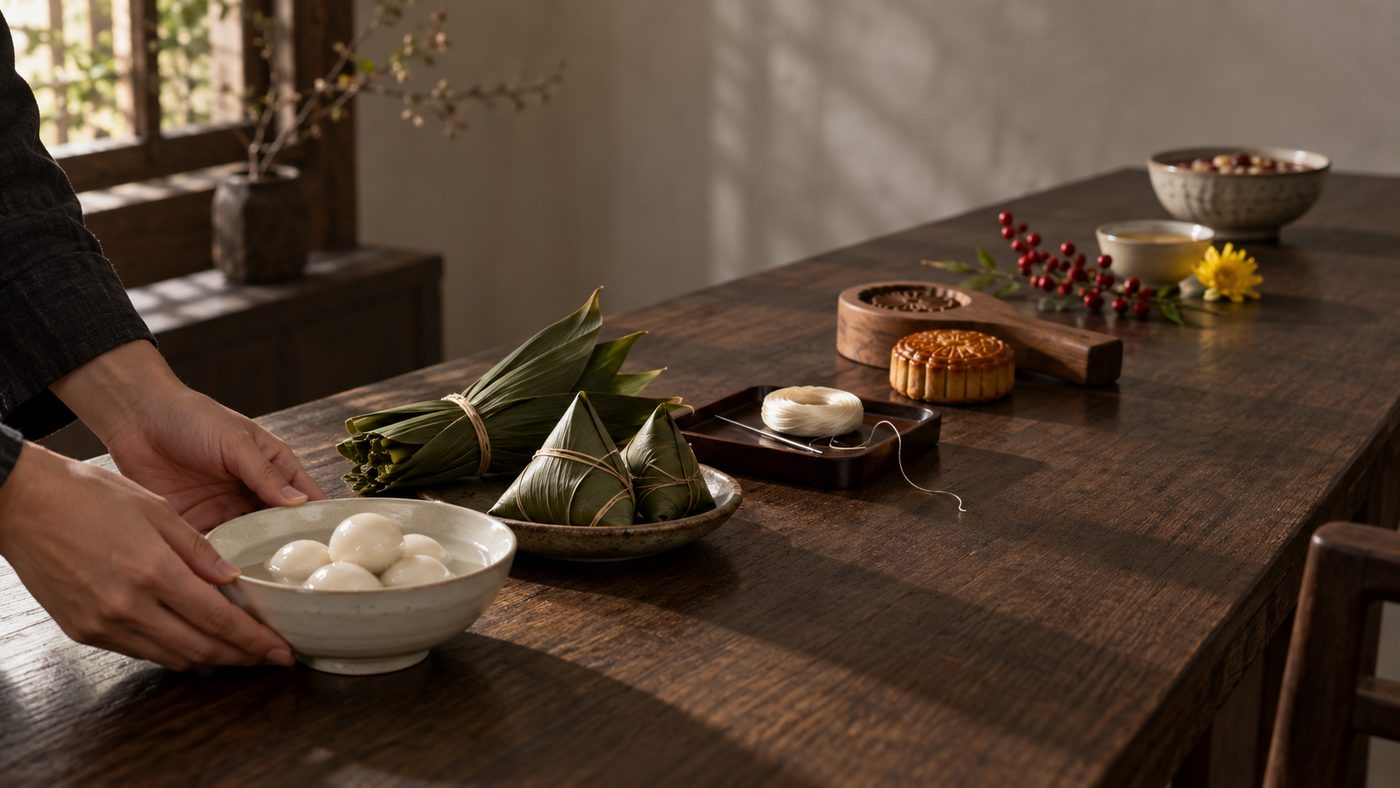
A long dark table lit from a window, with the objects of the Chinese festival year set out in calendar order and receding into soft focus: rice balls, bamboo-wrapped dumplings, a needle and silk, a mooncake mold, dogwood berries beside chrysanthemum wine, and a far bowl of porridge, as a pair of hands sets down the first bowl.
The year in the order you eat it: rice balls, rice dumplings, needle and thread, a mooncake, dogwood and chrysanthemum wine, porridge. Illustration.

Lunar year 2026 Fire Horse · begins Tuesday, February 17, 2026

Every festival of lunar year 2026 with its calendar address, its Gregorian date, and whether it is a public holiday in mainland China.
Festival On the calendar Date Day off (mainland)
Chinese New Year The first day of the lunar year; the year’s animal changes here. 1st day of the 1st lunar month Tuesday, February 17, 2026 4 days, from the eve
Lantern Festival The first full moon of the year; sweet rice balls, lanterns, riddles. 15th day of the 1st lunar month Tuesday, March 3, 2026 no
Qingming Tomb-sweeping; a solar term, so it barely moves. the 5th solar term, 15 days after the spring equinox follows the sun, not the moon Sunday, April 5, 2026 1 day
Dragon Boat Festival Boat races and bamboo-wrapped rice dumplings at the start of summer. 5th day of the 5th lunar month Friday, June 19, 2026 1 day
Qixi The night the Weaver Girl and the Oxherd meet; a festival of skill. 7th day of the 7th lunar month Wednesday, August 19, 2026 no
Ghost Festival The month the gates of the underworld stand open; offerings to the dead. 15th day of the 7th lunar month Thursday, August 27, 2026 no
Mid-Autumn Festival The eighth month’s full moon; reunion, mooncakes. 15th day of the 8th lunar month Friday, September 25, 2026 1 day
Double Ninth Climb a hill, carry dogwood, drink chrysanthemum wine; Seniors’ Day. 9th day of the 9th lunar month Sunday, October 18, 2026 no
Winter Solstice The longest night; dumplings in the north, rice balls in the south. A solar term. the 22nd solar term, when the sun reaches 270° follows the sun, not the moon Tuesday, December 22, 2026 no
Laba A porridge of mixed grains; the first cooking of the New Year season. 8th day of the 12th lunar month Friday, January 15, 2027 no
New Year’s Eve The reunion dinner and the wait for midnight. last day of the 12th lunar month (the 29th this year) Friday, February 5, 2027 yes

Lunar year 2027 Fire Goat · begins Saturday, February 6, 2027

Every festival of lunar year 2027 with its calendar address, its Gregorian date, and whether it is a public holiday in mainland China.
Festival On the calendar Date Day off (mainland)
Chinese New Year The first day of the lunar year; the year’s animal changes here. 1st day of the 1st lunar month Saturday, February 6, 2027 4 days, from the eve
Lantern Festival The first full moon of the year; sweet rice balls, lanterns, riddles. 15th day of the 1st lunar month Saturday, February 20, 2027 no
Qingming Tomb-sweeping; a solar term, so it barely moves. the 5th solar term, 15 days after the spring equinox follows the sun, not the moon Monday, April 5, 2027 1 day
Dragon Boat Festival Boat races and bamboo-wrapped rice dumplings at the start of summer. 5th day of the 5th lunar month Wednesday, June 9, 2027 1 day
Qixi The night the Weaver Girl and the Oxherd meet; a festival of skill. 7th day of the 7th lunar month Sunday, August 8, 2027 no
Ghost Festival The month the gates of the underworld stand open; offerings to the dead. 15th day of the 7th lunar month Monday, August 16, 2027 no
Mid-Autumn Festival The eighth month’s full moon; reunion, mooncakes. 15th day of the 8th lunar month Wednesday, September 15, 2027 1 day
Double Ninth Climb a hill, carry dogwood, drink chrysanthemum wine; Seniors’ Day. 9th day of the 9th lunar month Friday, October 8, 2027 no
Winter Solstice The longest night; dumplings in the north, rice balls in the south. A solar term. the 22nd solar term, when the sun reaches 270° follows the sun, not the moon Wednesday, December 22, 2027 no
Laba A porridge of mixed grains; the first cooking of the New Year season. 8th day of the 12th lunar month Tuesday, January 4, 2028 no
New Year’s Eve The reunion dinner and the wait for midnight. last day of the 12th lunar month (the 29th this year) Tuesday, January 25, 2028 yes

Two clocks in one calendar

Read down the date column and something odd shows up. Chinese New Year lands on February 17 one year and February 6 the next, and every festival below it slides with it. Qingming and the Winter Solstice do not slide. They sit within a day of April 5 and December 21 every year of your life, which is a strange thing for two dates on the same calendar to do, until you know that the Chinese calendar is really two instruments bolted together.

The first instrument is the moon. A month begins on the new moon and runs until the next one, which takes about 29 and a half days, so months alternate between 29 and 30 and a year of twelve comes up around eleven days short of the sun. Left alone, the festivals would walk backward through the seasons the way Ramadan does. The calendar refuses to let that happen, and every two or three years it inserts an entire extra month to drag the year back into line. Every festival that sits on a lunar date, which is seven of the nine here, gets carried along in that lurch. It never moves on the Chinese calendar. It only ever moves on yours.

The second instrument is the sun. The year is also cut into 24 solar terms, points on the sun's path that fall on nearly the same western date every time. Two of those points grew festivals of their own. Qingming, the fifth term, comes fifteen days after the spring equinox and is the day families clean the graves. The Winter Solstice, the twenty-second, is the longest night and was once so important that the Zhou dynasty began its year there. Neither has a lunar date at all, which is why Qingming is the one famous festival you will never find in our converter's month table, and why the rows above mark them separately. Same book, different page of it.
The year in order

A paragraph each, with the festivals that have their own page linked. The ones that do not yet are coming, one at a time.

Chinese New Year 1st day of the 1st month

The big one, and the only festival that the whole country physically moves for. The lunar year turns on the new moon, the animal changes with it, and the fortnight before is spent cleaning the house, settling debts and getting home. New Year's Eve is the reunion dinner; the first day is for visiting; the celebrations run, in theory, until the Lantern Festival two weeks later. Mainland China gives four statutory days, from the eve through the third of the month, and stretches them to a week with borrowed weekends.

Lantern Festival 15th day of the 1st month

The first full moon of the year, and the official end of New Year. People go out after dark to look at lanterns, solve the riddles hung from them, and eat sweet glutinous rice balls, which are round for the same reason the mooncake is. In the old cities it was the one night of the year the curfew lifted and unmarried women were out in the streets, which is why some scholars call it, rather than Qixi, the real lovers' night of the Chinese calendar. Not a day off anywhere on the mainland.

Qingming around April 5 · a solar term

Tomb-sweeping day. Families go to the family graves, clear the weeds, repaint the inscriptions, lay out food and burn paper offerings, and then, because it is also the first properly warm weekend of spring, have a picnic. It is the only festival on this page that is a solar term first and a festival second, which is why it barely moves. One statutory day on the mainland.

Dragon Boat Festival 5th day of the 5th month

Long narrow boats with a dragon's head, paddled to a drum, and pyramids of sticky rice wrapped in bamboo leaf. The story everyone tells is that both commemorate the poet Qu Yuan, who drowned himself in 278 BC; the racing and the rice are very likely older than the story, and the fifth month was feared as a poisonous one long before anyone attached a poet to it. One statutory day on the mainland.

Qixi 7th day of the 7th month

The seventh night, when the Weaver Girl and the Oxherd, two stars on opposite banks of the Milky Way, are allowed to meet across a bridge of magpies. It is sold now as Chinese Valentine's Day, a label only a few decades old. For most of its history it was a festival of skill, on which girls threaded needles by moonlight and floated them on water to see whether they had the knack. The page tells both halves.

Ghost Festival 15th day of the 7th month

The seventh lunar month is the month the gates of the underworld stand open, and its fifteenth is the night the dead are fed. Families set out food and burn paper money and paper goods on the pavement, and the sensible avoid swimming, moving house, or whistling after dark. In Singapore and Malaysia it is one of the biggest events of the year, with open-air opera stages put up for an audience whose front row is left empty on purpose. Not a day off.

Mid-Autumn Festival 15th day of the 8th month

The eighth month's full moon, and the second-largest reunion of the year. Families eat together, go outside to look at the moon, and cut a mooncake into wedges. The organizing idea is roundness, and the page explains the salted egg yolk, the woman and the rabbit who live on the moon, and why the festival is not a solar term. One statutory day on the mainland.

Double Ninth 9th day of the 9th month

Nine is the number of yang in the Book of Changes, and a day with two of them was thought too much of a good thing. The prescription, written down in the sixth century, was to climb somewhere high, carry a sprig of dogwood and drink chrysanthemum wine, and people still do all three. Since 1989 it has also been Seniors' Day in China. A public holiday in Hong Kong and Macau, not on the mainland.

Winter Solstice around December 21 · a solar term

The longest night, and the day the sun turns back, which the calendar treats as a small New Year: the northern half of the country eats dumplings, the southern half eats rice balls, and Cantonese families hold a dinner that many rate above the real New Year's Eve. A solar term, so it holds still. Not a day off.

Laba 8th day of the 12th month

The one most people only eat. Laba is a porridge of eight or more grains, beans and dried fruit, cooked on the eighth day of the last month, and it marks the point at which the New Year preparations begin in earnest. Temples give it away by the vat. Not a day off.

Which ones are actually a day off

Fewer than you would guess. The State Council order that took effect at the start of 2025 gives mainland China seven statutory holidays, and only four of them are traditional festivals: Chinese New Year, four days from the eve; and Qingming, the Dragon Boat Festival and Mid-Autumn, one day each. The other three, New Year's Day, Labor Day and National Day, are on the Gregorian calendar and never move. Everything else on this page is a working day on the mainland, including the Lantern Festival, Qixi, the Ghost Festival, the Double Ninth and the Winter Solstice.

The single days rarely stay single. Each winter the State Council publishes the coming year's arrangement, which moves adjacent weekends to turn a one-day festival into a three-day break, sometimes at the cost of a working Saturday on either side. Any list of holidays you read before that notice comes out is a forecast. Hong Kong and Macau run their own calendars, which add the Double Ninth and take Mid-Autumn as the day after the festival rather than the night itself; Taiwan keeps a third list again.

Questions people ask

What are the main Chinese festivals?

Nine, in calendar order: Chinese New Year on the first day of the first lunar month, the Lantern Festival on the fifteenth, Qingming in early April, the Dragon Boat Festival on the fifth of the fifth month, Qixi on the seventh of the seventh, the Ghost Festival on the fifteenth of the seventh, the Mid-Autumn Festival on the fifteenth of the eighth, the Double Ninth on the ninth of the ninth, and the Winter Solstice around December 21. Laba, on the eighth of the twelfth month, opens the run-up to the next New Year. Seven of those nine sit on lunar dates; Qingming and the solstice are solar terms.

Why do Chinese festival dates change every year?

Because most of them are fixed on the lunar calendar and read off the Gregorian one. A lunar month runs from one new moon to the next, about 29.5 days, so twelve of them fall roughly eleven days short of a solar year, and the calendar catches up by inserting a whole extra month every two or three years. A festival stays at its lunar address, the fifteenth of the eighth month, say, and the Gregorian date swings by up to a month around it. The two exceptions, Qingming and the Winter Solstice, are set by the sun and land within a day of the same date every year.

When is Chinese New Year in 2027?

Saturday, February 6, 2027, the first day of the first lunar month. Lunar year 2026 began on Tuesday, February 17, 2026. Both are computed by the same calendar engine that runs our converter, in China Standard Time.

Which Chinese festivals are public holidays?

In mainland China, four of the traditional festivals carry a statutory day off under the State Council order in force from 2025: Chinese New Year (four days, from the eve through the third day of the first month), Qingming, the Dragon Boat Festival and the Mid-Autumn Festival, one day each. The Lantern Festival, Qixi, the Ghost Festival, the Double Ninth, the Winter Solstice and Laba are ordinary working days there. Hong Kong and Macau add the Double Ninth, as Chung Yeung, and Taiwan keeps its own list. The single days are usually stretched to three by moving an adjacent weekend, so any calendar you read in advance is a forecast until the State Council publishes the year’s arrangement each winter.

Is Chinese New Year the same as Lunar New Year?

Same day, different name for a wider group of people. Chinese New Year is the first day of the first month of the Chinese calendar. Korea, Vietnam and other countries that took that calendar keep their own New Year on the same new moon, with their own names (Seollal, Tết) and customs, so Lunar New Year is the name that covers all of them. The one country whose date sometimes differs is Vietnam, which reckons the calendar in its own time zone and very occasionally lands a day apart.

What is the difference between a lunar festival and a solar-term festival?

Which clock sets it. The Chinese calendar has two: months counted from the new moon, and 24 solar terms marked on the sun’s path. Chinese New Year, the Dragon Boat Festival, Mid-Autumn and the rest sit on lunar dates and move a month against the Gregorian calendar. Qingming and the Winter Solstice sit on solar terms and stay within a day of April 5 and December 21, which is why Qingming is the one famous festival you will never find in a lunar month table.

Keep going

  • The calendar converter turns any date either way, 1900 to 2100, and carries the month-by-month table the festival dates above are drawn from.
  • The 24 solar terms are the sun's half of the calendar, which is why Qingming holds still.
  • The Chinese almanac is the book that prints all of these dates, and a verdict on every day between them.
  • The Chinese zodiac changes animal on the first row of each table above, and on no other day.

Sources

The dates in both tables are computed by the site's own lunisolar engine, the one behind the converter, in China Standard Time; the holiday column follows the State Council order below. Each festival's own page carries its primary sources.

Stay in the loop.

Chinese mythology, the zodiac, and the meaning behind names and symbols, rooted in the classics and read back to you. No spam. Unsubscribe anytime.