Chinese Mythology
Taotie: The Mask on Shang Bronzes, and Where the Name Came From
The taotie is the face on the pot. It is the animal mask that covers Chinese ritual bronzes from roughly 1500 BCE onward: frontal, rigidly symmetrical, two enormous raised eyes, curling horns, and no lower jaw. What it is not is a monster with a story. The name taotie belongs to a glutton in a much later book, and the earliest surviving text that attaches it to the bronzes was written around 239 BCE, some nine hundred years after casters were already putting the face on vessels. Nobody knows what the Shang called it.
Start with the object
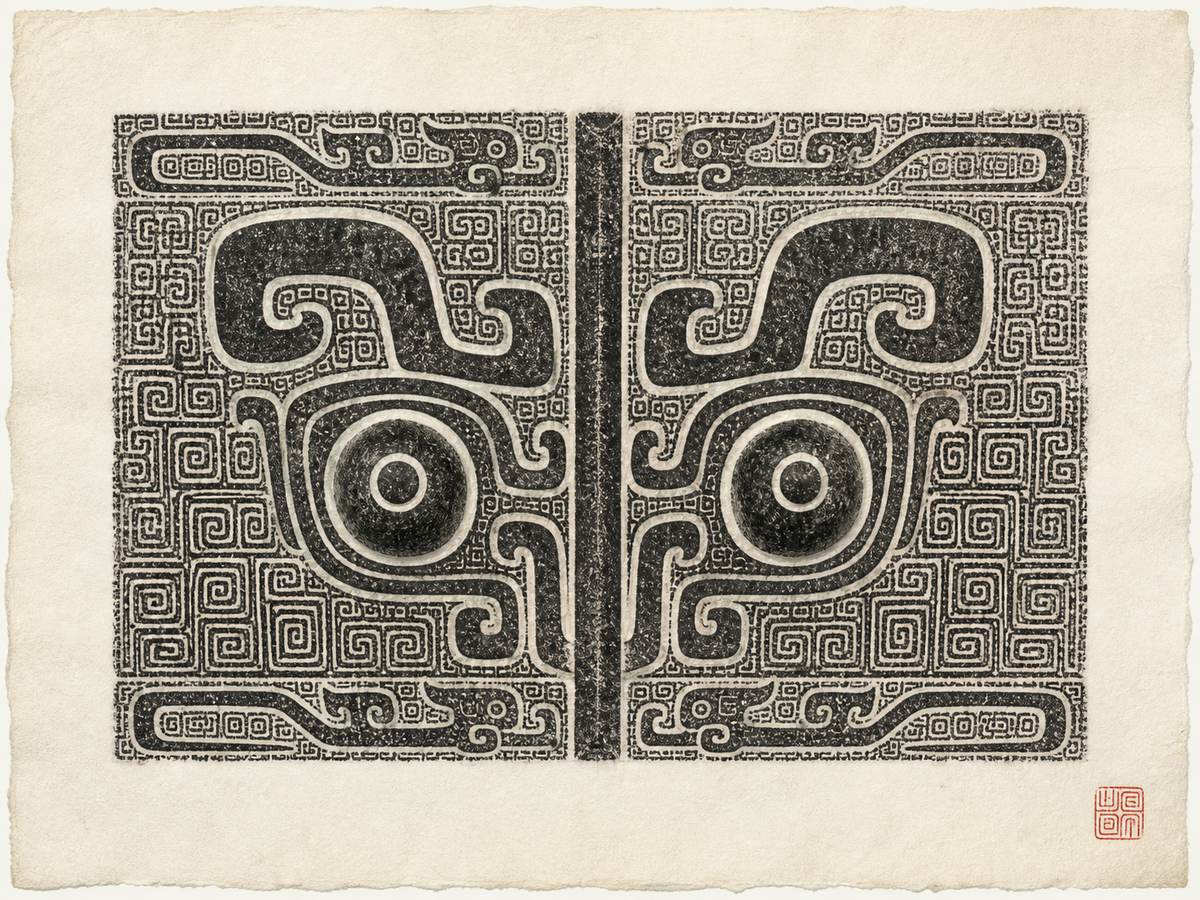
In the Freer Gallery in Washington there is a small bronze box on four feet, with a roof-shaped lid and a knob on top. It is a fangyi, a wine container, cast in the early Anyang period of the late Shang, around 1200 BCE. It is twenty-three centimeters tall, which is to say you could pick it up in one hand. The bronze has gone green, and the recessed lines of its decoration are packed with red, which the museum thinks may be cinnabar.
On each of its four sides is a face.
Look at it properly, the way you would look at any object that is trying to tell you something. The first thing you notice is that it is perfectly symmetrical, and not approximately so: a raised ridge runs down the center of each panel, and the left half is the exact mirror of the right. The second thing is the eyes, two of them, round and bulging and lifted well clear of the surface, which is the only part of the design your brain will accept as anatomy. Above them a pair of horns curl outward in thick hooked bands. Below them, bands that read as a brow and a snout.
And then it stops. There is no lower jaw. No chin, no mouth, no teeth. The face has a top half and simply no bottom half.
Every remaining square millimeter is filled with leiwen, thunder pattern, tiny squared spirals packed together so tightly that there is not one patch of plain metal anywhere. And along the borders above and below the face, the museum's own catalog notes, there are dragons in profile, one on each side of the ridges, facing inward. Which is the detail that gives the whole thing away: those dragons are drawn in exactly the same vocabulary of hooks and spirals as the face is. Look at the mask one way and it is a monster. Look at it another way and it comes apart into two dragons in profile, nose to nose.
That is the taotie. Or rather, that is the thing we call the taotie, which turns out not to be quite the same statement.
The name is nine hundred years younger than the face
Here is the fact that reorganizes everything else on this page.
Chinese founders were casting this design onto vessels by 1500 BCE and were still doing it into the early Zhou. The earliest surviving text that calls the design a taotie was written in 239 BCE.
Set those next to each other. The Freer fangyi was already about nine centuries old when somebody first wrote down a name for what was on it. That is a longer gap than the one between us and the Norman conquest.
The text is the Lüshi Chunqiu, and it gives the matter one sentence:
The Zhou tripods bear the taotie. It has a head and no body. It eats a man, and before he is swallowed the harm has reached its own person. This is a way of speaking about retribution.
Read that carefully and you can see what is happening. The author is looking at a bronze and explaining it. He notices the thing anyone notices, that the face has no lower half, and he turns it into a moral: here is a creature so greedy it consumed itself, cast onto a ritual vessel as a warning against appetite. It is a good reading. It is also a reading, arrived at by a man in the third century BCE staring at an antique, and there is no evidence whatsoever that it is what the people who made the antique had in mind.
There is a nice irony in the provenance. The Lüshi Chunqiu was compiled under Lü Buwei, the merchant who became chancellor of Qin and regent to the boy who would become the First Emperor. Lü had three thousand retainers and put the best of them to work on an encyclopedia of everything worth knowing. When it was finished he hung it up at the city gate of Xianyang and offered a thousand pieces of gold to anyone who could improve a single character of it. Nobody took the money. Chinese still uses the phrase, one word a thousand gold, for writing of unimprovable quality.
So the sentence that every article about the taotie ultimately rests on, including this one, comes from the book nobody dared correct. It is still a guess.
Before that, it was an insult
Go back further and the word turns up in an even less monstrous context.
Its first appearance is in the Zuo Tradition, under the eighteenth year of Duke Wen, in a passage about four notorious characters of high antiquity whom the sage-king Shun banished to the four frontiers to fend off goblins. Three of them, Hundun, Qiongqi and Taowu, are the sort of names you would expect. The fourth is described like this:
The Jinyun clan had a worthless son, greedy for food and drink, grasping after goods and bribes, encroaching and extravagant, never to be filled or satisfied, hoarding and piling up wealth without knowing any limit. The people of the world ranked him with the other three monsters and called him Taotie.
That is not a description of an animal. It is a character assassination. The man is a glutton and a grafter, and Taotie is what the neighbors called him, roughly the way English might call someone a pig. The word arrives in the record as an insult aimed at a human being, with no bronze vessel anywhere in the vicinity.
Somewhere between that passage and the Lüshi Chunqiu, somebody looked at the jawless face on an old ritual pot, thought of the man who could never be filled, and put the two together. It was an inspired connection. There is no reason to think it was a correct one.
What we actually know, and what we are guessing
This is where the honest version has to be laid out, because it is more interesting than the tidy version.
What is solid. The design exists in enormous quantity, is datable, and evolves in traceable ways across the Shang and into the Zhou. The vessels it decorates were made for offerings of food and drink to ancestors, which is not in dispute. And it is frontal, symmetrical, two-eyed and jawless with great consistency across centuries and workshops.
What is not solid. Everything about what it meant. The sinologist Sarah Allan has put the problem as plainly as it can be put: there is no particular reason to assume the term taotie was even known during the Shang. We have a design from one civilization and a vocabulary from another one nine hundred years downstream, and we have been reading the first through the second for two thousand years because it is the only vocabulary anyone left us.
And there is a genuinely deflationary case. It runs through Max Loehr and his student Robert Bagley, and the argument they were having was with Bernhard Karlgren.
Karlgren's camp held that bronze decoration developed the way the writing system did, from realistic animals gradually abstracted into pattern. The attraction of that story, Bagley points out, is that it lets you work backwards: if the motifs evolved out of real animals, then whatever those animals meant is what the motifs mean, and the decoration becomes a code you can crack. Loehr thought the sequence ran the other way, and more importantly he thought the code was not there. What is implicit in his work, in Bagley's reading of it, is that aesthetic matters have to be treated as independent of everything else: the internal logic of design and formal development, on its own, accounts for how these bronzes changed, with no appeal to external significance required at all.
Bagley's analogy is Palestrina, who was employed by the church and whose music certainly served a religious function, but whose job was not to convey theology, since the theology was already in the fixed text. His job was to make it magnificent. That, Bagley says, is how Loehr saw the Shang bronze-casters: not required to encode anything.
That last part is easy to underrate, so it is worth spelling out. Shang bronzes were made by the piece-mold method: a clay model, a clay mold built around it and then cut away in sections, the sections carved, fired, reassembled around a core, and filled with metal. The decoration was therefore carved into flat mold segments before anything was cast. Which means the symmetry is not a stylistic choice so much as an artifact of working in mirrored sections. The flanges sit where the mold pieces met. The leiwen ground exists because a carved-in-clay technique wants dense filler to make raised shapes read. On this account, you do not need a myth to explain the face. You need a workshop.
And the case against that. These are ritual vessels. They were expensive beyond ordinary comprehension, they were buried with kings, and they existed to feed the dead. It takes a certain determination to insist that the only thing decorating them means nothing. Most scholars still read the imagery inside its religious setting even while conceding that nobody can say what it meant.
Both positions are held by serious people and the argument is live. This page is not going to settle it, and any page that tells you it is settled is selling something.
The glutton, and the monsters on the wall
The word did not stay in the museum.
In modern Chinese a taotie is simply a glutton, a person of enormous and undignified appetite, and the term has warmed up considerably over the centuries. A taotie feast is a spread so lavish it is faintly ridiculous. A taoke, a taotie-guest, is a foodie, and it is a compliment. The Bronze Age face has ended up in restaurant reviews. The Ming even gave the glutton a family: Yang Shen's list of the dragon's nine sons makes the taotie the son who loves food and drink, which is why he sits on the lids of cauldrons.
And then there is the wall. In 2016 Zhang Yimou made The Great Wall, his first film in English, on a budget of $150 million, in which an army of alien creatures called Tao Tei arrives on a meteorite, breeds in a hive under a mountain, and assaults the Great Wall every sixty years, with Matt Damon shooting arrows at them. It scored 35 percent on Rotten Tomatoes and 42 on Metacritic.
It is also, by a wide margin, the reason most English speakers have encountered the word. So, for the record: the meteorite, the hive, the sixty-year cycle, the queen, and the connection to the wall are all screenplay. The early texts give you a jawless face on a wine vessel and a greedy man in Shandong, and that is the entire inheritance.
Say it tāo tiè, two syllables, roughly tow-tyeh: the first rhyming with cow and held high and flat, the second dropping sharply, like yeah with a t on the front.
The masks are still there, on several thousand surviving vessels in museums all over the world, being symmetrical and eyeless-jawed and entirely uncommunicative. They were doing that for nine hundred years before anyone gave them a name, and they have never once confirmed it.
If the design intrigues you more than the monster does, the profile dragons in those same borders are the other half of the vocabulary, and they have a page of their own. And if the gap between a thing and its name is what interests you, Pangu is the same problem at the other end of the scale: China's account of the creation of the universe, which nobody wrote down until the third century CE. The court that cast these vessels is also the court that scratched the oracle bones behind most of the character histories in our symbol pages, which is to say: same century, same workshops, same people, two completely different kinds of evidence.
In the classics
The passages behind the story, in the standard published translations. Open any one for the original text.
“The Zhou tripods bear the taotie. It has a head and no body. It eats a man, and before he is swallowed the harm has reached its own person. This is a way of speaking about retribution. ”
Original text
周鼎著饕餮,有首無身,食人未咽,害及其身,以言報更也。
“The Jinyun clan had a worthless son, greedy for food and drink, grasping after goods and bribes, encroaching and extravagant, never to be filled or satisfied, hoarding and piling up wealth without knowing any limit. The people of the world ranked him with the other three monsters and called him Taotie. ”
Original text
縉雲氏有不才子,貪于飲食,冒于貨賄,侵欲崇侈,不可盈厭,聚斂積實,不知紀極…天下之民以比三凶,謂之饕餮。
As seen in
The Great Wall
film · 2016The film's antagonists, an army of alien creatures that arrive on a meteorite and attack every sixty years, as Tao Tei.
Zhang Yimou's first English-language film, made for $150 million. The meteorite, the hive and the sixty-year cycle are all invented for the screenplay; none of it appears in any early Chinese text.
Questions people ask
What is a Chinese taotie?
It is the animal mask that decorates Chinese ritual bronze vessels, and it is one of the most recognizable designs in world art. It is always frontal and always symmetrical: a pair of large raised eyes, a set of curling horns or crests, abstract bands for brows and snout, and no lower jaw at all. Every remaining scrap of background is filled with tiny squared spirals called leiwen. It appears on vessels from about 1500 BCE through the early Zhou. The word taotie itself is much younger than the design, and the Shang casters who made it left no word for what they were making.
What is the legend of Taotie?
There is less legend than you would expect, and it is worth knowing what the sources actually say. The oldest appearance of the word, in the Zuo Tradition, is not about a creature at all: it is a nickname for a greedy man, the worthless son of the Jinyun clan, who was banished to the frontier with three other troublemakers. The oldest text that connects the name to bronzes, the Lüshi Chunqiu of 239 BCE, gives it one line: the taotie on the Zhou tripods has a head and no body, and when it eats a man the harm reaches itself before he is swallowed, which the author offers as a lesson about retribution. Everything else, the hunger that devours the world, the son of a dragon, the hive of them under a wall, was added later, mostly much later.
What is the legend of the tao tei?
This one comes from a film. The Tao Tei are the monsters in The Great Wall, Zhang Yimou's 2016 English-language epic, where they are alien creatures that arrive on a meteorite, live in a hive under a mountain, and attack the wall every sixty years. The name is borrowed from the bronze motif and essentially nothing else is. No early Chinese text describes taotie as a species, an army, or extraterrestrial, and none connects them to the Great Wall. The film cost $150 million and scored 35 percent on Rotten Tomatoes, and it is the reason a large share of English speakers have met the word at all.
How do you pronounce taotie?
Two syllables, roughly tow-tyeh. The first rhymes with cow and is held high and level. The second is closer to the English word yeah with a t on the front, and the voice falls sharply through it. In pinyin it is written tāotiè, and the two tone marks are doing real work: high and flat, then a hard drop. The common English mistake is to say it as tay-oh-tee, which adds a syllable that is not there.
What does the taotie mask mean?
Honestly, nobody knows, and the field is openly divided about it. One camp reads the vessels in their obvious ritual setting, since they were made for offerings of food and drink to ancestors, and treats the mask as religious imagery of some kind, perhaps a mask, perhaps a spirit. Another camp, associated with Max Loehr and Robert Bagley, argues that the design developed by its own decorative logic and that the casting method largely produced it, with no fixed symbolic content at all. What can be said with confidence is narrow: the design is far older than any text about it, the name was applied to it by people writing many centuries later, and the interpretations they offered were their guesses rather than inherited knowledge.
Sources & further reading
- Taotie: the mask described as frontal, bilaterally symmetrical, with a pair of raised eyes and typically no lower jaw; Sarah Allan's point that there is no particular reason to assume the term was known in the Shang period; Robert Bagley's argument that the design came out of the casting process rather than carrying iconographic meaning; and the modern Chinese sense of a glutton
- Ritual wine container (fangyi) with masks (taotie) and dragons, Freer Gallery of Art F1991.3a-c, early Anyang period, late Shang, c. 1200 BCE, with the museum's description of a large taotie mask on each of four sides bordered above and below by confronted dragons flanking the flanges
- Chinese ritual bronzes: the piece-mold casting process, how carving the design into sections of the mold produced subdivided symmetrical decoration, the role of flanges and of leiwen spiral grounds, and the use of the vessels for ritual offerings of food and drink to ancestors
- Lüshi Chunqiu: compiled in 239 BCE under Lü Buwei, chancellor of Qin, by the scholars he recruited; displayed at the Xianyang city gate with a thousand pieces of gold offered for any single improved character, the origin of the idiom one word a thousand gold
- 饕餮: the Lüshi Chunqiu and Zuo Tradition passages quoted in full, and the appearance of the motif on ritual vessels from the Erlitou culture onward
- The Zuo Tradition, eighteenth year of Duke Wen, on the Jinyun clan's worthless son and the banishment of the four monsters to the frontiers
- Matthew Martin's review of Robert Bagley, Max Loehr and the Study of Chinese Bronzes: Style and Classification in the History of Art (Cornell East Asia Series 141, 2008), in the Journal of Art Historiography no. 5, December 2011 — on the Loehr and Karlgren dispute over classification, on Karlgren's realistic-to-abstract sequence and its appeal to scholars looking for decodable symbolism, on Loehr's position that the internal logic of design and formal development alone accounts for the changes without appeal to external significance, and on Bagley's Palestrina analogy
- The Great Wall (2016): Zhang Yimou's first English-language film, budget $150 million, 35 percent on Rotten Tomatoes and 42 on Metacritic, with antagonists named Tao Tei who arrive from a meteorite and attack every sixty years
By Julian 祝君瑜, retold from the classics, with the original passages cited, updated 2026-08-26