Chinese Mythology
Guanyin: Who She Is, and Why She Used to Be a Man
Guanyin, 观音 (Guānyīn), is the bodhisattva of compassion, the figure who hears people in trouble and comes. Male or female is the question everyone asks, and the answer is that the figure arrived in China male, was still being carved with a mustache in the Tang, and had become a woman by the Song. The sutra that made the cult famous had already granted permission for exactly that, in writing, several centuries earlier.
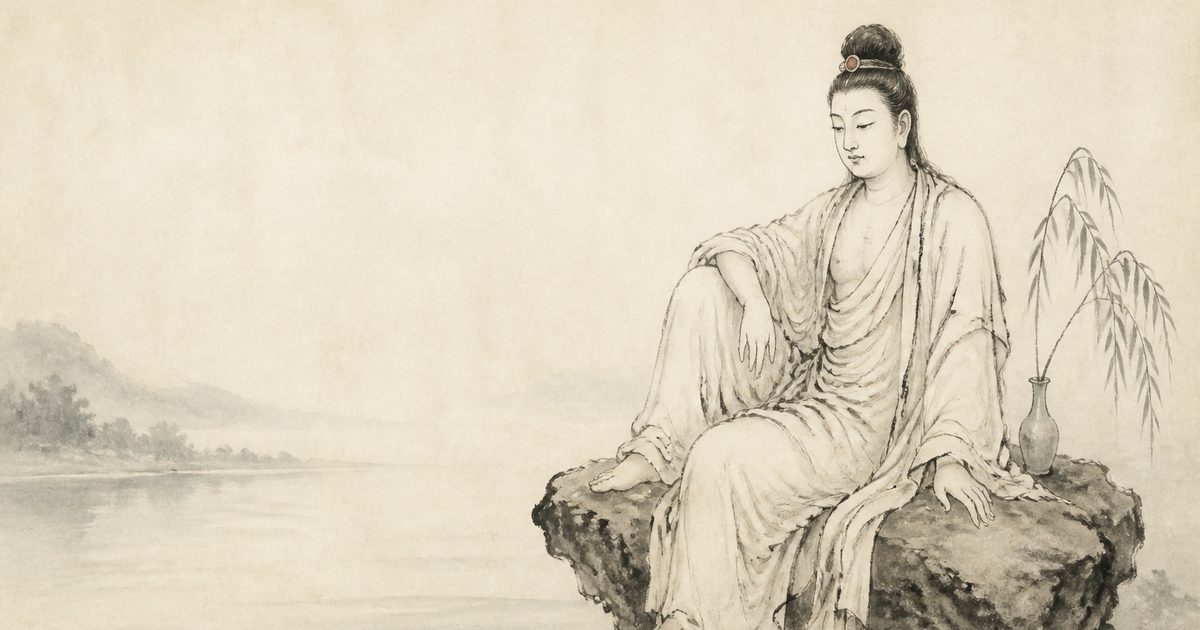
Guanyin is the one you call. That is the whole job, and it is worth saying plainly before anything else, because the figure gets introduced in English as a goddess of mercy and that description manages to be wrong in three words out of four.
Not a goddess, at least not originally, and not in any doctrine. A bodhisattva is someone who has done the work, qualified for release from the whole exhausting machinery of rebirth, and then declined to walk through the door until everybody else can come too. Not mercy either, which implies a judge with the power to let you off. The Chinese name says what the figure actually does, and it is a listening word. Guanyin hears you and arrives.
And then there is the question everyone actually types into a search box, which is whether Guanyin is a man or a woman. The short answer is that the figure came to China as a man, was still being carved with a mustache in the seventh century, and by the twelfth is unmistakably a woman. The longer answer is more interesting, because the scripture that made the cult enormous had already put the permission slip in writing, several hundred years before anyone in China used it.
The most successful bodhisattva in the world
Start with the reach, because it is easy to underestimate from the outside. Guanyin is not a specialist deity consulted for a niche problem. In Chinese folk practice she is the default: the figure on the shelf in a restaurant, in a taxi, in the front room of a family that has not thought about Buddhism in three generations and would be surprised to hear they were doing anything religious. Half the shrines you will pass in a Chinese city are hers, and many of her temples keep a cup of a hundred numbered bamboo sticks on the altar, each pointing to a four-line verse, for questions too big for a yes or no. You can draw one of Guanyin's hundred sticks here, confirmed by the moon blocks the way the temples do it.
The name traveled as far as the figure did. In Japan she is Kannon, in Korea Gwaneum, in Vietnam Quan Âm, all of them the same two characters read in a local accent.
Which brings us to the best-hidden appearance of a Buddhist deity in modern consumer life. In 1933 a Tokyo outfit called Precision Optical Instruments Laboratory built its first trial cameras and branded them Kwanon, after the bodhisattva. Canon's own corporate history says so without any embarrassment: the name, it explains, reflected the benevolence of Kwanon and the company's hope of making the best cameras in the world. Two years later, wanting something the export market could pronounce, they filed the trademark as Canon, which sounded near enough. So the second-largest camera company on earth is named after the bodhisattva of compassion, by way of a pun that only works if you already knew.
The physical center of the cult is an island. Mount Putuo, off the coast of Zhejiang, is one of the four sacred mountains of Chinese Buddhism, each the seat of a different bodhisattva, and its name is simply Potalaka with the Sanskrit worn down by Chinese mouths. Potalaka is the mountain the Flower Garland Sutra places somewhere to the south, where the bodhisattva lives. India had a mythical mountain; China found it a postcode. The temple at the landing point is called the Yard of the Guanyin Who Refused to Leave, which is the kind of name a place only gets when the story behind it is better than the building.
The name, and the man who said it was wrong
Here is the part almost nobody writing in English mentions.
Guanyin is short for Guanshiyin, which reads as observing the sounds of the world, and the Lotus Sutra spells out what that means as a piece of machinery rather than a compliment. Hundreds of thousands of millions of beings, the text says, suffering torments; they hear of this bodhisattva and with a single mind call the name, and he observes the sound of their voices and every one of them is released. The name is not a description of his character. It is the instruction manual.
That translation is Kumarajiva's, made in the early fifth century, and it is one of the most influential pieces of Chinese prose ever produced by a foreigner.
Two hundred and forty years later, Xuanzang came home. He had spent seventeen years walking to India and back, he had read the texts in the original in the country that produced them, and he was about to spend the rest of his life retranslating the canon on the grounds that the existing versions were not good enough. In the travelogue he wrote in 646 he stops at an image of the bodhisattva and does something a translator almost never does in a travel book. He takes the Sanskrit apart in front of you: avalokita, which means observing, plus ishvara, which means sovereign. Therefore Guanzizai, the Sovereign Observer. And then the older renderings, the ones every Chinese Buddhist was already using, including the one in Kumarajiva's Lotus Sutra: all errors.
He was the most qualified person in the empire to say it, and he had the imperial patronage to make it stick. It did not stick. Guanzizai survives in the Heart Sutra, which is Xuanzang's own translation and which hundreds of millions of people have memorized, so the corrected name is literally on the lips of the faithful daily and nobody uses it for the figure. Everywhere else Guanyin won.
Now the twist, which is that the loser of this argument may have been right. Xuanzang's case rests on the Sanskrit ending -ishvara, sovereign, and he had certainly read it. But the earlier Sanskrit form appears to have been Avalokitasvara, with svara, and svara means sound. It shows up that way in surviving fragments from the fifth century, and the current scholarly position is that this is the original and the source of the Chinese name. Which would mean Kumarajiva translated the text he actually had, accurately; the Sanskrit itself drifted afterward; and Xuanzang, holding a later manuscript, corrected a good translation of an older one against a newer one and called it an error.
The correction was authoritative, well-argued, and aimed at the wrong century.
What the sutra promised, and what it permitted
The chapter that did the work is chapter twenty-five of the Lotus Sutra, the Universal Gate, and it circulated separately as its own little book for centuries because it is so much more immediately useful than the rest. It is a list of things that will not kill you if you call the name. Fire will not burn you. The flood will put you down in the shallows. Thrown off a mountain, you will hang in the air like the sun. Swords break, chains fall off, and the bandits on the road let you past.
It is not subtle and it was not meant to be. This is a text for people whose lives contained fire, water, bandits and the law, offering a single action available to the illiterate and the desperate in equal measure. That is why Guanyin, and not some more philosophically distinguished figure, became the one on every shelf.
Then the chapter does the thing that mattered most, though not for another eight hundred years. The bodhisattva, it explains, appears in whatever body will work. It runs through a long list: a buddha, a monk, a king, a general, a merchant. And in the middle of that list, without any fuss at all: to those who can be brought across by the body of the wife of an elder, a householder, an official or a brahmin, he appears in a woman's body and preaches to them; and to those who need a boy or a girl, he appears as a boy or a girl.
Hold on to that. It is the pivot of everything below, and it was written down in Chinese in the early fifth century.
How a bodhisattva changed sex
The Indian Avalokiteshvara is male. The figure arrives in China male, is described as male, and the sculpture agrees: Tang images are commonly masculine, and quite a few of them have a mustache. As late as the seventh century, if you had told a Chinese Buddhist that Guanyin was a woman, you would have been corrected.
By the Song, and clearly by around the twelfth century, the images are female, and they stay that way. Today the mustache is so far gone that photographs of Tang statues read to modern visitors as a mistake or a joke.
There is no single moment when this happened, and honest sources do not offer one. What can be dated is the moment the female version acquired a biography, and that has an address.
In 1100 the abbot of Xiangshan Temple in Ruzhou handed a text to the local prefect, a man named Jiang Zhiqi. It told the story of Miaoshan, a princess, the third daughter of a king, who refused the marriage her father arranged, was punished for it with escalating cruelty, and at the end gave up her own eyes and hands to make the medicine that cured him. The reward is transfiguration: she becomes the bodhisattva, and the thousand arms and thousand eyes of one of Guanyin's most striking forms are explained as the restoration, at scale, of what she gave away.
Jiang Zhiqi wrote it up. The text was cut into stone, with the calligraphy done by Cai Jing, one of the finest brushes of the dynasty and one of its more spectacular political villains. The stele is still in Baofeng County in Henan: two and a quarter meters high, a meter and a half wide, four thousand two hundred and eighty characters. Within four years the text had reached Hangzhou.
That is what a religion looks like when it naturalizes something. A figure that arrived from India with no origin story a Chinese reader could feel now had one: a Chinese girl, a Chinese family, a specific mountain, an unbearable father, and a resolution built out of filial piety, which is the one virtue no Chinese audience was going to argue with. Miaoshan is a woman. The image follows the story.
But go back to chapter twenty-five, because this is the part the standard account of the sex change leaves out. The tradition did not break its own rules to make Guanyin a woman. The rule was already there, in the founding text, in the sentence about appearing in a woman's body to those who need one. The doctrinal position is that a bodhisattva at this level has no fixed form at all, and the sutra had listed the female bodies specifically.
So the honest way to put it is not that Guanyin changed sex. It is that a text written in India, in a religion whose institutional life was overwhelmingly male, contained a clause allowing the figure to appear as a woman where a woman was what was needed. In China, for about a thousand years, a woman was what was needed. The clause got used.
What is not settled
Three things, and it is worth being clear about which is which.
The disappearing syllable. Guanshiyin became Guanyin, and the popular explanation is a naming taboo: the second emperor of the Tang was Li Shimin, and using a character from a reigning emperor's personal name was not done. It is a real mechanism and this site has reported two solid instances of it, including Chang'e, whose name changed to dodge a Han emperor. But this particular case is contested, because the shortened form turns up in material older than the Tang, which would make it an ordinary contraction that the taboo later reinforced. Two out of three is a good record. This page is not going to make it three by pretending.
The date of the change. Nobody can point at the first female Guanyin. The sources give a before and an after and a slow middle, and anyone offering you a year is selling something. The 1100 stele is not that year either. It dates the story, not the image.
Miaoshan. There is no reason to think she existed, and that is not really the interesting question. The interesting question is why a story about a daughter destroyed by her father's demands was the one that made a foreign deity feel Chinese, and the answer is not flattering to anybody.
One last thing, which is the useful correction to carry away. Guanyin turns up constantly in Journey to the West, where she recruits every member of the pilgrimage and is who they call when a demon is beyond them, and readers often come away with her as a supporting character in the monkey's story. It is worth turning that around. In the logic of the novel she is not helping with the journey. The journey is hers, and the monkey is one of the things she picked up along the way.
In the classics
The passages behind the story, in the standard published translations. Open any one for the original text.
“Among them is an image of the bodhisattva Avalokiteshvara. (In the language of the Tang, Guanzizai, the Sovereign Observer. Run the syllables together and you get the Sanskrit as given above; separate them out and you have avalokita, which translates as "observing," and ishvara, which translates as "sovereign." The old renderings, Guangshiyin, or as some have it Guanshiyin, or Guanshizizai, are all errors.) ”
Original text
中有阿縛盧枳低濕伐羅菩薩像。(唐言觀自在。合字連聲,梵語如上;分文散音,即阿縛盧枳多,譯曰觀,伊濕伐羅,譯曰自在。舊譯為光世音,或云觀世音,或觀世自在,皆訛謬也。)
“If there are immeasurable hundreds of thousands of millions of beings suffering torments, and they hear of this bodhisattva Guanshiyin, and with a single mind call his name, then Guanshiyin will that very moment observe the sound of their voices, and every one of them will be released. ”
Original text
若有無量百千萬億眾生,受諸苦惱,聞是觀世音菩薩,一心稱名,觀世音菩薩,即時觀其音聲,皆得解脫。
“To those who can be brought across by the body of the wife of an elder, a householder, an official or a brahmin, he appears in a woman's body and preaches the Dharma to them. To those who can be brought across by the body of a boy or a girl, he appears as a boy or a girl and preaches the Dharma to them. ”
Original text
應以長者、居士、宰官、婆羅門婦女身得度者,即現婦女身而為說法。應以童男、童女身得度者,即現童男、童女身而為說法。
“To the south of here there is a mountain called Potalaka, and on it there is a bodhisattva named Guanshiyin the Sovereign. ”
Original text
於此南方有山,名補怛洛伽山,彼有菩薩名觀世音自在。
As seen in
Journey to the West
novel · c. 1592The bodhisattva who assembles the pilgrimage party and is the standing escalation path whenever the pilgrims are beaten, as Guanyin.
She recruits every member of the group, including the monkey, and is who they call when a demon is beyond them.
Questions people ask
Who is Guanyin?
Guanyin is the bodhisattva of compassion, the most widely worshipped figure in Chinese Buddhism and one of the most widely worshipped anywhere. A bodhisattva is someone who has qualified for release from the cycle of rebirth and has declined to take it until everyone else can go too, so Guanyin is not a god who rules anything. The job is narrower and stranger than that: to hear people in trouble and to come. The figure originates in the Indian Buddhist bodhisattva Avalokiteshvara and arrived in China with the sutras, in the first few centuries CE.
Is Guanyin male or female?
Both, historically, and neither, doctrinally. The figure came to China as the male Indian bodhisattva Avalokiteshvara and was still being depicted as male, sometimes with a mustache, into the Tang dynasty. From the Song onward the depictions are female, and today almost every image you will see is a woman. Buddhist doctrine holds that a bodhisattva at this level has no fixed sex and takes whatever form is useful, and the Lotus Sutra says so explicitly, listing women and girls among the bodies he assumes. So the historical change of sex is real, and the tradition had already licensed it in writing before it happened.
What does the name Guanyin mean?
It is a shortening of Guanshiyin, which reads as "observing the sounds of the world." The Lotus Sutra explains it as a mechanism rather than a title: call the name, and the bodhisattva observes the sound of your voice and releases you. What is less well known is that Xuanzang, the Tang pilgrim who spent seventeen years in India and is the most authoritative translator in Chinese history, wrote in 646 that this rendering was simply wrong and the name should be Guanzizai, the Sovereign Observer. He lost. Modern scholarship has since gone some way toward saying he was the one who was wrong.
Is Guanyin the same as Avalokiteshvara?
Yes, the same figure, and the difference between the names is a thousand years of Chinese history. Avalokiteshvara is the Indian bodhisattva; Guanyin is what that figure became after it was translated, adopted, given a Chinese biography as the princess Miaoshan, and reimagined as a woman. Almost everything a Chinese devotee associates with Guanyin, including the sex, the princess story, the island of Putuo and the white robe, was added in China. The relationship is closer to the same character in a different literature than to a translated word.
Why is Guanyin called the goddess of mercy?
Because European missionaries and travelers needed a familiar handle and reached for one. The phrase is not a translation of anything: the Chinese name means "observing the sounds of the world," mercy is not the operative concept, and for most of the figure's history the goddess part would have been wrong too. It stuck because it is easy to say and because it arrived at the point when the figure really was being depicted as a woman. It is a useful phrase to recognize and a poor one to reason from.
Related figures
Sources & further reading
- Records of the Western Regions of the Great Tang, scroll 3 (Chinese Wikisource): Xuanzang's gloss of the name and his verdict on the older renderings
- Avalokiteśvara, Wikipedia: the finding that Avalokitasvara, with svara, is the earlier Sanskrit form, attested in fifth-century fragments
- Guanyin, Wikipedia: the male depictions before the Song and the female form from around the twelfth century
- 觀世音菩薩, Chinese Wikipedia: the bearded Tang images, the Potalaka passage, and both sides of the naming-taboo argument
- The Universal Gate chapter of the Lotus Sutra, full text: the name mechanism and the list of bodies
- Henan Provincial Cultural Heritage Bureau: the Xiangshan stele of 1100, Jiang Zhiqi, Cai Jing's calligraphy, and its dimensions
- Han Bingfang, Guanyin belief and the Miaoshan legend (Institute of World Religions, Chinese Academy of Social Sciences)
- Canon Global, corporate history: the Kwanon cameras of 1933 and the 1935 trademark
- Mount Putuo, Wikipedia: the name from Potalaka, the four sacred mountains, and the temple of the Guanyin who refused to leave
By Julian 祝君瑜, retold from the classics, with the original passages cited, updated 2026-08-26