Chinese Mythology
Zhong Kui: The Demon Queller Who Began as a Stick
Zhong Kui, 钟馗 (Zhōng Kuí), is the demon queller of Chinese folk religion: a scowling, black-bearded figure with a drawn sword, hung on doors to keep the year's bad things outside. The story says he was a candidate who failed the imperial examination and came back from the dead to hunt demons for the emperor who had wronged him. The oldest surviving telling of that story is eleventh-century, and the scholar who wrote it down spent the next paragraph explaining why it could not be true.
The dream everybody tells
The story goes like this, and it is worth telling properly before taking it apart.
In the Kaiyuan era the Tang emperor Xuanzong came back from military exercises at Mount Li with a fever that would not break. It ran for the better part of a month. The physicians and the exorcists between them exhausted everything they had and none of it worked.
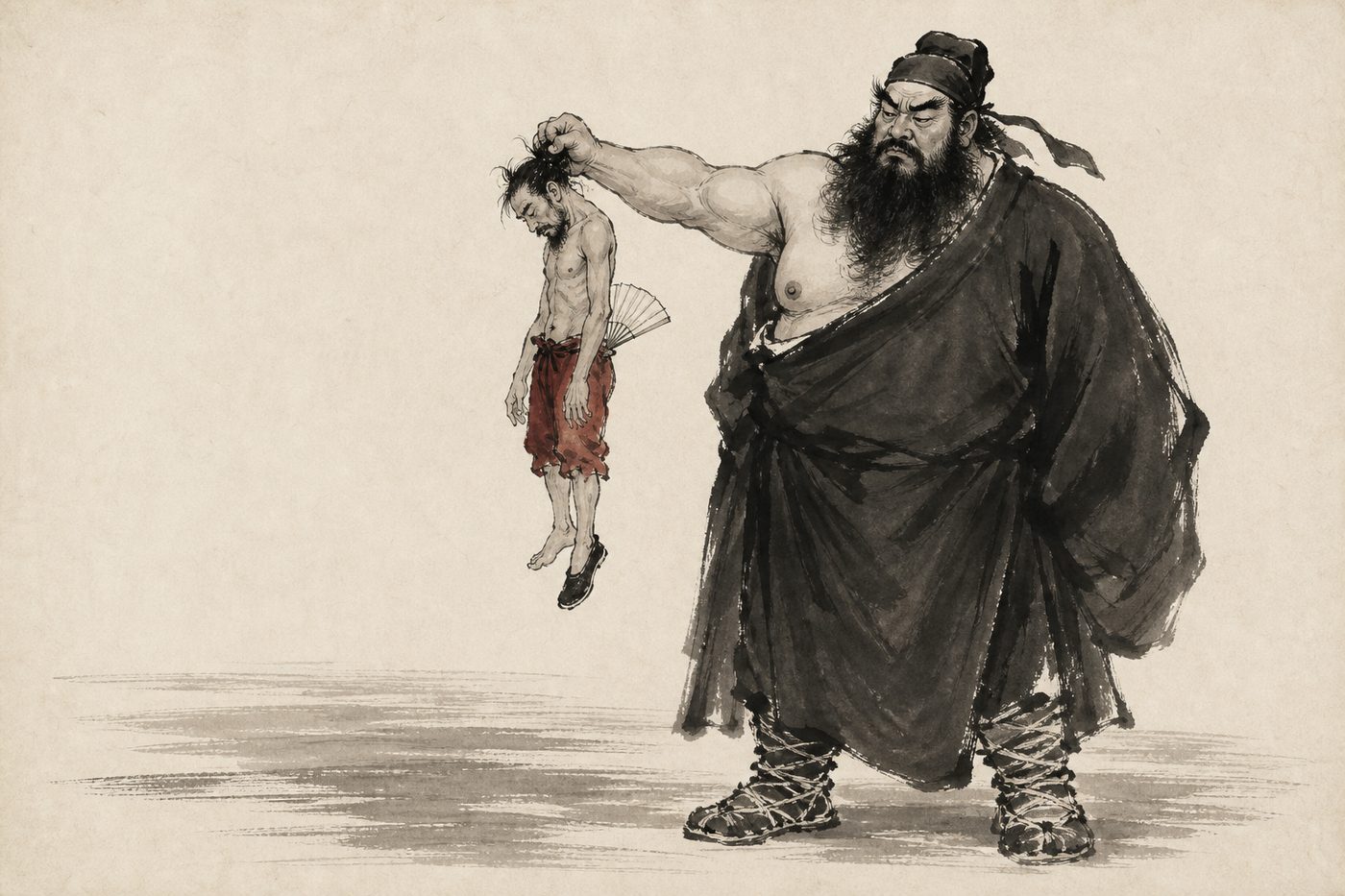
Then one night he dreamed of two ghosts. The small one was dressed in crimson and short breeches, one foot bare, the other shoe swinging loose, with a big bamboo-and-paper fan shoved into his belt. He had stolen Lady Yang's purple scent-bag and the emperor's own jade flute, and he was running laps of the hall with them, enjoying himself. The large one wore a cap and blue robes, one arm bared, both feet wrapped in raw hide. He caught the small one, dug out its eye, tore it in half and ate it.
The emperor, who seems to have been remarkably composed about all this, asked the large ghost who he was. The reply is the founding sentence of the entire cult: your servant Zhong Kui, the candidate who failed the military examination, sworn to rid Your Majesty's realm of its monsters.
Xuanzong woke up cured. He sent for the court painter Wu Daozi, described the dream, and asked him to paint it. Wu Daozi listened, went into something like a trance, painted the thing in one sitting and presented it. The emperor stared at it for a long time, then struck the table and said that the two of them must have had the same dream, because how else could it look like this.
That is the legend. It has everything: an emperor, a miracle cure, a named painter, a date. It is also, in the only form we have of it, a piece of writing about a painting rather than a report of an event, and the man who copied it out did not believe it for a moment.
The oldest source for the story debunks it, in the same paragraph
Everything above comes from a single place: a note by Shen Kuo, the Song polymath, in the supplement to his Dream Pool Essays, written in the 1090s. Shen Kuo is not recounting the dream. He is describing an old painting kept in the palace, attributed to Wu Daozi, and copying out the colophon that some Tang hand had written at the head of the scroll. That colophon is our source. There is no earlier one.
And then, without a paragraph break, Shen Kuo does something that almost nobody who repeats this story bothers to mention. He checks it.
He notes that during the Huangyou years a house in Shangyuan county at Jinling was opened up and found to contain a stone inscription from the tomb of the mother of Zong Que, a Liu Song general who died six centuries before Xuanzong ever had a fever. The inscription records that Zong Que had a sister. Her name was Zhong Kui. He then adds three more: a Li Zhong Kui under the Later Wei, and two Sui generals, Qiao Zhong Kui and Yang Zhong Kui. His conclusion is four characters short of blunt: the name goes back a long way and does not begin in the Kaiyuan era. What begins in the Kaiyuan era is only this painting.
Read that again, because it is genuinely unusual. The earliest surviving text of the legend contains, in the same entry, the earliest surviving refutation of it. And the refutation is airtight, because you do not name your daughter after a demon-hunting god who has not been invented yet. You name her after something ordinary.
He may have begun as a stick
So if Zhong Kui was a common enough personal name in the fifth and sixth centuries that a general's sister and two Sui commanders carried it, what did it mean before it meant a god?
The answer that Ming and Qing philologists arrived at, and that modern scholarship has largely kept, is that it meant a mallet.
The Rites of Zhou describes the great jade tablet carried at the emperor's belt: three feet long, tapered at the top, with a zhongkui head. The old gloss on that line explains that a 终葵 is a 椎, a mallet or a spike, and that the tablet's upper end was cut into a mallet shape. The word is dialect. In the state of Qi, a mallet was called a 终葵, two syllables where the rest of the country used one.
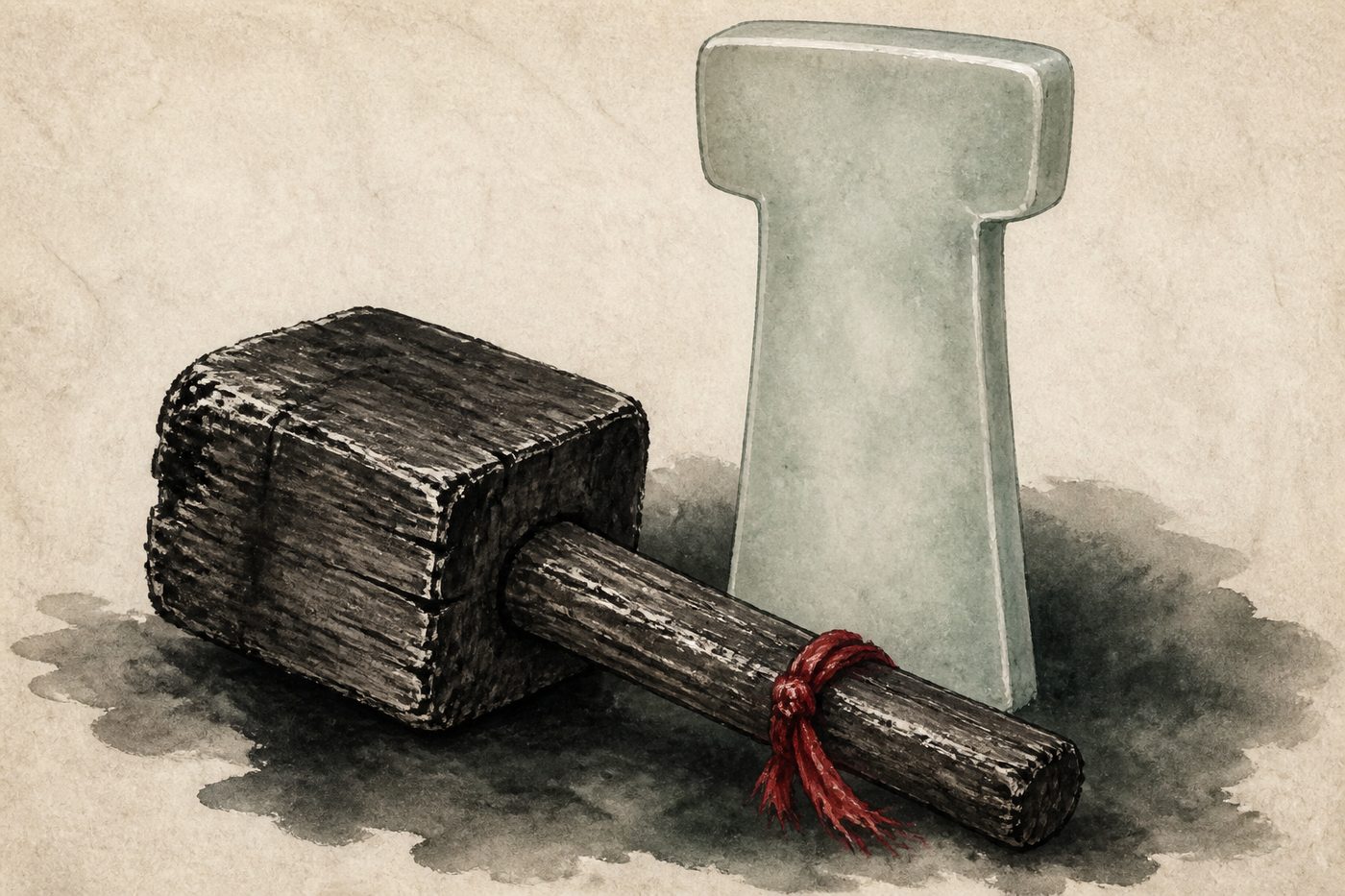
Gu Yanwu, in the thirty-second scroll of his Record of Daily Knowledge, put the last piece in: the ancients drove out ghosts with a mallet, in the manner of the great 傩 exorcism. Hitting things is the oldest exorcism technology there is, and the object you hit them with acquires the power. From there the chain is short and unremarkable. A mallet used to beat out demons becomes a lucky word. A lucky word becomes a personal name, in the way that Chinese parents named children Bixie, drive-off-evil, for exactly the same reason. And a personal name common enough to be everywhere eventually acquires a person to go with it.
The mallet went first. The man was reverse-engineered to explain the mallet, and then an emperor's fever gave him a biography.
How to say it
Zhōng Kuí, roughly jong-kway.
The first syllable rhymes with wrong and starts with the j of jeep. The zh of pinyin is not the zh of measure; it is a j pronounced with the tongue curled back. The second syllable is a single sound, kway, rhyming with way, not two beats and not rhyming with we. The tones are high level, then rising: flat, then up.
There is one nice irony buried in the spelling. The second character, 馗, is a real word with a real meaning, and it is not sinister at all. The Shuowen Jiezi defines it as a road where nine ways meet, a great crossroads, and adds that it is called that because it resembles the domed back of a turtle. If you have been told that his name means something like nine-roads-demon-slayer, that is the reason, and it is a coincidence. The characters are carrying a sound from the Qi dialect, not a meaning. The name is a spelling of a noise.
What he actually does
His work is narrow and he is very good at it.
He catches demons, binds them and eats them. That is the whole portfolio, and it is right there in the first sentence anyone wrote about him. The ghost he eats in the dream is not anonymous, either. In the version preserved through the Ming encyclopedias, the little thief gives its name as 虚耗, Emptiness-and-Waste, and explains itself: emptiness is stealing from people where no one can see, waste is turning a household's happiness into grief. It is the spirit of things going quietly wrong. Zhong Kui's function is to eat that.
The sword he carries is not a soldier's weapon but the exorcist's peachwood blade, the same object that Chinese ritual has been pointing at malevolent things for two thousand years. He works with staff. A retinue of lesser ghosts serve him rather than flee him, and by the Ming dynasty a whole genre of court plays had five of them clowning around their boss, which is how the number five attached itself to him. Above his head in almost every painting there is a bat, and the bat is a pun rather than a portent: the word sounds like the word for good fortune, a joke our page on the character for luck unpacks in full.
What he does not do is worth stating, because games and films keep adding it. He does not fly. He does not shapeshift. He casts no spells and rules no realm. He is a large angry official with a sword, and the point of him is that the things that terrify you are terrified of him.
The exam, the ugliness and the suicide are all later
Here is the version most English retellings give. Zhong Kui came first in the imperial examinations. The emperor saw him, found him too hideous to be given the honor, and stripped him of it. Zhong Kui, humiliated, killed himself on the palace steps. The underworld, embarrassed, made him king of the demon hunters.
Almost none of that is in the earliest text.
Shen Kuo's colophon describes the large ghost's cap, his blue robes, his bared arm and his hide-wrapped feet, and says nothing at all about his face. There is no ugliness. There is no rejection scene. There is no suicide. And the examination he failed is the military one, 武举, not the civil examination that every retelling assumes: he is a washed-out army candidate, not a snubbed scholar. That single character has been quietly corrected in translation for a very long time.
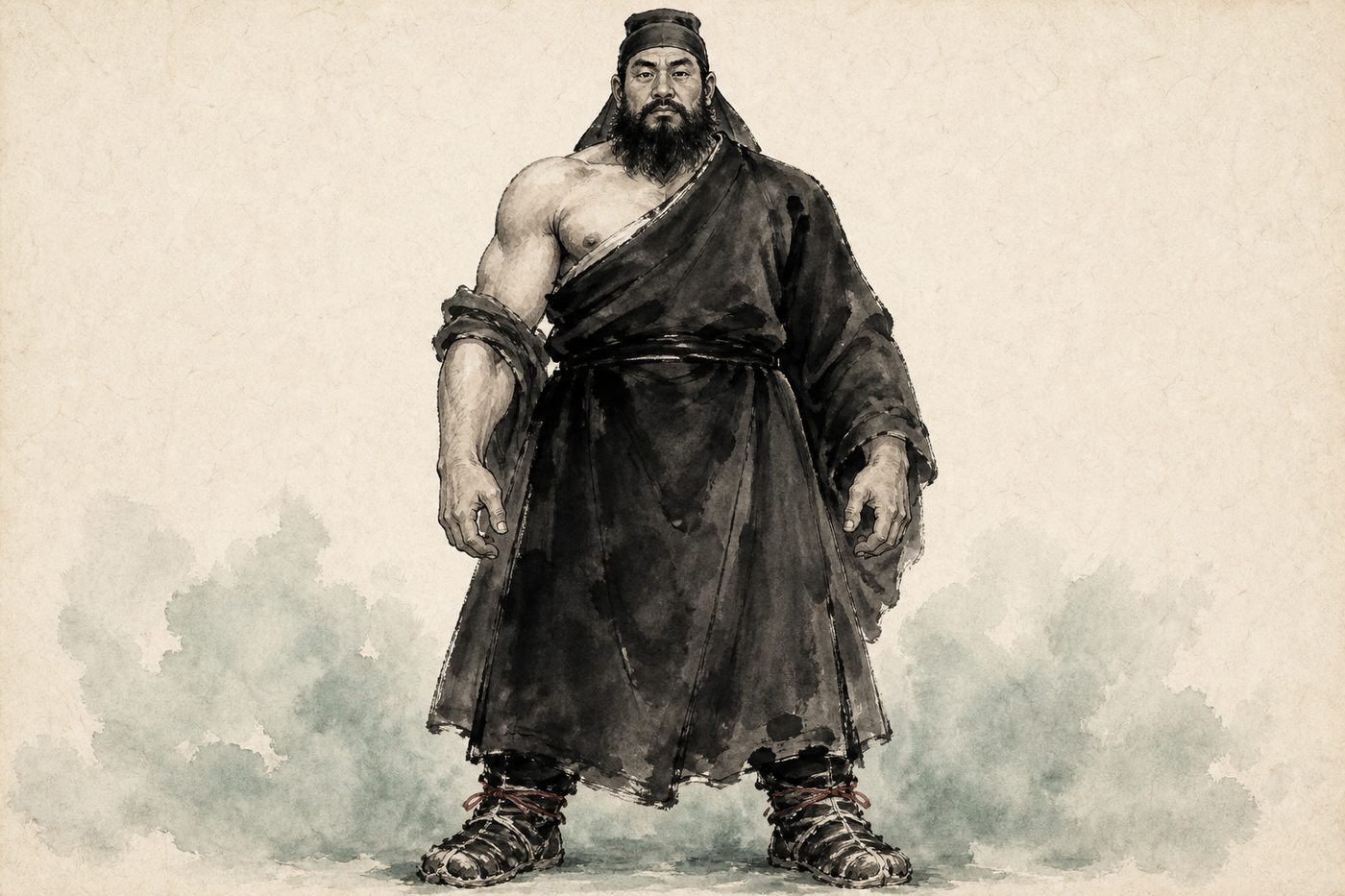
The suicide comes from a different work, the Tang Yishi, which survives only in quotation, most usefully in a Ming encyclopedia, and which supplies the line about him striking the steps and dying in shame and rage. Whether that text is genuinely Tang or a later attribution is not settled.
None of which makes the popular version worthless. It makes it legible. A demon queller has to look worse than the demons or the picture on your door does not work, so the tradition gave him a face. And a god of the wronged needs a wrong, so the tradition gave him an injustice, and made it an examination, which is the injustice every literate Chinese family understood in its bones. The story grew the parts it needed.
The sister he married off
One of the most reproduced Zhong Kui subjects in all of Chinese painting has nothing to do with demons. It shows a procession: the god escorting his younger sister to her wedding, surrounded by his ghost servants carrying the dowry, all of them behaving beautifully. It is called Zhong Kui Marries Off His Sister, and it is funny on purpose, the household staff of hell doing wedding logistics.
The groom in the story is Du Ping, a friend from home who paid for Zhong Kui's burial after his death, and to whom the god gives his sister in thanks. It is a story about a debt being settled, which is why it has outlasted most of the demon material.
Its provenance is later than the images, though. The earliest surviving play on the subject is Tianxia Le, by the early Qing dramatist Zhang Dafu. There is a good scholarly argument that the whole marriage narrative began as a misreading: the Song and Yuan paintings show a ghost procession, an entirely ordinary Zhong Kui subject, and somewhere along the line viewers read the procession as a wedding party and the tradition wrote a story to fit what they had seen. Du Ping is not in any Tang source. He is a character the opera needed.
New Year's Eve first, the fifth month later
The seasonal placement moved, and the modern one is not the original.
Zhong Kui began as a New Year figure, and specifically as the last night of the year. In the Tang, his image was an official gift: memorials of thanks survive from Zhang Shuo and, later, Liu Yuxi, written on behalf of officials who had received a Zhong Kui picture and the new calendar from the emperor together, which tells you the two were the same kind of object. You got the year ahead and the thing that guards it in one parcel.
Shen Kuo records the moment it went industrial. In 1072, the Song emperor Shenzong had the painting copied, cut onto printing blocks, and printed, and on New Year's Eve an official was sent round the two chancelleries to hand a copy to each senior minister. A dream had become a woodblock print run inside three centuries. The front gate, then as now, belonged to the door gods; Zhong Kui's print went on the back door or the single door, which is where the shops still put him. By the late thirteenth century he had even got into the New Year noise: Zhou Mi records that the palace in Hangzhou was given a screen painted with Zhong Kui catching ghosts, with a fuse hidden inside that set off a hundred and more firecrackers without a break.
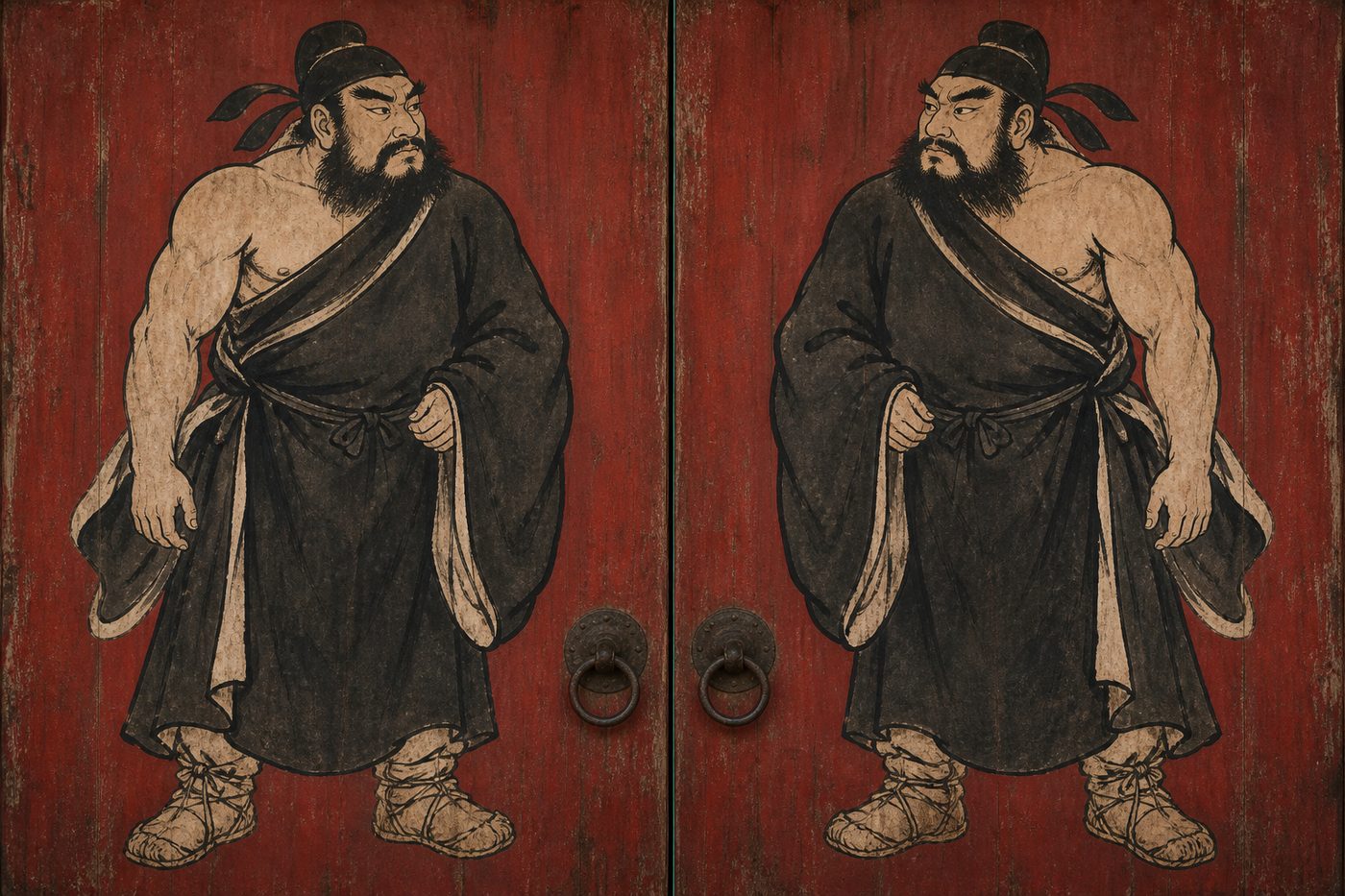
The move to the fifth month came later. The fifth lunar month, and Duanwu in particular, is the pestilential season in the Chinese calendar, the point in the year when disease and poison are strongest and the gates need guarding. That door had belonged to Zhang Tianshi, the Daoist patriarch. Ming drama, which paired Zhong Kui against the five poisons, gradually moved him into it, and by the Qing it was his. So he now works both ends of the year: the last night of it, and the worst month of it.
He and the Monkey King have never met
This question is being asked a great deal at the moment, so it deserves a straight answer.
They are not related. They are not from the same book. They never appear in the same story, and neither one is aware the other exists.
Sun Wukong is a literary character with a known home: Journey to the West, a novel of about 1592, which our page on Sun Wukong covers. He has an author, a plot and a hundred chapters. Zhong Kui has none of those things. He has no canonical text at all, only a note about a painting, some exorcism liturgy, a heap of Ming and Qing plays, and roughly twelve hundred years of pictures. One is a character. The other is a custom.
Chronologically they do not even overlap in the right direction. By the time Journey to the West was written, people had been hanging Zhong Kui on their doors for something like eight hundred years.
What they genuinely share is a studio. Game Science made Black Myth: Wukong, and is now making Black Myth: Zhong Kui, and those two facts, arriving inside a single year, have persuaded a lot of people that the two figures come from the same mythology in the way that two Marvel characters come from the same comics. They do not. Chinese myth is not one universe with a continuity department. It is several unrelated bodies of material, assembled at different times by different kinds of people for different purposes, and the demon queller on your door was never in the novel.
Where you meet him now
Outside China, increasingly, in a game. Black Myth: Zhong Kui was announced at Gamescom in August 2025 and showed fifteen minutes of itself in August 2026, and there is no release date; the studio has been unusually frank that it does not have one. Whether the game's Zhong Kui should be a soldier or a scholar, handsome or hideous, is a question the oldest texts answer better than the fan forums do, and we have laid them out, layer by layer, beside the figures of the first game in the real mythology behind Black Myth. Before that he had a run as a playable god in Smite's Chinese pantheon, and a 2015 Chinese blockbuster that turned him into a horned giant in love with a snow demon. Inside China he is where he has always been: on doors, on the fifth-month prints, in the opera repertoire, and on a great many cheap red posters sold in the weeks before the new year.
The thing worth keeping is the order of events. A dialect word for a mallet became a lucky name. The name became so ordinary that people gave it to their daughters. Somebody eventually asked who Zhong Kui was, and the answer, assembled over centuries by painters and playwrights and one feverish emperor, was a failed soldier who came back angry and took a job. Shen Kuo saw the whole thing happening in real time, wrote down both the legend and its refutation on the same page, and left it to us to notice.
In the classics
The passages behind the story, in the standard published translations. Open any one for the original text.
“Then one night he dreamed of two ghosts, one large and one small. The small one wore crimson and short breeches, one foot bare and one shoe swinging from the other, a great bamboo-and-paper fan stuck in his belt. He had stolen Lady Yang's purple scent-bag and the emperor's jade flute, and was running circuits of the hall with them. The large one wore a cap and blue robes, one arm bared and both feet in raw hide. He caught the small one, dug out its eye, then tore it open and ate it. The emperor asked the large one, and who are you? It replied: your servant Zhong Kui, the candidate who failed the military examination. I have sworn to rid Your Majesty's realm of its monsters. ”
Original text
忽一夕,夢二鬼,一大一小。其小者衣絳,犢鼻屨,一足跣,一足懸一屨,搢一大筠紙扇,竊太真紫香囊及上玉笛,繞殿而奔。其大者戴帽,衣藍裳,袒一臂,鞹雙足,乃捉其小者,刳其目,然後擘而啖之。上問大者曰:爾何人也?奏云:臣鍾馗氏,即武舉不捷之士也。誓與陛下除天下之妖孽。
“Zong Que had a sister named Zhong Kui. Under the Later Wei there was a Li Zhong Kui, and the Sui had the generals Qiao Zhong Kui and Yang Zhong Kui. The name Zhong Kui, then, goes back a long way, and does not begin in the Kaiyuan era. What begins in the Kaiyuan era is only this painting. ”
Original text
愨有妹名鍾馗。後魏有李鍾馗,隋將喬鍾馗、楊鍾馗。然則鍾馗之名,從來亦遠矣,非起於開元之時。開元之時,始有此畫耳。
“The great tablet is three feet long, tapered at the upper end, with a zhongkui head. The Son of Heaven wears it at his belt. ”
Original text
大圭長三尺,杼上,終葵首,天子服之。
As seen in
Black Myth: Zhong Kui
game · announced 2025The player character is the demon queller himself, in an action retelling built around the folk story of Zhong Kui banishing evil, moving between the world of the living and the world of the dead, as Zhong Kui.
Game Science, revealed at Gamescom Opening Night Live on 19 August 2025 and shown in fifteen minutes of gameplay on 20 August 2026. There is no release date; the studio has said plainly that it does not have one.
Zhong Kui: Snow Girl and the Dark Crystal (钟馗伏魔:雪妖魔灵)
film · 2015A demon hunter who transforms into a horned giant, caught between his duty and a snow demon he has fallen in love with, as Zhong Kui.
Directed by Peter Pau and Zhao Tianyu, with Chen Kun and Li Bingbing. It took roughly 64 million US dollars in China on a 30 million budget, and the reviews were unkind about the effects.
Questions people ask
Who is Zhong Kui?
Zhong Kui is the demon queller of Chinese folk religion, a god whose job is to catch and destroy the malevolent spirits that cause illness and misfortune. He is shown as a heavy, black-bearded man in official's robes with a drawn sword, usually scowling, often with a bat over his head. His image was hung on doors and gates to keep bad things out of the house. The story attached to him is that he was an examination candidate who was denied the rank he had earned, died, and was appointed by the underworld to hunt demons instead.
How do you pronounce Zhong Kui?
Roughly jong-kway. The first syllable rhymes with the English word wrong and begins with the j of jeep, not the zh of measure. The second rhymes with way. In pinyin it is written Zhōng Kuí, with a high level tone on the first syllable and a rising tone on the second, so the name goes flat and then up. The common English mistakes are to say the k as a hard separate consonant, or to rhyme the second syllable with we.
Was Zhong Kui a real person?
Almost certainly not, and the evidence against it is unusually old. Shen Kuo, writing in the 1090s and giving us the earliest surviving version of the legend, immediately noted that the name Zhong Kui was already in use long before the Tang emperor was supposed to have dreamed him. He cites a tomb inscription naming a woman called Zhong Kui, and three men of the Later Wei and Sui dynasties with the same name. Modern scholarship goes further and argues the name was originally not a name at all, but a word for a mallet used to drive out ghosts.
What are Zhong Kui's powers?
He catches, binds and eats demons. In the earliest account he simply seizes a thieving ghost, gouges out its eye and devours it, and that remains the core of the job. He carries a sword, which in the ritual tradition is a peachwood exorcist's blade rather than a soldier's weapon. He commands a retinue of lesser ghosts who work for him rather than against him, and by the Ming dynasty he was leading five of them through a whole genre of court plays. He does not fly, shapeshift or cast spells. His power is that things that frighten people are frightened of him.
Is Zhong Kui related to Sun Wukong?
No, and they are not from the same story at all. Sun Wukong is the invention of a sixteenth-century novel, Journey to the West. Zhong Kui belongs to a much older strand of folk religion and seasonal ritual, and his name is attested centuries before that novel was written. They come from different traditions and share no episode, no author and no world. What they now have in common is a developer: Game Science made Black Myth: Wukong and is making Black Myth: Zhong Kui, which is where the confusion comes from.
Why is Zhong Kui always drawn as ugly?
Because the ugliness is doing a job. A god who hunts monsters has to be more frightening than the monsters, and the images are functional objects hung on doors, not portraits. It is worth knowing that the ugliness is not in the earliest text. Shen Kuo's eleventh-century account describes his clothes, his bare arm and his hide-wrapped feet, and says nothing whatever about his face. The famous version, in which he is denied his examination rank because the emperor finds him hideous and kills himself on the palace steps in protest, appears in later sources.
What is Black Myth: Zhong Kui based on?
On the folk story of Zhong Kui banishing evil, rather than on any single novel. This is a real difference from its predecessor: Black Myth: Wukong had one source book, Journey to the West, whereas Zhong Kui has no canonical text of his own. What exists instead is a thousand years of accumulated material, an eleventh-century note about an emperor's dream, Tang exorcism liturgy, Ming court plays, Qing opera and several centuries of paintings, none of which agree with each other. The studio therefore has more room to invent than it did last time, and less to be accused of getting wrong.
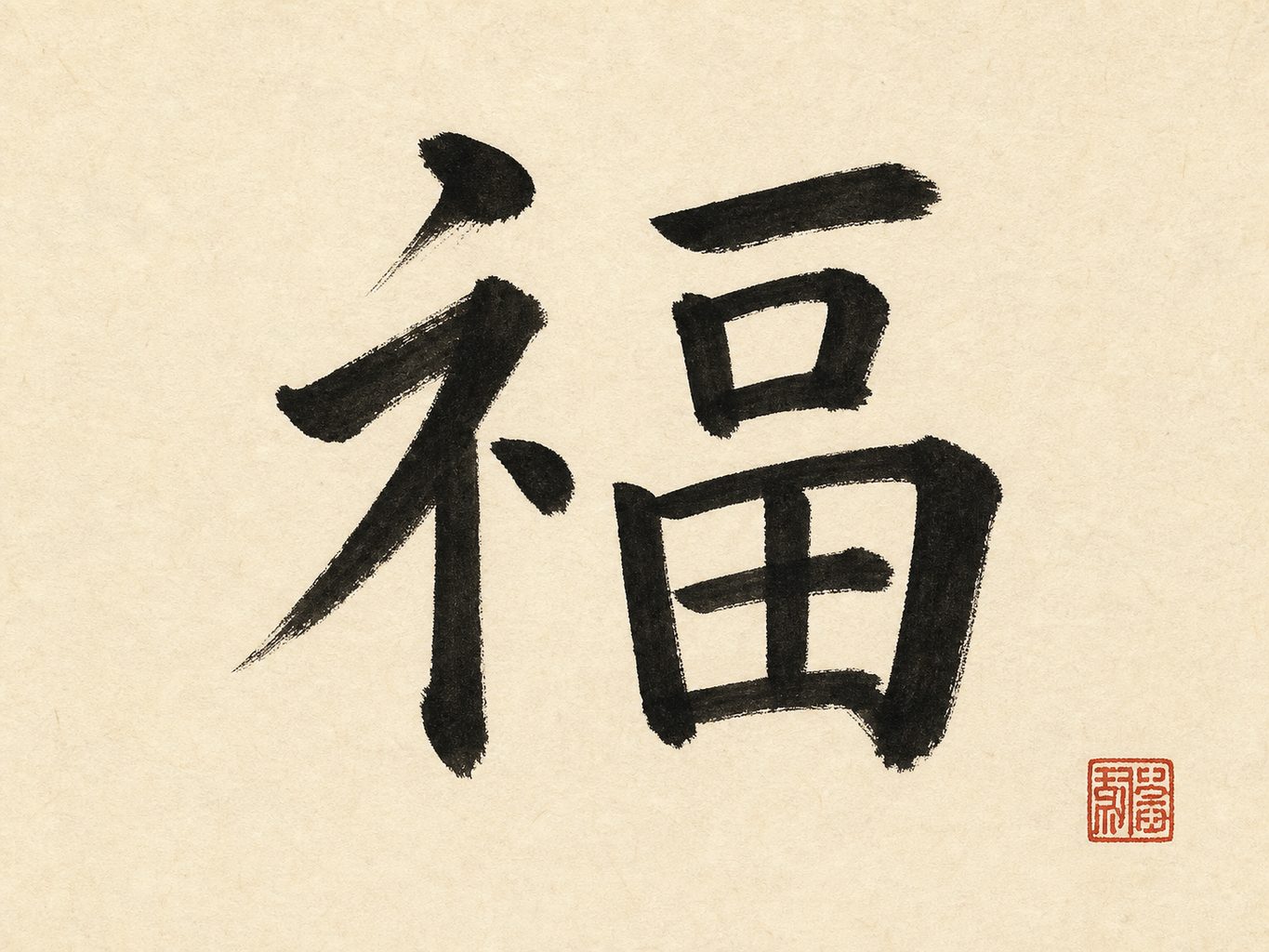
Write and wear 钟馗
The zhong kui is also a character you can write. See 钟馗 as a symbol, its strokes, meaning, and tattoo notes.
Related figures
Sources & further reading
- Zhong Kui (钟馗), Chinese Wikipedia (the origin theories, the 唐逸史 version with the suicide, the Dunhuang exorcism manuscript, and the sister)
- Hu Xinsheng (Shandong University), On the origins of the Zhong Kui cult and its associated rites (钟馗崇拜的起源与相关礼俗)
- Gu Yanwu, Record of Daily Knowledge (日知录), scroll 32, entry 终葵 (the argument that the ancients drove out ghosts with a mallet)
- Why can Zhong Kui expel evil? An answer from the old books (为啥钟馗能驱邪?翻遍古籍找到答案), The Paper (Zhang Shuo's and Liu Yuxi's memorials of thanks for the New Year gift, and the Ming handover of the fifth-month door from Zhang Tianshi)
- A textual study: Zhong Kui and his sister (考证:钟馗和他的妹妹), Silk Road Research (Zhang Dafu's early-Qing play as the earliest surviving version, and the reading of the marriage scene as a misread procession)
- Lin Zhili, On the Zhong Kui plays of the Ming court's great nuo ritual (論明代宮廷大儺儀式鍾馗戲), Bulletin of Chinese Literature, NCCU, no. 8 (2007)
- Dream Pool Essays, Supplement scroll 3 (梦溪笔谈·补笔谈卷三), Chinese Text Project (the full text of the Zhong Kui entry)
- Rites of Zhou, Records of Trades, the jade-workers (周礼·冬官考工记·玉人), with the gloss 终葵,椎也
- Black Myth: Zhong Kui, Wikipedia (the Gamescom reveal of 19 August 2025, the gameplay showing of 20 August 2026, and the absence of a release date)
- Zhong Kui: Snow Girl and the Dark Crystal, Wikipedia (the 2015 film, its budget and its box office)
By Julian 祝君瑜, retold from the classics, with the original passages cited, updated 2026-09-22