Chinese Mythology
Jiangshi: The Chinese Hopping Vampire, and Why It Really Hops
A jiangshi, 僵尸 (jiāng shī), is a reanimated corpse from Chinese folklore. The name means stiff corpse, which is the most accurate description anyone has ever given it. English calls it the Chinese vampire, and that is a borrowed label: the thing the tradition describes drains qi, the life breath, rather than blood. It is famous for hopping upright with its arms held out in front of it, and the reason for that pose turns out to have nothing to do with the supernatural at all.
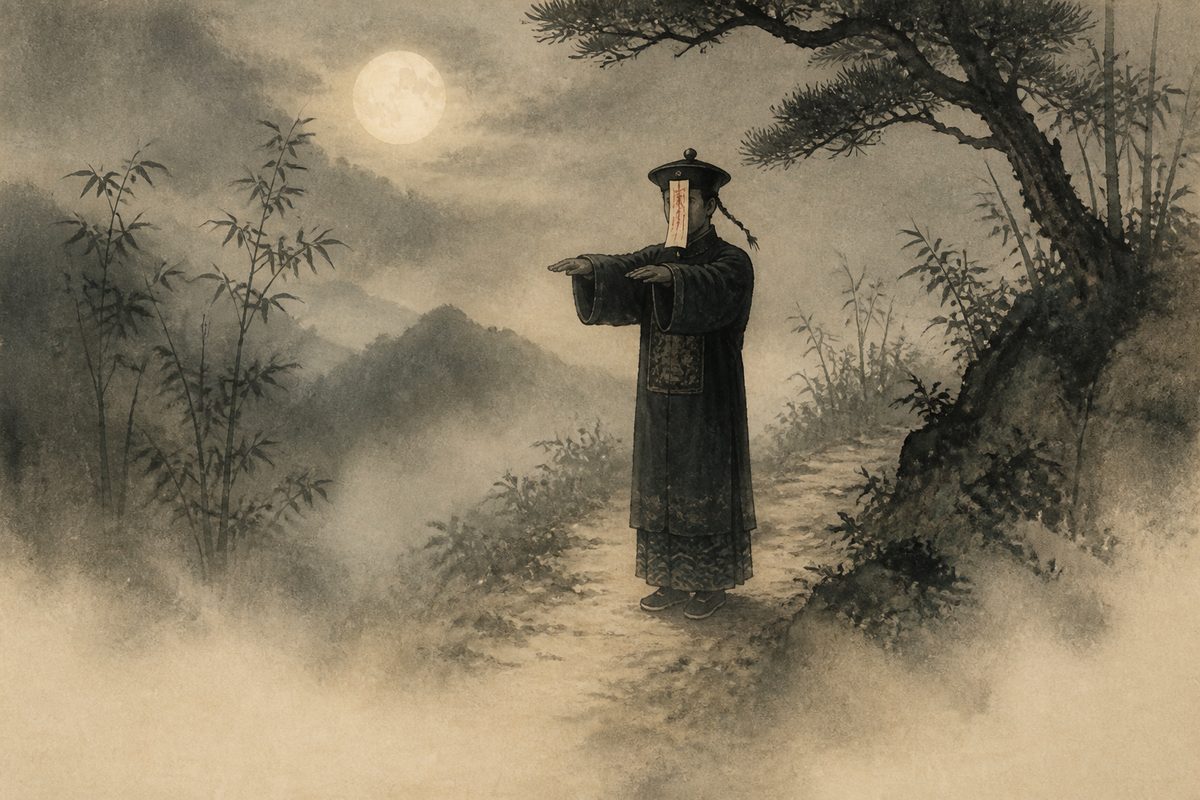
A stiff corpse, and the name says so
Chinese is often accused of vagueness by people who do not read it, and then it goes and names its most famous monster with the bluntness of a coroner's report. Jiangshi. Stiff corpse. That is the whole word. No poetry, no menace, no borrowed Latin. A body that has gone hard and is, regrettably, still moving. It is the word Journey to the West uses for the White Bone Spirit when she is finally a heap of bones.
English decided at some point to call it the Chinese vampire, and that decision has done more damage to public understanding of this creature than any amount of bad cinema. A vampire is a thing with an appetite for blood, and the jiangshi of the tradition is not particularly interested in blood. What it takes is qi, the life breath, the same qi that acupuncture is supposed to unblock and that a martial artist is supposed to cultivate. It drains the animating current out of the living. That is a genuinely different idea, and it comes from a genuinely different cosmology, and calling it a vampire flattens both.
The Qing writers who collected these stories, Yuan Mei in What the Master Would Not Discuss and Ji Yun in Notes from the Thatched Abode, are consistent about how a corpse turns. It is not a curse and not an infection. It is a failure of process. A body left unburied soaks up yang energy it should not have. A death happens in the wrong way or the wrong place. Or, in the version that gets closest to the machinery of Chinese thought, the two souls come apart badly: the hun, the higher soul, departs as it should, and the po, the earthbound one, simply stays, and what remains is a body running on the wrong half of a person.
Which is why the jiangshi is not really a horror story about evil. It is a horror story about paperwork.
What the oldest famous story actually describes
Here is the thing that ought to be at the top of every page about this creature and is at the top of none of them.
The best-known jiangshi story in Chinese literature is by Pu Songling, a schoolteacher from Shandong who failed the imperial examinations for most of his adult life and consoled himself by collecting the strangest things anyone would tell him. He worked at it for forty years, from the early 1670s to the early 1700s, accumulating close to five hundred tales, and died in 1715 without seeing a printed copy; Strange Tales from a Chinese Studio was not published until 1766, in Hangzhou. "Corpse Transformation" sits in volume one, near the very front. It is short, it is nasty, and it contains no hopping, no biting, and no blood.
An old man at Yangxin keeps a roadside inn with his son. Four traveling merchants arrive at dusk to find every room taken. The only space left is the room where the son's wife, dead that day, is laid out behind a paper screen, unburied. The men are exhausted and take it.
Three of them are asleep at once. The fourth is not. He hears the paper screen, and then he watches the dead woman throw off her covering, get down, and come slowly into the room where they are lying. She stoops over the head of each bed in turn and breathes on the sleeper, three times over each of them. Then she starts toward his bed, and he pulls the quilt over his head and holds his breath.
She breathes over the quilt three times and moves on. The fourth man waits, then bolts. She comes after him.
What follows is one of the great chase scenes in Chinese fiction, and it is conducted almost entirely around a poplar tree outside a temple, the man going left when she goes right and right when she goes left, both of them exhausted, neither able to gain a step. When he finally sags against the trunk, she lunges around it with both arms and he falls back, and she misses. And then, in a sentence Pu Songling does not decorate at all, she seizes the tree and goes rigid.
In the morning the innkeeper's three other guests are dead in their beds. Men have to be sent to pull the woman's hands off the poplar, and they cannot open them. When somebody looks closely, the four fingers of each hand are curled over like hooks and driven into the wood past the nails. They get several men on it before the hands come away, and the holes left in the trunk look, the text says, as though they had been made with a chisel.
Nothing in that story bites anybody. The weapon is breath.
Why it hops
Now the pose. Arms out, feet together, up and down the road in a series of small stiff jumps. It is the single most recognizable thing about the creature and the reason it has a distinct place in world folklore rather than being filed under generic walking dead. It is also, incidentally, exactly the sort of entry the lost catalog of Bai Ze was supposed to contain: a name, a description, and a line on what to do about it.
The answer is not supernatural and it is not really even folkloric. It is freight.
In the mountains of western Hunan there was, from the middle Qing onward, a trade in moving the dead. The practice is called ganshi, corpse driving, and the men who did it walked the bodies home overnight along the mountain roads, traveling in the dark, staying at inns that kept rooms for exactly this purpose. To an English reader that already sounds like a ghost story. To the villages along those roads it was a delivery service with an unusual cargo, and the sight of it passing was a thing you stayed indoors for.
The method, as the surviving accounts describe it, is the whole explanation. A long thin bamboo pole was passed under the armpits of several corpses standing in a row, and their arms were bound to the pole. The burial robes were wide enough to hide it entirely. A carrier then took the pole on his shoulders and walked, and bamboo being what it is, the pole flexed and sprang with every stride. Seen from a distance at night, by lantern light or moonlight, what you saw was a line of upright figures with their arms held straight out in front of them, bobbing up and down as they came down the road.
The hop and the outstretched arms are not two features of a monster. They are one bamboo pole.
It should be said plainly that this is not the only account. One rationalist version has drugs involved. Another, reported by state television, has the carrier bringing back only the head and the limbs, with a straw torso assembled under a black shroud, which is grimmer and more practical and probably says something about how far these journeys were. The accounts disagree. What they agree on is that something entirely physical was happening on those roads and that the villagers who saw it did not have the physical explanation.
The reason anybody was carrying corpses across Hunan
This part is not funny and should not be told as though it were.
The men being carried home were migrants. They had gone into the Xiangxi mountains or across into Sichuan to trade, or to work, or simply because there was nothing where they came from, and they had died there, of the climate or the road or the ordinary bad luck of being poor and a long way from anyone. A Chinese family in that period did not regard a grave in a strange province as an acceptable outcome. The body went home and was buried in its own ground, near its own people, where its own descendants would be able to sweep the grave in spring. Falling leaves return to the root, as the phrase has it, and it was not a sentiment. It was an obligation.
The trouble was getting them there. Those are hundreds of miles of mountain track, too narrow and too steep for a cart, over country that in that period would take a healthy man weeks. And the obvious alternative, the river, was closed to them, because the boat owners would not have a corpse aboard. So the bodies went overland, upright, tied to a pole, at night, in the care of a man who was part porter and part priest and who charged accordingly.
The most famous monster in Chinese folklore is, underneath, a picture of a labor migrant coming home the only way anyone could get him there.
Shen Congwen asks the shaman
The debunking, when it came, came from inside.
Shen Congwen was born in 1902 in Fenghuang, in western Hunan, in the middle of the country all of this is about, and became one of the finest Chinese writers of the twentieth century largely by writing that region down before it changed. He was Miao and Tujia on both sides of the family and considered himself Miao, which is to say he was not a skeptic from the coast arriving to be superior about mountain superstition. He was a local, and people talked to him. He was also, as it happens, slated to receive the 1988 Nobel Prize in Literature, and died in May of that year before it could be awarded.
At some point he put the question to a celebrated shaman: what is the incantation for driving corpses? And the man answered, in effect, that there was nothing to it. It was just a recitation of Wen Tianxiang's Song of the Righteous Spirit, a famous patriotic poem written in a Mongol prison in the 1280s, which any educated person could have recited and which has no ritual function whatsoever.
Shen read the answer for what it was. He describes noticing the man's smile, and being quite certain he was being played with, and he concluded that the whole practice was an absurd legend. Which is roughly where the evidence still stands: a real trade, a real road, a real cargo, and a set of professional mystifications draped over the top of it by men whose fee depended on the mystification.
The costume is from 1985
And now the part that reliably annoys people, so it may as well be stated with the receipts attached.
The jiangshi you are picturing right now, in the robes and the round black cap of a Qing official, with a strip of yellow paper hanging over its face and its arms locked out in front of it, is not a figure out of ancient folklore. It is a character design from Mr. Vampire, a Hong Kong film released in November 1985, directed by Ricky Lau, produced by Sammo Hung, with Lam Ching-ying as the magnificently unimpressed Daoist priest in the middle of it. It cost HK$8.5 million and took HK$20 million. It ran to four sequels between 1986 and 1992, spawned a whole cycle of imitators, and was so successful in Japan that it left a permanent mark on anime and video games.
Almost every rule the internet reports as ancient jiangshi lore is from that film or its cycle. Hold your breath and it cannot find you. Glutinous rice draws out the poison. A talisman on the forehead stops it dead. The peachwood sword, the black dog's blood, the ink line, the mirror. Some of those elements have roots in real Daoist ritual practice, which is a separate and genuinely old thing; the specific, tidy, gameable rulebook is a screenwriter's.
Even the costume has no documented reason behind it. The Qing was the most recent dynasty and therefore the most recent graves, which is the usual explanation, and there is a second one about the robes reading as instantly and comically official to a 1980s Hong Kong audience, and a third about lingering anti-Qing sentiment. None of them is recorded. Somebody in a costume department made a choice and the choice went around the world.
That is not a complaint. A folk tradition that stops being retold is a dead one, and this one is very much alive, right down to Juno Mak's Rigor Mortis in 2013, made explicitly as a farewell to the cycle, with several of the original cast in it. It is only worth knowing which layer you are looking at. Underneath the yellow paper and the hopping there is a Shandong schoolteacher's story about a woman who breathed on four sleeping men, and under that there is a bamboo pole, and under that there is somebody's son being carried back over the mountains so he could be buried at home.
In the classics
The passages behind the story, in the standard published translations. Open any one for the original text.
“The dead woman had already thrown off the covering and risen. In a moment she was down, and she moved slowly into the sleeping room. She stooped close over the head of each bed and breathed on the sleeping guests, three times over each of them. ”
Original text
女屍已揭衾起,俄而下,漸入臥室…俯近榻前,遍吹臥客者三。
“The corpse could not catch him, and it seized the tree and went rigid. … They sent men to pull the woman's hands away, and they were fixed so fast they could not be opened. Looking closely, the four fingers of each hand were curled over like hooks and driven into the wood past the nails. ”
Original text
屍捉之不得,抱樹而僵。…使人拔女手,牢不可開。審諦之,則左右四指並卷如鉤,入木沒甲。
As seen in
Mr. Vampire
film · 1985The film that created the modern jiangshi and launched the genre, as the jiangshi of the Ren family.
Directed by Ricky Lau, produced by Sammo Hung, with Lam Ching-ying as the Daoist priest. It took HK$20 million on a HK$8.5 million budget and its conventions are now reported worldwide as ancient folklore.
Rigor Mortis
film · 2013The genre's best-known modern homage, made as a tribute to the 1980s cycle.
Directed by Juno Mak, with several of the original genre's actors.
Questions people ask
Is Jiangshi a vampire or a zombie?
Neither, strictly, which is why English needed two borrowed words to describe it and got both slightly wrong. The name means stiff corpse. It is a body reanimated rather than a spirit, so it is not a ghost, but the tradition has it consume qi, the life breath, rather than blood, so vampire imports an appetite that is not in the older sources. It is closer to a zombie in mechanism and closer to a vampire in the modern films, which is precisely the confusion. The most accurate English phrase is the plainest one, hopping corpse. If you came here looking for the Chinese zombie, this is the creature people mean, and the two ideas really do share a mechanism: a dead body that gets up again, with no ghost involved.
How do you pronounce jiangshi, and why is it also spelled jiang shi or kyonshi?
In Mandarin it is jiāngshī, roughly jyahng-shr, two syllables both on the high level tone, and jiang shi with a space is the same word written as two. The other spellings come from the other languages that took the creature in. Cantonese, the language of the Hong Kong films, says goeng si, which older romanizations write as geung si or keung si. The Japanese name, kyonshī, follows the Cantonese sound of the Hong Kong films, which is why anime and games use that spelling, and Korean says gangsi. All of them are the one word, stiff corpse.
What happens if a Jiangshi bites you?
In the films, you become one. In the older written record, the question does not really arise, because the biting is a modern addition. In the most famous jiangshi story in Chinese literature, Pu Songling's Corpse Transformation, the corpse kills three of four sleeping men without touching any of them. It stoops over each bed and breathes on the sleeper three times, and in the morning three of them are dead. What it does with its hands, it does to a tree, and the tree keeps the fingernails.
Why do Jiangshi dress like that?
Because of a film made in 1985. The Qing-dynasty official's robes, the round cap, the strip of yellow paper hanging over the face and the stiff forward-held arms are the visual conventions of Mr. Vampire, directed by Ricky Lau and produced by Sammo Hung, which took HK$20 million, ran to four sequels, and defined the creature for everyone who has met it since. Why the production chose Qing court dress in particular is not recorded, and the explanations circulating online, from costume availability to anti-Qing sentiment, are guesses. The honest answer is that a costume department decided and nobody wrote down why.
What are Jiangshi afraid of?
The list every website gives, glutinous rice, a peachwood sword, the blood of a black dog, a mirror, an ink line, holding your breath so it cannot find you, and above all a talisman brushed in cinnabar and stuck to its forehead, is mostly the film canon rather than the folk record. The genuinely old layer underneath is thinner and more procedural, and it is about ritual correctness rather than weapons. A corpse turns because something in the burial went wrong, and the remedy in the sources is to complete what was left undone, which usually means getting the body into its proper grave.
Why does a Jiangshi hop?
Because of how corpses were once carried across Hunan, and this is the best answer anyone has. In the corpse-driving trade of the western Hunan mountains, a thin bamboo pole was passed under the armpits of several bodies and their arms bound to it, hidden by wide burial robes. A carrier shouldered the pole and walked, and the bamboo flexed with every step, so from a distance at night the bodies appeared to be standing upright with their arms held out in front of them, bobbing along the path. The hop and the outstretched arms are not two features of a monster. They are one bamboo pole.
Related figures
Sources & further reading
- Jiangshi: the literal meaning stiff corpse, the qi-draining distinction, the Qing-dynasty causes given in Yuan Mei's Zi Bu Yu and Ji Yun's Yuewei Caotang Biji, and the corpse-driving origin in western Hunan
- Wenshiyan on Xiangxi corpse driving (Tencent News): the bamboo-pole method, the competing rationalist accounts, the boatmen's refusal to carry a corpse, and Shen Congwen's exchange with the shaman about the incantation
- Mr. Vampire (1985): Ricky Lau, Sammo Hung, Lam Ching-ying, the box office, the sequels, and the visual conventions the film established
- Rigor Mortis (2013): Juno Mak's homage to the 1980s jiangshi cycle
- Pu Songling: the author of Strange Tales from a Chinese Studio, his repeated failures in the civil examinations, and the collection's publication after his death
- Shen Congwen: the modern Chinese writer, born in Fenghuang in western Hunan, whose fiction and essays are the best-known account of the region
- Hun and po: the two-soul model in Chinese thought, in which the hun rises and the po stays with the body
- Qi: the life breath or vital energy that the tradition has a jiangshi consume
- Strange Tales from a Chinese Studio: forty years of compilation from the early 1670s, close to five hundred tales, and first printing at Hangzhou in 1766, half a century after Pu Songling's death
- Wen Tianxiang: the Song loyalist whose Song of the Righteous Spirit was written in Yuan captivity, and which a Xiangxi shaman offered Shen Congwen as the corpse-driving incantation
By Julian 祝君瑜, retold from the classics, with the original passages cited, updated 2026-10-06