Chinese Mythology
Nezha: China's Rebel Boy God
Nezha, 哪吒 (Nézhā), is the boy god of Chinese myth: born as a ball of flesh after a three-and-a-half-year pregnancy, a dragon-slayer by age seven, dead by his own hand to spare his parents, and reborn in a body built from lotus. A protection deity with flaming wheels for feet, he is the hero of the sixteenth-century novel Investiture of the Gods and, since 2025, the star of the highest-grossing animated film ever made.
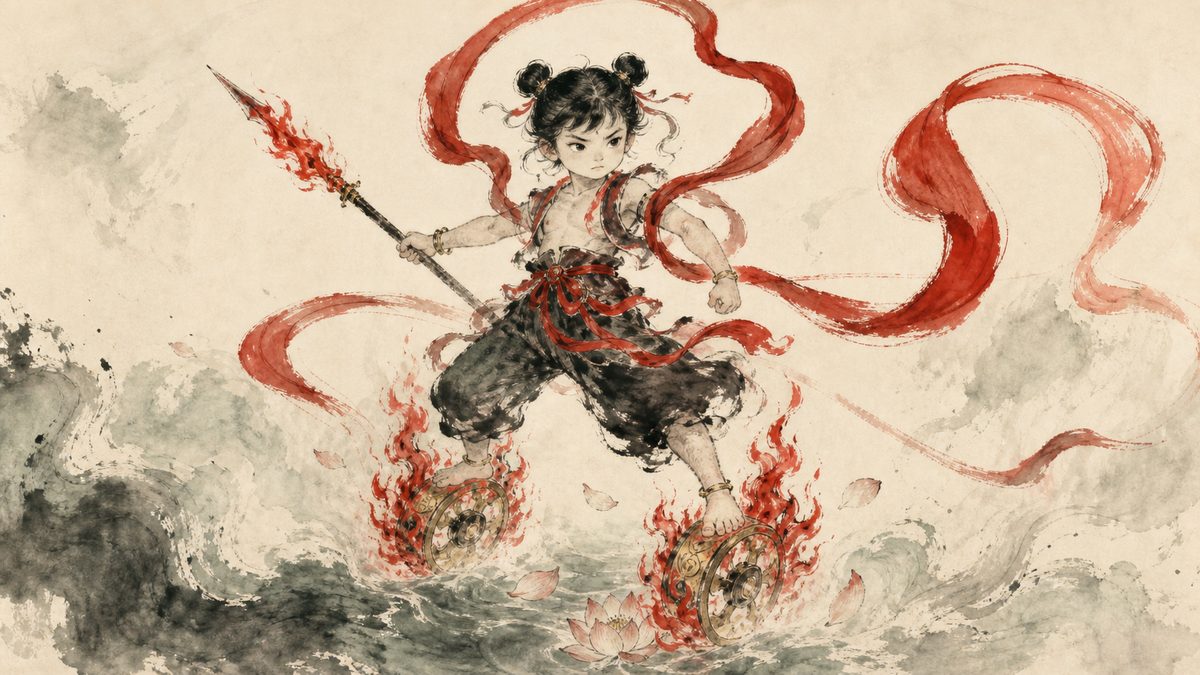
Every pantheon has a problem child, and China's arrived as a ball of flesh. Nezha is the boy god of Chinese myth: carried for three and a half years, born armed, a dragon-slayer before the age of eight, and the only figure in the entire celestial bureaucracy who settled his accounts by giving his body back to his parents and growing a new one out of lotus. He rides wheels of fire, answers prayers from taxi drivers, dances at Taiwanese temple fairs to electronic music, and, as of 2025, stars in the highest-grossing animated film ever made, anywhere, by anyone. The remarkable thing is that the modern hits keep discovering what the four-hundred-year-old story already knew: this is a child who refuses to accept the terms he was born under.
The biggest animated film on Earth
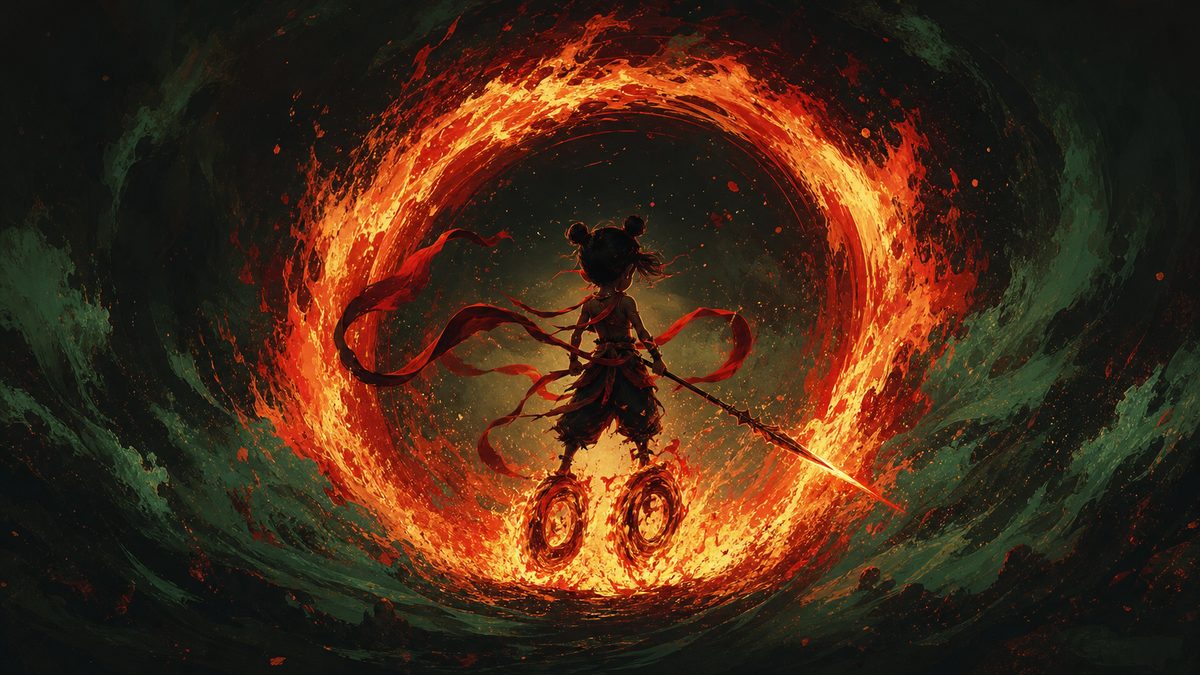
In January 2025 a sequel about this seven-year-old came out in China and rewrote the record books. Ne Zha 2 grossed about 2.27 billion dollars, becoming the first animated film past two billion, the highest-grossing animated film ever, the highest-grossing non-English-language film ever, and the fifth-highest-grossing film of any kind, animated or otherwise. It did nearly all of that in a single country, which had never been done at that scale, and its merchandise sold out so fast that stores reported over 400 million yuan of Nezha products gone in two weeks. Hollywood spent the spring reading think pieces about it.
The 2025 juggernaut stood on the shoulders of Ne Zha from 2019, the debut feature of a director who goes by Jiaozi, "Dumpling." That film reimagined the boy as the reincarnation of a demon orb, prophesied to bring destruction and determined not to; it earned 742.7 million dollars, became the highest-grossing Chinese animated film, and was China's first animated submission for the Academy Award for Best International Feature. Its battle cry, "my fate is decided by me, not by heaven," became a national catchphrase. Purists will tell you the films take liberties, and they do:
| The novel, c. 1600 | The films | |
|---|---|---|
| The birth | A ball of flesh after three and a half years | A demon orb split from a chaos pearl |
| Ao Bing the dragon prince | Killed at the shore in the story's first scandal | Recast as the other half of the same pearl |
| The death | A debt repaid, flesh to mother and bones to father | A defiant stand against a written fate |
| The moral | Even a god must answer to his father | Nobody, not even heaven, writes your ending |
But the update is less of a betrayal than it looks. Defying what you were born into is not a screenwriter's addition to Nezha. It is the oldest thing about him.
A god in sunglasses
Long before the box office, Nezha had already mastered the art of staying current. In Taiwan, where he is worshipped as the Third Prince, troupes of temple performers in giant god-puppet costumes began mixing the traditional processional dance with club music, a style now known as Electric-Techno Neon Gods, or simply Techno Nezha. Two towns, Beigang and Puzi, both claim to have invented it, which tells you it worked. At the opening ceremony of the 2009 World Games in Kaohsiung, dozens of neon-armored Nezhas danced in sunglasses and white gloves, and the form has since toured the world as a signature of Taiwanese culture. It sounds irreverent until you remember the god in question is a child who never did anything the dignified way.
The same living cult rides shotgun on the roads. Because the boy god travels on flaming wheels, professional drivers adopted him as a patron, and a small Nezha statue on the dashboard remains a common sight in Chinese-speaking Asia, an ancient deity moonlighting as traffic insurance. His formal titles run grander, Marshal of the Central Altar, commander of heaven's spirit soldiers in folk Daoism, but the wheels are the point: he is the god who moves fast, guards children, and understands engines. So who is he actually, and why does his story begin with his father reaching for a sword?
Born as a ball of flesh
The canonical telling comes from Investiture of the Gods, the Ming novel of gods and generals published sometime between 1567 and 1619 and attributed, shakily, to a scholar named Xu Zhonglin. At Chentang Pass, the garrison commander Li Jing waits out his wife's pregnancy for three and a half years, at which point she delivers not a child but a glowing, spinning ball of flesh. Li Jing does what any alarmed military man would do and slashes it with his sword. In the novel's words, in the sense of Gu Zhizhong's translation: he split open the ball, and out leapt a little boy, red light flooding the floor, a gold bracelet already on his wrist and a band of red silk already wound about his belly. The bracelet is the Universe Ring and the silk is the Red Armillary Sash, and the newborn is armed with both, which in hindsight everyone should have taken as a warning. A wandering immortal, Taiyi Zhenren, arrives promptly, names the boy Nezha, and takes him as a student. For seven years, nothing much happens. Then Nezha takes a bath.
The trouble with dragons
On a hot day, the boy dangles his feet in the river by the fort and rinses himself with his red sash, and because the sash is a divine weapon, the rinsing shakes the undersea crystal palace of the Dragon King of the East Sea to its foundations. The dragon kings of Chinese myth are rain bureaucrats with long memories and short tempers, and this one sends a yaksha, then his own third son, the prince Ao Bing, to deal with the disturbance. Both make the mistake of attacking a seven-year-old holding cosmic weaponry. Nezha kills the yaksha, then kills Ao Bing, and, in the novel's most notorious detail, pulls the tendon from the dragon prince's body to braid a belt as a present for his father. It is a child's logic applied with a god's strength, and it is horrifying, which the novel knows. The Dragon King goes over everyone's head, straight to heaven, and threatens to drown Chentang Pass and take Li Jing and his wife in payment. The parents are now hostage to the son's crime, and the son is seven.
Flesh to mother, bones to father
What Nezha does next is the hinge of the whole legend, and there is nothing else quite like it in any mythology. He walks out to face the dragons and says, in the novel's words, that what one person does, one person answers for; how could he dare drag his father and mother into it? Then he takes a sword and returns his body to the people who gave it to him, his flesh to his mother, his bones to his father, dying so that the debt dies with him. To a modern reader it is a shocking scene. To the original audience it was shocking and airtight: in the Confucian accounting where your body is a gift from your parents, giving it back is the one payment that clears every claim. The scholar Meir Shahar, whose book on Nezha is pointedly titled Oedipal God, reads the whole legend as Chinese culture's pressure valve, the place where a society built on filial piety let itself imagine the child who fights his father, and then made even the rebellion take the form of a repaid debt. The dragons are satisfied. The story is not over.
The lotus body
His soul drifts to his master, and Taiyi Zhenren does something wonderful. He sends a boy for two lotus blossoms and three lotus leaves, spreads the petals into a human outline, folds the stems into three hundred bones, and calls Nezha's spirit into the arrangement. With one ringing sound, the novel says, a figure leaps up, face pale as powder, lips like cinnabar, eyes flashing, and this is Nezha in his lotus incarnation. The choice of plant is the entire theology in one image: the lotus rises clean out of the mud, and a body built from it is pure, unindebted, owed to no parent and encumbered by no filial claim. The master adds the upgrades he is famous for, the fire-tipped spear and the Wind Fire Wheels that give him flame under each foot. The first thing the new Nezha does with his freedom is go after his father. Li Jing had, in grief and fury, smashed the temple where the boy's spirit was being worshipped, and the reborn son chases him across the sky until heaven intervenes, handing Li Jing a golden pagoda that can contain the boy, which is why Chinese temples know the father as the Pagoda-Bearing Heavenly King. Father and son settle into an armed truce and end the novel fighting on the same side. The truce, notably, is enforced by hardware.
An Indian prince in a Chinese temple
Now for the twist the temples do not advertise: the most Chinese of boy gods started out Indian. His name is the giveaway. As Shahar traces it, 哪吒 (Nézhā) is the worn-down stub of Nalakūvara, the name of a yaksha prince from Sanskrit tradition, squeezed through a series of Chinese transliterations until three syllables became two characters. Nalakūvara's father, the wealth god Kubera, entered the Buddhist pantheon as the Heavenly King Vaiśravaṇa, and when Vaiśravaṇa's cult reached Tang-dynasty China it fused with the legend of a real Tang general named Li Jing. The father became Chinese, and the Indian prince came along as his third son. Most Chinese names are chosen for meaning; Nezha's is a passport stamp, a Sanskrit name in Chinese dress. If you are curious how sound and meaning get balanced when a name crosses into Chinese, our Chinese name generator walks the same tightrope, with lower stakes.
Three heads, six arms, one monkey
Nezha's fame was never confined to one book. In Journey to the West, the other great Ming novel, he appears as heaven's boy marshal and is sent to arrest a rampaging Sun Wukong, unfolding into his battle form of three heads and six arms, each hand holding a different weapon. He loses, narrowly and honorably, which in that novel counts as a glowing performance review. The battle form outlived the fight: sān tóu liù bì, "three heads and six arms," is still the everyday Mandarin idiom for the superhuman capacity every overworked person wishes they had. And the older animation tradition got to him first anyway: Shanghai Animation Film Studio's Nezha Conquers the Dragon King of 1979 put the flesh-ball, the dragons, and the self-sacrifice on screen with hand-painted opera flourish and was screened at Cannes the following year, a full generation before Dumpling's version broke the world's box office.
Which brings the story around to why it keeps working. Nezha is the god of everyone who did not choose the terms they were born under: the wrong body, the wrong debt, the wrong prophecy, the wrong father. The old novel let him pay the unpayable and come back free, in a body of flowers, on wheels of fire. The new films let him shout it in a stadium voice. Either way, the boy on the burning wheels has been outrunning fate for centuries, and on current evidence he is still accelerating.
In the classics
The passages behind the story, in the standard published translations. Open any one for the original text.
“He split open the ball of flesh, and out leapt a little boy, red light flooding the floor, his face pale as powder, a gold bracelet on his right wrist and a band of red silk wound about his belly, its golden light dazzling the eye. ”
Original text
分開肉毬,跳出一個小孩兒來,滿地紅光,面如傅粉,右手套一金鐲,肚腹上圍著一塊紅綾,金光射目。
“As the saying goes, what one person does, one person answers for. How could I dare drag my father and mother into it? ”
Original text
常言道:一人做事一人當。豈敢連累父母?
“With one ringing sound a figure leapt up, face pale as powder, lips like cinnabar, eyes flashing light, sixteen Chinese feet tall. This was Nezha, reborn in a body of lotus. ”
Original text
只聽得韾一聲,跳起一個人來,面如傅粉,唇似塗硃,眼運精光,身長一丈六尺,此乃哪吒蓮花化身。
As seen in
Ne Zha 2
donghua · 2025The sequel that made the boy god the biggest animated-film character on Earth.
Grossed $2.267 billion, the first animated film past $2 billion, the highest-grossing animated film and highest-grossing non-English-language film ever, and the fifth-highest-grossing film of all time.
Ne Zha
donghua · 2019A retelling in which Nezha is born as a demon orb and fights the fate written for him.
Grossed $742.7 million, became the highest-grossing Chinese animated film, and was China's first animated submission for the Academy Award for Best International Feature.
Nezha Conquers the Dragon King (哪吒闹海)
donghua · 1979The landmark Shanghai Animation Film Studio feature of the dragon-slaying and self-sacrifice.
Screened out of competition at the 1980 Cannes Film Festival.
Questions people ask
Who is Nezha in Chinese mythology?
Nezha is a boy protection deity from Chinese folk religion and literature, best known from the Ming novel Investiture of the Gods. Born as a ball of flesh after a pregnancy of three and a half years, he kills a dragon prince at age seven, dies returning his body to his parents to spare them the dragons' revenge, and is reborn with a body made of lotus. He fights on flaming Wind Fire Wheels and is worshipped as the Third Prince and Marshal of the Central Altar.
Why did Nezha kill himself?
In the novel, the Dragon King of the East Sea threatens Nezha's parents and their city after Nezha kills his son Ao Bing. Declaring that what one person does, one person answers for, Nezha returns the debt of his own body, giving his flesh back to his mother and his bones back to his father, so the dragons' claim dies with him. In a culture built on filial piety, repaying the body to its givers was the one unanswerable way to shield them.
Is Nezha a boy or a girl?
A boy. The texts make him the third son of the general Li Jing, and his titles include Third Prince. He is usually drawn as a child of about seven with twin hair-buns, and classical art often gives him a youthful, androgynous beauty, which is why modern viewers sometimes ask. The films keep him a boy, if a famously scruffy one.
What are Nezha's weapons and powers?
His standard kit, granted across the legends: the Universe Ring, a gold bracelet he was born wearing; the Red Armillary Sash, the band of red silk that swirls around him; the fire-tipped spear; and the Wind Fire Wheels he rides, flame under each foot. In several tellings he can fight with three heads and six arms, a form so famous it survives as the everyday Chinese idiom for superhuman multitasking.
Is Nezha in Journey to the West?
Yes. In the other great Ming novel he serves the celestial court as a young marshal and is sent, three heads and six arms whirling, to arrest Sun Wukong during the Monkey King's rebellion. The two fight, the monkey wins on a technicality of speed, and they later end up on the same side. His lotus body appears there too, which is how widely the legend had already traveled.
Is Ne Zha 2 really the highest-grossing animated film ever?
Yes. Released in January 2025, Ne Zha 2 grossed about 2.27 billion dollars, making it the first animated film to pass two billion, the highest-grossing animated film and the highest-grossing non-English-language film ever, and one of the five highest-grossing films of any kind. It set those records largely in a single country, which had never been done at that scale.
Related figures
Sources & further reading
- Investiture of the Gods (封神演義), Chapter 12, full text (Chinese Wikisource)
- Investiture of the Gods (封神演義), Chapter 14, full text (Chinese Wikisource)
- Investiture of the Gods (Wikipedia): dating, disputed authorship, and Gu Zhizhong's translation 'Creation of the Gods' (New World Press)
- Meir Shahar, 'Oedipal God: The Chinese Nezha and His Indian Origins' (University of Hawai'i Press, 2015)
- Nezha (Wikipedia): the Nalakūvara name chain, titles, weapons, and the drivers' dashboard cult
- Ne Zha, 2019 film (Wikipedia): box office and the demon-orb premise
- Ne Zha 2 (Wikipedia): the 2025 records
- Electric-Techno Neon Gods, 電音三太子 (Wikipedia): the Techno Nezha performance tradition
- Nezha Conquers the Dragon King, 1979 (Wikipedia): Shanghai Animation Film Studio; Cannes 1980
By Julian 祝君瑜, retold from the classics, with the original passages cited, updated 2026-09-17