Chinese Mythology
Foo Dogs: Chinese Guardian Lions, and Which One Goes on the Left
Foo dogs are Chinese guardian lions, 石狮 (shíshī, "stone lions"), the pair of carved beasts either side of a gate. They are lions, not dogs. The male rests a paw on a ball, the female on a cub, and the rule is "male on the left" counted from the building looking out, so a visitor facing the door sees the male on the right. China had no lions: they arrived as tribute in 87 CE.
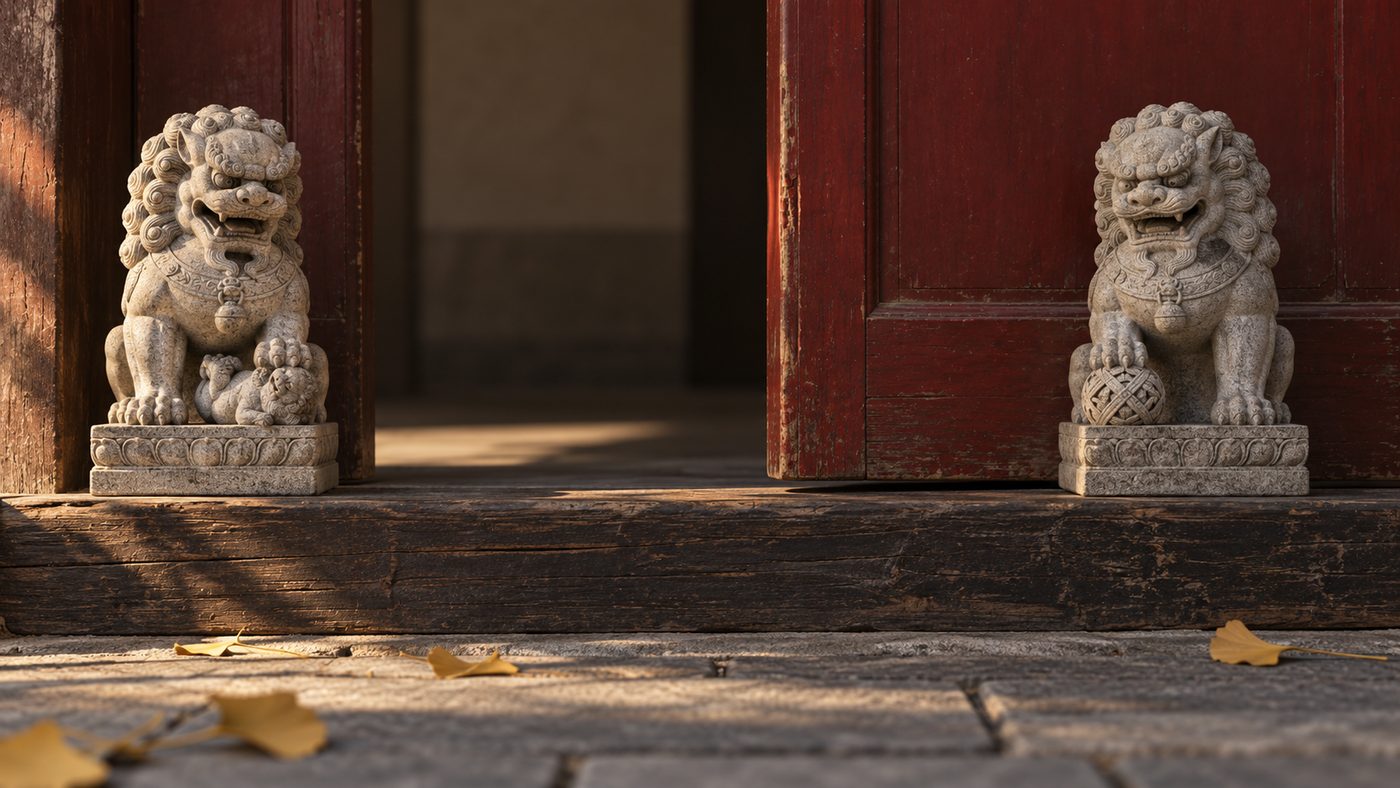
Lions, not dogs
Start with the name, because it is wrong twice. A foo dog is not a dog, and nobody in China calls it foo. In Chinese the pair outside a gate are simply stone lions, shishi, or gate-guarding lions, and the animal on the plinth is unmistakably a lion: mane in tight spiral curls, mouth open, claws out, chest thrown forward like a doorman who has decided you are not on the list. They come in twos, they sit facing out, and their job is to stop whatever is coming up the path, whether that is a thief, an evil spirit or simply bad luck, before it reaches the door.
You will find them outside the Forbidden City, outside temples and old government offices, outside banks in Hong Kong and restaurants in every Chinatown, and, in their thousands, on garden-center shelves in America, where the shopping results for "foo dogs" run from a fifteen-dollar resin pair to a fifteen-thousand-dollar marble one. That last fact explains most of the questions people bring to this page. They have just bought a pair, and they would like to know which one goes where.
Which one goes on the left
Here is the rule, stated the way Chinese states it: male on the left, female on the right. The catch is whose left. Chinese counts it from the building, looking out through its own front door, the way a throne faces its hall. At the Forbidden City's Gate of Supreme Harmony, which faces south, that puts the male on the east side, and the Palace Museum describes him there with his right paw on an embroidered ball and his partner across the way with a cub under her left paw.
So if you are standing on your path looking at your own front door, the male goes on your right and the female on your left. Plenty of placement advice in English gets this backward, because it translates "male on the left" without asking who is doing the facing.
| The male | The female | |
|---|---|---|
| Under the front paw | A ball, usually carved as an openwork embroidered ball | A lion cub, often lying on its back |
| The Chinese rule, from the building looking out | On the left | On the right |
| As you face the door from outside | On your right | On your left |
| At the Gate of Supreme Harmony (facing south) | East side | West side |
| What the pair is said to stand for | Authority over the world outside the gate | The household and its children |
Both face out, toward whoever is arriving. Neither should face the door or each other squarely, which is the habit of the painted door gods pasted on the doors themselves: the gods look inward across the seam, and the lions downstairs look out at the street. A pair is the whole point, so one lion on its own is not a gate guardian at all (there is a famous exception, which comes later).
What the classical record does not cover is the inside of your house. Lions belong at gates. The habit of putting a small pair on a mantelpiece or either side of an interior doorway is a modern feng shui retail custom, and the sellers apply the same facing-out logic to it. If the front door itself is your real concern, our feng shui guide to the entryway deals with what Chinese practice actually worries about there, and it is not usually the ornaments.
Where you still meet them
The bridge nobody can count
The most famous lions in China are not at a gate at all. They sit on the balustrade of Lugou Bridge, the Jin-dynasty bridge southwest of Beijing that English calls the Marco Polo Bridge, and there are so many of them, squeezed onto every post and clambering over each other, that Beijing turned them into a saying: the lions of Lugou Bridge, you can never count them. The joke is old. A guidebook to the capital published in 1635, the Sketch of the Sights of the Imperial Capital, describes lion mothers nursing their cubs, cubs looking back, hugging and riding on backs, and concludes: count them and you never finish. It adds that people credited the carving to Lu Ban, the patron saint of carpenters, working by divine hand.
The official count today is 501 lions on 281 posts, according to China News Service. In 2017 the bridge's heritage office began the first serious attempt to date them one by one, by carving style, and found that they span six eras, from the Jin dynasty to the People's Republic, as Visit Beijing reported. Some posts replaced in 1967 were cut from the stone of demolished city walls, so carbon-dating the rock would have told you nothing; and the youngest lions date only from the 1990s, after lightning struck a post in 1988. The bridge, in other words, has been quietly adding lions for eight hundred years, which is one way of making sure nobody ever finishes counting.
The bank lions of Hong Kong
Hong Kong has two famous pairs a few minutes' walk apart, and they tell the whole story of East meeting West in bronze and granite. HSBC's lions, Stephen and Stitt, are named after two of the bank's managers and are cast on the model of the pair outside its Shanghai headquarters of 1923, which were themselves inspired by the lions outside the Arsenal in Venice. They are Western lions, both male, with nothing Chinese about them but the address. During the Japanese occupation they were shipped to Japan to be melted down for weapons, recovered after the surrender, and brought home still carrying the bullet scars of the fighting for the colony.
The Bank of China, next door, went the other way. Its main entrance had a pair of stylized, sexless Art Deco lions, and the bank replaced them with a proper Chinese pair, male and female, modeled on the stone lions in front of Tiananmen, according to an account of the bank lions by Our China Story. Two banks, two answers to the question of what a lion is for.
Restaurants, Chinatowns and Japanese shrines
Everywhere else the pair is simply the sign that a building is Chinese and means well: outside the restaurant, the family association, the temple, the jewelry shop. Travel east and the lion changes species on paper. In Japan the guardian pair at a Shinto shrine is the koma-inu, which Japanese dictionaries gloss as "Korean dog," explaining that it is really a lion but took its name from the route by which it arrived. In Okinawa it is the shisa, a name usually traced to the local word for lion. And at Chinese New Year the lion gets up and dances, which is a different creature with a different page.
Where "foo" comes from
Nobody knows for certain, and anybody who says otherwise is selling statues. There are two candidates. The first is fó 佛, the Chinese word for the Buddha, which older English writers spelled Fo: the lions are Buddhist guardians, so "dogs of Fo" would make sense. The second is fú 福, good fortune, the character pasted upside down on doors at New Year. Wiktionary's editors lean toward fortune and note that there is no Chinese word built this way; the earliest English quotation they record is from 1916. Both explanations have the same weakness, which is that Chinese never puts either word in front of a lion.
The "dog" is easier to account for, if still not certain. Japan's shrine lions are officially Korean dogs, as we have just seen; the Qing court bred the small dogs the West later called Pekingese, whose Chinese name is literally lion dog; and to a Western eye a carved lion with a curly mane and a collar with a bell on it looks rather more like a pampered pet than a predator. Put all three together and a lion becomes a dog somewhere between the treaty ports and the antiques trade.
A country with no lions
The deepest oddity about the Chinese guardian lion is that China has never had any lions. The animal is not native to any part of it. It arrived as a diplomatic present. The Book of the Later Han records that in 87 CE, the first year of the Zhanghe reign, Parthia sent an envoy bearing a lion and a fuba, a creature "shaped like a qilin but with no horn," and the emperor's annals for the same year record a second lion from the Yuezhi of Central Asia. The Book of Han had already filed the lion among the marvels of a far-western country, alongside the rhinoceros.
Look at how the word was written. For centuries lion was 師子, with the character for "teacher" or "master" borrowed purely for its sound. The version with the animal radical, 獅, the one every stone lion is labeled with today, became standard only after the Song dynasty, according to Ren Jiang's history of lions in China for The Paper. There was also a native word, suanni, which the ancient dictionary Erya defines with magnificent vagueness as "like a striped cat, eats tigers and leopards." That is what you get when you describe an animal you know mostly by reputation.
So the lion came into Chinese art half from life and half from hearsay, and two families of stone beast grew from it. One is the winged, horned beasts set before Han and Southern Dynasties tombs, the ancestors of the pixiu. The other is the pair at the gate, and that one came with the Buddha.
The Buddha's lion
In Buddhist writing the lion is the Buddha. His teaching is the lion's roar, his seat is the lion throne, and the Treatise on the Great Perfection of Wisdom, a vast commentary translated into Chinese by Kumarajiva in the first years of the fifth century, pauses to ask the obvious question: is the lion throne a real lion? Did the Buddha conjure one, did a real lion turn up, or was one made of gold, silver, wood or stone? No, it answers. It is called lion as a title. The Buddha is the lion among men, and wherever he sits, couch or bare earth, is the lion seat.
That is the license for every stone lion in China. A beast nobody had seen became the emblem of a teacher nobody had seen, and from there it was a short step to setting lions at the gates of temples to guard the Dharma, and then at the gates of everyone else. The bodhisattva Manjushri rides one, which is why the single most famous lion in China stands alone. The Iron Lion of Cangzhou, cast in 953 and still standing in Hebei, carries a lotus seat on its back and was put up beside a temple, and The Paper's 2025 feature on it calls it "towering in solitude." It is not half of a pair. It is a mount waiting for its rider, which is the one good reason for a Chinese lion to be alone. When the Ming came to list the nine sons of the dragon, they adopted him into the family: suanni, the son who loves to sit, is the lion under the Buddha's throne.
Forty thousand cash
The oldest stone lions in China with a date on them come with an invoice. In 147 CE the four sons of the Wu family of Jiaxiang, in Shandong, built a pair of pillar-gates in front of the family tombs and carved an inscription on one of them recording who did what and what it cost. The stonemasons Meng Fu and Li Dimao built the gates, for one hundred and fifty thousand cash. Then: Sun Zong made the lions, forty thousand.
There is something wonderful about that line. The lions are still there, they are among the earliest dated stone lions anywhere in China, and the first thing anybody wrote down about them is the bill. It is also a reminder of what the pair was for at the start. These lions guarded the dead, standing on the spirit road to a tomb; the move to the front door of the living came later.
The ball, the cub, and a pun
The ball and the cub, the details everybody now asks about, are not ancient. The pairing of a male playing with an embroidered ball and a female with a cub under her paw dates from the Song and Jin dynasties, roughly the eleventh and twelfth centuries, according to Ren Jiang's history; in the same period lion statues spread from temples to houses, shops and government offices. By the Ming and Qing the matched pair at the gate had become close to standard equipment for official buildings and the homes of high officials.
The ball is usually explained as authority, the world held under one paw, and the cub as the continuation of the family. And the pair carries a joke that only works in Chinese. A big lion and a little lion, da shi and xiao shi, sound like taishi and shaoshi, the Grand Preceptor and Junior Preceptor, two of the highest titles at the imperial court, so a pair of lions at the gate was a wish that father and son would both rise to the top. It is the same lion that was once written with the character for teacher, now promoted to the emperor's tutor. Not bad for an animal that nobody in China had ever seen in the wild, and that most of the English-speaking world still calls a dog.
In the classics
The passages behind the story, in the standard published translations. Open any one for the original text.
“In the first year of the Zhanghe reign of Emperor Zhang, Parthia sent an envoy presenting a lion and a fuba. The fuba is shaped like a qilin but has no horn. ”
Original text
章帝章和元年,遣使獻師子、符拔。符拔形似麟而無角。
“That year Ban Chao, Chief Clerk of the Western Regions, attacked Yarkand and routed it. The Yuezhi sent an envoy presenting a fuba and a lion. ”
Original text
是歲,西域長史班超擊莎車,大破之。月氏國遣使獻扶拔、師子。
“The suanni is like a striped cat, and eats tigers and leopards. ”
Original text
狻麑,如虦貓,食虎豹。
“Question: why is it called the lion seat? Did the Buddha conjure a lion, did a real lion come, or was a lion made of gold, silver, wood or stone? ... Answer: it is called lion as a title; it is not a real lion. The Buddha is the lion among men, and wherever the Buddha sits, couch or bare ground, is called the lion seat. ”
Original text
問曰:何以名「師子座」?為佛化作師子,為實師子來,為金銀木石作師子耶?……答曰:是號名「師子」,非實師子也。佛為人中師子,佛所坐處若床若地,皆名「師子座」。
“In the first year of Jianhe, a dinghai year, on the fourth day of the third month, the filial sons Wu Shigong and his younger brothers Suizong, Jingxing and Kaiming had the stonemasons Meng Fu and Li Dimao build these pillar-gates, at a cost of one hundred and fifty thousand cash. Sun Zong made the lions, at a cost of forty thousand. ”
Original text
建和元年大歲在丁亥三月庚戌朔四日癸丑,孝子武始公、弟綏宗、景興、開明,使石工孟孚、李弟卯造此闕,直錢十五萬。孫宗作師子,直四萬。
“Lugou Bridge crosses the Lugou River. It was first built early in the Mingchang reign of the Jin, and our dynasty repaired it in the ninth year of Zhengtong. The bridge is two hundred paces long, and on the posts of its stone balustrade sit lions: mothers nursing, cubs looking back, hugging, riding on backs, every pose suiting the next. Count them and you never finish. People say Lu Ban, the master carpenter, carved them by divine hand. ”
Original text
盧溝橋跨盧溝水,金明昌初建,我正統九年修之。橋二百步,石欄列柱頭,獅母乳,顧抱負贅,態色相得,數之輒不盡。俗曰:魯公輸班神勒也。
Questions people ask
What is the meaning of a foo dog?
A foo dog is a Chinese guardian lion, set in a pair outside a gate to keep harm and bad luck from coming in. The pair is male and female: the male rests a paw on a ball and stands for authority over what lies outside, and the female rests a paw on a cub and stands for the family and its line. The Palace Museum describes the bronze pair at the Forbidden City's Gate of Supreme Harmony in exactly those terms. They are lions, not dogs; the word dog is an English addition.
Where should foo dogs be placed?
Outside the front door, one on each side, facing out toward whoever is arriving. The Chinese rule is male on the left and female on the right, counted from the building looking out, so if you stand on the path facing your door, the male with the ball goes on your right and the female with the cub on your left. At the Forbidden City's Gate of Supreme Harmony the male is on the east. The classical record puts them at gates; small pairs inside a house are a modern feng shui retail habit, and the same facing-out logic is what sellers apply.
Is it okay to have one foo dog?
As a gate guardian, no: the convention is always a pair, male and female, and a single gate lion reads as half a set. Lions alone do exist in Chinese art, but as something else. The most famous, the Iron Lion of Cangzhou cast in 953, carries a lotus seat on its back and is generally read as the mount of the bodhisattva Manjushri, not a door guard. If you only have room for one, Chinese practice would sooner suggest a different guardian than half a pair.
Are foo dogs Japanese or Chinese?
Chinese. The gate lion grew up in China from the Han dynasty on and traveled to Korea and Japan with Buddhism. In Japan it became the koma-inu, which Japanese dictionaries explain as Korean dog because of the route it took, and the Okinawan version is the shisa. The Japanese connection is probably part of how the English came to call a lion a dog.
How do you tell the male and female foo dogs apart?
Look under the front paw. The male has his paw on a ball, often carved as an openwork embroidered ball; the female has hers on a small lion cub, sometimes lying on its back. That pairing settled in the Song and Jin dynasties, around a thousand years ago, and became standard in the Ming and Qing. The two are otherwise near-identical, with the same curled mane and open mouth.
Related figures
Sources & further reading
- The Palace Museum, Spot the Sacred Animals in the Imperial Palace (Google Arts & Culture): the bronze pair at the Gate of Supreme Harmony, male with his paw on an embroidered ball, female with a cub under her paw
- Ren Jiang, Between Humans and Lions (人狮之间), The Paper, 2022: the ball-and-cub pair dates from the Song and Jin; the taishi / shaoshi pun; lions written without the animal radical until after the Song
- Lugou Bridge lions dated for the first time (卢沟桥狮子今年首次排辈), Visit Beijing, 2017: six eras of carving, the youngest from the 1990s, the 1967 posts in old city-wall stone
- China News Service, 2025: 501 lions on 281 posts of Lugou Bridge
- The Paper, 2025: the Iron Lion of Cangzhou, cast 953, lotus seat on its back, local name zhenhai hou
- Our China Story, 2025: Hong Kong's bank lions, HSBC's Stephen and Stitt and the Bank of China pair modeled on Tiananmen's
- Phoenix News (ifeng), 2026: the Wu family shrines at Jiaxiang, whose stone lions are the earliest in China with both a written record and an exact date
- Kotobank, koma-inu (狛犬): the Japanese shrine guardian, originally a lion, named 'Korean dog' after its route into Japan (Nihon Daihyakka Zensho; Nihon Kokugo Daijiten)
- Wiktionary, foo dog: etymology from fú (good fortune) or Fo (the Buddha), earliest quotation 1916
By Julian 祝君瑜, retold from the classics, with the original passages cited, updated 2026-10-06