Chinese Mythology
Pangu: China's Creation Myth, and Why It Is the Youngest One
Pangu is the giant who separated heaven from earth. He grew inside a black egg of chaos for eighteen thousand years, pushed the clear half up and the murky half down, held them apart while he grew ten feet a day, and when he finally died his body became the world: his eyes the sun and moon, his blood the rivers, his hair the stars. He is also the latest arrival in Chinese mythology, first written down in the third century CE.
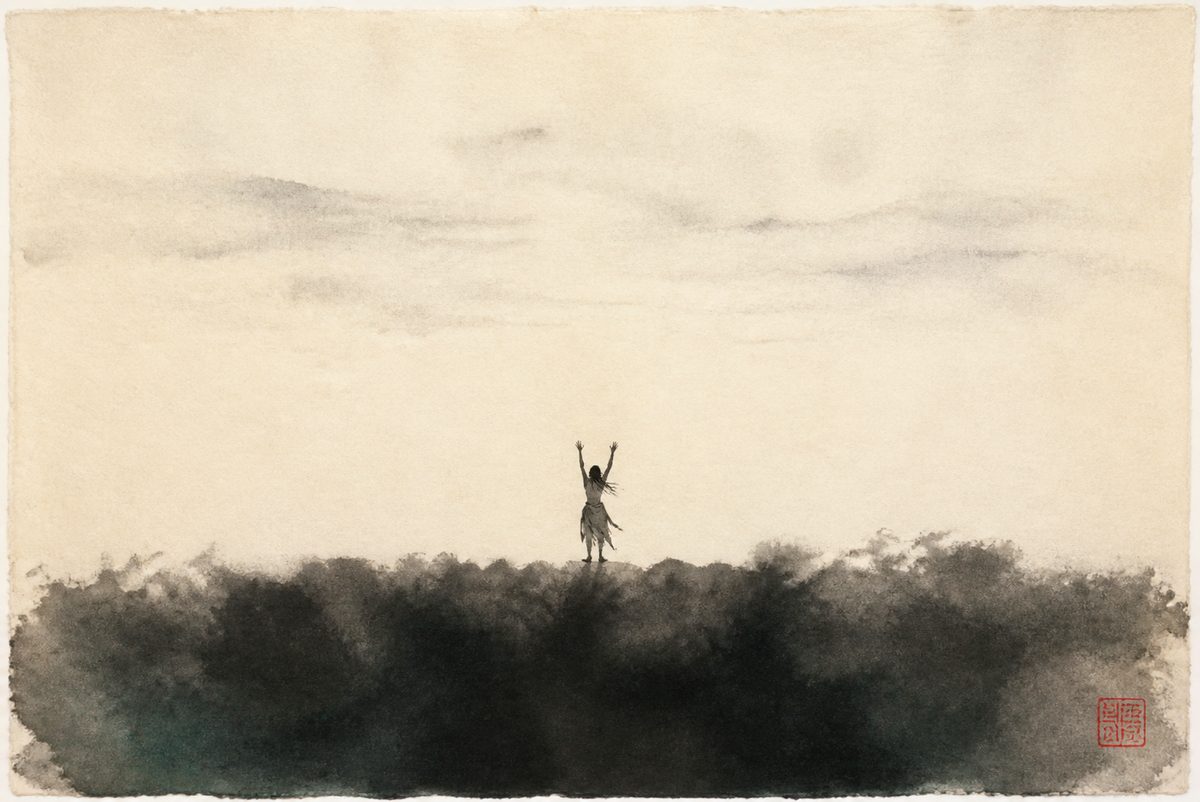
In the beginning there was an egg, and inside it a man
Heaven and earth were not yet separate. They were a single murky mass, dark and stirred together, and the shape the text reaches for is a chicken's egg. Somewhere inside that egg was Pangu, and he had been in there for eighteen thousand years.
Then the egg opened. Everything clear and light in it rose and became the sky. Everything murky and heavy sank and became the ground. And Pangu, who was between them, stood up.
Now, this is where the story does something that no other creation myth quite does, and it is worth slowing down for. The sky and the earth do not simply spring apart and stay apart. They creep. Every day the sky rose by one zhang, roughly ten feet. Every day the ground thickened by the same amount. And every day Pangu grew ten feet taller, holding his position between them like a man bracing a jack under a collapsing ceiling, for another eighteen thousand years.
Do the arithmetic, because the text certainly did. Ten feet a day for eighteen thousand years, and at the end of it the sky stands ninety thousand li above the earth, Pangu is ninety thousand li tall, and there is nothing left for him to do.
So he dies. And here the story turns from cosmic engineering into something much stranger and much better.
His breath became the wind and the clouds. His voice became the thunder. His left eye became the sun and his right eye became the moon. His arms and legs became the four poles of the world and its five sacred mountains. His blood became the rivers, his sinews the ridges and contours of the land, his flesh the fields, his hair and beard the stars, his skin and its hair the grass and the trees, his teeth and bones the metals and the stones, his marrow the pearls and the jade, and his sweat the rain.
And then the last line, the one that gets left out of every children's version, and, as we shall see, out of most of the English ones too. The vermin on his body, stirred by the wind, became the common people.
That is you. In the oldest Chinese account of where humanity comes from, we are the lice on the corpse of a dead giant, blown loose by a breeze. Say what you like about it, it is not flattering, and it is not vague.
The word you have already used, if you speak any Chinese at all
Before the textual archaeology, notice how alive this is.
If you have spent five minutes learning Chinese idioms you have met kāi tiān pì dì, "split open heaven, break open earth". It means since the dawn of time, or, applied to a person's achievement, utterly unprecedented, the first of its kind. Chinese speakers use it constantly and cheerfully, in newspapers and in ordinary conversation, mostly without a passing thought for the enormous dead man it describes. It is the Chinese equivalent of saying something is epoch-making, except that the epoch in question is the literal one.
When Chinese needed a name for Pangaea, the single landmass that geologists reconstruct behind the modern continents, it did not transliterate. It called it the Pangu continent. When a team of Chinese security researchers released the jailbreak tools that let people take control of their own iPhones, they called themselves Pangu, on the reasonable grounds that prying open something sealed was the family business.
He is also still, in the most literal sense, on people's walls. In the Smithsonian's National Anthropological Archives there is a woodblock print catalogued as MS 7322, printed in red and green on oiled paper, about ten inches by twenty-four. Pangu stands in the middle of it holding the sun in one hand and the moon in the other, the two of them marked with yang and yin. There is an axe resting on a tree stump beside him, which we will come back to. Across the top run Daoist magic credentials, the eight trigrams and a yin-yang, and an inscription that the catalogue glosses as an amulet to dispel evil, guard the home and bestow good fortune.
That is the detail I would keep if I could keep only one. This object was not made for a museum or a temple or a scholar. It was made cheaply, in quantity, to be pinned up in an ordinary house by an ordinary family who wanted their home protected. It reached the Smithsonian with no record of where it came from, which is exactly what happens to things that are too common to be worth documenting. The creator of the universe ended his career as a door charm, and there is something rather moving about that.
The temples are real too. There is a Pangu King temple in Huadu district in Guangdong, built in 1809 and still standing, and the tradition of temples to him goes back much further, as we are about to see, to the fifth century.
The axe he does not have
Look at the Smithsonian print again, and at essentially every other picture of Pangu ever made: the school textbook illustration, the temple mural, the Shen Yun stage version, the cover of any children's book of Chinese myths. He is a muscular giant with an enormous axe, and he has just brought it down on the darkness and cleaved the world in two.
There is no axe in the oldest account. There is no chisel, no hammer, no blade and no blow. In Xu Zheng's text the egg simply opens, and Pangu separates heaven and earth by the slow, unglamorous, faintly absurd method of standing in the gap and getting taller.
The axe arrives more than a thousand years later, in Ming-dynasty vernacular fiction, and from there it goes into the popular prints, and from the prints into every illustration since. This is not a small edit. A god who splits the world with an axe is a hero, a craftsman, a laborer whose achievement is an act. A god who splits the world by growing is something much odder and much more Chinese: a process rather than a person, closer to yeast than to Hercules.
Both versions are legitimately part of the tradition. Only one of them is thirteen centuries older than the other, and it is not the one you have seen.
The oldest account, and the sum it is doing
So where does the story actually come from?
One man, more or less. His name was Xu Zheng, he lived in the kingdom of Wu during the Three Kingdoms period, roughly 220 to 265 CE, and he wrote a book called the Sanwu Liji, the Records of Cycles of Three and Five. The book is lost. Every word of Pangu we have from it survives because Tang-dynasty encyclopedists, compiling the Yiwen Leiju in 624 CE and the Taiping Yulan later, copied the passage out into their collections of things worth knowing. The foundation of Chinese cosmogony reaches us as a quotation in somebody else's reference book.
And read to the end, that passage does something you would not expect a myth to do. It stops telling a story and starts explaining a number.
Number begins at one, is established at three, completed at five, abundant at seven, and reaches its limit at nine. That is why the sky stands ninety thousand li above the ground.
That is the sound of a cosmology being reverse-engineered. The figure of ninety thousand li is not something Pangu's biography produced; it is a figure the numerologists already held, and the eighteen thousand years and the ten feet a day are the arithmetic that gets you there. The title of the book gives the game away: three and five, the odd numbers, the sequence the last line recites. This is a myth written by somebody who was principally interested in sums.
The egg is borrowed too, and from a rather grander source than folklore. When Xu Zheng compares primordial chaos to a chicken's egg he is using the standard scientific image of his own century. The huntian or celestial-sphere model was the leading Han cosmological theory, and Zhang Heng, the polymath who built the water-driven armillary sphere and the first seismoscope, put it like this in his commentary on the instrument: the heavens are like a chicken's egg, round as a crossbow pellet; the earth is like the yolk, lying alone inside; heaven is large and earth is small.
So the egg in the creation myth is not a piece of peasant poetry. It is the astronomy of the day, dropped into a story, the way a myth written now might reach for a singularity or a big bang. Once you know that, the opening line stops being quaint and starts being rather sophisticated. The Huainanzi had done the same thing nearly four centuries earlier, when it explained why the stars drift west and the rivers run east by having the water god Gonggong headbutt the mountain that held up the sky.
The word that got softened on its way into English
Now the small thing that is actually a large thing.
The transformation passage ends: 身之諸蟲,因風所感,化為黎甿. The vermin on his body, stirred by the wind, became 黎甿.
English retellings, including the current English Wikipedia article, render that last word as animals. The parasites became the animals. It is a tidy image, it makes a pleasing final flourish to the list, and it is wrong.
黎甿, also written 黎氓, is an ordinary classical term for the common people, a variant of 黎民, the black-haired multitude, the general population, the ordinary run of humanity. Chinese dictionaries gloss it flatly as 百姓, the people. There is no ambiguity in it and no scholarly dispute about it. The line says that the vermin on the dead giant's body became us.
This matters more than a translator's slip usually does, because it changes what kind of creation myth this is. If the parasites become animals, then the passage is a charming account of where wildlife comes from, and human origins are simply not addressed. If the parasites become people, then the oldest Chinese cosmogony is telling you that humanity is an afterthought, an infestation, the thing that was living on the world-maker rather than the thing he made. That is a genuinely unusual claim, and it is the sort of claim that gets quietly sanded off in translation because it is uncomfortable.
I would not go to the stake for many things on this page. I will go to the stake for this one.
He is not in any of the old books
Here is the fact that reorganizes everything else.
Pangu does not appear in the Classic of Mountains and Seas. He does not appear in the Huainanzi. He is not in the Zhuangzi, not in the Chuci, not in any surviving pre-Han text at all. China had been producing written records for well over a thousand years before anybody wrote his name down.
The sharpest illustration of that silence is in the Heavenly Questions, the extraordinary poem in the Songs of Chu, which consists of nothing but questions fired at the universe, and which opens by asking who could possibly report what things were like before heaven and earth had taken shape, when there was only darkness and no form to see. That is Pangu's question. That is the precise gap he exists to fill. And the poet asking it, several centuries before Xu Zheng, plainly had never heard of him.
Which produces the pleasant paradox this page is built on: the Chinese story about the beginning of everything is the most recent major myth in the Chinese repertoire. The dragon is older. The archer Yi is older. The oracle bones are more than a thousand years older. The supposed first thing that ever happened was the last thing to be written down.
Two honest cautions, because certainty here would be cheap. First, absence of evidence in a textual record this badly damaged is an argument and not a proof; the First Emperor's book-burning and eighteen centuries of ordinary attrition have eaten most of what was written, and an oral Pangu could have circulated for a long time before anyone thought him worth committing to bamboo. Second, some scholars think the material was there all along under other names. Wei Juxian traced the idea back to the Zhou account in the Guoyu of Zhong and Li severing the connection between heaven and earth, which is a separation myth without a giant in it.
Still. The name and the story we have arrive in the third century CE, and the fact that they arrive so late is the single most interesting thing about them.
Where he came from, which nobody agrees on
Three explanations are on the table, each with real scholars behind it, and none of them has won.
He was always Chinese. This is Wei Juxian's line, above: an old indigenous separation myth, present in the record under other names, that eventually acquired a protagonist and a biography. The strength of the argument is that the raw idea of prying heaven and earth apart is demonstrably old in China. The weakness is that it does not explain the giant, the egg, or the body.
He came up from the south. The sinologist Derk Bodde connected the material to the ancestral traditions of the Miao and Yao peoples, and there is a phonetic road in: Panhu, the dog ancestor from whom the Yao and She peoples traced their descent, a figure who is genuinely old and genuinely non-Han. Wen Yiduo pursued that connection, and Qin Naichang has argued from Zhuang that the two syllables of the name mean whetstone and gourd, out of the widespread southern flood myth in which a brother and sister ride out the deluge inside a gourd and repopulate the earth. The strength here is the name, which means nothing in Chinese; the weakness is that the phonetic resemblance is doing an awful lot of work.
He came from India. Xu Zheng was writing in the kingdom of Wu in the third century, which is precisely when and where Buddhism was arriving in the Chinese south, and the Purusha Sukta of the Rigveda describes a cosmic man dismembered so that the universe can be assembled from his parts. Lü Simian argued for the connection, as did the Japanese scholar Takagi Toshio, and the Chinese-language encyclopedia treatment now calls this the mainstream academic position, though one encyclopedia's characterization is not a survey of the field and I would not repeat it as a verdict. The strength is the timing and the extremely specific structural match. The weakness is that dying-god cosmogonies turn up in places India never reached; Paul Carus was already noting the parallels with the Norse Ymir and the Babylonian Tiamat over a century ago, and Ymir did not come from the Vedas either.
Set the two body-lists side by side and judge for yourself.
| The world gets | From Pangu, in the Wuyun Linian Ji | From Purusha, in Rigveda 10.90 |
|---|---|---|
| The sun | his left eye | his eye |
| The moon | his right eye | his mind |
| The sky | the clear part that rose | his head |
| The ground | the murky part that sank | his feet |
| Wind and air | his breath | his breath |
| Human beings | the vermin on his body | his mouth, arms, thighs and feet |
The first five rows are close enough to make anyone uneasy. The sixth is where the two myths part company completely, and the difference tells you what each society was trying to say. The Vedic hymn takes humanity out of the noble parts of the body and uses the division to explain, and justify, the four social classes: priests from the mouth, warriors from the arms, and so on down. The Chinese text takes all of humanity, undifferentiated, off the giant's skin along with the fleas.
One of these is a charter for a social order. The other is a shrug.
The wife, and the four who come after
One last thing, because people always ask, and because there is an actual source for it.
Did Pangu have a wife? Not in Xu Zheng. He is alone in that text, thoroughly and structurally alone, and the loneliness is doing work: there is nobody else, because everything else is still him. But two and a half centuries later the Shuyi Ji, attributed to Ren Fang, reports in a single clause that in the country between Wu and Chu they said Pangu and his wife were the beginning of yin and yang. She gets no name and no story. She looks very much like the sibling-couple of the southern flood myths, drifting across and attaching herself to a famous figure, which is how these things generally happen.
That same fifth-century passage is worth reading whole, because it shows the myth in the act of growing. It reports that earlier scholars said his weeping became the rivers and the pupils of his eyes became the lightning; that an older account said clear weather was Pangu pleased and overcast skies were Pangu angry; that there was a tomb of his in the southern sea running more than three hundred li, where people believed later generations had buried his soul; and that there was a temple to him at Guilin where people still made offerings. Four competing versions and two cult sites, less than three hundred years after the first surviving mention. Myths do not arrive finished. They accumulate, and this one accumulated fast.
Which brings us to the company he keeps. Pangu is usually presented as the first of a sequence: Pangu separates heaven and earth, Nüwa makes people and later mends the sky, Fuxi gives humanity the trigrams and the arts of civilization, Shennong gives it farming and medicine, the Yellow Emperor gives it a state. It is a satisfying progression, and it is a retrospective arrangement. These figures come from different regions, different centuries and different books, and were tidied into a line long after the fact by people who wanted Chinese antiquity to have a table of contents.
Note where that leaves the human-origin question, incidentally. Pangu's text says we came off his body with the parasites. Nüwa's text says she knelt by a river and pinched us out of yellow clay, and got bored, and finished the job by flicking mud off a rope. Those are not two chapters of one story. They are two different answers to the same question, from two different places, sitting in the same tradition without ever being reconciled, and any account that stitches them into a smooth sequence is doing the tidying rather than reporting it.
Pangu was the first thing that happened and the last thing anyone wrote down. He built nothing, ruled nothing, and was worshipped mostly by people who wanted him to keep burglars and bad luck out of the house. He grew for thirty-six thousand years, lay down, and turned into the scenery.
If you like the sensation of a famous story turning out to be younger than its own reputation, the taotie is the same trick played on a piece of Bronze Age metalwork, where the monster everybody knows turns out to be a label somebody applied nine hundred years after the fact.
In the classics
The passages behind the story, in the standard published translations. Open any one for the original text.
“Heaven and earth were a murky blur, like a chicken's egg, and Pangu was born inside it. After eighteen thousand years heaven and earth split open. The clear yang became the sky; the murky yin became the ground. … Each day the sky rose one zhang, the ground thickened one zhang, and Pangu grew one zhang, and this went on for eighteen thousand years. The sky reached its utmost height, the ground its utmost depth, and Pangu his utmost length. Number begins at one, is established at three, completed at five, abundant at seven, and reaches its limit at nine. That is why the sky stands ninety thousand li above the ground, and only afterward came the Three Sovereigns. ”
Original text
天地混沌如雞子,盤古生其中。萬八千歲,天地開闢,清陽為天,濁陰為地。……天日高一丈,地日厚一丈,盤古日長一丈,如此萬八千歲。天數極高,地數極深,盤古極長。數起於一,立於三,成於五,盛於七,極於九,故天去地九萬里,後乃有三皇。
“Pangu was born first, and as he lay dying he transformed. His breath became the wind and the clouds, his voice the thunder. His left eye became the sun, his right eye the moon. His four limbs and five extremities became the four poles and the five sacred peaks. His blood became the rivers, his sinews the contours of the land, his flesh the fields, his hair and beard the stars, his skin and body hair the grasses and trees, his teeth and bones the metals and stones, his marrow the pearls and jade, his sweat the falling rain. And the vermin on his body, stirred by the wind, became the common people. ”
Original text
首生盤古,垂死化身;氣成風雲,聲為雷霆;左眼為日,右眼為月;四肢五體為四極五嶽;血液為江河;筋脈為地里;肌肉為田土;髮髭為星辰;皮毛為草木;齒骨為金石;精髓為珠玉;汗流為雨澤;身之諸蟲,因風所感,化為黎甿。
“Earlier scholars say that Pangu's weeping became the rivers, his breath the wind, his voice the thunder, and the pupils of his eyes the lightning. An old account says that when Pangu was pleased it was clear weather, and when he was angry it was overcast. Between Wu and Chu they say Pangu and his wife were the beginning of yin and yang. Today in the southern sea there is a tomb of Pangu, running more than three hundred li, and people say later generations buried his soul there. In Guilin there is a temple of Pangu, and people today make offerings at it. ”
Original text
先儒説盤古氏泣為江河,氣為風,聲為雷,目瞳為電。古説盤古氏喜為晴,怒為隂。吳楚間説盤古氏夫妻,陰陽之始也。今南海有盤古氏墓,亘三百餘里,俗雲後人追葬盤古之魂也。桂林有盤古氏廟,今人祝祀。
Questions people ask
What is Pangu the god of?
Strictly speaking he is not the god of anything, which surprises people. Pangu has no portfolio, no domain and no worshippers asking him for rain or sons in the way that the Jade Emperor or the kitchen god have. He is a one-event figure: he separated heaven from earth, held them apart while they set, died, and became the physical world. In the third-century account by Xu Zheng he does not rule anything and is not prayed to; the Three Sovereigns only arrive after he is gone. What he did acquire later was a protective function. By the fifth century there was a temple to him at Guilin, and by the nineteenth and twentieth centuries his image was being printed on cheap woodblock charms and hung in ordinary houses to keep evil out.
What does the name Pangu mean?
Less than you would hope. The two characters, 盘古, mean roughly "coiled" or "dish" and "ancient", which does not add up to anything meaningful in Chinese, and native speakers find the name just as opaque as you do. That opacity is one of the reasons scholars suspect the name came from outside the Chinese literary tradition. The linguist Wen Yiduo connected it to Panhu, the dog ancestor of the Yao and She peoples of southern China, and the anthropologist Qin Naichang has argued from Zhuang that the elements mean whetstone and gourd, drawn from a flood myth in which a brother and sister survive inside a gourd. Nobody has proved any of it. A name that resists translation in the language that uses it is itself a piece of evidence.
Did Pangu have a wife?
Not in the earliest texts, but there is a real source for the question. Xu Zheng's third-century account has him entirely alone, which is rather the point of it. Two and a half centuries later, the Shuyi Ji attributed to Ren Fang records that in the region between Wu and Chu people said Pangu and his wife were the beginning of yin and yang. So the wife exists, in a fifth-century regional tradition, mentioned in one clause and never named. She is not Nüwa. Nüwa's partner in the flood and marriage myths is Fuxi, and the pairing of Pangu with a spouse looks like the same widespread sibling-couple story attaching itself to a famous name.
How did Pangu create the world?
In two stages, and the second is the one people forget. First the separation: he grew inside the chaos-egg for eighteen thousand years, and when it broke the clear part rose to become the sky and the murky part sank to become the ground. He then stood between them and grew about ten feet taller every day for another eighteen thousand years, pushing them apart until the sky stood ninety thousand li above the earth. Second the transformation, which happens only when he dies. His breath became the wind, his voice the thunder, his left eye the sun and his right the moon, his blood the rivers, his hair the stars, his bones the minerals and his marrow the jade. He does not build the world. He is spent making it.
What is the oldest creation myth in the world?
Not this one, and the gap is larger than almost every English page about Pangu admits. Myths themselves are older than writing and cannot be dated, so the only honest ranking is of the written accounts, and there the Egyptian material comes first: the Pyramid Texts, carved inside royal tombs around 2350 BCE, already contain the creator Atum bringing the world out of the waters of Nun. Mesopotamia follows, with the Sumerian flood and origin accounts and then the Babylonian Enuma Elish. India's Purusha Sukta, the hymn of the dismembered cosmic man that Pangu resembles so closely, sits in the latest layer of the Rigveda, later than either but still roughly a thousand years BCE. Pangu arrives in the third century CE. That is some two and a half thousand years after the Pyramid Texts, and it puts China's account of the beginning of everything nearer in time to the printing press than to the oldest cosmogonies it gets listed beside.
When was Chinese mythology created?
There is no date, because it is not one body of material. Chinese mythology is a stack of layers laid down across more than fifteen centuries, and each layer can be dated by the text that carries it. The oracle bones of the late Shang, from around 1200 BCE, are the floor: they show a high god called Di and a working cult of royal ancestors. The great literary sources arrive much later, the Classic of Mountains and Seas assembled in stages between roughly the fourth century BCE and the first century CE, the Songs of Chu in the third century BCE, the Huainanzi presented to the throne in 139 BCE. Pangu is later still, third century CE, and the popular versions of half these figures were reworked again by Ming and Qing vernacular novels. Anyone who gives you one date for Chinese mythology is describing one layer and calling it the whole.
Who is the Chinese deity of creation?
Two figures, doing two different jobs, and the English-language habit of picking one is a mistranslation of the tradition rather than a summary of it. Pangu makes the world: he separates the chaos into sky and ground, holds them apart, dies, and his body becomes the physical stuff of it. Nuwa makes people: she shapes them out of yellow earth and later patches the broken sky with smelted stone. Neither account needs the other and neither contradicts it, because they were not written as rival answers to one question; they entered the record centuries apart, Nuwa the earlier of the two by a long way. The tradition also never made either of them a ruler. Sovereignty belongs elsewhere, to the Jade Emperor, who administers a heaven he did not build.
What is the most famous Chinese myth?
It depends on how you measure fame, and three different answers survive the question. If you count who is read, it is the Monkey King, whose sixteenth-century novel is the most adapted Chinese story on earth. If you count what is observed, it is Chang'e flying to the moon: an entire national holiday is built on her, and China named its lunar probes after her and their rovers after her rabbit. If you count what is taught first, it is the pair of origin stories, Pangu splitting heaven from earth and Nuwa shaping people from clay, which is where Chinese schoolchildren usually meet mythology at all. Pangu is the famous Chinese creation myth. He is not the famous Chinese myth, and the difference is worth keeping.
Did Pangu really use an axe to split heaven and earth?
Almost every illustration shows him swinging one, and the oldest surviving account gives him no tool at all. In Xu Zheng's third-century text there is no axe, no chisel and no blow: the egg opens on its own and Pangu separates the halves by growing between them. The axe and chisel appear much later, in Ming-dynasty vernacular fiction, and from there into the popular prints and school textbooks that most people have actually met. It is a thirteen-hundred-year gap between the earliest story and the picture in your head, and the two versions describe different kinds of god: one who works, and one who simply expands.
Sources & further reading
- Pangu: the attribution of the earliest account to Xu Zheng of Eastern Wu (220-265 CE), the transformation list, the origin hypotheses of Wei Juxian, Derk Bodde and Qin Naichang, Paul Carus on the Ymir and Tiamat parallels, the Pangu King Temple built in Huadu, Guangdong in 1809, and Pangaea rendered in Chinese as Pangu continent
- 盘古: the Chinese-language account, including the competing origin hypotheses and the proposal by Lü Simian and Takagi Toshio that the myth reflects contact with the Vedic Purusha
- Sanwu Liji (三五曆紀), the surviving text of Xu Zheng's account as preserved in Tang encyclopedias, on Chinese Wikisource
- Shuyi Ji (述異記), the fifth-century collection attributed to Ren Fang, with the passages on Pangu's weeping, his moods, his wife, his tomb in the southern sea and his temple at Guilin
- 黎甿: the classical term rendered as 百姓, the common people, which is the word the transformation passage uses for what the vermin became
- 浑天说: the Han celestial-sphere cosmology, with Zhang Heng's commentary on the armillary sphere comparing the heavens to a chicken's egg and the earth to the yolk inside it
- 盘古开天地: the account of how the axe and chisel entered the story through Ming vernacular fiction rather than the early texts
- Purusha Sukta, Rigveda 10.90: the cosmic man whose dismembered body yields the moon from his mind, the sun from his eye, the air from his breath, the sky from his head and the earth from his feet, and the four varnas from his mouth, arms, thighs and feet; identified by Jamison and Brereton as belonging to the latest layer of the Rigveda
- Pyramid Texts: the Old Kingdom funerary corpus, inscribed from around 2350 BCE, whose spells already carry Atum emerging from the waters of Nun; the earliest written creation account and the benchmark the Pangu dating is set against
- Shangdi: the high god attested in the late Shang oracle-bone inscriptions from around 1200 BCE, which is the floor of the datable Chinese record and the earliest layer referred to in the FAQ
- Classic of Mountains and Seas: assembled in stages between roughly the fourth century BCE and the first century CE, the dating used for the layer that predates Pangu
- Chinese Lunar Exploration Program: the probes named Chang'e and their rovers named Yutu, the jade rabbit, for the claim about which myth is most observed today
- Smithsonian National Anthropological Archives MS 7322, a woodblock print of Pangu holding the sun and the moon, red and green on oiled paper, 9.75 by 24 inches, used in Chinese homes as a talisman, with Daoist magic credentials and the eight trigrams inscribed at the top
By Julian 祝君瑜, retold from the classics, with the original passages cited, updated 2026-09-30