Chinese Mythology
Phoenix (凤凰): The Chinese Bird That Never Burned
The Chinese phoenix, 凤凰 (fènghuáng), is the king of birds and the sign that the world is being governed well. It is also the most mistranslated animal in Chinese myth. It does not burn, it does not die, and it was never reborn from its own ashes until a Chinese poet borrowed that ending from Europe in 1920. What it actually does is arrive when the music is right.
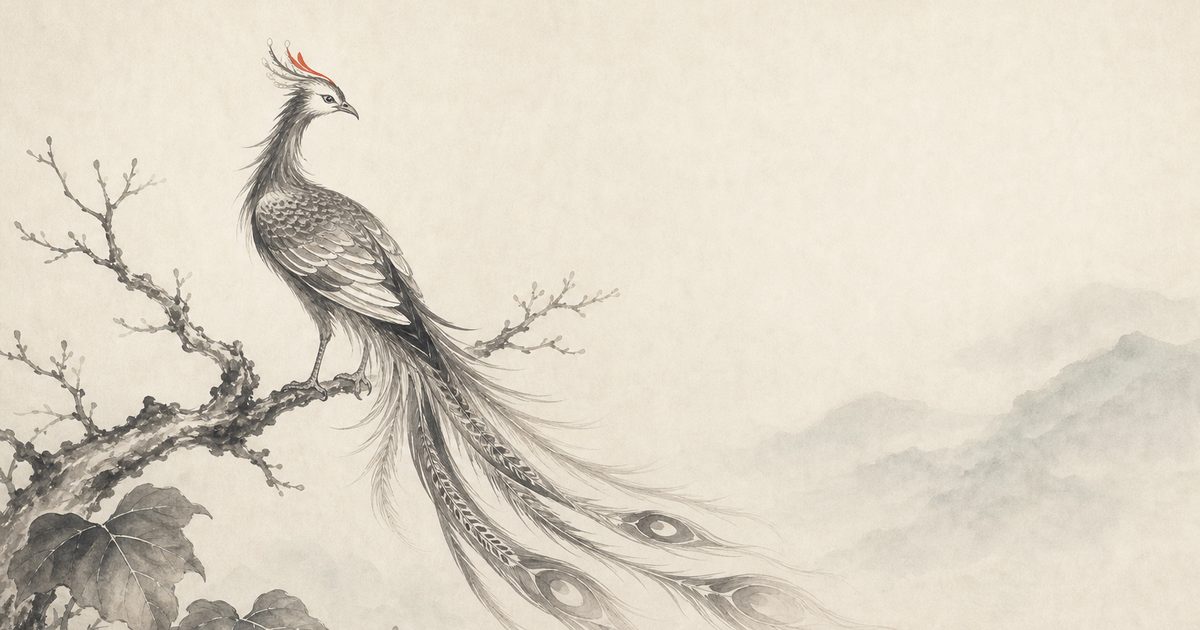
Phoenix. It is the wrong word. It has been the wrong word since the first European missionaries in China went looking through their own bestiary for something to call the enormous auspicious bird they kept finding on screens and robes and roof ridges, found a bird, and used it, and four centuries later here we all are.
The Greek phoenix burns. It builds a nest of spices, sets itself alight, and climbs out of its own ashes to do it again in five hundred years. The Chinese phoenix does none of that. It does not burn, it does not die, and for well over two thousand years of Chinese texts nobody ever once suggests that it should. What it does is turn up when a country is being run properly, listen to the music, and leave.
The bird that was also the wind
Start with the oldest evidence there is, which is not a story but a graph scratched into an ox bone.
In the Shang oracle-bone inscriptions of the late second millennium BCE, the character for the phoenix and the character for the wind are the same character. Not similar. The same. Every writing of "wind" in the oracle bones is written with the bird, and this is one of the settled results of the field rather than anybody's clever theory.
The mechanism is dull and completely convincing. Wind has no shape, so it cannot be drawn, and early Chinese writing solved that problem by borrowing an existing graph that sounded right. The two words were close enough in Old Chinese to swap, sharing a rhyme group and both starting with a lip consonant, so the scribes took the bird and used it for the wind. Much later the borrowed sense broke off into its own character and the bird got its own back.
Which leaves a rather lovely piece of residue in the language. Before the phoenix was an emblem of good government or a bride's headdress, it was a way of writing the wind, and the Shuowen Jiezi still remembers the association a thousand years afterward when it says the bird lodges at nightfall in the Cave of Winds.
As for what animal the scribes were drawing, the crest and the long trailing tail of the oracle-bone graph point at a real bird that lived in Bronze Age China and no longer does. The most persuasive candidate is the green peafowl, whose range once ran much further north than the patch of Yunnan it clings to now.
What the classics say it looks like
The Classic of Mountains and Seas gets there first, and it is refreshingly specific. On Danxue mountain, it says, there is a bird shaped like a chicken and patterned in five colors, and the patterns are writing. Virtue on the head. Duty on the wings. Ritual on the back. Humaneness on the breast. Good faith on the belly. The bird eats and drinks whatever nature provides, composes its own songs, choreographs its own dances, and when it shows up the world is at peace.
Read that again and notice what kind of animal is being described. It is a legible one. The five words on the plumage are the core Confucian virtues, so this is not a beast with a symbolic meaning attached by later commentators. It is a beast with the meaning printed on it.
Four hundred years later Xu Shen's Shuowen Jiezi, the first Chinese dictionary, quotes an ancient authority named Tianlao and assembles the bird out of other animals: goose in front, unicorn behind, snake's neck, fish's tail, a stork's brow, a mandarin duck's cheek, dragon markings, a tiger's back, a swallow's jaw and a rooster's beak, all five colors complete. It then sends it on a tour, from the land of gentlemen in the east, out past the four seas, over the Kunlun range, a drink at the Pillar Rock, a wash in the Weak River, and bed in the Cave of Winds.
One honest note, because the phrase gets quoted online with a confidence the manuscripts do not support. That opening description is textually unstable. Several early witnesses give "unicorn in front and deer behind" rather than "goose in front and unicorn behind," and the great Qing commentator Duan Yucai argued that the shorter, older reading is the right one and that some of the animal parts crept in later. The composite bird is real and ancient. Its exact parts list has been quietly renovated over the centuries, in the way that composite creatures always are.
The bird that never burned
Here is the part that surprises people, including a great many Chinese people.
Search Chinese for the phrase "the phoenix undergoes nirvana," and you will get several million results explaining that this ancient proverb teaches us to rise stronger from our trials. It is a favorite of graduation speeches, corporate rebrands and city-regeneration slogans. It is also, in the strict sense, a little over a century old.
The phrase comes from a poem. In 1920 a young Chinese poet in Japan named Guo Moruo wrote Nirvana of the Fenghuang, in which a pair of phoenixes gather fragrant wood, sing a long furious song about a world that has gone rotten, burn themselves alive, and rise renewed. It was published that year, collected in his landmark book The Goddesses in 1921, and became one of the founding poems of modern Chinese literature, its burning bird an unmistakable stand-in for a China that wanted to be reborn.
The reason we can be so sure about the borrowing is that Guo told us. He attached a note to the poem explaining that in Arabia there is an ancient divine bird called the Phoenix which, at the age of five hundred, gathers aromatic wood, burns itself, and is reborn from the ashes. He was not passing off a Chinese tradition. He was importing a foreign one on purpose, and welding it to a Buddhist word for the extinction of the self, which is not what nirvana means either.
None of this makes the poem less good or the image less useful. It does mean that when a tourist brochure tells you the ancient Chinese believed the phoenix was reborn in fire, the ancient Chinese are being credited with a twentieth-century poet's reading list.
Feng was male, huang was female
The bird's name is two birds. Feng was the male, huang the female, and the pairing is old enough that the character for huang was originally written without its bird radical at all, gaining one later so that the two graphs would look like a matched set.
You can still hear the split in one of the most famous love songs in Chinese history. Around 150 BCE the poet Sima Xiangru, playing the zither at a rich man's banquet, performed a piece called Feng Seeks Huang aimed squarely at the host's recently widowed daughter, Zhuo Wenjun. She heard it through a screen, and that night the two of them eloped and ended up running a wine shop, to the fury of her extremely wealthy father. The title only works because everyone in the room knew feng was male and huang was female.
Then the emblem moved. Once the Han emperors settled on the dragon as their personal animal, the empress needed a creature of her own, and the phoenix was promoted into the vacancy. Calling her a huang was awkward, since that syllable already belonged to the word for sovereign. So the female half of the pair got the male half's name, and the entire bird slid over to the women's side of the palace, where it stayed. Ming and Qing empresses wore phoenix crowns dense with gold birds and kingfisher feather. Chinese brides still wear a version of one, and the dragon and phoenix together are the standard wish for a well-matched marriage, which is why they turn up on every red envelope, cake tin and wedding invitation next to the double happiness character.
It is worth being clear about the other bird people mix it up with. The Vermilion Bird that guards the south in the Four Symbols is a quarter of the sky, a set of seven constellations, the exact counterpart of the White Tiger in the west. The fenghuang is not a compass direction. The two get illustrated identically, both are red and long-tailed and on fire in every video game that features them, and they come from completely different departments.
The pickiest bird in Chinese literature
The philosophers found a use for a bird with virtues written on it, and what they did with it was turn it into a standard.
Zhuangzi tells the best version. His friend Huizi has landed a senior government post and hears a rumor that Zhuangzi is coming to take his job, so he has the city searched for three days and nights. Zhuangzi turns up anyway and tells him a story about a bird of the phoenix family called the yuanchu, which flies from the Southern Sea to the Northern Sea and along the whole enormous journey will perch on nothing but the wutong tree, eat nothing but bamboo seed, and drink from nothing but the sweetest spring. An owl with a dead rat in its claws sees the yuanchu passing overhead and shrieks at it to back off. And now, Zhuangzi says to his old friend, you are shrieking at me over your rat.
That is the phoenix as a moral instrument, and the wutong detail became permanent. The Chinese parasol tree is called the phoenix tree in English precisely because of this bird; the tree even lives inside a word, since the first definition the oldest Chinese dictionary gives for the character for glory is the wutong itself, which is how a parasol tree came to sit inside the Chinese word for honor; and the proverb about planting a wutong so that a phoenix will come is still what a Chinese manager says when the real advice is that you should make the job worth taking.
The omen version runs alongside it. The Book of Documents describes the court music of the sage-king Shun running through its nine movements, at which point the phoenix arrives and pays its respects. The Classic of Poetry has the phoenixes calling on the high ridge with the wutong growing on the eastern slope. In both cases the bird is a verdict. It comes because the ruler is good and the music is right, and the corollary that every Chinese court understood perfectly is that it stays away when they are not.
Seven thousand years of birds facing the sun
The texts are old. The birds are older.
In 1977, excavating the waterlogged Neolithic village at Hemudu near Yuyao in Zhejiang, archaeologists lifted a small piece of carved ivory out of the mud, about sixteen centimeters long. Incised on its face is a sun, five concentric rings with flames radiating off them, and on either side of the sun a bird, hook-beaked and round-eyed, wings up, leaning in toward the light. It is roughly seven thousand years old, it is one of the finest pieces of art anyone has recovered from Neolithic China, and it is now in the Zhejiang Provincial Museum.
Nobody can tell you those two birds were called feng, because the people who carved them left no writing at all. What the ivory does prove is that the combination the later tradition is built from, a solar bird worth the best material and the best craftsman in the settlement, was already in place on the lower Yangtze thousands of years before the first oracle bone. The bird cult ran strong in the region afterward too. The state of Chu, which produced most of the phoenixes that survive from the Warring States period, put them on lacquer, silk and drums with a freedom that makes the later imperial versions look starched.
Where you meet it now
Mostly at weddings, on television, and in a piece of music that will take the top of your head off.
Song of the Phoenix is a suona piece, the suona being the Chinese shawm, an instrument with the approximate subtlety of a fire alarm and considerably more range. In the folk tradition of the piece, and in Wu Tianming's 2016 film of the same name, it is a funeral honor that a village band may only play for a genuinely good man, and deciding who qualifies is the master's alone. The film was the director's last, it was dying quietly in a few hundred cinemas, and its producer knelt on a stage in front of the industry press to beg for screen time. He got it, and the film went on to take more than eighty million yuan.
Elsewhere the bird has gone corporate and demotic at the same time. Phoenix Television broadcasts out of Hong Kong to a global Chinese audience. Fenghuang is a common enough girl's name to be unremarkable, and Chinese parents who want their daughters to succeed say they hope she will become a phoenix, the female counterpart of the more famous line about a son becoming a dragon. Less kindly, the last decade produced the coinage "phoenix man," meaning a man who has flown up out of a poor rural family into a city career, and the phrase is usually said with a sneer, which is a fairly bleak thing to have done to your own metaphor for merit.
The bird itself remains what it always was, which is a piece of quality control. It arrives when the music has been played properly all the way through, it refuses to sit on the wrong tree, and it carries the standards it is judging you against printed in its own feathers. Given the state of most things, it is not surprising that hardly anybody claims to have seen one.
In the classics
The passages behind the story, in the standard published translations. Open any one for the original text.
“There is a bird here shaped like a chicken, patterned in the five colors. Its name is the fenghuang. The pattern on its head reads virtue, on its wings duty, on its back ritual, on its breast humaneness, on its belly good faith. This bird eats and drinks as nature provides, sings its own song and dances its own dance, and when it is seen the world is at peace. ”
Original text
有鳥焉,其狀如雞,五采而文,名曰鳳皇,首文曰德,翼文曰義,背文曰禮,膺文曰仁,腹文曰信。是鳥也,飲食自然,自歌自舞,見則天下安寧。
“The feng is a divine bird. Tianlao said of its form that it is goose in front and unicorn behind, snake-necked and fish-tailed, with a stork's brow and a mandarin duck's cheek, dragon markings and a tiger's back, a swallow's jaw and a rooster's beak, and all five colors complete. It comes from the land of gentlemen in the east, soars beyond the four seas, passes Kunlun, drinks at the Pillar Rock, washes its feathers in the Weak River and lodges at nightfall in the Cave of Winds. When it is seen, the world is at great peace. ”
Original text
鳳,神鳥也。天老曰:鳳之象也,鴻前麐後,蛇頸魚尾,鸛顙鴛思,龍文虎背,燕頷雞喙,五色備舉。出於東方君子之國,翱翔四海之外,過崑崙,飲砥柱,濯羽弱水,莫宿風穴。見則天下大安寧。
“In the south there is a bird called the yuanchu. Do you know it? The yuanchu sets out from the Southern Sea and flies to the Northern Sea. It will perch on nothing but the wutong tree, eat nothing but the seed of the bamboo, and drink from nothing but the sweetest spring. ”
Original text
南方有鳥,其名為鵷鶵,子知之乎?夫鵷鶵發於南海而飛於北海,非梧桐不止,非練實不食,非醴泉不飲。
“When the panpipe music of Shao had run through its nine movements, the fenghuang came and paid its respects. ”
Original text
簫韶九成,鳳皇來儀。
As seen in
Song of the Phoenix (百鸟朝凤)
film · 2016The last suona master of a Chinese village and the funeral piece only a worthy man is allowed to be played out with.
Director Wu Tianming's final film. Its producer knelt on stage to beg cinemas for screen time, and the story took the film from a few hundred screens to over 80 million yuan.
Journey to the West (西游记)
novel · c. 1592The Peacock and the Garuda are made children of the phoenix, which is how the bird gets folded into the Buddhist end of the pantheon, as Fenghuang.
Questions people ask
What is the Chinese phoenix?
The Chinese phoenix, 凤凰 (fènghuáng), is the king of all birds and one of the four great auspicious creatures alongside the dragon, the qilin, and the turtle. Its job in the tradition is to be an omen. The Classic of Mountains and Seas describes it as a five-colored bird with the words virtue, duty, ritual, humaneness and good faith written in the markings of its plumage, and says that when it appears the world is at peace. It is a sign that a country is being governed well, not a monster to be fought.
Does the Chinese phoenix rise from the ashes?
No, and the difference matters. Death and fiery rebirth belong to the Greek and Egyptian phoenix, not to the fenghuang, which in over two thousand years of Chinese sources never burns and never dies. The rebirth story entered Chinese through a single poem, Guo Moruo's Nirvana of the Fenghuang, written in 1920, and Guo attached his own note explaining that he had taken the self-immolating bird from an Arabian legend. The phrase people now quote as ancient wisdom is a little over a hundred years old.
What is the difference between the Chinese phoenix and the Western phoenix?
Almost everything except the English name. The Western phoenix is solitary, tied to the sun, and defined by a cycle of burning and rebirth. The fenghuang is a composite bird of good omen, associated with music, virtuous rule, and the wutong tree, and it usually arrives in pairs. Sixteenth-century European writers reached for the closest word they had, phoenix stuck, and the two birds have been confused ever since.
Is the Chinese phoenix male or female?
Both, and then neither, and then female. Originally feng was the male bird and huang the female, which is why the old love song is called Feng Seeks Huang. Once Han emperors claimed the dragon, the phoenix was reassigned as the imperial consort's emblem, and by the later dynasties the whole bird had been read as feminine. Empresses wore phoenix crowns and Chinese brides still do.
What does the Chinese phoenix symbolize?
Good government, high standards, and a good marriage, in that historical order. In the classics it is an omen that a sage is on the throne. In the philosophers it is a standard of personal integrity, the bird that refuses to perch on the wrong tree. In wedding decoration it pairs with the dragon to mean a well-matched couple, which is the meaning most people meet first today.
What tree does the Chinese phoenix live in?
The wutong, the Chinese parasol tree, known in English as the phoenix tree for exactly this reason. Zhuangzi's version of the bird will perch on nothing else, eat nothing but bamboo seed, and drink only from a sweet spring, and the image became a stock way of saying that a person of quality does not take just any job. Planting a wutong to attract a phoenix is still a Chinese saying about making yourself worth joining.
Sources & further reading
- Fenghuang, Wikipedia (the composite bird, the feng and huang pairing, and its imperial use)
- The Classic of Mountains and Seas, Classic of the Southern Mountains, the Danxue passage (Chinese Text Project)
- Shuowen Jiezi, the entry for 鳳 with Duan Yucai's commentary on the variant readings (Shuowen.org)
- 汉典 (zdic), the character 鳳 with its seal and oracle-bone forms and dictionary glosses
- The oracle-bone graph for wind is the graph for the phoenix (National Taiwan University, CASE science outreach)
- The oracle-bone phoenix and the origin of the auspicious bird (National Taiwan University, CASE science outreach)
- Nirvana of the Fenghuang was invented by Guo Moruo a century ago (Huaxi Dushi Bao, The Cover)
- Guo Moruo, Chinese Wikipedia (the 1920 poem and The Goddesses, 1921)
- The ivory butterfly-shaped ornament carved with twin birds facing the sun, Hemudu, excavated 1977 (Zhejiang provincial cultural research)
- Hemudu culture, Wikipedia (the Yuyao site, its dates and its bird-and-sun carvings)
- The phoenix originally had a sex, and was later feminized (China News Service)
- Zhuangzi, Autumn Floods, the yuanchu and the rotting rat (Chinese Text Project)
- The Book of Documents, Yi Ji, the nine movements of the Shao music (Chinese Text Project)
- Song of the Phoenix (2016), Wikipedia (Wu Tianming's last film and its box-office rescue)
- Firmiana simplex, the wutong or Chinese parasol tree, called the phoenix tree (Wikipedia)
By Julian 祝君瑜, retold from the classics, with the original passages cited, updated 2026-09-21