Chinese Mythology
Nian Monster: The Beast Behind Chinese New Year, and Where It Came From
Nian, 年兽 (niánshòu), is the monster said to have come down on the last night of the year to eat the village, until people discovered it feared red, fire, and noise. It is the origin story attached to almost every Chinese New Year custom. It is also the best-dated legend in Chinese folklore: the earliest known text naming the beast is a Shanghai newspaper column from 17 January 1933, and in it the animal is chained up in a picture.
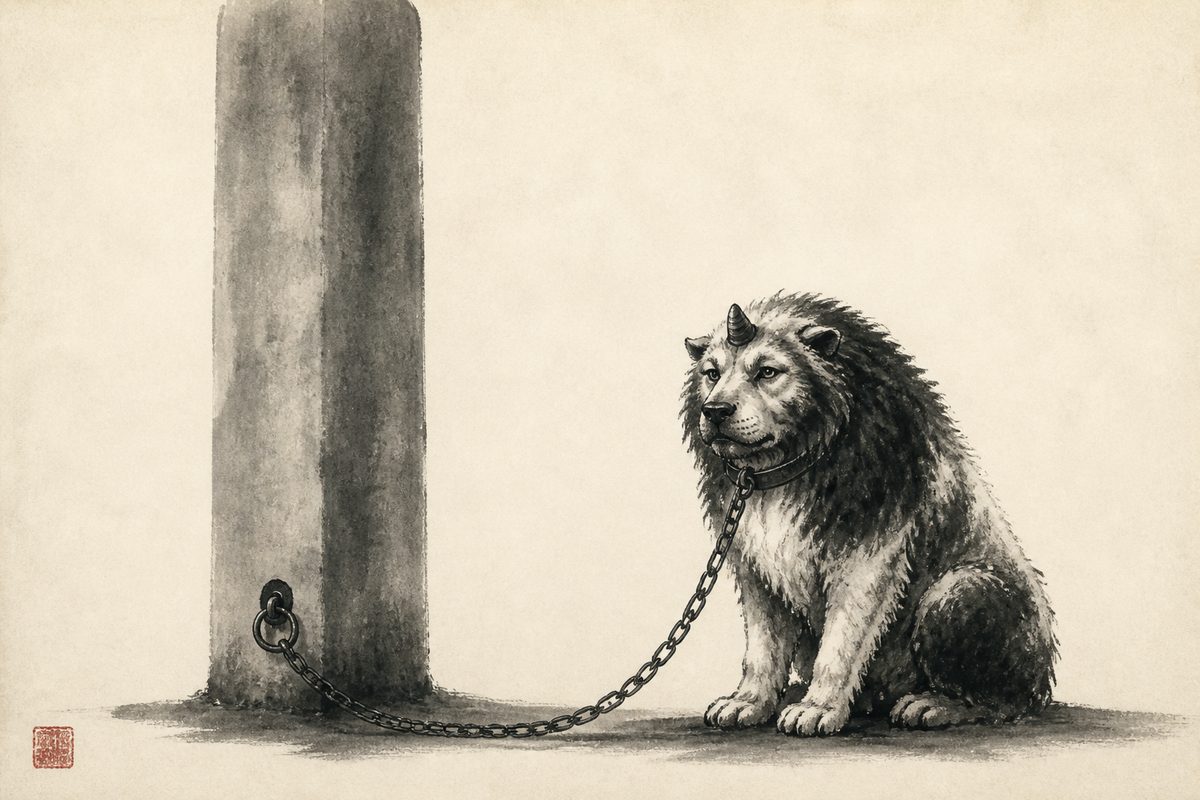
Every year, on the last night of the year, the monster came down.
The story, the way everybody tells it
It lived apart from people, in the deep mountains or at the bottom of the sea, depending on who is telling you, and for three hundred and sixty-four days it was somebody else's problem. Then the cold came, and the food ran out, and on the last night of the twelfth month it came down the valley into the village and ate what it found: the grain in the stores, the pigs and the chickens in their pens, and, in the tellings that are meant to frighten children, the children.
So the village learned to do what you do with something that cannot be fought. They left food out at the doors as a toll. They shuttered the houses, took the old and the young up into the hills before dark, and came back in the morning to see what was left, and they did this every year, and every year it worked well enough that nobody thought to try anything else.
Then, one year, a beggar came through. He was old, he was ragged, he had a staff and a sack and no sense at all, and while the whole village was streaming up the hillside he asked an old woman for a meal and announced that he would be staying the night. She fed him, told him he was a fool, and left.
What he did with the evening was very simple. He pasted red paper over her doorway. He lit every lamp in the house and left them burning. And when the beast came up the street he stepped out into the light in a red coat and set fire to a heap of bamboo, which cracked and banged in the flames like something being torn apart.
The monster ran. In the morning the village came down expecting rubble and found the old woman's house standing, the red paper still up, the lamps burned down to nothing, the bamboo in ash, and no beggar anywhere. And that, the story says, is the whole of it: the beast is afraid of the color red, of firelight, and of loud noise, and it has been chased off the same way every year since. Red on the doors. Lights on all night. Bangs at midnight.
Some tellings give the beggar a name. In that version he is Hongjun Laozu, the primordial patriarch of popular Daoist fiction, and instead of simply chasing the beast off he tames it and rides away on it as his mount, which is why it never comes back. No early text supports this either; it is the same young story with a god added at the end.
The Chinese for celebrating the New Year is guo nian, and guo means to cross, to get through, to pass. Once you have heard the story, the phrase stops meaning "to observe the year" and starts meaning "to get past Nian." That small shiver is the reason the legend has traveled as far as it has.
What it looks like
Ask for a picture and you will get a fairly consistent one: a lion's head with a flat pushed-in face, an ox's heavy body, a mane, and a single horn coming off the brow. Children's books add teeth. Festival costumes add green scales and a lot of gold. Put that description next to a lion-dance head and you will notice it is more or less the same animal, which is why the two get explained by each other so often.
The interesting thing about the description is that there is no early source to check it against. It is not that the accounts disagree about the beast's appearance, in the way that accounts of a dragon or a qilin disagree while still arguing over the same creature. It is that before the twentieth century there are no accounts. The look was assembled after the story was, out of the visual material lying nearest to hand, which in a Chinese New Year street is a lion-dance head.
Keep the lion's head in mind, because the earliest description anyone has found does not have one in it.
Where you have already met it
Almost certainly in a classroom. The Nian story is the standard way Chinese New Year is introduced to English-speaking children, and it has become the standard way it is introduced to English-speaking adults too: Britannica has an entry for the beast, the Confucius Institute for Scotland has a page on it, and every January the explainers go out again with the village and the beggar and the three fears. If you know one piece of Chinese mythology, there is a good chance this is it.
It is also, increasingly, merchandise. Identity V put out a Nian Beast pet for a Lunar New Year event in 2024, which is roughly what happens to any Chinese folklore creature with a recognizable silhouette. And in 2026 the beast got the full treatment: Boonie Bears: The Hidden Protector, released into the New Year holiday by one of China's largest animation franchises, rebuilt Nian as a pair of twin guardians defending humanity from a destroyer called Sha, and took around $154 million doing it. Ninety-odd years after it was first written down as a thing that wanted to eat people, the monster is now the protector of the festival it exists to menace.
The version where Nian is the good guy
You may have met a different arrangement. In that one the monster is called Xi, and Nian is a boy, or a god, or a small brave person who kills it, and Chinese New Year's Eve is called chuxi because chu means to remove and xi is the thing that got removed.
It is a tidy story and the etymology is not right. Xi means evening. Chuxi is the evening on which the old year is taken away, and it is used in exactly that sense by Zhou Chu, a general and writer who died in 297, in a note on the year-end customs of Sichuan. Nobody in the third century needed a monster to make the word work.
The Xi version can be dated even more tightly than the Nian one. It comes from a children's novella by Guo Mingzhi published in the magazine Juren in 1981, which the Shanghai Animation Film Studio adapted in 1984 into a paper-cut short called The Story of New Year's Eve, directed by Qian Jiaxing. That film is where most people first met it. It is younger than Star Wars.
So where does Nian come from?
This is a question a lot of people have asked in Chinese, and one of them went and looked properly.
Zhu Chunxiang, a reference librarian at the Shanghai Library, worked back through the Republican-era newspaper archives to find the earliest printed appearance of the beast. What he found is dated 17 January 1933. It is a column in Jingangzuan, a Shanghai tabloid edited by the writer Zheng Yimei, and the author is the novelist and journalist Sun Yusheng, writing under a pen name, reminiscing about the seasonal customs of old Shanghai.
Here is the whole of it:
The painters always draw a stone pillar, and chained to the pillar a beast that resembles a dog and is not a dog. Some say the beast is the Heavenly Dog Star. Some say the beast is named Nian, and constantly wants to eat people, so the Purple Tenuity Star has it chained there and does not let it reach the lower world to work its harm, and so keeps people from meeting with the year-affliction; hanging this up at New Year is therefore most fitting.
Read that again with the legend in your head, because almost nothing survives the comparison. There is no village. There is no winter, no beggar, no red paper, no lamps, no bamboo. The beast is not attacking anything. It is chained up, in a picture, in the corner of a New Year print, and the man describing it does not even know what it is: some say one thing, some say another. The first written Nian is an uncaptioned detail in somebody else's artwork.
And then Sun Yusheng does something I find genuinely disarming. He adds one more sentence:
However, poorly read as I am, I truly do not know the source of this allusion, and I am ashamed to have no way of verifying it.
The first man known to have written the name down, in the act of writing it down, tells you he cannot find where it comes from and is embarrassed about it. Ninety years later that has been retold to schoolchildren on four continents as an ancient legend, with the hedge sanded off and a village added.
Zhu treats that column as the source of every later Nian story, and he has a suggestion about where the picture came from, which he offers as a suggestion and so will we. New Year prints of the "Purple Tenuity shining down" type show that star deity subduing a beast, which supplies the animal and the chain. What supplies the name, on his reading, is a phrase every household in late imperial China knew: nianguan, the year gate, the point before the New Year at which debts had to be settled. A year gate is a thing that comes round annually and that people dread. Give it teeth and you have a monster.
He was not the first to be suspicious. In 1973 the Taiwanese folklorist Zhu Jiefan published a piece in Taiwan Folkways under the title "Doubts on the Year-as-Monster Legend," arguing that the story did not sit right with the older cultural record at all.
It is fair to ask how anyone can prove a story is missing. You cannot search all of Chinese literature, and this page has not. What you can do is open the books that exist specifically to record what people did at New Year, and see whether the beast is in them. Zong Lin's Record of the Seasons of Jing and Chu, from the sixth century, walks through the year custom by custom. Dun Lichen's Annual Customs of Beijing, published in 1900, does the same for the capital in enormous detail, right down to the sound of the firecrackers thickening as midnight comes on. Both describe the red, the noise, the lights, the vigil. Neither of them has ever heard of Nian.
What a year was, before it was an animal
The word is the strange part. If a monster called Nian had been terrorizing villages since antiquity, you would expect the character to carry some trace of it. It carries the opposite.
The first Chinese dictionary, compiled around the year 100, files the word under the grain radical and glosses it in three characters: grain ripening. Duan Yucai, annotating it in 1815, quotes the old glossary of terms for the year, in which the Xia dynasty called it sui, the Shang called it si, the Zhou called it nian, and the age before them called it zai, and then explains the Zhou choice: a nian is one ripening of the crop.
A year, in other words, started life as a unit of harvest. It is a farmer's count of how many times the grain has come in. The Spring and Autumn Annals can record that a state "greatly had year," which means the harvest was enormous, and which only makes sense if a year is a quantity rather than a stretch of time.
The oldest form of the character says the same thing in a picture. On the Shang oracle bones and the early bronzes, nian is written as the grain sign sitting on top of the sign for a person, which is often read as someone carrying the harvest home. After the Western Zhou the person picked up an extra stroke and turned into the sign for a thousand, which is why the first dictionary calls that part the sound element, and the modern character grew out of the clerical script from there.
There is no beast anywhere in that. There is a field.
Everything the beast is supposed to explain, and what actually explains it
The Nian legend is what folklorists call an etiology: a story whose real job is to account for something that already exists. Its particular skill is that it accounts for four different things at once, which is what makes it feel so satisfying. Each of the four has an older explanation, and each older explanation is in a text you can go and read.
| The custom | What the Nian story says it is for | The earliest text that actually describes it |
|---|---|---|
| Red at the door | The beast is frightened of the color | Zong Lin, 6th century: peach-wood boards set at the gate, called immortal wood, and the two door gods Shen Tu and Yu Lei painted left and right |
| Firecrackers | The bang drove the beast off | Zong Lin, 6th century: bamboo exploded in the courtyard at cockcrow to drive off the one-legged mountain-xiao |
| Drums and shouting | Noise to scare the beast away | Book of the Later Han: the Great Nuo, a state exorcism with 120 boys in red headscarves beating drums |
| Staying up all night | The village hid awake until the beast left | Zhou Chu, 3rd century: gifts, a farewell dinner, and a vigil kept until dawn |
The red on the door has kept multiplying since: lanterns, paper-cuts, knots, a fortune character hung upside down. Our page of Chinese New Year decorations takes them one at a time, with where each actually came from.
The one-legged thing the firecrackers were really for
Bamboo cracks when you put it in a fire, because the sealed segments build up steam until they burst, and for centuries that bang was the sound of the New Year. The Chinese word for firecracker still says so: it means exploding bamboo, long after the bamboo was replaced by paper and gunpowder.
Zong Lin's sixth-century record explains what the noise was aimed at, and it is not Nian. On the first day of the first month, he writes, you rise at cockcrow and set off bamboo crackers in the courtyard first of all, to drive off the shanxiao and the evil ghosts. The compiler's note then describes the creature, drawing on an earlier book of marvels: it is a foot or so tall, it has one leg, it is not remotely afraid of people, and if you offend it, it gives you chills and fever.
That is a far better monster than Nian, and I am sorry it lost. It is knee-high. It hangs around your fire toasting the crabs it has caught, it steals your salt to season them, and its supernatural power is to give you malaria. The whole apparatus of the loudest festival on earth was built to keep a one-legged salt thief away from the house.
The men with four golden eyes
The noise has a grander ancestor too, and this one is state business.
The Book of the Later Han describes an annual court ceremony called the Great Nuo, held the day before the winter sacrifice, whose stated purpose was driving out the pestilence. A hundred and twenty boys were chosen from the palace households, aged ten to twelve, and dressed in red headscarves and black tunics, and each was given a large handled drum. Leading them was an officer called the Fangxiang, who wore a mask with four golden eyes, was covered in a bear skin, and wore a black jacket over a vermilion skirt, carrying a spear and raising a shield. Behind him came twelve figures in coats of fur and horns.
Consider what is in that sentence. Red, worn deliberately. Deafening rhythmic noise, made by children. Twelve costumed beasts. Two thousand years ago, at the turn of the year, exactly the elements the Nian story claims to explain were already assembled in the imperial palace, and the beasts were on our side. They were the ones doing the chasing.
What people were actually doing on the last night
For the vigil, the earliest good account belongs to Zhou Chu, and it is not about fear at all. Writing in the third century about the customs of Sichuan, he lists three things people did as the year ran out: they sent one another gifts and good wishes, which was called seeing the year off with presents; they invited one another round for food and wine, which was called parting from the year; and on the final evening they stayed awake until dawn, which was called keeping the year.
Gifts, a dinner party, and an all-nighter. Not a barricade.
Eight hundred years later Su Shi wrote three poems on those exact three customs, from a posting at Fengxiang in 1062, and sent them to his younger brother, whom he was spending the New Year apart from. The one about the vigil opens by looking at the year itself:
Would you know the year as it runs out? It is like a snake going down into a ravine. Half the long scaled body is under already, and who can block a thing so set on leaving? As for holding it back by the tail, you may work hard at it, but what good will it do?
And then, having established that the thing at the door is time and cannot be stopped, he looks around the room:
The children force themselves not to sleep. They keep the night together, in noise and delight.
Nine hundred and sixty-odd years ago, in the room the Nian story asks us to imagine as a barricaded house full of frightened people waiting out a monster, there were children fighting sleep because staying up was the best part of the year. Su Shi wrote them down because he was lonely and they were happy.
The beast is folklore now anyway
None of this is meant to take the story off anyone. Ninety years of telling is how folklore is made, and the Nian legend has done everything folklore does: it has crossed languages, split into variants, acquired a rival version with the roles reversed, been taught to schoolchildren on four continents, and grown a lion's head and an ox's body that its first sentence never gave it. It is now, unarguably, a Chinese New Year tradition. It is simply a Chinese New Year tradition that is younger than radio.
What the dating does is give the older material back. Underneath the beast there is a one-legged salt thief with a fever in its pocket, a hundred and twenty boys in red drumming through a palace, two painted men on a door, a farmer counting harvests, and a homesick poet watching children refuse to go to bed. All of that is real, all of it is written down, and none of it needed a monster.
New Year's Eve is a lunar date, which is why it wanders across January and February; if you want to know which day it lands on in a given year, our Chinese calendar converter will turn any lunar date into a Gregorian one. For the god who has been sitting in the kitchen all year taking notes, and who leaves for his annual report a week before any of this begins, see Zao Jun, the Kitchen God. And the Chinese mythical creatures hub has the rest of the bestiary, including several beasts with considerably better paperwork.
In the classics
The passages behind the story, in the standard published translations. Open any one for the original text.
“The painters always draw a stone pillar, and chained to the pillar a beast that resembles a dog and is not a dog. Some say the beast is the Heavenly Dog Star. Some say the beast is named Nian, and constantly wants to eat people, so the Purple Tenuity Star has it chained there and does not let it reach the lower world to work its harm, and so keeps people from meeting with the year-affliction; hanging this up at New Year is therefore most fitting. However, poorly read as I am, I truly do not know the source of this allusion, and I am ashamed to have no way of verifying it. ”
Original text
画家每绘一石柱,柱上锁一似狗非狗之兽,或云是兽即天狗星,或云是兽名年,常欲食人,紫微星故锁系之,不令至下界肆恶,而使人不逢年患,故过年时悬此最宜。然腹俭如余,殊不知此典出处,且愧无从考证也。
“Grain ripening. It takes the grain radical, with the thousand element for sound. The Erya says: the Xia called it sui, the Shang called it si, the Zhou called it nian, and Tang and Yu called it zai. A nian is one ripening of the grain. ”
Original text
穀孰也。从禾千聲。爾雅曰:夏曰歲,商曰祀,周曰年,唐虞曰載。年者,取禾一孰也。
“On the first day of the first month, rise at cockcrow and first set off bamboo crackers in the courtyard, to drive off the mountain-xiao and the evil ghosts. It is a foot or so tall and one-legged, and it is not afraid of people; offend it and it gives you chills and fever. ”
Original text
正月一日……雞鳴而起,先於庭前爆竹,以辟山臊惡鬼。……其長尺餘,一足,性不畏人,犯之則令人寒熱。
“Make peach boards and set them at the door; these are called immortal wood. Paint two gods and paste them left and right of the door, Shen Tu on the left and Yu Lei on the right; common usage calls them the door gods. ”
Original text
造桃板著戶,謂之仙木。繪二神貼戶左右,左神荼,右鬱壘,俗謂之門神。
“The day before the La sacrifice, the Great Nuo, which is called driving out the pestilence. The procedure: from the sons of the palace attendants, choose one hundred and twenty boys aged ten and up and under twelve to be the zhenzi. All wear red headscarves and black tunics, and carry big handled drums. The Fangxiang officer has four golden eyes, is covered in a bear skin, wears a black jacket and vermilion skirt, and carries a spear and raises a shield. The twelve beasts have coats of fur and horns. ”
Original text
先臘一日,大儺,謂之逐疫。其儀:選中黃門子弟年十歲以上,十二以下,百二十人為侲子。皆赤幘皁製,執大鼗。……方相氏黃金四目,蒙熊皮,玄衣朱裳,執戈揚盾。十二獸有衣毛角。
“In the customs of Shu, late in the year people send each other gifts and good wishes, and this is called seeing the year off with presents. Inviting one another to food and wine is called parting from the year. And on the last evening, staying awake until dawn is called keeping the year. ”
Original text
蜀之風俗,晚歲相與饋問,謂之饋歲。酒食相邀為別歲。至除夕,達旦不眠,謂之守歲。
“Would you know the year as it runs out? It is like a snake going down into a ravine. Half the long scaled body is under already, and who can block a thing so set on leaving? As for holding it back by the tail, you may work hard at it, but what good will it do? The children force themselves not to sleep. They keep the night together, in noise and delight. ”
Original text
欲知垂盡歲,有似赴壑蛇。修鱗半已沒,去意誰能遮。況欲繫其尾,雖勤知奈何。兒童強不睡,相守夜歡譁。
As seen in
Boonie Bears: The Hidden Protector (熊出没·年年有熊)
film · 2026Nian recast as twin guardian beings who protect humanity from a destroyer called Sha.
The Chinese New Year release of one of China's biggest animated franchises, which took about $154 million. The beast is now the hero of the holiday it was invented to threaten.
Identity V
game · 2024A limited Nian Beast pet, issued for a Chinese-server Lunar New Year event, as Nian Beast.
One of a long line of seasonal Nian cosmetics across Chinese-published games; the beast has become reliable New Year merchandise.
The Story of New Year's Eve (除夕的故事)
film · 1984The paper-cut animated short that turned Nian from the monster into the hero, and invented the monster called Xi.
Adapted from Guo Mingzhi's 1981 children's novella. Directed by Qian Jiaxing at the Shanghai Animation Film Studio.
Questions people ask
What is the legend of Nian?
The legend says that a monster called Nian lived away from people, in the mountains or under the sea, and came out once a year at the end of winter to eat grain, livestock, and villagers. People learned to survive it by leaving food out and fleeing to the hills, until an old man in red stayed behind and drove the beast off with red paper on the doors, lamps burning all night, and the crack of exploding bamboo. From then on the village kept all three every year, which is why Chinese New Year is red, bright, and loud. The story is genuinely told across the Chinese-speaking world, and it is also young: the earliest text known to name the beast is a Shanghai newspaper column of 17 January 1933.
Why does Nian hate red?
In the legend, no reason is ever given. That is part of what makes the story feel old and part of what gives it away, because the customs it explains all have documented reasons of their own. Red at the New Year door is attested in the sixth century, in Zong Lin's Record of the Seasons of Jing and Chu, where households set peach-wood boards at the gate and pasted up paintings of the two door gods Shen Tu and Yu Lei. The red was a guard posted at the entrance, and it was already an old custom when Zong Lin wrote it down, roughly fourteen hundred years before anyone wrote about a beast that was frightened of the color.
What did Nian look like?
Modern retellings give it a lion's head, an ox's body, a flat face, and a single horn, and there is no early description to check that against. The earliest known text, from 1933, is much stranger and much vaguer: it describes a New Year print in which a beast is chained to a stone pillar, an animal that resembles a dog and is not a dog, and it does not commit to what the animal is. Some people said it was the Heavenly Dog Star, the writer reports; some said it was named Nian. The lion's head and the ox's body arrived later, along with the village.
What does Nian mean in Chinese?
It means year, and it always has. The first Chinese dictionary, compiled around the year 100, glosses the character as grain ripening and files it under the grain radical; Duan Yucai's commentary adds that a nian is one ripening of the crop. The Spring and Autumn Annals can even say that a state had a great deal of year, meaning a bumper harvest. So the word at the heart of the monster story began as a farming measurement, a count of how many times you have brought the grain in.
Is the Nian monster a real ancient Chinese myth?
It is real folklore and it is not ancient. The Shanghai Library reference librarian Zhu Chunxiang traced the earliest known appearance of the beast to a column by the novelist Sun Yusheng published on 17 January 1933, and the Taiwanese folklorist Zhu Jiefan had already published doubts about the story in 1973 on the grounds that it did not fit the older cultural record. The two standard premodern compendia of New Year custom, Zong Lin's in the sixth century and Dun Lichen's Annual Customs of Beijing in 1900, both describe the holiday in detail and neither mentions the beast. Ninety years of retelling has made Nian genuine folklore anyway; it just is not old folklore.
Related figures
Sources & further reading
- Zhu Chunxiang, 'Tracing the Origin of the Nian Beast Legend', The Paper (澎湃新闻)
- 'What exactly is the Nian beast?', The Paper (澎湃新闻)
- Shuowen Jiezi, the entry for 秊, with Duan Yucai's commentary
- Zong Lin, Record of the Seasons of Jing and Chu, Chinese Wikisource
- Book of the Later Han, scroll 95, Treatise on Ritual, Chinese Wikisource
- Zhou Chu, Record of Local Customs, Chinese Wikisource
- Dun Lichen, Annual Customs of Beijing (燕京岁时记), 1900, Chinese Wikisource
- Su Shi, 'Keeping the Year', with the 1062 dating and context
- Nian (Britannica), the standard modern telling
- Boonie Bears: The Hidden Protector (Wikipedia), the 2026 film and its box office
- Nian (Wikipedia), the modern variants, including Hongjun Laozu taking the beast as his mount
- Nian beast (年獸), Chinese Wikipedia, the Hongjun Laozu variant and the grain-and-person reading of the character
- Wiktionary, 年, glyph origin from the oracle bones to the clerical script
By Julian 祝君瑜, retold from the classics, with the original passages cited, updated 2026-10-06