Chinese Mythology
Black Tortoise (玄武): Guardian of the North, and Why It Is Two Animals
The Black Tortoise, 玄武 (xuánwǔ), guards the north: winter, the element water, and the cold end of the year. It is the strangest of the four celestial guardians. It is the only one made of two animals, a tortoise with a snake coiled around it, the only one whose name does not contain the animal, and the only one that eventually grew a human body, took a new name, and got a mountain of its own.
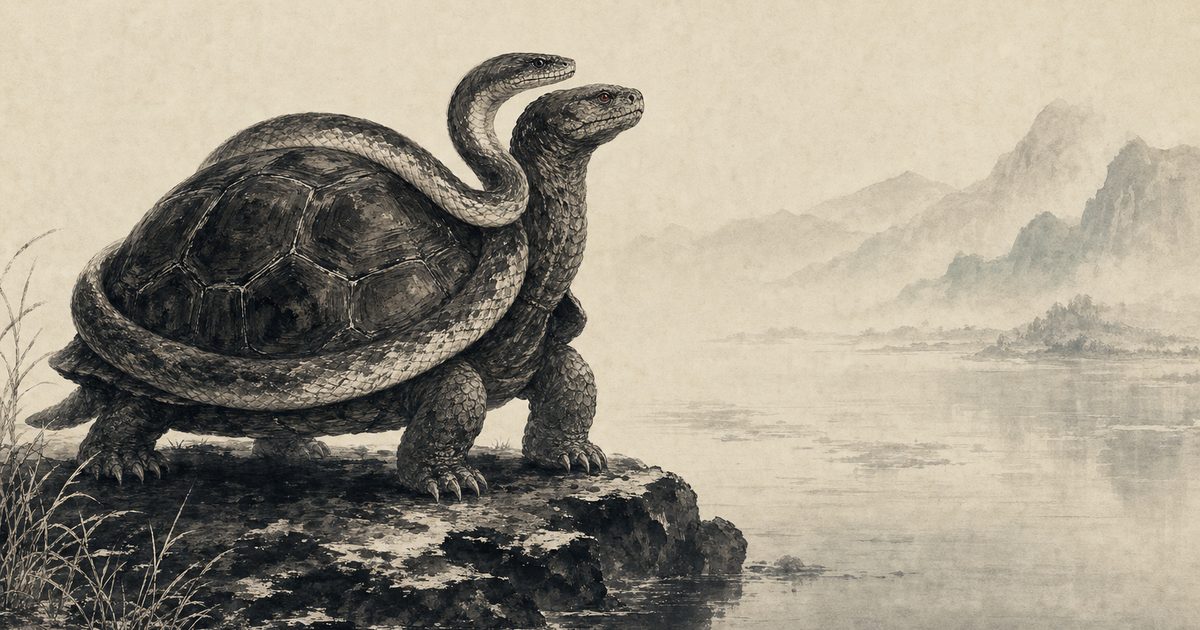
Three of the four creatures that guard the Chinese sky are exactly what they sound like. There is a dragon in the east, a tiger in the west, a red bird in the south. Then you get to the north, and things go sideways.
The northern guardian is called 玄武 (xuánwǔ), and neither of those characters means tortoise. The first, xuán, is dark, black, unfathomable. The second, wǔ, is martial, the same character sitting inside the Chinese word for martial arts. Dark Warrior. No animal in the name at all. And when you look at what the Dark Warrior is actually drawn as, it is not one animal but two: a heavy old tortoise with a long snake wound around its shell, the two heads raised side by side and pointing the same way, like a creature that has been assembled out of spare parts and is quietly pleased about it.
It gets better. Of the four guardians, this is the only one that eventually stood up, grew a human body, changed its name to dodge an imperial taboo, and ended up with a mountain range covered in temples. And the single sentence in a Han dynasty dictionary that explains why the snake is there also explains why, if you want to insult a man in Chinese today, you call him a tortoise.
The rudest word in Chinese
Start with the insult, because it is the part of this story that is still alive.
乌龟 (wūguī), tortoise, is not a neutral word in modern Chinese. Neither is 王八 (wángbā), an old northern slang term for the same animal. Both mean a man whose wife is unfaithful, and wángbā dàn, roughly "tortoise's egg", is one of the standard insults of the language, the sort of thing shouted in traffic. There is also suōtóu wūguī, "the tortoise that pulls its head in", which is what you call a coward who will not come out and face a thing.
This is a spectacular fall. Before the Han dynasty the tortoise was one of the four spiritual creatures, ranked with the dragon, the phoenix and the qilin. Its shell was the medium the Shang kings used to ask heaven questions, drilled and heated until it cracked, which is how the oldest Chinese writing we have came to be scratched onto tortoise plastrons in the first place. Its domed back over its flat belly was read as a small model of the cosmos, the round vault of heaven over the square earth. It was the animal you carved under a stone monument so the monument would last.
So what happened? The answer is that the tortoise was destroyed by a piece of bad natural history, and the same piece of bad natural history is why the guardian of the north has a snake on it.
| The tortoise as | What it meant | Where that comes from |
|---|---|---|
| Oracle | The shell heaven answers through | Shang divination; the earliest Chinese writing survives on plastrons |
| Cosmos | Round heaven over square earth, worn as a back and a belly | The dome-and-flat-base reading of the shell |
| Guardian | The north, winter, water, endurance | Sima Qian's northern palace and the Book of Rites banner order |
| Insult | A cuckold, and a coward who hides his head | The Shuowen claim that tortoises have no males and mate with snakes |
Later readers tried to soften it. There is a well traveled folk explanation that 王八 is really 忘八, "forgetting the eight", meaning a man who has forgotten the eight Confucian virtues and above all forgotten shame. It is a tidy story and almost certainly a later rationalization; the Qing scholar Zhai Hao already flagged it as a false transmission, and the older pronunciations do not line up. The unflattering version is the real one.
The name on the map
The Dark Warrior is also, quietly, all over the modern Chinese map, because for two thousand years the way you named the north side of anything was to name it after him.
Go to Nanjing and you are in Xuanwu District, wrapped around Xuanwu Lake, a large park lake under the old city wall that on a spring weekend is full of pedal boats. Nobody there is thinking about celestial guardians. The name is just the name, the way nobody in London thinks about a saint when they say St Pancras.
And the compass logic put the name on gates. A properly laid out Chinese capital faced south, so the ceremonial front gate took the southern guardian, the Vermilion Bird, and the back gate, the one at the rear of the palace, took the Dark Warrior. Which is how the most famous ambush in Chinese history got its name.
On 2 July 626, Li Shimin, second son of the founding Tang emperor, positioned men at the Xuanwu Gate, the northern gateway into the palace city at Chang'an, and waited for his brothers. He shot the crown prince, Li Jiancheng, himself. His general Yuchi Jingde killed the younger brother, Li Yuanji, as he fled. Within three days their father named Li Shimin heir apparent; within about two months he abdicated. Li Shimin became Emperor Taizong and presided over what is conventionally called the finest stretch of government in imperial Chinese history. The Xuanwu Gate Incident is taught in every Chinese school, and it is named, in the end, after a tortoise with a snake on it, because that was simply the word for north.
The name traveled too. In Japanese the same two characters are read Genbu, in Korean Hyeonmu, in Vietnamese Huyền Vũ. And in Japan you can still go and look at him: the Kitora Tomb in Asuka, Nara Prefecture, built somewhere between the seventh and early eighth centuries and opened to researchers after 1983, has all four guardians painted on its four walls with a star chart on the ceiling, and the north wall carries the Black Tortoise, exactly where a Chinese astronomer would have expected to find him.
What Sima Qian put in the north
Now the deep end, which is where these creatures actually come from. They are not stories that later got attached to stars. They are stars that later got attached to stories.
Chinese astronomy divides the band of sky the moon moves through into twenty eight mansions, then groups them in fours, seven mansions to a quarter, one animal to a quarter. The White Tiger page walks through that system in detail, and the four quarters are set out together here. The northern seven are Dipper, Ox, Girl, Emptiness, Rooftop, Encampment, and Wall, which in modern terms sweep from Sagittarius and Capricorn across Aquarius to the Great Square of Pegasus and the edge of Andromeda.
Sima Qian, in his treatise on the celestial offices around 94 BCE, introduces this quarter with a sentence of magnificent brevity. The northern palace is the Dark Warrior: Emptiness and Rooftop. Rooftop governs the roofing of houses; Emptiness governs matters of weeping.
Sit with that for a moment, because it is the whole character of the Chinese north in eleven characters. Out of seven mansions he picks two, and the two he picks are shelter and mourning. Get the roof on. Bury your dead. That is what winter is for in an agricultural empire: the work is done, the ground is shut, and what remains is keeping the weather out and observing the funerals. The tiger of the west governs war and executions, the bird of the south governs the entertaining of guests, and the north governs roofing and weeping. These are not decorative attributions. They are a farmer's calendar written across the sky.
Why the snake
Which brings us back to the snake, and to Xu Shen.
Around 100 CE, Xu Shen compiled the Shuowen Jiezi, the first Chinese dictionary to analyze characters by their parts, and still the text every serious discussion of a Chinese character begins from. His entry for the character for tortoise notes that the graph is written with the element for snake, because, he says, the tortoise's head and the snake's head are the same. Then he explains why that matters. It is the nature of heaven and earth, he writes, that the broad shouldered have no males; the tortoises and softshell turtles therefore take the snake as their male.
There it is. Under that belief the snake is not the tortoise's enemy and not its friend. It is the tortoise's missing half, the male principle to a creature understood as all female, and a tortoise with a snake wrapped around it is not two animals in a scene. It is one complete animal, yin and yang shut into a single shell, which is precisely the kind of thing you want standing watch over the dark quarter of the universe.
The zoology is, of course, entirely wrong. Tortoises have males. They do not mate with snakes. But look at what that one mistaken sentence built: the iconography of a celestial guardian on one side, and on the other, by a short and brutal inference about whose children a tortoise is raising, the rudest word in the language. The guardian of the northern sky and the insult shouted at a Beijing crossroads are the same idea, running in opposite directions, out of the same dictionary entry.
The god with his own mountain
The fourth guardian did something the other three never managed. It became a person.
Daoism had already given the four quarters divine ranks. But the northern one kept going, absorbing older northern deities and acquiring a full biography: a prince who renounced a throne, trained in the mountains, attained the Way, and returned as a barefoot warrior with loose black hair and a drawn sword, standing on a tortoise and a snake that are now two separate subordinate generals under his command. The animal had been promoted into a god and demoted into his footstool at the same time.
Then the name changed, for a reason that has nothing to do with religion. Emperor Zhenzong of the Song, in the Dazhong Xiangfu era of the early eleventh century, announced that his house descended from a divine ancestor named Zhao Xuanlang. That made the character xuán taboo, and 玄武 became 真武, Zhenwu, the Perfected Warrior. It is the same mechanism that had renamed Chang'e a thousand years earlier to avoid the personal name of an emperor of Han, and it is a useful reminder that Chinese divine names are not fixed things; they bend around whichever family is currently sitting on the throne.
The Perfected Warrior's greatest patron came four centuries later. The Yongle Emperor took the Ming throne by civil war, from his own nephew, and credited Zhenwu with protecting him while he did it. Being an emperor with a debt and no shortage of conscripts, he paid it in architecture. In 1412 he ordered the rebuilding of the Wudang Mountains in Hubei as an imperial sanctuary, and Chinese accounts of the project put the workforce at more than two hundred thousand soldiers, civilians and craftsmen. It ran for twelve years. When it was finished in 1423 there were thirty three palaces and monasteries strung along the pilgrimage route up the range.
The showpiece sits at the summit of Tianzhu Peak: the Golden Hall, a small building of gilded bronze in which the roof tiles, the columns and the window lattices are all cast metal, and inside it a gilded bronze Zhenwu on a throne. The pieces were cast near Beijing and shipped south in 1416, then carried up the mountain and bolted together at sixteen hundred meters. The main structure weighs something over four hundred tons.
It is all still there. UNESCO inscribed the Wudang complex on the World Heritage list in December 1994, and the mountains are now equally famous as the traditional home of Wudang martial arts, which means a fair proportion of the visitors climbing to a bronze hall built for the Dark Warrior are there because of kung fu films. He would probably not mind.
The one at your back
There is one more place you meet him, and it is the place where a reader is most likely to be given advice about him.
The Book of Rites preserves the oldest practical use of the four: an army on the march flies the Red Bird in front, the Dark Warrior behind, the Azure Dragon on the left, and the White Tiger on the right. James Legge's 1885 translation is still the standard English rendering. That formation, four animals used as a compass rose, is the direct ancestor of the siting rule that popular feng shui still applies to a building. The dragon and tiger sides are the ones English writing usually fixates on. The Dark Warrior is the one behind you, and in that tradition his position is the one you want high, solid and unbroken: a hill at your back, a mountain behind the house, something to lean against.
Two honest notes, the same two the tiger page makes. This siting practice is a living folk tradition with real internal logic, not classical doctrine that Confucius or Sima Qian would recognize as an instruction. And the positions are relative to the building, not to the compass. If you want the parts of the tradition that do run on a fixed compass and a birth date, start with your kua number instead.
Which leaves the tortoise more or less where he began: at the back, in the cold, holding up the part of the year nobody writes poems about. The dragon gets the spring. The bird gets the summer. The tiger gets the harvest and the executions. The Dark Warrior gets the roof, the funeral, the still black water under the ice, and a shell strong enough that four thousand years of people have carved things on it and expected them to last. The snake, as far as anyone in the Han dynasty was concerned, was helping.
In the classics
The passages behind the story, in the standard published translations. Open any one for the original text.
“The northern palace is the Dark Warrior: Emptiness and Rooftop. Rooftop governs the roofing of houses. Emptiness governs matters of weeping. ”
Original text
北宮玄武,虛、危。危為蓋屋;虛為哭泣之事。
“The tortoise is the old one. It is the creature whose bone is outside and whose flesh is inside. The graph follows the snake, for the tortoise's head and the snake's head are the same. It is the nature of heaven and earth that the broad shouldered have no males; the tortoises and softshell turtles therefore take the snake as their male. ”
Original text
龜:舊也。外骨內肉者也。从它,龜頭與它頭同。天地之性,廣肩無雄;龜鼈之類,以它為雄。
“On the march the banner with the Red Bird should be in front, that with the Dark Warrior behind, that with the Azure Dragon on the left, and that with the White Tiger on the right. ”
Original text
行:前朱鳥而後玄武,左青龍而右白虎。
Questions people ask
What is the Black Tortoise in Chinese mythology?
The Black Tortoise, 玄武 (xuánwǔ), is the guardian of the north, one of the Four Symbols that hold the four quarters of the Chinese sky alongside the Azure Dragon of the east, the Vermilion Bird of the south, and the White Tiger of the west. It rules winter, the element water, and the color black. Like the other three it is an astronomical object before it is a story: the name covers seven of the twenty-eight lunar mansions, a band of sky running from Sagittarius through Aquarius to Pegasus. It is usually pictured as a tortoise with a long snake coiled around its shell.
Why is the Black Tortoise a tortoise and a snake together?
Because educated Chinese opinion held for centuries that tortoises had no males. Xu Shen's Shuowen Jiezi, the first Chinese dictionary, states around 100 CE that broad shouldered creatures have no males and that tortoises and softshell turtles therefore take the snake as their male. Under that belief the snake is not an attacker or a companion but the missing half of the animal, which is why the two are drawn fused rather than fighting. The zoology is wrong. Tortoises have males and do not mate with snakes. The iconography it produced is nearly two thousand years old and still standard.
Is the Black Tortoise the same as Zhenwu?
They are the same figure at two stages of its life. Xuanwu began as a direction and a group of constellations, then Daoism personified it as a god, and under Emperor Zhenzong of the Song dynasty the name was changed to Zhenwu, the Perfected Warrior, to avoid the taboo on the personal name of Zhao Xuanlang, the ancestor the emperor had just claimed for his house. Zhenwu is normally shown as a barefoot warrior with loose black hair and a sword, with a tortoise and a snake at his feet as two subordinate generals. The animal did not disappear; it was demoted.
What does Xuanwu mean?
Neither character means tortoise. 玄 (xuán) is dark in the sense of black and unfathomable, the color assigned to the north and to winter. 武 (wǔ) is martial, the same character in the Chinese word for martial arts. So the name is closer to Dark Warrior than to Black Tortoise, and the older classics use a plainer term still: the Book of Rites simply calls the northern banner the Dark Warrior with no animal named at all. English settled on Black Tortoise because that is what the pictures show.
Where is the Black Tortoise in the sky?
In the northern quarter of the twenty-eight lunar mansions, which are Dipper, Ox, Girl, Emptiness, Rooftop, Encampment, and Wall. In modern terms they run from Sagittarius and Capricorn through Aquarius to the Great Square of Pegasus and the edge of Andromeda. Sima Qian, writing around 94 BCE, names only two of them when he introduces the northern palace, Emptiness and Rooftop, and gives each a job: Rooftop governs the roofing of houses, Emptiness governs matters of weeping.
Why is the tortoise an insult in Chinese?
Because of the same false belief that built the guardian. If a female tortoise had to mate with a snake, then a tortoise stood for a husband whose children were not his, and 王八 (wángbā) and 乌龟 (wūguī) became standard words for a cuckold. Wangba dan, tortoise's egg, is one of the most common insults in the language, and suotou wugui, the tortoise that pulls its head in, is the ordinary word for a coward. A popular alternative story reads wangba as wangba written with different characters, meaning a man who has forgotten the eight virtues, but the Qing scholar Zhai Hao already treated that as a false transmission, and the sounds do not support it.
Sources & further reading
- Black Tortoise, Wikipedia (the seven northern mansions with their determinative stars, and the Japanese, Korean and Vietnamese names)
- Four Symbols (Chinese constellation), Wikipedia (the four quarters and their assigned elements, seasons and colors)
- Records of the Grand Historian, Treatise on the Celestial Offices: the four palaces of the sky and the northern one (Chinese Text Project)
- Shuowen Jiezi, the entry for 龜, containing the claim that tortoises take the snake as their male (Chinese Text Project dictionary)
- The Book of Rites, Quli I: the banner order on the march, which places the Dark Warrior at the rear (Chinese Text Project, Legge translation)
- 玄武, Chinese Wikipedia (the Song naming taboo on Zhao Xuanlang and the change from Xuanwu to Zhenwu)
- 王八蛋, Chinese Wikipedia (the tortoise as an insult, and Zhai Hao's rejection of the 忘八 etymology)
- Xuanwu Gate Incident, Wikipedia (the coup of 2 July 626 at the north gate of the palace city in Chang'an)
- Xuanwu Lake, Wikipedia (the lake and district in Nanjing that carry the name)
- Ancient Building Complex in the Wudang Mountains, UNESCO World Heritage List (the official inscription record for the site)
- Wudang Mountains, Wikipedia (the Yongle construction program and the worship of the Lord of the North)
- 武当山, Chinese Wikipedia (the 1412 order, the workforce of over two hundred thousand, the thirty three halls finished in 1423, and the December 1994 World Heritage listing)
- 武当山金殿, Chinese Wikipedia (the Golden Hall on Tianzhu Peak: gilded bronze, components shipped from Beijing in 1416, and the Zhenwu statue inside)
- Kitora Tomb, Wikipedia (the Asuka tomb whose north wall carries Genbu, with a star chart on the ceiling)
By Julian 祝君瑜, retold from the classics, with the original passages cited, updated 2026-08-26