Chinese Mythology
Hou Yi (后羿): The Archer Who Shot the Suns, and the Other Man With His Name
Hou Yi, 后羿 (Hòu Yì), is the archer who shot the extra suns out of the sky when ten of them rose at once and began cooking the world. He was given a drug that ends death, and his wife took it and left for the moon. He is also, strictly speaking, two people. The archer of the old myths and Lord Yi of Youqiong, a Xia-dynasty warlord who came to a considerably worse end, were separate men who got welded together.
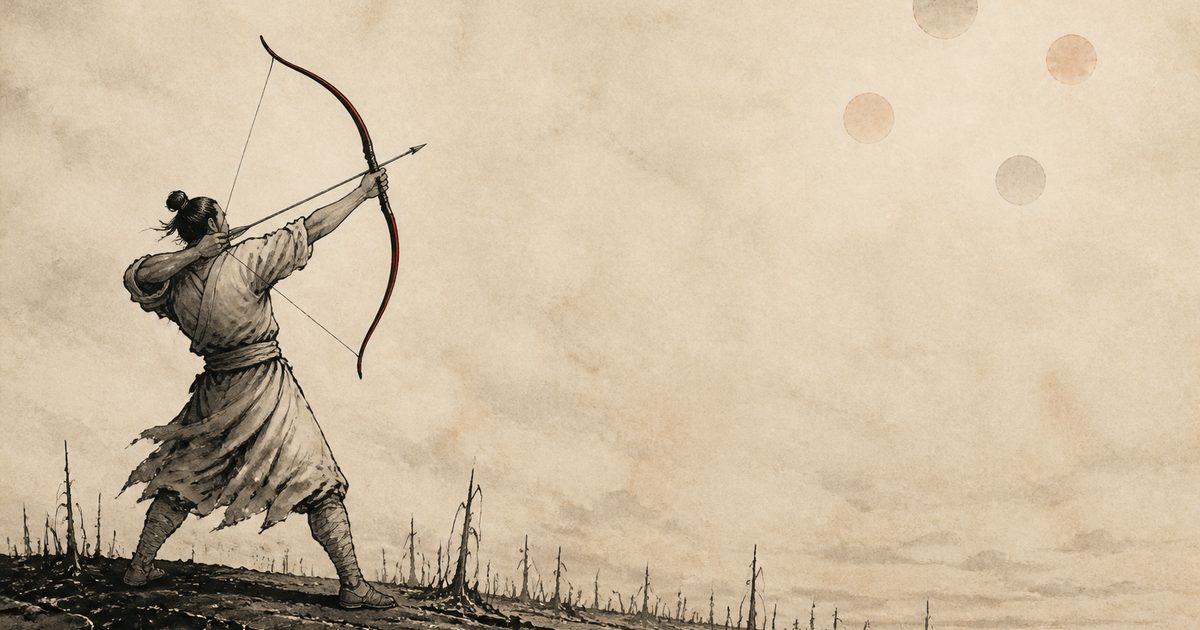
Ten suns came up at once. Not one after another, in the decent rotation their mother had arranged for them, but all ten together, hanging over the world like a row of open furnace doors. The crops burned in the field. The grass and the trees died. Rivers went off as steam. And a man walked out onto the cracked ground with a bow, planted his feet, and began shooting at the sky.
That is the story every Chinese child knows, and it is a magnificent one. There is only one difficulty with the way it is usually told in English, which is the name at the top of it.
China renamed him in 2025
In August 2025, parents across China opened their children's new Chinese textbooks and discovered that a story they had learned by heart had been retitled. Hou Yi Shoots the Suns was now Yi Shoots the Nine Suns. Sima Guang, in the neighboring lesson, was no longer smashing a gang to save a drowning playmate but a weng, which is a different sort of jar. The man stopping his own ears to steal something was stealing a bell rather than a doorbell. Social media did what social media does. "I can't help my kid with Chinese anymore" became the week's refrain, and the phrase "sweeping revisions" trended.
The publishers pushed back on the drama. Most of the talk of sweeping revisions, they said, was self-media exaggeration; what had happened was that a handful of phrases had been quietly tightened up while the familiar wording stayed where it was. Sima Guang really does break a weng in the History of Song. The bell really is a bell in the Lüshi Chunqiu. And Hou Yi really did not shoot the suns.
That last one is the change worth stopping on, because the reasoning behind it has been sitting in the Chinese record for eighteen hundred years, and the English-speaking world has walked straight past it.
The eight-year-old who caught the textbook out
Before the rename there was a smaller and more delightful scandal. In 2019 a second-grader in Fuzhou, reading the same story in the same series, put his hand up. The text says the rivers were boiled dry. Two paragraphs later it has Yi wading across ninety-nine rivers on his way to the eastern sea. If the water is gone, the boy wanted to know, what exactly is he wading through?
This is a very good question, and the extraordinary thing is that he got an answer. The People's Education Press replied in public, conceded that the verb was wrong, thanked him, and said the editorial team was looking into it and would fix the wording in the next edition. Commentators spent a fortnight arguing about whether a myth is allowed to be internally inconsistent, which is itself an excellent thing for a country to spend a fortnight arguing about.
Keep the boy in mind. He is the reason the rest of this page exists, in the sense that people who read the sun-shooting story closely tend to find that it does not quite hold still.
He is a marksman now
The largest audience Yi has ever had is holding a phone. In Honor of Kings, Tencent's arena game, he is one of the marksmen: a bow at the back of the fight, doing from range what he has always done. The game came out in China in October 2015, went worldwide in June 2024, and is the highest-grossing mobile game ever made, which means that for an enormous number of people on earth the first Hou Yi they ever met had a cooldown timer.
There is a small irony in this. When Tencent first localized the game for Western players, a great many of the Chinese heroes were renamed and redesigned for audiences assumed not to know who they were. Yi survived to become globally famous under a name that is not really his.
What the oldest texts actually say
Now to the roots, and they are stranger than the retellings.
The oldest text to put a bow in his hands is the Classic of Mountains and Seas, that magnificent gazetteer of monsters and mountains that reads like a geography compiled by someone who had been drinking. It says: God Jun bestowed on Yi a red bow and white corded arrows, so that he might succor the lands below, and so Yi first went down to relieve the hundred hardships of the world beneath. That is the whole commission. A red bow, white arrows, and a job.
Notice what is missing. The suns are not mentioned. The text that arms him never says what he shot.
Now turn to another chapter of the same book, and meet the suns' family. Beyond the southeast sea, between the waters of Gan, lies the country of Xihe, and a woman named Xihe was bathing the suns in the Gan abyss. Xihe, the text says, is the wife of God Jun, and she gave birth to the ten suns.
Read those two passages next to each other and something rather appalling comes into focus. God Jun handed the archer the bow. God Jun was also the suns' father. Whether the compilers of a text assembled over several centuries meant that as one story is a fair question, and the honest answer is that we cannot know. But it is there on the page, and it is the sort of detail that a folktale would have sanded off and a genuinely old text simply leaves lying about.
The nine is a footnote
The version of the shooting that everyone quotes comes from the Huainanzi, the great syncretic compendium presented to the Han throne in 139 BCE. It gives him a full campaign, not just the suns. Yao sends him to execute Chisel Tooth in the wilds of Chouhua, to kill Nine Gullets on the banks of the Xiong river, to bring down Great Wind with a corded arrow over the marsh of Qingqiu, to shoot upward at the ten suns and downward to kill the Yayu, to cut the Long Snake in two at Dongting, and to take the Giant Boar in the Sanglin. The people were overjoyed, the text says, and they made Yao the Son of Heaven.
Read that list again and count the suns he brings down. You cannot, because it does not say. The Huainanzi says he shot upward at the ten suns, and moves briskly on to the boar.
The number nine arrives three centuries later, in a footnote. Wang Yi, annotating the Heavenly Questions around the second century CE, explains the line for his readers: the Huainanzi says that in Yao's time ten suns came out together and the plants withered, so Yao ordered Yi to shoot up at the ten suns, and he hit nine of them, and the nine crows inside those suns all died and their feathers fell, and one sun was left. Every falling three-legged crow in every children's book on earth descends from that gloss. It is a commentator tidying up an arithmetic problem, and it has comprehensively outlived the text it was tidying.
The other Yi
Here is where the name goes wrong.
Open the Zuo Zhuan at the fourth year of Duke Xiang and you find a minister named Wei Jiang telling his ruler a cautionary tale about a man called Lord Yi. When the house of Xia was in decline, Wei Jiang says, Lord Yi moved from Chu to Qiongshi and used the people of Xia to take the Xia government in its place. He trusted to his archery. He did not attend to the affairs of the people but gave himself over to the beasts of the plain. He cast off four good officers and used a man named Han Zhuo instead, who curried favor within and spread bribes without, made a fool of the people, and had Yi watched while he was out hunting. Yi's own household killed him and boiled him and served him to his sons. The sons could not bring themselves to eat, and died at the gate of Qiong.
No suns. No monsters. No drug of deathlessness, no woman on the moon. A usurper who preferred hunting to governing, and a stew.
| Yi the archer | Lord Yi of Youqiong | |
|---|---|---|
| When | The reign of Yao, in the age of myth | Early Xia, after the fall of Tai Kang |
| Earliest source | Classic of Mountains and Seas; Heavenly Questions; Huainanzi | Zuo Zhuan, Duke Xiang year four; the Book of Documents |
| Famous for | Shooting at the ten suns and killing six monsters | Seizing the Xia throne and then neglecting it |
| His wife | Chang'e, who takes the drug and leaves for the moon | Chun Hu, whom Han Zhuo takes along with the state |
| How he dies | Murdered by Feng Meng, his own student | Killed and cooked by his household, served to his sons |
| What the name means | Yi, a personal name | Lord Yi, a name with a title in front of it |
后 does not mean "after"
The confusion is helped along by an accident of modern Chinese. In the language people speak now, that first syllable overwhelmingly means after, so Hou Yi reads to a modern eye like "Later Yi," as though he were a sequel.
In the old language it is a title: lord, sovereign, the ruler of a place. It is the same word sitting in front of Hou Ji, the Lord of Millet who taught agriculture, and inside the formal name of the Xia royal house itself. Lord Yi is not a man called Hou Yi. He is a man called Yi with a rank attached, in the way that Chef Ding and Music-Master Kuang are a cook and a musician with their names on. The Book of Documents has him as Lord Yi of Youqiong, which is a title, a name and an address.
And the classical philologists were perfectly clear about this. Open the Shuowen Jiezi, the first Chinese dictionary, finished around 100 CE, and you do not find one Yi. You find two, filed under two different characters in two different sections of the book: one in the feather section, glossed as an ancient lord, and a second under the bow radical, described as Emperor Ku's archery officer, destroyed by Shao Kang of Xia.
Duan Yucai, annotating that dictionary around 1815, spells the distinction out and then produces the clincher. Quoting the Han commentator Gao You on a Huainanzi passage about Yi's skill, he records Gao's verdict on which Yi is meant: this is the Yi of Yao's time, who could shoot the ten suns, bring down Great Wind, kill the Yayu, cut down Nine Gullets and shoot the earl of the river. Not Lord Yi of Youqiong.
Not Lord Yi of Youqiong. A Chinese scholar wrote that around the year 200, flatly, as a correction, and here we are.
Even Qu Yuan had them apart. The Heavenly Questions, that dizzying poem of unanswered riddles from the third century BCE, asks in one breath how Yi shot the suns and how the crows shed their feathers, and elsewhere entirely asks a quite different question about Yi of the Yi people, who wrecked the Xia populace, shot the earl of the river and took the river goddess as his wife. Two men, two stanzas, one poem. The oldest surviving voice to mention either of them was already keeping them straight.
Two deaths, and the one everybody tells
Both Yis were murdered, which cannot have helped.
The archer's death is in the Mencius, and it is one of the neatest cruel anecdotes in the Chinese canon. Feng Meng studied archery under Yi. When he had learned everything Yi had to teach, he worked out that in all the world only Yi was better than himself, and so he killed Yi. Mencius then delivers the line that makes it literature rather than gossip: in this, Yi too had a share of the blame. Teach a man everything and give him nothing else, and you have manufactured the person who removes you.
The other death is the stew.
What most people now know is neither of these. In the modern folk version, the one on the festival television and in the picture books, Feng Meng is downgraded from murderer to burglar. He waits until Yi is out hunting, breaks in, and demands the drug of deathlessness at knifepoint, and Chang'e swallows it herself rather than let him have it. It is a kinder story about a nicer woman, and it does not appear in the early record at all. If you want the full account of how she got up there, and why the oldest texts have her arriving on the moon and turning into a toad, Chang'e has her own page, and the jade rabbit she found waiting for her has another.
The suns' mother has a satellite
The gods of this story have done curiously well in the space age.
Chang'e has an entire lunar program, eight missions and counting, and the rovers are named after her rabbit. And Xihe, the woman bathing her ten children in the abyss, is now a spacecraft: China's first solar exploration satellite, the Chinese H-alpha Solar Explorer, launched from Taiyuan on 14 October 2021 and named after the mother of the suns, watching the one sun that survived through a telescope tuned to the deep red of its light.
The archer got a mobile game.
There is something fitting about that, and something a little sad. The woman who left him is on the moon and in orbit. The suns' mother has a telescope. And the man himself, whose name was never quite his own, is a marksman with a cooldown timer, still drawing on a sky that has one sun in it because he did his job. If you want to know which full moon his wife is being celebrated on this year, the Mid-Autumn Festival page has the dates worked out through 2035.
In the classics
The passages behind the story, in the standard published translations. Open any one for the original text.
“God Jun bestowed on Yi a red bow and white corded arrows, so that he might succor the lands below. And so Yi first went down to relieve the hundred hardships of the world beneath. ”
Original text
帝俊賜羿彤弓素矰,以扶下國,羿是始去恤下地之百艱。
“Beyond the southeast sea, between the waters of Gan, lies the country of Xihe. There is a woman there named Xihe, and she was bathing the suns in the Gan abyss. Xihe is the wife of God Jun, and she gave birth to the ten suns. ”
Original text
東南海之外,甘水之間,有羲和之國。有女子名曰羲和,方浴日於甘淵。羲和者,帝俊之妻,生十日。
“By the time of Yao, ten suns came out together. They scorched the grain, they killed the grasses and trees, and the people had nothing to eat. Chisel Tooth, Nine Gullets, Great Wind, the Yayu, the Long Snake and the Giant Boar were all plagues upon the people. So Yao sent Yi to execute Chisel Tooth in the wilds of Chouhua, to kill Nine Gullets on the banks of the Xiong river, to bring down Great Wind with a corded arrow over the marsh of Qingqiu, to shoot upward at the ten suns and downward to kill the Yayu, to cut the Long Snake in two at Dongting, and to take the Giant Boar in the Sanglin. The people were overjoyed, and they set up Yao as the Son of Heaven. ”
Original text
逮至尧之时,十日并出。焦禾稼,杀草木,而民无所食。猰貐、凿齿、九婴、大风、封豨、修蛇皆为民害。尧乃使羿诛凿齿于畴华之野,杀九婴于凶水之上,缴大风于青丘之泽,上射十日而下杀猰貐,断修蛇于洞庭,擒封豨于桑林。万民皆喜,置尧以为天子。
“Long ago, when the house of Xia was in decline, Lord Yi moved from Chu to Qiongshi, and used the people of Xia to take the government of Xia in its place. He trusted to his archery. He did not attend to the affairs of the people but gave himself over to the beasts of the plain. He cast off Wu Luo, Bo Yin, Xiong Kun and Mang Yu, and used Han Zhuo instead. Han Zhuo curried favor within and spread bribes without, made a fool of the people and set a watch on Yi while he was out hunting. His own household killed him and boiled him, and served him to his sons. The sons could not bring themselves to eat, and died at the gate of Qiong. ”
Original text
昔有夏之方衰也,后羿自鉏遷于窮石,因夏民以代夏政。恃其射也,不修民事,而淫于原獸。棄武羅、伯因、熊髡、尨圉,而用寒浞……浞行媚于内而施賂于外,愚弄其民而虞羿于田……家眾殺而亨之,以食其子。其子不忍食諸,死于窮門。
“Feng Meng studied archery under Yi. When he had exhausted everything Yi had to teach, he reckoned that in all the world only Yi was better than himself, and so he killed Yi. Mencius said, in this Yi too had a share of the blame. ”
Original text
逢蒙學射於羿,盡羿之道,思天下惟羿為愈己,於是殺羿。孟子曰:是亦羿有罪焉。
As seen in
Honor of Kings
game · 2015A ranged marksman on the hero roster, as Hou Yi.
Tencent's mobile arena game, released in China in October 2015 and worldwide in June 2024, and the highest-grossing mobile game ever made.
Questions people ask
What is Hou Yi the god of?
Strictly, he is not a god of anything. He is a hero rather than a deity, and the oldest texts treat him as a man with an errand. The Classic of Mountains and Seas says God Jun gave him a red bow and white corded arrows and sent him down to relieve the hardships of the world below, which makes him something closer to a sent official than a god of archery. Later folk religion did give him shrines, and popular writing often files him under sun gods, but that is a promotion the early sources never granted him.
Who was Hou Yi's wife?
Chang'e, the woman who ended up on the moon. The connection is old but the marriage is not: the Huainanzi of 139 BCE says only that Yi obtained the drug of deathlessness from the Queen Mother of the West and that Chang'e stole it and fled to the moon, without ever calling them husband and wife. That gloss arrives with Gao You's commentary a few centuries later. The Heavenly Questions also has a Yi taking the goddess of the Luo river after shooting her husband, which is a second marriage attached to a second man.
What happened to Hou Yi?
Both of them died badly, which is part of why they are so easily confused. Mencius says the archer Yi was murdered by his own student Feng Meng, who worked out that with his teacher gone he would be the finest shot alive, and Mencius adds that Yi was partly to blame for training him. The other Yi, Lord Yi of Youqiong, was killed by his own household while his minister Han Zhuo held the state, and the Zuo Zhuan records that they cooked him and served him to his sons.
How many suns did Hou Yi shoot?
The earliest source does not say. The Huainanzi says he shot upward at the ten suns, and stops there. The familiar number comes from Wang Yi, annotating the Heavenly Questions around the second century CE, who wrote that Yi shot up at the ten suns and hit nine of them, that the nine crows inside those suns all died and their feathers fell, and that one sun was therefore left. Nine is a commentator's arithmetic that has outlived almost everything else in the story.
Are Hou Yi and Yi the same person?
No, and Chinese scholarship has been saying so for a very long time. Gao You, annotating the Huainanzi around 200 CE, wrote of the sun-shooter that this is the Yi of Yao's time and not Lord Yi of Youqiong. Duan Yucai repeated the point in his great commentary on the Shuowen Jiezi around 1815, noting that the dictionary files the two men under two different characters entirely. In August 2025 China's national textbook publisher renamed the school story from Hou Yi Shoots the Suns to Yi Shoots the Nine Suns for exactly this reason.
Sources & further reading
- Hou Yi Reconsidered, by Sun Juan and Huang Zhenyun, Guangming Daily, 15 September 2018 (the scholarly case that the archer and the Xia lord are two men)
- What should Hou Yi look like? by Huang Yi, Beijing Daily, 10 August 2022 (the title reading of 后, and Ye Zhengbo's argument)
- The dictionary entry for 羿, with the Shuowen text and Duan Yucai's commentary quoting Gao You (Zdic)
- Wang Yi's commentary on the Heavenly Questions, where the nine suns and the falling crows first appear (Chinese Wikisource)
- The Heavenly Questions, with both the sun-shooting line and the separate lines about Yi of the Yi people (Chinese Text Project)
- Yi Shoots the Nine Suns, the Huainanzi passage with translation and notes (Guwendao)
- Zuo Zhuan, Duke Xiang year four, the speech of Wei Jiang (5000yan)
- Netizens call the primary-school Chinese textbook revisions sweeping, and officials respond, Sina, 9 August 2025 (the rename to Yi Shoots the Nine Suns)
- A primary-school pupil questions Yi Shoots the Nine Suns, and the People's Education Press says the wording was wrong and will be revised (The Paper, 2019)
- An eight-year-old boy's challenge to Yi Shoots the Nine Suns, commentary by Li Qinyu (Guangming Online, 14 June 2019)
- Honor of Kings, Wikipedia (release dates, scale, and the renaming of heroes for Western markets)
- China launches its first solar exploration satellite, named Xihe, 14 October 2021 (China.org.cn)
- Chinese H-alpha Solar Explorer, Wikipedia (the Xihe mission, orbit and instrument)
By Julian 祝君瑜, retold from the classics, with the original passages cited, updated 2026-08-26