Chinese Mythology
Bull Demon King (牛魔王): The Monkey King's Sworn Brother and the Fight at Flame Mountain
The Bull Demon King, 牛魔王 (Niú Mówáng), is the eldest of Sun Wukong's seven sworn brothers in Journey to the West, the one demon who can fight the Monkey King to a standstill. Husband of Princess Iron Fan and father of Red Boy, he holds the fan that can put out the Flame Mountain, and the three chapters in which Wukong tries to borrow it end with a shape-shifting duel, a bull a thousand fathoms long, and a rare mercy: he surrenders, is led away by the nose, and lives.
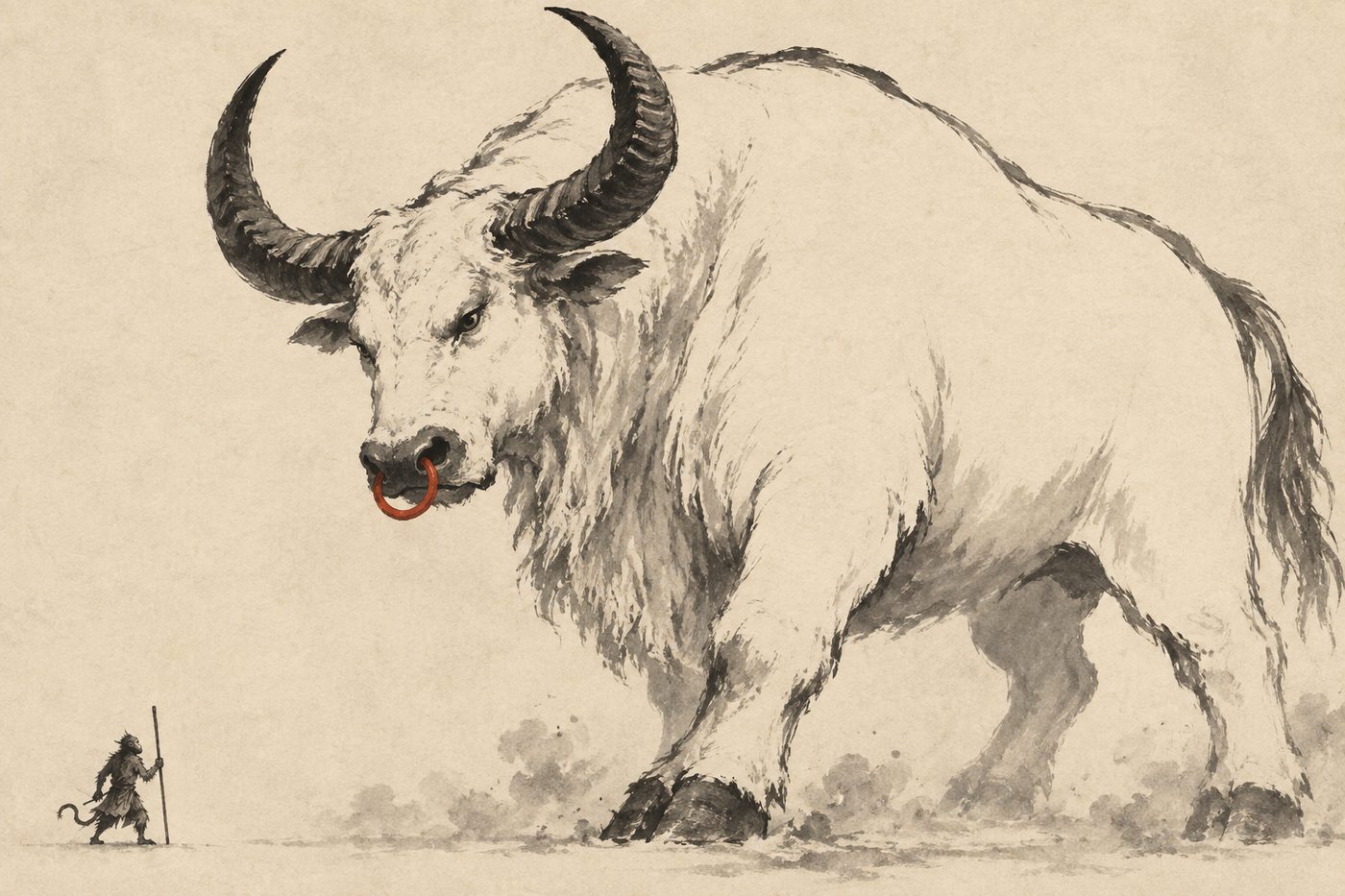
Every hero needs one opponent he cannot simply beat, and the Monkey King's is a bull. The Bull Demon King, Niú Mówáng, is the eldest of Sun Wukong's sworn brothers, a demon lord with a wife who owns a magic fan, a mistress who owns a fortune, and a son who breathes fire, and when the two old friends finally fight, in chapters 59 to 61 of Journey to the West, the novel gives them the longest, strangest and most evenly matched duel in the book. He is the villain of the first animated feature ever made in Asia. He is the father-in-law of Goku. He is the boss of a chapter of the most successful Chinese video game ever made. And he is, when you strip the armor off, a white bull the size of a mountain range, which is how the book prefers to leave him.
The Bull King in your living room
You have probably met him without the introduction. In Black Myth: Wukong, the 2024 game that sold ten million copies in its first three days, Chapter 5 is set on the Flaming Mountains, and its whole plot is the Bull King's broken household: the player arrives in disguise, claiming to be the Bull King's daughter, and the summary on Wikipedia records what happens next, "the Bull King sees through the ruse and recognizes his son Red Boy," after which the son seizes the relic the father was about to hand over and the chapter ends in a family tragedy. If you watched Dragon Ball as a child you know him as the Ox-King, Chi-Chi's enormous, gentle father, who in the early episodes lives on a burning mountain: his Japanese name, Gyūmaō, is the Bull Demon King's three characters read aloud in Japanese, and the burning mountain is the Flame Mountain with the serial numbers filed off. Akira Toriyama took Goku from Wukong and took the neighbors with him. He is the Demon Bull King of LEGO's Monkie Kid series, complete with Princess Iron Fan and a son renamed Red Son, and he has turned up in Doraemon, in Hong Kong films, and in every television Journey to the West since the 1980s. None of them agree on what he looks like, because the novel only describes him properly once, and it is not a man.
Asia's first animated feature was about him
Before any of that, he was the first cartoon villain in Chinese history. Princess Iron Fan, released in Shanghai in November 1941 by the brothers Wan Laiming and Wan Guchan, was the first full-length animated film made in China and, by most reckonings, the first in Asia: seventy-three minutes of ink-black bull and rubber-limbed monkey, made in a city at war. The plot is chapters 59 to 61 with the ending rewritten for wartime: the pilgrims cannot beat the Bull King alone, so the villagers of the Flame Mountain join in, and together they bring him down and win the fan. A sixteen-year-old in Osaka saw it and decided to draw for a living. His name was Osamu Tezuka, and there is a reasonable case that Japanese animation, and therefore Goku's father-in-law, descends from a Chinese cartoon about a bull.
Big brother
Now the book. The Bull King arrives early and without explanation. In chapter 3, before the havoc in Heaven, the newly immortal Monkey King is touring the world looking for friends worth having, and "took up with six sworn brothers: the Bull Demon King, the Flood Dragon Demon King, the Roc Demon King, the Lion Camel King, the Macaque King and the Snub-Nosed Monkey King, seven in all counting the Handsome Monkey King himself." Each has a grand title, and Wukong recites them thirty-eight chapters later when he needs to prove to Red Boy that he knew the boy's father: the Bull King is "the Great Sage Who Pacifies Heaven," and, Wukong adds, "we let him be the eldest." It is the only time in the novel that the Monkey King, who promoted himself to Great Sage Equal to Heaven and picked a fight with the Jade Emperor over the title, concedes precedence to anyone. The bull was there first, and was bigger.
A household, which no other demon has
What makes the Bull King different from every other monster on the road is that he has a family, and it is a mess. His wife is Princess Iron Fan, whom the text also calls the Rakshasi, a demoness with a palm-leaf fan that can put out a mountain of fire with one wave. Their son is Red Boy, the Great King Holy Infant, a child demon who breathes true fire and who, back in chapter 41, captured the monk and was subdued by Guanyin, who kept him as her attendant. The parents regard this as a kidnapping. And the Bull King has left home. When Wukong tracks him down in chapter 60, the local earth god explains that he is living in a cave on Thunder-Piling Mountain with the Jade-Faced Princess, the orphaned daughter of a fox king, who "had a fortune of a million with no one to manage it," heard of the Bull King's powers, and, the text says with a straight face, "offered to bring her wealth as dowry and take him as her husband. The Bull King abandoned the Rakshasi and has not been back since." A sworn brother of the hero, a bitter wife with the one object the hero needs, a rich mistress, and a son in the custody of a bodhisattva. No wonder the borrowing takes three chapters.
The fire was Wukong's
Here is the detail that turns the episode from a monster fight into a comedy of consequences. The Flame Mountain is eight hundred li of fire with not an inch of grass anywhere around it, and Wukong assumes, reasonably, that the Bull King lit it. The earth god corrects him, and the correction is worth having in full: "This fire was set by you, Great Sage. Five hundred years ago, when you made havoc in Heaven, Erlang captured you and delivered you to Laozi, who put you in his Eight Trigrams furnace. When the lid was lifted after the smelting, you kicked the furnace over, and a few bricks fell out with fire still in them, landed here, and became the Flame Mountain." The earth god, it turns out, was the boy who tended the furnace, demoted to this posting for letting it happen. Wukong, who does not enjoy being told things, tells him he is talking nonsense and only half believes him. But the book means it. The fire the pilgrims cannot cross is the Monkey King's own, five hundred years old, and the grudge that keeps the fan from him is the Monkey King's own too, since it was he who handed Red Boy to Guanyin. The Bull King's whole episode is Wukong walking into the consequences of Wukong.
Borrowing the fan, three times
The chapter titles say it plainly: Wukong "borrows" the fan three times, and each attempt is a different kind of trick. The first is the belly trick. Princess Iron Fan, who has no intention of lending anything to the monkey who took her son, fans him clean off the mountain; he comes back with a wind-fixing pill, is fanned again and does not move, and when she retreats inside he turns into a tiny insect, rides into her stomach on the foam of a cup of tea, and negotiates from the inside, addressing her throughout as sister-in-law. She gives him a fan. It is the wrong fan: the first wave of it makes the fire worse.
The second is the disguise swap, and it is the funniest sequence in the episode. Wukong finds the Bull King at the fox princess's cave, is refused, follows him to a banquet under a lake, steals his mount, a water-parting golden-eyed beast, rides to Princess Iron Fan's cave wearing the Bull King's shape, and is welcomed home by a wife who has had a few drinks and is glad to see him. She hands over the real fan and, in bed, tells him how to shrink it. He flies off in triumph with the fan grown to twelve feet and no idea how to make it small again. The Bull King, discovering the theft, returns the compliment: he turns himself into Zhu Bajie, meets Wukong on the road, offers to carry the fan for a while, and is handed it. The third attempt is simply a fight, with the real Bajie and the earth god's troops joining in, and it is the fight the whole world remembers.
The duel of shapes, and the white bull
Losing the ground battle, the Bull King drops his armor and his iron club and flies off as a swan. What follows is a transformation duel in the exact shape of the one Wukong fought against Erlang in chapter 6, except that this time the monkey is the hunter. The text lays out the moves like a card game, and a table is the only honest way to show it:
| The Bull King becomes | Wukong answers with |
|---|---|
| A swan | A gyrfalcon, which drops on the swan's neck |
| A yellow hawk | A black phoenix |
| A white crane, crying southward | A vermilion phoenix, the king of birds, which no bird dares attack |
| A musk deer, grazing on a cliff | A hungry tiger |
| A great spotted leopard | A golden-eyed lion with a voice like thunder |
| A bear | A mangy elephant with a trunk like a snake |
Then the Bull King stops playing. "He gave a little laugh and showed his true form: a great white bull, its head like a mountain ridge, its eyes like flashes of lightning, its two horns like a pair of iron pagodas, its teeth a row of blades, more than a thousand fathoms from head to tail and eight hundred from hoof to back." He asks the monkey what he proposes to do about it, and Wukong answers by growing ten thousand fathoms tall, with a head like Mount Tai and a mouth like a pool of blood, and the two of them shake the mountains until every god in the neighborhood comes to watch. This is the image the painting at the top of this page is built on, because it is the only physical description the novel ever gives him, and it is not a man with horns. It is livestock at the scale of geography.
The demon who was not killed
The ending is the part the adaptations most often change, and it is worth keeping straight. The gods surround him. He runs. He is intercepted by Li Jing, the Pagoda-Bearing Heavenly King, and his son Nezha, sent by the Jade Emperor at the Buddha's own request. Nezha cuts off his head and another grows; ten heads, ten times. Nezha hangs his fire-wheels on the bull's horns and blows, and the bull roars and thrashes. And then, in the text's own words, "the Pagoda-Bearing Heavenly King fixed his true form in the demon-revealing mirror, and he could not move or change, and had no way out but to cry: Spare my life! I will gladly submit to the Buddha's house." Nezha threads his binding cord through the bull's nostrils and leads him off by hand, the way a farmer leads an ox. Princess Iron Fan gives up the real fan to save her husband. The fire goes out under three waves of it, rain falls, and the chapter's closing poem records the outcome in a single line: "the bull led to the Buddha, his wildness done."
Note what did not happen. He was not killed, as most monsters in the book are; he was not revealed to be some god's runaway pet, as many of the rest turn out to be. He surrendered, and the surrender was accepted, and Heaven's officers walked him off to the western paradise by the nose. The novel is generous with its endings for the people it likes, and it liked the Bull King. He had, after all, been the Monkey King's big brother.
Is he stronger than Wukong?
The fair reading is that the book refuses to answer, and the refusal is the point. They fight from the hour of the rabbit into the hour of the dragon and break off by mutual consent. They match each other transformation for transformation. When Wukong finally wins it is because Bajie's rake joins in, because the earth god's spirit soldiers block the cave, and because the entire apparatus of Heaven, fire-wheels, mirror, cord and all, is sent to hold one bull still. Everyone else on the road Wukong beats, or outwits, or has removed by a phone call to the relevant bodhisattva. The Bull King he has to be helped with. And the novel, in its opening chapters, had already settled their ranking the only way that matters to two proud demons who once drank together: when the seven brothers swore, the monkey let the bull go first.
So that is who is glaring at you from the poster, the game, the cartoon and the anime: not a boss, and not a minotaur, but the Monkey King's eldest sworn brother, a bull the size of a landscape, with a marriage in ruins and a son in the custody of the Goddess of Mercy, who guarded a fire the hero had started and lost the fight to the hero's whole army, and who, of all the demons on that long road to India, was one of the very few allowed to walk away.
In the classics
The passages behind the story, in the standard published translations. Open any one for the original text.
“Your honored father is the Bull Demon King, styled the Great Sage Who Pacifies Heaven. He and I swore brotherhood with five others, seven in all, and we let him be the eldest. ”
Original text
你令尊叫做牛魔王,稱為平天大聖,與我老孫結為七弟兄,讓他做了大哥。
“This fire was set by you, Great Sage. ... Five hundred years ago, when you made havoc in Heaven, Erlang captured you and delivered you to Laozi, who put you in his Eight Trigrams furnace. When the lid was lifted after the smelting, you kicked the furnace over, and a few bricks fell out with fire still in them, landed here, and became the Flame Mountain. ”
Original text
這火原是大聖放的。……因大聖五百年前大鬧天宮時,被顯聖擒了,壓赴老君,將大聖安於八卦爐內。煅煉之後開鼎,被你蹬倒丹爐,落了幾個磚來,內有餘火,到此處化為火焰山。
“The Bull King gave a little laugh and showed his true form: a great white bull, its head like a mountain ridge, its eyes like flashes of lightning, its two horns like a pair of iron pagodas, its teeth a row of blades, more than a thousand fathoms from head to tail and eight hundred from hoof to back. ”
Original text
牛王嘻嘻的笑了一笑,現出原身:一隻大白牛,頭如峻嶺,眼若閃光,兩隻角似兩座鐵塔,牙排利刃,連頭至尾有千餘丈長短,自蹄至背有八百丈高下。
“Then the Pagoda-Bearing Heavenly King fixed his true form in the demon-revealing mirror, and he could not move or change, and had no way out but to cry: "Spare my life! I will gladly submit to the Buddha's house." ... He threaded the cord through the bull's nostrils and led him away by hand. ”
Original text
又被托塔天王將照妖鏡照住本像,騰那不動,無計逃生,只叫:「莫傷我命,情願歸順佛家也。」……將索穿在鼻孔裡,用手牽來。
“At this time he also took up with six sworn brothers: the Bull Demon King, the Flood Dragon Demon King, the Roc Demon King, the Lion Camel King, the Macaque King and the Snub-Nosed Monkey King, seven in all counting the Handsome Monkey King himself. ”
Original text
此時又會了個七弟兄,乃牛魔王、蛟魔王、鵬魔王、獅驼王、獼猴王、𤟹狨王,連自家美猴王七個。
As seen in
Black Myth: Wukong
game · 2024The lord of Chapter 5, the Flaming Mountains, where his broken family, Rakshasi and Red Boy, carries the plot; he sees through the player's disguise and recognizes his son, as Bull King.
Princess Iron Fan (铁扇公主)
film · 1941The villain of the first feature-length animated film made in China, and in Asia, by the Wan brothers; the pilgrims and the villagers defeat him to win the fan, as Bull Demon King.
The film that inspired the sixteen-year-old Osamu Tezuka to draw.
Dragon Ball
anime · 1986The Ox-King, Chi-Chi's father and Goku's father-in-law, is written in Japanese with the same three characters, Gyūmaō; in the early series he guards a burning mountain, as Ox-King (Gyūmaō).
LEGO Monkie Kid
anime · 2020The Demon Bull King is the first-season villain, with Princess Iron Fan and their son Red Son alongside him, as Demon Bull King.
Questions people ask
Is the Bull Demon King stronger than Wukong?
As close to equal as anyone in the novel gets. In chapter 61 of Journey to the West the two fight from dawn through the morning without a decision, then run through a chain of matched transformations that neither wins, and the Bull King only loses when Zhu Bajie's rake joins the fight and the armies of Heaven, Nezha's fire-wheels and Li Jing's demon-revealing mirror, are sent to pin him. The text also settles their seniority: when they swore brotherhood the Bull King was made eldest. He is the one opponent Wukong cannot beat alone.
Who are the children of the Bull Demon King?
One son, Red Boy, called in the novel the Great King Holy Infant, a child demon who breathes true fire from a mountain cave and captures the monk Tang Sanzang in chapter 41. Guanyin subdues him and keeps him as her attendant, which is the grudge behind the whole Flame Mountain episode: the Bull King and Princess Iron Fan hold Wukong responsible for losing their child. The LEGO series Monkie Kid renames him Red Son.
Is the Ox-King in Dragon Ball the Bull Demon King?
By name, yes. The Ox-King, Chi-Chi's father in Dragon Ball, is written in Japanese with the same three characters as the Bull Demon King, Gyūmaō, and in the early series he lives on a burning mountain, an echo of the Flame Mountain. Akira Toriyama built Goku on Sun Wukong and borrowed the supporting cast with him; the Ox-King is a gentle giant rather than a demon, but the source is not in doubt.
Who played the Bull Demon King?
He has been played and drawn many times. He is the villain of Princess Iron Fan, the 1941 Wan brothers cartoon that was the first feature-length animated film made in Asia, a recurring figure in the 1986 CCTV Journey to the West, the Bull King of Chapter 5 of Black Myth: Wukong in 2024, and the Demon Bull King of LEGO Monkie Kid. In the novel he is not a costume at all: his true form is a white bull a thousand fathoms long.
What happened to the Bull Demon King in the end?
He surrendered and lived. Cornered in chapter 61, with Nezha's fire-wheels burning on his horns and the Pagoda-Bearing Heavenly King's mirror holding him in his true form, he cried out for his life and promised to submit to the Buddha. Nezha threaded a cord through his nostrils and led him off, and the chapter's closing poem says the bull was led to the Buddha. He is one of very few demons in the book who is neither killed nor revealed to be a god's runaway pet.
Why is he a bull?
The novel never says. Unlike Wukong, whose birth from a stone gets a whole chapter, the Bull King simply exists when the Monkey King meets him in chapter 3, already a demon king with a title. What the text does supply is his true form, a colossal white bull, and a wife and son who are not bulls at all: Princess Iron Fan is a Rakshasi and Red Boy breathes fire. If you were born in a Year of the Ox, the tradition credits you with strength and stubbornness, both of which he has in surplus.
Sources & further reading
- Journey to the West (西遊記), Chapter 3, full text (Chinese Wikisource)
- Journey to the West (西遊記), Chapter 41, full text (Chinese Wikisource)
- Journey to the West (西遊記), Chapter 59, full text (Chinese Wikisource)
- Journey to the West (西遊記), Chapter 60, full text (Chinese Wikisource)
- Journey to the West (西遊記), Chapter 61, full text (Chinese Wikisource)
- Anthony C. Yu, 'The Journey to the West', Revised Edition (University of Chicago Press), the standard English translation
- Princess Iron Fan (1941 film) (Wikipedia)
- Black Myth: Wukong, plot (Wikipedia)
- Bull Demon King (Wikipedia)
- Journey to the West Research, posts tagged Demon Bull King
By Julian 祝君瑜, retold from the classics, with the original passages cited, updated 2026-09-16