In China, jade was never a gemstone. It was the material a civilization used to think
with: the stone you buried an emperor in, the stone a ruler's authority physically lived
inside, and the stone Confucius reached for when a student asked him what a good person is
actually like. Diamonds have never held that job anywhere. Jade held it for four thousand
years, and in a quiet way it still does.
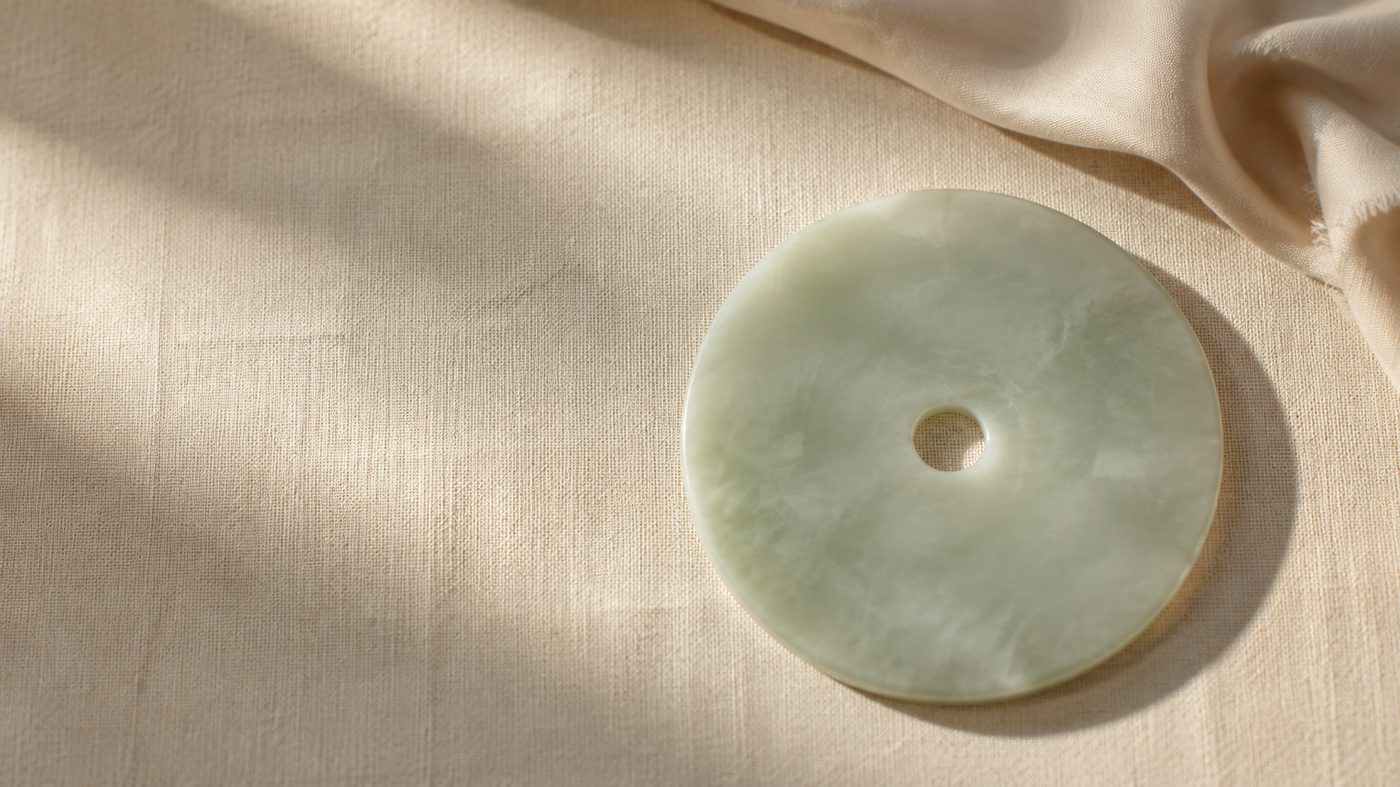
Jade in the form most people meet it, worn against the skin. The ritual shapes are further
down. Illustration, not a photograph of a specific object.
Two thousand years before anyone wrote it down
Everything on the rest of this page comes from books. The books are late.
At Liangzhu, on the Yangtze delta, a city was built and occupied between roughly 3300 and
2300 BCE, and its graded cemeteries were filled with worked jade. UNESCO, which inscribed
the site on the World Heritage list in 2019, describes those jade objects as the things that carry
the society's belief system: not grave goods that happen to be valuable, but the medium
the belief was expressed in. Among them are discs and squared tubes.
Hold that against the dates. Chinese writing appears on oracle bones around 1250 BCE. The
Zhou li, which we are about to watch assign each jade shape to a quarter of the
cosmos, is later still. So the shapes came first, by something like two thousand years,
and the texts arrived long afterward to explain objects people had already been making for
eighty generations.
This is worth knowing before reading any confident sentence about what a jade disc
meant. The Zhou ritualists were not inventing a system. They were writing
documentation for one that was already ancient when they found it, and we have no way to
ask the people at Liangzhu whether the documentation is right.
UNESCO, Archaeological Ruins of Liangzhu City (World Heritage list).
Five virtues, or eleven?
Here is a small thing that almost every English page about jade gets wrong, and it is wrong
in an unusually specific way: it tells you jade has five virtues, and stops.
Five is a real number with a real source. The Shuowen Jiezi, the first Chinese
dictionary, compiled around 100 CE, opens its jade section with a definition of admirable
brevity: jade is the beautiful among stones, and it has five virtues. Each one is read off
a physical property of the rock.
Warm and moist to the touchbenevolence
Its inner structure readable from outsiderighteousness
A note that carries farwisdom
It breaks rather than bendscourage
Sharp-edged without cuttingintegrity
So five is correct. It is also not the only count, and the other one is older. Three
centuries before that dictionary, the Liji, the Book of Rites, has the disciple
Zigong ask Confucius why a gentleman prizes jade and thinks little of the lesser stone that
looks like it. Confucius denies the obvious answer, that jade is simply rarer, and instead
lists eleven qualities jade resembles: benevolence, intelligence,
righteousness, humility, music, loyalty, good faith, heaven, earth, virtue, and the way
itself. That exchange, and what it is doing in a chapter about crystals, is set out on our
feng shui and crystals page.
What matters here is that the two lists do not reconcile. They are not the same eleven with
six removed; they overlap without matching, because they were built for different
arguments. The dictionary is describing a mineral, and finds five properties worth naming.
The Book of Rites is describing a person, and needs eleven. Neither the tradition nor
anyone since has felt obliged to merge them.
If you have read that jade has five virtues and stopped there, you have the lexicographer's
answer and not the philosopher's.
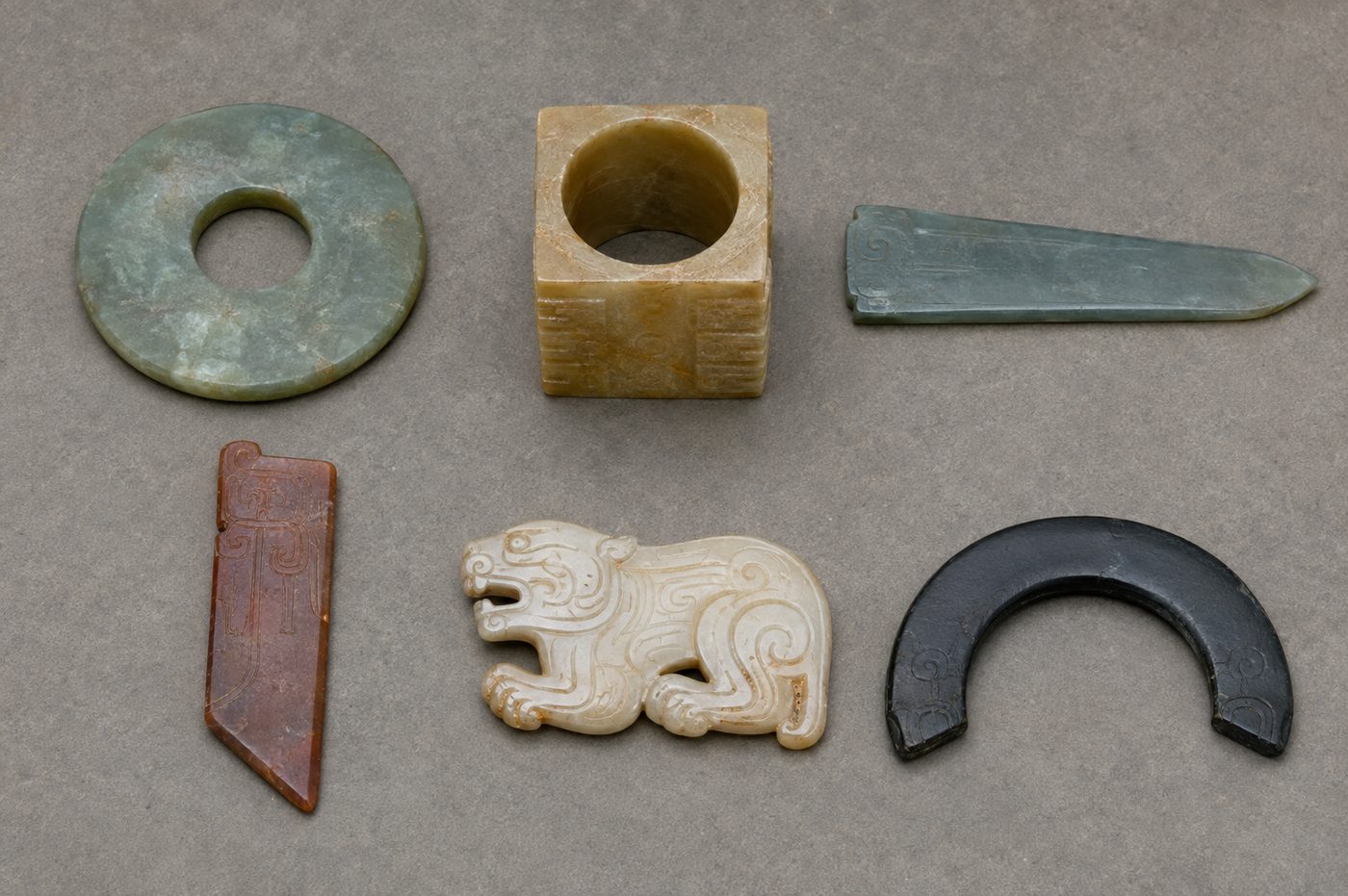
Around the third century BCE the Zhou li, the Rites of Zhou, laid out the duties of
the state's ritual officials in exhaustive administrative detail, and among them is one
line that fixes jade into the structure of the cosmos. Six jade objects, it says, are made
to perform the rites for heaven, earth and the four directions. Each has its own shape, its
own color and its own address.
Object
Shape
Color
Addressed to
bi
Flat disc with a hole through the center
Green
Heaven
cong
Square tube with a round bore
Yellow
Earth
gui
Long pointed tablet
Blue
East
zhang
Tablet with an angled tip
Red
South
hu
Plaque carved as a tiger
White
West
huang
Half-ring, an arc
Black
North
The six, in the order the text gives them. Illustration of the types, not photographs of
specific surviving objects.
The sacrificial offerings accompanying each, the text adds, take the color of their jade.
Read the first two rows again and the logic surfaces. The disc addressed to heaven is round
and pierced; the tube addressed to earth is square outside and round inside. Round heaven,
square earth. These objects are not symbols laid on top of a cosmology. They are the
cosmology, cut into stone you can pick up.
Zhou li, Chun Guan Zong Bo, section 60.
And the six that are not those
Two entries earlier in the same chapter, the Zhou li defines a
second set of six jades. Not for heaven and earth. For people.
These are the rank tokens, held to distinguish the states of the realm: the king holds one
form, and below him a duke, a marquis, a count, a viscount and a baron each hold a
different one, four of them tablets and two of them discs. Hold up your jade and it says
what you are.
This matters because English writing on jade routinely merges the two sets into a single
vague list of six ritual jades, which produces the odd impression that a tiger plaque and a
baron's disc were doing the same job. They were not. One set addresses the cosmos and one
set ranks the aristocracy. They sit two entries apart in the same chapter, which suggests
the compilers were not confused even if their later translators were.
Zhou li, Chun Guan Zong Bo, section 58.
You cannot carve jade
Here is the fact that makes everything above cost something.
Jade cannot be cut. It is not especially hard, but it is extraordinarily tough, an
interlocking felt of mineral fibers that blunts a blade instead of parting under one. A
bronze tool will not carve it. Neither will a steel one. The only way to shape jade is to
wear it away, with a softer tool dragging a harder grit across the surface, hour after
hour, until the sand has ground a groove. What looks like carving is abrasion.
The tradition knew this and put it in a poem. The Shijing, the Book of Songs,
twice ends a stanza on the same image: the stones of those other hills can be made into a
grindstone, and the stones of those other hills can be used to work jade. It is one of the
oldest lines in Chinese literature about how anything is made, and what it describes is
not a chisel. It is sand from somewhere else.
Now go back and count. A ritual disc the width of a hand, ground flat on both faces and
pierced through the middle with abrasive alone. Thousands of small jade plaques, each one
drilled at four corners, enough to cover a body. Those objects are not expensive because
the material is rare. They are expensive because someone spent a year of their life
rubbing.
Which is why the most quoted jade sentence in Chinese is about neither beauty nor money.
Jade uncut will not become a vessel, says the Book of Rites, and a person who does not
learn will not know the way. The proverb survives because everyone who used it understood
exactly how much work the first half described.
Shijing, Minor Odes, He Ming; Liji, Xue Ji, section 2.
The seal that made an emperor
The most valuable piece of jade in Chinese history is missing, and has been since 936.
Its story starts, in the earliest telling, as a story about feet. A man of Chu named Bian
He finds an unworked jade matrix in the mountains and presents it to his king. The court's
jade expert examines it and says: it is a rock. The king has Bian He's left foot cut off
for lying. A reign later he tries again with the next king, gets the same verdict from the
same profession, and loses the right foot. When a third king comes to the throne, Bian He
does not go to court. He sits at the foot of the mountain holding his stone and weeps for
three days and three nights, until the tears run out and he cries blood. Asked what he is
grieving for, he says: not my feet. I am grieving that a treasure is called a rock and an
honest man is called a liar. The king has the stone cut open. Inside is jade, and it is
named after him.
Two things about that story are usually left out.
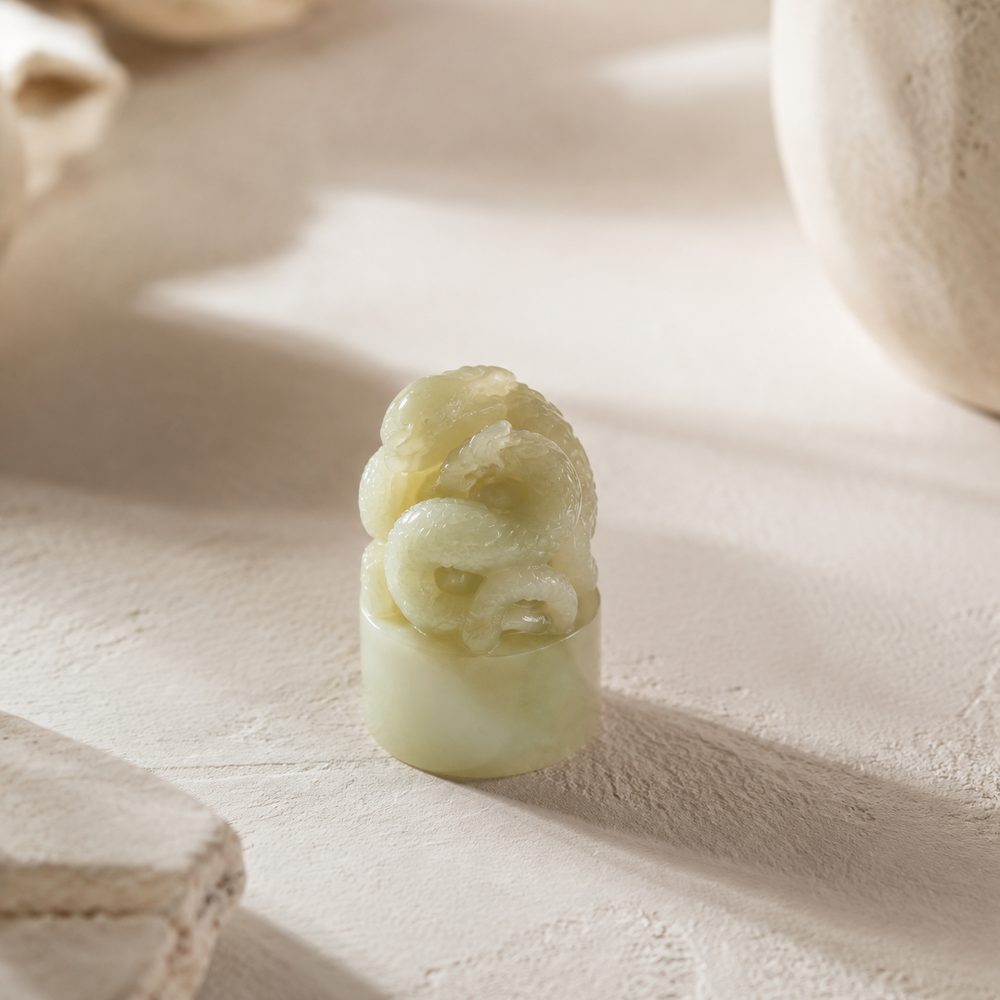
An imperial seal is identified by its handle. The face is not shown here on purpose: the
record preserves three different readings of the Heirloom Seal's inscription, and a
picture cannot footnote which one it is choosing.
The first is what it is doing there. It comes from the Han Feizi, and Han Fei is
not telling a jade story. The chapter runs straight on from Bian He to Wu Qi, torn limb
from limb, and Shang Yang, pulled apart by chariots, and the argument being made is about
the fate of men who bring a ruler something valuable that the court is not equipped to
recognize. The jade is a figure for statecraft. Almost every English retelling keeps the
amputations and drops the argument.
The second is what happened to the stone. It became a disc, the disc passed to the state of
Zhao, and when Qin unified China the First Emperor had it carved into a seal: four inches
square, the handle a knot of five coiled dragons, the inscription cut in small seal script
and attributed to his chancellor Li Si. That object, the Heirloom Seal of the Realm, then
spent a thousand years as the physical answer to the question of who was legitimately in
charge. It is thrown to the ground by a furious empress dowager and chips a corner. It is
fished out of a well. It passes to Wei, to Jin, goes missing, comes back, crosses six
dynasties, is carried off to the Turks by an empress, and is returned to the Tang in 630,
by which point the emperor had given up and carved himself a replacement. In 936 the last
Later Tang emperor burned himself to death, and the seal has not been seen since.
And the inscription? English pages give you one reading, confidently: having received the
Mandate from Heaven, may he live long and prosper. The Chinese record does not agree with
itself. The commentary to the Hou Han shu gives that reading. The
Jin shu and Du You's Tongdian give a different wording. The
Jin yang qiu gives a third. A Qing scholar set all three side by side and left the
disagreement standing, which is the honest thing to do with it.
Han Feizi, He Shi; the seal's form and transmission from the Yuxi ji, with
the inscription attributed to Li Si in the Yuxi pu as quoted in
Taiping Yulan 682; the three competing readings collated in
Gaiyu congkao 20.
Sewn into jade
The Han dynasty buried its emperors inside the stone.
The procedure is set down in the Treatise on Ritual of the Hou Han shu, with an
older handbook quoted in the commentary, and it is startlingly matter-of-fact about what it
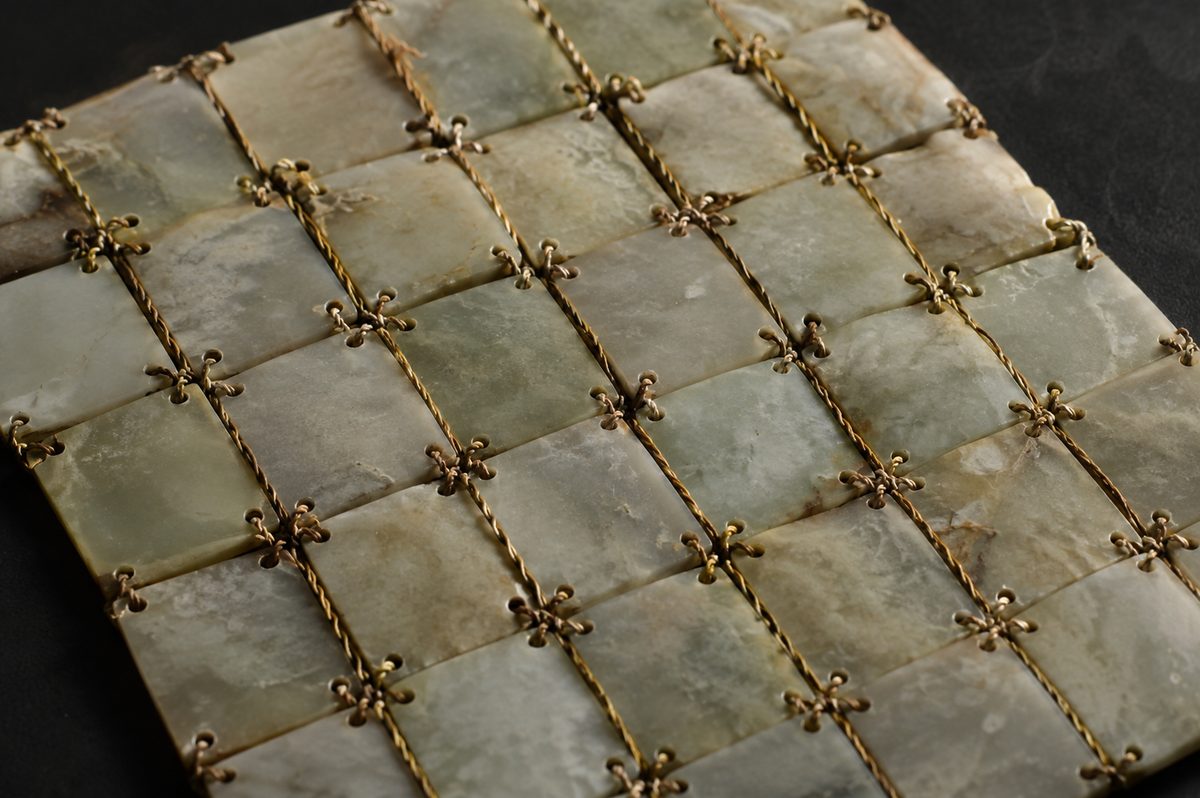
describes. Jade is made into a jacket, shaped like armor, the pieces sewn together with
gold wire. Below the waist, jade tablets a foot long and two and a half inches wide
continue the covering down to the feet, stitched the same way.
Plaques drilled at the corners and stitched with twisted wire. Illustration, not a
photograph of a specific surviving object.
The wire was graded, and the grades are the whole point. Gold for the emperor. Silver for
kings and marquises. Copper for honored consorts and grand princesses. Even at the moment
of being sealed into a stone shell for eternity, you were sealed in at your correct rank.
One precision worth having, since getting this sort of thing right is the reason this site
exists: the histories do not call this a suit of clothes. The word they use means a case, a
box, the thing you keep something in. Jade burial suit is a modern archaeological name, and
a good one, but it is ours and not theirs. The Han court thought it was packing something
away.
Why do it at all? The texts are less forthcoming than we would like, and rather than fill
the silence it is worth saying plainly that the ritual manuals describe this practice far
more thoroughly than they explain it.
Hou Han shu, Treatise on Ritual, juan 96, with the Han jiu yi quoted in
commentary; the rank grades from the same treatise as quoted in Beitang shuchao 131.
The stone got into the language and stayed
Chinese characters are built from components, and one of them is jade. Open the
Shuowen Jiezi at the jade section and you are reading a list of words a culture
decided belonged to this material. Some are predictable. Treasure is there. So is the verb
for handling something pleasurable, which is why the modern Chinese word for a collectible
curio still carries it.
Then there are three entries in a row, and the dictionary gives all three the same
four-character definition: to work jade. The first is the ordinary word for
carving a stone. The second is a word for engraving. The third is
li, which in modern Chinese means reason, principle, logic, the grain of
an argument, the thing you are being when you are being reasonable. Its original sense was
a jade-worker's.
The route from one to the other is short and completely legible. Jade has grain. To work
it you read the grain and follow it, because a cut across the structure fails and a cut
along it succeeds. Do that to a stone and you are shaping it. Do it to a problem and you
are analyzing it. The Qing commentator Duan Yucai makes the link explicit, glossing the
entry with a line from the Zhanguo ce about unworked jade and concluding that the
word means, at root, to split something along what is already inside it.
A civilization that spent four thousand years grinding this particular rock ended up
using the word for grinding it whenever it wanted to say make sense of something.
That is not a metaphor anyone chose. It is a fossil.
Shuowen Jiezi, book 1, jade section, the entries for zhuo, diao and li; Duan
Yucai's commentary, citing the Zhanguo ce.
Jade you can actually hold
Almost none of the above is for sale, which raises the fair question of what any of it has
to do with the bangle on your wrist.
More than you would think. The ruyi, the curved ceremonial scepter with a
head like a stylized cloud, is the ritual object that made it into ordinary life. Its name
means, roughly, as you wish. It went from a court presentation piece to the thing
carved small and given at weddings and birthdays, which makes it the six ritual jades'
distant and much more cheerful descendant.
Jade also went into names. The character for jade and its relatives are among the most
common elements in Chinese given names, especially for daughters, so a very large number of
people are walking around called some version of jade, fine jade, or
jade of the mountains. If you want yours, the
Chinese name generator will build one and tell you what it
means.
And if the piece you are holding right now came with no paperwork and a family story
instead, the rest of this cluster is about that piece specifically: what it is made of,
whether it has been treated, what the carving on it is saying, and what any of it is worth.
The rest of the cluster
This page is about what jade has meant. These five are about the piece in your hand.
Jadeite against nephrite, what imperial jade actually means, and the stones sold as jade
that are not jade. Also why every object on this page is the cheaper of the two minerals.
What a worn piece says: the classical rule about never taking jade off, the motif puns on
pendants, and which of the modern beliefs have a source behind them.
A calculator and the method behind it: why a bangle is sized to your knuckles rather than
your wrist, and why this is the one measurement that can never be revised.
Moral character, more than wealth or luck. The classic statement is in the Liji, the Book of Rites, where Confucius explains that a gentleman values jade not because it is rare but because its physical properties resemble the virtues: its warmth is like benevolence, the note it gives when struck is like music, and its willingness to break rather than bend is like courage. Later usage keeps that frame. Calling a person jade-like in Chinese is a remark about their character, not their bank balance.
Why is jade so important in China?
Because it was load-bearing in three systems at once. It was the ritual material addressed to heaven and earth in the Zhou li, the material of the rank tokens that said who outranked whom, and the material in which an emperor’s legitimacy physically resided, in the form of the Heirloom Seal of the Realm. No other substance in Chinese culture carries all three jobs, and gold carries none of them.
What are the six ritual jades?
Six jade forms specified in the Zhou li for the rites to heaven, earth and the four directions: a green disc for heaven, a yellow square tube for earth, a blue pointed tablet for the east, a red angled tablet for the south, a white tiger plaque for the west, and a black half-ring for the north. They are frequently confused with a second set of six defined two entries earlier in the same chapter, which are rank tokens for the nobility rather than ritual vessels.
What was written on the imperial jade seal of China?
The record disagrees with itself, which is worth knowing before trusting any single confident answer. The commentary to the Hou Han shu reports one inscription; the Jin shu and Du You’s Tongdian report a different wording; the Jin yang qiu reports a third. The most widely quoted version says the holder received the Mandate from Heaven and should enjoy long life and lasting prosperity. The seal itself has been missing since 936.
Did Chinese emperors really wear jade burial suits?
Yes, and the practice was regulated by rank. The Treatise on Ritual in the Hou Han shu describes the body being covered in jade plaques shaped into a jacket like armor and sewn with gold wire, continuing below the waist down to the feet. Kings and marquises got silver wire instead of gold, and honored consorts and grand princesses got copper. The histories call the object a case rather than a garment.
Sources
Every claim on this page traces to one of these, read directly rather than through an English
summary. Where a passage is quoted in English the wording is James Legge's, which is in the
public domain.