Chinese Mythology
Caishen: The Chinese God of Wealth Who Began as a Plague General
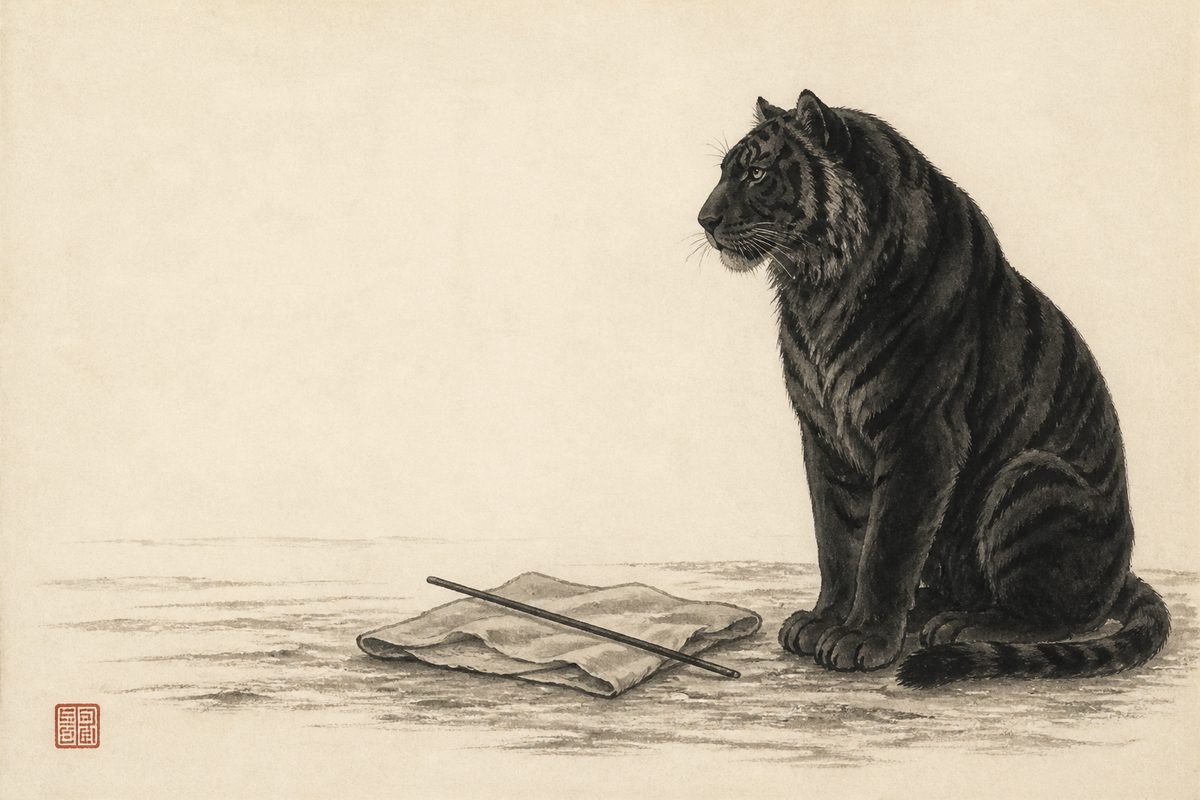
Caishen, 财神 (cáishén), is the Chinese god of wealth, and the name is a job title rather than a person: at least five different men have held the post. The one on the black tiger, Zhao Gongming, enters the written record in the fourth century as a commander of plague, sent down with ghost troops to fill a quota of the dead. His promotion to the money department took about twelve hundred years, and the paperwork survives.
Every year, in the first week of the lunar new year, several hundred million people welcome home a god whose name is not a name.
You have seen him. He is on the wall behind the till, on the free calendar from the herbalist, on the foil packet the sweets came in: a beaming old gentleman with a white beard and a court official's winged cap, holding out a boat-shaped ingot of gold. People call him Caishen, 财神 (cáishén). That is not what he is called. That is what he does. It means the Wealth God in roughly the way that Chief Medical Officer means the person currently holding that post, and like any post it has had a succession of holders, several of them at once, in different provinces, with the public entirely unbothered by the overlap.
So the question everyone asks first, which is who Caishen actually is, has no clean answer. What it has instead is a paper trail. At least five men have held the office. And the one who holds it most often, the one on the black tiger, walks into the Chinese written record in the fourth century in a role that has never appeared on a new year calendar.
He is running an epidemic.
The oldest thing written about him is a death list
The story comes from the Soushen ji, the Records of an Inquest into the Spirit-Realm, compiled in the fourth century by Gan Bao, an official historian of the Jin who put together several hundred accounts of hauntings, portents and returns from the dead. His collection was later broken up and scattered, and this particular story survives because the compilers of the Taiping Guangji, the enormous imperial anthology finished in 978, copied it into their scroll on divinities and noted where they got it.
A court gentleman named Wang You is dying. He has already said his goodbyes to his mother. Then a visitor is announced: a man from his own district, of his own social class, formerly an aide to a provincial governor, whose name Wang You knows. The man arrives, sits down, and explains himself with the particular ease of an official on assignment far from home who has found a compatriot.
This year the state has a great matter in hand. Three generals have gone out, distributing the call-up. Some ten of us serve as staff officers in the bureau of Zhao Gongming. We arrived here in a rush, saw that you had a fine tall house, and so came to impose on you.
Read that again, because the machinery in it is extraordinary. The visitor is a ghost. The great matter of state is an epidemic. The call-up being distributed is the list of who dies. And the dead of that season are being processed not by a demon or a devil or anything with horns, but by a bureau, staffed by ten or so administrators, working under a named general who has an office and a chain of command. Death by disease, in fourth-century China, was imagined as conscription paperwork.
Wang You, who is an official himself and therefore knows how these things work, does the sensible thing and pleads his case. He has an aged mother, no brothers, nobody to support her. The ghost is moved, points out that a man holding high office whose house has no savings must be a decent sort, and takes him off the list. He cures him by pouring a cup of water under his bedclothes, which in the morning is still lying there unabsorbed, like dew on a lotus leaf, and which Wang You's household, being thorough, gets out a measure and measures. Everybody else the ghost named dies on schedule.
Then comes the line that makes the story evidence rather than an anecdote:
There had been an irregular text going about which said: the Emperor on High has sent three generals, Zhao Gongming and Zhong Shiji, each in charge of some tens of thousands of ghosts, down to take people. Nobody knew where it came from. When Wang You recovered he saw this text, and it agreed with what he had been told about Zhao Gongming.
So the name was in circulation before the story. Somewhere in fourth-century China there were pamphlets going around naming the officers in charge of the current outbreak, the way a rumor names the men behind a purge, and Zhao Gongming was on them. He is not a character invented for a ghost story. He is the season's plague, with a name and a rank.
The Daoist canon files him the same way. The Scripture of the Divine Incantations of the Cavern Abyss runs through a long and frankly magnificent roster of disease demons, each with a headcount, and partway through arrives at seven named kings who divide the epidemics between them: Liu Yuanda, Zhang Yuanbo, Zhao Gongming, Li Gongzhong, Shi Wenye, Zhong Shiji and Shao Dufu, each with a quarter of a million wounding spirits under him. Zhong Shiji is there too, the same colleague from the same pairing. I would not lean hard on the date of that particular scroll, since the scripture accumulated over centuries and its later sections are much younger than its early ones. Gan Bao carries the weight on his own.
Promoted, with the plague still on his file
Now jump a thousand years or so, to a Ming-dynasty illustrated encyclopedia of gods called the Complete Compendium of the Deities of the Three Religions, which gives each deity a woodblock portrait and a short official biography. Marshal Zhao is in the third scroll, and he has come up in the world.
He has a respectable origin now. He is surnamed Zhao, named Gongming, a man of the Zhongnan mountains who withdrew there during the Qin to cultivate the Way, achieved it, and was summoned into the celestial administration. Nothing about a quota. Nothing about ghost troops. The plague general has been given a hermitage and a career path.
He has also acquired the look he still has. The compendium describes the iron crown on his head, the iron rod in his hand, the black face and whiskers, and the tiger he rides, and then it does something no English page about him ever mentions: it explains each of those as a piece of elemental notation. The iron is metal meeting water. The black face is the breath of the north. The tiger is the shape of metal itself. His appearance is not a costume. It is a diagram.
And then the job description, which is where the whole story turns:
He drives the thunder and takes the lightning, summons the rain and calls the wind, dispels plague and cuts off the fevers, and turns away disaster: no merit is greater than the Marshal's. And as for grievances at law that have been suppressed, the lord can have them settled; in fair buying and selling and the seeking of wealth, the lord can make it profitable and harmonious. In any matter that is fair, one may pray before the god, and nothing goes unanswered.
Two things in that passage are worth stopping for.
The first is that he is still dealing in plague. He has not been reassigned. The man who once distributed the call-up now dispels the disease and cuts off the fevers, which is the same portfolio operated in reverse, and the text carries both facts in a single breath without any apparent sense that a career has been transformed.
The second is the clause everybody skips. The wealth power arrives bundled with a lawsuit power, and both are fenced by the same condition, stated twice for emphasis: fair buying and selling, and then, in case that was missed, in any matter that is fair. He is not a god of money. He is a god of things being settled properly, of whom money is one department. Pray to him about a crooked deal and, on the plain reading of his own job description, you are outside his remit.
His full title at the end of that entry runs to nearly eighty characters and takes in a Grand Commandant of the Jade Bureau of the Divine Empyrean, an Inspector of the Five Directions, a Superintendent of the Nine Provinces, a Great General of the Direct Palace, a Vice-Marshal of Thunder, an Attendant Censor of the North Pole, a Grand Commandant of the Three Realms and a Director-General of the Twenty-Eight Lunar Lodges, before finally arriving at Marshal Zhao. Not one word of it means wealth.
Where the money actually is
The version most people know comes from the Investiture of the Gods, the sprawling Ming novel about the fall of the Shang dynasty, in which Zhao Gongming fights on the losing side, is killed by sorcery involving a straw effigy and seven arrows, and turns up at the end among the several hundred souls being posted to divine office. In chapter 99 the strategist Jiang Ziya stands on the canonization terrace and reads out the appointments one after another, like an honors list. Zhao Gongming's runs:
We hereby invest you as the True Lord of the Dark Altar, Golden Dragon As-You-Wish, Orthodox Unity, Dragon and Tiger, commanding four upright gods beneath you, to welcome what is auspicious and receive blessing, and to pursue the runaway and arrest the absconded.
Once again, no money. His two stated duties are to welcome good fortune and to chase down fugitives, the second of which is a police function that folk practice would later read, with a certain logic, as debt collection. The wealth is entirely in the names of the four men assigned to work under him, and those names are not names either. They are job descriptions, and the novel prints them in a neat two-by-two block, which is the single most revealing thing on the page:
| The four under Marshal Zhao | What the title literally says | The department |
|---|---|---|
| Xiao Sheng, Heavenly Worthy Who Summons Treasure | summon + treasure | bringing wealth in |
| Cao Bao, Heavenly Worthy Who Receives Jewels | receive + valuables | taking wealth in |
| Chen Jiugong, Envoy Who Attracts Wealth | attract + wealth | acquisition |
| Yao Shaosi, Immortal Officer of Profitable Trade | profitable + market | the sale itself |
That is a wealth ministry with four staff and a boss who was hired for something else. Chinese religion is administrative to its bones, from the Kitchen God's annual report on your household straight up to the Jade Emperor receiving it, and the wealth god turns out to be no exception: he did not develop a talent for money, he was given a department that had one.
The last of those four titles has had an afterlife the other three have not. The word in it, lishi, meaning a profitable transaction, is old. It turns up in the Zuo Commentary, the great narrative history of the Spring and Autumn period, in a speech where a Zheng minister quotes an ancient covenant with the merchants of his state: if you have profitable trade and precious goods, we will not interfere. Two and a half thousand years later the same word is alive in Cantonese, spelled slightly differently, as lai see, which is what a Hong Kong family calls the red envelope your aunt presses into your hand at new year.
The two civil wealth gods
The martial wealth gods ride tigers and carry weapons and look after commerce, which is risky. The civil wealth gods wear court robes and look after the other kind of wealth, the sort that arrives as salary and is not supposed to be gambled. The two usual holders of that post are a murdered minister and a retired statesman, and both of them are in the Shiji, Sima Qian's history of the world as it stood around 91 BCE.
Bi Gan was a prince of the royal house and a kinsman of the last Shang king, and the Basic Annals of the Yin dispatch him in three sentences of appalling brevity. He remonstrated, on the principle that a minister must argue to the death. The king replied that he had heard a sage's heart had seven apertures. Then he cut Bi Gan open and looked.
Sima Qian says nothing about wealth, nothing about deification, and nothing about the heart being missing afterwards. What happened is that a much later folk tradition took the story literally and ran a piece of reasoning off it that is either very silly or rather beautiful, depending on the hour: a man without a heart cannot be moved by favor or grudge, cannot be flattered, cannot take against you, and is therefore the ideal patron for a marketplace, where the one thing everybody wants from an authority is that it not have a preference. Bi Gan is worshipped as a wealth god because of an organ he no longer has. That is folk logic laid on top of the history centuries later, and it deserves saying plainly, but it is folk logic with a genuine point in it.
Fan Li is the happier story, and the Shiji gives him a whole section of the Biographies of the Money-Makers. He was the strategist who spent twenty years engineering the revenge of the king of Yue, and who, at the moment of triumph, worked out what usually happens next to men who know too much, got into a small boat, changed his name, and went into trade. He settled at Tao, which he chose because it sat in the middle of the country where the roads of the feudal states met and goods changed hands. The trading maxim he took with him is one the Shiji puts in the mouth of his old teacher Ji Ran: sell the dear thing as though it were dung, buy the cheap thing as though it were a pearl, and let money and goods move like running water.
In the course of nineteen years he made a thousand in gold three times, and twice scattered it among poor friends and distant kin. This is what is meant by a rich man who likes to practice his virtue. And so when people speak of the wealthy they all say Lord Zhu of Tao.
He is the Chinese god of wealth who is not a god of getting. He is the god of making a fortune, giving it away, and doing it again, and the last line tells you he was already a byword for money by the first century BCE, a thousand years and more before anyone thought to put him on an altar.
Which Caishen is on the wall
If you are looking at a Chinese wealth image and want to know what you are looking at, the sorting is quick.
Court robes, a placid expression, a scepter or an ingot held out in both hands, and no weapon anywhere: that is a civil wealth god, Bi Gan or Fan Li, and the wealth on offer is the steady kind. Armor, a beard, an iron rod, and a black tiger underneath: that is Zhao Gongming, and the wealth on offer is the commercial kind, with the risk that goes with it.
A red face and a long-handled blade is neither. That is Guan Yu, the third-century general who became the other martial wealth god, adopted by the merchants of Shanxi as the guarantor of a straight deal and carried along their trade routes until he ended up beside tills all over the world. His route into the office is completely different from Zhao Gongming's and his own page tells it properly, so he gets no more from me here than a nod and a direction.
And the winged, horned, lion-bodied creature on the jade bracelet is not a wealth god at all. That is the pixiu, a beast rather than a deity, whose entire reputation rests on an anatomical joke about having no way of letting gold out again. You can own a pixiu. You do not pray to it, and it holds no office.
The one you should be most suspicious of is the ceramic cat with the raised paw. That is not Chinese. It is the Japanese maneki-neko, one of the earliest records of which is an entry dated 1852 in a chronology of Edo, and it became so popular in Chinese restaurants and shops that it is now routinely sold as the Chinese lucky cat. It is a charming object with no claim whatsoever on the tradition described above.
Where in a room any of this should go, and which direction it should face, is a feng shui question rather than a mythological one, and it lives on our wealth-corner page.
The fifth day, and the scramble to be first
The god comes home on the fifth day of the first lunar month, which in the Gregorian calendar wanders around the back half of January and February and can be looked up on our Chinese calendar converter. The day is called po wu, the breaking of the five, because the taboos that hedge the first days of the year are lifted on it; where it sits among the sixteen days of Chinese New Year is on that page. You may sweep. You may take out the rubbish. Shops reopen. And the wealth god is received.
He is not the only god a shop feeds, and the two are worth keeping apart. The wealth god is asked for money, once a year, with gongs. The earth god is asked for the conditions that make money possible on this particular plot of ground, and in Fujian and Taiwan he is fed quietly on the second and sixteenth of every lunar month. One is a windfall; the other is a lease.
Our best account of what that looked like comes from Gu Lu, whose Records of the Delightful Year set down the customs of the Suzhou region in 1830, month by month:
The fifth day of the first month is the birthday of the Road-Head God. Brass gongs and firecrackers, the meat and the wine all set out, and since being first counts as profit itself, everyone rises early to receive him. This is called meeting the road-head.
The word Gu Lu uses for profit there, in the phrase about being first, is the same lishi that names the fourth of Marshal Zhao's four assistants. It had been in the language for two millennia by then and it was still doing the same work.
What followed was inevitable and is very human. If being first was itself lucky, then rising early was not enough, and households in Shanghai and elsewhere began receiving the god the previous midnight, on the fourth, to get ahead of the neighbors. The practice acquired a name that gives the game away entirely: grabbing the road-head. An arms race, in other words, conducted with gongs, at midnight, over a god who is supposed to reward fair dealing.
There is one more thing hiding in Gu Lu's entry, and it quietly corrects the most common misunderstanding about the day. He notes that the road-head of his time was the traveling god among the five household sacrifices, and that the five roads must simply mean east, west, south, north and center. The Five-Road Wealth God, in other words, was never five gods. He was one god of roads, facing five ways, on the sensible theory that money comes to a household from somewhere and you may as well cover the approaches. The five gods on the modern print, one for each direction, are what happens when a phrase outlives its own grammar.
Is manifesting real? What the tradition does instead
Manifesting, in the form most people meet it now, holds that a wish held clearly enough in the mind draws its object toward you: write the figure down, picture the house, feel as though the money has already arrived. The idea has an American pedigree rather than a Chinese one. The phrase law of attraction turns up in 1855 in a book by the Spiritualist Andrew Jackson Davis, and it reached most of its present audience through Rhonda Byrne's The Secret in 2006. On the question the search box is really asking, the honest answer is short. There is no scientific evidence that a thought, on its own, moves money toward the person thinking it.
The Chinese wealth cult is an interesting thing to set beside it, because it asks almost nothing of your inner life. Nobody receiving the god on the fifth day is told to believe, or to visualize, or to feel rich already. They are told to get up early, strike the gong, set out the meat and the wine, and be first. Gu Lu's account from 1830 is almost entirely about behavior: a date, a list of offerings, and a race. The god is an official, and you do not manifest an official. You call on him on the day his office is open, with something in your hands.

The second difference is that the office has terms. The Ming job description for Marshal Zhao, quoted above, makes his help with money conditional twice over: fair buying and selling, and any matter that is fair. The civil gods carry the same condition in their biographies. Fan Li is remembered in the Shiji for getting rich three times and giving it away twice. Bi Gan, in the later folk reading, is trusted because a man with no heart cannot play favorites. Guan Yu got the job from merchants who needed a guarantor for a straight deal. Behind all of them stands a line from the Analects:
Wealth and rank are what people desire; if they are not obtained by the right way, one does not keep them.
Put together, the tradition's answer to how you get money has three parts, and none of them is a state of mind. Turn up on the date. Bring something. Deal fairly, because the god you are asking only takes fair cases.
The two ideas do meet at one point, and it is not the point the manifesting books would choose. Psychologists have tested what happens when people vividly imagine the outcome they want. In a study of graduates looking for work, Gabriele Oettingen and Doris Mayer found in 2002 that those who indulged in positive fantasies about the future sent out fewer applications, and that the lower effort went with less success. A 2011 follow-up by Heather Barry Kappes and Oettingen found that such fantasies measurably lowered people's energy, down to their systolic blood pressure. Picturing the result can feel enough like having it that the work stops. The fifth-day ritual never lets a wish stand on its own. It ties the wish to an alarm clock and a shopping list.
None of this makes the offering table a mechanism either. The tradition never claimed the god was a law of nature. It treated him as a patron, and a patron is asked, not operated. If you want what the practice actually offers, you can take its structure and leave the metaphysics wherever you prefer to keep it: a fixed day each year to take stock of your money, something given before anything is asked, and a rule that the gain has to be one you could explain to a man with no heart.
What the record actually shows
There is no moment you can point to. No emperor issued an edict transferring Zhao Gongming from disease to finance, and no text announces the change. The Ming compendium has him cutting off fevers and blessing fair trade in the same paragraph, perfectly content, which suggests the two jobs overlapped for a very long time before one of them quietly became the whole of him.
That is probably the right way to read it. A god who commands the epidemic is a god who decides which households are ruined this year, and a god who decides which households are ruined is not, in a peasant economy, very far from a god who decides which households prosper. The department was always about who gets wiped out. Somewhere between the fourth century and the Ming, people stopped asking him to spare them and started asking him to pay them, and he was in a position to do both.
His four assistants, meanwhile, are still standing behind him on every new year print, holding the treasure bowls, doing the work their names describe. He is the one with the sword and the tiger and the enormous title, and they are the ones with the money. Anyone who has worked in an office will recognize the arrangement.
In the classics
The passages behind the story, in the standard published translations. Open any one for the original text.
“This year the state has a great matter in hand. Three generals have gone out, distributing the call-up. Some ten of us serve as staff officers in the bureau of Zhao Gongming. ”
Original text
今年國家有大事,出三將軍,分佈徵發。吾等十餘人,為趙公明府參佐。
“There had been an irregular text going about which said: the Emperor on High has sent three generals, Zhao Gongming and Zhong Shiji, each in charge of some tens of thousands of ghosts, down to take people. Nobody knew where it came from. When Wang You recovered he saw this text, and it agreed with what he had been told about Zhao Gongming. ”
Original text
初有妖書云:「上帝以三將軍趙公明、鍾士季,各督數萬鬼下取人。」莫知所在。祐病差,見此書,與所道趙公明合焉。
“There are also Liu Yuanda, Zhang Yuanbo, Zhao Gongming, Li Gongzhong, Shi Wenye, Zhong Shiji and Shao Dufu, each commanding two hundred and fifty thousand wounding ghost-spirits, and spreading epidemic disease. ”
Original text
又有劉元達、張元伯、趙公明、李公仲、史文業、鍾仕季、少都符,各將五傷鬼精二十五萬人,行瘟疫病。
“He drives the thunder and takes the lightning, summons the rain and calls the wind, dispels plague and cuts off the fevers, and turns away disaster: no merit is greater than the Marshal's. And as for grievances at law that have been suppressed, the lord can have them settled; in fair buying and selling and the seeking of wealth, the lord can make it profitable and harmonious. In any matter that is fair, one may pray before the god, and nothing goes unanswered. ”
Original text
驅雷得電,喚雨呼風,除瘟剪瘧,禳災,元帥之功莫大焉。至如訟冤伸抑,公能使之解釋;公平買求財,公能使之宜利和合。但有公平之事,可以對神禱,無不如意。
“We hereby invest you as the True Lord of the Dark Altar, Golden Dragon As-You-Wish, Orthodox Unity, Dragon and Tiger, commanding four upright gods beneath you, to welcome what is auspicious and receive blessing, and to pursue the runaway and arrest the absconded. ”
Original text
特敕封爾為金龍如意正一龍虎玄壇真君之神;率領部下四位正神,迎祥納福,追逃捕亡。
“In the course of nineteen years he made a thousand in gold three times, and twice scattered it among poor friends and distant kin. This is what is meant by a rich man who likes to practice his virtue. And so when people speak of the wealthy they all say Lord Zhu of Tao. ”
Original text
十九年之中三致千金,再分散與貧交疏昆弟。此所謂富好行其德者也。…故言富者皆稱陶朱公。
“Bi Gan said: one who serves as a minister has no choice but to fight to the death. So he remonstrated with Zhou insistently. Zhou said in anger: I have heard that a sage's heart has seven apertures. He cut Bi Gan open and looked at his heart. ”
Original text
比干曰:「為人臣者,不得不以死爭。」迺強諫紂。紂怒曰:「吾聞聖人心有七竅。」剖比干,觀其心。
“The fifth day of the first month is the birthday of the Road-Head God. Brass gongs and firecrackers, the meat and the wine all set out, and since being first counts as profit itself, everyone rises early to receive him. This is called meeting the road-head. ”
Original text
正月初五日,為路頭神誕辰。金鑼爆竹,牲醴畢陳,以爭先為利市,必早起迎之,謂之接路頭。
“Wealth and rank are what people desire; if they are not obtained by the right way, one does not keep them. ”
Original text
富與貴,是人之所欲也,不以其道得之,不處也。
Questions people ask
Who is the Chinese god of wealth?
Caishen is the Chinese god of wealth, and the word is a title rather than a personal name, so more than one figure holds it. The most widespread identification is Zhao Gongming, the martial wealth god who rides a black tiger and carries an iron rod. Others include Bi Gan and Fan Li on the civil side, and Guan Yu as a second martial option. Households and shops pick one, and the tradition has never required them to agree.
Is Caishen the Chinese god of money, or the god of fortune?
In English all three phrases, god of money, god of fortune and god of wealth, usually lead to him, and for money and wealth that is right. Fortune is a different office. Fortune in the Chinese sense, being blessed and on the right side of heaven, belongs to Fu, the first of the three star gods Fu Lu Shou, the figure in the red robe beside Rank and Longevity. Caishen's own remit is narrower than money, too: the Ming description of his office, discussed further down this page, grants profit only in fair buying and selling, which makes him less a god of cash than a god of deals done properly.
Is Caishen the same as Guan Yu?
No, but Guan Yu is one of the men who holds the office. Chinese practice divides wealth gods into civil and martial types, and Guan Yu is a martial one, adopted by Shanxi merchants as the guarantor of commercial honesty and carried along their trade routes. Zhao Gongming is the other, and older, martial wealth god. If the figure on the shrine has a red face and a long-handled blade, that is Guan Yu; if he rides a black tiger, that is Zhao Gongming.
What do you do on the fifth day of Chinese New Year?
The fifth day of the first lunar month is when the god of wealth is received. Gu Lu's Records of the Delightful Year, an 1830 account of customs around Suzhou, describes gongs, firecrackers, meat and wine set out, and everybody rising early because being first was itself considered lucky. In Shanghai the competition pushed the whole business back to midnight on the fourth day, a practice known as grabbing the road-head. The day is also called po wu, the breaking of the five, when the taboos of the first days of the year are lifted and shops reopen.
Is the lucky cat Chinese?
No. The beckoning cat is Japanese, the maneki-neko, and one of the earliest records of it is an entry dated 1852 in a chronology of Edo. It became so popular in Chinese shops and restaurants that it is now widely assumed to be Chinese and is often called the Chinese lucky cat. The Chinese wealth figures are Caishen himself and the pixiu, the beast that swallows gold and has no way of letting it out again.
How do you pronounce Caishen?
Caishen is written 财神 and pronounced cáishén, roughly tsigh-shun, with the first syllable rhyming with English sigh. Cai means wealth or property and shen means god or spirit. Zhao Gongming, the martial wealth god, is pronounced roughly jow gong-ming.
Related figures
Sources & further reading
- Extensive Records of the Taiping Era (太平广记), scroll 294, the Wang You entry, attributed to the Soushen ji
- Scripture of the Divine Incantations of the Cavern Abyss (太上洞渊神咒经), scroll 11
- Complete Compendium of the Deities of the Three Religions (三教源流搜神大全), scroll 3, the Marshal Zhao entry
- Investiture of the Gods (封神演义), chapter 99, the canonization roll
- Records of the Grand Historian (史记), scroll 129, Biographies of the Money-Makers
- Records of the Grand Historian (史记), scroll 3, Basic Annals of the Yin
- Zuo Commentary (春秋左氏传), 16th year of Duke Zhao, the earliest use of the word lishi
- Maneki-neko (Wikipedia), the beckoning cat is Japanese, first recorded in an Edo chronology for 1852
- Caishen (Wikipedia), the civil and martial rosters and the Five Roads framework
- Analects (论语), book 4, Li Ren, 4.5: wealth not obtained by the right way is not kept
- Law of attraction (Wikipedia): the term in Andrew Jackson Davis, 1855; The Secret, 2006; no empirical scientific evidence
- Oettingen and Mayer (2002), The motivating function of thinking about the future: expectations versus fantasies, Journal of Personality and Social Psychology 83(5)
- Kappes and Oettingen (2011), Positive fantasies about idealized futures sap energy, Journal of Experimental Social Psychology 47(4)
By Julian 祝君瑜, retold from the classics, with the original passages cited, updated 2026-10-07