Chinese Mythology
Fu Lu Shou (福禄寿): The Three Star Gods of Fortune, Rank, and Long Life
Fu Lu Shou, 福禄寿 (Fú Lù Shòu), are the Three Star Gods of Chinese folk religion: Fortune, a red-robed official; Rank, a courtier holding a child; and Longevity, the bald old man with the enormous forehead, a staff, and a peach. Each began as a star, Jupiter, a star of the Big Dipper's Wenchang group, and Canopus, and each was later given a human biography. Bundled into a household trinity in the Ming dynasty, they stand in restaurants, cabinets, and jade carvings across the Chinese world, always in the same order, and always reading as a pun.
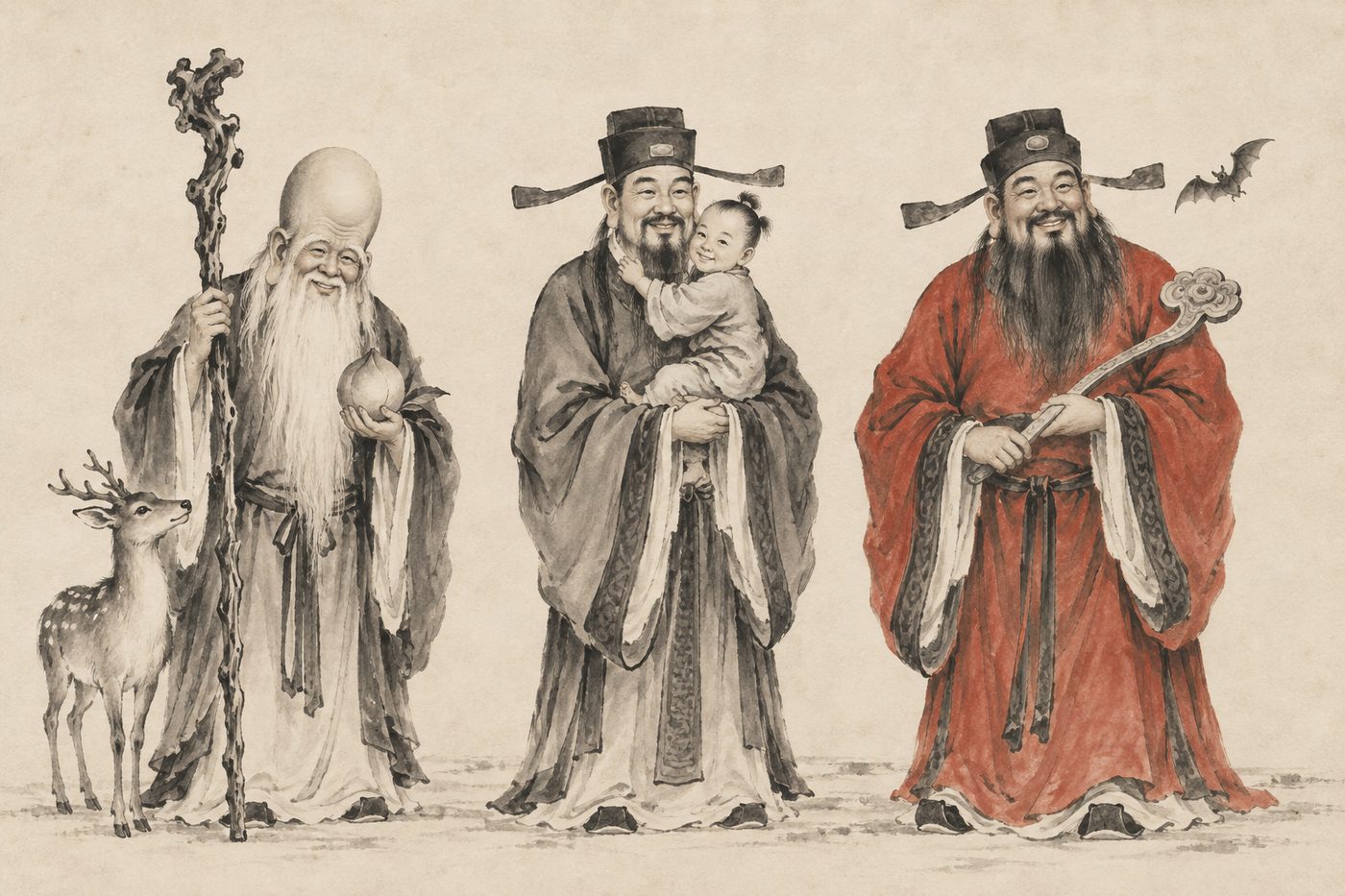
Three old men walk into a restaurant, and stay. You have seen them: on a shelf above the till, in a grandmother's glass cabinet, carved from a single lump of jade in a hotel lobby, printed on a birthday cake box. One wears red and holds a scepter. One wears an official's winged hat and holds a small child. One is bald, with a forehead like a second head, and carries a staff and a peach. They are Fu, Lu and Shou, Fú, fortune, Lù, rank, Shòu, long life, the Three Star Gods, and they are less a religion than a sentence: everything a Chinese family has ever wished for, standing in a row. What is not obvious from the shelf is that each of them is a real star, that the Han dynasty government sacrificed to one of them, that another is a real Tang official whose name the tradition spells wrong, and that the whole arrangement is a pun you can learn to read in five minutes.
Where you meet them
Everywhere the Chinese world has put down a shelf. The three figures are standard subjects of Chinese export porcelain, common enough that the collectors' reference site Gotheborg keeps a glossary entry for them. They are carved in jade, ivory, boxwood and soapstone, painted on New Year prints, embroidered on birthday hangings, and stood in a row in the reception of every Cantonese restaurant that has ever opened. Singapore has a shopping mall named for them, the Fu Lu Shou Complex on Rochor Road, several floors of religious goods, which is about as literal as a cult gets. Hong Kong cinema borrowed them for a joke: Sammo Hung's Lucky Stars action comedies of the 1980s, with Jackie Chan and Yuen Biao, take their Chinese title from the saying that the lucky stars are shining overhead. And in three-color jade, the stones with green, red and lavender or white in one piece, carvers call the material itself fu lu shou, one color per god, which is worth knowing before you buy a bangle.
Which one is which
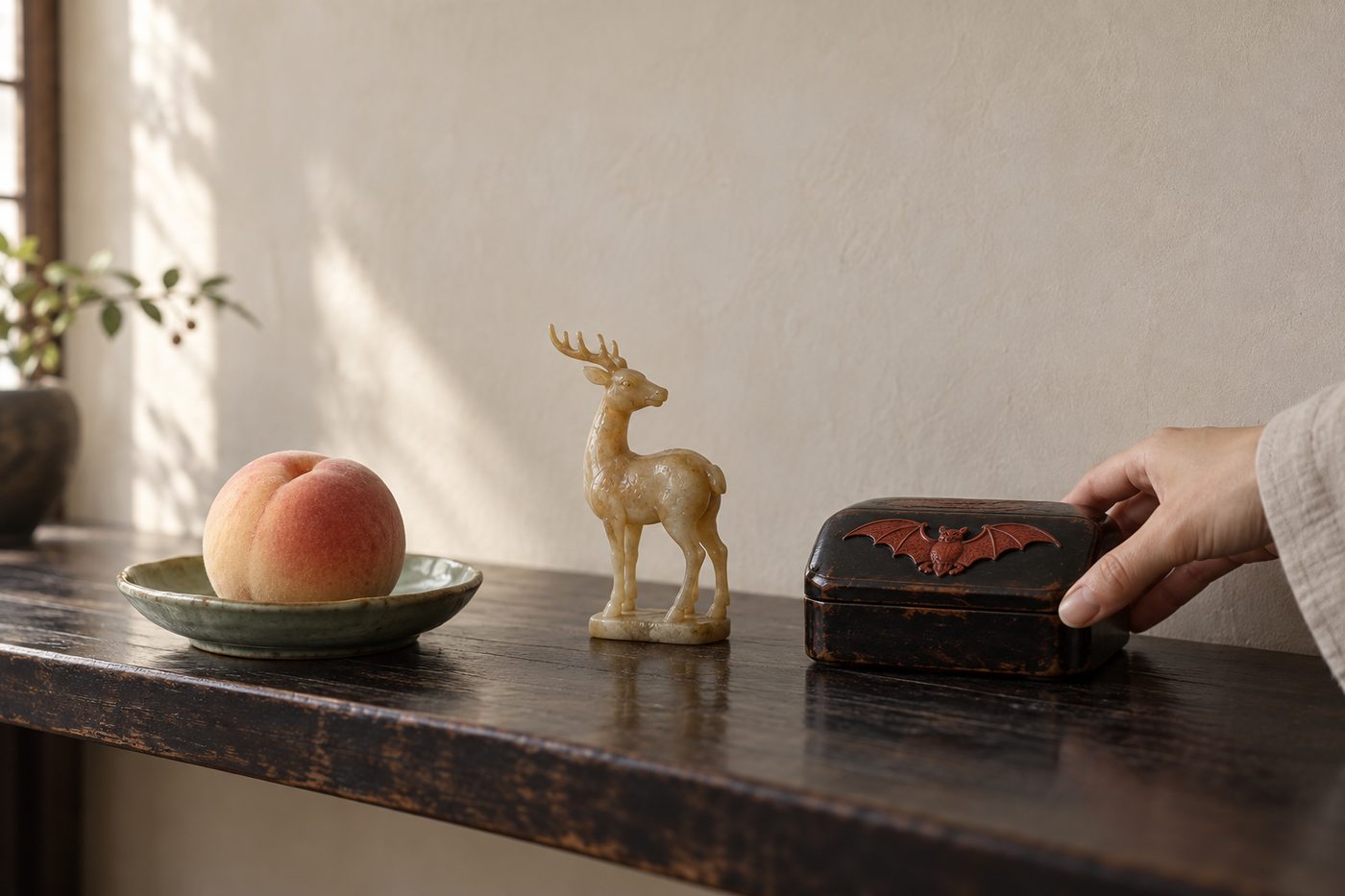
The secret of the set is that it is a rebus. Every attribute is a word that sounds like another word, and once you know the puns you can read a Fu Lu Shou like a sentence. Here is the cast, with the sky each one came from and the man each one was later said to be, drawn from the Han dynasty Records of the Grand Historian and from the scholar Ulrich Theobald's summary of the later identifications:
| Fortune (Fu) | Rank (Lu) | Longevity (Shou) | |
|---|---|---|---|
| The star | Jupiter, the Year Star | The sixth star of the Wenchang group by the Dipper, the Controller of Salaries | Canopus, the Old Man of the South Pole |
| The man he became | Yang Cheng, Tang governor of Daozhou | Immortal Zhang of Sichuan, a Five Dynasties Daoist | None; he stayed a star |
| What he holds | A ruyi scepter or a scroll, in red official's robes | A child, or a ruyi, in a winged official's hat | A staff of gnarled peach wood and a peach |
| The pun beside him | A bat, fú, which sounds like fortune, fú | A deer, lù, which sounds like rank, lù | A peach and a crane, both emblems of long life |
So a bat is not a bat; it is the word fortune with wings. A deer is the word rank on four legs. And the peach is the fruit from the garden of the Queen Mother of the West, which ripens once in three thousand years and confers immortality on whoever eats it, so Longevity is holding his own job description. Rank's child is the promise of sons who will pass the examinations; the winged black hat is the uniform of the men who did. Fortune's ruyi, the curved scepter whose name means as-you-wish, is the least subtle prop in Chinese art, and none the worse for it.
It helps to know one more thing about Lu, because the English "prosperity" flattens it. The word originally meant a register, the list of officials entitled to a state salary, and only by extension the salary itself. Lu is not money; Lu is having a place on the list. That is why his star sits among the Wenchang group, the constellation that governs literary success and the civil-service examinations, and why he holds a child rather than a coin. The symbol pages on this site take the characters on their own, with the strokes, the idioms and the tattoo cautions: 福, good luck and 寿, long life, while 禄 shares its ground with the character for wealth on the prosperity page. This page is about the three men.
Which way round they go
This is the question that gets asked, and the honest answer is that the tradition has an order and the shops have another. The old convention runs right to left, the direction Chinese was written for two thousand years: Fortune on the viewer's right, Rank in the middle, Longevity on the viewer's left, so that a literate eye reads Fu, Lu, Shou across the shelf exactly as it would read the three characters on a scroll. That is how Theobald gives it and how most older porcelain sets and paintings are composed, and it is the order in the painting at the top of this page. Many modern retailers and feng shui guides print the mirror image, Fu on the left, because they read the name left to right like English. If you own a set, the rule that everyone agrees on is that Rank stands in the middle, and that the three stand together, high, clean, and facing into the room rather than at a wall. Beyond that, there is no classical text that punishes you for the wrong order, whatever a website selling figurines may say, and it is worth being suspicious of anyone who claims there is.
Fu Lu Shou Xi Cai: the five blessings
If you have heard the longer version, Fú Lù Shòu Xǐ Cái, that is the three gods plus two more wishes: Xi, happiness, the doubled character pasted on wedding doors, and Cai, wealth. The five words are a New Year greeting, not a set of five figures, and the reason wealth is not one of the three stars is instructive. Wealth has its own god, Caishen, a black-faced marshal on a tiger, with his own festival on the fifth day of the year and his own very different personality. Fortune, Fu, is a broader and older idea than money: the state of being blessed, protected, on the right side of heaven. The Chinese pantheon is an administration, and Fu and Cai are different departments.
Three stars before they were three men
Now the sky, which is where all three began. The oldest is Longevity. Sima Qian's Records of the Grand Historian, written around 90 BCE, has a treatise on the offices of heaven that reads the sky as a mirror of the court, and it records, of the star we call Canopus: "Near the horizon by the Wolf star is a great star called the Old Man of the South Pole. When the Old Man appears, there is order and peace; when it does not, armies rise. It is customarily watched for at the autumn equinox in the southern suburbs." Canopus is the second-brightest star in the sky, and from the latitude of the old Chinese capitals it barely clears the southern horizon, showing at dawn around the autumn equinox, as the Tang commentary on the passage notes. A star that comes and goes on schedule and means peace when it comes is a natural candidate for an old man who has seen it all.
Rank is in the same treatise, in a list. Sima Qian describes six stars above the bowl of the Big Dipper that make up the Wenchang Palace, the celestial civil service, and names them in order of precedence: Senior General, Junior General, Honored Minister, Controller of Fate, Controller of the Center, and sixth, "the Controller of Salaries." That last clerk, Si Lu, keeping the register of who is paid what, is the star that became the god of getting on in the world. Fortune, for his part, is Jupiter, the Year Star, whose twelve-year circuit underlies the twelve-branch cycle of the Chinese calendar, and whose position was read for the fortunes of states. Three stars, three different kinds of luck: one for the individual body, one for the career, one for the year.
The Han state fed its old people and prayed to a star
Here is the passage that turns Longevity from a superstition into a policy. The Book of the Later Han, in its treatise on rites, describes what happened in the eighth month of every year in the first and second centuries: "every county and district checks the household registers and counts the people. Those who have just turned seventy are given a royal staff and fed gruel; at eighty and ninety the rites add further gifts. The royal staff is nine feet long and topped with a dove, for the dove is the bird that does not choke, and the wish is that the old should not choke. In this month the Old Man Star is sacrificed to at the Old Man Temple in the southern suburbs of the capital." The same paragraph, in other words, contains a pension scheme and a star cult. The dove-headed staff was a real object, a license that entitled its holder to privileges at government offices, and the text of the decree granting it has been dug out of Han tombs. Look again at the figurine on the shelf. The bald old man is holding a staff. He has been holding it since the Han census-takers handed one to every seventy-year-old and then went to the southern suburbs to sacrifice to his star.
The God of Fortune is a real man with the wrong name
Fortune, the youngest of the three as a person, is a case study in how a god gets made and how the paperwork gets smudged. The Ming compendium of the three religions' gods, the Sanjiao soushen daquan, says the Star of Fortune was a Tang inspector of Daozhou, in what is now Hunan, and gives his name, Theobald reports, as Yang Cheng, written with the surname that means poplar. The man is real and the name is nearly right. The historical governor is Yang Cheng with a different surname character, and what he did is on record in a poem by the greatest popular poet of the dynasty.
Bai Juyi's "The People of Daozhou" is one of his protest ballads, and it explains everything. Daozhou, it says, was a district of very short people, "the tall ones barely three feet," and for years the court had demanded dwarfs from it as local tribute, to be kept at the palace for entertainment: "bought as dwarf slaves and sent up every year, and called Daozhou's local tribute." Families were broken up to fill the quota; "the old man weeps for his grandson, the mother for her child." Then Yang Cheng arrived as governor and simply stopped sending them. The court wrote to ask why. His reply, as the poem gives it, is one of the great pieces of bureaucratic courage in Chinese literature: "I have checked the Six Statutes; local tribute means what the land produces, not what it does not. What Daozhou's soil produces is short people, not dwarf slaves." The emperor, moved, abolished the tribute. And the last lines record what the district did about it: "for fear their children and grandchildren should forget the governor, when they have a boy they mostly name him Yang." A governor who refused an order and saved a district's children became, within a few centuries, the god you pray to for good fortune. It is hard to think of a better qualification. That the Ming hagiographers got his surname wrong is exactly the kind of thing Bai Juyi would have enjoyed.
A monk's cap on a bald head
The three were already a set, and already a joke, by the time Journey to the West was written in the 1590s. In chapter 26 Sun Wukong, hunting for a cure for a tree he has knocked over, flies to the island of Penglai and finds the three stars playing go under a pine: Longevity watching, Fortune and Rank at the board. He calls them "little brothers." When they come down to earth to plead his case, the pig Zhu Bajie sees the bald god and cannot help himself. "You meaty-headed old fellow," he says, "it's been ages, and still so carefree you can't be bothered to wear a hat," and jams his own monk's cap onto the famous dome, and claps and roars: "A cap on and up in rank, as they say." The pun is the whole trinity in one line. Jiā guān jìn lù, to be capped and promoted, is a wish for exactly what the god of Rank hands out, said while assaulting the god of Longevity, who throws the cap on the ground and calls the pig a lout. Four hundred years later the forehead is still funny, the cap joke is still told at birthdays, and nobody has yet found the text that explains why the old man's head is that shape. My hunch is that it is the peach, and that the painters simply liked the rhyme.
So the next time the three old men are watching you eat, you can read them. Right to left, like a line of old writing: a governor who would not send children to the palace, a clerk from the constellation that grades examinations, and a star that comes up once a year over the southern horizon and has meant peace since the Han. A bat, a deer, a peach. Fortune, rank, long life. It is a modest list, when you look at it. It has been enough for most people, most of the time.
In the classics
The passages behind the story, in the standard published translations. Open any one for the original text.
“Near the horizon by the Wolf star is a great star called the Old Man of the South Pole. When the Old Man appears, there is order and peace; when it does not, armies rise. It is customarily watched for at the autumn equinox in the southern suburbs. ”
Original text
狼比地有大星,曰南極老人。老人見,治安;不見,兵起。常以秋分時候之於南郊。
“The six stars that cap the bowl of the Dipper like a basket are the Wenchang Palace: the first is the Senior General, the second the Junior General, the third the Honored Minister, the fourth the Controller of Fate, the fifth the Controller of the Center, and the sixth the Controller of Salaries. ”
Original text
斗魁戴匡六星曰文昌宮:一曰上將,二曰次將,三曰貴相,四曰司命,五曰司中,六曰司祿。
“In the second month of autumn, every county and district checks the household registers and counts the people. Those who have just turned seventy are given a royal staff and fed gruel; at eighty and ninety the rites add further gifts. The royal staff is nine feet long and topped with a dove, for the dove is the bird that does not choke, and the wish is that the old should not choke. In this month the Old Man Star is sacrificed to at the Old Man Temple in the southern suburbs of the capital. ”
Original text
仲秋之月,縣道皆案戶比民。年始七十者,授之以王杖,餔之糜粥。八十九十,禮有加賜。王杖長九尺,端以鳩鳥為飾。鳩者,不噎之鳥也。欲老人不噎。是月也,祀老人星於國都南郊老人廟。
“The people of Daozhou are mostly dwarfs; the tall ones are barely three feet. They were bought as dwarf slaves and sent up every year, and called Daozhou's local tribute. ... From the day Yang Cheng came to govern the prefecture he sent no dwarf slaves, though the court wrote again and again to ask. Cheng replied: I have checked the Six Statutes; local tribute means what the land produces, not what it does not. What Daozhou's soil produces is short people, not dwarf slaves. ... And for fear their children and grandchildren should forget the governor, when they have a boy they mostly name him Yang. ”
Original text
道州民,多侏儒,長者不過三尺餘。市作矮奴年進送,號為道州任土貢。……一自陽城來守郡,不進矮奴頻詔問。城云臣按六典書,任土貢有不貢無。道州水土所生者,只有矮民無矮奴。……仍恐兒孫忘使君,生男多以陽為字。
“When Bajie saw the Star of Longevity he grabbed him and laughed: "You meaty-headed old fellow, it's been ages, and still so carefree you can't be bothered to wear a hat." And he jammed his own monk's cap onto the god's head, clapped his hands and roared with laughter: "Good, good, good! A cap on and up in rank, as they say." ”
Original text
那八戒見了壽星,近前扯住,笑道:「你這肉頭老兒,許久不見,還是這般脫灑,帽兒也不帶個來。」遂把自家一個僧帽,撲的套在他頭上,撲著手呵呵大笑道:「好,好,好,真是『加冠進祿』也。」
As seen in
The Lucky Stars (福星高照 series)
film · 1983Sammo Hung's Hong Kong action-comedy series takes its title from the idiom of the lucky stars shining overhead; the trinity as a running joke rather than a cult.
Winners and Sinners (1983), My Lucky Stars (1985), Twinkle, Twinkle, Lucky Stars (1985), with Jackie Chan and Yuen Biao.
Questions people ask
What is the meaning of Fu Lu Shou?
Three words, three gods. Fu means fortune or blessing, Lu means official rank and the salary that goes with it, and Shou means long life. Fu Lu Shou are the Three Star Gods who personify them: Fortune as a red-robed official with a ruyi scepter, Rank as a courtier holding a child, and Longevity as a bald old man with a high forehead, a staff and a peach. Together they are shorthand for a complete good life, which is why the set turns up at weddings, birthdays, shop openings and New Year.
How should Fu Lu Shou be placed?
The traditional order runs right to left, the way Chinese was once written: Fortune on the viewer's right, Rank in the middle, Longevity on the viewer's left, as the scholar Ulrich Theobald notes in his entry on the Three Stars. Many modern shops and feng shui guides give the mirror image, Fu on the left, because they read the name left to right in the Western manner. Both are conventions; there is no classical text that punishes you for the wrong one. Put them somewhere high, clean and facing into the room, and keep Rank in the middle, which everyone agrees on.
What do Fu Lu Shou symbolize in feng shui?
The three things a household is asking for: good fortune, career and status, and long life. In feng shui practice the set is placed in the living room or dining room rather than the bedroom or kitchen, usually on a high shelf or cabinet facing the door, and treated as a statement of intent rather than a machine. The figures carry their own symbols, a bat for Fortune, a deer for Rank, a peach and a crane for Longevity, each of them a pun on the god's name, so the group is a rebus you can read as well as a shrine.
What is the meaning of Fu Lu Shou Xi Cai?
The five blessings. Fu, Lu and Shou are the three gods; add Xi, happiness, usually written as the double-happiness character of weddings, and Cai, wealth, and you have the five things a New Year greeting wishes you. Wealth is not one of the three stars because it has its own god, Caishen, the God of Wealth, who is a separate figure with a separate cult. The five-word version is a greeting; the three-figure version is what stands on the shelf.
Are Fu Lu Shou real people?
Stars first, people second. The Han-dynasty Records of the Grand Historian already names the Old Man of the South Pole, the star Canopus, as an omen of peace, and Han rites sacrificed to it every autumn. The human biographies came later: Fortune is identified with Yang Cheng, a real Tang governor of Daozhou who refused to send dwarfs to court as tribute and was celebrated in a poem by Bai Juyi; Rank is identified with a Sichuan Daoist called Immortal Zhang; Longevity stayed a star. The three were bundled into one household set in the Ming dynasty.
Why does the God of Longevity have such a big forehead?
Nobody has a text that explains it, and the honest answer is that the tall bald dome is a convention that hardened in Ming and Qing painting and porcelain. Popular readings say it holds a lifetime of wisdom, or that it looks like the peach he carries, the fruit of immortality from the Queen Mother of the West's garden. In Journey to the West the pig Zhu Bajie calls him a meaty-headed old fellow to his face and jams a monk's cap on the dome, so the joke was already old by 1592.
Sources & further reading
- Records of the Grand Historian (史記), ch. 27, Treatise on the Celestial Offices, full text (Chinese Wikisource)
- Book of the Later Han (後漢書), Treatise on Rites and Ceremonies, full text (Chinese Wikisource)
- Bai Juyi, 'The People of Daozhou', full text (Chinese Wikisource)
- Journey to the West (西遊記), Chapter 26, full text (Chinese Wikisource)
- Ulrich Theobald, 'Fu lu shou sanxing, the Three Stars' (ChinaKnowledge.de), on the stars, the human identifications, and the right-to-left order
- Britannica: Fulushou
- Sanxing (deities) (Wikipedia)
- The Lucky Stars film series (Wikipedia)
By Julian 祝君瑜, retold from the classics, with the original passages cited, updated 2026-09-16