Chinese Mythology
Xiwangmu (西王母): The Queen Mother of the West, Before the Peaches
The Queen Mother of the West, 西王母 (Xī Wáng Mǔ), also called Xiwangmu, is the Chinese goddess who keeps the peaches of immortality and decides who gets one. She is usually painted as a serene white-haired matriarch. The oldest text that names her describes something else entirely: a figure with a human face, a leopard's tail, tiger's teeth and a howl, living in a cave and holding the portfolio for plague and celestial punishment.
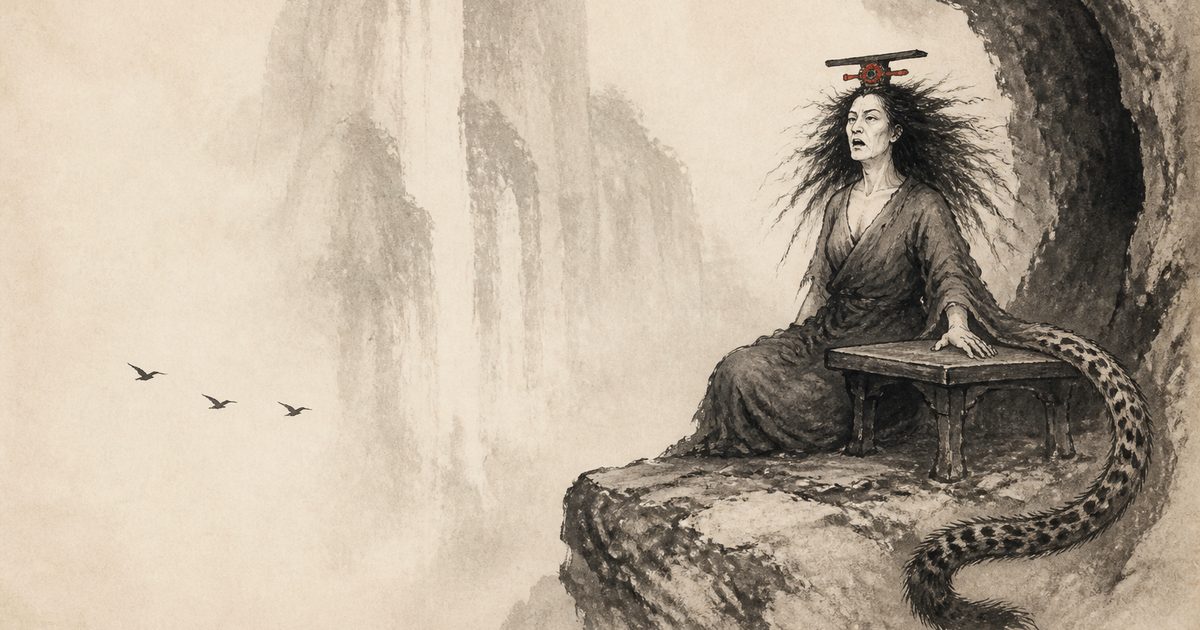
Almost every picture ever painted of the Queen Mother of the West shows a serene, beautifully dressed woman with a tray of peaches. She is the grandmother of Chinese heaven. She hands out eternal life at banquets.
Now open the oldest book that mentions her by name and read what it actually says. Three hundred and fifty leagues west, says the Classic of Mountains and Seas, is the Jade Mountain, and this is where the Queen Mother of the West lives. She is shaped like a person, but she has a leopard's tail and tiger's teeth, and she is good at howling. Her hair is wild. She has charge of the plagues of Heaven and of the Five Destructions.
Not peaches. Plague.
That is the same goddess, roughly two thousand three hundred years earlier, and the distance between those two pictures is the most interesting thing about her. Nobody else in the Chinese pantheon has traveled quite so far from where they started.
She acquired a brand-new religion in 1949
Start at the present, because this is the part of her story that almost never gets told in English, and it is astonishing.
In the late 1940s, in Hualien on the eastern coast of Taiwan, a spirit-medium reported that the Golden Mother of the Jade Pond had come down. The two temple lineages that grew out of that event date it slightly differently: the Hualien County heritage register, following the temple's own account, puts the first descent on the third day of the sixth lunar month of 1948, while the Ministry of the Interior's survey of Taiwanese religion dates the rise of the whole movement to 1949. Either way it happens inside living memory, in a small town, to a real person, in a decade of refugees and rationing.
She took in a group of about fifty sworn godchildren, and the thing went off like a flare. By 1950 it had already split into two lineages, and the way they divided the estate is the detail I cannot get out of my head: one side took the statue and the other side took the incense burner. To this day you can tell them apart by their robes, yellow for one house and blue-green for the other. The larger of the two, the Cihuitang, ran to something in the region of nine hundred branch halls by the early 2000s.
The Taipei branch is the one to see. Songshan Cihuitang was founded in 1968 after its own founder received instructions from the goddess, installed her image in 1985, and grew into the largest temple of the movement in northern Taiwan. Every year it stages the Taipei Mother Goddess Cultural Season, a street procession with floats and performing troupes that the Ministry of the Interior lists among the grandest in the city.
So the goddess of the Classic of Mountains and Seas, the one in the cave with the leopard tail, currently presides over a religious movement founded after the invention of the ballpoint pen. Very few deities anywhere can say that.
The banquet Monkey ruined
Her other modern life is the one everybody has already met without knowing whose party it was.
In Journey to the West, the 1592 novel that gave the world the Monkey King, Sun Wukong is fobbed off with the job of guarding the celestial peach orchard, on the reasonable assumption that this will keep him out of trouble. The local earth god walks him round it and explains the stock: twelve hundred trees at the front with small blossoms and small fruit, ripening once in three thousand years, which make you an immortal; twelve hundred in the middle, layered blossom and sweet fruit, once in six thousand years, which let you rise on the sunset clouds and never grow old; twelve hundred at the back with purple veins and pale pits, once in nine thousand years, which make your years equal to Heaven and Earth and your age equal to the sun and the moon.
Monkey listens to all of this, waits for the staff to leave, and eats the best ones. Then he discovers that the Queen Mother is holding her Peach Banquet and that he has not been invited, drinks the wine, and brings the whole of heaven down on himself.
That orchard is hers. Every adaptation of the novel since, every film and television series and animated retelling, has staged that scene, which means her single biggest role in world culture is as the host of a party that gets wrecked in the first act. If you want the raid from the other side, the Monkey King has his own page.
The monster in the oldest book
Now to the roots, and they are much stranger than the peaches.
The Classic of Mountains and Seas is a gazetteer of mountains, rivers and monsters assembled over several centuries, and it mentions her three times in three different chapters, each time with the same disconcerting details. On the Jade Mountain she has the leopard's tail, the tiger's teeth, the wild hair and the howl, and she holds the portfolio for Heaven's plagues and the Five Destructions. In the western wilderness she turns up again at Kunlun, ringed by an abyss of water too weak to float anything and a mountain of fire that ignites whatever is thrown at it, and this time the text specifies that she lives in a hole in the ground. In the northern chapter she is leaning on a table with her headdress and her staff, and three blue birds bring her food.
Take those pieces one at a time.
The sheng she wears on her head is a flat ornament worn crosswise, the sort of thing you see on Han tomb tiles above her face like a small architectural beam. It is a real object, and it is so distinctive that the hoopoe, a bird with an enormous fanned crest, is still called the daisheng, the wearer of the sheng, in Chinese today.
The howl is not a decorative flourish. The verb the text uses is the one for a long drawn whistling cry, the noise a tiger or a gibbon makes, and it puts her firmly on the wrong side of the line between spirit and beast.
The three birds are the loveliest thread. They start out as household staff, simply fetching her meals. By the Han they have become her messengers, and by the Tang the blue bird means a message from a woman you cannot reach. Li Shangyin, who could not leave her alone, ends one of his untitled poems with a line every educated Chinese reader still knows: it is not far from here to the fairy mountain, and the blue bird will kindly go and look for me. Two thousand years of romantic longing, descended from a catering arrangement.
| The earliest record | The later record | |
|---|---|---|
| Shape | Human form with a leopard's tail and tiger's teeth | A composed, richly dressed empress |
| Home | A cave on the Jade Mountain, or a hole at Kunlun | A palace beside the Jade Pond |
| Portfolio | The plagues of Heaven and the Five Destructions | Immortality, and the register of who receives it |
| Attendants | Three blue birds who fetch her food | Jade maidens, and the whole rank of female immortals |
| What she gives out | Nothing. Nobody asks her for anything | Peaches, elixir, and the drug of deathlessness |
| Earliest source | Classic of Mountains and Seas | Tale of King Mu, then the Han apocrypha |
The year the whole country ran
In the spring of 3 BCE, north China was in drought and something very strange happened, and because the Han kept excellent records we know a great deal about it.
People began passing stalks of straw and twigs from hand to hand. They called it passing the summons. The Book of Han is worth quoting at length here, because the detail is what makes it:
On the roads they met one another in numbers reaching a thousand at a time. Some went with their hair loose and their feet bare, some broke open the gate bars at night, some climbed over the walls to get in, some drove and rode at a gallop, using the post stations to carry it on. It passed through twenty-six commanderies and kingdoms and reached the capital.
That summer, in the capital and across the provinces, people gathered in the lanes and along the field paths, set out offerings, laid out gaming boards, and sang and danced in worship of the Queen Mother of the West. And a text went round with the straw. The Mother tells the people, it said, that whoever wears this writing will not die. If you do not believe my words, look under the pivot of your door, and you will find white hairs there.
Then, the historian notes, with the flatness of a man closing a file: it stopped in the autumn.
Twenty-six commanderies and kingdoms is most of the settled empire. Historians of Chinese religion generally treat this as the earliest mass religious movement the Chinese record preserves in any detail, and it is worth being precise about what that means: not a rebellion, not a court cult, not a philosophy, but ordinary people in enormous numbers, moving on their own initiative, worshipping a goddess the government had not told them to worship. The imperial annals, incidentally, give the same event three sentences and file it under the drought.
The king who never came back
Long before the peaches, there is a scene at a lake.
The Tale of King Mu, Son of Heaven is a curious book, recovered in 281 CE from a tomb that had been sealed for around five and a half centuries, and it reads like the travel diary of a Zhou king driving his famous eight horses west until the map runs out. On the day jiazi, it says, the Son of Heaven was received as a guest by the Queen Mother of the West. He presented a white jade tablet and a dark jade disc, a hundred lengths of figured silk and three hundred lengths of braid. She bowed twice and accepted them.
The next day he raised a cup to her beside the Jade Pond, and she sang to him:
White clouds are in the sky, the hills rise of themselves. The road is long and far, mountains and rivers lie between us. If you do not die, you may yet come again.
He answered that he was going home to put the states of Xia in order, and that when the people were settled he would return, and that it would take three years.
He never came back. And nine hundred years later Li Shangyin wrote four lines about it that turned the whole story into a knife. The Queen Mother opens her latticed window at the Jade Pond, he writes, and the sound of the Yellow Bamboo song comes up from below, shaking the earth with grief. The eight horses can run thirty thousand leagues in a day. So why has King Mu not come back?
The Yellow Bamboo song, in the same book, is the lament King Mu composed for commoners freezing to death on his road. The poet is being extremely deliberate. Late Tang emperors were dying in some numbers from the mercury and lead in the elixirs their alchemists fed them, and Li Shangyin has arranged his four lines so that the goddess of eternal life sits at her window waiting for a man who is very obviously dead, while the sound of ordinary people dying of cold drifts up past her. She, of all beings, cannot work out where he has got to.
Seven peaches for an emperor
The peaches arrive properly in the Esoteric Biography of Emperor Wu of Han, a piece of religious fiction from somewhere between the fourth and sixth centuries that describes her descending to the palace of Emperor Wu on the seventh night of the seventh month.
She has her attendants bring peaches. Seven of them come up on a dish, each the size of a duck's egg, round and blue-green. She gives the emperor four and eats three herself, which is a beautifully judged detail, and as he eats he quietly pockets every pit. What is that for, she asks. I mean to plant them, says the emperor of the world. This peach fruits once in three thousand years, she tells him, and the soil of the middle land is thin, so what would be the use? He stops.
He is the most powerful man alive and she has just told him, kindly enough, that his empire is not good ground. The whole later career of the peach is in that exchange, and so is the reason she matters: what she controls is not immortality but access to it, and access implies refusal.
It is worth keeping the two orchards apart. Seven peaches on a dish in the Esoteric Biography, thirty-six hundred trees in Journey to the West, six centuries between them, and the later invention has almost entirely eaten the earlier one.
Whose wife is she?
The commonest thing said about her in English is that she is the wife of the Jade Emperor. In folk religion this is perfectly true. Walk into a village temple and you will find them paired, she under the name Wangmu Niangniang, and the popular story in which she draws the Milky Way across the sky with her hairpin to keep the Weaver Girl from her cowherd husband depends on her being the heavenly matriarch with the authority to do it.
In the early record it is not true at all, and the sequence matters. The Classic of Mountains and Seas has her alone in a cave. The Tale of King Mu has her receiving a foreign monarch on her own authority, with nobody standing behind her. The Jade Emperor as supreme sovereign of heaven only takes his final shape under the Song, a good thousand years later.
Han art did try to find her a partner, and the attempt is revealing. On tomb tiles and bronze mirrors of the Eastern Han she is regularly balanced by the King Father of the East, a figure with almost no independent mythology, no stories, and a name that is simply hers with the compass point reversed. He looks a great deal like something invented to fill the other half of the picture. She was there first, and she was there alone.
Her real relationships are transactional, which suits her. The archer Yi climbed to her for the drug that ends death, and got it, and lost it; that story is told properly on his page, and what his wife did with it is told on hers. That is the pattern with the Queen Mother. People come a very long way to ask her for something, and what happens next is their problem.
Somewhere behind all of it, the three birds are still flying out from the mountain to fetch her dinner.
In the classics
The passages behind the story, in the standard published translations. Open any one for the original text.
“Three hundred and fifty leagues further west is the Jade Mountain, and this is where the Queen Mother of the West lives. The Queen Mother of the West is shaped like a person, but she has a leopard's tail and tiger's teeth, and she is good at howling. Her hair is wild and she wears a sheng headdress. She has charge of the plagues of Heaven and of the Five Destructions. ”
Original text
又西三百五十里,曰玉山,是西王母所居也。西王母其狀如人,豹尾虎齒而善嘯,蓬髮戴勝,是司天之厲及五殘。
“In the great wilderness there is a mountain called the Hill of Kunlun. A spirit lives there with a human face and a tiger's body, patterned, with a tail, and all of it white. Below it the abyss of the Weak Water rings it round, and beyond that stands a mountain of blazing fire, where anything thrown at it catches alight. There is one who wears a sheng headdress, with tiger's teeth and a leopard's tail, who lives in a cave, and her name is the Queen Mother of the West. ”
Original text
大荒之中,有山名曰崑崙之丘。有神,人面虎身,有文有尾,皆白,处之。其下有弱水之淵環之,其外有炎火之山,投物輒然。有人戴勝,虎齒,有豹尾,穴處,名曰西王母。
“The Queen Mother of the West leans on a table, wearing the sheng headdress and holding a staff. South of her are three blue birds, who fetch her food. This is north of the Ruins of Kunlun. ”
Original text
西王母梯几而戴勝杖,其南有三青鳥,為西王母取食。在崑崙虛北。
“In the first month of the fourth year of the Jianping period under Emperor Ai, the people took fright and ran. They carried a stalk of straw or a twig and passed it from hand to hand, and they called this passing the summons. On the roads they met one another in numbers reaching a thousand at a time. Some went with their hair loose and their feet bare, some broke open the gate bars at night, some climbed over the walls to get in, some drove and rode at a gallop, using the post stations to carry it on. It passed through twenty-six commanderies and kingdoms and reached the capital. That summer, in the capital and in the commanderies and kingdoms, the people gathered in the lanes and the field paths, set out offerings and laid out gaming boards, and sang and danced in worship of the Queen Mother of the West. They also passed round a written text that said: the Mother tells the people that whoever wears this writing will not die. If you do not believe my words, look under the pivot of your door, and you will find white hairs there. It stopped in the autumn. ”
Original text
哀帝建平四年正月,民驚走,持稿或棷一枚,傳相付與,曰行詔籌。道中相過逢多至千數,或被髮徒踐,或夜折關,或踰牆入,或乘車騎奔馳,以置驛傳行,經歷郡國二十六,至京師。其夏,京師郡國民聚會里巷仟佰,設祭張博具,歌舞祠西王母,又傳書曰:「母告百姓,佩此書者不死。不信我言,視門樞下,當有白髮。」至秋止。
“In the spring of the fourth year there was a great drought. The people east of the pass passed round the tallies of the Queen Mother of the West, which went through the commanderies and kingdoms, west through the pass, and reached the capital. ”
Original text
四年春,大旱。關東民傳行西王母籌,經歷郡國,西入關至京師。
“On the auspicious day jiazi, the Son of Heaven was received as a guest by the Queen Mother of the West. He took up a white jade tablet and a dark jade disc to present himself before her, and offered a hundred lengths of figured silk and three hundred lengths of braid. The Queen Mother of the West bowed twice and accepted them. On the day yichou, the Son of Heaven raised a cup to the Queen Mother of the West on the shore of the Jade Pond. The Queen Mother of the West sang to him: white clouds are in the sky, the hills rise of themselves, the road is long and far, mountains and rivers lie between us. If you do not die, you may yet come again. The Son of Heaven answered her: I go home to the eastern land, to bring the states of Xia into order. When the people are settled and equal, I will come and look on you. In three years I shall be back in your country. ”
Original text
吉日甲子,天子賓于西王母。乃執白圭玄璧,以見西王母,好獻錦組百純,□組三百純。西王母再拜受之。乙丑,天子觴西王母于瑤池之上。西王母為天子謠曰:「白雲在天,丘陵自出。道裡悠遠,山川間之。將子無死,尚能複來。」天子答之曰:「予歸東土,和治諸夏。萬民平均,吾顧見汝。比及三年,將複而野。」
“She ordered her attendants to fetch peaches. Presently they brought seven peaches on a dish, each the size of a duck's egg, round and blue-green, and set them before the Queen Mother. She gave four to the Emperor and ate three herself. The peaches were sweet and their taste filled the mouth. The Emperor kept every pit as he ate. The Queen Mother said, what is this for? The Emperor said, I mean to plant them. The Queen Mother said, this peach bears fruit once in three thousand years, and the soil of the middle land is thin. What would be the use of planting it? So the Emperor stopped. ”
Original text
命侍女索桃,須臾,以鎜盛桃七枚,大如鴨子,形圓,色青,以呈王母。母以四枚與帝,自食三桃。桃之甘美,口有盈味。帝食輒錄核。母曰:「何謂?」帝曰:「欲種之耳。」母曰:「此桃三千歲一生實耳,中夏地薄,種之不生如何!」帝乃止。
“The first twelve hundred trees have small blossoms and small fruit, and ripen once in three thousand years. Eat one and you become an immortal and attain the Way, your body strong and your frame light. The middle twelve hundred have layered blossoms and sweet fruit, and ripen once in six thousand years. Eat one and you rise on the sunset clouds and never grow old. The last twelve hundred have purple veins and pale yellow pits, and ripen once in nine thousand years. Eat one and your years equal Heaven and Earth, and your age matches the sun and the moon. ”
Original text
前面一千二百株,花微果小,三千年一熟,人吃了成仙了道,體健身輕。中間一千二百株,層花甘實,六千年一熟,人吃了霞舉飛昇,長生不老。後面一千二百株,紫紋緗核,九千年一熟,人吃了與天地齊壽,日月同庚。
As seen in
Journey to the West
novel · 1592Host of the Peach Banquet, whose orchard the Monkey King eats his way through before wrecking the party, as Queen Mother.
Her single largest appearance in world culture, carried forward by every film, television and animated adaptation of the novel since.
Shin Megami Tensei
game · 1992A recruitable deity on the demon roster, filed under the Megami class, as Xi Wangmu.
Atlus has kept her in the series roster across multiple entries, which is how a large number of players outside Asia first meet the name.
Questions people ask
What is Xiwangmu the goddess of?
Today she is the goddess of immortality, and specifically of who is allowed to have it. She keeps the peaches that extend life, she holds the drug of deathlessness that the archer Yi came to her for, and in Daoist practice she governs the female immortals. That is her later job. In the Classic of Mountains and Seas, the oldest text that names her, she holds a very different post: charge of the plagues of Heaven and of the Five Destructions, which is to say epidemic disease and celestial punishment. She began as the deity who kills you and ended as the deity who lets you live forever.
What does Xiwangmu look like?
It depends entirely on which century you ask. The Classic of Mountains and Seas gives her a human shape with a leopard's tail and tiger's teeth, wild unbound hair, a flat sheng headdress, and a talent for howling, living in a cave on the Jade Mountain. By the Han dynasty she appears on tomb tiles and bronze mirrors as an enthroned figure attended by a hare pounding elixir, a three-legged crow, a nine-tailed fox and a toad. From the Tang onward she is painted as a beautiful, composed, richly dressed empress of the immortals, and that is the image almost every modern illustration follows.
Is Xiwangmu the Jade Emperor's wife?
In late folk religion, yes, and in a great many temple pairings and television dramas she is his consort under the name Wangmu Niangniang. In the early record, no. The Classic of Mountains and Seas has her unattached and alone in a cave, the Tale of King Mu has her receiving a foreign king by herself, and the Jade Emperor as a supreme celestial sovereign is a much later development, formalized under the Song. Han-dynasty art did give her a partner, but it was the King Father of the East, a figure who looks very much as though he was invented to balance the composition.
What are the peaches of immortality?
There are two distinct sets and they are six centuries apart. In the Esoteric Biography of Emperor Wu of Han, she brings seven peaches, gives the emperor four and eats three herself, and when he pockets the pits to plant them she tells him the tree fruits once in three thousand years and the soil of the middle land is too thin for it. In Journey to the West, published in 1592, she owns a whole orchard of thirty-six hundred trees in three grades, ripening at three thousand, six thousand and nine thousand years, which the Monkey King eats his way through before wrecking the banquet.
What is the difference between Xiwangmu and the Queen Mother of the West?
None. They are the same goddess and the same three characters, 西王母. Xiwangmu is the Mandarin reading of her name, and Queen Mother of the West is the standard English translation of it, used by Wikipedia and by scholars including Suzanne Cahill. You will also meet her as Xi Wangmu, Hsi Wang Mu in older Wade-Giles books, Wangmu Niangniang in folk temples, and Yaochi Jinmu, the Golden Mother of the Jade Pond, in Taiwan.
Sources & further reading
- The Classic of the Western Mountains, with her first appearance on the Jade Mountain (Chinese Text Project)
- The Classic of the Great Wilderness, West, where she lives in a cave at Kunlun (Chinese Text Project)
- The Classic of the Regions Within the Seas, North, with the three birds that fetch her food (Chinese Text Project)
- Book of Han, Treatise on the Five Phases, the full account of the movement of 3 BCE (Chinese Wikisource)
- Book of Han, Annals of Emperor Ai, the same year recorded as a drought (Chinese Text Project)
- Tale of King Mu, Son of Heaven, book three, the banquet at the Jade Pond (Chinese Wikisource)
- Esoteric Biography of Emperor Wu of Han, the seven peaches (Chinese Wikisource)
- Journey to the West chapter five, the three grades of peach tree (Chinese Text Project)
- Li Shangyin, The Jade Pond, with commentary on it as a satire of Tang emperors seeking elixirs (Gushiwen)
- Songshan Cihuitang, in the Ministry of the Interior's Religions of Taiwan survey (the 1949 Hualien origin, the 1968 founding, the annual Mother Goddess procession)
- Cihuitang Main Hall, Hualien County Bureau of Cultural Affairs heritage register (the temple's own dating of the first descent to 1948)
- Queen Mother of the West, Wikipedia (the standard English name, the Wade-Giles variants, and the scholarship)
By Julian 祝君瑜, retold from the classics, with the original passages cited, updated 2026-08-26