Chinese Mythology
The Jade Rabbit (玉兔): What the Moon Rabbit Is Actually Pounding
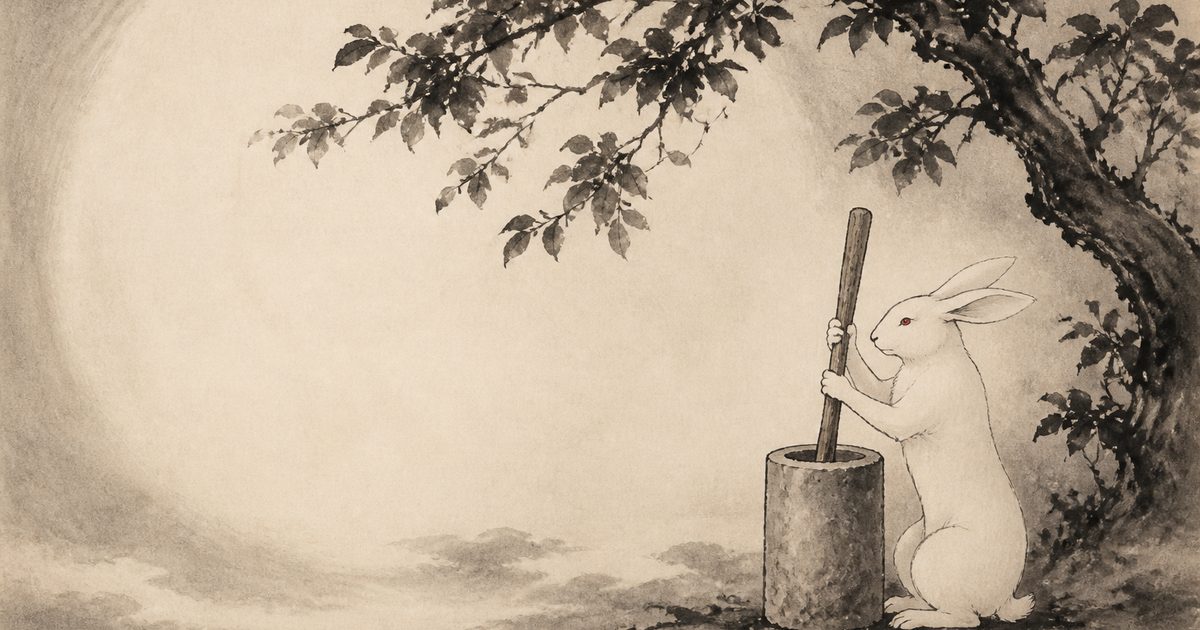
The Jade Rabbit, 玉兔 (Yùtù), is the hare that lives on the moon and pounds medicine with a mortar and pestle. The oldest surviving description of it at work is a Han dynasty court song, and it answers the question nobody asks: the rabbit is kneeling, the pills are being carried down to the emperor, and whoever swallows them does not die. It is not a pet. It is staff.
Were you born in a Year of the Rabbit?
Enter your birth date to find out your sign and which of the five elements it falls under. We handle the Chinese New Year cutoff, so a birthday in January or early February lands on the right side.
Chinese fortune-telling reads a lot into a birthday. For a playful old birth-chart custom, try our Chinese gender predictor.
Everybody can see the rabbit. That is the first remarkable thing about it. Across an enormous stretch of the world, from Beijing to Kyoto to Seoul and, quite independently, across Mesoamerica, people have looked up at the same gray blotches on the same satellite and agreed that what they are looking at is a hare. Not a face. Not a woman. A hare, in profile, with its ears back.
And in the Chinese version the hare is holding a pestle, and it is working.
So here is the question nobody thinks to ask, which turns out to have an answer, and the answer turns out to be strange. What is in the mortar?
Two rovers are named after it
Start with the modern end, because the modern end is spectacular.
When China went to the moon it named the spacecraft after the goddess and the rovers after her rabbit. The first, Yutu, was named by a worldwide public poll and set down on the surface on 14 December 2013. It seized up in its first lunar night, could no longer move, and then simply refused to die: it kept returning data for 972 days, more than ten times its design life, from a spot it could not leave.
Its successor did better. Yutu-2 rode down with Chang'e 4 and on 3 January 2019 became the first machine ever to land softly on the far side of the moon, the side nobody on earth has ever seen with their own eyes. It is still the longest-working lunar rover in history, by a margin that keeps growing.
Consider what that means. An animal whose entire mythological job description is grinding out the medicine that stops things dying was put on the moon by engineers, and then outlived its own life expectancy by years. Twice.
Lord Rabbit of Beijing
Meanwhile, back on earth, the rabbit has a second career as a small clay man.
The earliest description of him comes from a Ming writer, Ji Kun, active around 1636, in a collection with the marvelous title Surviving Drafts from the Pavilion of the Flower King. In the capital at Mid-Autumn, he writes, they mostly model rabbit shapes out of clay, robed and capped and squatting like a person, and the sons and daughters make offerings to it and bow.
That is Lord Rabbit. Two and a half centuries later the Records of the Seasons of the Capital catalogues the range on offer, and the range is glorious. Every Mid-Autumn, it says, the cleverer traders model toads and rabbits out of yellow clay and sell them. Some are robed and capped with a canopy raised over them. Some are in armor with a banner strapped to the back. Some ride a tiger. Some just sit there. The big ones are three feet high and the small ones a little over one.
So: a rabbit's head, with the cleft lip and the long ears, on a human body in painted parade armor, mounted on a tiger, being bowed to by children.
Then something happens that happens to a lot of gods. By the late Qing he is a toy. The bowing gets shorter, the playing gets longer, and a figure people once made offerings to is what you buy a child at the Mid-Autumn Festival market. He is now on China's national register of intangible cultural heritage, listed under Beijing painted clay sculpture, which is the modern way of saying we noticed we were about to lose him.
There is a Beijing joke that survives the demotion. Lord Rabbit is addressed with enormous formality, grandfather, sir, and he is about six inches tall and made of mud.
What the mortar is for
Now the old texts, and the good part.
By the Jin dynasty the question had already been asked and answered in four words. The poet Fu Xuan wrote a set of verses imitating Qu Yuan's Heavenly Questions, and one of them runs: what is there in the moon? A white rabbit pounding medicine. Question, answer, done. Everyone already knew.
But the fullest early account is older and much odder, and it is not a myth at all. It is a piece of court flattery. The Dong Tao Xing is an anonymous Han song preserved in Guo Maoqian's great Anthology of Yuefu Poetry, and if you read only the famous line out of it you get a rabbit pounding medicine. If you read the whole thing you get a supply chain.
It opens with a man climbing a mountain toward the five sacred peaks, where the palaces are made of gold and the magic herbs grow. He arrives at the gate of the Jade Hall and does not have the heart to turn back. A herald comes out. What does the man outside want? And he answers: I want to follow the holy way and beg one thing, that my life be extended.
Then comes the fourth stanza, and this is the passage that ought to be famous:
Orders went down to the officers, and they gathered the divine herb from the branch tip of the Ruo tree. The white rabbit kneels and pounds the toad pills. They are presented to His Majesty on a jade dish, and whoever takes this medicine may become an immortal.
Read that again slowly, because four things in it are not in any children's book.
The rabbit kneels. Not sits, not hops, not perches decoratively on a moon: it kneels, in the posture a subordinate takes in front of a throne. It is one link in a chain of command that starts with a petition and ends with a delivery. The medicine is going downward, to a named recipient, and the recipient is not the goddess and not the Queen Mother of the West but His Majesty, the living emperor. And the last stanza confirms it, dissolving into pure court chorus: long life and old age to Your Majesty, on all four sides they bow their heads, may Your Majesty be kept as long as heaven itself.
This is a Han emperor's immortality program, sung. The rabbit is not a pet, a mascot or a symbol of anything. It is the night shift at the imperial pharmacy.
And the shift never ends, which is the part the poets seized on. Li Bai, raising a cup to the moon and asking it questions on a friend's behalf, gets to the fifth couplet and puts the two residents side by side: the white rabbit pounds its medicine, autumn and then spring again, and Heng'e sits up there alone, so who exactly is her neighbor? It is a small, sly line. The rabbit is right there, has been right there the entire poem, and is such a fixture that Li Bai can use it as the setup for a joke about loneliness. He also calls her Heng'e rather than Chang'e, using her older name, which she lost to an emperor's naming taboo.
The toad pills
One phrase in that stanza deserves a flag rather than a flourish.
The thing the rabbit is pounding is called, in the original, toad pills. And the oldest surviving version of what happened to Chang'e, the woman who stole the drug and fled to the moon, ends with her arriving there and turning into a toad. That is not a legend I am reaching for; it is on her own page, and it is in the sources.
So the literal reading of the Han text is available and it is horrible: the rabbit is grinding up the neighbor.
The sober reading is almost certainly the right one. Toad pill is very likely just a drug name, of the same species as the tiger balm on a pharmacy shelf, and Chinese pharmacy really did use toad secretions. Han carving and Tang mirrors show the rabbit and the toad pounding side by side, colleagues rather than one being the ingredient. But the phrase sits there in the earliest full description of the most famous rabbit in Asia, and the coincidence is the sort of thing a text throws up when it is old enough not to have been tidied.
The origin story is Indian
Now the correction, and it is a big one.
Ask an English speaker where the jade rabbit came from and you will very often get this: three animals, a monkey, a fox and a rabbit, meet a starving old man. The monkey brings fruit, the fox brings fish, the rabbit has nothing, so it builds a fire and throws itself in. The old man reveals himself as the Jade Emperor and sets the rabbit's image on the moon in honor of the sacrifice.
That is a real story, beautifully told, and it is not Chinese. It is the Sasa Jataka, the birth story of the wise hare, number 316 in the Pali collection, in which the Bodhisattva is born as a hare with an otter, a jackal and a monkey for friends. The hare, having nothing but its own body to offer, shakes itself three times first so that any insects in its fur will not burn with it, and leaps into the coals. The fire does not warm it. The brahmin is Sakka, king of the gods, who has come to test him, and Sakka squeezes a mountain and paints the sign of a hare on the disc of the moon with the essence of it.
Swap Sakka for the Jade Emperor and the otter and jackal for a fox, and you have the version circulating in English.
Here is the ordering problem. The Chinese rabbit is on the moon in Han poetry and Han tomb art, pounding away, centuries before that story could plausibly have been naturalized in China. The Chinese rabbit therefore did not come from the fire. It has no origin story at all in the early record, which is a genuinely unusual thing for a mythological figure and much more interesting than the tidy version. It simply is there. Nobody asks how, in the same way nobody asks how the moon got there.
Both stories are now part of the tradition and there is no need to pick between them. But the self-sacrifice story explains the Buddhist hare, and the mortar explains the Chinese one, and they are answers to different questions.
Everyone's moon has a rabbit, and they are all making something different
| Tradition | What is in the mortar | Who it is for |
|---|---|---|
| Han China | Pills compounded from the herb of the Ruo tree | The emperor, and anyone who wants to stop dying |
| Later Chinese folk tradition | The drug of deathlessness | The Queen Mother of the West, and by extension the moon's household |
| Japan | Mochi, pounded rice cake | Whoever is watching the harvest moon |
| The Buddhist birth story | Nothing. There is no mortar | The hungry brahmin, who is a god in disguise |
Japan's swap is the one people notice, and it is a good-natured piece of cultural translation: the pharmacist becomes a cook, and the moon's most famous resident spends eternity making a snack. Korea has the rabbit too. So, entirely separately, does Mesoamerica, which never spoke to any of them and looked at the same blotches and saw the same animal.
Why a rabbit at all
Because of what the moon does.
The moon is the only thing in the sky that visibly dies and comes back, every month, without fail, and any culture watching it closely will eventually want an animal that behaves the same way. The toad qualified first, being a creature that vanishes into the mud and returns. But rabbits do something even more to the point: they are the standing symbol of a population that cannot be killed off, because there are always more of them by next season.
Put an animal like that on an object like that and give it a mortar, and you have compressed the entire human argument about death into one small white figure grinding away at something it never finishes. She left her whole life behind to get up there. The archer she left never got any of the medicine at all. The rabbit just keeps working, and, if you would like to know whether you were born in one of its years, the answer is a scroll away.
In the classics
The passages behind the story, in the standard published translations. Open any one for the original text.
“A little further on stands the Jade Hall, and I had not the heart to turn back. A herald came out of the gate. What does the man outside want? And I said, I want to follow the holy way and beg one thing, that my life be extended. Orders went down to the officers, and they gathered the divine herb from the branch tip of the Ruo tree. The white rabbit kneels and pounds the toad pills. They are presented to His Majesty on a jade dish, and whoever takes this medicine may become an immortal. Take your divine medicine, and there is none who will not rejoice. Long life and old age to Your Majesty. On all four sides they bow their heads in silence, the gods of heaven guard you left and right, and may Your Majesty be kept as long as heaven itself. ”
Original text
小復前行玉堂,未心懷流還。傳教出門來:門外人何求?所言:欲從聖道求一得命延。教敕凡吏受言,采取神藥若木端。白兔長跪搗藥蝦蟆丸。奉上陛下一玉柈,服此藥可得神仙。服爾神藥,莫不歡喜。陛下長生老壽,四面肅肅稽首,天神擁護左右,陛下長與天相保守。
“In the capital at Mid-Autumn they mostly model rabbit shapes out of clay, robed and capped and squatting like a person, and the sons and daughters make offerings to it and bow. ”
Original text
京中秋節多以泥摶兔形,衣冠踞坐如人狀,兒女祀而拜之。
“Every Mid-Autumn the cleverer traders model toads and rabbits out of yellow clay and sell them, and these are called Lord Rabbit. Some are robed and capped with a canopy raised over them, some are in armor with a banner at the back, some ride a tiger, and some just sit there. The big ones are three feet high and the small ones a little over one. ”
Original text
每屆中秋,市人之巧者用黃土摶成蟾兔之像以出售,謂之兔兒爺。有衣冠而張蓋者,有甲冑而帶纛旗者,有騎虎者,有默坐者。大者三尺,小者尺餘。
“The hare, finding it had nothing to give a hungry brahmin but its own body, shook itself three times so that any insects in its fur would not die with it, and leapt into the coals. The fire did not so much as warm it, for the brahmin was Sakka, king of the gods, testing him. Sakka said that this virtue should be known for a whole aeon, squeezed a mountain, and with the essence of it drew the sign of a hare on the disc of the moon. ”
Original text
Sasapandita Jataka, Ja 316
“The white rabbit pounds its medicine, autumn and then spring again. Heng'e perches up there alone, and who is her neighbor? ”
Original text
白兔擣藥秋復春,姮娥孤棲與誰鄰?
As seen in
Yutu, the Chang'e 3 lunar rover
film · 2013China's first lunar rover, named Jade Rabbit by worldwide public poll, landed 14 December 2013 and returned data for 972 days, as Yutu.
Not fiction. The rover is real hardware and the name was chosen by public vote.
Yutu-2, the Chang'e 4 lunar rover
film · 2019The first rover on the far side of the moon, landed 3 January 2019, and the longest-working lunar rover in history, as Yutu-2.
Questions people ask
What is the myth of the jade rabbit?
A white hare lives on the moon and pounds medicine in a mortar. That is the whole of it in the old Chinese sources, which never explain how the rabbit got there or why it agreed to the job. The fullest early account is an anonymous Han song called Dong Tao Xing, preserved in Guo Maoqian's Anthology of Yuefu Poetry, in which the rabbit kneels to pound pills that are then carried down and presented to the emperor on a jade dish, with the promise that whoever takes them can become an immortal.
Who is the Jade Rabbit?
The moon's pharmacist. In Chinese the name is Yutu, jade rabbit, where jade means the white purity of the animal rather than the stone. Later tradition made it the companion of the moon goddess Chang'e, and later still a servant of the Queen Mother of the West, who owns the drug of deathlessness. In the earliest texts it has no owner at all. It is simply on the moon, kneeling at a mortar, working.
How did the jade rabbit get on the moon?
The Chinese sources do not say, which is the honest answer and rarely the one given. The story usually told in English, in which three animals meet a starving old man and the rabbit throws itself into the fire and is placed on the moon as a reward, is the Buddhist Sasa Jataka from India, with the Jade Emperor standing in for the god Sakka. The rabbit was already on the Chinese moon in Han dynasty poetry and Han tomb art, before that story could have reached it.
What does the moon rabbit symbolize?
Longevity and the medicine that produces it. Every early appearance has the rabbit doing pharmacy rather than posing: kneeling with a pestle, grinding pills of deathlessness, sometimes alongside a toad doing the same work on Eastern Han stone carving and Tang bronze mirrors. The association with the moon reinforces it, since the moon is the one visible object that dies and comes back every month.
What is the Japanese myth about the moon and rabbit?
Japan inherited the rabbit and changed what is in the mortar. The Japanese moon rabbit pounds mochi, the pounded rice cake, rather than the elixir of immortality, which turns a pharmacist into a cook and is a much cheerier image. The Buddhist self-sacrifice story traveled with it, so Japan has both the hare that burned itself and the hare that makes rice cakes, and treats them as the same animal.
Sources & further reading
- Dong Tao Xing, the anonymous Han lyric in five stanzas, in the Anthology of Yuefu Poetry scroll 34 (Chinese Wikisource)
- Asking the Moon, Cup in Hand, by Li Bai (Chinese Wikisource)
- Palace Museum feature on the jade rabbit pounding medicine, with the Fu Xuan line, the Eastern Han carved lintel and the Tang mirrors (China.com culture)
- The Birth Story about the Wise Hare, Jataka 316, translated by Anandajoti Bhikkhu (Ancient Buddhist Texts)
- Lord Rabbit, Chinese Wikipedia (the documentary chain from Ji Kun and Liu Tong in the Ming to the Records of the Seasons of the Capital and Xu Ke in the late Qing)
- Lord Rabbit was a god in the Ming and a children's toy by the Qing (China News Service, 18 September 2013)
- Clay sculpture, Beijing Lord Rabbit: the national intangible cultural heritage project record (China Intangible Cultural Heritage Digital Museum)
- China's first moon rover Jade Rabbit finishes its 972-day exploration (CGTN America, 3 August 2016)
- Yutu (rover), Wikipedia (the naming poll, the landing date and the mission record)
- Yutu-2, Wikipedia (the far-side landing and the operating record)
- Yutu-2 becomes the world's longest-working lunar rover (Global Times, September 2024)
- Rabbits, reproduction and making mochi on the moon (McGill University Office for Science and Society)
- Moon rabbit, Wikipedia (the spread of the motif across Asia and the Japanese substitution)
By Julian 祝君瑜, retold from the classics, with the original passages cited, updated 2026-08-26