Chinese Mythology
Bai Ze: The Beast That Named 11,520 Spirits
Bai Ze, 白泽 (báizé), is the divine beast that talks. In the legend it meets the Yellow Emperor on a shoreline in the east and dictates a complete inventory of the supernatural world: 11,520 kinds of spirit, monster and haunting, each named, each with instructions. The emperor had the whole thing drawn and published. That book existed, was used as a household charm for centuries, and is lost, except for one Tang-dynasty fragment that now sits in a library in Paris.
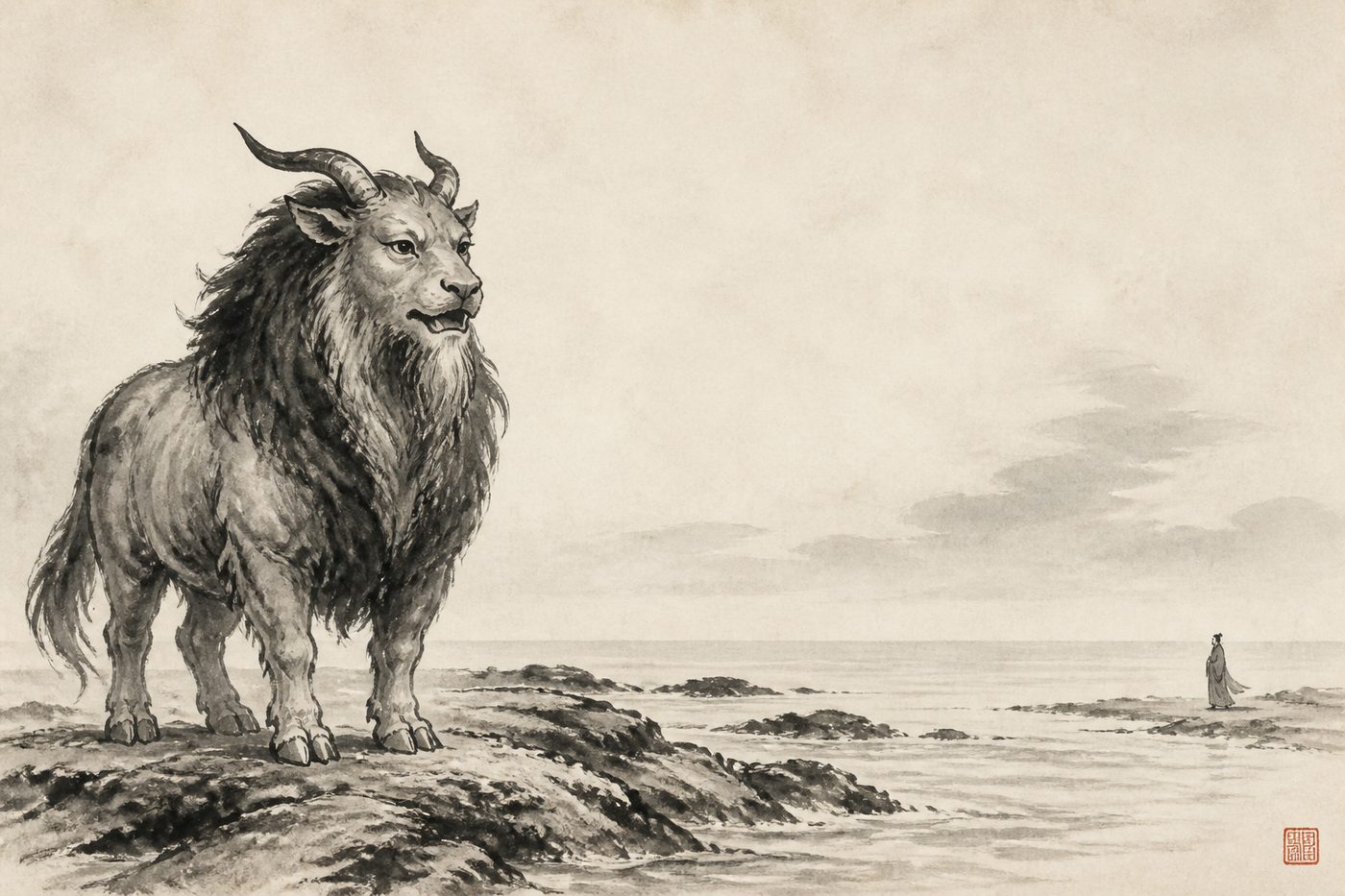
Every other great beast in the Chinese bestiary is defined by what it does to you. The qilin appears when a sage is born. The phoenix turns up for a golden age. The pixiu swallows treasure and, having no anus, never gives any of it back, which is a design decision of some elegance if you are in the market for a wealth charm.
Bai Ze is defined by what it says.
It is the only creature in the whole cast whose function is bibliographic. It meets the Yellow Emperor on a shoreline, it opens its mouth, and out comes a complete inventory of the supernatural world: every spirit, every monster, every category of haunting, named and enumerated. The emperor takes dictation. The result is a book.
And the book was real. That is the thing about this animal that keeps me up. Somewhere behind the legend of a talking beast on a beach there is an actual, physical, circulating text, used in Chinese households for centuries as protection, quoted by other books, and now lost, apart from one battered Tang-dynasty copy that a French archaeologist carried out of a cave in 1908 and which is presently in Paris.
The beast that gave a briefing
The story, in the fullest version we have, goes like this.
The Yellow Emperor, the semi-divine sovereign at the front of the Chinese historical tradition, is on a progress through his territories. He goes east until he reaches the sea, climbs a mountain called Huan, and on the shore he encounters a divine beast called Bai Ze. It can speak. More than that, it understands, in the phrasing of the text, the nature of all things.
So he asks it about ghosts and spirits.
And the beast answers. Of the things which are, in the text's formula, essence become substance or wandering soul become alteration, there are eleven thousand five hundred and twenty kinds. Bai Ze names them all. The emperor orders the whole set drawn and published for the empire to see.
That passage comes from the Yunji Qiqian, an enormous Daoist anthology compiled around 1029, which is quoting an older work called the Basic Annals of Xuanyuan. It is late, and it is the version everybody retells, and it is worth being precise about what "late" means here: the anthology is a thousand years old and the source it quotes is older still, but neither of them is contemporary with anything.
The oldest text we can put a date on that names the animal at all is much earlier and much shorter. Ge Hong, the alchemist and physician, finished the Baopuzi around 320, and in the chapter on extending life he runs through everything the Yellow Emperor had to go and learn from somebody else, since even a sage born able to speak could not simply sit still and acquire the Way. He climbed one mountain for an alchemical text and another to question a hermit. He consulted specialists on breathing, on astronomy, on medicine, on siting a grave. And, in seven characters: to get to the bottom of spirits and malignities, he recorded what Bai Ze said.
That is the whole mention. One clause in a list of consultants, four centuries before anyone wrote the story out. English reference works often name the Book of Song as the earliest source instead, and they are right about a different thing: the Book of Song is the earliest text that tells the story. The Baopuzi is the earliest that knows the name.
Eleven thousand five hundred and twenty
The number deserves a paragraph of its own, because it is doing something.
11,520 is not a round number in the way English expects round numbers to look, but it is deeply round in Chinese numerological terms, and it comes from the Book of Changes. The Xi Ci commentary counts the total of the "myriad things" at 11,520, arrived at by multiplying out the yarrow-stalk numbers of the sixty-four hexagrams. It is the traditional figure for everything.
So when Bai Ze names 11,520 kinds of spirit, the text is not reporting a tally. It is saying: all of them. The complete set. Nothing left over.
The formula the passage uses for what those things are comes from the same commentary: essence become substance, wandering soul become alteration. It is the classical Chinese account of how a ghost happens. Not a soul that fails to move on, in the Western way, but a concentration of vital stuff that has taken on a form, and a detached soul that has become a change in the world. Two mechanisms, one for monsters and one for hauntings, in eight characters.
An informant who covers all 11,520 is not a folklore character. It is a claim about a complete science.
It is not in the Classic of Mountains and Seas
Now three corrections, because the received version of this creature in English is wrong in three separate ways and each one is fixable.
The first: Bai Ze is repeatedly said, on wikis and in game lore and in a good deal of published fantasy reference, to come from the Classic of Mountains and Seas. It does not.
What does exist is a floating sentence, to the effect that on a certain eastern mountain there is a beast called Bai Ze which can speak, and which comes when a ruler has virtue. That sentence circulates widely with the Classic of Mountains and Seas attached to it. It is a fragment, quoted in later compendia, and it is not in the book.
How do I know? By checking, which takes about four minutes and which nobody appears to do. The received Classic of Mountains and Seas is eighteen chapters, it has been in continuous transmission for two thousand years, and the full text is freely available. Read all eighteen and the creature is not in any of them, not under this name and not under the shorter one. Anybody can repeat the check.
Where the fragment came from is a separate question and an open one. It may be a genuine lost passage from an edition that no longer survives, since the text we have is not the text the Han had. It may be a later attribution that stuck. What it is not is something you can look up.
The Ze beast, before it was white
The second correction is smaller and stranger.
The earliest full narrative of the encounter is not in the Daoist anthology at all. It is in the Book of Song, the official history of the Liu Song dynasty, finished by Shen Yue in 488, in the section on auspicious omens. And that passage does not call the animal Bai Ze. It calls it the Ze beast, with no white on the front.
It says: in the time of the Yellow Emperor, when he toured east as far as the shore, the Ze beast came out. It could speak, and it understood the essences of all things, so as to warn the people and rid the age of harm. And, in the standard formula for this class of omen, it says that when a worthy ruler's bright virtue reaches into the remote, it comes.
Everything is there except the color. Which raises the mildly awkward question of what the white is doing, and the mildly awkward answer is that nobody can say for certain. The second character of the name, on its own, can mean a marsh or a low wet place, and it can also mean a luster, the sheen on a polished surface. White marsh, or white brilliance. Translators have gone both ways and neither is provably right, and a page that picks one and states it flatly is telling you more than it knows.
I have some sympathy for whoever added the white. A speaking beast on a shoreline is better with an adjective.
The book, and the piece of it in Paris
The third thing is not a correction. It is the reason this creature is worth a page at all.
The Bai Ze Tu, the diagram or chart of Bai Ze, was a real book. Its premise was exactly what the legend describes: a catalog of supernatural entities, each one identified, so that a person confronted by one would know what they were looking at and what to do about it. Know the name, and you have the thing half beaten. This is a very old idea and it turns up everywhere, but the Chinese version came with a manual.
It was used domestically. There is a saying, still quoted, to the effect that a household with the Bai Ze chart in it has no trouble with monsters. In the Tang dynasty the beast's image went further up the social scale: a Bai Ze banner was carried in imperial processions, recorded in the Tongdian, and Bai Ze pillows are noted in a treatise on the five phases as something you slept on to keep bad things away. The catalog had become an amulet, which is what happens to reference works when they get famous enough.
And then it was lost. The complete text does not survive.
What survives is one manuscript, cataloged as Pelliot chinois 2682, copied in the ninth or tenth century, recovered from the sealed library cave at Dunhuang and now in the Bibliothèque nationale de France. It is a fragment of the Bai Ze Jing Guai Tu, the chart of Bai Ze's spirits and prodigies. It gives entries: this kind of apparition, this is its name, this is what you say to it or do about it.
There is one detail in it I find genuinely moving, and it is a negative. The surviving fragment contains no picture of Bai Ze.
Of course it does not. It was never a book about the beast. It was the beast's book, the transcript of the briefing, a list of everything else. The informant does not appear in the file.
Nine eyes and six horns are Japanese
Which brings us to the image in your head, if you have one, and where it came from.
The Bai Ze that appears in games, on card art, in fantasy encyclopedias and on a large majority of the images returned by a search, has three faces, nine eyes distributed across them and its flanks, and six horns. It is a striking and genuinely unsettling design. It is also Japanese, and it is younger than the United States.
The creature crossed to Japan, where it is read Hakutaku, and the standard depiction was established by Fukuhara Gogaku in a work called Hakutaku hi kai zu, published in 1785. That is where the three faces and the multiplied eyes come from. It has no basis in the Chinese sources, which describe a speaking beast and are otherwise not very interested in what it looked like.
Japan then took the idea and ran with it in a way China never quite did. During the cholera epidemic that hit Edo in 1858, people placed images of Hakutaku at their pillows for protection. That is a real and specific and rather touching use of a monster catalog's mascot: a city dying of an unknown disease, reaching for the animal that is supposed to know the names of things.
None of this makes the Japanese version illegitimate. It is a genuine and old tradition in its own right and the artwork is far better than anything the Chinese record left us. But if you are told the nine eyes are ancient Chinese iconography, you are being told something that is off by about fifteen hundred years and one country.
What it is for
Set the three corrections aside and what remains is a creature with an unusual and rather modern preoccupation.
The qilin means a sage is coming. The pixiu means money is staying. Both are omens in the ordinary sense: a message about the state of the world, delivered by an animal turning up.
Bai Ze is an omen too, on the same schedule, arriving when a ruler is good enough. But its message is not itself. Its message is a document, and the document is about everything else, and the point of the document is that being frightened of an unnamed thing is worse than knowing what the thing is called.
That is the whole idea. A jiangshi, the stiff-limbed hopping corpse of Chinese folklore, is exactly the sort of entity that would have had an entry in the chart: a name, a description, a line on what to do. Whether it did, we cannot know, because that page of the book is one of the ones that is gone.
Eleven thousand five hundred and twenty of them. One fragment left. And the beast that dictated the list is not in the picture.
In the classics
The passages behind the story, in the standard published translations. Open any one for the original text.
“The Yellow Emperor … in exhausting the study of spirits and malignities, he recorded what Bai Ze said. ”
Original text
黃帝……窮神奸則記白澤之辭。
“The Ze beast. In the time of the Yellow Emperor, when he toured east as far as the shore, the Ze beast came out. It could speak, and it understood the essences of all things, so as to warn the people and rid the age of harm. When a worthy ruler's bright virtue reaches into the remote, it comes. ”
Original text
澤獸,黃帝時巡狩至於東濱,澤獸出,能言,達知萬物之精,以戒於民,為時除害。賢君明德幽遠則來。
“The emperor toured east as far as the sea and climbed Mount Huan, and on the shore he came upon the divine beast Bai Ze, which could speak and understood the nature of all things. He therefore asked it about the ghosts and spirits of the world. Of those which, since antiquity, are essence become substance or wandering souls become alteration, there are eleven thousand five hundred and twenty kinds. Bai Ze named them, and the emperor ordered them drawn and set out for the whole world to see. ”
Original text
帝巡狩,東至海,登桓山,於海濱得白澤神獸,能言,達於萬物之情。因問天下鬼神之事,自古精氣為物、遊魂為變者凡萬一千五百二十種,白澤言之,帝令以圖寫之,以示天下。
As seen in
Onmyoji
game · 2016Appears as a shikigami under the Japanese reading of the name, in the nine-eyed form, as Hakutaku.
The design follows the eighteenth-century Japanese iconography, not the Chinese one.
Questions people ask
Is the Bai Ze a real animal?
No. It is a creature of Chinese legend, not a species, and no classical source treats it as an ordinary animal. The texts are clear that it is a divine or numinous beast, that it speaks, and that it appears only when a ruler is virtuous, which is not a description of anything with a habitat. What is real is the book attributed to it. A manuscript copied in the ninth or tenth century, cataloged as Pelliot chinois 2682, survives in the Bibliothèque nationale de France, and it is a working list of spirits with instructions for handling them.
What does Bai Ze mean?
The first character means white. The second is harder, and anyone who tells you it has one settled meaning is overselling it: on its own it can mean a marsh or a low wet place, and it can also mean a sheen or a luster on a surface. So the name reads as something like white marsh or white brilliance, and translators have gone both ways. The earliest full account, in the fifth-century Book of Song, does not use the white at all: it calls the animal simply the Ze beast.
What does Bai Ze do?
It informs. That is its entire function, and it is what separates it from every other auspicious beast in the Chinese tradition. In the legend recorded in the Yunji Qiqian, quoting the Basic Annals of Xuanyuan, it meets the Yellow Emperor on the eastern shore and answers his questions about the supernatural world, naming 11,520 kinds of spirit and haunting, which the emperor then has drawn and published. It does not fight anything, guard anything or bring anything. It gives a briefing.
Who is Bai Ze in Chinese mythology?
One of the auspicious beasts, in the same broad company as the qilin and the phoenix, but with a role none of the others share. The others are omens: their arrival signals that a sage has been born or a golden age has come. Bai Ze is an omen too, and the Book of Song says it appears when a worthy ruler's virtue reaches far enough, but it also does something the others never do. It talks, and what it says becomes a book. In later centuries its image was used as a protective charm on banners and pillows, on the logic that the thing which cataloged the monsters can keep them off.
Related figures
Sources & further reading
- Bai Ze: the Dunhuang manuscript Pelliot chinois 2682 at the Bibliothèque nationale de France, copied in the ninth or tenth century; the 11,520 spirits; and Fukuhara Gogaku's Hakutaku hi kai zu of 1785 with its three faces, nine eyes and horns, plus the pillow images of the 1858 Edo cholera epidemic
- 白泽: the Chinese-language survey of the sources, giving the Baopuzi clause, the Book of Song passage, the Yunji Qiqian narrative, and the Tang-dynasty Bai Ze banner and Bai Ze pillow
- Yellow Emperor: the legendary sovereign of the encounter, and the frame the story hangs on
- Dunhuang manuscripts: the sealed library cave at Mogao, its opening in 1900, and the dispersal of its contents to Paris, London and elsewhere
- Classic of Mountains and Seas: the received text, its bestiary, and its transmission
- 山海經, the full received text in eighteen chapters (Chinese Wikisource). Checked chapter by chapter on 13 August 2026: 白澤 does not occur anywhere in it
- I Ching, Xi Ci commentary: the phrase about essence becoming substance and the wandering soul becoming alteration, which the Bai Ze passage borrows (Chinese Text Project)
By Julian 祝君瑜, retold from the classics, with the original passages cited, updated 2026-08-26