Chinese Mythology
Kitchen God: Zao Jun, the Chinese Deity Who Files a Report on You
Zao Jun, 灶君 (zàojūn), the Chinese Kitchen God, lives above the stove, watches the household all year, and goes up to report what he has seen. He is one of the oldest gods still in domestic use: a proverb about him is quoted at Confucius in the Analects, and the earliest full account of his job, written around 320, describes a monthly audit that docks days off your life. The sugar on his mouth is a bribe, and it is a cheap version of an older one.
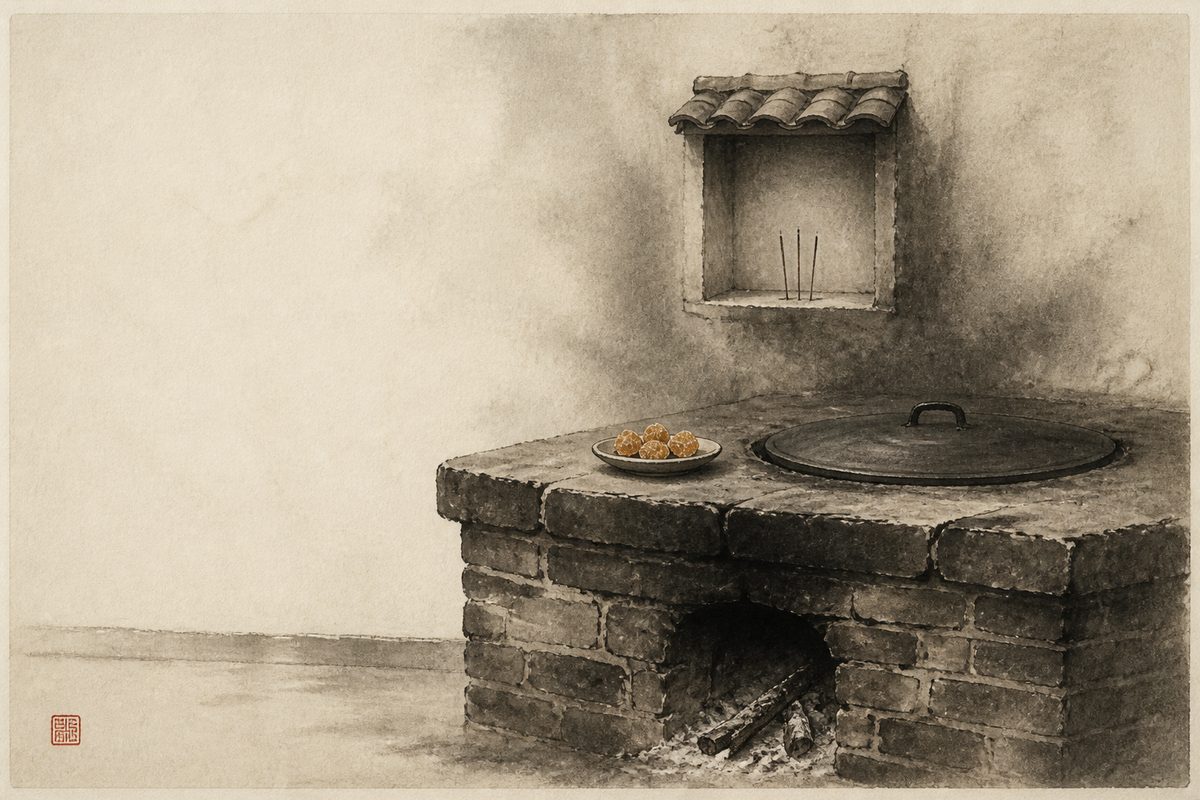
There is a god living over your cooker, and his job is to tell on you.
That is not a folkloric flourish. It is the plain content of the tradition, held with remarkable consistency for something like two and a half thousand years. Zao Jun, 灶君 (zàojūn), the Lord of the Stove, sits above the hearth in a small paper portrait, watches the household through the year, and at the end of the twelfth lunar month goes up to report on what he has seen. Chinese religion has grander gods and better-looking ones. It has none that has been closer to more people for longer, because the stove is where the family actually lives, and he is on it.
The English pages about him tend to open with a legend involving a man who left his wife and later threw himself into a fire out of shame. We will get nowhere near that story, for a reason worth stating early: it is a late one, it has several incompatible versions, and it is nowhere in the texts that actually document him. What those texts document instead is a job. So this is the story of the job.
Confucius already knew the joke
The stove god's first appearance in the Chinese record is not in a myth. It is in a piece of political needling in the Analects, and the man doing the needling is Wangsun Jia, who ran the state of Wei in everything but name while its duke held the title.
Wangsun Jia asked: what is meant by the saying, better to court the stove than to court the southwest corner? The Master said: not so. One who has offended against Heaven has nowhere left to pray.
The southwest corner of a Chinese house was the honored spot, where the senior spirit of the household was venerated. The stove was the working end of the building. So the proverb is about influence: never mind the dignified figure in the place of honor, go and be nice to the one who does the cooking, because he is the one who decides what happens to you.
Commentators have read the exchange the same way for a very long time, and it is hard to read it any other way. Wangsun Jia is the stove. The duke is the corner. He is asking a distinguished visitor, in the politest possible code, whether the visitor has worked out yet who is actually worth flattering in Wei. Confucius, who was not a fool and did not want the job on those terms, declines the offer with a line about Heaven that is not really about Heaven.
What matters for us is what the joke assumes. For the proverb to land in the fifth century BCE, everyone in the room already had to know that the stove had a spirit in it, that the spirit could be curried favor with, and that flattering it might get you somewhere. All the machinery of the Kitchen God is present, as a shared reference, in the earliest layer of Chinese literature we have.
The stove had a spirit before it had a man in it
The Zhuangzi confirms it from the other direction. Duke Huan of Qi, out hunting in the marshes, sees a ghost and falls ill for several days. A scholar is brought in who asks whether the duke would like to know what actually lives where, and then produces a catalogue of the resident spirits of an ordinary Chinese world, beginning at home and working outward:
There are. In the sludge there is Lü. In the stove there is Ji. In the litter inside the door, Thunder takes up residence.
Then the northeast corner, the northwest corner, the water, the hills, the mountains, the wilds and the marshes, each with its own named occupant. It is a wonderfully domestic list. Chinese houses were not haunted; they were staffed.
And the staffing was official. The Book of Rites sets out seven sacrifices the king establishes for the multitude of clans, and three of them are furniture: the door, the stove, and the central roof-hole over the spot where rain came into an old house. The door is Menshen. The stove is the god of this page. The roof-hole is the household's own patch of earth, which is the same office the earth god holds outdoors.
Ji, in the stove, is our man, and the name is worth pausing over because for a long time it was not a man at all. When the stove god finally gets a full personnel file, in a Tang miscellany of the 860s called Miscellaneous Morsels from Youyang, the compiler Duan Chengshi opens the entry with the appearance and only afterwards gets to the paperwork:
The stove god is named Wei and looks like a beautiful woman. He is also surnamed Zhang, named Dan, with the courtesy name Zigu. His wife's courtesy name is Qingji, and he has six daughters, all named Chaqia, Inspect.
There is a great deal packed into three sentences. The god has two identities at once, an older one that looks like a woman and a newer one with a surname, a given name and a courtesy name like any respectable gentleman. He has acquired a wife, who has a courtesy name of her own, which in the ninth century was not nothing. And he has six daughters, all of whom are called the same thing, and the thing they are called is Inspect.
A household deity with six daughters named after the act of checking up on people is not a subtle piece of theology, and I would not want it to be. The family that lives over your stove is an inspectorate.
The audit, and the exchange rate
The mechanism is set out most fully by Ge Hong, the fourth-century alchemist whose Master Who Embraces Simplicity is the great compendium of what an educated Chinese person around the year 320 thought about extending a life. Ge Hong is running through the ways a person loses time. There are spirits in the body who report you to the Director of Destinies every sixtieth day. And then:
Also, on the last night of the month, the stove god likewise goes up to Heaven and reports a person's offenses. For a large one he takes a ji; a ji is three hundred days. For a small one he takes a suan; a suan is three days. I myself have not been able to establish whether this is so or not.
Three things there.
The first is that the report is monthly, not annual. The stove god of the fourth century filed twelve times a year, on the last night of each lunar month, which is a rate of oversight the modern once-a-year version has quietly relaxed.
The second is the currency. The penalty is not hellfire or bad luck. It is subtraction from your allotted lifespan, in specified units, like a fine. Ge Hong's surrounding pages list what earns them, and the list is long and startlingly ordinary: stepping over a well, striding across the stove, using light scales and short measures, passing off the fake as the real, laughing at people who do good, being ungrateful for a kindness. This is not a god who is interested in your soul. He is interested in whether you cheat.
The third is the last sentence, and it is my favorite line in any of this. Having laid the whole apparatus out, Ge Hong adds that he has not been able to establish whether it is true. A working Daoist alchemist, writing the standard account of the Kitchen God's audit, ends it with a shrug. If you have ever been told that pre-modern people simply believed what they were told, here is a man in the year 320 politely declining to.
Duan Chengshi, five hundred years later, gives the same schedule and the same units. He does not give the same numbers.
| Baopuzi, c. 320 | Youyang Zazu, c. 860 | |
|---|---|---|
| How often he reports | last night of every month | last day of every month |
| A large offense costs | one ji: 300 days | one ji: 300 days |
| A small offense costs | one suan: 3 days | one suan: 100 days |
| The author's own view | cannot establish whether it is true | reported flat, no comment |
The large penalty is stable across five centuries. The small one has multiplied by thirty-three. Somebody's copy was wrong, or the tariff was revised, or the two authors were working from different traditions, and there is no honest way to pick. What the disagreement does show is that this was a system detailed enough to have numbers in it that could drift, which is not how vague folk beliefs behave.
The man who saw him and got rich
The earliest datable stove sacrifice in a standard dynastic history is not a piety story. It is a get-rich story, and it is in the Book of the Later Han, in the chapter on the Yin family, who became imperial in-laws when one of their daughters married the founder of the Eastern Han.
The chapter pauses to explain where the family's money came from:
In the reign of Emperor Xuan there was one Yin Zifang, a man of the utmost filial devotion and kindness. Cooking at dawn on the La day, he saw the stove god take visible form, and bowed twice to receive the blessing. The household had a yellow sheep, and he sacrificed it accordingly. From that time on he grew suddenly and hugely rich, with more than seven hundred qing of land, and carriages, horses and servants on the scale of a territorial lord.
The La day was the great winter sacrifice at the close of the year. Yin Zifang is up before dawn lighting the fire, the god appears, and he does the only sensible thing, which is to bow and then sacrifice the animal he happens to own. The history adds that this is why people afterwards always sacrificed to the stove on the La day, and offered a yellow sheep when they did.
I would treat the causation as the family's own view rather than the historian's. What the passage genuinely establishes is that by the first century BCE the stove already had a sacrifice attached to a fixed day in the year, that a specific animal went with it, and that the Han elite told a story in which being decent to the stove god made a household rich. The wealth line running out of that story is a real one; the god households later welcome in for money, on the fifth day of the new year rather than the last days of the old, has a page of his own.
Buying him off, itemized
By the Song dynasty the practice has a menu, and we have it in verse, because Fan Chengda went home to his estate at Stone Lake in the 1180s, watched his tenants keep the year, and wrote up ten of their end-of-year customs as poems. The third is Sacrifice to the Stove, and it is the entire transaction in thirteen lines.
Old tradition says the twenty-fourth of the last month: the Stove Lord goes to court in Heaven, meaning to speak of matters. Cloud carriage and wind horses linger a moment, for the house has cups and dishes and a rich set of rites. A pig's head boiled soft, a pair of fresh fish, bean paste and sweet spikenard and round rice cakes. The men pour the offering, the women keep away; wine is poured on the ground and paper money burned, and the Stove Lord is pleased. Do not hear the maidservants quarreling, sir. Do not take offense at what the cat and the dog fouled. We send you up drunk and full to the gate of Heaven: say no more about whether the ladle was long or short, and beg us a little profit to bring back and share out.
Look at what is actually being requested. Not forgiveness, not blessing, not virtue. The family wants four specific things: that the servants' fights go unmentioned, that the mess the animals made be overlooked, that the business about the ladle being long or short be dropped, and that he bring something back for them while he is up there. The ladle line is a small domestic masterpiece. Whatever the argument was about the serving spoon, it is the kind of thing that gets remembered in a house all year and that nobody wants read out in Heaven.
The method is equally frank. He is to be sent up drunk. The wine is not devotion, it is impairment, applied to a witness on his way to give evidence.
Two details of the Song practice have not survived and are worth noticing on the way past. The men pour and the women keep away, which is the reverse of most Chinese household ritual and which later hardened into a proverb about men not worshipping the moon and women not sacrificing to the stove. And the last request, for a little profit to bring back and share out, uses a word, lishi, that had been in the language since the Zuo Commentary and that also names one of the four assistants in the wealth god's department. Even the Kitchen God, on his way to file a report, is expected to come back with something.
Monthly, then yearly, then sugared
Fan Chengda's own preface to the sequence says the stove god goes up the following morning to report the year's business. Ge Hong's, eight hundred years earlier, went up on the last night of every month. Somewhere between the two, twelve reports a year became one, and the sacrifice consolidated onto the single date at the end of the twelfth month that everybody keeps today. Nobody announced the change. It shows up as a difference between two texts, which is how most religious change is visible at all.
The other thing that changed is the price. A boiled pig's head, two fresh fish, bean paste cakes and enough wine to get a deity drunk is a serious outlay for a farming household. What replaced it is malt sugar: a lump of hard, viciously sticky candy, pressed against the lips of the paper portrait before it goes up in smoke. Ask three people what the sugar is for and you will get two answers, given with equal confidence. It sweetens his words. It glues his mouth shut. Both readings are alive, and the ambiguity is the joke, because a household that is genuinely innocent does not need to consider option two.
The paper portrait usually carries a couplet down its sides, and the couplet states the bargain without embarrassment: above, speak of good things; below, keep us safe. That is not worship. That is terms.
Which day, and why nobody agrees
The sacrifice falls on the twenty-third or the twenty-fourth day of the twelfth lunar month, which lands in January or early February and can be pinned to a Gregorian date with our Chinese calendar converter. The day is called Little New Year, and it opens the fortnight of cleaning, shopping and dread that ends with the reunion dinner.
Which of the two dates a family keeps is broadly a north-and-south matter, north on the twenty-third and south on the twenty-fourth, with the usual exceptions along the coast and among boat-dwelling communities, who keep it later still. I am reporting that as current practice rather than citing it, because the explanations offered for the split are folk explanations and I have not found a text that settles it.
What can be dated is which one is older. Fan Chengda, writing in the 1180s, says the twenty-fourth, and calls it old tradition even then. The twenty-third is the newcomer: the earliest text we have found for it is from Beijing, and the evidence for when it took over is laid out on our Little New Year page.
The god you burn
Here is the part that I think is genuinely strange, and that no other deity in the Chinese house does.
At the end of the year the paper portrait above the stove is taken down and burned. That is not disposal; it is transport, the smoke being how he gets up there. The niche then stands empty for the few days he is away, and on New Year's Eve a new print is pasted up to receive him back. He is, uniquely, an annually replaced god, renewed each winter like a license, and the household buys him at the market alongside the couplets and the paper cuts.
There is a compass version of the stove and a religious one, and they are different subjects: where the range should sit and which way the fire mouth should face belongs to feng shui, and the reporting line, up through the Kitchen God to the Jade Emperor who receives the annual return, belongs to the celestial civil service.
But the thing itself is small and cheap and stuck to a wall over a stove, and it has been there, in one form or another, since before anybody wrote the Analects down. Twenty-five centuries of Chinese households have cooked under the same quiet arrangement: someone is watching, he goes up once a year, and the least you can do is make sure he leaves in a good mood.
In the classics
The passages behind the story, in the standard published translations. Open any one for the original text.
“Wangsun Jia asked: what is meant by the saying, better to court the stove than to court the southwest corner? The Master said: not so. One who has offended against Heaven has nowhere left to pray. ”
Original text
王孫賈問曰:「『與其媚於奧,寧媚於竈。』何謂也?」子曰:「不然。獲罪於天,無所禱也。」
“There are. In the sludge there is Lü. In the stove there is Ji. In the litter inside the door, Thunder takes up residence. ”
Original text
有。沈有履。竈有髻。戶內之煩壤,雷霆處之…
“Also, on the last night of the month, the stove god likewise goes up to Heaven and reports a person's offenses. For a large one he takes a ji; a ji is three hundred days. For a small one he takes a suan; a suan is three days. I myself have not been able to establish whether this is so or not. ”
Original text
又月晦之夜,灶神亦上天白人罪狀。大者奪紀。紀者,三百日也。小者奪算。算者,三日也。吾亦未能審此事之有無也。
“The stove god is named Wei and looks like a beautiful woman. He is also surnamed Zhang, named Dan, with the courtesy name Zigu. His wife's courtesy name is Qingji, and he has six daughters, all named Chaqia, Inspect. He habitually goes up to Heaven on the last day of the month to report a person's offenses. For a large one he takes a ji, three hundred days; for a small one a suan, one hundred days. He is therefore the Celestial Emperor's inspector above, and an earth-spirit below. ”
Original text
竈神名隗,狀如美女。又姓張名單,字子郭。夫人字卿忌,有六女,皆名察洽。常以月晦日上天白人罪狀,大者奪紀,紀三百日,小者奪算,算一百日。故為天帝督使,下為地精。
“In the reign of Emperor Xuan there was one Yin Zifang, a man of the utmost filial devotion and kindness. Cooking at dawn on the La day, he saw the stove god take visible form, and bowed twice to receive the blessing. The household had a yellow sheep, and he sacrificed it accordingly. From that time on he grew suddenly and hugely rich, with more than seven hundred qing of land, and carriages, horses and servants on the scale of a territorial lord. ”
Original text
宣帝時,陰子方者,至孝有仁恩,臘日晨炊而竈神形見,子方再拜受慶。家有黃羊,因以祀之。自是已後,暴至巨富,田有七百餘頃,輿馬僕隸,比於邦君。
“Old tradition says the twenty-fourth of the last month: the Stove Lord goes to court in Heaven, meaning to speak of matters. Cloud carriage and wind horses linger a moment, for the house has cups and dishes and a rich set of rites. A pig's head boiled soft, a pair of fresh fish, bean paste and sweet spikenard and round rice cakes. The men pour the offering, the women keep away; wine is poured on the ground and paper money burned, and the Stove Lord is pleased. Do not hear the maidservants quarreling, sir. Do not take offense at what the cat and the dog fouled. We send you up drunk and full to the gate of Heaven: say no more about whether the ladle was long or short, and beg us a little profit to bring back and share out. ”
Original text
古傳臘月二十四,竈君朝天欲言事。雲車風馬小留連,家有盃盤豐典祀。猪頭爛熟雙魚鮮,豆沙甘鬆粉餌圎。男兒酌獻女兒避,酹酒燒錢竈君喜。婢子闘爭君莫聞,猫犬觸穢君莫嗔。送君醉飽登天門,杓長杓短勿復云,乞取利市歸來分。
Questions people ask
Who is the Chinese Kitchen God?
Zao Jun, the Lord of the Stove, is the household deity who lives above the cooking range, watches the family through the year, and goes up to report on their conduct. He is among the oldest gods still in everyday domestic use in China: a proverb about him is quoted at Confucius in the Analects, and Ge Hong's Master Who Embraces Simplicity, written around 320, already describes his reporting schedule and the penalties attached to it. He is not a god of cooking. He is a resident observer who happens to live on the stove.
What is the Kitchen God called in Chinese?
Zao Jun (灶君, zàojūn), the Lord of the Stove, is the name this page uses. Zao Shen (灶神), the stove god, is the plain descriptive name, and the one Ge Hong already uses around 320. In everyday speech he is Zao Wang, the Stove King, or more fondly Zao Wang Ye (灶王爷), Lord Stove King; Cantonese speakers say Jou Gwan. A household with no paper portrait writes his formal title on red paper instead: Siming Zaojun, the Stove Lord who directs fates, which is a fair summary of the report he files.
Why do people put sugar on the Kitchen God's mouth?
To interfere with the report. Before he ascends at the end of the twelfth lunar month, families smear malt sugar or sticky candy on the lips of his paper portrait, so that his mouth is either sweetened into saying nice things or gummed shut, depending on which relative you ask. It is the budget version of a much older practice: in the 1180s the poet Fan Chengda described sending him up drunk and full on a boiled pig's head and a pair of fish, with the family asking him out loud not to mention the servants' quarrels or what the cat had fouled.
When is the Kitchen God festival?
The twenty-third or twenty-fourth day of the twelfth lunar month, a week or so before Chinese New Year, which puts it in January or early February depending on the year. Northern households generally keep the twenty-third and southern households the twenty-fourth. The twenty-fourth is the older of the two: it is the date Fan Chengda gives in the 1180s, and he calls it old tradition even then. Our Chinese calendar converter will turn any lunar date into a Gregorian one.
Is The Kitchen God's Wife a true story?
Amy Tan's 1991 novel is fiction, though it draws on her mother's life. The god in its title is not fiction. Zao Jun is a real and very old figure of Chinese folk religion, still honored in households across China, Taiwan and the diaspora, and he does have a wife: a Tang-dynasty miscellany from around 860 gives her a courtesy name, Qingji, and gives the couple six daughters, all of them named Inspect.
Who is the Chinese god of cooking?
There is not really one, which surprises people. The stove has a god, but his brief is conduct rather than cuisine: Zao Jun watches the household and reports on it, and no early text credits him with anything to do with the quality of the food. The figure Chinese tradition associates with food itself is Shennong, the Divine Farmer, who is credited with agriculture and with tasting the plants to find out which ones were safe.
Related figures
Sources & further reading
- The Analects (论语), Bayi 3.13, Chinese Wikisource
- Zhuangzi (庄子), Mastering Life, Chinese Wikisource
- Ge Hong, The Master Who Embraces Simplicity (抱朴子), Chinese Wikisource
- Duan Chengshi, Miscellaneous Morsels from Youyang (酉阳杂俎), scroll 14, Chinese Wikisource
- Book of the Later Han (后汉书), scroll 32, the Yin family biographies
- Fan Chengda, Stone Lake Collection (石湖诗集), scroll 30, Siku Quanshu edition
- Kitchen God (Wikipedia), the modern practice and the regional dates
- The Kitchen God's Wife (Wikipedia), Amy Tan's 1991 novel
- 灶神, Chinese Wikipedia: the everyday names Zao Shen, Zao Wang and Zao Wang Ye, and the Siming Zaojun tablet
By Julian 祝君瑜, retold from the classics, with the original passages cited, updated 2026-10-09