Chinese Mythology
The Eight Immortals (八仙): Who They Are, and How the Eight Got Fixed
The Eight Immortals, 八仙 (Bāxiān), are the best-known group in Chinese popular religion: Lü Dongbin, Zhongli Quan, Iron-Crutch Li, Zhang Guolao, Han Xiangzi, Cao Guojiu, Lan Caihe, and He Xiangu, the one woman. They are not gods but xian, people who became deathless. The surprise is how recent the line-up is. The number eight is old; these particular eight were only settled in the Ming dynasty, by a novel.
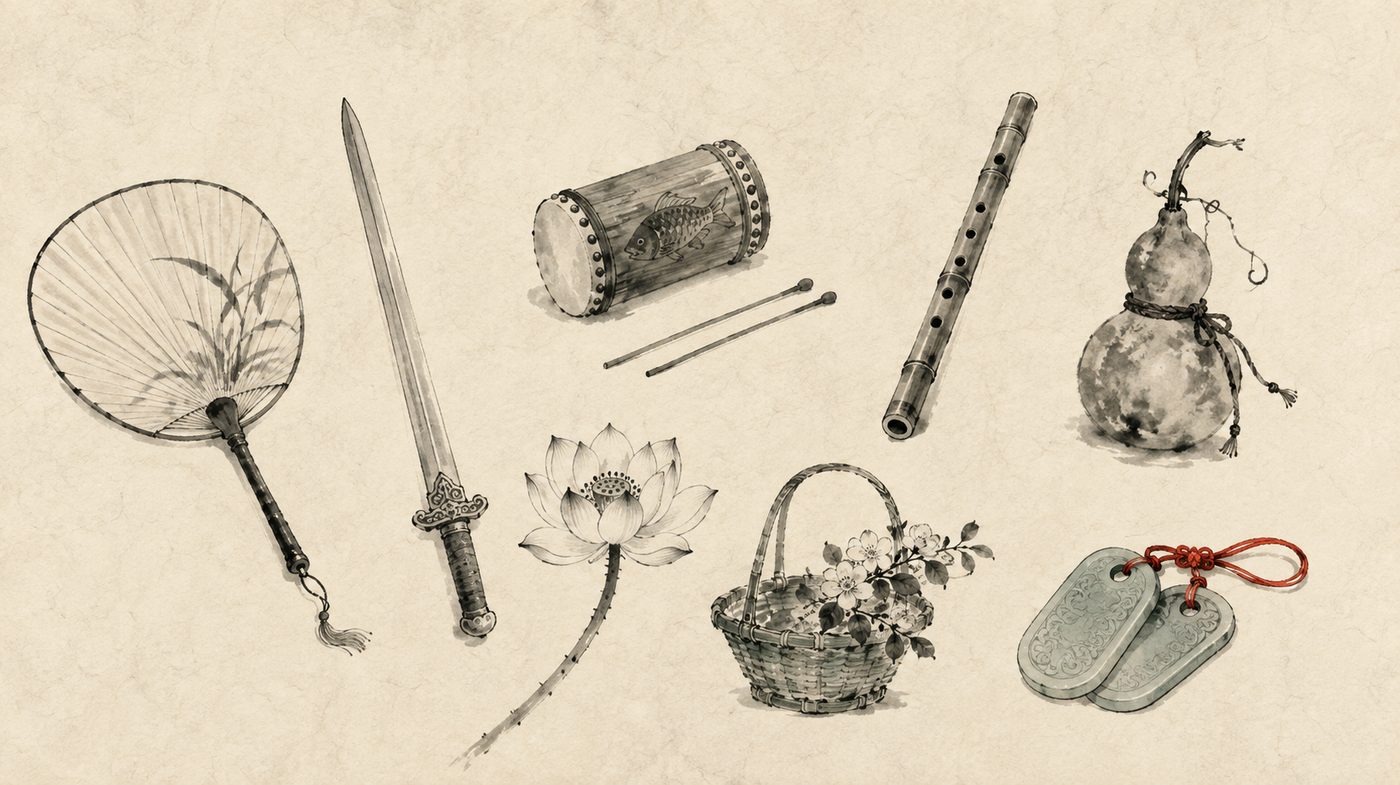
Eight people, one of them a woman, one of them a beggar, one of them a cripple with an iron crutch, and one of them riding a donkey backwards. They are not related, they did not live in the same century, and for several hundred years nobody could agree on who the eighth one was. They are the Eight Immortals, and if you have ever looked at a Chinese vase, a temple roof, a wedding cake, or a Jackie Chan film, you have met them.
The eight, and what each one carries
Every one of the eight is identified by an object. This is not decoration. It is a naming system, and once you have it you can read a great deal of Chinese art you previously had to guess at.
| Immortal | Carries | The object says |
|---|---|---|
| Zhongli Quan | a palm-leaf fan | it fans the dead back to life; he is the fat, cheerful, bare-bellied one |
| Lü Dongbin | a sword | the demon-cutting blade; he is the scholar of the group and the one with the most stories |
| Zhang Guolao | a fish drum, a bamboo tube struck with two rods | great age; he is the one on the backwards donkey |
| Han Xiangzi | a flute | youth, and the growth of things |
| Iron-Crutch Li | a gourd and an iron crutch | medicine, and poverty; the gourd holds the drug that cures |
| He Xiangu | a lotus | she is the woman of the eight, and the lotus is the flower that comes up clean out of mud |
| Lan Caihe | a flower basket | the beggar, of uncertain age and uncertain gender, who sang in the street |
| Cao Guojiu | a pair of jade clappers | the court; he is the imperial relative and the last to be admitted |
Now the useful part. Because the objects are so firmly attached, Chinese decorative art learned to use the objects alone, without the people. A fan, a sword, a fish drum, a flute, a gourd, a lotus, a basket and a pair of clappers, arranged around the shoulder of a jar, and any Chinese viewer knows exactly who is meant and what is being wished on the owner. The set has its own name, 暗八仙, the covert or hidden Eight Immortals, and the Western antiques trade knows it as the Eight Daoist Emblems, which is what the ceramics reference Gotheborg files it under.
It is the closest thing Chinese ornament has to a rebus. It also explains a very common experience: you look at an old bowl, count eight small unrelated objects around the rim, and cannot work out what they have to do with one another. They do not have to do with one another. They stand for eight people who are not in the picture.
The Eight Drunken Immortals, and the film that made them famous
Ask a Western audience about the Eight Immortals and a surprising number will answer with a martial arts film. That is Drunken Master, directed by Yuen Woo-ping and starring a 24-year-old Jackie Chan, which opened in Hong Kong on 5 October 1978, took the equivalent of nearly two million US dollars there, and ended the year as the second most popular film in the colony. Its whole structure is the eight: the young hero is drilled through eight drunken boxing forms, one named for each immortal, and the joke of the finale is that he has skipped He Xiangu's form because he was not willing to imitate a woman, and has to improvise it under fire.
Drunken boxing is real. So is the long association between these eight and wine, which runs through the poetry and the paintings and is a good part of why the group is fun rather than pious. The specific eight forms in the film are shakier. The film's own documentation, following its martial arts sources, records that the Eight Drunken Immortals set is very probably the invention of Yuen Woo-ping as choreographer, assembled out of routines borrowed from other systems rather than handed down intact from a school.
That is worth saying plainly, because the internet has spent forty years quietly promoting a 1978 fight scene into an ancient lineage. The film is magnificent. The lineage is a film credit.
Not gods, exactly
The word doing the work here is 仙 (xiān), which English translates as immortal and which is not at all the same as god. Chinese popular religion runs a celestial bureaucracy: the Jade Emperor at the top, ministries below him, gods holding posts with jurisdictions and paperwork, exactly like the earthly government it is modeled on, and you can read the whole org chart on our guide to the Chinese gods.
The eight are not in that bureaucracy. They are people who got out of dying, by discipline, by pill, by accident, or by meeting somebody who had already managed it, and who then spent eternity wandering about being difficult. They hold no office and answer to nobody. This is why they are the group the storytellers love: a god has responsibilities, and an immortal has time.
Two of them do have institutional weight. Zhongli Quan and Lü Dongbin are counted among the Five Northern Patriarchs of Quanzhen Daoism, one of the two great surviving Daoist schools, and that canonization was confirmed by imperial edict under the Yuan. The Lü Dongbin cult in particular grew enormous. The Palace of Eternal Joy in southern Shanxi, a Yuan temple complex whose murals are among the finest surviving in China, was built around him, and Paul Katz of Academia Sinica has written a whole book about how his legend and that building made each other. So one of the eight is simultaneously a comic character in a popular novel and a founding patriarch of a living religion, which tells you something about how Chinese religion actually works.
Crossing the sea
The story everyone knows is the crossing. The eight are on their way to a birthday party in the Western Paradise, they come to the sea, and Lü Dongbin proposes that instead of riding clouds like sensible immortals, each of them should get across on whatever they happen to be carrying. So Iron-Crutch Li floats on his gourd, Lan Caihe on the flower basket, Han Xiangzi in the flute, and so on across all eight. Lan Caihe's basket attracts the attention of a dragon prince, there is a theft, a rescue, and a fairly serious war with the Dragon King before the Bodhisattva Guanyin arrives to make everybody behave.
Out of it comes one of the most-used idioms in the language: 八仙过海,各显神通, the Eight Immortals cross the sea, each revealing their own divine powers. It is said of any group tackling the same problem by wildly different methods, and it is genuinely everyday speech, the sort of thing said about a project team or a set of siblings. It is also, quietly, a very good statement of the group's whole point, which is not teamwork but assortment.
The eight were not always these eight
Here is the part almost nobody writes in English, and it is the most interesting thing about the group.
The number came first. The membership came last.
Eight was already a set-making number in Chinese thought, and there were earlier Eight Immortals who have nothing to do with ours. The kingdom of Shu had a group of eight that includes the philosopher Laozi, the Han Confucian Dong Zhongshu, and Zhang Daoling, the founder of organized Daoism. Nothing about that list overlaps with the one on this page. It was simply eight immortals, from Shu.
By the Yuan dynasty a recognizable group is on stage, and the stage is where you can watch it wobble. Yuan drama loved these figures, and the plays do not agree with each other. In Ma Zhiyuan's Lü Dongbin Thrice Drunk at Yueyang Tower, the eight are listed by name and He Xiangu is not among them; her place is taken by a Song Daoist called Xu Shenweng, gourd on his back. In Yue Bochuan's play about Iron-Crutch Li, the odd man out is somebody called Zhang Silang. A Ming novel about the treasure fleets swaps in two more names again. The eight were a shape with interchangeable parts, and the parts kept being swapped.
What fixed them was a book. In the Ming dynasty Wu Yuantai wrote A Record of the Origins of the Eight Immortals and Their Journey to the East, usually shortened to Journey to the East, a fifty-six-chapter novel that gathered every scattered legend into one narrative, ran the eight through their mortal lives in order, and finished with the crossing of the sea. It is not a great novel. It did not have to be. It was popular, it was complete, and it was the version that got copied, staged, painted and eventually televised, so its cast list became the cast list.
That is the honest history of the Eight Immortals: a number that was waiting for members, a few centuries of substitutions, and a Ming bestseller that closed the door behind the last one in. If a page tells you the eight are ancient and fixed, it is repeating the novel's own claim about itself.
Three of them were real people
The other thing the retellings flatten is that some of these are documented human beings, and the documentation is remarkably unmagical.
Zhang Guo is in the dynastic history. The Old Book of Tang, completed in 945, gives him a biography among the Masters of Technique, and it opens by admitting that nobody knew where he came from: he lived hidden on Mount Zhongtiao in the time of Empress Wu, was reputed to hold a secret art of long years, and said of himself that he was several hundred years old. Emperor Xuanzong had him fetched to court, granted him an honorary senior rank and the Daoist name Master of Penetrating Mystery, and offered him the hand of the Princess Yuzhen, which Zhang declined with a line the historians thought worth preserving: to take a wife and get a princess, now that is a frightening thing. Everything about the backwards donkey, which folds up like paper when he is not riding it, is later. The court appointment is not.
Han Xiang was a Tang official. He is the grand-nephew of Han Yu, one of the greatest prose writers in the language, and we know this because Han Yu wrote a poem at him. In 819 Han Yu submitted a memorial objecting to the court receiving a finger-bone of the Buddha with honors, was demoted to a post at the far southern edge of the empire, and on the road, at a snowbound pass, his young relative caught up with him. The poem he wrote there is one of the most-memorized in Chinese, and its title says plainly what the folk tradition later garbled: Demoted, I Reach Blue Pass and Show This to My Grand-Nephew Xiang. Cloud lies across the mountains, the snow has closed the pass, the horse will not go on, and be ready to gather my bones by that fever-ridden river. Han Xiangzi the flute-playing immortal is a legend that later attached itself to that young man.
Cao Yi is the least romantic of all. He was born in 1018, grandson of a famous general, younger brother of the empress of Emperor Renzong, and he had precisely the career you would expect of a well-connected Song aristocrat: a run of prefectures, a string of military commissionerships, an enfeoffment as Prince of Jiyang. The History of Song preserves Emperor Shenzong praising him, and the praise is that he went home from court and never talked about state business. He died in 1089, at seventy-one, of nothing in particular. Then folk tradition made him the eighth immortal, the imperial brother-in-law with the jade clappers, admitted last and slightly awkwardly, which is roughly how he seems to have lived.
Lan Caihe was there first
The one who really breaks the "ancient fixed group" story is the beggar.
Lan Caihe appears in the Extensive Records of the Taiping Era, the enormous imperial anthology completed in 978, which the compilers credit to a Southern Tang collection of immortal biographies. The description is one of the great pieces of Chinese character writing, and it has survived unchanged for a thousand years: nobody knew where he came from, he wore a torn blue gown and a wide black wooden belt with six plaques on it, one foot had a boot on it and the other went bare, in summer he padded the gown with wadding and in winter he lay down in the snow and the breath came off him like steam off a pot. He begged through the towns with a set of great clappers, singing, drunk, and people followed him about to watch.
That is 978. It is roughly three centuries before anyone thought of putting eight of these people in a boat. Lan Caihe was a solo curiosity in an anthology long before the group existed, and the group, when it eventually formed, simply took him. He also arrives with his ambiguity intact. The text never says how old he is or, with any conviction, what gender he is, and the tradition has been comfortable with that ever since, which is why he is painted sometimes as a boy, sometimes as a young woman, and in the theater is often played by whoever is available.
What the eight are actually for
Put the roster back together and the design becomes obvious. An old man and a youth. A woman and seven men. A cripple and an athlete. A beggar, a scholar, a soldier and an imperial in-law. The eight are not a team with complementary powers, in the way a modern audience expects a group of eight to be. They are a sample. They cover the field of human conditions on purpose.
Which is the argument the group exists to make: the way out is not reserved. A Song empress's brother and a barefoot busker who sang for coins got through the same door, and the busker got there first by about four hundred years.
You will find the eight all over the rest of Chinese material culture once you start looking, most often at birthdays, because a group of deathless people is an obvious thing to wish on somebody turning eighty. The fuller pantheon they sit beside is worth having straight in your head, and if you want the other great Ming novel about somebody who declined to die on schedule, the Monkey King is a few centuries and one enormous personality away.
In the classics
The original passages behind the story, in the standard published translations.
張果者,不知何許人也。則天時,隱於中條山,往來汾、晉間,時人傳其有長年秘術,自云年數百歲矣。
“Zhang Guo. Nobody knew where he came from. In Empress Wu's time he lived hidden on Mount Zhongtiao, coming and going between Fen and Jin, and people of the day passed on that he held a secret art of long years. He said of himself that he was several hundred years old. ”
娶婦得公主,真可畏也。
“To take a wife and get a princess. Now that is a frightening thing. ”
雲橫秦嶺家何在,雪擁藍關馬不前。知汝遠來應有意,好收吾骨瘴江邊。
“Cloud lies across the Qin ridges. Where is my house now? Snow has closed Blue Pass and the horse will not go on. You have come a long way and I know you had your reasons. Be ready to gather my bones by that fever-ridden river. ”
藍采和,不知何許人也。常衣破藍衫,六銙黑木腰帶,闊三寸餘。一腳著靴,一腳跣行。夏則衫內加絮,冬則臥於雪中,氣出如蒸。
“Lan Caihe. Nobody knew where he came from. He always wore a torn blue gown and a black wooden belt with six plaques on it, a good three inches wide. One foot had a boot on it and the other went bare. In summer he padded the gown with wadding, and in winter he lay down in the snow, and the breath came off him like steam off a pot. ”
As seen in
Drunken Master (醉拳)
film · 1978The training and the finale are built on the Eight Drunken Immortals, a set of eight drunken boxing forms each named for one of the eight, with the hero failing at He Xiangu's form because he refuses to imitate a woman, as the Eight Drunken Immortals.
Directed by Yuen Woo-ping, with Jackie Chan and Yuen Siu-tien. It opened in Hong Kong on 5 October 1978, took HK$6,763,793 there, and finished the year as the colony's second most popular film. It is the single reason most non-Chinese audiences have heard of the eight at all.
Legend of the Eight Immortals (八仙全传)
drama · 1998A thirty-episode serial retelling the whole cycle, with the eight united against a demonic cult, built on the shape Wu Yuantai's novel gave the story.
Made in Singapore for the Television Corporation of Singapore and broadcast on Channel 8. It is one of a long line of television versions across the Chinese-speaking world, which is a good part of why the Ming roster and not one of the Yuan ones is the standard today.
Questions people ask
What do the 8 immortals represent?
Between them, everybody. The eight are assembled to cover the whole range of human conditions rather than to divide up a set of powers: old age and youth, male and female, wealth and poverty, high birth and the street. Zhang Guolao is the old man, Han Xiangzi the young one, He Xiangu the woman, Lan Caihe the beggar, Cao Guojiu the aristocrat, Iron-Crutch Li the cripple. The point being made is that the door to immortality is not guarded by rank. A Song empress's brother and a barefoot busker got through the same one.
Who are the Eight Drunken immortals?
They are eight drunken boxing forms, one named for each immortal, made famous by the 1978 Hong Kong film Drunken Master. Drunken boxing itself is a real and old family of Chinese martial arts, and the eight have long been associated with wine. The specific eight forms in the film are another matter: the film's own documentation credits them to the choreography of its director, Yuen Woo-ping, assembled from routines in other systems rather than handed down as a set. They are a superb piece of cinema and a shaky piece of lineage.
Who are the eight gods?
If you mean the Eight Immortals, they are not gods, and the distinction matters in Chinese religion. They are xian, immortals: human beings who reached deathlessness through discipline, luck, or an encounter with somebody who already had it. Gods in the Chinese pantheon hold office in a celestial bureaucracy under the Jade Emperor. The eight hold no office. Two of them, Zhongli Quan and Lü Dongbin, are counted among the founding patriarchs of Quanzhen Daoism, which is a lineage rather than a job.
Who is the leader of the Eight Immortals?
Lü Dongbin, by every measure except formal rank, of which there is none. He gets the most stories, he does the recruiting in most of them, and his cult vastly outgrew the group: the Palace of Eternal Joy in Shanxi, a Yuan dynasty temple complex large enough to have a book-length scholarly study of its own, was built around him and not around the eight. Zhongli Quan has the better claim to seniority, since in the standard telling he is the one who converts Lü Dongbin.
Are the Eight Immortals real people?
Three of them are documented, and the documents are strikingly ordinary. Zhang Guo has a biography in the Old Book of Tang, where he is a Daoist adept summoned to the court of Emperor Xuanzong and given an honorary title. Han Xiang was a real Tang official, the grand-nephew of the great writer Han Yu, who addressed a famous poem to him in 819. Cao Yi, the model for Cao Guojiu, was the brother of a Song empress and died a marquis in 1089. The immortality is later. The men are not.
Sources & further reading
- David K. Jordan (University of California, San Diego), Tales of the Eight Immortals: a scholar's introduction and translations, used here for the formation of the group and the role of the Ming novel
- FYSK Daoist culture database (daoinfo.org), The Eight Immortals: names the Yuan dramas that carry early versions of the group and identifies Wu Yuantai's novel as the text that fixed the roster
- Paul R. Katz, Images of the Immortal: The Cult of Lü Dongbin at the Palace of Eternal Joy (University of Hawaii Press, 1999), the standard scholarly study of the Lü Dongbin cult and its Yuan temple
- Gotheborg.com ceramics glossary, Eight Daoist Emblems: the emblems as the antiques trade names and identifies them on porcelain
- Chinese Wikipedia, 八仙: the attribute pairings, the earlier Shu-kingdom group of eight, and the alternative rosters in the Yuan and Ming sources
- Chinese Wikipedia, 全真五祖: Zhongli Quan and Lü Dongbin among the five northern patriarchs of Quanzhen Daoism, canonized by Yuan imperial edict
- Chinese Wikipedia, 曹佾: the Song courtier who is the historical model for Cao Guojiu, with his career and titles from the History of Song
- Wikipedia, Drunken Master (1978): the film's credits, Hong Kong release and box office, and the note on the origin of its Eight Drunken Immortals forms
By Julian 祝君瑜, retold from the classics, with the original passages cited, updated 2026-09-07