Chinese Mythology
Chinese Door Gods (门神): Shentu, Yulü, and the Two Generals on the Gate
The Chinese door gods, 门神 (ménshén, roughly "mun-shun"), are the pair of armed figures pasted one on each leaf of a gate so that whatever is coming for the house stops outside. The post has been held by three casts: the peach-tree spirits Shentu and Yulü, who tie up ghosts with reed rope and feed them to a tiger; the two Tang generals Qin Shubao and Yuchi Gong, who got the job from a Ming novel; and, round the back, the demon queller Zhong Kui. Woodblock shops in Kaifeng have been printing them since the eleventh century, and in 2016 a cartoon had them facing redundancy.
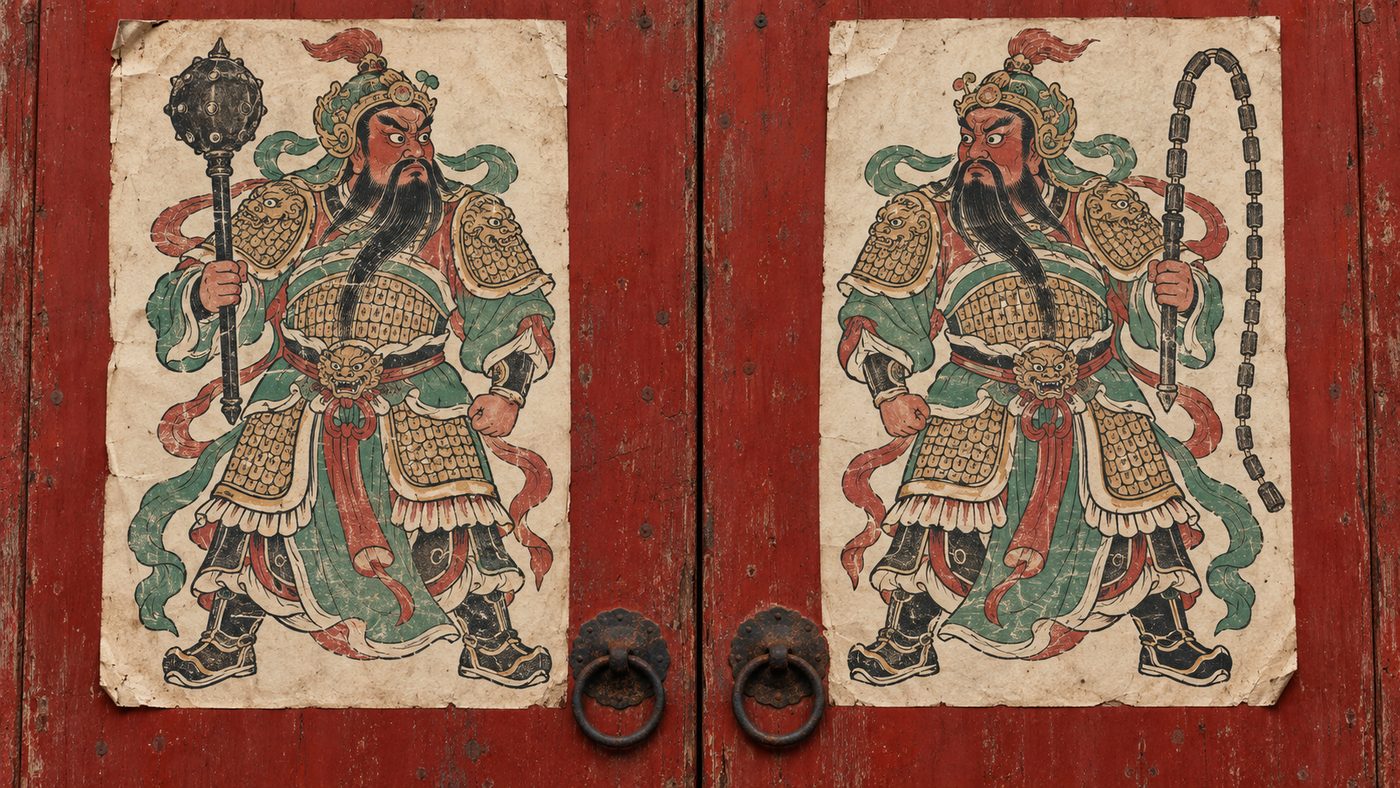
Doors. Everything in this story comes down to doors. A Chinese house, a Chinese temple, a Chinese palace: each is a wall with a hole in it, and the hole is where the trouble gets in. So for something like two thousand years the hole has had a pair of armed men standing in it, printed on paper, one on each leaf, glaring inward at each other across the seam as if daring anything to try the gap between them. They are the door gods, and if you have walked past a Chinese shopfront in late January, or through the gate of a Hokkien temple in Penang or Singapore on any day at all, you have met them. What is less obvious is that the job has changed hands. Twice, at least. And that the men most people take to be the door gods got the post from a novel.
Which one goes where
First the practical part, because it is the one people get wrong. The two figures are a mirrored pair. They face each other, across the crack where the doors meet, never out toward the street. The sixth-century Record of the Seasons of Jing-Chu, the earliest surviving Chinese book of annual customs, gives the order for the original pair: peach boards are fixed to the door, "two spirits are painted and pasted left and right, Shentu on the left and Yulü on the right; common usage calls them the door gods." Left and right there means as you stand outside looking in. For the two generals the prints follow the same logic. The weapons turn inward, the faces turn inward, and a pair pasted so that both men stare off in opposite directions is the equivalent of hanging a painting upside down. People will be too polite to say.
Front gate, back door, temple gate: each gets a different cast, and the table below is the whole page in miniature.
| Who | Where they stand | What they carry | Earliest text | Where you meet them now |
|---|---|---|---|---|
| Shentu and Yulü | The front gate, left and right | Reed rope, and a tiger to feed | A lost passage of the Classic of Mountains and Seas, quoted by Wang Chong c. 80 CE | Older prints, temple gates, the 2016 film |
| Qin Shubao and Yuchi Gong | The front gate, mirrored | A mace and an iron whip, in full armor | Journey to the West, chapter 10, 1592 | Most house doors since the Ming; the woodblock shops of Kaifeng and Tianjin |
| Wei Zheng | The back door, in the novel | The sword that beheaded the dragon king | Journey to the West, chapter 10 | Almost nowhere; the shops gave his door to Zhong Kui |
| Zhong Kui | The back door, in practice | A drawn sword and a scowl | Shen Kuo, 11th century, for the image on doors | Northern prints, and a game studio |
Temples are the case that surprises visitors. A house pastes a printed sheet; a temple paints the whole gate, floor to lintel, and picks the pair to suit the hall, so a Buddhist temple may put a heavenly king on each leaf and a folk temple the two generals, with civil officials, or attendants carrying a crown and a deer, on the inner doors. The paintings are the first thing a temple commissions and the first thing it repaints. Southeast Asia's Chinese temples are the place to see them at their most lavish; the sea-goddess temples of the Hokkien diaspora have kept door painters in work for generations.
The shops that still print them
The door gods are a printed object, and have been since the Song. Meng Yuanlao, writing in 1147 about the Kaifeng of his youth, the capital that had fallen to the Jurchen twenty years before, lists what the market stalls sold in the twelfth month: "door gods, Zhong Kui, peach boards, peach charms," along with the paper effigies of the wealth-god's mule and the paper deer and horse that went up at the same time. That is the earliest description of the trade, and the trade is still there. Zhuxian, the town twenty-odd kilometers south of Kaifeng, is on China's national register of intangible cultural heritage as entry Ⅶ-7, listed in the first batch in 2006; the register's own entry cites Meng Yuanlao as evidence that Zhuxian was cutting blocks in the Northern Song, counts three hundred workshops at the Ming-Qing peak, and reports that the city has recovered two hundred and twenty old printing blocks and reprinted three hundred sets from them. The generals on those blocks are squat, wide, heavily outlined, colored in mineral pigments the workshops grind themselves, and they have looked like that for a very long time.
The other great name is Yangliuqing, outside Tianjin, entry Ⅶ-1 on the same list, a canal town that grew rich when the Ming reopened the Grand Canal and that cut its blocks from the local pear wood; the register quotes the old boast that in Yangliuqing "every family can color and every household paints." Between them, the northern shops of Yangliuqing and the central shops of Zhuxian, with Taohuawu in Suzhou and Mianzhu in Sichuan for the south and west, supplied most of the door gods in China for four hundred years, and the four are still the four names a collector uses. A door god from any of them is a woodblock outline with hand-brushed color, on thin paper meant to last exactly one year on a door before the sun and the rain finish it, which is why so few old ones survive and why the blocks matter more than the prints.
Laid off in a cartoon
The modern layer is a joke about unemployment, and the joke turns out to be old. In Little Door Gods, the 2016 feature from Light Chaser Animation, directed by Gary Wang, the divine economy has collapsed because nobody believes in minor gods any more; door gods, earth gods and the Eight Immortals are all facing the sack, and Yulü, the hotheaded younger of the two peach-tree brothers, goes down to the human world to do something big enough to prove the post still matters, while his cautious elder brother Shentu follows to fetch him back. A shorter English cut turned up on Netflix in 2017 as The Guardian Brothers. It is a decent film and a very good premise, and the reason it works is that it is true: the door gods really have been half-forgotten, and by their own worshippers, for at least a century.
We know this because a Manchu gentleman called Fucha Dunchong said so in 1900, in his Record of the Seasons of Yanjing, the standard account of Beijing's calendar of customs in the last years of the Qing. His entry on door gods is four sentences long and worth all of them. The door gods, he says, "all wear armor and hold halberds, with bows hung and swords at the belt. Some say they are Shentu and Yulü; some say they are Qin Qiong and Jingde. In fact they are neither. It is enough to call them door gods." And then the complaint: the door itself is the first of the five household sacrifices, a proper object of worship in the old rites, and the people of the capital "make gods of it without sacrificing to it, and have lost the point." He is a man watching a custom outlive its meaning, which is what customs do, and what the film is about.
Two generals who could not get a night off
Now the story most people half know, told as the book tells it, because the book is where it comes from.
It is chapter 10 of Journey to the West, the Ming novel of 1592, and the Monkey King is nowhere in it. Emperor Taizong of the Tang has broken a promise to a dragon king, the dragon has been beheaded by the emperor's minister Wei Zheng in a dream, and the dragon's ghost has come to the palace to complain. (The dragon's side of this, the rain quota he fudged and the terrace he was executed on, is on our Dragon King page; it is the same chapter.) The emperor stops sleeping. Outside his bedchamber, every night, something is throwing bricks and tiles and howling. His doctors give him seven days. He summons his generals and admits, with some embarrassment, that a man who led armies at nineteen and never saw a ghost in his life is now seeing them nightly.
Yuchi Gong, whom the novel calls Hu Jingde, answers like a soldier: a man who founded a dynasty and killed men without number, afraid of ghosts? Qin Shubao makes the practical offer. "Set your mind at rest, Your Majesty. Tonight Jingde and I will guard the palace gate and see what sort of ghost this is." So that evening the two of them put on full armor, take up a gilded mace and a battle-axe, and stand outside the bedchamber door, one on the left, one on the right. The novel gives them a set-piece poem, gold helmets and dragon-scale mail and mirrors on their breastplates, and then, having dressed them up, closes the poem with a couplet that is the whole custom in fourteen characters. They were heroes, it says, old servants of the founding, and all it got them "was a thousand years as gate-wardens and an eternity as door gods."
The night passes. Nothing. The emperor sleeps. In the morning he rewards them and asks them to do it again, and again, and after two or three nights of this he feels guilty. Two of the greatest soldiers of the age are standing up all night in armor outside his door. So he has an idea, and it is the founding idea of the entire tradition: "I mean to summon skilled painters to take the two generals' true likenesses and paste them on the door, so as not to trouble them further. What do you say?" The court agrees, two painters who can work from life are found, the generals put their armor back on and pose, "painted them just so, and pasted the pictures on the door. That night, too, nothing happened."
That is it. That is the origin story, and it is told in a comic register, and it explains itself as it goes: the picture works because the men worked, and the picture is there because the men were tired. What every English retelling adds, that the Tang began pasting the generals on doors, has no support before the Ming. But surely, you will say, the generals are historical? They are. Qin Shubao and Yuchi Gong are real, and buried near the real Taizong. The night watch is not in any Tang source. The novel is where the door gods got them, and the shops, which were already selling door gods four hundred years earlier, simply changed the faces.
The back door
The chapter has a coda most people skip. After the front gate goes quiet, the racket moves round to the back, the tiles start flying at the rear gate instead, and the emperor, who has learned how this works, asks who guards that. His minister Xu Maogong gives the answer that a Chinese household still follows: the front gate was Jingde and Shubao's, "now the back gate is troubled, it falls to Wei Zheng." So Wei Zheng, the civil minister with the dragon-killing sword, takes the back door, and the novel describes him with a line that shows it knows exactly which tradition it is rewriting: his cloak sleeves streaming like frost, "a face to outdo the spirits Yulü and Shentu."
In the book, then, the back-door god is Wei Zheng. In the shops he is not. The back door belongs, in the north especially, to Zhong Kui, the black-bearded demon queller with the drawn sword who had been printed for New Year since 1072, three centuries before the novel, and whose own page explains how a failed examination candidate ended up with the job. A civil minister with a sword was never going to compete with that. The novel gave the front gate its two generals and lost the back door to an incumbent.
The peach tree on Mount Dushuo
Behind all of them is a tree. The oldest door gods are not soldiers at all but two spirits who live in it, and the passage that describes them has a complication that most pages cite straight past: it is attributed to the Classic of Mountains and Seas, and it is not in the Classic of Mountains and Seas. It survives because Wang Chong, the skeptic philosopher of the first century, quoted it in his Lunheng in a chapter on whether ghosts have bodies. Here is what he quotes. In the middle of the ocean is Mount Dushuo, and on it a peach tree so large that it "twists and coils for three thousand li." Among its branches, to the northeast, is the Gate of Ghosts, "through which all the ghosts come and go." Two spirits stand over it, Shentu and Yulü, who inspect the ghosts as they pass, and any "that do harm they bind with reed rope and feed to a tiger." So the Yellow Emperor, the passage ends, made a rite: peach-wood figures set up at the season, the two spirits and the tiger painted on the doors, reed rope hung across, to keep out evil. Everything on a Chinese gate at New Year is in that sentence. The peach wood became the peach boards and then the red couplets; the rope was still being hung across doors in the sixth century; the tiger is a separate print; the two spirits are the door gods.
Their names are 神荼 and 郁垒, and here is a small confession that will comfort you: most Chinese readers cannot pronounce them either. The characters have special readings kept alive only by this pair, and the Record of the Seasons of Jing-Chu commentary, written in the early seventh century, already shows the names wobbling. It quotes an older geographical text, the Kuodi tu, in which the tree stands on Mount Taodu with a golden cockerel on top that crows at sunrise, and the two spirits beneath it are called simply Yu and Lü, "so there is no name Shentu there at all." Then it quotes a second-century source, the Fengsu tongyi, in which they are brothers, and the second name comes out backwards, Lüyu for Yulü. Whether there were ever two names or one long one, and which is older, we do not know, and Wang Chong, who was quoting a book we no longer have, is as close as anyone will get.
What the door was before it had gods
One last thing, because Dunchong's complaint deserves an answer. The door was sacred before anyone stood in it. The Book of Rites has the household make five sacrifices, and the commentators put the door and the gate at the head of the list, with the hearth, the central court and the roads (or the well, depending on whose list you read): not a god at the door but the door itself, the threshold as a thing you owed offerings to. What the door gods did, across two thousand years, was give that abstraction a face, and then a second face, and then a set of prints you could buy for a few coins. The peach boards themselves did not disappear either: they thinned into paper and became the red couplets pasted down the two sides of the frame, which is why the Qing account of Beijing's year opens its couplet entry by saying flatly that the spring couplet is the peach board. Meng Yuanlao caught the middle of that process in Kaifeng, where the palace exorcism on New Year's Eve used "two of the hall-guard generals, also in armor, dressed as the door gods," which is the custom running in reverse: real soldiers costumed as the pictures of soldiers, who were in turn standing in for spirits in a tree.
So when you next pass a pair of them, faded to pink on a shop door in August, look at which way they are facing. Toward each other, across the gap. A thousand years as gate-wardens. An eternity as door gods. The novel meant it as a joke at the generals' expense, and it has turned out to be the job description.
In the classics
The passages behind the story, in the standard published translations. Open any one for the original text.
“The Classic of Mountains and Seas also says: in the middle of the ocean is Mount Dushuo. On it stands a great peach tree that twists and coils for three thousand li, and among its branches, to the northeast, is the Gate of Ghosts, through which all the ghosts come and go. Above it are two spirits, one called Shentu and one called Yulü, who inspect and command the ghosts. Those that do harm they bind with reed rope and feed to a tiger. So the Yellow Emperor made a rite to drive them out at the proper season: he set up great peach-wood figures, painted Shentu, Yulü and the tiger on the doors, and hung reed rope to ward off evil. ”
Original text
《山海經》又曰:滄海之中,有度朔之山。上有大桃木,其屈蟠三千里,其枝間東北曰鬼門,萬鬼所出入也。上有二神人,一曰神荼,一曰郁壘,主閱領萬鬼。惡害之鬼,執以葦索而以食虎。於是黃帝乃作禮以時驅之,立大桃人,門戶畫神荼、郁壘與虎,懸葦索以御凶魅。
“Peach boards are made and fixed to the door; these are called immortal wood. Two spirits are painted and pasted to the left and right of the door, Shentu on the left and Yulü on the right; common usage calls them the door gods. ... The Kuodi tu says: on Mount Taodu is a great peach tree that twists and coils for three thousand li, with a golden cockerel on top that crows when the sun strikes it. Beneath it are two spirits, one named Yu and one named Lü, who hold reed rope and watch for ill-omened ghosts, and kill any they catch. So there is no name Shentu there at all. ”
Original text
造桃板著戶,謂之仙木。繪二神貼戶左右,左神荼,右鬱壘,俗謂之門神。……《括地圖》曰︰「桃都山有大桃樹,盤屈三千里,上有金雞,日照則鳴。下有二神,一名鬱,一名壘,并執葦索,以伺不祥之鬼,得則殺之。」即無神荼之名。
“As the New Year approaches, the market stalls all print and sell door gods, Zhong Kui, peach boards and peach charms. ... On the last day of the year the palace stages the great exorcism ... using two of the hall-guard generals, also in armor, dressed as the door gods. ”
Original text
近歲節,市井皆印賣門神、鐘馗、桃板、桃符……至除日,禁中呈大儺儀……用鎮殿將軍二人,亦介冑,裝門神。
“Shubao said: set your mind at rest, Your Majesty. Tonight Jingde and I will guard the palace gate and see what sort of ghost this is. ... They were heroes, old servants of the founding, and all it got them was a thousand years as gate-wardens and an eternity as door gods. ... "I mean to summon skilled painters to take the two generals' true likenesses and paste them on the door, so as not to trouble them further. What do you say?" The ministers did as ordered, chose two men who could paint from life, had Hu and Qin put on their armor as before, painted them just so, and pasted the pictures on the door. That night, too, nothing happened. ”
Original text
叔寶道:「陛下寬心,今晚臣與敬德把守宮門,看有甚麼鬼祟。」……他本是英雄豪傑舊勳臣,只落得千年稱戶尉,萬古作門神。……「朕欲召巧手丹青,傳二將軍真容,貼於門上,免得勞他。如何?」眾臣即依旨,選兩個會寫真的,著胡、秦二公依前披掛,照樣畫了,貼在門上。夜間也即無事。
“Maogong stepped forward and said: when the front gate was troubled, Jingde and Shubao stood guard; now the back gate is troubled, it falls to Wei Zheng. The emperor agreed and ordered Wei Zheng to guard the back door that night. Wei Zheng took the order, dressed, picked up the sword that had beheaded the dragon, and stood before the rear gate ... his cloak sleeves streaming like frost, a face to outdo the spirits Yulü and Shentu. ”
Original text
茂公進前奏道:「前門不安,是敬德、叔寶護衛;後門不安,該著魏徵護衛。」太宗准奏,又宣魏徵今夜把守後門。徵領旨,當夜結束整齊,提著那誅龍的寶劍,侍立在後宰門前……兜風氅袖采霜飄,壓賽壘荼神貌。
“The door gods all wear armor and hold halberds, with bows hung and swords at the belt. Some say they are Shentu and Yulü; some say they are Qin Qiong and Jingde. In fact they are neither. It is enough to call them door gods. The door is the first of the five household sacrifices and no evil spirit; the people of the capital make gods of it without sacrificing to it, and have lost the point. ”
Original text
門神皆甲胄執戈,懸弧佩劍,或謂為神荼、鬱壘,或謂為秦瓊、敬德,其實皆非也。但謂之門神可矣。夫門為五祀之首,並非邪神,都人神之而不祀之,失其旨矣。
As seen in
Little Door Gods (小门神)
film · 2016Shentu and Yulü are the leads: two door gods facing lay-off because nobody believes in them, one of whom goes down to the human world to prove the job still matters, as Yu Lei and Shen Tu.
Light Chaser Animation, dir. Gary Wang; a shorter English cut reached Netflix in 2017 as The Guardian Brothers.
Questions people ask
What are the names of the Chinese door gods?
It depends which pair is on the door. The oldest pair are Shentu and Yulü, two spirits who guard the ghost gate in a peach tree on Mount Dushuo in a lost passage of the Classic of Mountains and Seas, quoted by Wang Chong in the first century. The pair most people recognize today are the Tang generals Qin Shubao (also called Qin Qiong) and Yuchi Gong (also called Yuchi Jingde or, in the novel, Hu Jingde), whose portraits are pasted on the palace door in chapter 10 of Journey to the West. Zhong Kui is often on the back door. Regional prints use other pairs too, including Guan Yu and Zhang Fei in some southern workshops.
Which side does each door god go on?
The two figures face each other across the seam of a double door, so each one looks inward toward the other, never outward. The sixth-century Record of the Seasons of Jing-Chu gives the order for the old pair: Shentu on the left, Yulü on the right, as you face the door from outside. For the two generals the usual print convention is the same idea: the two sheets are mirror images, and you paste them so the weapons and the faces turn toward the gap. A pair pasted facing away from each other is the classic mistake.
Why do Chinese temples have door gods painted on them?
For the same reason houses do: the door is the point where the outside gets in. A temple gate is a full-height painting rather than a printed sheet, and the pair is chosen to suit the temple, so a Buddhist hall may have heavenly kings or guardian generals and a folk temple may have the Tang generals, with civil officials or attendants on the inner doors. Fucha Dunchong, writing in Beijing in 1900, pointed out that the door itself was the first of the five household sacrifices long before anyone painted a god on it.
When do you put up door gods for Chinese New Year?
With the spring couplets, in the last days before New Year's Eve, so that the gate is dressed when the year turns. Meng Yuanlao describes the Kaifeng market stalls printing and selling door gods in the twelfth month in 1147, and the same rhythm holds: the old prints come down, the new ones go up, and they stay all year, fading in the sun, until the next set replaces them. Nothing is taken down at the end of the holiday.
Is there a door gods movie?
Yes. Little Door Gods (2016) from Light Chaser Animation, directed by Gary Wang, makes Shentu and Yulü the leads: the divine job market has collapsed because nobody believes in door gods any more, and one brother goes down to the human world to prove the post still matters. A shorter English version was released on Netflix in 2017 under the title The Guardian Brothers.
Sources & further reading
- Zhuxian Town woodblock New Year prints, entry Ⅶ-7 on China's national intangible cultural heritage list (2006 first batch): Kaifeng, the Song capital; three hundred workshops at the Ming-Qing peak; two hundred and twenty old blocks recovered
- Yangliuqing woodblock New Year prints, entry Ⅶ-1 on the same list: Tianjin, the Grand Canal, pear-wood blocks
- Little Door Gods (2016), Light Chaser Animation, Wikipedia entry (release, Netflix cut, plot)
- Menshen, Wikipedia (an overview of the regional pairs and temple usage)
By Julian 祝君瑜, retold from the classics, with the original passages cited, updated 2026-09-22