Chinese Mythology
The Yellow Emperor: What He Invented, and Who Actually Invented It
The Yellow Emperor, Huangdi, is the figure Chinese tradition puts at the head of its own history: the sovereign under whom writing, medicine, the calendar and the state are said to have arrived. He is almost certainly not a historical person, and the more interesting thing is what the oldest texts actually credit him with. Read them closely and he invents very little himself. He asks, and other people write it down.
Every civilization keeps a founder somewhere near the front of the drawer, and China's is the Yellow Emperor. Huangdi. Under him, tradition says, the Chinese acquired writing, medicine, silk, the calendar, the compass, boats, wells, houses, money, the marketplace and the first proper army, which is a productive few decades by any standard. He is where the histories start. He is where a great many surnames start. Twice a year, in two different provinces, several thousand people put on formal clothes and bow to him.
He was not a real person. That much is not really in dispute, and we will get to how comfortable the Chinese record itself is about saying so. But "not real" is the least interesting true thing about him, and it closes a conversation that ought to stay open, because the moment you stop asking whether he existed you can start asking a much better question, which is what he was for.
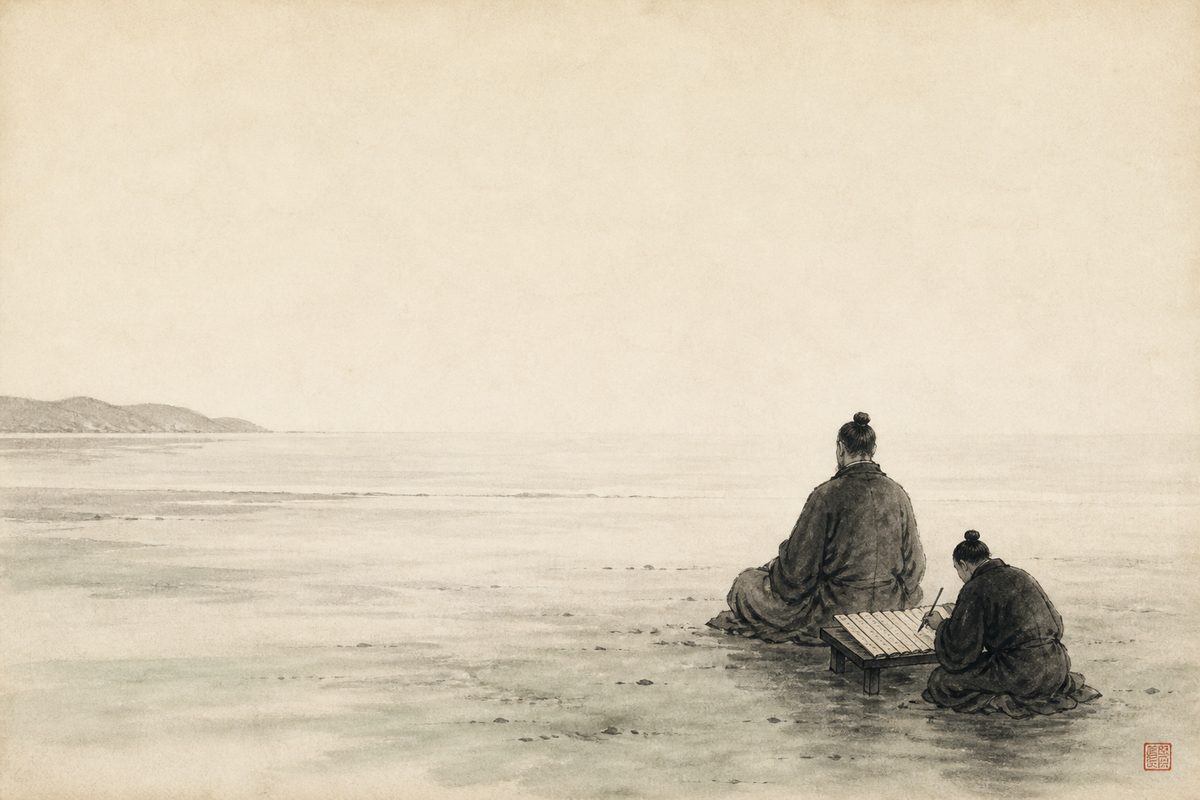
So here is the thing that falls out of the oldest texts, and it is not what the encyclopedia entries lead with. Line up everything the Yellow Emperor is credited with, then go and check who the source actually names, and he keeps stepping out of the frame. The writing is Cangjie's. The sixty-year cycle is Dachao's. The calendar is Rong Cheng's. The medicine is Qi Bo's, and we know that because the medical classic with the Yellow Emperor's name on the cover is a transcript of him asking Qi Bo questions. The complete catalog of the supernatural world is dictated to him on a beach by a talking animal, and his contribution is to order it written up. Four texts, four different centuries, and the same posture in all of them. He listens. Somebody writes it down.
That is not a debunking. It is, if anything, a promotion. Chinese antiquity is full of figures who make things: Pangu makes the world by growing, Nüwa makes people out of mud, Fuxi makes a method for reading the cosmos, Shennong makes a pharmacopoeia with his mouth and dies of it. The Yellow Emperor makes an administration. He is the point in the story where China stops inventing things and starts filing them.
Two provinces, two ceremonies, and a tomb with nobody in it
Start with the present, because the present is stranger.
Every year at the Qingming festival, in Huangling County in Shaanxi, there is a national ceremony at the Mausoleum of the Yellow Emperor on Qiaoshan. It is a serious event. Offerings at the site are recorded as far back as 442 BCE; a formal shrine went up in 770 CE under the Tang, after which it hosted regular national sacrifices; the State Council named it the first National State-Protected Great Cultural Site in 1961; restoration began in 1993, annual national offerings resumed in 2004, and the ceremony went onto the national intangible cultural heritage list in 2006. The site's own traditional epithet, and it is not modest, is the First Tomb Under Heaven.
And then, roughly a month earlier, on the third day of the third lunar month, several hundred kilometers east in Xinzheng in Henan, there is a second national ceremony, at his birthplace. It was named the Xinzheng Yellow Emperor Ancestor Worship Ceremony in 2006 and the State Council added it to the national intangible cultural heritage list in 2008. Nine rituals are commonly performed, according to China's State Council Information Office, among them a twenty-one-gun salute, the placing of a flower basket, burning incense, the singing of odes, dance, and a prayer for the country.
Two provinces, two ceremonies, one legendary ancestor, and a certain amount of civic elbowing that nobody involved would describe in those terms. Shaanxi has the tomb; Henan has the cradle. Both are on the national heritage list. Both are televised.
Now the good part. The tomb in Shaanxi, by the tradition's own account, is empty. Not looted, not lost: empty by design. The Yellow Emperor is held to have attained immortality and gone up to heaven, leaving behind only his clothes and his cap, and it is the clothes and the cap that are buried at Qiaoshan. The First Tomb Under Heaven is a cenotaph, and everybody involved has always known it.
Hold on to that, because the sources for the empty tomb turn out to be two passages in the same book by the same author, and we will come back to them at the end.
The year 4603
The most consequential thing that ever happened to the Yellow Emperor happened in the twentieth century, and it happened to him rather than because of him.
In 1903, Chinese radical publications began dating their issues from his birth. This was an explicitly anti-Manchu move: if all Han Chinese were one family descended from one ancestor, then the Qing court, which was not Han, was an occupation. The trouble was that nobody knew when he was born, so the journals simply picked. The magazine Jiangsu counted 1905 as the year 4396, which puts year one at 2491 BCE. Minbao, the organ of Sun Yat-sen's revolutionary alliance, counted the same year as 4603, putting year one at 2698 BCE. The scholar Liu Shipei, who lived from 1884 to 1919, worked up a Yellow Emperor calendar of his own and fixed the birth at 2711 BCE. Three respectable revolutionary calculations, two centuries apart, all confidently printed on mastheads.
Minbao's first issue, in November 1905, put his portrait on the cover and called him the first great nationalist in the world. Chen Tianhua, Zou Rong and Zhang Binglin pushed the descent argument hard in print. When the Qing fell, the new Republic issued banknotes in 1912 with his face on them.
This is where a page like this one has to be careful, so let us be plain about it. That machinery had an ugly setting. Huang Jie's History of the Yellow Race, published between 1905 and 1908, argued that the Han deserved to rule China because of their direct descent from the Yellow Emperor, which is a racial-lineage theory wearing a scholar's gown. The official framing shifted afterward: under the Republic's Five Races Under One Union, and later under the broader idea of a Chinese nation encompassing all its peoples, he was recast as everybody's ancestor rather than the Han's. The phrase you still hear, descendants of Yan and Huang, folds him together with the Flame Emperor, whose own strange double identity is a story that belongs to Shennong's page. It is an inclusive phrase by intention and a Han-shaped one by descent, and thoughtful people in China have said so.
None of which was available to anyone before 1903. A figure who had spent two thousand years as a genealogical convenience for aristocrats became, inside about five years, a national ancestor with a calendar and a portrait. It is the fastest promotion in his career and it happened three and a half thousand years after he supposedly died.
The medicine that still carries his name
Search his name in English today and one of the first page of results will be an acupuncture college. That is not an accident of the algorithm; it is the Huangdi Neijing, the Yellow Emperor's Inner Canon, which remains the foundational text of Chinese medicine and sits on the curriculum at Chinese medicine schools worldwide, Yo San University among them. Students still read it. Practitioners still argue about it. It has been continuously in use for something like two millennia, which puts it in a very small club of books.
He did not write it. Nobody serious thinks he wrote it; it is a Han-era compilation that puts its material in his mouth, and that is the ordinary way an ancient Chinese technical corpus acquires authority. But the form the compilers chose is the interesting part, and we will come to it properly below, because the Inner Canon is not a treatise. It is a conversation, and the Yellow Emperor is the one asking the questions.
A sword named after him has been on sale since 1990
His personal name, in Sima Qian's account, is Xuanyuan. If you have played Chinese role-playing games you already know it, because Xuan-Yuan Sword has been running since 1990, when Softstar's DOMO Studio in Taiwan released the first title and, in doing so, made one of the earliest Chinese-made RPGs of any kind. The series takes its name and its central artifact from him. Several generations of Chinese-speaking teenagers have met the Yellow Emperor for the first time as a legendary blade in an inventory screen, which is roughly how a lot of English-speaking teenagers first met Excalibur, and there is nothing wrong with either route.
The first time anyone wrote his name down, it was a family tree
Now to the record itself, in the order it actually accumulates.
The oldest surviving mention of the Yellow Emperor is not a story. It is a bronze vessel cast in the first half of the fourth century BCE by the royal house of the state of Qi, and what it says is that he is their ancestor. That is the debut: not a deed, not a myth, a claim of descent. The cult grows through the Warring States, when a dozen states are competing for legitimacy and an impeccably ancient forefather is a useful thing to have. Qi, where the bronze was cast, is also where many of the thinkers later grouped under Huang-Lao came from, which will matter shortly.
Everything that follows keeps this shape. Sima Qian, writing around 94 BCE, traces the founding houses of the Xia, the Shang and the Zhou back to him, and the Han founder Liu Bang as well. Wang Mang invoked descent from him to justify replacing the Han in 9 CE. Hundreds of noble families claimed the line in the Tang and Song. The revolutionaries of 1903 claimed it for four hundred million people at once.
So the standard question, was he real, is asking the wrong thing of the evidence. He arrives in the record already performing a function, and the function is genealogical. He is a socket. Things get plugged into him.
The staff
Here is the passage that gave this page its spine, and it does not mention the Yellow Emperor at all.
The Lüshi Chunqiu, compiled at the court of Lü Buwei and dated to 239 BCE, has a chapter arguing that a ruler should not do things himself. In it comes a roll call: Dachao made the sexagenary cycle, Rong Cheng made the calendar, Xihe read the sun, Shangyi read the moon, Yi Di made wine, Zhurong made the marketplace, Wu Peng made medicine, Wu Xian made divination, and a dozen more besides. Twenty names, twenty inventions. And then the sentence that gives the whole thing away: these twenty officials are the means by which the sage governs the world.
Read that once more. Invention, in this text, is not filed under genius. It is filed under staffing. The sage's achievement is not that he thought of the calendar; it is that he had a Rong Cheng.
Sima Qian's Yellow Emperor works the same way. The Records of the Grand Historian gives him the wars, at Banquan against the Flame Emperor, three battles before he got his way, and at Zhuolu where Chiyou was captured and killed. It gives him a bestiary of trained animals for the campaign, which is a list the pixiu turns up in. And then it gives him the thing that actually matters: he promoted Feng Hou, Li Mu, Chang Xian and Da Hong to govern the people. Four names, one clause, and the state exists.
One of those twenty inventions deserves a footnote here, because it is still running. Dachao's sexagenary cycle is the sixty-year rotation of ten stems and twelve branches that dates every year, month, day and hour in the traditional calendar; it is the machinery under the animal zodiac, under a birth chart, under the whole apparatus. If you want to see what a date of yours looks like in it, our Chinese calendar converter will do the arithmetic. Whoever Dachao was, his invention outlasted every dynasty that used it.
Here is the ledger, laid out plainly. The left column is what he gets credited with in popular retellings. The right columns are what the texts say.
| Credited to him | The text | Date | Who it names | What he does in that account |
|---|---|---|---|---|
| Writing | Pre-Qin texts including the Xunzi and the Hanfeizi | Warring States | Cangjie | Nothing. He is not in the sentence, and the association with his reign is later assembly |
| The sixty-year calendar cycle | Lüshi Chunqiu, Wu gong | 239 BCE | Dachao | Nothing. The chapter's point is that rulers should delegate |
| Medicine | The Yellow Emperor's Inner Canon, Basic Questions | Han compilation | Qi Bo | Asks the questions. The book is his side of a dialogue |
| The catalog of every spirit and monster | Yunji Qiqian, quoting the lost Basic Annals of Xuanyuan | c. 1029 CE, from an earlier source | Bai Ze | Listens, then orders it drawn up and published |
| Silk | Records of the Grand Historian, chapter 1 | c. 94 BCE | Leizu, named only as his principal consort | Marries her. The sericulture credit is a later tradition, not in this text |
Note the fifth row in particular. Leizu is very widely called the inventor of silk, and Sima Qian, who is the source everyone gestures at, says only that the Yellow Emperor took a wife from Xiling and that she was Leizu, his principal consort. The silk arrives in the story later. We are keeping her in the table with the correction attached rather than dropping her, because the gap between what the source says and what everyone repeats is precisely the shape of this whole page.
He asks, and somebody writes it down
Now to the four texts, because the pattern in them is startling once you notice it.
Open the Inner Canon at chapter one of the Basic Questions and you get a birth formula, of which more in a moment, and then the Yellow Emperor turns to his Heavenly Teacher and asks a question, and it is a rather touching one: he has heard that people in high antiquity lived past a hundred with their vigor undiminished, whereas people now are worn out at fifty, and he wants to know whether the age has changed or whether people have lost something. Qi Bo answers. The ancients who understood the Way, he says, modeled themselves on yin and yang, kept to measure in food and drink and regularity in rising and resting, and did not labor recklessly, so body and spirit stayed together and they lived out their allotted span. That is how the foundational text of Chinese medicine begins: not with a doctrine, but with a sovereign admitting he does not know something and a specialist explaining it to him.
Now the beach. In an account preserved in the Daoist anthology Yunji Qiqian, quoting a lost text called the Basic Annals of Xuanyuan, the Yellow Emperor is touring east and comes to the sea, climbs a mountain, and meets a divine beast called Bai Ze which can speak and understands the nature of all things. He asks it about the ghosts and spirits of the world. It answers with a number, eleven thousand five hundred and twenty kinds, and names them. And the emperor's response, in the text's own six characters, is to order the whole thing drawn up and shown to the world. The beast has its own page here and deserves it; what belongs on this one is the verb. He commissions. The first bestiary in the Chinese tradition exists because a head of state took minutes.
And then there is Ge Hong, the alchemist, writing around 320 CE in the Baopuzi. Making the argument that even a sage born able to speak could not simply sit still and acquire the Way, he runs through everything the Yellow Emperor had to go and learn from somebody else: he climbed one mountain for an alchemical text and another to question a hermit, and consulted specialists on breathing, on astronomy, on medicine, on siting a grave, and, to get to the bottom of spirits and malignities, recorded what Bai Ze said. Ge Hong intends this as a list of the emperor's diligence. Read it flat, it is a list of everything he did not know.
Four sources, spread across a thousand years and three genres, none of them coordinating with the others, and the man does the same thing in all four. Whatever the Yellow Emperor is, he is not an inventor. He is the first Chinese figure to understand that the useful thing to do with an expert is to write down what they say.
A school of government named after him came out of a tomb in 1973
Because things kept being written in his name long after anyone thought he had lived, and one of them has a genuinely remarkable modern afterlife.
Huang-Lao means, quite literally, Huangdi and Laozi. It was a syncretic school of statecraft that took shape in Qi in the late Warring States and became something close to the working ideology of the early Han court, favored by thinkers and politicians through the reigns of Emperors Wen and Jing in the first half of the second century BCE. Sima Qian says as much. Its central instinct was that a ruler governs best by not intervening much, which, given everything above, is a philosophy with an appropriate patron.
And then its texts vanished. For roughly two thousand years Huang-Lao was a school known only by references to it in other people's books, which is a frustrating way to know about a thing that once ran a country.
In December 1973, excavators opened tomb number three at Mawangdui, near Changsha in Hunan, a tomb sealed in 168 BCE. Among the silk manuscripts inside were four texts that Tang Lan identified in 1975 as a lost Huang-Lao corpus, now generally called the Four Classics of the Yellow Emperor: the Jingfa, the Shi Da Jing, the Cheng and the Dao Yuan. Robin D. S. Yates and Leo S. Chang have since produced the major English translations, in 1997 and 1998 respectively.
A philosophy named for a man who never existed and never wrote anything, lost for two millennia, recovered from the grave of somebody who evidently did the filing. It is the most on-brand thing that has ever happened to the Yellow Emperor.
Four clauses, and the one word that splits them
Here is the smallest thing on this page and possibly the sharpest.
Sima Qian introduces him with a four-beat formula: numinous from birth, able to speak while still a weakling, quick-witted as a small child, earnest and sharp as he grew. Then a fifth clause closes it: 成而聰明, and grown, perceptive.
The Inner Canon opens with the same formula. Word for word the same, all four beats. And then its fifth clause: 成而登天, and grown, he ascended to heaven.
One phrase. Two characters. The historian's man grows up clever and gets a burial mound; the medical classic's man grows up and leaves the earth. It is the same sentence being pulled in opposite directions by two genres that want two different kinds of authority out of the same figure, and you can watch it happen inside a shared formula that neither text bothered to alter. Sima Qian wants a sage-king he can put at the head of a history. The Inner Canon wants an immortal whose health advice is therefore worth taking. Both got what they needed from the same five clauses.
Twenty-five sons, fourteen surnames, twelve names
If you have a Chinese surname, there is a decent chance you have been told at some point that it goes back to him. That is not folk embroidery; it is in the Warring States record, in a passage from the Discourses of the States that is oddly technical about it. The Yellow Emperor's sons formed twenty-five lineages, of which fourteen received surnames, making twelve surnames in total, and the text lists them: Ji, You, Qi, Ji, Teng, Zhen, Ren, Xun, Xi, Ji, Xuan and Yi. Twenty-five sons, fourteen granted names, twelve names to go round. Somebody has done the arithmetic and it does not come out even, which is exactly the kind of detail nobody invents.
The same passage explains his own. He came into his own by the Ji River and so was Ji; the Flame Emperor came into his own by the Jiang and so was Jiang. Surnames, in this account, come from water. It is the founding charter of the Chinese surname system, and if you want to see where the modern ones actually come from, several thousand years of movement later, our surname guides trace them one at a time.
While we are here, one correction, because it is the single most common thing people get wrong about him in English. The surname Huang, borne by more than thirty million people, has nothing to do with Huangdi the Yellow Emperor. Different character, different word, different origin entirely; his family name in Sima Qian is Gongsun. Our page on the Huang surname sets out where it really comes from, which involves an ancient state rather than a sovereign.
The bow at Tripod Lake
Which leaves the ending, or rather the endings, and they are in the same book.
Chapter one of the Records of the Grand Historian disposes of it in four characters: the Yellow Emperor died, and was buried at Qiaoshan. No drama, no dragon. A man, a death, a hill.
Chapter twenty-eight of the same work tells it differently, and the setting matters as much as the story. This is the Treatise on the Feng and Shan Sacrifices, Sima Qian's long, dry, quietly devastating account of Emperor Wu's pursuit of immortality and the parade of specialists who came to court to encourage it. One of them is a man called Gongsun Qing, and what he tells the emperor is this. The Yellow Emperor mined copper at Shoushan and cast a tripod at the foot of Mount Jing. When the tripod was finished, a dragon came down with hanging whiskers to receive him. He mounted, and more than seventy officials and palace women climbed up with him, and the dragon rose. The lesser officials who could not get on seized the dragon's whiskers, and the whiskers tore out and fell, and the emperor's bow fell with them. The common people looked up as he went into the sky, and they clutched the bow and the whiskers and they wailed. Which is why, ever after, the place is called Tripod Lake and the bow is called Wuhao.
It is a magnificent piece of storytelling and it is also, in context, a sales pitch. Gongsun Qing is telling a mortal emperor who very much wants not to die that a previous emperor managed it, and that the method involved casting a bronze vessel, which Emperor Wu could certainly arrange. Sima Qian records the speech; the chapter it sits in is about what such promises cost.
So: buried at Qiaoshan, or gone into the sky at Tripod Lake with seventy-odd staff. One author, one book, two endings, and no attempt to reconcile them. The tradition eventually did the reconciling itself, in the neatest possible way. If he ascended, then whatever is under the mound at Qiaoshan can only be his clothes and his cap. And that, to this day, is the official account of the First Tomb Under Heaven.
Which is a rather good place to leave him, because it makes the point better than any argument could. The most important ancestral tomb in China is, by its own tradition, a tomb with nobody in it, and it has been receiving offerings for two and a half thousand years anyway. That is not a failure of the story. That is the story. He was never the kind of thing that fits in a grave. He was a place to put a claim: a lineage, a dynasty, a book of medicine, a school of government, and eventually a nation. You do not need a body for that. You need a name and somewhere to bow.
Pangu separates heaven from earth, Nüwa makes people, Fuxi gives them a way of reading the world, Shennong gives them food and medicine and pays for it. The Yellow Emperor, arriving last in a sequence that was assembled backwards, gives them a filing system. It is the least glamorous gift in the set and the only one anybody is still using.
In the classics
The passages behind the story, in the standard published translations. Open any one for the original text.
“The Yellow Emperor was the son of Shaodian. His family name was Gongsun and his personal name was Xuanyuan. He was numinous from birth, able to speak while still a weakling, quick-witted as a small child, earnest and sharp as he grew, and perceptive once grown. … He had the auspice of earth virtue, and so was called the Yellow Emperor. The Yellow Emperor had twenty-five sons, of whom fourteen received surnames. … He promoted Feng Hou, Li Mu, Chang Xian and Da Hong to govern the people. … The Yellow Emperor died, and was buried at Qiaoshan. ”
Original text
黃帝者,少典之子,姓公孫,名曰軒轅。生而神靈,弱而能言,幼而徇齊,長而敦敏,成而聰明。……有土德之瑞,故號黃帝。黃帝二十五子,其得姓者十四人。……舉風后、力牧、常先、大鴻以治民。……黃帝崩,葬橋山。
“The Grand Historian says: scholars often speak of the Five Emperors, and they are very ancient. Yet the Book of Documents records only from Yao onward, while what the hundred schools say about the Yellow Emperor is not refined, and gentlemen of standing find it hard to speak of. … I have arranged and ordered the material, selecting the accounts that are most reliable, and so I have set this down as the first chapter of the annals. ”
Original text
太史公曰:學者多稱五帝,尚矣。然尚書獨載堯以來;而百家言黃帝,其文不雅馴,薦紳先生難言之。……余并論次,擇其言尤雅者,故著爲本紀書首。
“Dachao made the sexagenary cycle, Qianru made the counting of captives, Rong Cheng made the calendar, Xihe read the sun, Shangyi read the moon, Houyi read the year, Hu Cao made clothing, Yi Yi made the bow, Zhurong made the marketplace, Yi Di made wine, Gao Yuan made the house, Yu Xu made the boat, Bo Yi made the well, Chi Ji made the mortar, Cheng Ya made the horse and cart, Han Ai made driving, Wang Bing made the yoking of oxen, Shi Huang made diagrams, Wu Peng made medicine, and Wu Xian made divination. These twenty officials are the means by which the sage governs the world. ”
Original text
大橈作甲子,黔如作虜首,容成作厤,羲和作占日,尚儀作占月,后益作占歲,胡曹作衣,夷羿作弓,祝融作市,儀狄作酒,高元作室,虞姁作舟,伯益作井,赤冀作臼,乘雅作駕,寒哀作御,王冰作服牛,史皇作圖,巫彭作醫,巫咸作筮,此二十官者,聖人之所以治天下也。
“In antiquity there was the Yellow Emperor. He was numinous from birth, able to speak while still a weakling, quick-witted as a small child, earnest and sharp as he grew, and once grown he ascended to heaven. He put a question to his Heavenly Teacher: I have heard that the people of high antiquity all passed a hundred years with their movement undiminished, while people of the present are worn out at fifty. Has the age changed, or have people lost something? Qi Bo replied: those of high antiquity who understood the Way modeled themselves on yin and yang, kept in accord with the arts of number, were measured in food and drink and regular in rising and resting, and did not labor recklessly. So body and spirit stayed together, and they finished the years allotted to them, departing only past a hundred. ”
Original text
昔在黃帝,生而神靈,弱而能言,幼而徇齊,長而敦敏,成而登天。乃問於天師曰:余聞上古之人,春秋皆度百歲,而動作不衰;今時之人,年半百而動作皆衰者,時世異耶,人將失之耶?岐伯對曰:上古之人,其知道者,法於陰陽,和於術數,食飲有節,起居有常,不妄作勞,故能形與神俱,而盡終其天年,度百歲乃去。
“The Yellow Emperor's sons formed twenty-five lineages, of whom fourteen received surnames, making twelve surnames in all. They are Ji, You, Qi, Ji, Teng, Zhen, Ren, Xun, Xi, Ji, Xuan and Yi. … The Yellow Emperor came into his own by the Ji River, the Flame Emperor by the Jiang. Coming into their own, their virtues differed, and so the Yellow Emperor was Ji and the Flame Emperor was Jiang. ”
Original text
凡黃帝之子,二十五宗,其得姓者十四人為十二姓。姬、酉、祁、己、滕、箴、任、荀、僖、姞、儇、依是也。……黃帝以姬水成,炎帝以姜水成。成而異德,故黃帝為姬,炎帝為姜。
“The Yellow Emperor mined copper at Shoushan and cast a tripod at the foot of Mount Jing. When the tripod was finished, a dragon came down with hanging whiskers to receive the Yellow Emperor. The Yellow Emperor mounted, and more than seventy of his officials and palace women went up with him, and the dragon rose. The lesser officials who could not get on all seized the dragon's whiskers, and the whiskers tore out and fell, and the Yellow Emperor's bow fell with them. The common people looked up as the Yellow Emperor went into the sky, and they clutched his bow and the whiskers and wailed. That is why later ages named the place Tripod Lake, and the bow Wuhao. ”
Original text
黃帝采首山銅,鑄鼎於荊山下。鼎既成,有龍垂胡髯下迎黃帝。黃帝上騎,群臣後宮從上者七十餘人,龍乃上去。餘小臣不得上,乃悉持龍髯,龍髯拔,墮,墮黃帝之弓。百姓仰望黃帝既上天,乃抱其弓與胡髯號,故後世因名其處曰鼎湖,其弓曰烏號。
As seen in
Xuan-Yuan Sword
game · 1990Namesake. The long-running Taiwanese role-playing series from Softstar's DOMO Studio takes its title from Xuanyuan, the Yellow Emperor's personal name, and builds its central artifact around the sword that carries it., as Xuanyuan.
Questions people ask
What was the Yellow Emperor known for?
For founding Chinese civilization, in the specific sense that almost everything a civilization needs is dated to his reign: writing, the sixty-year calendar cycle, medicine, silk, boats, wells, the marketplace, the first standing army. What repays a closer look is that the texts rarely say he made any of it. Sima Qian's account in the Records of the Grand Historian has him promoting Feng Hou, Li Mu, Chang Xian and Da Hong to govern the people. The Lüshi Chunqiu of 239 BCE lists twenty inventions under twenty different names and concludes that these twenty officials are how a sage governs. He is known, in other words, for a staff.
Who are considered descendants of the Yellow Emperor?
Historically, almost anyone who needed to be. The oldest surviving mention of him is a fourth-century BCE bronze cast by the royal house of the state of Qi claiming him as their ancestor, and the claim never stopped being useful. Sima Qian traced the founders of the Xia, Shang and Zhou to him, and the Han founder Liu Bang too. Wang Mang used descent from him to justify taking the throne in 9 CE. Hundreds of Tang and Song noble families claimed it. Today the phrase you will hear is descendants of Yan and Huang, which pairs him with the Flame Emperor and is used to mean Chinese people in general, though some readers note that it sits awkwardly with the country's non-Han citizens.
Is the Yellow Emperor the same as the Jade Emperor?
No, and they are not even the same kind of being. The Yellow Emperor is a legendary human sovereign placed at the head of Chinese history, given a father, a family name, twenty-five sons and a burial mound. The Jade Emperor is the supreme celestial administrator of Daoist religion, a much later figure who runs heaven as a bureaucracy and has no earthly reign. The confusion is understandable in English, where both arrive as an emperor plus a color. In Chinese the two names share only the word for emperor.
Is the Yellow Emperor a god?
He has been treated as one, on and off, for about two and a half thousand years, which is not the same as being one. In the Warring States period he was a cult figure and a political banner. Under the early Han he lent his name to Huang-Lao, the working philosophy of the court. Daoists later kept him as an immortal and a master of longevity techniques, and the English-language account notes that his religious standing faded from the second century CE as a deified Laozi rose past him. Today he is honored in state ceremony as an ancestor rather than worshipped as a deity, which is a distinction Chinese ritual has always been comfortable holding.
Was the Yellow Emperor a real person?
Almost certainly not, and the best witness for the defense is the historian who put him first. Sima Qian closes his chapter on the Five Emperors by saying that the Book of Documents records only from Yao onward, that what the hundred schools say about the Yellow Emperor is not refined, and that gentlemen of standing find it hard to speak of. He then describes traveling the country, comparing local accounts, and keeping only the more reliable version. The founder of Chinese history begins his book with a source warning.
Sources & further reading
- Records of the Grand Historian, chapter 1: the Yellow Emperor's parentage and names, the wars at Banquan and Zhuolu, the auspice of earth virtue, the twenty-five sons, the four promoted officials, the burial at Qiaoshan, and the historian's closing note on how little he trusts his own sources
- Lüshi Chunqiu, Wu gong: the list of twenty inventors and the closing statement that these twenty officials are how the sage governs the world
- The Yellow Emperor's Inner Canon, Basic Questions chapter 1: the birth formula and the opening exchange with Qi Bo
- Discourses of the States, Discourses of Jin part four: the twenty-five sons, the twelve surnames, and the Ji River etymology of the surname Ji
- Records of the Grand Historian, chapter 28: Gongsun Qing's account of the tripod at Mount Jing, the dragon, the torn whiskers and the fallen bow
- Yellow Emperor: the English-language account, including the fourth-century BC bronze from the state of Qi, the Huang-Lao school, the dynastic descent claims, and the 1903 to 1912 nationalist calendars, Minbao cover and Republican banknote
- Mausoleum of the Yellow Emperor: the Qiaoshan site in Huangling County, the cenotaph tradition, offerings recorded from 442 BC, the Tang shrine of 770 CE, the 1961 designation, the resumption of national offerings in 2004 and the 2006 heritage listing
- Xinzheng celebrates Yellow Emperor with worship ceremony, the People's Government of Henan Province: the birthplace rite at Xinzheng
- Ceremony to worship the Yellow Emperor held in Zhengzhou, State Council Information Office: the 2008 national intangible cultural heritage listing and the nine rituals, including the twenty-one-gun salute
- Records of the Grand Historian, Basic Annals of the Five Emperors, at the Chinese Text Project (bilingual reading text)
- The Yellow Emperor's Inner Canon, Basic Questions chapter 1, at the Chinese Text Project
- Discourses of the States, Discourses of Jin part four, at the Chinese Text Project
- Huangdi Sijing: the four lost Huang-Lao texts recovered from Mawangdui in December 1973, identified by Tang Lan in 1975, with the Yates and Chang translations
- Mawangdui Silk Texts: the 1973 excavation of tomb three at Changsha and the tomb's sealing date of 168 BC
- Xuan-Yuan Sword: the Softstar DOMO Studio series begun in 1990 and named for the Yellow Emperor's personal name
- Yo San University: the Yellow Emperor's Classic of Internal Medicine on a working acupuncture and Chinese medicine curriculum
By Julian 祝君瑜, retold from the classics, with the original passages cited, updated 2026-08-26