Chinese Mythology
Fox Spirit: The Nine-Tailed Fox Began as a Man-Eater
The fox spirit, 狐狸精 (húlijīng), is the shapeshifting fox of Chinese folklore, and in its nine-tailed form, 九尾狐 (jiǔwěihú), it is the creature the rest of Asia borrowed. Almost everything said about it in English describes its last two centuries. In the oldest text that mentions it, the Classic of Mountains and Seas, the nine-tailed fox of Qingqiu cries like a human baby and eats people, and the only reason given to seek it out is that eating its flesh protects you from poison. The lucky version, the seductress version and the insult all came later, and each one can be dated.
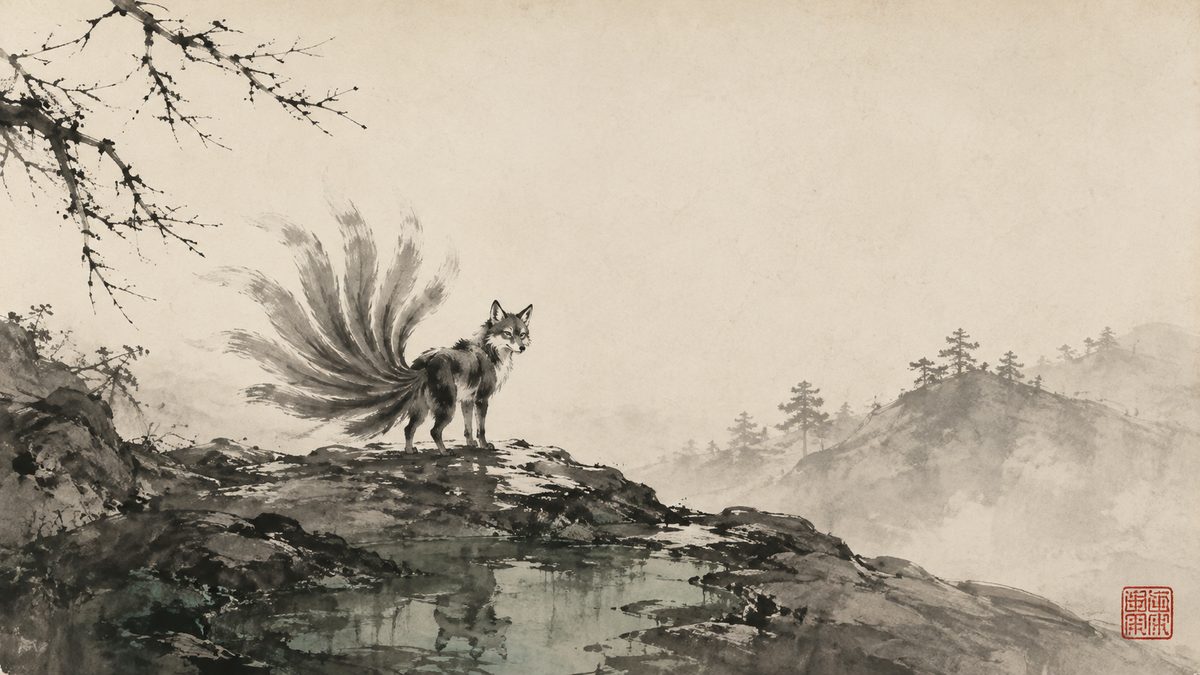
The first fox in the record eats people
Foxes. Chinese foxes, specifically, and the tailed, talking, shape-changing kind, about which the English-speaking internet has arrived at a settled opinion that is roughly two centuries old and about two thousand years short.
The settled opinion goes like this. The nine-tailed fox is an auspicious creature. It symbolizes good fortune, or prosperity, or a happy marriage. It can turn into a beautiful woman. It is, depending on which page you land on, either a lucky charm or a seductive menace, and either way it is faintly glamorous.
Now here is the oldest surviving text that mentions it, the Classic of Mountains and Seas, a catalogue of hills and their contents assembled somewhere between the fourth century BCE and the early Han. It works through the southern mountains hill by hill, noting what each one has on it, in the flat tone of a surveyor with a quota. It reaches a hill called Qingqiu. Jade on the south slope, blue-green pigment on the north. And then:
There is a beast there. Its shape is like a fox, and it has nine tails. Its voice is like a baby's. It eats people. One who eats it is proof against gu poison.
Read that again, because two of those clauses are doing work that almost nobody reports.
Its voice is like a baby's. Not charming. Not enchanting. This is a predator that makes the one sound a human being is neurologically incapable of walking away from, in a wooded upland, at a distance, in the dark. The great fourth-century scholar Guo Pu, whose commentary travels with the text, adds only the flat identification: this is the nine-tailed fox. He does not soften it either.
It eats people. Plainly. The verb is not hedged.
And then the sting in the tail, which is the funniest and grimmest line in the entry: the reason to care about this animal is that if you eat it, you are protected against gu, the poison-magic of the south. Guo Pu glosses that too, saying that consuming its flesh keeps a person from encountering malign vapors. So the earliest documented human interest in the nine-tailed fox is not veneration. It is pharmacology.
That is where this creature starts. Not as a symbol of anything. As something in the hills that eats you, and that you might, with luck and a spear, eat first.
Then it became a certificate of kingship
Give it four hundred years or so.
By the first century CE, Zhao Ye is compiling the Spring and Autumn Annals of Wu and Yue, a semi-legendary history of the two southern states, and he tells a story about Yu the Great, the flood-tamer, at a place called Tushan. Yu is thirty and unmarried and worrying about it, which is the sort of detail that makes ancient historiography suddenly companionable. A white fox with nine tails appears in front of him.
Yu does not run. He does not pray. He performs an act of political interpretation, out loud, like a man reading a memo:
White is the color I wear. As for its nine tails, that is the proof of kingship.
He then quotes a local song about a white fox trailing its nine heavy tails, a guest who comes to be king, and a house that will prosper. He concludes, with visible satisfaction, that the meaning is plain. He marries a woman of Tushan called Nüjiao. Their son is Qi, and Qi is the one who inherits, which is the moment the Chinese throne stops being handed to the worthiest candidate and starts being handed to the eldest son.
Notice what the fox is doing in this story, because it is not what a modern reader expects. It is not a lover. It is not a temptation. It is a credential. Nine tails are a number Yu can cite. The animal appears, is read, and is used, and the marriage is the consequence of the omen rather than its content. The fox itself never speaks, never transforms, and never comes back.
This is the first flip, and it is a big one. Inside four hundred years the animal has gone from a thing that eats you to a thing that certifies you. Nobody explains the change. It simply happens, the way these things do, and the older reading does not disappear so much as go quiet for a while.
One encyclopedia, two entries, one scroll apart
Here is the part that made this page worth writing, and I have not seen it on an English page anywhere.
In 978, the second emperor of the Song ordered a vast compilation of everything strange, odd, marvelous and worth preserving from the previous thousand years of Chinese writing. A committee under a scholar named Li Fang produced the Extensive Records of the Taiping Era, five hundred scrolls of it, organized by subject. Scroll 447 is the fox scroll.
It opens with a section headed On Foxes, which quotes a book called the Records of the Mysterious Middle, now lost, traditionally attributed to that same Guo Pu though the attribution is not secure. The quotation is the single most influential thing ever written about Chinese foxes:
At fifty years a fox can change into a woman. At a hundred it becomes a beautiful woman, or a spirit-medium, or a man who has relations with women. It can know what happens a thousand miles off, it is skilled at bewitching, and it makes people lose their wits. At a thousand years it communicates with heaven and becomes a celestial fox.
There it is. The whole shapeshifting apparatus, on a fifty-year clock, filed under a heading that treats the fox as a hazard.
Turn a few entries on in the same scroll and you reach a section headed Auspicious Responses, which quotes a register of good omens:
The nine-tailed fox is a divine beast. Its form is red, with four legs and nine tails. It comes from the land of Qingqiu. Its voice is like a baby's. Eating it keeps a person from meeting evil vapors, or anything of the gu-poison kind.
Divine beast. Qingqiu. The voice like a baby's. The protection against gu. Every distinctive detail of the Classic of Mountains and Seas entry, carried forward across a thousand years and roughly seven hundred miles of textual transmission, faithfully.
Except one.
It eats people is gone.
I want to be careful here, because this is exactly the point where a myth page normally starts inventing motives, and I do not know why the clause is missing. It may have dropped out of the register of omens centuries before the Song committee ever saw it. What can be said, and is quite enough, is this: the same imperial office, in the same decade, in the same scroll, filed this animal under two mutually contradictory headings, and the version filed as auspicious is the version with the man-eating removed.
That is not a Chinese story becoming a Japanese one, or an ancient view becoming a modern one. That is one editorial project holding two incompatible foxes at once and seeing no need to reconcile them. When you meet an English page confidently announcing what the nine-tailed fox "represents," it is picking one heading out of a scroll that already contained both.
| Roughly when | Text | What the fox is there | What changed |
|---|---|---|---|
| 4th c. BCE to early Han | Classic of Mountains and Seas | A nine-tailed beast at Qingqiu that cries like a baby and eats people | The starting point. A predator, valuable as medicine |
| 1st century CE | Spring and Autumn Annals of Wu and Yue | A white nine-tailed fox at Tushan | Becomes a political omen. Nine tails now read as proof of kingship |
| By the 4th c., preserved 978 | Records of the Mysterious Middle, in scroll 447 | A shapeshifter graded by age | Gains transformation, and can become either a man or a woman |
| 978 | Register of auspicious responses, same scroll | A divine beast | The man-eating clause is absent |
| Late 17th century | Strange Tales from a Chinese Studio | A friend worth more than a wife | Becomes a person |
| Today | Hanyu Dictionary | A woman who takes another woman's man | Becomes an insult |
The fox spirit was never only female
Go back one paragraph in the ladder and look at what the hundred-year fox is allowed to become. A beautiful woman. Or a spirit-medium. Or a man who has relations with women.
That third option is sitting in the founding text of the entire shapeshifting tradition, in the same sentence as the other two, and it has been quietly deleted from every English summary I can find. The fox spirit is treated in English as female by definition, to the point where the phrase is used as a synonym for a type of woman. The source that invented the transformation doctrine does not agree. It offers a male form as a peer of the female one, with the same predatory job description attached.
Chinese fiction went on to use both. The male fox scholar who befriends, tutors and occasionally out-argues the human hero is a stock figure of the strange-tale tradition, and readers of those stories would have found "fox spirit means a seductive woman" a strange and rather flattening thing to say.
It became true anyway. Section six is how.
The most famous Chinese fox woman is wearing someone else's body
If you have met one Chinese fox woman by name, it is Daji, and the telling everyone knows is the late Ming novel Investiture of the Gods. It opens with a king being rude to a goddess. King Zhou of Shang, the last of his line, visits the temple of Nüwa, is struck by the beauty of her statue, and writes a lewd poem on her wall wishing he could take her home to wait on him. Nüwa, in the first chapter, answers by summoning three demons from an old tomb: a thousand-year fox spirit, a nine-headed pheasant spirit and a jade lute spirit. Her orders are to hide their true forms, get inside the palace, and confuse the king until his dynasty falls, which it is due to do anyway.
The fox takes the first chance it gets. In chapter four, at a posting inn on the road to the capital, the noblewoman Daji is on her way to be the king's consort, the lamp goes out, and by morning she is someone else. The novel is precise about it: the fox has drawn out Daji's souls, she has been dead a long while, and the thing the king falls for has borrowed her body to bewitch him. Everything the dynasty does next, the cruelty, the ruin, the fall, is filed to a fox in a dead woman's shape.
Notice what that does to the old ladder. The hundred-year fox of 978 could become a beautiful woman or a man, at its own choice. Daji's fox is only ever the woman, sent by a goddess to destroy a man, and the story is so popular that it fixed the picture. A woman sent to ruin a man is exactly the meaning the modern insult kept.
Pu Songling's fox is the friend, not the wife
If one writer is responsible for the fox that the world now pictures, it is Pu Songling, who spent forty years failing the imperial examinations and collecting strange stories in Shandong, and who left behind the Strange Tales from a Chinese Studio: nearly five hundred pieces, a great many of them about foxes, written in the late seventeenth century and not printed until 1766.
The Western reception of that book is where the seductive fox lady comes from. And it is, I think, a genuine misreading, because Pu Songling's foxes are not primarily seductive. They are good company. They turn up, they are funnier and better-read than the humans, they solve the family's problems, and they are frequently the only decent character in the story.
He says so himself, in his own voice, at the end of the tale called "Jiaonuo." The story gives its hero, young Kong, both a fox wife and a fox friend. Pu Songling closes the piece as the Historian of the Strange, the persona he uses to comment on his own tales, and what he writes is this:
In the case of young Kong, I do not envy him the beautiful wife. I envy him the close friend. To look at her face is to forget you are hungry; to hear her voice is to find your jaw unclenching. To have a good friend like that, and now and then an evening of talk, is a giving of color and a surrender of the soul that beats going to bed together.
The man who wrote the fox stories, asked to say what he actually wanted from a fox, answered: conversation. He put it in writing, at the end of the story, where the moral goes.
Two centuries later the English word "vixen" would collide with a partial translation of his life's work, and the result is the meaning most readers now arrive with.
How it turned into something you call a woman you dislike
Open a Chinese dictionary today and the entry is short and unromantic. The Hanyu Dictionary defines a huli jing as a woman who lures and seduces men. It attaches a citation from Dream of the Red Chamber, where a character is accused of being one, and it prints its own English gloss: "fox spirit symbolizing a seductive woman."
Which means the welding is not something that happened to the word in translation. It is in the reference book, in both languages, in the same line.
Used of a real person the term is an insult, and it is aimed at women, usually at the other woman in an affair, and it is not gentle. Worth knowing before you use it affectionately about a friend, and worth knowing if someone has used it about you: the accusation is not that you are magical.
The older, warmer meaning has not died. It has retreated into fiction, where a fox spirit in a costume drama is closer to a compliment about charm and quick wits. But in ordinary speech the two-thousand-year argument has collapsed into one word aimed at one target, which is a fairly bleak outcome for a creature that started out as a hill hazard and spent a stretch in the middle certifying emperors.
Chinese, Japanese, or Korean?
Google's own list of related questions for "fox spirit" includes "what are the 13 types of kitsune," which tells you the English phrase has become a shared changing-room for three different traditions.
Sorting them out is quick. The Chinese huli jing is the one described above: graded by age, capable of either sex, and documented from the Classic of Mountains and Seas onward. The Japanese kitsune descends from the same imported material and then develops on its own, with its shrine associations, its rice-deity connections, and the classification schemes that produce those numbered lists of fox types. The Korean kumiho is a third development, with its own body of tales and its own reputation. The nine-tail count is common to all three, which is precisely why the confusion persists.
One practical tell for a reader: the Chinese scheme is chronological, not categorical. A Chinese fox is not a fire fox or a wind fox. It is a fifty-year fox, a hundred-year fox, or a thousand-year fox, and the tails count what it has accumulated rather than what type it is. Any page that hands you a taxonomy of fox varieties is describing the Japanese material, whatever flag it has put at the top.
Where you meet it now
The nine-tailed fox is having a long, loud moment in games, animation and period drama, and there is nothing wrong with that; a creature that survived being reclassified twice by imperial committees can survive a video game.
One caution for anyone searching, since it costs nothing to know. A 2026 search for the English string "nine tailed fox" returns a character from a Japanese anime, and a restaurant in Baltimore, before it returns much about the creature in this article. That is a fact about search results rather than about mythology, and it is a large part of why the version that reaches English readers is the recent, flattened one.
The old fox is still there in the texts, and the texts are all linked below. It cries like a baby, it eats people, it certifies kings, it turns into a man or a woman as it prefers, it makes a better friend than a spouse, and at some point in the last few centuries it was reduced to a word people use to hurt each other. Six positions in two thousand years. Not bad for an animal that fits in a coat.
In the classics
The passages behind the story, in the standard published translations. Open any one for the original text.
“The hill of Qingqiu. On its south slope there is much jade, and on its north slope much blue-green mineral pigment. There is a beast there. Its shape is like a fox, and it has nine tails. Its voice is like a baby's. It eats people. One who eats it is proof against gu poison. ”
Original text
青丘之山,其陽多玉,其陰多青雘。有獸焉,其狀如狐而九尾,其音如嬰兒,能食人;食者不蠱。
“The nine-tailed one came to Yu. Yu said: White is the color I wear. As for its nine tails, that is the proof of kingship. The song of Tushan runs: The white fox comes trailing, its nine tails full and heavy. Our house welcomes the stranger, the guest who comes to be king. Found a house, found a line, and by me that house shall prosper. Where heaven and man meet, here is where it happens. The meaning is plain. Yu then married the woman of Tushan, who was called Nüjiao. ”
Original text
九尾造於禹。禹曰:「白者,吾之服也。其九尾者,王之證也。塗山之歌曰:『綏綏白狐,九尾痝痝。我家嘉夷,來賓為王。成家成室,我造彼昌。天人之際,於茲則行。』明矣哉!」禹因娶塗山,謂之女嬌。
“At fifty years a fox can change into a woman. At a hundred it becomes a beautiful woman, or a spirit-medium, or a man who has relations with women. It can know what happens a thousand miles off, it is skilled at bewitching, and it makes people lose their wits. At a thousand years it communicates with heaven and becomes a celestial fox. / The nine-tailed fox is a divine beast. Its form is red, with four legs and nine tails. It comes from the land of Qingqiu. Its voice is like a baby's. Eating it keeps a person from meeting evil vapors, or anything of the gu-poison kind. ”
Original text
狐五十歲,能變化為婦人。百歲為美女,為神巫,或為丈夫與女人交接,能知千里外事,善蠱魅,使人迷惑失智。千歲即與天通,為天狐。/九尾狐者,神獸也。其狀赤色,四足九尾。出青丘之國。音如嬰兒。食者令人不逢妖邪之氣,及蠱毒之類。
“The Historian of the Strange remarks: In the case of young Kong, I do not envy him the beautiful wife. I envy him the close friend. To look at her face is to forget you are hungry; to hear her voice is to find your jaw unclenching. To have a good friend like that, and now and then an evening of talk, is a giving of color and a surrender of the soul that beats going to bed together. ”
Original text
異史氏曰:「余於孔生,不羨其得艷妻,而羨其得膩友也。觀其容可以忘飢,聽其聲可以解頤。得此良友,時一談宴,則『色授魂與』,尤勝于『顛倒衣裳』矣。」
Questions people ask
What is a fox spirit called?
In Chinese it is a huli jing, 狐狸精, which is simply "fox" plus a word meaning a spirit or essence that a creature accumulates over a very long life. The nine-tailed form has its own name, jiuweihu, the nine-tailed fox, and that is the one the oldest texts describe. The Japanese kitsune and the Korean kumiho are separate traditions with their own names and their own rules, not translations of this one. If an English page uses all four words interchangeably, it is not describing anything in particular.
What does it mean to have a fox spirit?
In modern Chinese it usually is not a compliment. The Hanyu Dictionary defines huli jing as a woman who lures and seduces men, and prints its own English gloss as "fox spirit symbolizing a seductive woman." Used of a real person it is an insult, aimed almost always at women, and typically at the other woman in an affair. The older meaning, a fox that has lived long enough to take human form, survives mainly in fiction and in period drama, where it is closer to a compliment about charm and cleverness.
What are the powers of a fox spirit?
The classic list is graded by age and comes from a lost book quoted in the Extensive Records of the Taiping Era in 978. At fifty a fox can turn into a woman. At a hundred it can be a beautiful woman, or a spirit-medium, or a man who has relations with women. At that stage it also knows what is happening a thousand miles away, bewitches skillfully, and can make people lose their wits. At a thousand years it communicates with heaven and becomes a celestial fox. Shapeshifting, distant knowledge and enchantment are the whole of it. Fire and combat were added by modern games.
Are nine-tailed foxes good or evil?
Both, in the sources, and the record changes its mind more than once. In the Classic of Mountains and Seas the nine-tailed fox of Qingqiu eats people. In the Han-era annals of Wu and Yue a white one appears to Yu the Great and is read as proof that he will be king. By 978 an imperial encyclopedia was filing the animal under two headings in the same scroll, one treating it as a dangerous shapeshifter and the other calling it a divine beast. Anyone who tells you the nine-tailed fox is simply lucky, or simply wicked, has read one layer of a two-thousand-year argument.
Is the nine-tailed fox a real story?
It is a real and well-documented tradition, meaning the texts exist and can be dated, not that anyone met the animal. Its first appearance is in the Classic of Mountains and Seas, a geography of the strange compiled between roughly the fourth century BCE and the early Han. It reappears in the Spring and Autumn Annals of Wu and Yue in the first century CE, in the imperially compiled Extensive Records of the Taiping Era in 978, and in Pu Songling's Strange Tales in the seventeenth century. Every quotation on this page links to the original.
What are the 13 types of kitsune?
That list is Japanese, not Chinese, and it does not belong to the creature this page is about. Kitsune classification schemes assign foxes to elemental or functional categories, and the count varies by source rather than being fixed at thirteen. Chinese texts do not sort foxes that way at all. The Chinese scheme is chronological, not categorical: a fox is graded by how long it has lived, fifty years to a hundred to a thousand, and the tails count its accumulated age rather than a type.
Is the fox one of the Chinese zodiac animals?
No, and this is the most common mix-up we see. The twelve are the rat, ox, tiger, rabbit, dragon, snake, horse, goat, monkey, rooster, dog and pig. There is no fox among them, and no classical source assigns the fox to a branch, an element or a year. If you were sent here looking for your own sign, our Chinese zodiac guide will find it from your birth year.
Sources & further reading
- Hanyu Dictionary (汉典), entry for 狐狸精, with its modern definition and its own English gloss
- Chinese Wikisource, Classic of the Southern Mountains with Guo Pu's commentary
- Chinese Wikisource, Extensive Records of the Taiping Era, scroll 447 (the fox scroll)
- Chinese Text Project, Spring and Autumn Annals of Wu and Yue, Account of Wuyu
- Chinese Wikisource, Investiture of the Gods, chapter 1 (King Zhou's poem at Nüwa's temple; Nüwa summons the thousand-year fox, the pheasant and the jade lute)
- Chinese Wikisource, Investiture of the Gods, chapter 4 (the fox takes Daji's body at the Enzhou posting inn)
By Julian 祝君瑜, retold from the classics, with the original passages cited, updated 2026-10-06