Chinese Mythology
Yue Lao (月老): The Old Man Under the Moon and the Red Thread of Fate
Yue Lao, 月老 (Yuè Lǎo), the Old Man Under the Moon, is the Chinese god of marriage. He keeps the register of who will marry whom and ties an invisible red thread between the feet of the two people fated to wed, whatever their rank, distance or family feud. The whole cult grows out of one Tang-dynasty story, "The Inn of Betrothal," in which the old man is an underworld clerk reading his ledger by moonlight, and the hero, told his bride is a beggar's three-year-old, tries to have her killed. Temples to him in Taiwan count thousands of matches a year.
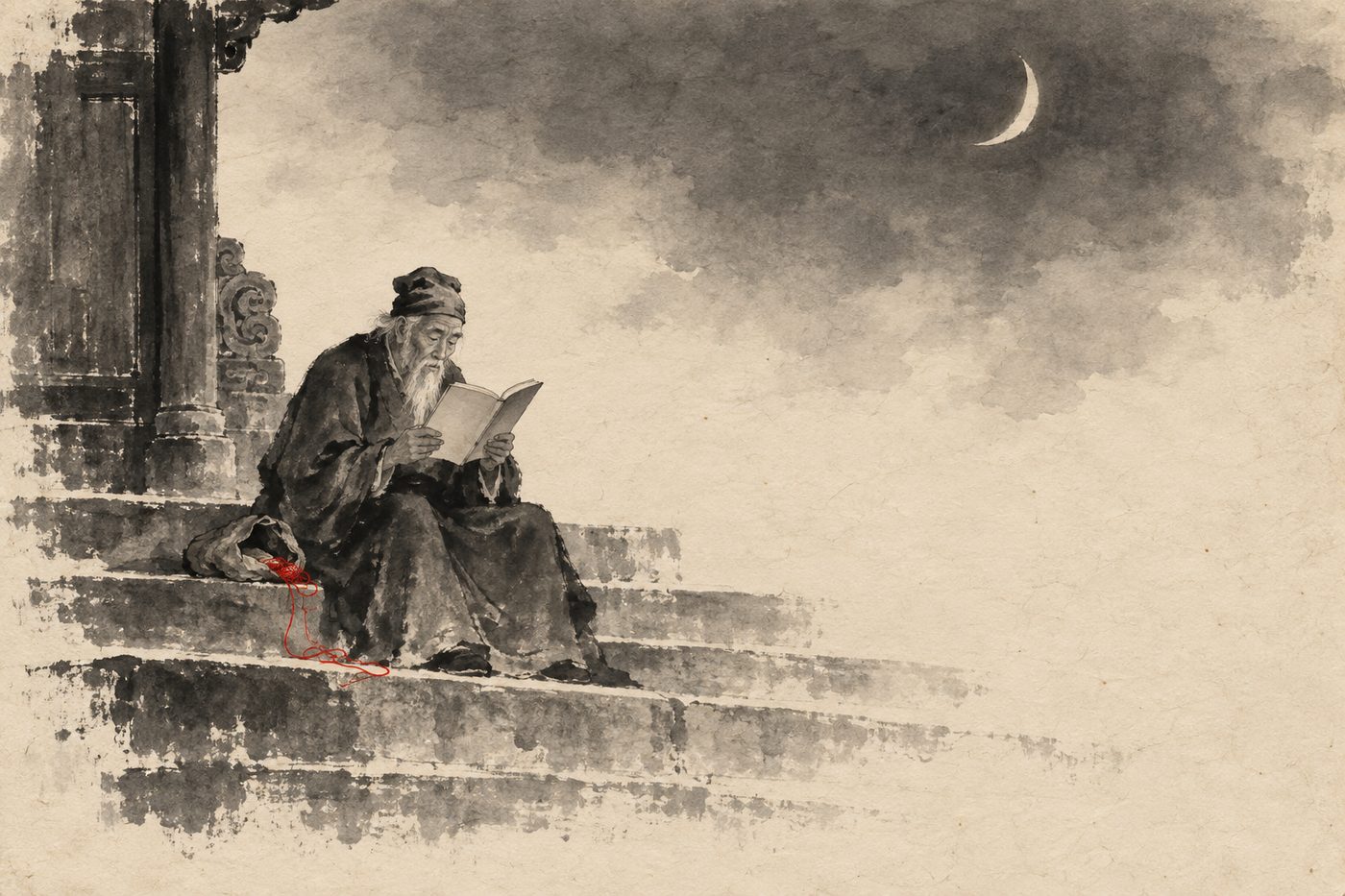
You already know the red thread. You have seen it on a wrist, in a tattoo, in a hundred anime episodes: an invisible red string that ties you to the one person you are meant to find. What you may not know is that it belongs to a specific god, that the god belongs to a specific story, and that the story is far stranger than the bracelet. The god is Yue Lao, the Old Man Under the Moon, China's god of marriage, and the tale that created him, written in the ninth century, involves a bag of red cord, an underworld ledger, a three-year-old beggar's child, a hired knife, and a bride who never takes off the little flower patch between her eyebrows. He is still in business. In Taipei, a temple that installed him in 1971 now counts its successes in boxes of wedding cookies, thousands a year. Here is where the thread comes from.
The thread you have already seen
The red string has traveled further than the god. Japan took the image early, and the akai ito, the red thread of fate tied around the little fingers of two people destined to meet, is by now a stock device of manga, anime and romance drama, which is how most of the world met it: on a pinkie, in a cartoon, with no old man in sight. From there it went onto wrists as a bracelet and onto skin as a fine red line of ink. The Chinese original ties ankles, not fingers, and it comes with a bureaucrat attached.
The bureaucrat has had a recent star turn of his own. Till We Meet Again, a 2021 Taiwanese fantasy written and directed by Giddens Ko from his own novel, is titled in Chinese simply Yue Lao: a young man dies, loses his memory, and is offered a choice by the underworld between rebirth as a snail and a traineeship in the matchmaking department, tying red threads between the living. It collected a string of Golden Horse nominations, took a quarter of a billion Taiwan dollars at the local box office, and sent the god's name spiking in search engines a long way from any temple.
How people actually pray to him
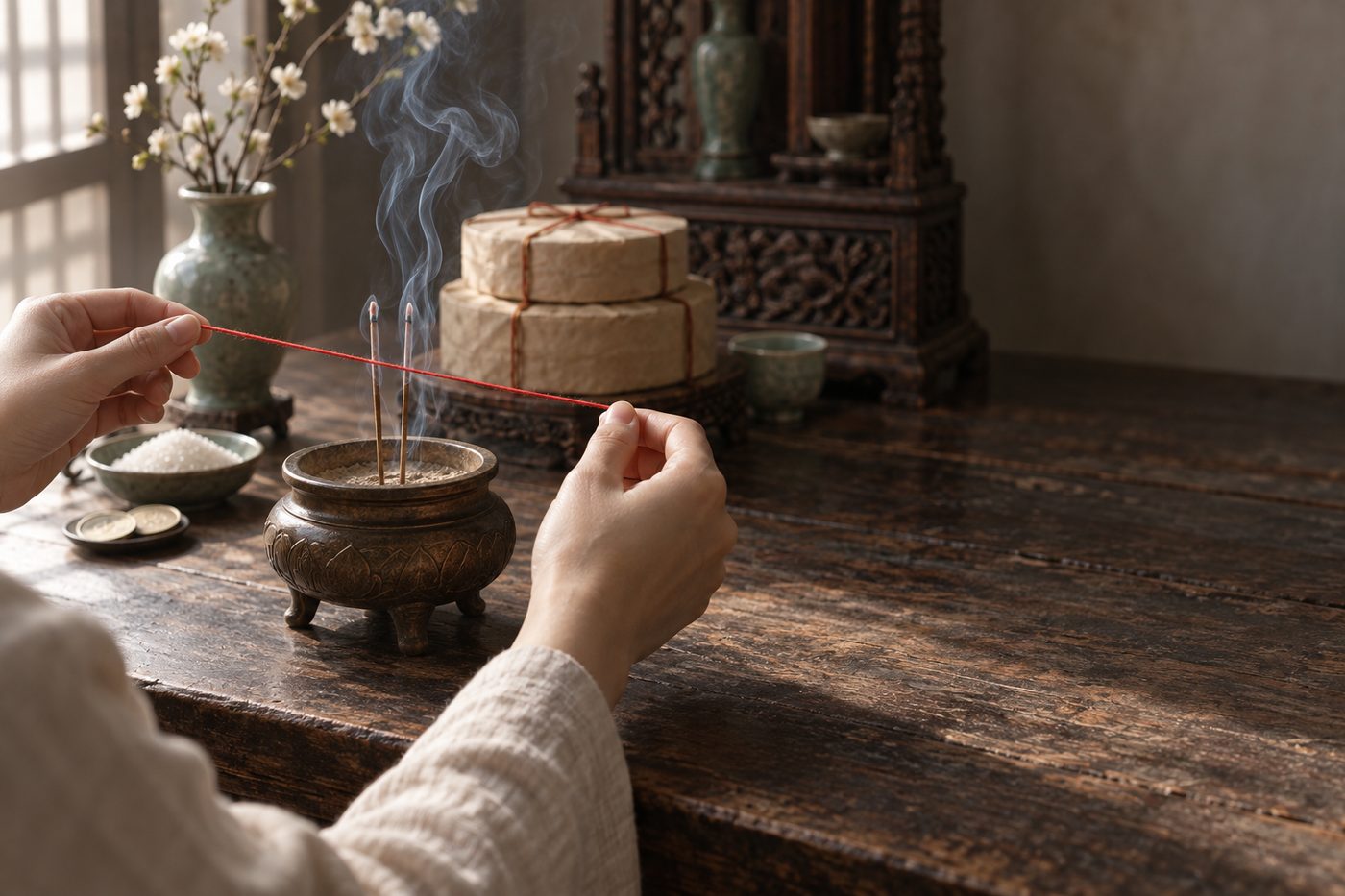
The temples are the living part, and Taipei's Xiahai City God Temple, in the old merchant quarter of Dadaocheng, is the famous one. The temple is dedicated to the city god; Yue Lao joined its pantheon only in 1971, according to Taiwan Panorama, which interviewed the staff. The ritual they describe is simple and has the great merit of being countable. You light incense and introduce yourself to the god, name, age, address, and what you are looking for. You receive a red thread. You pass it three times in a circle over the smoke of the incense burner and then carry it in your wallet. The offerings have their own logic: lead coins, because the word for lead in Taiwanese sounds like the word for a fated match, and granulated sugar, to sweeten the god's disposition and, one assumes, your own. When a match ends in marriage, the couple comes back with a box of wedding cookies, and the temple keeps count.
The count is the interesting part. The temple's marketing director, Titan Wu, told the magazine that 310 couples returned with cookies in 2000, 3,177 in 2003, and 7,871 in 2011, an average of twenty-one boxes a day, and that over twelve years the god had been credited with more than fifty thousand marriages. You may believe what you like about the causation. The queue is real. Tainan's temples have their own Yue Lao shrines, Hong Kong and Singapore theirs, and most of Taiwan's, the magazine noted, were installed in the twenty or thirty years before 2009, which tells you this is a cult that has grown, not survived.
Can the thread be read in advance?
People have always wanted to. The old man in the story will not show anyone the ledger, but China built a whole tradition of trying to read it sideways, by comparing the birth years of two people to see whether their animals get along, and that tradition is very much alive: if you want to know what the matchmakers of the old villages would have said about you and someone in particular, the Chinese zodiac compatibility pages walk through every pair of signs. The other place the thread gets a night of its own is the seventh of the seventh lunar month, Qixi, sold now as Chinese Valentine's Day, though the god of the red thread is not in that story either. He has his own.
The inn at Songcheng
The story is called "The Inn of Betrothal," Dinghun Dian, by Li Fuyan, a writer of the early ninth century, and it survives because the great Song anthology Taiping Guangji of 978 copied it into its section on predestined marriages. It begins with a young man in a hurry. Wei Gu of Duling, orphaned early, wants a wife and cannot get one; every proposal falls through. In the second year of the Zhenguan era, which is 628, traveling to Qinghe, he puts up at an inn south of Songcheng, and a fellow guest arranges for him to meet a go-between at dawn outside the Longxing Temple to discuss the daughter of a former official. Wei Gu, keen, goes early.
"The slanting moon was still bright," the story says, "and an old man was sitting on the steps, leaning on a cloth bag, checking a book by its light." Wei Gu looks over his shoulder and cannot read a word of it, which annoys him, since he has studied since childhood and can even read the Sanskrit of the western countries. What book is this? "Not a book of this world," says the old man, amused. What, then? "A book of the underworld." And what is an officer of the underworld doing in the road at dawn? The old man explains, with the patience of a civil servant, that the officers of the dead manage the affairs of the living, so of course they walk among them; on any road half the travelers are ghosts, and you cannot tell which. His own department? "The marriage register of the whole world."
Wei Gu, who has one thing on his mind, asks whether the match he has come to discuss will work. No, says the old man; your wife is three years old at present, and will enter your house at seventeen. And what is in the bag? Red cords, "for tying the feet of husband and wife. Once they are seated I secretly bind them. Though the families be enemies, though rank divide them like a gulf, though one be posted to the ends of the earth and the other live in a far province, once this cord is tied, there is no escaping it. Your foot is already tied to hers. What use is looking elsewhere?" And where is she? "The daughter of the old woman who sells vegetables north of this inn."
The knife between the eyebrows
At daylight the go-between has not come, and the old man rolls up his book, shoulders his bag and walks off. Wei Gu follows him into the vegetable market. There is a one-eyed old woman carrying a filthy three-year-old girl. "That," says the old man, "is your wife." Wei Gu's reply is the reason this story is worth telling and the greeting cards leave out. "May I kill her?" The old man says the child is fated to eat a great salary and to hold a fief through her son, and how could she be killed; and vanishes.
Wei Gu sharpens a small knife and gives it to his servant with the promise of ten thousand cash. The next day the servant walks into the crowded market with the blade in his sleeve, stabs, and runs. Asked whether he hit, he says: "I aimed at her heart, but by ill luck only struck between the eyebrows." Wei Gu goes on proposing, and goes on failing, for fourteen years. Then, on his father's merit, he is given a post at Xiangzhou, where the prefect, Wang Tai, likes his work and marries him to his daughter, a girl of sixteen or seventeen, and beautiful. Wei Gu is entirely happy. There is only one oddity. "Between her eyebrows she always wore a small flower patch, and never took it off, even to bathe or when alone."
After a year he presses her, and she weeps and tells him. She is not the prefect's daughter but his niece; her father had been magistrate of Songcheng and died in office, her mother and brother died after, and she was left as an infant with her nurse, a woman called Chen, on a farm south of the town, near an inn, selling vegetables to get by. At three, carried through the market, she was stabbed by a madman. The scar is still there, under the patch. "Was the nurse one-eyed?" asks Wei Gu. "Yes. How did you know?" "The one who stabbed you was me." They tell each other everything, and honor each other, the story says, more than ever; a son becomes a provincial governor. The magistrate of Songcheng, hearing the tale, renamed the inn: the Inn of Betrothal.
He is never called the Old Man Under the Moon in his own story
Now the correction, which is small and tells you how gods are made. Read the tale again and you will notice that the old man has no name. He is not Yue Lao. He is not the Old Man Under the Moon. He is an old man who happens to be reading under the moon, because it is before dawn and that is the light there is. The title is the story's setting promoted to a proper noun by a thousand years of retelling, and by the time the novel Dream of the Red Chamber was written, around 1760, the promotion was complete. In chapter 57 Aunt Xue explains the whole system to two girls as settled fact, opening with the old saying that a marriage fated across a thousand miles is drawn together by a single thread, and going on: "The one in charge of marriages is the Old Man Under the Moon, who settles it in advance and secretly hobbles the two people's feet with a single red silk thread, and though the two families be divided by seas and countries, though they be sworn enemies, in the end the two will find their way to becoming husband and wife." The saying she quotes, qiānlǐ yīnyuán yī xiàn qiān, is still the first thing a Chinese speaker says when a couple met by absurd coincidence. When exactly the name attached to the man, between the ninth century and the eighteenth, the story itself cannot tell us, and it would be dishonest to pretend otherwise. What is certain is that the temples came after the name, and the wedding cookies after the temples. Set the two side by side and you can see how far the god has traveled from his story:
| In the Tang story | On the altar today | |
|---|---|---|
| What he is called | Nothing; "an old man" | Yue Lao, the Old Man Under the Moon |
| Where he sits | The steps of a temple gate before dawn, reading by the last of the moon | A side shrine in a city-god or Matsu temple, in Taipei since 1971 |
| What he carries | A book of the underworld, the marriage register, and a bag of red cords | A red thread for you, passed three times over the incense |
| What happens when you object | He vanishes; your servant's knife lands between a child's eyebrows | You come back with wedding cookies, by the thousand |
What kind of god ties feet together?
It is worth being clear what he is, because the English word cupid gets used and it is wrong. Cupid shoots you, and you want. The old man ties you, and you arrive. He is not a god of desire at all; he never asks whether Wei Gu will like the girl, and Wei Gu, on being told, tries to have her killed. He is a clerk of outcomes, a functionary of the underworld with a ledger, the marriage department of the same bureaucracy that keeps the register of deaths, and his cord is a hobble, tied to the feet so that wherever the two people walk they walk toward each other. That is a very Chinese idea of fate: not a spark, but paperwork, filed in advance, and enforced by geography. It is also, if you sit with the story a moment, a consoling one. The hero does everything wrong. He is impatient, snobbish, and homicidal. And the thread holds anyway, and the girl he tried to erase grows up to be the wife he cannot imagine having done without, with a small flower on her forehead to remind him. The god's whole promise is that your mistakes are not strong enough to cut it. Which is, when you think about it, exactly what people are asking for when they pass a red thread through the smoke.
In the classics
The passages behind the story, in the standard published translations. Open any one for the original text.
“Only red cords, for tying the feet of husband and wife. Once they are seated I secretly bind them. Though the families be enemies, though rank divide them like a gulf, though one be posted to the ends of the earth and the other live in a far province, once this cord is tied, there is no escaping it. ”
Original text
赤繩子耳,以係夫婦之足,及其坐則潛用相係。雖仇敵之家,貴賤懸隔,天涯從宦,吳楚異鄉,此繩一係,終不可逭。
“I aimed at her heart, but by ill luck only struck between the eyebrows. ... Yet between her eyebrows she always wore a small flower patch, and never took it off, even to bathe or when alone. ”
Original text
初刺其心,不幸才中眉間。……然其眉間常貼一花鈿,雖沐浴閒處,未嘗暫去。
“The one in charge of marriages is the Old Man Under the Moon, who settles it in advance and secretly hobbles the two people's feet with a single red silk thread, and though the two families be divided by seas and countries, though they be sworn enemies, in the end the two will find their way to becoming husband and wife. ”
Original text
管姻緣的有一位月下老人,預先注定,暗里只用一根紅絲把這兩個人的腳絆住,憑你兩家隔著海,隔著國,有世仇的,也終久有机會作了夫婦。
As seen in
Till We Meet Again (月老)
film · 2021A dead young man with amnesia is given a choice between rebirth as a snail and a traineeship in the underworld's matchmaking department, tying red threads as an apprentice Yue Lao, as Ah Lun.
Written and directed by Giddens Ko from his own novel; multiple Golden Horse nominations; Taiwan's Chinese title is simply the god's name.
Questions people ask
What is Yue Lao the god of?
Marriage, specifically who marries whom. Yue Lao, the Old Man Under the Moon, keeps the register of every future marriage and ties an invisible red cord between the feet of the two people destined to wed. In the Tang story that created him, "The Inn of Betrothal," he says the cord holds regardless of rank, distance or family enmity. He is not a god of romance or desire; he is the clerk of matches, which is why people go to him for a spouse rather than for a date.
How do you pray to Yue Lao?
At a temple that houses him, such as Taipei's Xiahai City God Temple, you light incense, tell the god your name, age, address and what you are looking for, and receive a red thread, which you pass three times in a circle over the incense burner's smoke and then keep in your wallet or purse. Offerings there include lead coins, whose name in Taiwanese sounds like the word for a fated match, and granulated sugar to sweeten the god's disposition. When a match leads to marriage, the couple returns with a box of wedding cookies, which is how the temple counts its successes.
Is there a movie about Yue Lao?
Yes. Till We Meet Again, whose Chinese title is simply the god's name, is a 2021 Taiwanese romantic fantasy written and directed by Giddens Ko from his own novel. A young man dies, loses his memory, and is offered a choice between rebirth as a snail and a job as a trainee matchmaker god in the underworld, tying red threads between the living. It collected a string of Golden Horse nominations and made the god a search term far beyond the temple.
What does the red thread of fate mean?
That the person you will marry is already decided and already connected to you. In the Tang story the old man carries a bag of red cords and ties one between the feet of a future husband and wife, and says that once tied it cannot be escaped, however far apart the two are born. The image passed into a proverb, a marriage fated across a thousand miles is drawn by one thread, and from China into Japan, where the red string of fate became a standard motif of manga and anime and, from there, of bracelets and tattoos worldwide.
Is Yue Lao real, or from a story?
He is from a story. The Old Man Under the Moon first appears in "The Inn of Betrothal," a ninth-century tale by Li Fuyan preserved in the Taiping Guangji, and the story never even gives him that name: he is an unnamed old man reading his marriage register by moonlight. The name, the temples and the ritual all came later. Whether the god is real is a question for the people who take him wedding cookies; that the story is the origin is not in doubt.
Why does Yue Lao tie the thread to the feet, not the fingers?
Because in the original story the cord is a hobble, not a bracelet. The old man ties it between the feet of the two people so that, wherever they walk, they end up walking toward each other, and the story's own hero proves the point by trying to run away from his match and marrying her anyway fourteen years later. The little-finger version comes from Japan's red string of fate; the Chinese god ties ankles.
Sources & further reading
- Taiping Guangji (太平廣記), vol. 159, 'The Inn of Betrothal' (定婚店), full text (Chinese Wikisource)
- Dream of the Red Chamber (紅樓夢), Chapter 57, full text (Chinese Wikisource)
- 'A Match Made in Heaven? Yue Lao Helps to Tie the Knot' (Taiwan Panorama), the Xiahai City God Temple's own figures
- Till We Meet Again (2021 film) (Wikipedia)
- Yue Lao (Wikipedia)
By Julian 祝君瑜, retold from the classics, with the original passages cited, updated 2026-09-16