Chinese Mythology
Guan Yu (关羽): How a Defeated General Became a Chinese God
Guan Yu, 关羽 (Guān Yǔ), died in the winter of 219 as a defeated general who had just lost a province. Over the following sixteen hundred years the Chinese state promoted him, in stages and on paper, from marquis to duke to king to emperor to god, until his official title ran to twenty-six characters and his temples outnumbered Confucius's. He is the god of loyalty, the god of war, and, improbably, the god of money. No other subject in Chinese history was ever promoted that far after dying.
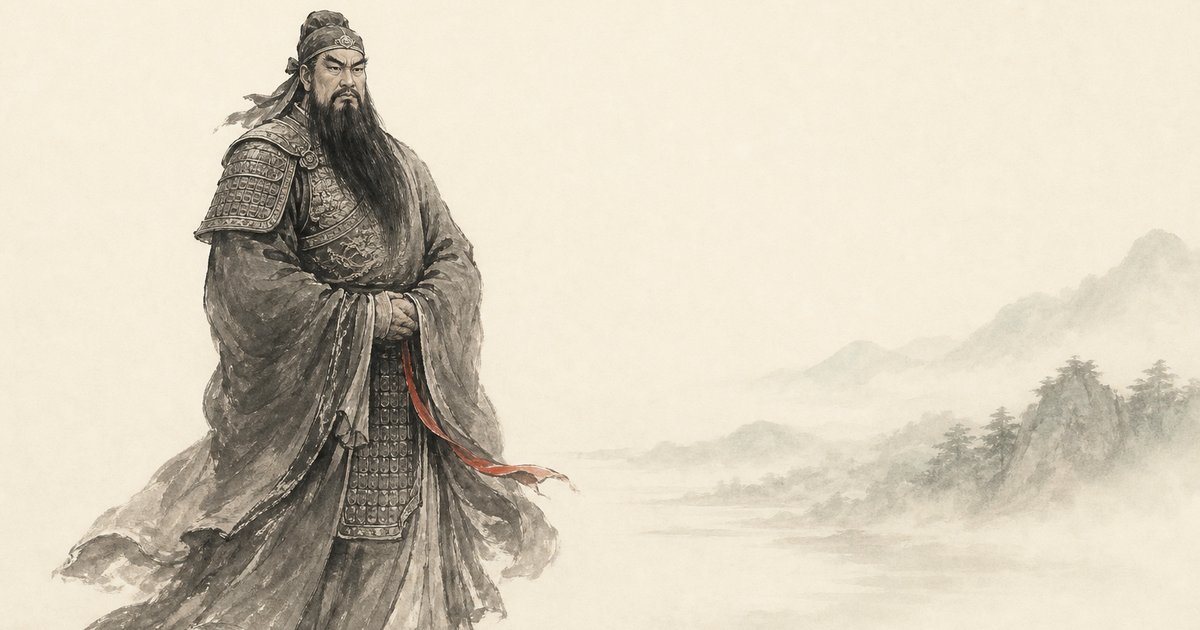
The career was not a success
It is worth being blunt about this, because almost nothing else written about Guan Yu is. He was a capable field commander who spent his last years holding Jing province for Liu Bei, launched a northern campaign in 219 that went brilliantly and then collapsed, lost the province to an alliance he had not expected, was cut off in the retreat, captured at Linju, and executed. He was somewhere around sixty. The state he served outlived him by forty-three years and then fell.
The record of all this is short. Chen Shou compiled the Records of the Three Kingdoms within about sixty years of the events, having grown up in the very state Guan Yu died for, and the biography he wrote runs to a few pages. It is not hagiography. Chen Shou's closing verdict on Guan Yu and his sworn brother Zhang Fei allows that both were worth ten thousand men, and then puts the knife in: Yu was hard and pleased with himself, and each of them was destroyed by his own defect, which is the ordinary way of things.
That is the man. Everything that follows is what China did with him.
The one incident that started it
Around the year 200, Guan Yu was separated from Liu Bei and taken by Cao Cao, the most powerful man in the empire and the one with the most to offer. Cao Cao offered it. Rank, gifts, a marquisate, the lot. Guan Yu accepted the hospitality, discharged his debt by killing an enemy commander for Cao Cao at Baima, then sealed up every single thing he had been given, left a letter, and rode back to Liu Bei, who at that point had almost nothing and was losing.
The detail that made this immortal is not Guan Yu's, though. It is Cao Cao's. When his staff wanted to send riders after the departing general, Cao Cao told them not to bother, on the grounds that each man serves his own lord. In four words of recorded speech the enemy certified the loyalty, which is a far stronger endorsement than any friend could have given, and Chinese moral literature has been quoting it ever since.
One episode. Everything downstream is built on it.
He entered the martial temple as a name on a wall
Here is the part that almost never survives translation into English, and it is the most interesting thing about him.
China had an official martial temple long before it had Guan Yu. In 731 the Tang court established a temple to Jiang Ziya, the strategist of the Zhou founding, and in 760 raised him to Wucheng Wang, King of Martial Accomplishment, with sacrifices explicitly set at the same rank as those offered to Confucius. That is where the parity of a martial sage with a civil sage actually comes from, and the man holding the post was not Guan Yu.
In 782 the court expanded the temple, adding sixty-four generals of history to be venerated alongside the king, in imitation of the worthies enshrined beside Confucius in the civil temple. Guan Yu is on that list. He appears in the roster under his lifetime rank, marquis of Hanshou, as one name among sixty-four, in a building dedicated to somebody else.
By the Qing dynasty, the main deity of the martial temple was Guan Yu, and the martial temple had become the Guandi temple. He did not join the institution at the top. He walked in as an item on the guest list and left owning the building. Our page on the character for warrior records where that ended, with Guan Yu level with Confucius; this is how the seat changed hands.
Sixteen hundred years of promotions
The paperwork is unusually well preserved, and reading it in sequence is like watching a share price.
He was first given a posthumous name by Shu Han in 260, forty-one years after his death: the Zhuangmiu Marquis. And immediately there is an argument, which is worth reporting honestly rather than smoothing over. The Explanations of Posthumous Names gives that second character, miu, three glosses, and all three are insults: it is what you call a man when his name and the reality diverge, when he injures people and blocks the worthy, when he obscures the good. On that reading the first honor the Shu state ever paid him was a coded complaint about losing Jing province. Other scholars, including the Qing commentator Lu Bi, argue that the character is here simply standing in for a homophone, mu, which is straightforwardly respectful, and that no criticism was meant at all. The evidence genuinely does not settle it. Either the god of loyalty began with a mild insult or he did not, and anyone who tells you confidently which is overselling their hand.
After that the direction is uniform and steep:
- 1102. The Song emperor Huizong makes him a duke, Zhonghui Gong, the Loyal and Gracious Duke. - 1108. Six years later, a king: Wu'an Wang, King of Martial Peace. - 1123. The title grows: Righteous and Valiant King of Martial Peace. - 1590. The Wanli emperor of the Ming makes him an emperor: Xietian Huguo Zhongyi Dadi, the Loyal and Righteous Great Emperor Who Aids Heaven and Guards the Realm. A subject of the Han has been raised to the rank of the reigning dynasty's own sovereign, which as far as the record goes had never been done for anyone else. - 1614. Wanli extends it again, into the Daoist register, with demon-subduing and celestial-worthy formulas attached. - 1879. Under the Guangxu emperor the official title reaches twenty-six characters, which unpack into something like this: Loyal and Righteous, Divinely Martial, Numinously Aiding, Benevolent and Brave, Awe-Inspiringly Manifest, Guardian of the Realm and Protector of the People, Wholehearted and Pacifying, Assisting and Proclaiming Virtue, the Sagely Emperor Lord Guan.
Twenty-six characters, for a man whose own government had given him three. Each Qing emperor in the sequence added a couple of characters of his own, the way successive owners add extensions to a house, and no one ever took any away.
The reason for all of it is not mysterious and the dynasties were fairly open about it. A state that needs soldiers and officials to stay loyal through defeat has an obvious use for a god who did exactly that, and the promotions cluster around periods when the dynasty in question was frightened.
The surgery is real. The surgeon is not.
Because Guan Yu is so thoroughly a figure of fiction now, readers assume the vivid material is invented and the dull material is history. It is very often the other way round.
The bone-scraping is real, or at least it is in the history. Chen Shou records that an old arrow wound had left poison in the bone of Guan Yu's left arm, that a doctor opened the arm and scraped the bone, and that Guan Yu, who happened to be entertaining his officers at the time, went on carving his meat and pouring his wine and talking and laughing while the blood ran off his elbow and filled the dish beneath it. That is in the third-century record, without embellishment.
What is not in the record is the doctor's name. The physician is anonymous. Hua Tuo, the legendary surgeon who performs the operation in every opera, television series and children's book, was assigned to the scene by Romance of the Three Kingdoms over a thousand years later.
The same sorting applies elsewhere. The red face is the novel's. The Green Dragon Crescent Blade is the novel's, and worse, it is an anachronism: the crescent-bladed polearm he is always shown holding is a Song-dynasty weapon that appears in the military manuals of the eleventh century, some eight hundred years after he could have carried one. The peach-garden oath with Liu Bei and Zhang Fei, which our page on righteousness covers in full, is likewise fourteenth-century fiction and does not appear in the third-century sources.
None of which has damaged him in the slightest. It is a useful reminder that the popular version of a figure and the historical one are not competing for the same job.
Why a general became the god of money
This is the strangest turn in the story and it has a completely rational explanation.
Guan Yu was born in Hedong Jie county, in the salt country of what is now southern Shanxi. In the Ming and Qing dynasties, Shanxi produced the most formidable merchant network in the empire, the Jinshang, who ran the long-distance trade and eventually the remittance banks that moved silver across China. They took their most famous native son as their patron.
The logic was practical rather than sentimental. Long-distance commerce in a country without enforceable commercial law is a problem of trust between strangers, often strangers separated by two thousand miles and several months. What the Shanxi houses had instead of contract law was reputation, sworn relationships, and a shared god who was famous above all for keeping his word when keeping it cost him everything. An oath sworn before Guan Yu was the enforcement mechanism. Wherever the Shanxi merchants built a guildhall, and they built them in every commercial city in China, they built a Guandi temple inside it, usually as the most conspicuous structure on the site.
That is how a third-century cavalry commander became the Wu Caishen, the martial god of wealth, and why to this day there is a small red shrine to him beside the till in a great many Chinese restaurants, shops and offices worldwide. The figure by the cash register is not there because he was good with money. He is there because he could not be bought. He is also, strictly, the junior of the two martial wealth gods: the older one is the black-tiger marshal Zhao Gongming, whose own route into the office ran through a fourth-century plague roster, and who is covered on our page for Caishen.
Three religions claim him, and none of them will let go
Very few figures anywhere have been successfully annexed by every available tradition at once.
The Confucian state made him the martial sage, with a temple in every prefecture and sacrifices on the official calendar. Daoism enrolled him as an emperor of its own pantheon, a subduer of demons with a full liturgy. Chinese Buddhism absorbed him as the Qielan Pusa, the Sangharama, a guardian of monastery grounds, on the strength of a legend that has his ghost converted by a monk at Yuquan Temple near where he died; walk into a Chinese Buddhist monastery today and there is a reasonable chance of finding a long-bearded general standing guard in a side hall. Popular religion, meanwhile, took him as the god of sworn brotherhood, which is where the martial underworld's devotion comes from.
The modern result is a genuinely odd tableau, most visible in Hong Kong, where the same deity is venerated on altars inside police stations and on altars inside the premises of the societies the police are raiding. It looks like a contradiction and is not quite one. One side is honoring loyalty to a rightful authority and the other is honoring loyalty to the man standing next to you, and Guan Yu, who spent his career doing both and died doing the second, is a legitimate patron of either.
Where you meet him now
Outside China he is most often encountered with a controller in hand, as a playable general in Koei's Dynasty Warriors series or in Total War: Three Kingdoms, whose two modes ship the legend and the histories side by side and make you choose which one you are playing. Inside China he is inescapable: the shrine in the shop, the statue at the restaurant door, the temple complex at Xiezhou in his home county, one of the largest surviving Guandi temples in the world.
The thing worth holding onto is the shape of the whole arc. A man lost a war and was executed, and was given a posthumous name that may have been a rebuke. Sixteen centuries later his official title was twenty-six characters long, three religions were claiming him, and merchants two thousand miles from his birthplace were swearing contracts on his name. Nothing about that was inevitable, and all of it followed from a single afternoon when he gave the presents back.
In the classics
The passages behind the story, in the standard published translations. Open any one for the original text.
“Yu sealed up everything he had been given, left a letter of farewell, and rode off to his first lord in Yuan's camp. Those around Cao Cao wanted to go after him. Cao Cao said, each man serves his own lord. Let him go. ”
Original text
羽盡封其所賜,拜書告辭,而奔先主於袁軍。左右欲追之,曹公曰:彼各為其主,勿追也。
“The doctor said, the arrowhead was poisoned and the poison has gone into the bone. The arm must be opened and the bone scraped to get the poison out, and only then will the trouble be gone. Yu put out his arm and told the doctor to cut. He happened at that moment to have his officers in to eat, and the blood ran off his arm and filled the dish beneath it, while Yu went on carving his meat and pouring his wine, talking and laughing as though nothing were happening. ”
Original text
醫曰:矢鏃有毒,毒入於骨,當破臂作創,刮骨去毒,然後此患乃除耳。羽便伸臂令醫劈之。時羽適請諸將飲食相對,臂血流離,盈於盤器,而羽割炙引酒,言笑自若。
“Guan Yu and Zhang Fei were both called a match for ten thousand men, tigers of their age. Yu repaid what he owed Cao Cao, Fei released Yan Yan out of principle, and both had something of the great servant of state about them. But Yu was hard and pleased with himself, and Fei was violent and without kindness, and each was destroyed by his own defect, which is the ordinary way of things. ”
Original text
關羽、張飛皆稱萬人之敵,為世虎臣。羽報效曹公,飛義釋嚴顏,並有國士之風。然羽剛而自矜,飛暴而無恩,以短取敗,理數之常也。
“When the name and the reality diverge, call him Miu. When he injures men and keeps the worthy from office, call him Miu. When he obscures the benevolent and harms the good, call him Miu. ”
Original text
名與實爽曰繆;傷人蔽賢曰繆;蔽仁傷善曰繆。
As seen in
Dynasty Warriors
game · 1997 onwardA playable Shu general, green robe and long beard, carrying the crescent blade he never actually owned, as Guan Yu.
Koei Tecmo. The series is how most players outside China first meet the Three Kingdoms cast.
Total War: Three Kingdoms
game · 2019A legendary commander, with a Romance mode that plays him as the novel's demigod and a Records mode that plays him as the man in the histories, as Guan Yu.
Creative Assembly. The two modes are an unusually honest piece of design: the game ships both the myth and the source, and lets you pick.
Three Kingdoms (三国)
drama · 2010Sworn brother to Liu Bei across ninety-five episodes, from the oath to the execution at Linju, as Guan Yu.
Directed by Gao Xixi; one of the most widely watched Chinese historical dramas ever made.
Questions people ask
Who was Guan Yu?
Guan Yu was a general who served the warlord Liu Bei during the collapse of the Han dynasty, and who died in the winter of 219 after losing the province he had been left to hold. That is the whole of the historical career. What makes him significant is everything that happened afterward: successive Chinese dynasties kept raising his rank posthumously until he was a god with an official state cult, and today he is worshipped across China, Taiwan, Hong Kong and the diaspora as the god of loyalty, of war, and of wealth.
Why is Guan Yu worshipped as a god?
Because the state kept promoting him and the public kept agreeing. The historical seed is a single episode: captured by Cao Cao around 200, showered with rank and gifts, he sealed every gift up and rode back to his defeated lord anyway. Chen Shou's third-century record has Cao Cao refusing to send anyone after him, on the grounds that each man serves his own lord. That is the founding act of the cult. Later dynasties found a god of unbought loyalty extremely useful and said so in writing, repeatedly, for sixteen hundred years.
What is Guan Yu the god of?
Three things that do not obviously belong together. He is the god of loyalty and sworn brotherhood, which follows from his story. He is the god of war, holding the title of martial sage at formal parity with Confucius as the civil sage. And he is a god of wealth, which is the surprising one: Shanxi merchants adopted their most famous native son as the guarantor of commercial honesty and carried his cult wherever they traded. Buddhism separately absorbed him as a temple guardian, and Daoism as an emperor of its own pantheon.
Is Guan Yu a real historical person?
Yes, and that is unusual for a major Chinese deity. He appears in Chen Shou's Records of the Three Kingdoms, compiled within about sixty years of his death by a historian who grew up in the state Guan Yu served. The biography is short and distinctly unflattering in places. Chen Shou's closing verdict is that Guan Yu was hard and pleased with himself, and that he was destroyed by his own defect. The god was built on top of a documented man, not instead of one.
Did Guan Yu really have his bone scraped without anesthetic?
The operation is in the histories; the famous surgeon is not. Chen Shou records that an arrow wound had left poison in the bone, that a doctor opened the arm and scraped it, and that Guan Yu went on eating and drinking with his officers while the blood filled the dish under his arm. The doctor is not named. Hua Tuo, the celebrated physician who performs the surgery in every retelling, was added by Romance of the Three Kingdoms more than a thousand years later.
What is the difference between Guan Yu and Guan Gong or Guan Di?
They are the same figure at different ranks, and the name you use signals which one you mean. Guan Yu is the man in the histories. Guan Gong, Lord Guan, is the respectful popular name. Guan Di, Emperor Guan, is the deity of the state cult, and dates from 1590, when the Wanli emperor promoted him from king to emperor. Temples to him are called Guandi temples for that reason.
Why do both police officers and criminals worship Guan Yu?
Because they are worshipping different halves of the same virtue. The state cult venerates loyalty to a rightful lord; the sworn-brotherhood tradition venerates loyalty to the men beside you, which is the code the martial underworld runs on and has since long before modern organized crime. Hong Kong is where this is most visible, with altars to the same god in police stations and in triad premises. Neither side is being ironic, and neither is misreading him.
Write and wear 关羽
The guan yu is also a character you can write. See 关羽 as a symbol, its strokes, meaning, and tattoo notes.
Sources & further reading
- Guan Yu, Wikipedia (the historical career, the death at Linju, and the deification)
- Guan Yu, Chinese Wikipedia (the posthumous title 壮缪侯, the dispute over 缪, and the sources for the bone-scraping episode)
- Martial temples (武庙), Chinese Wikipedia (the founding of the 太公尚父庙 in 731, the 760 elevation of Jiang Ziya to 武成王 at parity with Confucius, the sixty-four generals of 782 with Guan Yu among them, and the Qing-era conversion of the martial temple into a Guandi temple)
- How Guan Yu was made a god (关羽是如何被神化的), Guangming Daily digest (the canonization sequence with dates, the Wanli promotion to emperor, and the twenty-six-character Qing title of 1879)
- The road to sainthood: Lord Guan's titles (Chengsheng zhi lu: Guan Gong de fenghao), Tencent News (the full ladder from 忠惠公 in 1102 to the Qing titles)
- Guan Yu as god of wealth, the symbol of Shanxi merchant culture (Caishen Guandi: the symbol of Jinshang enterprise culture), Huaxia
- The Shanxi merchants' contribution to Guan Yu culture (晋商对关公文化的贡献), Yuncheng Daily
- Records of the Three Kingdoms, scroll 36 (三国志·蜀书六), Chinese Wikisource (the full text of the biography)
- Guandi temple at Xiezhou (解州关帝庙), Chinese Wikipedia (the temple at his birthplace, and the scale of the cult)
- Sangharama (伽蓝菩萨), Chinese Wikipedia (Guan Yu's absorption into Chinese Buddhism as a monastery guardian)
By Julian 祝君瑜, retold from the classics, with the original passages cited, updated 2026-08-26