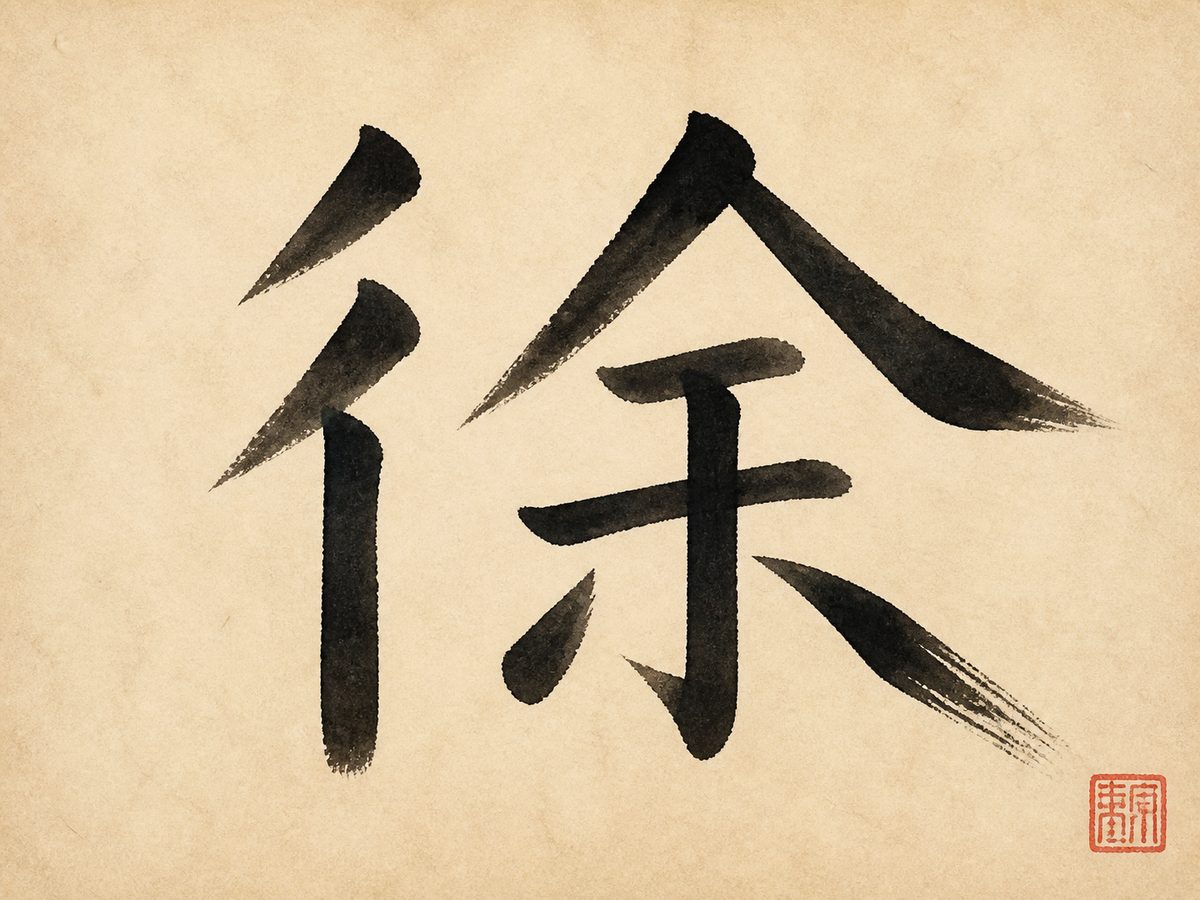
Two names, one spelling, and a tone
Most Chinese surnames that collide in English collide for an obvious reason. Several families sound similar, or an old spelling and a new spelling look different enough to confuse people. This one collides for a reason that is much more interesting, and slightly infuriating, which is that the distinction exists perfectly well in Chinese and English throws it away.
There are two big Chinese surnames pronounced with the same consonant and the same vowel. One is 徐, and it rises. The other is 許, and it dips down and comes back up. In Mandarin those are two entirely different words, as different as "bat" and "pat," and no Chinese speaker has ever confused them. Pinyin spells the first Xu and the second Xu. Wade-Giles spells the first Hsu and the second Hsu.
The result is that English-language reference works cannot file them under their names. They have to file them under their characters, which is how you end up with two separate encyclopedia articles whose titles are identical except for a Chinese character in brackets, sitting a few places apart in the same set of search results.
This page is about the first one. If your family writes 許, a great deal of what follows is somebody else's history.
How to actually say it
Since this is the thing people ask most, here it is properly.
The consonant is the hardest sound in Mandarin for English speakers, and both romanizations are misleading about it in opposite directions. Pinyin writes it x, which suggests a k sound that is not there at all. Wade-Giles writes it hs, which at least tells you something is hissing but makes it look like an aspirated h.
What it actually is: put the tip of your tongue down behind your lower front teeth and hold it there. Now raise the middle of your tongue toward the roof of your mouth and push air through the gap. That is a thinner, brighter hiss than the English sh, made further forward, and it is the same sound at the front of Xi'an and Xiao and Xie.
The vowel is the German ü. Say "ee," and then, without moving your tongue at all, round your lips as if for "oo."
Put them together and add a rising pitch, as though you were asking a question. The English approximation everybody uses is "shoo," and honestly, "shoo" with rounded lips and a rising tone will be understood by anyone. The lips are what matter most; the tongue position is polish.
A surname that means taking your time
Open the Shuowen Jiezi, the dictionary Xu Shen finished around 100 CE, and the entry runs to three characters: unhurried walking.
The character shows it. On the left is 彳, a radical that turns up in a whole family of words about going somewhere, and which is itself the left half of the character for a crossroads. On the right is a component supplying the sound. Ten strokes, and one of a small number of Chinese surnames where the simplified and traditional forms are the same, so nobody in the family has to decide which one to write on a wedding invitation.
The word never went out of use, and it kept its unhurriedness. The Zhuangzi has a wheelwright describe the perfect stroke of his chisel as neither slow nor fast, got by the hand and answered in the heart. The Art of War puts it in the most famous four-line description of an army ever written: swift as the wind, and in its slowness like a forest. And Su Shi opens the Red Cliff Rhapsody, which is roughly the Chinese equivalent of the opening of Moby-Dick for sheer quotability, with a clear breeze coming on slowly and the water not rising into waves. That word for slowly is this surname.
None of which is where the surname came from. That is the honest bit, and most name-meaning pages skip it: Chinese surnames overwhelmingly come from places and titles rather than from what their characters mean, and the meaning is a happy accident sitting on top. Still, of all the accidents to be landed with, a name that means take your time is a good one.
If you want to watch a brush take its time over it, our calligraphy tool draws 徐 in six classical scripts.
The state that gave its name to a province
The real origin is a country that lost a war.
There was a state called Xu, in what is now northern Jiangsu and Anhui, and its ruling house carried the clan name Ying. The traditional genealogy runs back to Ruo Mu, a son of Bo Yi, the minister who helped Yu the Great control the floods, which is the standard way a Chinese lineage says "we go back to the beginning." Xu was one of the eastern states, outside the Zhou heartland, and eventually the state of Wu destroyed it.
The survivors did what displaced Chinese families did: they took the name of the place they had lost and wore it. That is why the surname is still concentrated in Jiangsu today, more than two and a half thousand years later, and why one of the Nine Provinces of ancient geography, and a city of several million people now, is called Xuzhou. The state is gone. Its name is carried by about twenty million people and a railway junction.
The man who sailed east for the drug that stops death
And now the best Xu of all, who is barely a person and mostly a rumor.
In 219 BCE the First Emperor of China, who had unified the country and was in the process of discovering that this did not make him immortal, was approached by a court specialist named Xu Fu with a proposal. There were islands in the eastern sea where immortals lived, and on them grew the drug that ends death. Give him ships and he would fetch it.
He was given ships. He was also given, according to the accounts, three thousand boys and girls, and craftsmen, and seed grain. He sailed east.
He did not come back.
What happened next is the part that has kept the story alive for two thousand years, because Japan thinks it knows. Shingu, in Wakayama prefecture, claims to be where he landed, and has a park dedicated to him. He is venerated at shrines in several parts of Japan, and not as a sorcerer or a fraud but as a god of farming, a god of medicine and a god of silk, which is to say as the man who brought the technology. Whether any of it happened is entirely unprovable and the shrines are entirely real, which is a combination this site runs into a lot.
The drug he was sent for is the same drug that turns up all over Chinese myth, and it never does anybody any good. Hou Yi was given it and lost it. The rabbit on the moon has been grinding out batches of it since the Han dynasty for an emperor who is long dead. The First Emperor, still waiting for Xu Fu's ships, is thought to have hastened his own end taking mercury preparations meant to do the same job.
The Xu family's confluence
Fifteen hundred years later, another Xu changed the country in a quieter way.
Xu Guangqi was born in 1562 in what was then a minor town on the Yangtze delta. He met the Italian Jesuit Matteo Ricci, was baptized as Paul, and in 1607 the two of them published a Chinese translation of the first six books of Euclid's Elements. It is difficult to overstate how strange that must have been from both sides: a Ming official and a Renaissance Jesuit sitting down together to find Chinese words for point, line, parallel and theorem, several of which Xu invented and all of which are still the standard terms.
He died in 1633 and was buried on his family's land outside the town. The land was at a confluence of creeks, and it was known as the place where the Xu family gathered. The town grew into Shanghai; the family land became a Jesuit compound with a cathedral, a library and an observatory; and the district is called Xujiahui to this day, which means, quite literally, the Xu family's confluence. Several million people change subway lines there every week under a name that is one man's surname and one man's back garden.
Still going somewhere
The surname kept producing people who would not sit still.
Xu Xiake spent thirty years of the late Ming walking around China and writing down what he saw, in geographical detail nobody had attempted before, and his journal opens on a day in 1613 in Ninghai. In 2011 the State Council picked a date for a national tourism day and, after a public poll that drew close to a million votes, chose that one: 19 May, the day a man in his twenties set out on foot. The painter Xu Beihong, who died in 1953, went the other way, taking European anatomy training back into Chinese ink and producing the galloping horses that hang in about half the Chinese restaurants on earth.
For a name that means unhurried, it has covered a remarkable amount of ground.